Introduction to the periodic
table and chemical bonding
Lecture 2
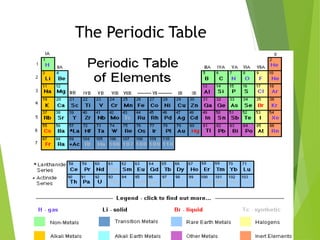
The Periodic Table
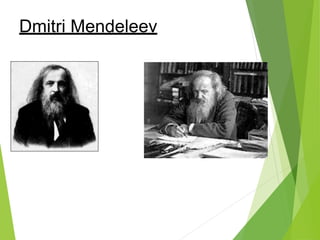
Dmitri Mendeleev
Periodic Table
 Divided into two main sections:
Metals and Nonmetals
 Vertical columns = GROUPS
– There are 18 groups in the periodic table.
– Elements have similar properties
– Rows = PERIODS
– Chemical and physical properties change A LOT
across periods
Types of Elements
 Metals
– An element that is a good conductor of heat and
electricity
– Room temperature most are solid
– Malleability: the ability to be hammered into thin
sheets
– Ductile: ability to be made into wire
Alkali Metals
 Group I of periodic table
 Very reactive
 Usually silver in appearance
 React violently with water
Alkali Earth Metals
 More dense, strong and hard
 High melting points
 Too reactive, are not found in nature
 Group II elements
 Examples ??
Transition Metals
 These are the “typical” metals
 Middle “chunk” of periodic table
 Groups III – XII
 Examples
Non-Metals
 A poor conductor of heat and electricity
 Gases at room temperature
 Remember: there are always exceptions
Noble Gases
 Considered non-metals
 Group 18 of the periodic table.
 Unreactive elements
 Example of a noble gas???
Halogens
 Most reactive nonmetals
 Reacts with metals to form salts
 Group 17
 Examples??
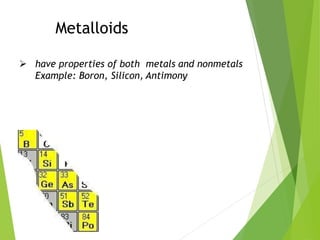
Metalloids
 have properties of both metals and nonmetals
Example: Boron, Silicon, Antimony
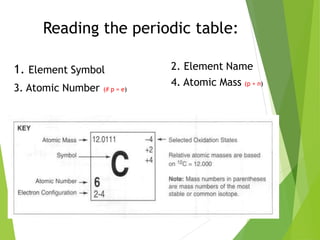
Reading the periodic table:
1. Element Symbol
3. Atomic Number (# p = e)
2. Element Name
4. Atomic Mass (p + n)
2. Chemical bonding
 Chemical bonding provides the energy necessary to hold two
different atoms together as part of a chemical compound.
 Strength of the bond depends on the molecules or atoms
involved in the process of bond formation.
 Every atom wants to gain electrons up to 8, or lose electrons
to equal zero, in order to be stable just like the noble gases
 Principles ionization energy
Types of Chemical Bonding
i. Ionic Bonds
ii. Covalent Bonds
iii. Hydrogen Bonds
iv. Van deer Waals interactions
v. Metallic Bonds
Ionic Bonding
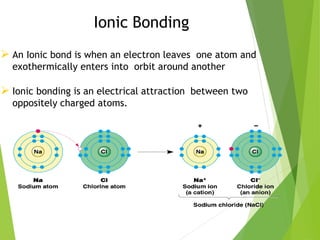
 An Ionic bond is when an electron leaves one atom and
exothermically enters into orbit around another
 Ionic bonding is an electrical attraction between two
oppositely charged atoms.
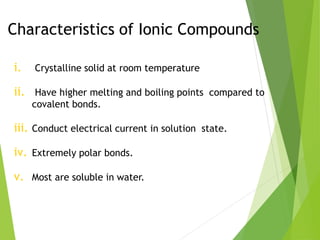
Characteristics of Ionic Compounds
i. Crystalline solid at room temperature
ii. Have higher melting and boiling points compared to
covalent bonds.
iii. Conduct electrical current in solution state.
iv. Extremely polar bonds.
v. Most are soluble in water.
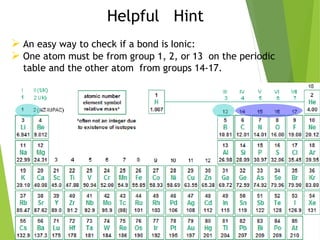
Helpful Hint
 An easy way to check if a bond is Ionic:
 One atom must be from group 1, 2, or 13 on the periodic
table and the other atom from groups 14-17.
Covalent Bonds
 A type of chemical bond in which there is mutual sharing
of electrons between two atoms is called covalent bond.
 It is further classified into
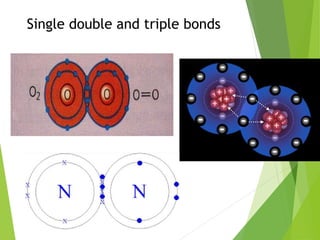
i. single
ii. double
iii. triple covalent bond
 Base on polarity:
i. polar
ii. non polar bond
Electronegativity deference and bond type:
Less than 0.5 non polar 0.5-1.9 polar above 2 ionic
Single double and triple bonds
Hydrogen Bonds
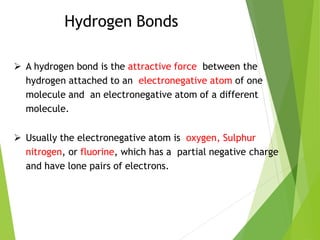
 A hydrogen bond is the attractive force between the
hydrogen attached to an electronegative atom of one
molecule and an electronegative atom of a different
molecule.
 Usually the electronegative atom is oxygen, Sulphur
nitrogen, or fluorine, which has a partial negative charge
and have lone pairs of electrons.
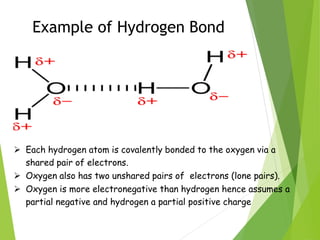
Example of Hydrogen Bond
 Each hydrogen atom is covalently bonded to the oxygen via a
shared pair of electrons.
 Oxygen also has two unshared pairs of electrons (lone pairs).
 Oxygen is more electronegative than hydrogen hence assumes a
partial negative and hydrogen a partial positive charge
Van der Waals interactions
 Due to the movement of electrons in a molecule around the
nuclei, temporary areas of slightly positive and negative
charges occur around the molecule.
 When molecules come close together, the attractive forces
between slightly positive and negative regions pull on the
molecules and hold them together.
 The strength of the attraction depends on the size of the
molecule, its shape, and its ability to attract electrons.
 Van der Waals Forces are not as strong as covalent and Van
der Waals Forces are not as strong as covalent and ionic
bonds, but they play a role in biological forces. ionic bonds,
but they play a role in biological forces.
 Van der Waals forces in water hold the water molecules
together, forming droplets and a surface of water together
Metallic Bonds
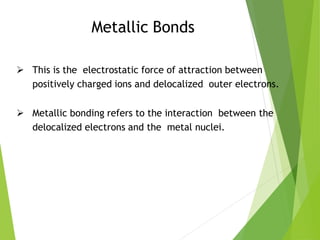
 This is the electrostatic force of attraction between
positively charged ions and delocalized outer electrons.
 Metallic bonding refers to the interaction between the
delocalized electrons and the metal nuclei.
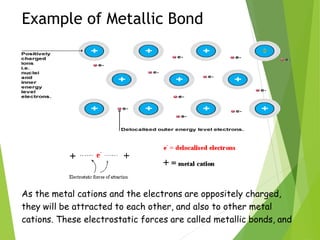
Example of Metallic Bond
As the metal cations and the electrons are oppositely charged,
they will be attracted to each other, and also to other metal
cations. These electrostatic forces are called metallic bonds, and
3. Lewis Structures
 Lewis Structures – visual representation of
covalent bonding that indicates where the
valence shell electrons are in the molecule.
 Shared electron pairs are shown as lines and
lone pairs (pairs of electrons not involved in
bonding) are shown as dots
Lewis Structure Assumptions
 Only valance electrons are involved in bonding.
 Atoms react to form molecules to attain stability
 Atoms in molecules want eight valance electrons
(octet rule) except for hydrogen which wants two electrons
(duet rule).
 In covalent compounds, atoms share electrons to form
bonds in order to achieve stable noble gas electron
configurations.
 In ionic compounds, electrons are transferred from one
atom to another to achieve stable noble gas electron
configurations.
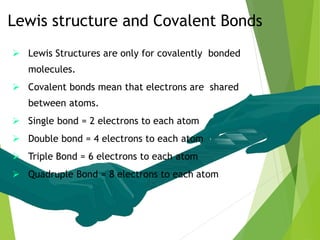
Lewis structure and Covalent Bonds
 Lewis Structures are only for covalently bonded
molecules.
 Covalent bonds mean that electrons are shared
between atoms.
 Single bond = 2 electrons to each atom
 Double bond = 4 electrons to each atom
 Triple Bond = 6 electrons to each atom
 Quadruple Bond = 8 electrons to each atom
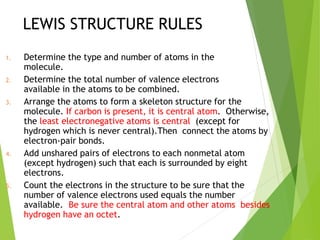
LEWIS STRUCTURE RULES
1. Determine the type and number of atoms in the
molecule.
2. Determine the total number of valence electrons
available in the atoms to be combined.
3. Arrange the atoms to form a skeleton structure for the
molecule. If carbon is present, it is central atom. Otherwise,
the least electronegative atoms is central (except for
hydrogen which is never central).Then connect the atoms by
electron-pair bonds.
4. Add unshared pairs of electrons to each nonmetal atom
(except hydrogen) such that each is surrounded by eight
electrons.
5. Count the electrons in the structure to be sure that the
number of valence electrons used equals the number
available. Be sure the central atom and other atoms besides
hydrogen have an octet.
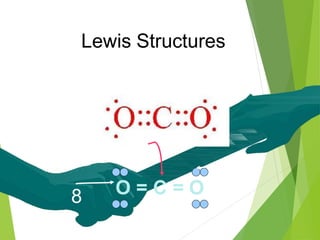
Lewis Structures
CO2 carbon dioxide
O = C = O
8 8
8
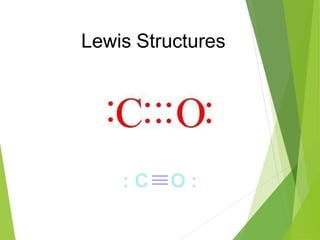
Lewis Structures
CO carbon monoxide
: C O :
PRACTICE
Draw Lewis Structures for the following:
a. CH3I
b. NH3
c. H2S
d. PF3
e. IBr
f. F2O
Significance of chemical bonding in
drug receptor interaction and
pharmacological effect

bonding periodic table and lewis structure.pptx

  • 1.
    Introduction to theperiodic table and chemical bonding Lecture 2
  • 2.
  • 3.
  • 4.
    Periodic Table  Dividedinto two main sections: Metals and Nonmetals  Vertical columns = GROUPS – There are 18 groups in the periodic table. – Elements have similar properties – Rows = PERIODS – Chemical and physical properties change A LOT across periods
  • 5.
    Types of Elements Metals – An element that is a good conductor of heat and electricity – Room temperature most are solid – Malleability: the ability to be hammered into thin sheets – Ductile: ability to be made into wire
  • 6.
    Alkali Metals  GroupI of periodic table  Very reactive  Usually silver in appearance  React violently with water
  • 7.
    Alkali Earth Metals More dense, strong and hard  High melting points  Too reactive, are not found in nature  Group II elements  Examples ??
  • 8.
    Transition Metals  Theseare the “typical” metals  Middle “chunk” of periodic table  Groups III – XII  Examples
  • 9.
    Non-Metals  A poorconductor of heat and electricity  Gases at room temperature  Remember: there are always exceptions
  • 10.
    Noble Gases  Considerednon-metals  Group 18 of the periodic table.  Unreactive elements  Example of a noble gas???
  • 11.
    Halogens  Most reactivenonmetals  Reacts with metals to form salts  Group 17  Examples??
  • 12.
    Metalloids  have propertiesof both metals and nonmetals Example: Boron, Silicon, Antimony
  • 13.
    Reading the periodictable: 1. Element Symbol 3. Atomic Number (# p = e) 2. Element Name 4. Atomic Mass (p + n)
  • 14.
    2. Chemical bonding Chemical bonding provides the energy necessary to hold two different atoms together as part of a chemical compound.  Strength of the bond depends on the molecules or atoms involved in the process of bond formation.  Every atom wants to gain electrons up to 8, or lose electrons to equal zero, in order to be stable just like the noble gases  Principles ionization energy
  • 15.
    Types of ChemicalBonding i. Ionic Bonds ii. Covalent Bonds iii. Hydrogen Bonds iv. Van deer Waals interactions v. Metallic Bonds
  • 16.
    Ionic Bonding  AnIonic bond is when an electron leaves one atom and exothermically enters into orbit around another  Ionic bonding is an electrical attraction between two oppositely charged atoms.
  • 17.
    Characteristics of IonicCompounds i. Crystalline solid at room temperature ii. Have higher melting and boiling points compared to covalent bonds. iii. Conduct electrical current in solution state. iv. Extremely polar bonds. v. Most are soluble in water.
  • 18.
    Helpful Hint  Aneasy way to check if a bond is Ionic:  One atom must be from group 1, 2, or 13 on the periodic table and the other atom from groups 14-17.
  • 19.
    Covalent Bonds  Atype of chemical bond in which there is mutual sharing of electrons between two atoms is called covalent bond.  It is further classified into i. single ii. double iii. triple covalent bond  Base on polarity: i. polar ii. non polar bond Electronegativity deference and bond type: Less than 0.5 non polar 0.5-1.9 polar above 2 ionic
  • 20.
    Single double andtriple bonds
  • 21.
    Hydrogen Bonds  Ahydrogen bond is the attractive force between the hydrogen attached to an electronegative atom of one molecule and an electronegative atom of a different molecule.  Usually the electronegative atom is oxygen, Sulphur nitrogen, or fluorine, which has a partial negative charge and have lone pairs of electrons.
  • 22.
    Example of HydrogenBond  Each hydrogen atom is covalently bonded to the oxygen via a shared pair of electrons.  Oxygen also has two unshared pairs of electrons (lone pairs).  Oxygen is more electronegative than hydrogen hence assumes a partial negative and hydrogen a partial positive charge
  • 23.
    Van der Waalsinteractions  Due to the movement of electrons in a molecule around the nuclei, temporary areas of slightly positive and negative charges occur around the molecule.  When molecules come close together, the attractive forces between slightly positive and negative regions pull on the molecules and hold them together.  The strength of the attraction depends on the size of the molecule, its shape, and its ability to attract electrons.  Van der Waals Forces are not as strong as covalent and Van der Waals Forces are not as strong as covalent and ionic bonds, but they play a role in biological forces. ionic bonds, but they play a role in biological forces.  Van der Waals forces in water hold the water molecules together, forming droplets and a surface of water together
  • 24.
    Metallic Bonds  Thisis the electrostatic force of attraction between positively charged ions and delocalized outer electrons.  Metallic bonding refers to the interaction between the delocalized electrons and the metal nuclei.
  • 25.
    Example of MetallicBond As the metal cations and the electrons are oppositely charged, they will be attracted to each other, and also to other metal cations. These electrostatic forces are called metallic bonds, and
  • 26.
    3. Lewis Structures Lewis Structures – visual representation of covalent bonding that indicates where the valence shell electrons are in the molecule.  Shared electron pairs are shown as lines and lone pairs (pairs of electrons not involved in bonding) are shown as dots
  • 27.
    Lewis Structure Assumptions Only valance electrons are involved in bonding.  Atoms react to form molecules to attain stability  Atoms in molecules want eight valance electrons (octet rule) except for hydrogen which wants two electrons (duet rule).  In covalent compounds, atoms share electrons to form bonds in order to achieve stable noble gas electron configurations.  In ionic compounds, electrons are transferred from one atom to another to achieve stable noble gas electron configurations.
  • 28.
    Lewis structure andCovalent Bonds  Lewis Structures are only for covalently bonded molecules.  Covalent bonds mean that electrons are shared between atoms.  Single bond = 2 electrons to each atom  Double bond = 4 electrons to each atom  Triple Bond = 6 electrons to each atom  Quadruple Bond = 8 electrons to each atom
  • 29.
    LEWIS STRUCTURE RULES 1.Determine the type and number of atoms in the molecule. 2. Determine the total number of valence electrons available in the atoms to be combined. 3. Arrange the atoms to form a skeleton structure for the molecule. If carbon is present, it is central atom. Otherwise, the least electronegative atoms is central (except for hydrogen which is never central).Then connect the atoms by electron-pair bonds. 4. Add unshared pairs of electrons to each nonmetal atom (except hydrogen) such that each is surrounded by eight electrons. 5. Count the electrons in the structure to be sure that the number of valence electrons used equals the number available. Be sure the central atom and other atoms besides hydrogen have an octet.
  • 30.
    Lewis Structures CO2 carbondioxide O = C = O 8 8 8
  • 31.
  • 32.
    PRACTICE Draw Lewis Structuresfor the following: a. CH3I b. NH3 c. H2S d. PF3 e. IBr f. F2O
  • 33.
    Significance of chemicalbonding in drug receptor interaction and pharmacological effect