LESSON 1
What is the Greek’s view of
Motion and the Universe?
THALES
• First known person to use natural
explanations for natural phenomena
rather than turning to supernatural
world.
• He believed that “everything comes
out of water and that EARTH
FLOATS ON WATER.”
ANAXIMANDER
• Refined the ideas of Thales
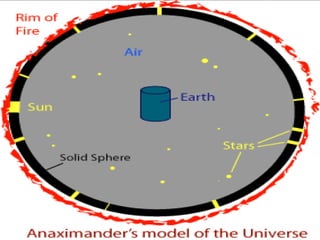
• He proposed that “a cylindrical
Earth is at rest in the center of the
universe, surrounded by air, and by
one or more spherical shells with
holes in them.
ANAXIMENES
• Suggested that the stars were fixed
onto a solid transparent crystalline
sphere that rotated about the Earth.
ANAXAGORAS
• Stated that the moon shine by reflected
sunlight had mountains and was
inhabited and the sun was not a GOD
but a large fiery stone much larger than
Greece and a large distance from Earth.
EMPEDOCLES
• He said that light travelled fast but
not at infinite speed.
DEMOCRITUS
• Proposed that the Milky way was
composed of thousands of unresolved
stars
PYTHAGORAS
• One of the first to use mathematics
to challenge question and support
his observations of the stars.
• He and his followers believed in a
well-ordered harmonous universe
based on geometry rather than
experiments.
PLATO
• He viewed the universe as perfect and
unchanging.
• He reasoned that the most perfect orbit of
a planet would be circular and its motion
is constant like the stars.
• The universe was also described as a large
spherical ball with the stars all at the edge
and the Earth in the center.
• “Saving the appearance”
– EMPEDOCLES MOTIONS
The heavenly objects
change their position
in the sky over a
period of time.
CLOCK CALENDAR IN
THE SKY
• DIURNAL MOTION
– Is the apparent daily motion of the sky from
east to west in which celestial objects are
seen to RISE and SET.
• ANNUAL MOTION
– Carries the sun eastward in the sky over the
course of an entire year. It brings in new
constellation as the year progresses.
WANDERING STARS
AND PLANETS
• They move against the backdrop of
the celestial sphere
RETROGRADE MOTION
OF THE PLANETS
• Planets do not only move relative to the
fixed stars but they change direction,
generally moving from west to east.
The truth behind the
motions of heavenly
objects must be circular
motion at a constant speed
which forever remains the
same.
HIPPARCHUS
• Noted that the position of the stars
were shifted in a systematic way
which indicated that they were not
the ones moving but the Earth.
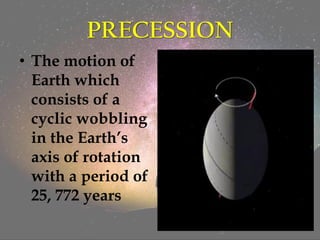
PRECESSION
• The motion of
Earth which
consists of a
cyclic wobbling
in the Earth’s
axis of rotation
with a period of
25, 772 years
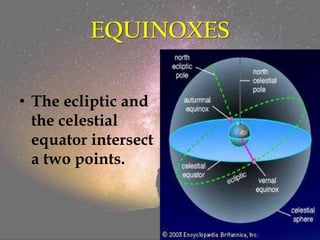
EQUINOXES
• The ecliptic and
the celestial
equator intersect
a two points.
ARISTOTLE
• He believed that motion itself had
certain properties. And rest is the
natural state of the universe because
most things we see are not moving.
Two types of motion
• CELESTIAL MOTION
– As an unchanging endless circular motion of
heavenly objects in a sphere.
• TERRESTRIAL MOTION
– Pertains to movement of matter that has
been classified:
• Alternation or Alternate motion
• Natural or vertical motion
• Horizontal or violent motion
ASSIGNMENT:
What is the Greek’s view of Motion and the Universe?
1. Thales
2.Anaximander
3. Anaximenes
4. Anaxagoras
5. Empedocles
6. Democritus
7. Pythagoras
8. Plato
9. Hipparchus
10. Aristotle
LESSON 2
HOW DO THE MODELS OF
THE UNIVERSE DIFFER
FROM EACH OTHER?
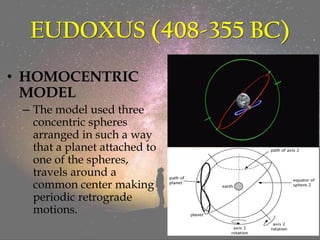
EUDOXUS (408-355 BC)
• HOMOCENTRIC
MODEL
– The model used three
concentric spheres
arranged in such a way
that a planet attached to
one of the spheres,
travels around a
common center making
periodic retrograde
motions.
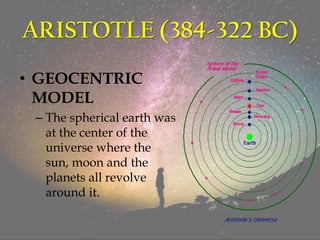
ARISTOTLE (384-322 BC)
• GEOCENTRIC
MODEL
– The spherical earth was
at the center of the
universe where the
sun, moon and the
planets all revolve
around it.
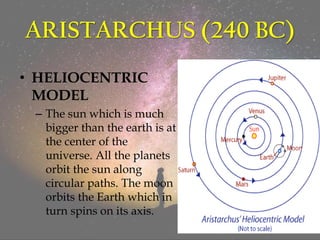
ARISTARCHUS (240 BC)
• HELIOCENTRIC
MODEL
– The sun which is much
bigger than the earth is at
the center of the
universe. All the planets
orbit the sun along
circular paths. The moon
orbits the Earth which in
turn spins on its axis.
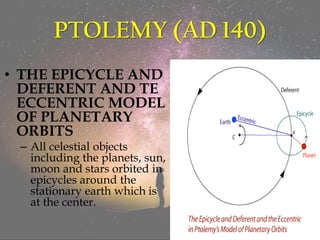
PTOLEMY (AD 140)
• THE EPICYCLE AND
DEFERENT AND TE
ECCENTRIC MODEL
OF PLANETARY
ORBITS
– All celestial objects
including the planets, sun,
moon and stars orbited in
epicycles around the
stationary earth which is
at the center.
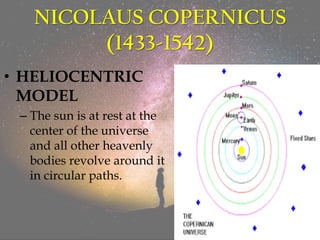
NICOLAUS COPERNICUS
(1433-1542)
• HELIOCENTRIC
MODEL
– The sun is at rest at the
center of the universe
and all other heavenly
bodies revolve around it
in circular paths.
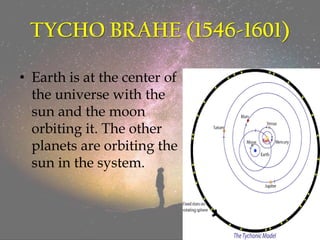
TYCHO BRAHE (1546-1601)
• Earth is at the center of
the universe with the
sun and the moon
orbiting it. The other
planets are orbiting the
sun in the system.
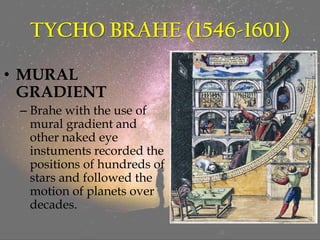
TYCHO BRAHE (1546-1601)
• MURAL
GRADIENT
– Brahe with the use of
mural gradient and
other naked eye
instuments recorded the
positions of hundreds of
stars and followed the
motion of planets over
decades.
GALILEO GALILEI (1564-
1642)
• was the first to use TELESCOPE to
study heavens.
• made several observations that prove
that the HELIOCENTRIC MODEL was
CORRECT and the PTOLEMAIC
MODEL was INCORRECT.
GALILEI’s some observations:
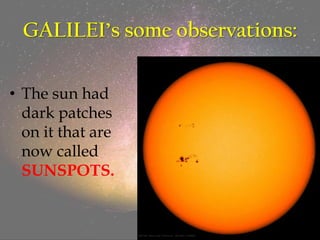
• The sun had
dark patches
on it that are
now called
SUNSPOTS.
GALILEI’s some observations:
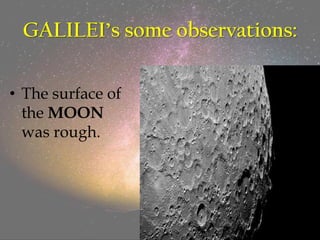
• The surface of
the MOON
was rough.
GALILEI’s some observations:
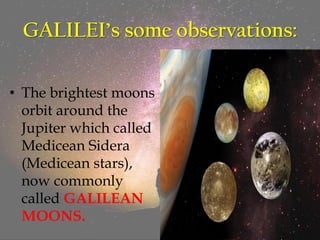
• The brightest moons
orbit around the
Jupiter which called
Medicean Sidera
(Medicean stars),
now commonly
called GALILEAN
MOONS.
GALILEI’s some observations:
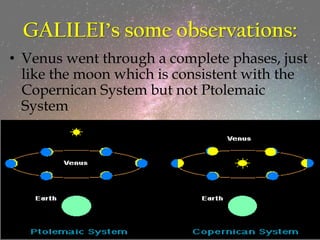
• Venus went through a complete phases, just
like the moon which is consistent with the
Copernican System but not Ptolemaic
System
GALILEI’s some observations:
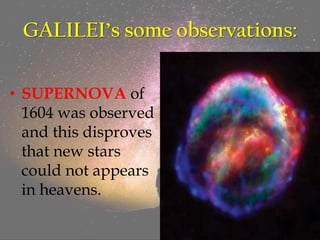
• SUPERNOVA of
1604 was observed
and this disproves
that new stars
could not appears
in heavens.
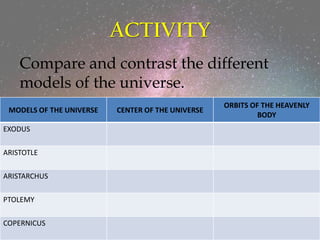
ACTIVITY
Compare and contrast the different
models of the universe.
MODELS OF THE UNIVERSE CENTER OF THE UNIVERSE
ORBITS OF THE HEAVENLY
BODY
EXODUS
ARISTOTLE
ARISTARCHUS
PTOLEMY
COPERNICUS
LESSON 3
How do the planets move
according to Kepler’s Laws
of Planetary motion?
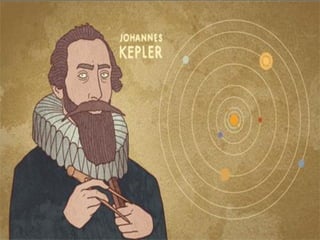
JOHANNES KEPLER
(1571-1630)
• He used Tycho Brahe’s data to come
up with his own heliocentric model
of the universe.
• He developed three laws of
planetary motion.
Three Laws of Planetary
Motion
Laws of Planetary
Motion
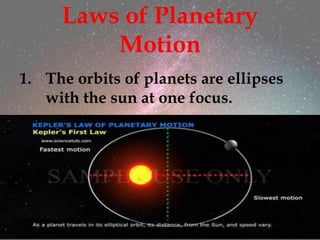
1. The orbits of planets are ellipses
with the sun at one focus.
Laws of Planetary
Motion
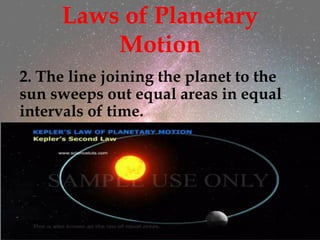
2. The line joining the planet to the
sun sweeps out equal areas in equal
intervals of time.
Laws of Planetary
Motion
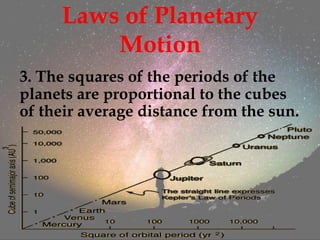
3. The squares of the periods of the
planets are proportional to the cubes
of their average distance from the sun.
SUMMARY
• The Greek’s view of motion and the
universe
– Motion can be celestial or terrestrial.
– There is a clock calendar in the sky that includes
diurnal motion or annual motion.
– Wandering stars orbit in the direction opposite to
the direction of the celestial sphere.
– Heavenly objects move in perfect circular orbits.
– The Earth is at the exact center of the motion of the
celestial bodies.
– Earth is spherical.
SUMMARY
• The models of the universe differ in terms
of their center and how heavenly bodies
orbit around the center.
• Kepler’s Laws of Planetary Motion show:
– Orbits of the planets are elliptical.
– Planets move faster when closer to the sun and
slower when further from the sun
– The period for a planet to orbit the sun increases
rapidly with the radius of the orbit.
Reference
Prepared by:
JIMNAIRA U. ABANTO
Padolina, Padua, Crisostomo, Alumaga
(2016);Physical Science, Vibal Group Inc.

Physical science chapter1 for shs

  • 1.
    LESSON 1 What isthe Greek’s view of Motion and the Universe?
  • 2.
    THALES • First knownperson to use natural explanations for natural phenomena rather than turning to supernatural world. • He believed that “everything comes out of water and that EARTH FLOATS ON WATER.”
  • 3.
    ANAXIMANDER • Refined theideas of Thales • He proposed that “a cylindrical Earth is at rest in the center of the universe, surrounded by air, and by one or more spherical shells with holes in them.
  • 5.
    ANAXIMENES • Suggested thatthe stars were fixed onto a solid transparent crystalline sphere that rotated about the Earth. ANAXAGORAS • Stated that the moon shine by reflected sunlight had mountains and was inhabited and the sun was not a GOD but a large fiery stone much larger than Greece and a large distance from Earth.
  • 6.
    EMPEDOCLES • He saidthat light travelled fast but not at infinite speed. DEMOCRITUS • Proposed that the Milky way was composed of thousands of unresolved stars
  • 7.
    PYTHAGORAS • One ofthe first to use mathematics to challenge question and support his observations of the stars. • He and his followers believed in a well-ordered harmonous universe based on geometry rather than experiments.
  • 8.
    PLATO • He viewedthe universe as perfect and unchanging. • He reasoned that the most perfect orbit of a planet would be circular and its motion is constant like the stars. • The universe was also described as a large spherical ball with the stars all at the edge and the Earth in the center. • “Saving the appearance” – EMPEDOCLES MOTIONS
  • 9.
    The heavenly objects changetheir position in the sky over a period of time.
  • 10.
    CLOCK CALENDAR IN THESKY • DIURNAL MOTION – Is the apparent daily motion of the sky from east to west in which celestial objects are seen to RISE and SET. • ANNUAL MOTION – Carries the sun eastward in the sky over the course of an entire year. It brings in new constellation as the year progresses.
  • 11.
    WANDERING STARS AND PLANETS •They move against the backdrop of the celestial sphere RETROGRADE MOTION OF THE PLANETS • Planets do not only move relative to the fixed stars but they change direction, generally moving from west to east.
  • 12.
    The truth behindthe motions of heavenly objects must be circular motion at a constant speed which forever remains the same.
  • 13.
    HIPPARCHUS • Noted thatthe position of the stars were shifted in a systematic way which indicated that they were not the ones moving but the Earth.
  • 14.
    PRECESSION • The motionof Earth which consists of a cyclic wobbling in the Earth’s axis of rotation with a period of 25, 772 years
  • 15.
    EQUINOXES • The eclipticand the celestial equator intersect a two points.
  • 16.
    ARISTOTLE • He believedthat motion itself had certain properties. And rest is the natural state of the universe because most things we see are not moving.
  • 17.
    Two types ofmotion • CELESTIAL MOTION – As an unchanging endless circular motion of heavenly objects in a sphere. • TERRESTRIAL MOTION – Pertains to movement of matter that has been classified: • Alternation or Alternate motion • Natural or vertical motion • Horizontal or violent motion
  • 18.
    ASSIGNMENT: What is theGreek’s view of Motion and the Universe? 1. Thales 2.Anaximander 3. Anaximenes 4. Anaxagoras 5. Empedocles 6. Democritus 7. Pythagoras 8. Plato 9. Hipparchus 10. Aristotle
  • 19.
    LESSON 2 HOW DOTHE MODELS OF THE UNIVERSE DIFFER FROM EACH OTHER?
  • 20.
    EUDOXUS (408-355 BC) •HOMOCENTRIC MODEL – The model used three concentric spheres arranged in such a way that a planet attached to one of the spheres, travels around a common center making periodic retrograde motions.
  • 21.
    ARISTOTLE (384-322 BC) •GEOCENTRIC MODEL – The spherical earth was at the center of the universe where the sun, moon and the planets all revolve around it.
  • 22.
    ARISTARCHUS (240 BC) •HELIOCENTRIC MODEL – The sun which is much bigger than the earth is at the center of the universe. All the planets orbit the sun along circular paths. The moon orbits the Earth which in turn spins on its axis.
  • 23.
    PTOLEMY (AD 140) •THE EPICYCLE AND DEFERENT AND TE ECCENTRIC MODEL OF PLANETARY ORBITS – All celestial objects including the planets, sun, moon and stars orbited in epicycles around the stationary earth which is at the center.
  • 24.
    NICOLAUS COPERNICUS (1433-1542) • HELIOCENTRIC MODEL –The sun is at rest at the center of the universe and all other heavenly bodies revolve around it in circular paths.
  • 25.
    TYCHO BRAHE (1546-1601) •Earth is at the center of the universe with the sun and the moon orbiting it. The other planets are orbiting the sun in the system.
  • 26.
    TYCHO BRAHE (1546-1601) •MURAL GRADIENT – Brahe with the use of mural gradient and other naked eye instuments recorded the positions of hundreds of stars and followed the motion of planets over decades.
  • 27.
    GALILEO GALILEI (1564- 1642) •was the first to use TELESCOPE to study heavens. • made several observations that prove that the HELIOCENTRIC MODEL was CORRECT and the PTOLEMAIC MODEL was INCORRECT.
  • 28.
    GALILEI’s some observations: •The sun had dark patches on it that are now called SUNSPOTS.
  • 29.
    GALILEI’s some observations: •The surface of the MOON was rough.
  • 30.
    GALILEI’s some observations: •The brightest moons orbit around the Jupiter which called Medicean Sidera (Medicean stars), now commonly called GALILEAN MOONS.
  • 31.
    GALILEI’s some observations: •Venus went through a complete phases, just like the moon which is consistent with the Copernican System but not Ptolemaic System
  • 32.
    GALILEI’s some observations: •SUPERNOVA of 1604 was observed and this disproves that new stars could not appears in heavens.
  • 33.
    ACTIVITY Compare and contrastthe different models of the universe. MODELS OF THE UNIVERSE CENTER OF THE UNIVERSE ORBITS OF THE HEAVENLY BODY EXODUS ARISTOTLE ARISTARCHUS PTOLEMY COPERNICUS
  • 34.
    LESSON 3 How dothe planets move according to Kepler’s Laws of Planetary motion?
  • 36.
    JOHANNES KEPLER (1571-1630) • Heused Tycho Brahe’s data to come up with his own heliocentric model of the universe. • He developed three laws of planetary motion.
  • 37.
    Three Laws ofPlanetary Motion
  • 38.
    Laws of Planetary Motion 1.The orbits of planets are ellipses with the sun at one focus.
  • 39.
    Laws of Planetary Motion 2.The line joining the planet to the sun sweeps out equal areas in equal intervals of time.
  • 40.
    Laws of Planetary Motion 3.The squares of the periods of the planets are proportional to the cubes of their average distance from the sun.
  • 41.
    SUMMARY • The Greek’sview of motion and the universe – Motion can be celestial or terrestrial. – There is a clock calendar in the sky that includes diurnal motion or annual motion. – Wandering stars orbit in the direction opposite to the direction of the celestial sphere. – Heavenly objects move in perfect circular orbits. – The Earth is at the exact center of the motion of the celestial bodies. – Earth is spherical.
  • 42.
    SUMMARY • The modelsof the universe differ in terms of their center and how heavenly bodies orbit around the center. • Kepler’s Laws of Planetary Motion show: – Orbits of the planets are elliptical. – Planets move faster when closer to the sun and slower when further from the sun – The period for a planet to orbit the sun increases rapidly with the radius of the orbit.
  • 43.
    Reference Prepared by: JIMNAIRA U.ABANTO Padolina, Padua, Crisostomo, Alumaga (2016);Physical Science, Vibal Group Inc.