

The Value of Qualitative
Research:
Its Characteristics, Strengths,
Weaknesses and Kinds
Presented by:
Jimnaira Abanto
QUICK REVIEW
I. Definition of Qualitative Research
II. Purpose of Qualitative Research
III. Characteristics of Qualitative Research
IV. Strengths of Qualitative Research
V. Weaknesses of Qualitative Research
VI. Kinds of Qualitative Research
Today's Agenda
Qualitative Research
It is a scientific method of observation to
gather non-numerical data.
It refers to the meanings, concepts,
characteristics, metaphors, symbols and
description of phenomena, and not to their
counts or measures.
Purpose of Qualitative Research
Qualitative Research promotes a deep,
holistic understanding of a particular
phenomenon.
Immanuel Kant
Maurice Merleau-Ponty
Life consists of what we experience
in our activities and reflections as we
live out our personal histories and
that we live in a matrix of complex
relationships with others.
Characteristics
of Qualitative
Research
NATURALISTIC INQUIRY
it studies a person or group in his/its
natural setting.
INDUCTIVE ANALYSIS
HOLISTIC PERSPECTIVE
Qualitative research allows the
researcher to immerse in a subject.
“The whole is greater than the sum
of its parts” .
DYNAMIC SYSTEM
Qualitative research is not concerned
with having straightforward, right or
wrong answers
UNIQUE CASE ORIENTATION
CONTEXT SENSITIVITY
Qualitative researcher must remember
that every study is special
Qualitative researcher is sensitive to
the cultures, traditions and beliefs of his
subjects
RESEARCHER AS THE KEY
INSTRUMENT
Qualitative researcher collects data
himself through examining documents,
observing behavior, and interviewing
participants
MULTIPLE METHODS
Qualitative researcher typically gathers
multiple forms of data, such as
interviews, observations, and
documents, rather than relying on a
single data source
DESIGN FLEXIBILITY
THEMATIC ANALYSIS
Qualitative researcher can continue to
do research on other topics or
questions that emerge from initial
research
Qualitative researcher develops themes
in reporting his findings.
EMPATHIC NEUTRALITY
Ideally, qualitative researcher is non-
judgmental when compiling findings.
Strengths of Qualitative
Research
It adopts a naturalistic approach to its subject
matter.
Promotes a full understanding of human
behavior/personality traits in their natural setting.
It is instrumental for positive societal changes.
Strengths of Qualitative
Research
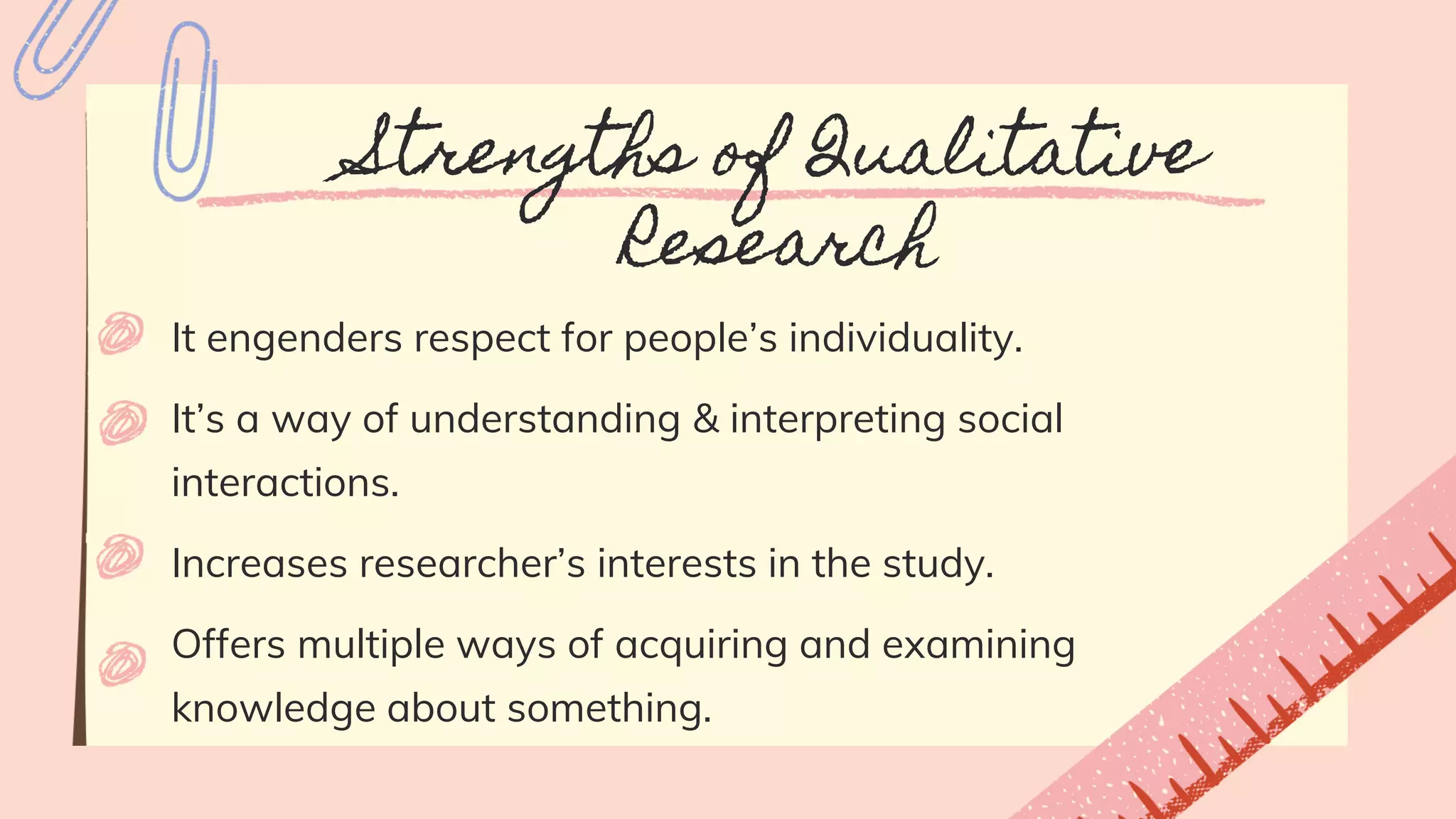
It engenders respect for people’s individuality.
It’s a way of understanding & interpreting social
interactions.
Increases researcher’s interests in the study.
Offers multiple ways of acquiring and examining
knowledge about something.
Weaknesses of Qualitative
Research
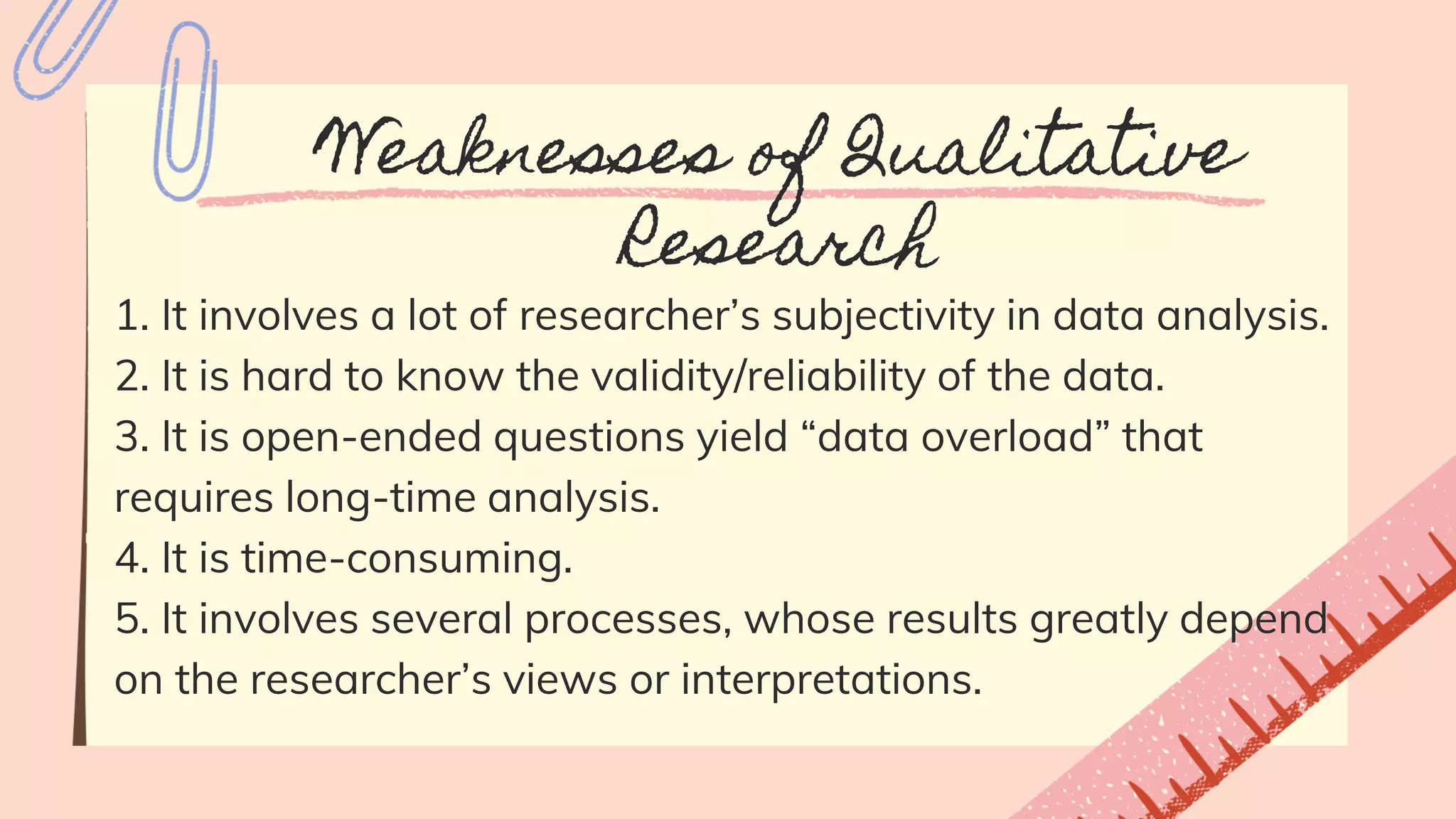
1. It involves a lot of researcher’s subjectivity in data analysis.
2. It is hard to know the validity/reliability of the data.
3. It is open-ended questions yield “data overload” that
requires long-time analysis.
4. It is time-consuming.
5. It involves several processes, whose results greatly depend
on the researcher’s views or interpretations.
Tupes of Qualitative Research
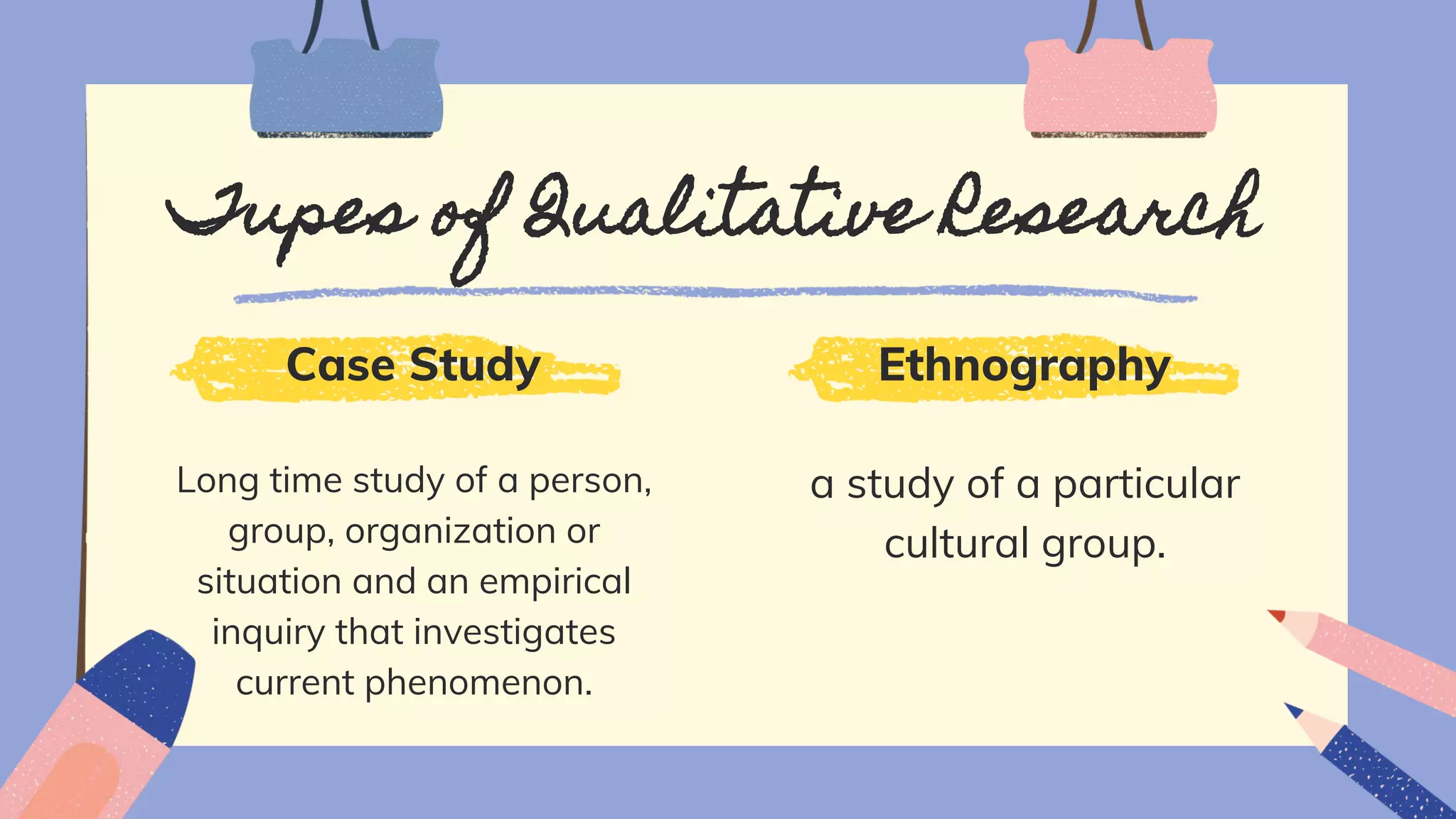
Case Study
Long time study of a person,
group, organization or
situation and an empirical
inquiry that investigates
current phenomenon.
Ethnography
a study of a particular
cultural group.
Tupes of Qualitative Research
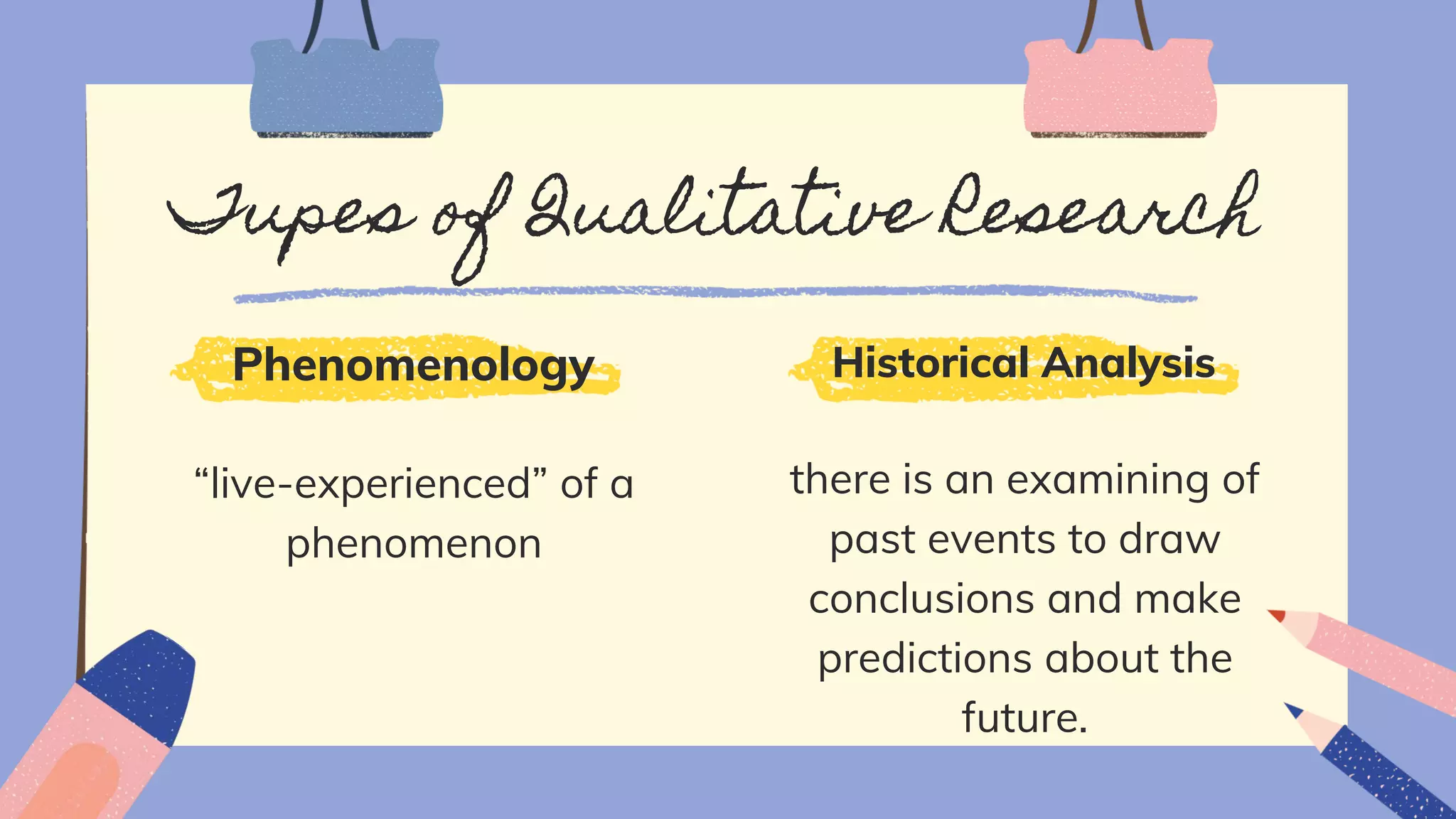
Phenomenology
“live-experienced” of a
phenomenon
Historical Analysis
there is an examining of
past events to draw
conclusions and make
predictions about the
future.
Tupes of Qualitative Research
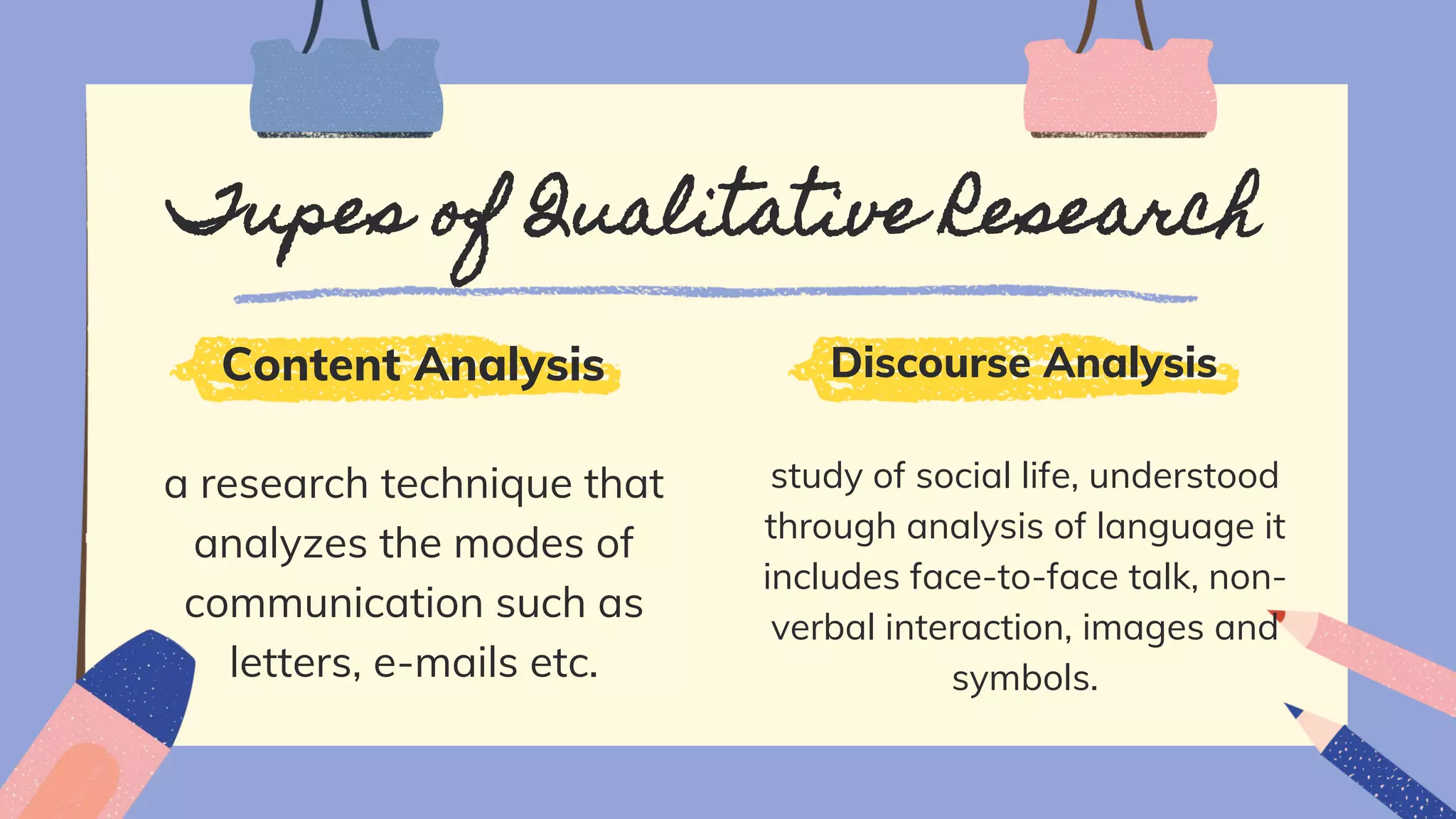
Content Analysis
a research technique that
analyzes the modes of
communication such as
letters, e-mails etc.
Discourse Analysis
study of social life, understood
through analysis of language it
includes face-to-face talk, non-
verbal interaction, images and
symbols.
Tupes of Qualitative Research
Grounded Theory
takes place when there is a
discovery of new theory
which underlies your study
at the time of data
collection and analysis
Narrative Report
designed to present things or
events that have happened in
the past through a logical
progression of the relevant
information
Tupes of Qualitative Research
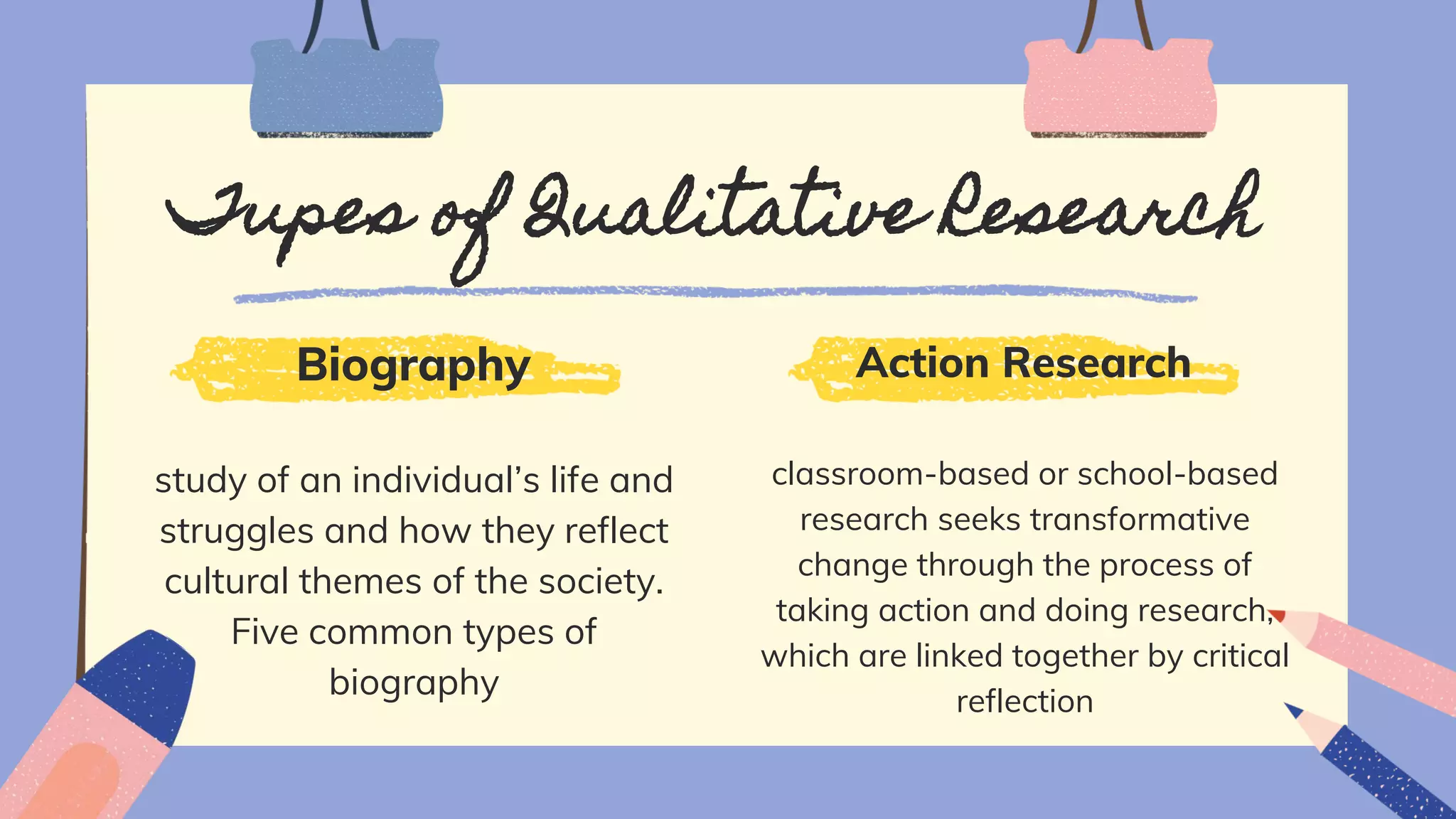
Biography
study of an individual’s life and
struggles and how they reflect
cultural themes of the society.
Five common types of
biography
Action Research
classroom-based or school-based
research seeks transformative
change through the process of
taking action and doing research,
which are linked together by critical
reflection
Five common types of biography
Scholarly Chronicles
focus on the historical portrayal of an
individual life.
Life History Writing
narrative of a life through the conceptual
analysis of the subject’s motives and
beliefs within the world of ideas.
a nonfiction account of life experiences
of a person
recording of life memories, experiences,
whether one’s or another’s.
Intellectual Biography Memoir Biography
Narrative Biography
stylistic presentation of the biographer’s
reflections and insights in relation to the
factual account of life.
Activity Time!
Activity is in Google Classroom
References:
Pastor, m (2020) Practical Research 1 – Grade 11
Alternative Delivery Mode Quarter 1– Module 2: Qualitative Research and
its important to daily life, First Edition
Abdullah, S.N. (2018) .Practical Research 1: Qualitative Research for SHS
[PowerPoint slides].Retrieved from
http://www.academia.edu./ppt
Thank You!

THE VALUE OF QUALITATIVE RESEARCH

  • 1.
    The Value ofQualitative Research: Its Characteristics, Strengths, Weaknesses and Kinds Presented by: Jimnaira Abanto
  • 2.
  • 3.
    I. Definition ofQualitative Research II. Purpose of Qualitative Research III. Characteristics of Qualitative Research IV. Strengths of Qualitative Research V. Weaknesses of Qualitative Research VI. Kinds of Qualitative Research Today's Agenda
  • 4.
    Qualitative Research It isa scientific method of observation to gather non-numerical data. It refers to the meanings, concepts, characteristics, metaphors, symbols and description of phenomena, and not to their counts or measures.
  • 5.
    Purpose of QualitativeResearch Qualitative Research promotes a deep, holistic understanding of a particular phenomenon.
  • 6.
    Immanuel Kant Maurice Merleau-Ponty Lifeconsists of what we experience in our activities and reflections as we live out our personal histories and that we live in a matrix of complex relationships with others.
  • 7.
    Characteristics of Qualitative Research NATURALISTIC INQUIRY itstudies a person or group in his/its natural setting. INDUCTIVE ANALYSIS HOLISTIC PERSPECTIVE Qualitative research allows the researcher to immerse in a subject. “The whole is greater than the sum of its parts” .
  • 8.
    DYNAMIC SYSTEM Qualitative researchis not concerned with having straightforward, right or wrong answers UNIQUE CASE ORIENTATION CONTEXT SENSITIVITY Qualitative researcher must remember that every study is special Qualitative researcher is sensitive to the cultures, traditions and beliefs of his subjects RESEARCHER AS THE KEY INSTRUMENT Qualitative researcher collects data himself through examining documents, observing behavior, and interviewing participants
  • 9.
    MULTIPLE METHODS Qualitative researchertypically gathers multiple forms of data, such as interviews, observations, and documents, rather than relying on a single data source DESIGN FLEXIBILITY THEMATIC ANALYSIS Qualitative researcher can continue to do research on other topics or questions that emerge from initial research Qualitative researcher develops themes in reporting his findings. EMPATHIC NEUTRALITY Ideally, qualitative researcher is non- judgmental when compiling findings.
  • 10.
    Strengths of Qualitative Research Itadopts a naturalistic approach to its subject matter. Promotes a full understanding of human behavior/personality traits in their natural setting. It is instrumental for positive societal changes.
  • 11.
    Strengths of Qualitative Research Itengenders respect for people’s individuality. It’s a way of understanding & interpreting social interactions. Increases researcher’s interests in the study. Offers multiple ways of acquiring and examining knowledge about something.
  • 12.
    Weaknesses of Qualitative Research 1.It involves a lot of researcher’s subjectivity in data analysis. 2. It is hard to know the validity/reliability of the data. 3. It is open-ended questions yield “data overload” that requires long-time analysis. 4. It is time-consuming. 5. It involves several processes, whose results greatly depend on the researcher’s views or interpretations.
  • 13.
    Tupes of QualitativeResearch Case Study Long time study of a person, group, organization or situation and an empirical inquiry that investigates current phenomenon. Ethnography a study of a particular cultural group.
  • 14.
    Tupes of QualitativeResearch Phenomenology “live-experienced” of a phenomenon Historical Analysis there is an examining of past events to draw conclusions and make predictions about the future.
  • 15.
    Tupes of QualitativeResearch Content Analysis a research technique that analyzes the modes of communication such as letters, e-mails etc. Discourse Analysis study of social life, understood through analysis of language it includes face-to-face talk, non- verbal interaction, images and symbols.
  • 16.
    Tupes of QualitativeResearch Grounded Theory takes place when there is a discovery of new theory which underlies your study at the time of data collection and analysis Narrative Report designed to present things or events that have happened in the past through a logical progression of the relevant information
  • 17.
    Tupes of QualitativeResearch Biography study of an individual’s life and struggles and how they reflect cultural themes of the society. Five common types of biography Action Research classroom-based or school-based research seeks transformative change through the process of taking action and doing research, which are linked together by critical reflection
  • 18.
    Five common typesof biography Scholarly Chronicles focus on the historical portrayal of an individual life. Life History Writing narrative of a life through the conceptual analysis of the subject’s motives and beliefs within the world of ideas. a nonfiction account of life experiences of a person recording of life memories, experiences, whether one’s or another’s. Intellectual Biography Memoir Biography Narrative Biography stylistic presentation of the biographer’s reflections and insights in relation to the factual account of life.
  • 19.
    Activity Time! Activity isin Google Classroom References: Pastor, m (2020) Practical Research 1 – Grade 11 Alternative Delivery Mode Quarter 1– Module 2: Qualitative Research and its important to daily life, First Edition Abdullah, S.N. (2018) .Practical Research 1: Qualitative Research for SHS [PowerPoint slides].Retrieved from http://www.academia.edu./ppt
  • 20.