
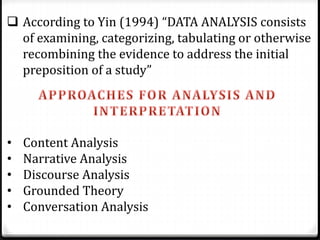

 According to Yin (1994) “DATA ANALYSIS consists
of examining, categorizing, tabulating or otherwise
recombining the evidence to address the initial
preposition of a study”
• Content Analysis
• Narrative Analysis
• Discourse Analysis
• Grounded Theory
• Conversation Analysis
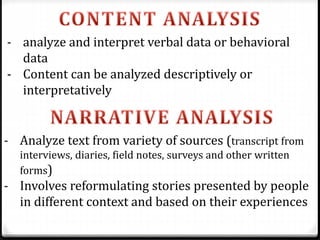
- analyze and interpret verbal data or behavioral
data
- Content can be analyzed descriptively or
interpretatively
- Analyze text from variety of sources (transcript from
interviews, diaries, field notes, surveys and other written
forms)
- Involves reformulating stories presented by people
in different context and based on their experiences
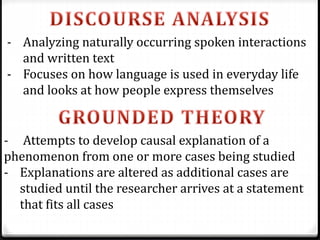
- Analyzing naturally occurring spoken interactions
and written text
- Focuses on how language is used in everyday life
and looks at how people express themselves
- Attempts to develop causal explanation of a
phenomenon from one or more cases being studied
- Explanations are altered as additional cases are
studied until the researcher arrives at a statement
that fits all cases
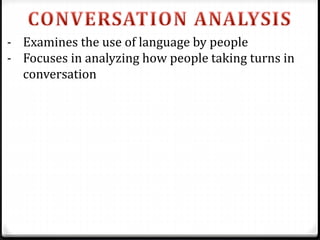
- Examines the use of language by people
- Focuses in analyzing how people taking turns in
conversation
STEPS IN ANALYZING DATA
1. Organize and prepare the data for analysis
2. Read through the data
3. Conduct analysis based in the specific approach or
method
4. Generate a description of the setting or people and
identify themes from the coding. Search for theme
connections
5. Represent the data within a research report
6. Interpret the larger meaning of the data
- Actual process of making sure that the data is
organized in chunks or segments and later making
meaning on it.
- According the Creswell (2009), coding and
categorizing involves taking text data or pictures
gathered during data collection, segmenting it into
categories, and labeling those categories with a term,
often a term used by the actual participant
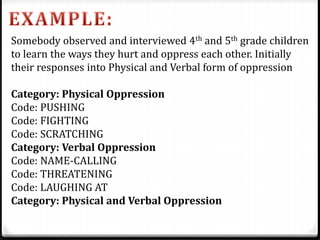
Somebody observed and interviewed 4th and 5th grade children
to learn the ways they hurt and oppress each other. Initially
their responses into Physical and Verbal form of oppression
Category: Physical Oppression
Code: PUSHING
Code: FIGHTING
Code: SCRATCHING
Category: Verbal Oppression
Code: NAME-CALLING
Code: THREATENING
Code: LAUGHING AT
Category: Physical and Verbal Oppression
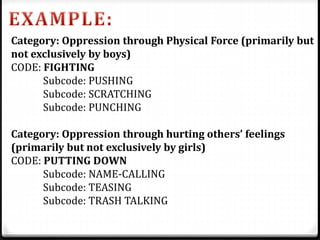
Category: Oppression through Physical Force (primarily but
not exclusively by boys)
CODE: FIGHTING
Subcode: PUSHING
Subcode: SCRATCHING
Subcode: PUNCHING
Category: Oppression through hurting others’ feelings
(primarily but not exclusively by girls)
CODE: PUTTING DOWN
Subcode: NAME-CALLING
Subcode: TEASING
Subcode: TRASH TALKING
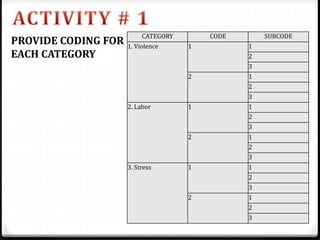
PROVIDE CODING FOR
EACH CATEGORY
CATEGORY CODE SUBCODE
1. Violence 1 1
2
3
2 1
2
3
2. Labor 1 1
2
3
2 1
2
3
3. Stress 1 1
2
3
2 1
2
3
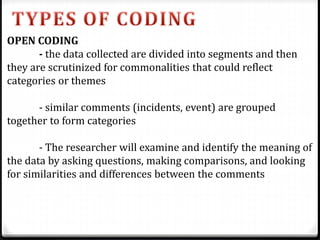
OPEN CODING
- the data collected are divided into segments and then
they are scrutinized for commonalities that could reflect
categories or themes
- similar comments (incidents, event) are grouped
together to form categories
- The researcher will examine and identify the meaning of
the data by asking questions, making comparisons, and looking
for similarities and differences between the comments
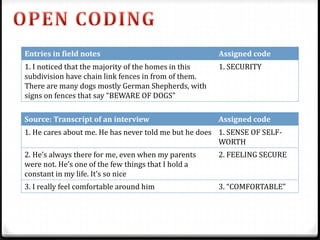
Source: Transcript of an interview Assigned code
1. He cares about me. He has never told me but he does 1. SENSE OF SELF-
WORTH
2. He’s always there for me, even when my parents
were not. He’s one of the few things that I hold a
constant in my life. It’s so nice
2. FEELING SECURE
3. I really feel comfortable around him 3. “COMFORTABLE”
Entries in field notes Assigned code
1. I noticed that the majority of the homes in this
subdivision have chain link fences in from of them.
There are many dogs mostly German Shepherds, with
signs on fences that say “BEWARE OF DOGS”
1. SECURITY
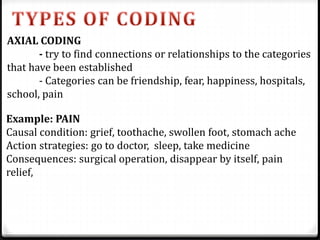
AXIAL CODING
- try to find connections or relationships to the categories
that have been established
- Categories can be friendship, fear, happiness, hospitals,
school, pain
Example: PAIN
Causal condition: grief, toothache, swollen foot, stomach ache
Action strategies: go to doctor, sleep, take medicine
Consequences: surgical operation, disappear by itself, pain
relief,
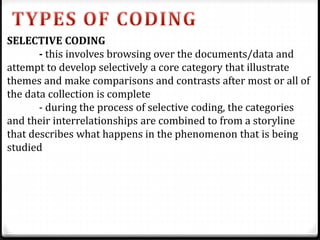
SELECTIVE CODING
- this involves browsing over the documents/data and
attempt to develop selectively a core category that illustrate
themes and make comparisons and contrasts after most or all of
the data collection is complete
- during the process of selective coding, the categories
and their interrelationships are combined to from a storyline
that describes what happens in the phenomenon that is being
studied
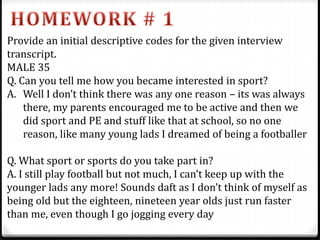
Provide an initial descriptive codes for the given interview
transcript.
MALE 35
Q. Can you tell me how you became interested in sport?
A. Well I don’t think there was any one reason – its was always
there, my parents encouraged me to be active and then we
did sport and PE and stuff like that at school, so no one
reason, like many young lads I dreamed of being a footballer
Q. What sport or sports do you take part in?
A. I still play football but not much, I can’t keep up with the
younger lads any more! Sounds daft as I don’t think of myself as
being old but the eighteen, nineteen year olds just run faster
than me, even though I go jogging every day
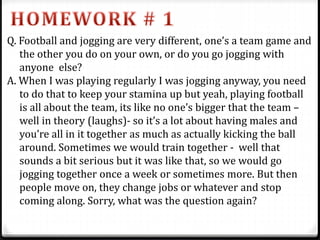
Q. Football and jogging are very different, one’s a team game and
the other you do on your own, or do you go jogging with
anyone else?
A. When I was playing regularly I was jogging anyway, you need
to do that to keep your stamina up but yeah, playing football
is all about the team, its like no one’s bigger that the team –
well in theory (laughs)- so it’s a lot about having males and
you’re all in it together as much as actually kicking the ball
around. Sometimes we would train together - well that
sounds a bit serious but it was like that, so we would go
jogging together once a week or sometimes more. But then
people move on, they change jobs or whatever and stop
coming along. Sorry, what was the question again?
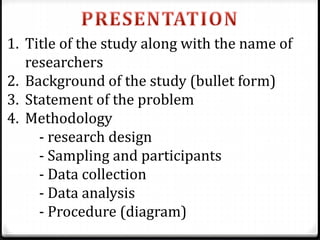
1. Title of the study along with the name of
researchers
2. Background of the study (bullet form)
3. Statement of the problem
4. Methodology
- research design
- Sampling and participants
- Data collection
- Data analysis
- Procedure (diagram)

Analyzing data

  • 2.
     According toYin (1994) “DATA ANALYSIS consists of examining, categorizing, tabulating or otherwise recombining the evidence to address the initial preposition of a study” • Content Analysis • Narrative Analysis • Discourse Analysis • Grounded Theory • Conversation Analysis
  • 3.
    - analyze andinterpret verbal data or behavioral data - Content can be analyzed descriptively or interpretatively - Analyze text from variety of sources (transcript from interviews, diaries, field notes, surveys and other written forms) - Involves reformulating stories presented by people in different context and based on their experiences
  • 4.
    - Analyzing naturallyoccurring spoken interactions and written text - Focuses on how language is used in everyday life and looks at how people express themselves - Attempts to develop causal explanation of a phenomenon from one or more cases being studied - Explanations are altered as additional cases are studied until the researcher arrives at a statement that fits all cases
  • 5.
    - Examines theuse of language by people - Focuses in analyzing how people taking turns in conversation
  • 6.
    STEPS IN ANALYZINGDATA 1. Organize and prepare the data for analysis 2. Read through the data 3. Conduct analysis based in the specific approach or method 4. Generate a description of the setting or people and identify themes from the coding. Search for theme connections 5. Represent the data within a research report 6. Interpret the larger meaning of the data
  • 7.
    - Actual processof making sure that the data is organized in chunks or segments and later making meaning on it. - According the Creswell (2009), coding and categorizing involves taking text data or pictures gathered during data collection, segmenting it into categories, and labeling those categories with a term, often a term used by the actual participant
  • 8.
    Somebody observed andinterviewed 4th and 5th grade children to learn the ways they hurt and oppress each other. Initially their responses into Physical and Verbal form of oppression Category: Physical Oppression Code: PUSHING Code: FIGHTING Code: SCRATCHING Category: Verbal Oppression Code: NAME-CALLING Code: THREATENING Code: LAUGHING AT Category: Physical and Verbal Oppression
  • 9.
    Category: Oppression throughPhysical Force (primarily but not exclusively by boys) CODE: FIGHTING Subcode: PUSHING Subcode: SCRATCHING Subcode: PUNCHING Category: Oppression through hurting others’ feelings (primarily but not exclusively by girls) CODE: PUTTING DOWN Subcode: NAME-CALLING Subcode: TEASING Subcode: TRASH TALKING
  • 10.
    PROVIDE CODING FOR EACHCATEGORY CATEGORY CODE SUBCODE 1. Violence 1 1 2 3 2 1 2 3 2. Labor 1 1 2 3 2 1 2 3 3. Stress 1 1 2 3 2 1 2 3
  • 11.
    OPEN CODING - thedata collected are divided into segments and then they are scrutinized for commonalities that could reflect categories or themes - similar comments (incidents, event) are grouped together to form categories - The researcher will examine and identify the meaning of the data by asking questions, making comparisons, and looking for similarities and differences between the comments
  • 12.
    Source: Transcript ofan interview Assigned code 1. He cares about me. He has never told me but he does 1. SENSE OF SELF- WORTH 2. He’s always there for me, even when my parents were not. He’s one of the few things that I hold a constant in my life. It’s so nice 2. FEELING SECURE 3. I really feel comfortable around him 3. “COMFORTABLE” Entries in field notes Assigned code 1. I noticed that the majority of the homes in this subdivision have chain link fences in from of them. There are many dogs mostly German Shepherds, with signs on fences that say “BEWARE OF DOGS” 1. SECURITY
  • 13.
    AXIAL CODING - tryto find connections or relationships to the categories that have been established - Categories can be friendship, fear, happiness, hospitals, school, pain Example: PAIN Causal condition: grief, toothache, swollen foot, stomach ache Action strategies: go to doctor, sleep, take medicine Consequences: surgical operation, disappear by itself, pain relief,
  • 14.
    SELECTIVE CODING - thisinvolves browsing over the documents/data and attempt to develop selectively a core category that illustrate themes and make comparisons and contrasts after most or all of the data collection is complete - during the process of selective coding, the categories and their interrelationships are combined to from a storyline that describes what happens in the phenomenon that is being studied
  • 15.
    Provide an initialdescriptive codes for the given interview transcript. MALE 35 Q. Can you tell me how you became interested in sport? A. Well I don’t think there was any one reason – its was always there, my parents encouraged me to be active and then we did sport and PE and stuff like that at school, so no one reason, like many young lads I dreamed of being a footballer Q. What sport or sports do you take part in? A. I still play football but not much, I can’t keep up with the younger lads any more! Sounds daft as I don’t think of myself as being old but the eighteen, nineteen year olds just run faster than me, even though I go jogging every day
  • 16.
    Q. Football andjogging are very different, one’s a team game and the other you do on your own, or do you go jogging with anyone else? A. When I was playing regularly I was jogging anyway, you need to do that to keep your stamina up but yeah, playing football is all about the team, its like no one’s bigger that the team – well in theory (laughs)- so it’s a lot about having males and you’re all in it together as much as actually kicking the ball around. Sometimes we would train together - well that sounds a bit serious but it was like that, so we would go jogging together once a week or sometimes more. But then people move on, they change jobs or whatever and stop coming along. Sorry, what was the question again?
  • 18.
    1. Title ofthe study along with the name of researchers 2. Background of the study (bullet form) 3. Statement of the problem 4. Methodology - research design - Sampling and participants - Data collection - Data analysis - Procedure (diagram)

Editor's Notes

  • #3 Codes requires a skill and lot of common sense because there is no standard way of doing it
  • #5 Discourse – social context in which communication occurred Grounded – analytic induction
  • #6 Conversation- meaning are usually shaped in the context of the exchange itself
  • #7 2. Gain a general sense of het information and reflect on the overall meaning 3. narrative, content, grounded, discourse, conversational
  • #9 Third category – a child can exclude others physically from a game, accompanied with verbal statement “you can’t play with us”
  • #10 Qualitative analysis – familiarize yourself with the data
  • #12 Commonly used in ethnographic, (phenomenology and grounded theory – process of organizing data collected as initial step in data analysis