Chemical Bonds
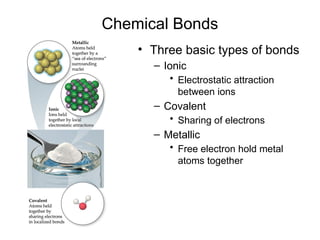
• Threebasic types of bonds
– Ionic
• Electrostatic attraction
between ions
– Covalent
• Sharing of electrons
– Metallic
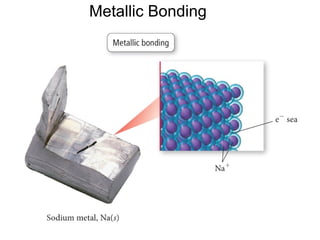
• Free electron hold metal
atoms together
3.
Lewis Symbols
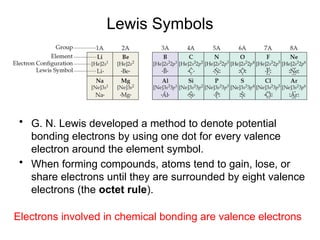
• G.N. Lewis developed a method to denote potential
bonding electrons by using one dot for every valence
electron around the element symbol.
• When forming compounds, atoms tend to gain, lose, or
share electrons until they are surrounded by eight valence
electrons (the octet rule).
Electrons involved in chemical bonding are valence electrons
4.
Ionic Bonding
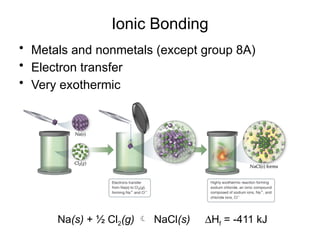
• Metalsand nonmetals (except group 8A)
• Electron transfer
• Very exothermic
Na(s) + ½ Cl2(g) NaCl(s) DHf = -411 kJ
5.
Ionic Bonding
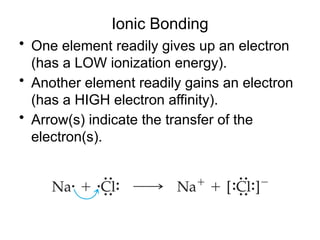
• Oneelement readily gives up an electron
(has a LOW ionization energy).
• Another element readily gains an electron
(has a HIGH electron affinity).
• Arrow(s) indicate the transfer of the
electron(s).
6.
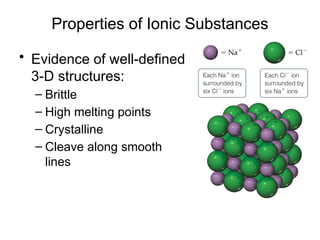
Properties of IonicSubstances
• Evidence of well-defined
3-D structures:
– Brittle
– High melting points
– Crystalline
– Cleave along smooth
lines
7.
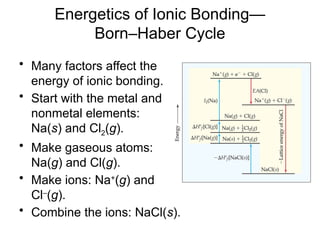
Energetics of IonicBonding—
Born–Haber Cycle
• Many factors affect the
energy of ionic bonding.
• Start with the metal and
nonmetal elements:
Na(s) and Cl2(g).
• Make gaseous atoms:
Na(g) and Cl(g).
• Make ions: Na+
(g) and
Cl–
(g).
• Combine the ions: NaCl(s).
8.
Energetics of IonicBonding
• We already discussed making ions (ionization energy and
electron affinity).
• It takes energy to convert the elements to atoms
(endothermic).
• It takes energy to create a cation (endothermic).
• Energy is released by making the anion (exothermic).
• The formation of the solid releases a huge amount of
energy (exothermic).
• This makes the formation of salts from the elements
exothermic.
9.
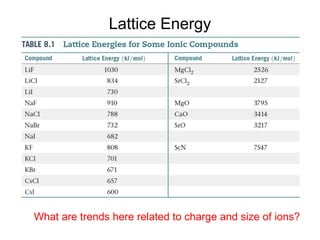
Lattice Energy
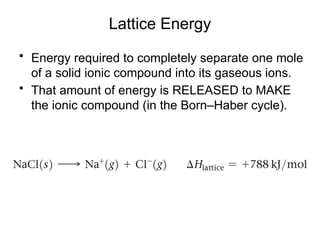
• Energyrequired to completely separate one mole
of a solid ionic compound into its gaseous ions.
• That amount of energy is RELEASED to MAKE
the ionic compound (in the Born–Haber cycle).
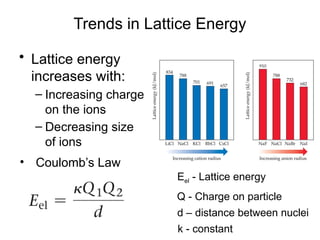
Trends in LatticeEnergy
• Lattice energy
increases with:
– Increasing charge
on the ions
– Decreasing size
of ions
Eel - Lattice energy
Q - Charge on particle
d – distance between nuclei
• Coulomb’s Law
k - constant
12.
Electron Configuration ofIons
• Main group metals lose electrons, resulting in the
electron configuration of the previous noble gas.
• Nonmetals gain electrons, resulting in the electron
configuration of the nearest noble gas.
• Transition metals do NOT follow the Octet rule.
• Transition metals lose the VALENCE electrons FIRST,
THEN lose the d- electrons necessary for the given ion
charge.
• The octet rule, although useful, is clearly limited in scope.
13.
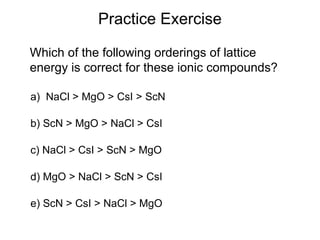
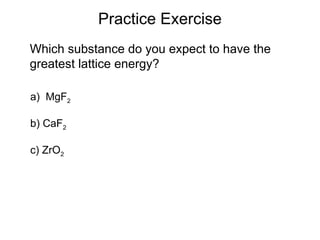
Practice Exercise
Which ofthe following orderings of lattice
energy is correct for these ionic compounds?
a) NaCl > MgO > CsI > ScN
b) ScN > MgO > NaCl > CsI
c) NaCl > CsI > ScN > MgO
d) MgO > NaCl > ScN > CsI
e) ScN > CsI > NaCl > MgO
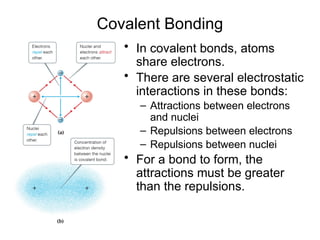
Covalent Bonding
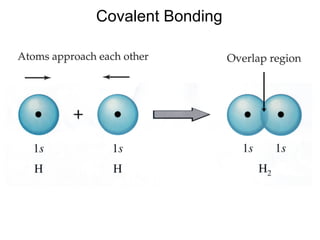
• Incovalent bonds, atoms
share electrons.
• There are several electrostatic
interactions in these bonds:
– Attractions between electrons
and nuclei
– Repulsions between electrons
– Repulsions between nuclei
• For a bond to form, the
attractions must be greater
than the repulsions.
16.
Covalent Bonding
• Ina covalent “single” bond, 2 electrons are
“shared” between 2 atoms
• Covalently bound species are different than ionic
– exist as individual, discrete species (vs. 3-D crystal
lattice structure for ionic)
– tend to exhibit much lower melting and boiling points (vs.
ionic)
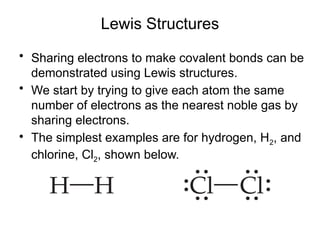
Lewis Structures
• Sharingelectrons to make covalent bonds can be
demonstrated using Lewis structures.
• We start by trying to give each atom the same
number of electrons as the nearest noble gas by
sharing electrons.
• The simplest examples are for hydrogen, H2, and
chlorine, Cl2, shown below.
19.
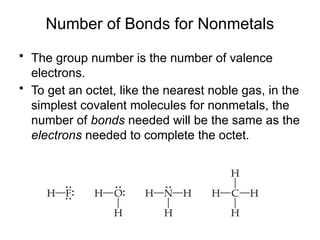
Number of Bondsfor Nonmetals
• The group number is the number of valence
electrons.
• To get an octet, like the nearest noble gas, in the
simplest covalent molecules for nonmetals, the
number of bonds needed will be the same as the
electrons needed to complete the octet.
20.
Electrons on LewisStructures
• Lone pairs: electrons located on only
one atom in a Lewis structure
• Bonding pairs: shared electrons in a
Lewis structure; they can be
represented by two dots or one line,
NOT both!
21.
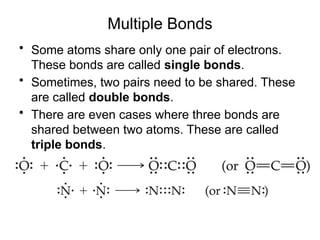
Multiple Bonds
• Someatoms share only one pair of electrons.
These bonds are called single bonds.
• Sometimes, two pairs need to be shared. These
are called double bonds.
• There are even cases where three bonds are
shared between two atoms. These are called
triple bonds.
22.
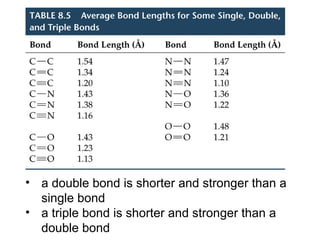
• a doublebond is shorter and stronger than a
single bond
• a triple bond is shorter and stronger than a
double bond
23.
Polarity of Bonds
•The electrons in a covalent bond are not
always shared equally.
• Bond polarity is a measure of how equally or
unequally the electrons in a covalent bond
are shared.
• In a nonpolar covalent bond, the electrons
are shared equally.
• In a polar covalent bond, one of the atoms
attracts electrons to itself with a greater force.
24.
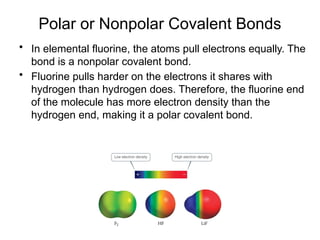
Polar or NonpolarCovalent Bonds
• In elemental fluorine, the atoms pull electrons equally. The
bond is a nonpolar covalent bond.
• Fluorine pulls harder on the electrons it shares with
hydrogen than hydrogen does. Therefore, the fluorine end
of the molecule has more electron density than the
hydrogen end, making it a polar covalent bond.
25.
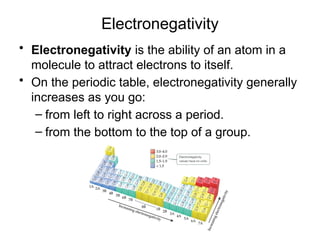
Electronegativity
• Electronegativity isthe ability of an atom in a
molecule to attract electrons to itself.
• On the periodic table, electronegativity generally
increases as you go:
– from left to right across a period.
– from the bottom to the top of a group.
26.
Arrange the followingin order of
increasing electronegativity: Na, F,
O, K, Al, Si, Mg
27.
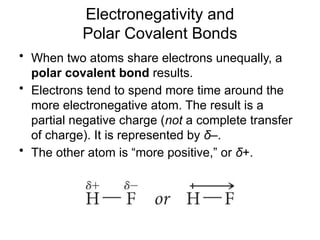
Electronegativity and
Polar CovalentBonds
• When two atoms share electrons unequally, a
polar covalent bond results.
• Electrons tend to spend more time around the
more electronegative atom. The result is a
partial negative charge (not a complete transfer
of charge). It is represented by δ–.
• The other atom is “more positive,” or δ+.
28.
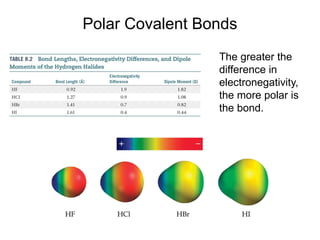
Polar Covalent Bonds
Thegreater the
difference in
electronegativity,
the more polar is
the bond.
29.
Dipoles
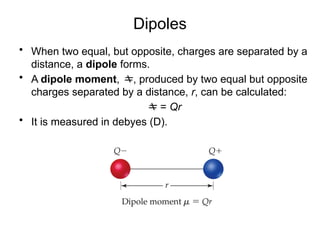
• When twoequal, but opposite, charges are separated by a
distance, a dipole forms.
• A dipole moment, , produced by two equal but opposite
charges separated by a distance, r, can be calculated:
= Qr
• It is measured in debyes (D).
30.
Is a CompoundIonic or Covalent?
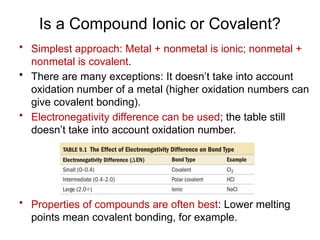
• Simplest approach: Metal + nonmetal is ionic; nonmetal +
nonmetal is covalent.
• There are many exceptions: It doesn’t take into account
oxidation number of a metal (higher oxidation numbers can
give covalent bonding).
• Electronegativity difference can be used; the table still
doesn’t take into account oxidation number.
• Properties of compounds are often best: Lower melting
points mean covalent bonding, for example.
31.
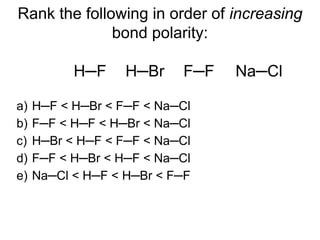
Rank the followingin order of increasing
bond polarity:
H─F H─Br F─F Na─Cl
a) H─F < H─Br < F─F < Na─Cl
b) F─F < H─F < H─Br < Na─Cl
c) H─Br < H─F < F─F < Na─Cl
d) F─F < H─Br < H─F < Na─Cl
e) Na─Cl < H─F < H─Br < F─F
32.
Metallic Bonds
• Therelatively low ionization energy of metals allows them
to lose electrons easily.
• The simplest theory of metallic bonding involves the metal
atoms releasing their valence electrons to be shared as a
pool by all the atoms/ions in the metal.
– An organization of metal cation islands in a sea of
electrons
– Electrons delocalized throughout the metal structure
• Bonding results from attraction of cation for the delocalized
electrons.
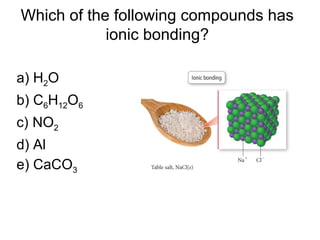
a) H2O
b) C6H12O6
c)NO2
d) Al
e) CaCO3
Which of the following compounds has
ionic bonding?
35.
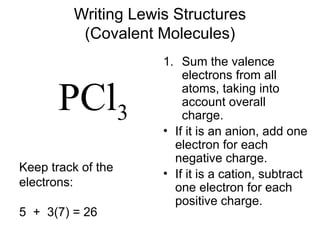
Writing Lewis Structures
(CovalentMolecules)
1. Sum the valence
electrons from all
atoms, taking into
account overall
charge.
• If it is an anion, add one
electron for each
negative charge.
• If it is a cation, subtract
one electron for each
positive charge.
PCl3
Keep track of the
electrons:
5 + 3(7) = 26
36.
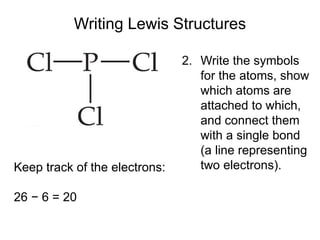
Writing Lewis Structures
2.Write the symbols
for the atoms, show
which atoms are
attached to which,
and connect them
with a single bond
(a line representing
two electrons).
Keep track of the electrons:
26 − 6 = 20
37.
Writing Lewis Structures
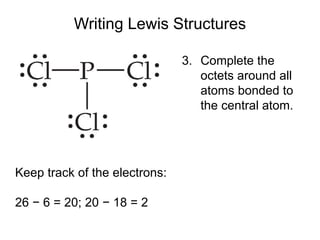
3.Complete the
octets around all
atoms bonded to
the central atom.
Keep track of the electrons:
26 − 6 = 20; 20 − 18 = 2
38.
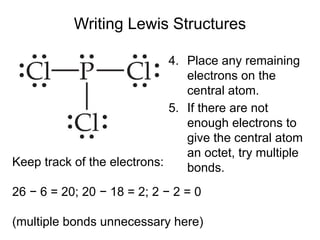
Writing Lewis Structures
4.Place any remaining
electrons on the
central atom.
5. If there are not
enough electrons to
give the central atom
an octet, try multiple
bonds.
Keep track of the electrons:
26 − 6 = 20; 20 − 18 = 2; 2 − 2 = 0
(multiple bonds unnecessary here)
39.
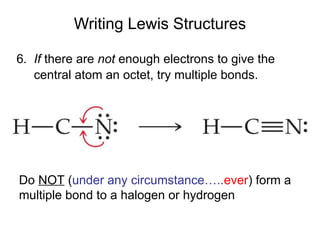
Writing Lewis Structures
6.If there are not enough electrons to give the
central atom an octet, try multiple bonds.
Do NOT (under any circumstance…..ever) form a
multiple bond to a halogen or hydrogen
40.
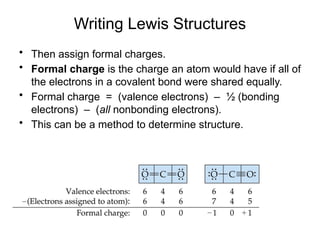
Writing Lewis Structures
•Then assign formal charges.
• Formal charge is the charge an atom would have if all of
the electrons in a covalent bond were shared equally.
• Formal charge = (valence electrons) – ½ (bonding
electrons) – (all nonbonding electrons).
• This can be a method to determine structure.
41.
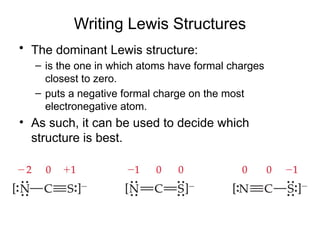
Writing Lewis Structures
•The dominant Lewis structure:
– is the one in which atoms have formal charges
closest to zero.
– puts a negative formal charge on the most
electronegative atom.
• As such, it can be used to decide which
structure is best.
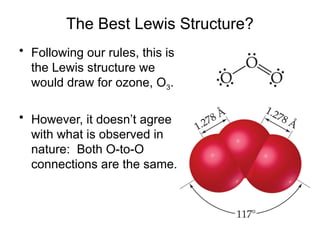
The Best LewisStructure?
• Following our rules, this is
the Lewis structure we
would draw for ozone, O3.
• However, it doesn’t agree
with what is observed in
nature: Both O-to-O
connections are the same.
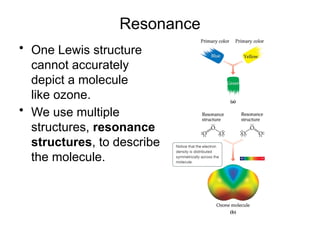
47.
Resonance
• One Lewisstructure
cannot accurately
depict a molecule
like ozone.
• We use multiple
structures, resonance
structures, to describe
the molecule.
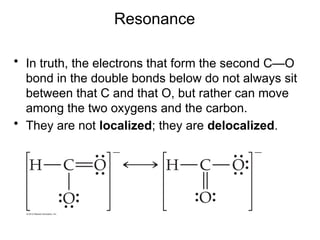
48.
Resonance
• In truth,the electrons that form the second C—O
bond in the double bonds below do not always sit
between that C and that O, but rather can move
among the two oxygens and the carbon.
• They are not localized; they are delocalized.
49.
Resonance
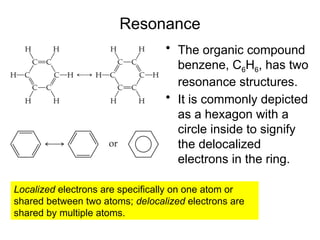
• The organiccompound
benzene, C6H6, has two
resonance structures.
• It is commonly depicted
as a hexagon with a
circle inside to signify
the delocalized
electrons in the ring.
Localized electrons are specifically on one atom or
shared between two atoms; delocalized electrons are
shared by multiple atoms.
50.
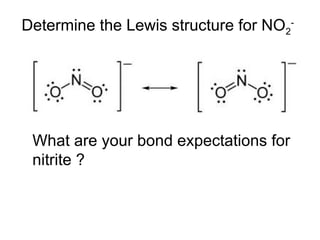
Determine the Lewisstructure for NO2
-
What are your bond expectations for
nitrite ?
51.
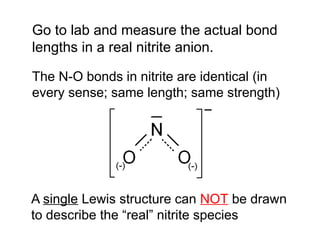
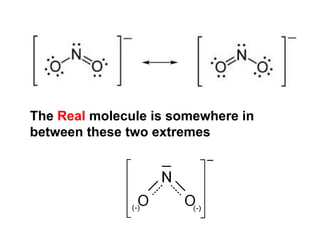
A single Lewisstructure can NOT be drawn
to describe the “real” nitrite species
Go to lab and measure the actual bond
lengths in a real nitrite anion.
The N-O bonds in nitrite are identical (in
every sense; same length; same strength)
Exceptions to theOctet Rule
• There are three types of ions or molecules
that do not follow the octet rule:
– Ions or molecules with an odd number of
electrons
– Ions or molecules with less than an octet
– Ions or molecules with more than eight valence
electrons (an expanded octet)
55.
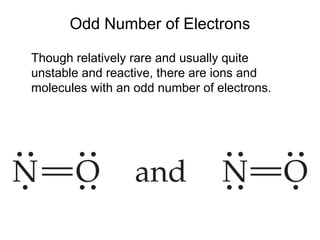
Odd Number ofElectrons
Though relatively rare and usually quite
unstable and reactive, there are ions and
molecules with an odd number of electrons.
56.
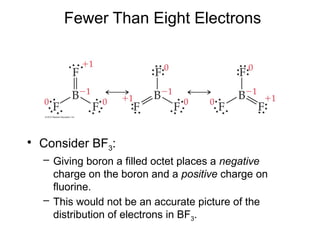
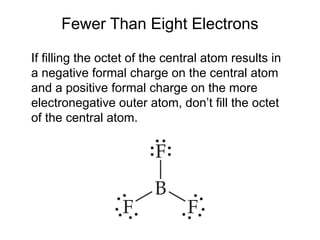
Fewer Than EightElectrons
• Consider BF3:
– Giving boron a filled octet places a negative
charge on the boron and a positive charge on
fluorine.
– This would not be an accurate picture of the
distribution of electrons in BF3.
57.
Fewer Than EightElectrons
If filling the octet of the central atom results in
a negative formal charge on the central atom
and a positive formal charge on the more
electronegative outer atom, don’t fill the octet
of the central atom.
58.
Draw the Lewisstructure for PF5
octet expansion – some atoms can exceed
8 valence electrons
(usually P & S)
59.
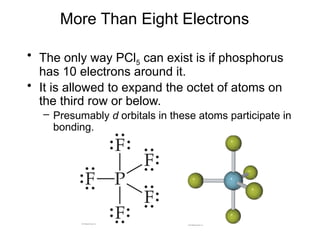
More Than EightElectrons
• The only way PCl5 can exist is if phosphorus
has 10 electrons around it.
• It is allowed to expand the octet of atoms on
the third row or below.
– Presumably d orbitals in these atoms participate in
bonding.
60.
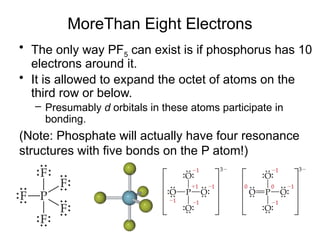
MoreThan Eight Electrons
•The only way PF5 can exist is if phosphorus has 10
electrons around it.
• It is allowed to expand the octet of atoms on the
third row or below.
– Presumably d orbitals in these atoms participate in
bonding.
(Note: Phosphate will actually have four resonance
structures with five bonds on the P atom!)
Editor's Notes
#2 Whenever two atoms or ions are strongly held together, we say there is a chemical bond between them. There are three general types of chemical bonds: ionic, covalent, and metallic.
Table salt is sodium chloride, NaCl, which consists of sodium ions, Na+, and chloride ions, Cl−. The structure is held together by ionic bonds, which are due to the electrostatic attractions between oppositely charged ions. The water consists mainly of H2O. H2O molecules. The hydrogen and oxygen atoms are bonded to one another through covalent bonds, in which molecules are formed by the sharing of electrons between atoms. The spoon consists mainly of iron metal, in which Fe atoms are connected to one another by metallic bonds, which are formed by electrons that are relatively free to move from one atom to another.
#3 The electrons involved in chemical bonding are the valence electrons, which, for most atoms, are those in the outermost occupied shell. The American chemist G. N. Lewis suggested a simple way of showing the valence electrons in an atom and tracking them during bond formation, using what are now known as either Lewis electron-dot symbols or simply Lewis symbols.
The Lewis symbol for an element consists of the element’s chemical symbol plus a dot for each valence electron. Sulfur, for example, has the electron configuration [Ne]3s23p4[Ne]3s23p4 and therefore six valence electrons. Its Lewis symbol consists of a symbol for the element with the six valence electrons positioned around it.
The dots are placed on the four sides of the symbol—top, bottom, left, and right—and each side can accommodate up to two electrons. All four sides are equivalent, which means that the choice of sides for placement of two electrons rather than one electron is arbitrary. In general, we spread out the dots as much as possible.
#5 Each ion has an octet of electrons, the Na+ octet being the 2s22p62s22p6 electrons that lie below the single 3s valence electron of the Na atom. We put a bracket around the chloride ion to emphasize that all eight electrons are located on it.
#6 Ionic substances possess several characteristic properties. They are usually brittle substances with high melting points. They are usually crystalline. Furthermore, ionic crystals often can be cleaved; that is, they break apart along smooth, flat surfaces. These characteristics result from electrostatic forces that maintain the ions in a rigid, well-defined, three-dimensional arrangement.
#7 What factors make the formation of ionic compounds so exothermic?
We represent the formation of NaCl as the transfer of an electron from Na to Cl. Recall that the loss of electrons from an atom is always an endothermic process. Removing an electron from Na(g) to form Na+(g) for instance, requires 496kJ/mol. Recall that when a nonmetal gains an electron, the process is generally exothermic, as seen from the negative electron affinities of the elements. Adding an electron to Cl(g), for example, releases 349kJ/mol. From the magnitudes of these energies, we can see that the transfer of an electron from an Na atom to a Cl atom would not be exothermic—the overall process would be an endothermic process that requires 496−349=147kJ/mol. This endothermic process corresponds to the formation of sodium and chloride ions that are infinitely far apart—in other words, the positive energy change assumes that the ions do not interact with each other, which is quite different from the situation in ionic solids.
The principal reason ionic compounds are stable is the attraction between ions of opposite charge. This attraction draws the ions together, releasing energy and causing many ions to form a solid array, or lattice. A measure of how much stabilization results from arranging oppositely charged ions in an ionic solid is given by the lattice energy, which is the energy required to completely separate one mole of a solid ionic compound into its gaseous ions.
The coming together of Na+(g) and Cl−(g) to form NaCl(s) is therefore highly exothermic (ΔH=−788kJ/mol).
#15 The vast majority of chemical substances do not have the characteristics of ionic materials.
#17 For the very large class of substances that do not behave like ionic substances, we need a different model to describe the bonding between atoms. G. N. Lewis reasoned that atoms might acquire a noble-gas electron configuration by sharing electrons with other atoms. A chemical bond formed by sharing a pair of electrons is a covalent bond.
#22 As a general rule, the length of the bond between two atoms decreases as the number of shared electron pairs increases.
#36 Chemical formulas are often written in the order in which the atoms are connected in the molecule or ion. The formula HCN, for example, tells you that the carbon atom is bonded to the H and to the N. In many polyatomic molecules and ions, the central atom is usually written first, as in CO32− and SF4. Remember that the central atom is generally less electronegative than the atoms surrounding it. In other cases, you may need more information before you can draw the Lewis structure.
#40 In some instances, we can draw two or more valid Lewis structures for a molecule that all obey the octet rule. All of these structures can be thought of as contributing to the actual arrangement of the electrons in the molecule, but not all of them will contribute to the same extent. How do we decide which one of several Lewis structures is the most important? One approach is to do some “bookkeeping” of the valence electrons to determine the formal charge of each atom in each Lewis structure. The formal charge of any atom in a molecule is the charge the atom would have if each bonding electron pair in the molecule were shared equally between its two atoms.
#44 In drawing Lewis structures, always put halogens and hydrogens on the outside. (They only form one bond)
#45 Place electrons on the electronegative atom first.
Triple bond between N and O.
#47 To describe the structure of ozone properly, we write both resonance structures and use a double-headed arrow to indicate that the real molecule is described by an average of the two.
To understand why certain molecules require more than one resonance structure, we can draw an analogy to mixing paint. Blue and yellow are both primary colors of paint pigment. An equal blend of blue and yellow pigments produces green pigment. We cannot describe green paint in terms of a single primary color, yet it still has its own identity. Green paint does not oscillate between its two primary colors: It is not blue part of the time and yellow the rest of the time. Similarly, molecules such as ozone cannot be described as oscillating between the two individual Lewis structures shown previously—there are two equivalent dominant Lewis structures that contribute equally to the actual structure of the molecule.
The actual arrangement of the electrons in molecules such as O3 must be considered as a blend of two (or more) Lewis structures. By analogy to the green paint, the molecule has its own identity separate from the individual resonance structures.