Chemistry: Atoms First
Julia Burdge & Jason Overby
Copyright (c) The McGraw-Hill Companies, Inc. Permission required for reproduction or display.
CHEMICAL
BONDING
Formation of Ions and
the Lewis dot Structure
Presenter:
LIEZL E. VALIENTE
1. Explain the formation of ionic and
covalent bonds
3. Illustrate lewis dot structure of the
representative elements
4. Illustrate the chemical bonding of ionic
and covalent bond using their lewis dot
structure
2. Explain the formation of ions
Stable
Unstable
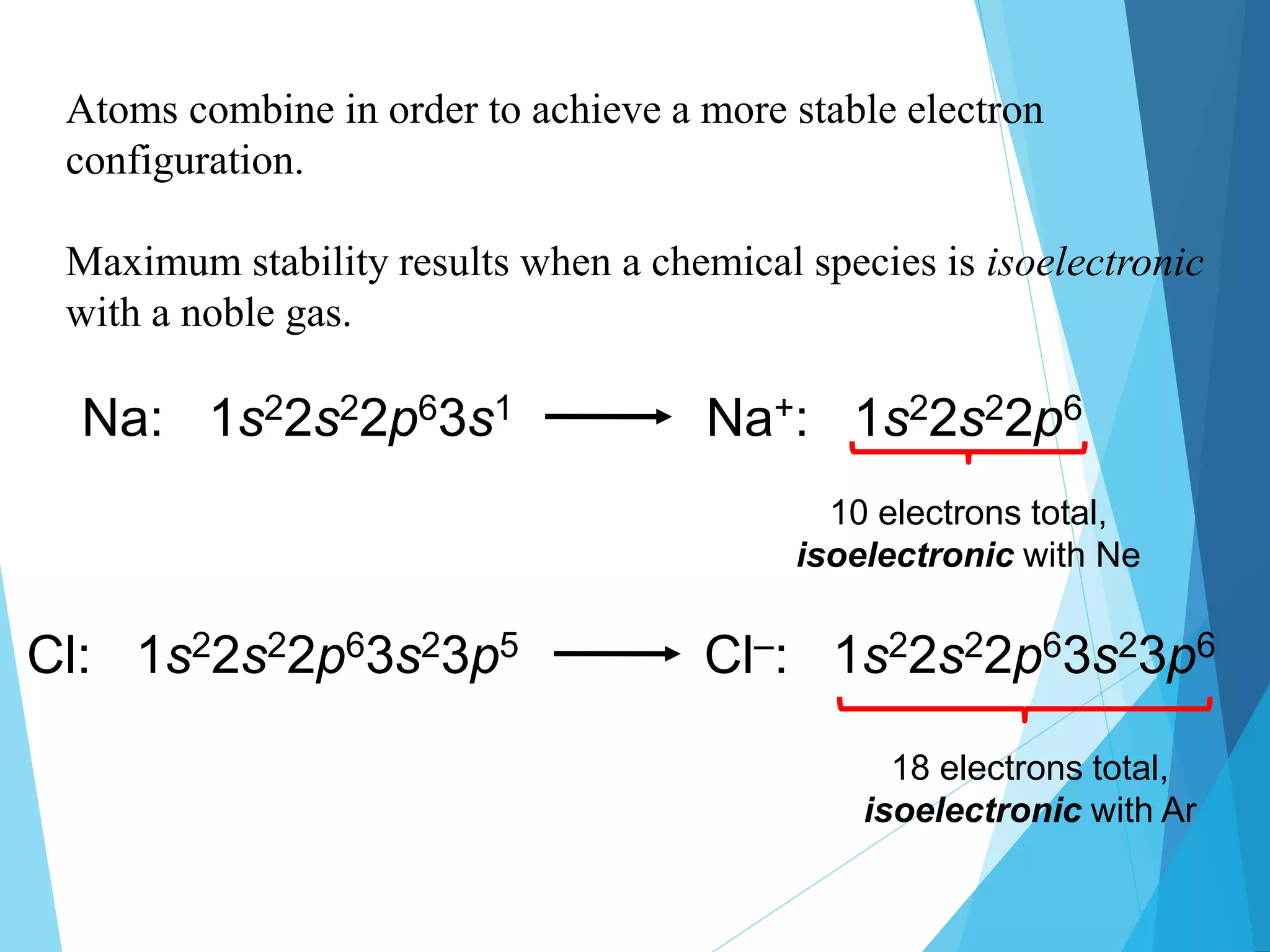
Atoms combine in order to achieve a more stable electron
configuration.
Maximum stability results when a chemical species is isoelectronic
with a noble gas.
Na: 1s22s22p63s1 Na+: 1s22s22p6
10 electrons total,
isoelectronic with Ne
Cl: 1s22s22p63s23p5 Cl‒: 1s22s22p63s23p6
18 electrons total,
isoelectronic with Ar
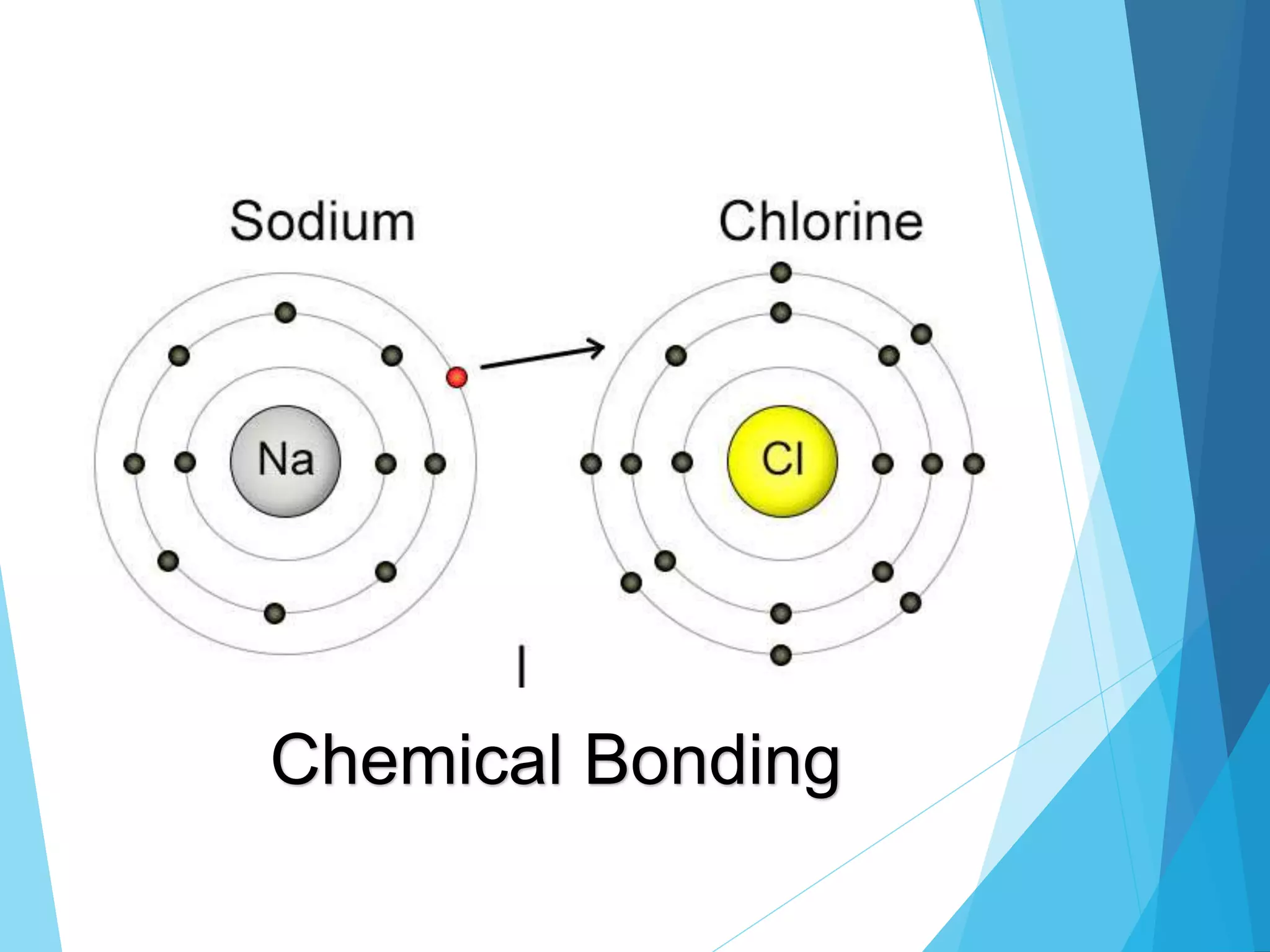
Chemical Bonding
Chemical Bonding
• refers to the formation of a chemical
bond between two or more atoms,
molecules, or ions to give rise to a
chemical compound.
Chemical Bonds
-the attractive force that holds atom together.
The Lewis Theory
-named after Gilbert Newton Lewis, a pioneer in understanding
the relationship between Lewis structure and chemical bonding.
1. Valence electrons play a fundamental role in chemical bonding
2. Chemical bonding that results from the transfer of 1 or more
electrons from 1 atom to another leading to the formation of
positive and negative ions is called ionic
3. Chemical bonding that involves the sharing of electrons is
called covalent (non-polar and polar)
4. Electrons are transferred/ shared to the extent that each atom
acquires an especially stable electron configuration. Usually
the configuration of a noble gas (8 outer shell electrons)
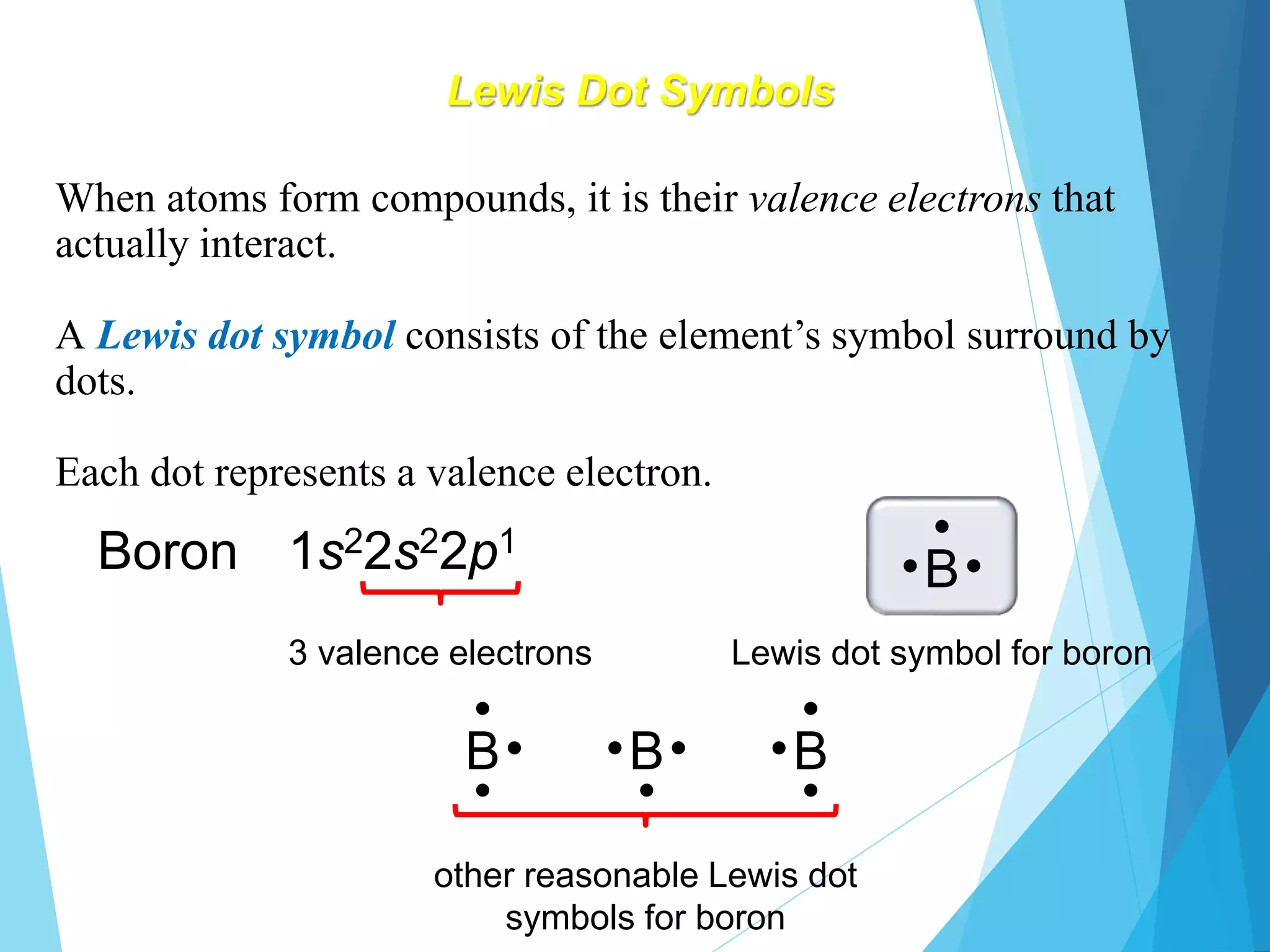
When atoms form compounds, it is their valence electrons that
actually interact.
A Lewis dot symbol consists of the element’s symbol surround by
dots.
Each dot represents a valence electron.
Boron 1s22s22p1
3 valence electrons
B
•
• •
Lewis dot symbol for boron
B
•
•
• B
•
•
• B
•
•
•
other reasonable Lewis dot
symbols for boron
Lewis Dot Symbols
Lewis Dot Symbols
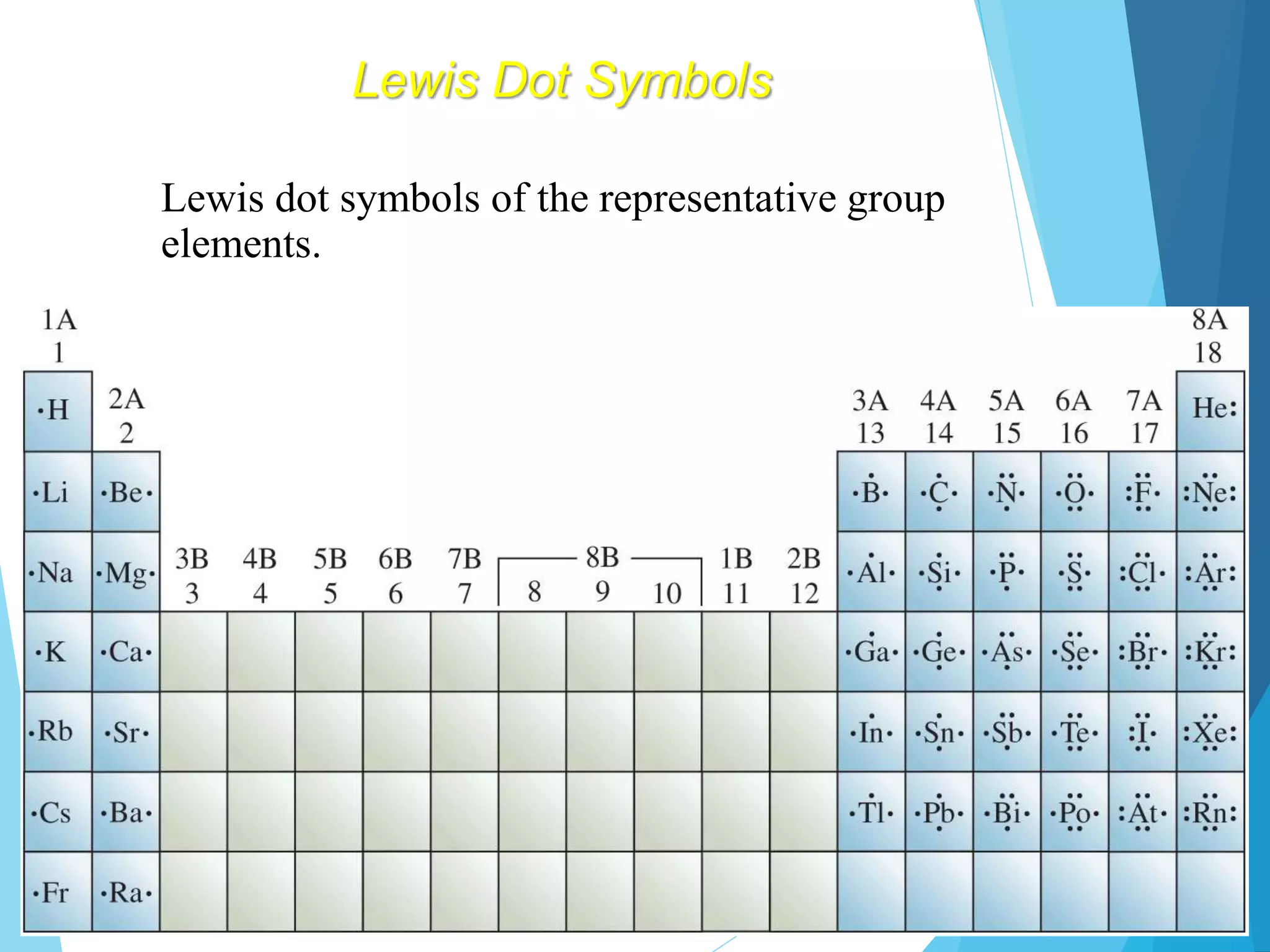
Lewis dot symbols of the representative group
elements.
Write the Lewis dot Structure:
1. Cl
2. Na
3. Mg
4. Ca
5. K
6. Br
7. Sr
8. F
9. I
10. O
Types of Chemical Bonds
Metal Non-Metal
Ionic Bond
Ionic Bond
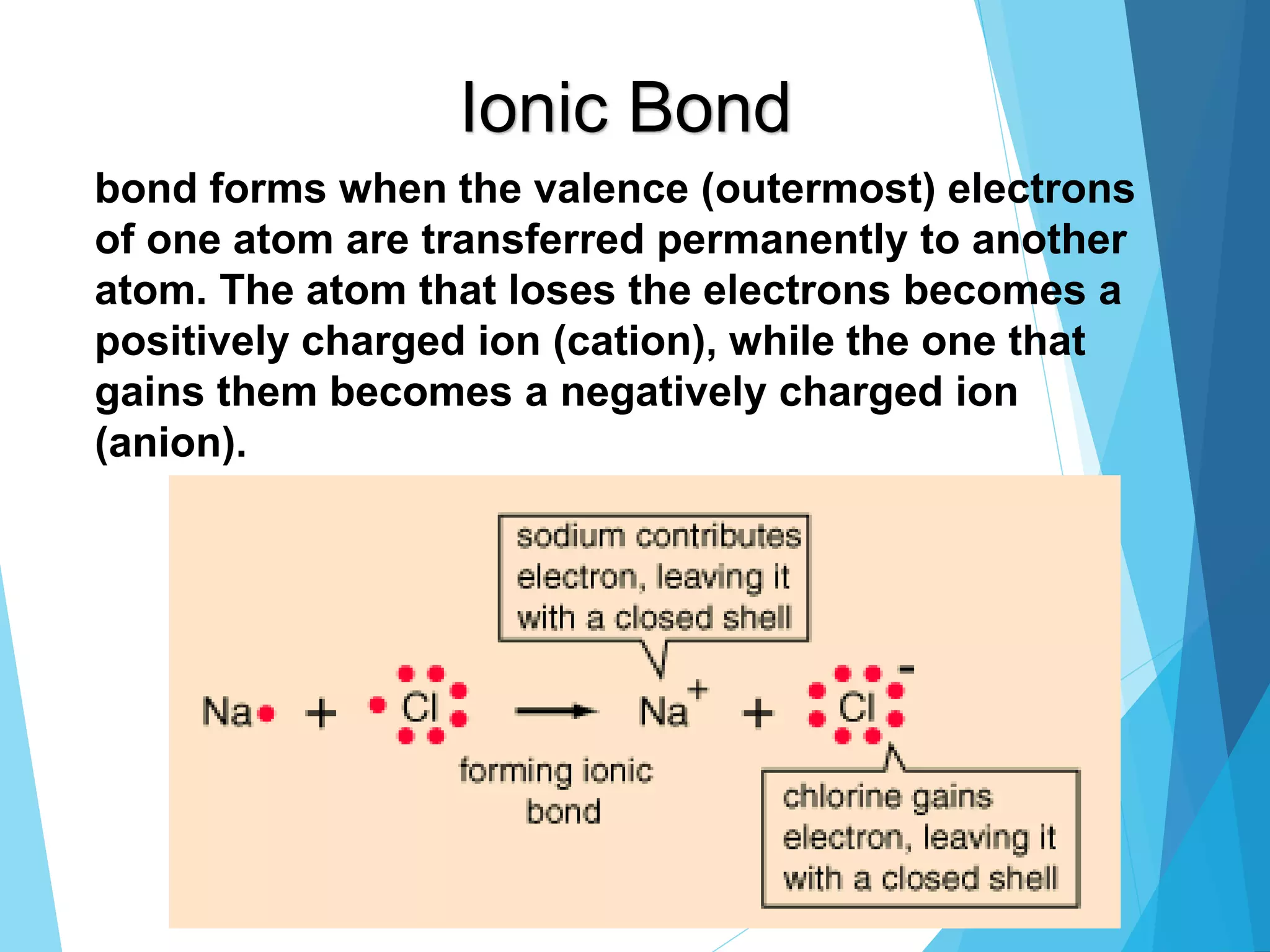
bond forms when the valence (outermost) electrons
of one atom are transferred permanently to another
atom. The atom that loses the electrons becomes a
positively charged ion (cation), while the one that
gains them becomes a negatively charged ion
(anion).
Lewis Dot Symbols
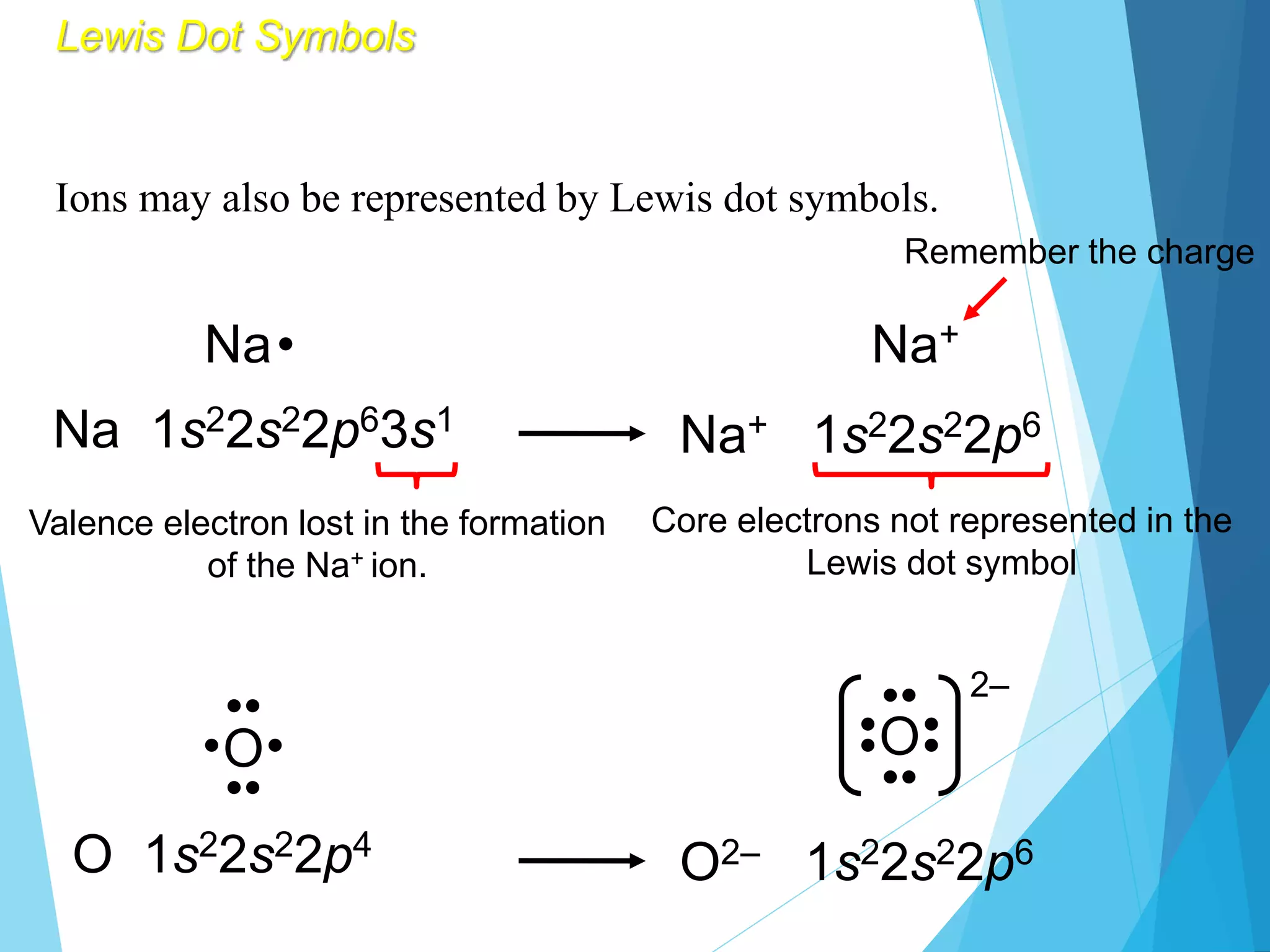
Ions may also be represented by Lewis dot symbols.
Na•
Na 1s22s22p63s1
Na+ 1s22s22p6
Na+
O
••
• •
••
O 1s22s22p4
O2‒ 1s22s22p6
O
••
••
•
•
•
•
2‒
Core electrons not represented in the
Lewis dot symbol
Valence electron lost in the formation
of the Na+ ion.
Remember the charge
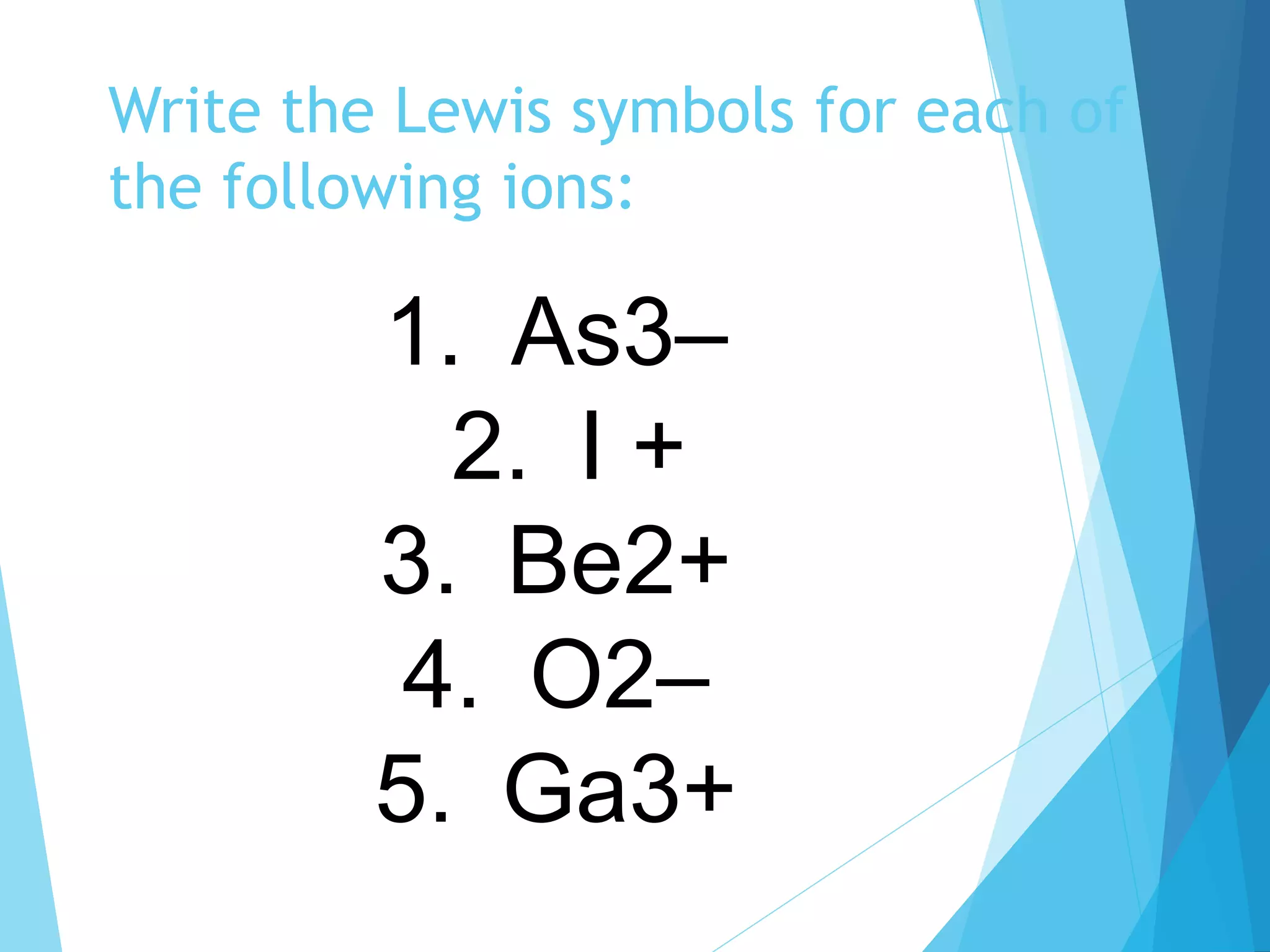
Write the Lewis symbols for each of
the following ions:
1. As3–
2. I +
3. Be2+
4. O2–
5. Ga3+
Illustrate the Lewis dot structure of
the ionic compounds:
1. Magnesium + Oxygen
2. Calcium + Chlorine
3. Potassium + Flourine
4. Sodium + Bromine
5. Magnesium + Sulfur
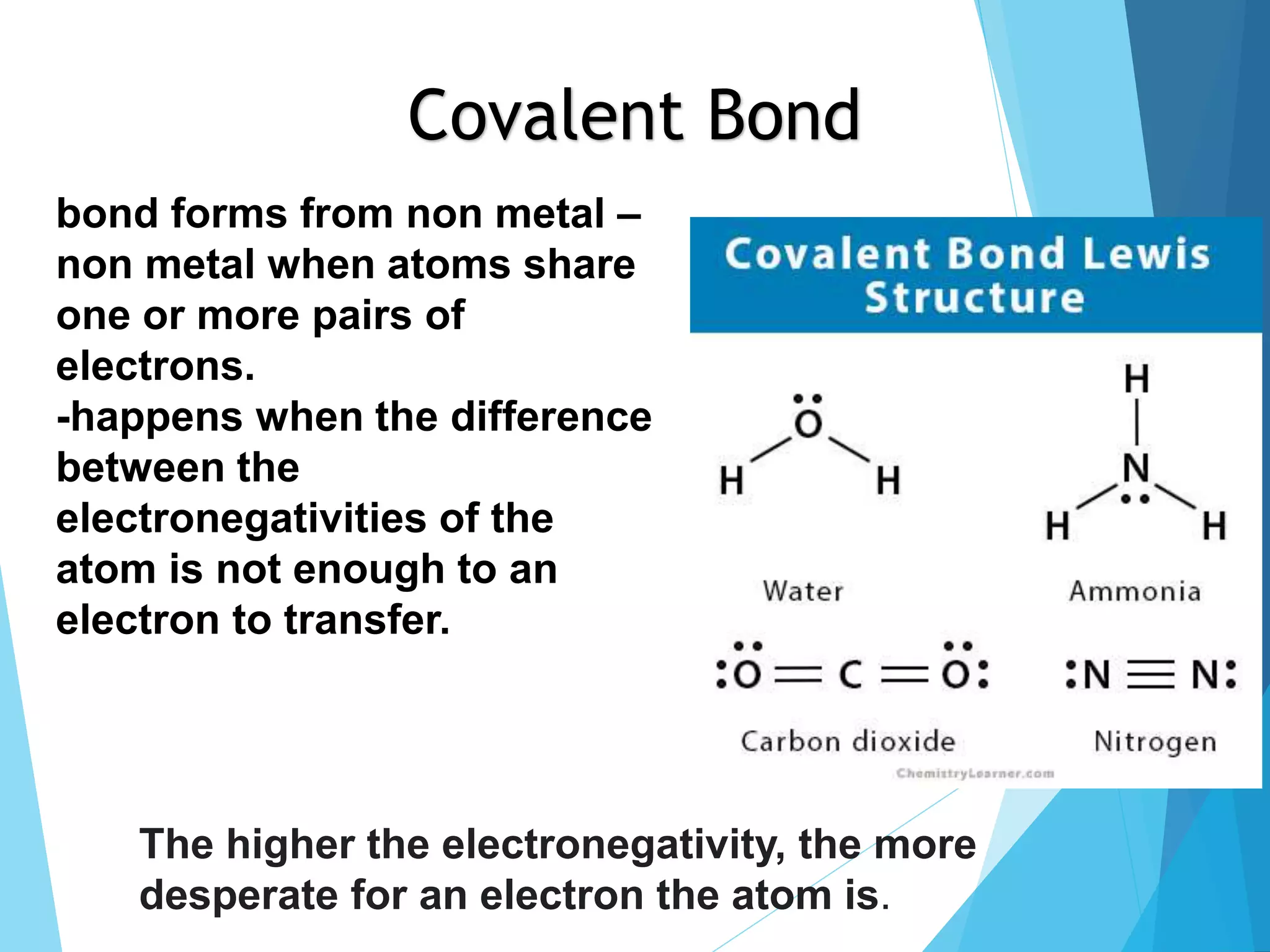
Covalent Bond
bond forms from non metal –
non metal when atoms share
one or more pairs of
electrons.
-happens when the difference
between the
electronegativities of the
atom is not enough to an
electron to transfer.
The higher the electronegativity, the more
desperate for an electron the atom is.
Polar and Nonpolar Covalent Bonds
In the nonpolar covalent bond of H2, electrons are shared
equally. In the polar covalent bond of HCl, electrons are shared
unequally.
Two types of covalent bonds
Nonpolar Covalent Bonds (equal share of
electrons) often occurs in diatomic
molecules such as Cl-Cl, N-N, O-O, F-F
Polar Covalent Bond
• A Polar Covalent Bond is unequal sharing of
electrons between two atoms.
Illustrate the Lewis dot structure of
the covalent compounds:
1. Oxygen + Oxygen
2. Nitrogen- Nitrogen
3. Water (H2O)
4. Carbon dioxide (CO2)
5. Methane (CH4)
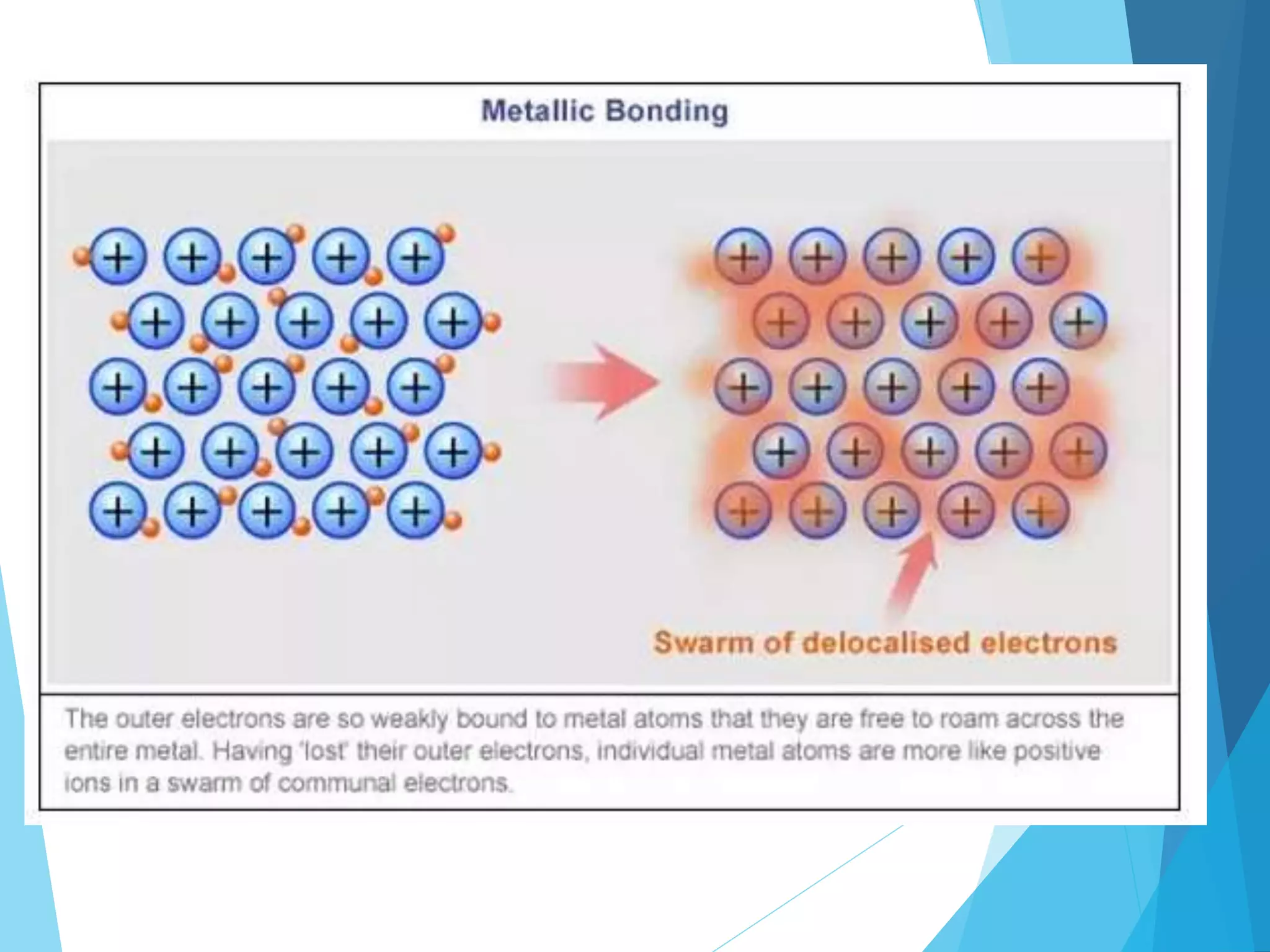
Metallic Bonding
Metallic bonds occur between
metals.
result from the electrostatic
attraction between metal
cations and delocalized
electrons. The nature of
metallic bonding accounts for
many of the physical properties
of metals, such as conductivity
and malleability.
Classification of Bonds
You can determine the type of bond between two
atoms by calculating the difference in
electronegativity values between the elements
The bigger the electronegativity difference the
more polar the bond.
Type of Bond Electronegativity
Difference
Nonpolar Covalent 0  0.4
Polar Covalent 0.5  1.9
Ionic 2.0  4.0
Electronegativity and Types of Bonds
Practice
What type of bond is HCl? (H = 2.1, Cl = 3.1)
Your Turn To Practice
 N(3.0) and H(2.1)
 H(2.1) and H(2.1)
 Ca(1.0) and Cl(3.0)
 Al(1.5) and Cl(3.0)
 Mg(1.2) and O(3.5)
 H(2.1) and F(4.0)
Difference = 3.1 – 2.1 = 1.0
Therefore it is polar covalent bond.

CHEMICAL BONDING.ppt

  • 1.
    Chemistry: Atoms First JuliaBurdge & Jason Overby Copyright (c) The McGraw-Hill Companies, Inc. Permission required for reproduction or display. CHEMICAL BONDING Formation of Ions and the Lewis dot Structure Presenter: LIEZL E. VALIENTE
  • 2.
    1. Explain theformation of ionic and covalent bonds 3. Illustrate lewis dot structure of the representative elements 4. Illustrate the chemical bonding of ionic and covalent bond using their lewis dot structure 2. Explain the formation of ions
  • 3.
  • 4.
    Atoms combine inorder to achieve a more stable electron configuration. Maximum stability results when a chemical species is isoelectronic with a noble gas. Na: 1s22s22p63s1 Na+: 1s22s22p6 10 electrons total, isoelectronic with Ne Cl: 1s22s22p63s23p5 Cl‒: 1s22s22p63s23p6 18 electrons total, isoelectronic with Ar
  • 5.
  • 6.
    Chemical Bonding • refersto the formation of a chemical bond between two or more atoms, molecules, or ions to give rise to a chemical compound. Chemical Bonds -the attractive force that holds atom together.
  • 7.
    The Lewis Theory -namedafter Gilbert Newton Lewis, a pioneer in understanding the relationship between Lewis structure and chemical bonding. 1. Valence electrons play a fundamental role in chemical bonding 2. Chemical bonding that results from the transfer of 1 or more electrons from 1 atom to another leading to the formation of positive and negative ions is called ionic 3. Chemical bonding that involves the sharing of electrons is called covalent (non-polar and polar) 4. Electrons are transferred/ shared to the extent that each atom acquires an especially stable electron configuration. Usually the configuration of a noble gas (8 outer shell electrons)
  • 8.
    When atoms formcompounds, it is their valence electrons that actually interact. A Lewis dot symbol consists of the element’s symbol surround by dots. Each dot represents a valence electron. Boron 1s22s22p1 3 valence electrons B • • • Lewis dot symbol for boron B • • • B • • • B • • • other reasonable Lewis dot symbols for boron Lewis Dot Symbols
  • 9.
    Lewis Dot Symbols Lewisdot symbols of the representative group elements.
  • 10.
    Write the Lewisdot Structure: 1. Cl 2. Na 3. Mg 4. Ca 5. K 6. Br 7. Sr 8. F 9. I 10. O
  • 11.
    Types of ChemicalBonds Metal Non-Metal Ionic Bond
  • 12.
    Ionic Bond bond formswhen the valence (outermost) electrons of one atom are transferred permanently to another atom. The atom that loses the electrons becomes a positively charged ion (cation), while the one that gains them becomes a negatively charged ion (anion).
  • 15.
    Lewis Dot Symbols Ionsmay also be represented by Lewis dot symbols. Na• Na 1s22s22p63s1 Na+ 1s22s22p6 Na+ O •• • • •• O 1s22s22p4 O2‒ 1s22s22p6 O •• •• • • • • 2‒ Core electrons not represented in the Lewis dot symbol Valence electron lost in the formation of the Na+ ion. Remember the charge
  • 16.
    Write the Lewissymbols for each of the following ions: 1. As3– 2. I + 3. Be2+ 4. O2– 5. Ga3+
  • 17.
    Illustrate the Lewisdot structure of the ionic compounds: 1. Magnesium + Oxygen 2. Calcium + Chlorine 3. Potassium + Flourine 4. Sodium + Bromine 5. Magnesium + Sulfur
  • 18.
    Covalent Bond bond formsfrom non metal – non metal when atoms share one or more pairs of electrons. -happens when the difference between the electronegativities of the atom is not enough to an electron to transfer. The higher the electronegativity, the more desperate for an electron the atom is.
  • 19.
    Polar and NonpolarCovalent Bonds In the nonpolar covalent bond of H2, electrons are shared equally. In the polar covalent bond of HCl, electrons are shared unequally.
  • 20.
    Two types ofcovalent bonds Nonpolar Covalent Bonds (equal share of electrons) often occurs in diatomic molecules such as Cl-Cl, N-N, O-O, F-F
  • 21.
    Polar Covalent Bond •A Polar Covalent Bond is unequal sharing of electrons between two atoms.
  • 22.
    Illustrate the Lewisdot structure of the covalent compounds: 1. Oxygen + Oxygen 2. Nitrogen- Nitrogen 3. Water (H2O) 4. Carbon dioxide (CO2) 5. Methane (CH4)
  • 23.
    Metallic Bonding Metallic bondsoccur between metals. result from the electrostatic attraction between metal cations and delocalized electrons. The nature of metallic bonding accounts for many of the physical properties of metals, such as conductivity and malleability.
  • 25.
    Classification of Bonds Youcan determine the type of bond between two atoms by calculating the difference in electronegativity values between the elements The bigger the electronegativity difference the more polar the bond. Type of Bond Electronegativity Difference Nonpolar Covalent 0  0.4 Polar Covalent 0.5  1.9 Ionic 2.0  4.0
  • 26.
  • 27.
    Practice What type ofbond is HCl? (H = 2.1, Cl = 3.1) Your Turn To Practice  N(3.0) and H(2.1)  H(2.1) and H(2.1)  Ca(1.0) and Cl(3.0)  Al(1.5) and Cl(3.0)  Mg(1.2) and O(3.5)  H(2.1) and F(4.0) Difference = 3.1 – 2.1 = 1.0 Therefore it is polar covalent bond.