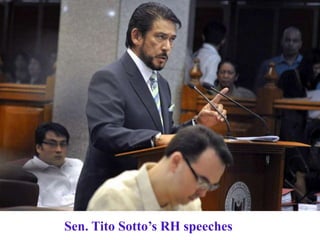

Sen. Tito Sotto’s RH speeches
‘It’s more fun’ in PH and Switzerland
SC Justice Mariano del Castillo’s ruling on
comfort women
MVP’s graduation speech
‘Pilipinas Kay Ganda’ logo
What is plagiarism?
(And why you should care!)
Definition:
Plagiarism is the presenting the words,
ideas, images, sounds, or the
creative expression of others as your
own.
Did You Know?
The word plagiarism comes from the
Latin plagiarius meaning "kidnapper"
How serious is the problem?
“A study of 4,500 students at 25 schools:
72% admitted to serious cheating on
written assignments using the
Internet.”
Based on the research of Donald L. McCabe, Rutgers University
Source: “CIA Research.” Center for Academic Integrity, Duke University, 2003
<http://academicintegrity.org/cai_research.asp>.
Students, If:
• you have included
the words and
ideas of others in
your work that you
neglected to cite,
Two types of plagiarism:
• Intentional
• Copying a friend’s work
• Buying or borrowing
papers
• Cutting and pasting
blocks of text from
electronic sources
without documenting
• Media
“borrowing”without
documentation
• Unintentional
• Careless paraphrasing
• Poor documentation
• Failure to use your own
“voice”
Excuses
It’s okay if
I don’t get caught!
I was too busy to
write that paper!
(Job, big game, too much homework!)
My teachers
expect
too much!
I’ve got to get
into a
certain college.!
My parents
expect “A”s!
This assignment
was BORING!
Everyone does it!
Plagiarism is a serious offense and can lead to
failing grades or suspension from school.
• The consequences are not
worth the risks!
• It is only right to give credit
to authors whose ideas you
use
• Citing makes it possible for
your readers to locate your
source
• Cheating is unethical
behavior
Is your academic
reputation valuable
to you?
Real life consequences:
• Plagiarism at UVA—
45 students dismissed, 3 graduate
degrees revoked
• CNN Article AP. 26 Nov. 2001
• Channel One Article AP. 27 Nov. 2002
Possible school consequences:
• “0” on the assignment
• Failing a class?
• Receiving a lower
grade?
• Parent notification
• Referral to
administrators
• Suspension or
dismissal from school
activities--sports and
extracurricular
How to avoid plagiarism
• Quote and cite phrases, sentences,
and paragraphs taken directly from
the original source.
• Quote and cite statistics, charts,
graphs and drawings taken directly
from the original source.
• When you paraphrase or summarize,
give credit to the original author.
Do I have
to cite
everything?
Question:
Answer: YES!!
Except –
• When you use your own words
• When the fact used is common knowledge.
What makes it “common knowledge”?
If you can find the same information in at least 3
different sources, you don’t have to cite it.
Ex. George Washington
wore wooden dentures.
What’s the big deal?
You can “borrow” from the
works of others in your
own work! Be very
careful.
Use these three strategies,
• Quoting
• Paraphrasing
• Summarizing
To blend source materials in with your own,
making sure your own voice is heard.
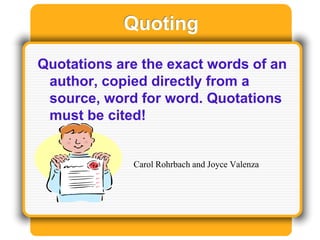
Quoting
Quotations are the exact words of an
author, copied directly from a
source, word for word. Quotations
must be cited!
Carol Rohrbach and Joyce Valenza
Paraphrasing
Paraphrasing means putting someone else’s words or
ideas into your own words.
Although you are using your own words, the ideas are
taken from someone else and must be cited on your
Works-Cited page.
Paraphrasing
• Paraphrasing is not simply
rearranging or rewording an original
passage.
• You have to understand what the
author is saying and write the ideas
entirely in your own words.
Paraphrasing
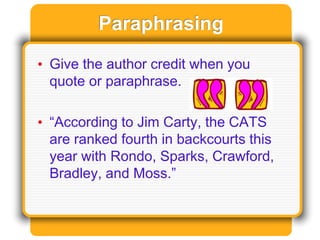
• Give the author credit when you
quote or paraphrase.
• “According to Jim Carty, the CATS
are ranked fourth in backcourts this
year with Rondo, Sparks, Crawford,
Bradley, and Moss.”
As you take notes:
• Include page numbers and source
references so you can go back and
check for accuracy as you write.
DON’T
• Cut and paste from any source
• Use another student’s work as your
own
• Just change a few words from any
source for your paper
• Turn in a paper you wrote for another
class
A Plagiarist is:
• Too careless
• Too lazy
• Too dishonest
• TO DO A GOOD JOB!
• By Cindy Nottage
Research in Different
Areas of Knowledge
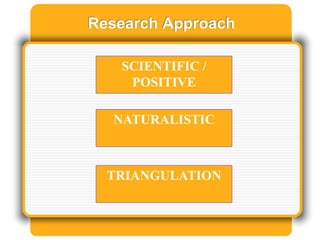
Research Approach
SCIENTIFIC /
POSITIVE
NATURALISTIC
TRIANGULATION
SCIENTIFIC / POSITIVE
 Gives stress to measurable and
observable facts instead of personal
views, feelings or attitudes
 It can be used in researches under the
hard science / STEM
 Allows control of variables or factors
affecting the study (Laursen, 2010)
NATURALISTIC
 People-oriented
 The data collected represent personal
views, attitudes, thoughts, emotions,
and other subjective traits of people in
natural setting.
 Focuses on discovering the real
concept or meaning behind people’s
lifestyles and social relations
 It can be used in researches under the
soft science
TRIANGULATION
 Combination or mixture of scientific and
naturalistic approach
SEATWORK # 4
DIRECTION: Categorize the given research
topic as hard science or soft science.
1. Iron Content of Oregano Plants
2. Aling Bebs: a Filipino centenarian
3. Parents’Views about the K-12 Curriculum
4. Electrical Wirings of a Japanese car
5. Medicinal Elements of Guava Leaves
6. Muslim Wedding Rites
7. Microorganisms in a Canal
SEATWORK # 4
DIRECTION: Categorize the given research
topic as hard science or soft science.
8. St. Joseph’s Grade 8 Teachers’
questioning Techniques
9. Historical Development of Filipino Novels
in English
10. The Nature of Ebola Virus
Works Cited
• “Boston Columnist Resigns Amid New Plagiarism Charges.”
CNN.com 19 Aug. 1998 3 March 2003
<http://www.cnn.com/US/9808/19/barnicle/>
• Fain, Margaret. “Internet Paper Mills.” Kimbal Library. 12 Feb.
2003. <http://www.coastal.edu/library/mills2.htm>
• Lathrop, Ann and Kathleen Foss. Student Cheating and
Plagiarism in the Internet Era. Englewood, CO: Libraries
Unlimited, 2000.
• Lewis, Mark. “Doris Kearns Goodwin And The Credibility Gap.”
Forbes.com 2 Feb. 2002.
<http://www.forbes.com/2002/02/27/0227goodwin.html>
• “New York Times Exposes Fraud of own Reporter.” ABC News
Online. 12 May, 2003.
<http://www.pbs.org/newshour/newshour_index.html>
• Sabato, Larry J. “Joseph Biden's Plagiarism; Michael Dukakis's
'Attack Video' – 1988.” Washington Post Online. 1998. 3 March
2002. <http://www.washingtonpost.com/wp-
srv/politics/special/clinton/frenzy/biden.htm>
Works Cited
• Plagiarism Lesson ppt. retrieved from
https://www.rcs.k12.va.us/cms/lib/VA01818713
• “THE LIST: 5 most talked-about plagiarism scandals in
Philippines”. ABS-CBN News. May 10 2017
• Dacanay, D.E. et.al (2016). Practical research 1: Teacher’s Guide.
“Ethics in Research”. DepEd-BLR. Page 13
• Baraceros, E. L. (2016). Practical research 1. REX Book Store Inc.

Plagiarism lesson

  • 1.
  • 2.
    ‘It’s more fun’in PH and Switzerland
  • 3.
    SC Justice Marianodel Castillo’s ruling on comfort women
  • 4.
  • 5.
  • 6.
    What is plagiarism? (Andwhy you should care!)
  • 7.
    Definition: Plagiarism is thepresenting the words, ideas, images, sounds, or the creative expression of others as your own.
  • 8.
    Did You Know? Theword plagiarism comes from the Latin plagiarius meaning "kidnapper"
  • 9.
    How serious isthe problem? “A study of 4,500 students at 25 schools: 72% admitted to serious cheating on written assignments using the Internet.” Based on the research of Donald L. McCabe, Rutgers University Source: “CIA Research.” Center for Academic Integrity, Duke University, 2003 <http://academicintegrity.org/cai_research.asp>.
  • 10.
    Students, If: • youhave included the words and ideas of others in your work that you neglected to cite,
  • 11.
    Two types ofplagiarism: • Intentional • Copying a friend’s work • Buying or borrowing papers • Cutting and pasting blocks of text from electronic sources without documenting • Media “borrowing”without documentation • Unintentional • Careless paraphrasing • Poor documentation • Failure to use your own “voice”
  • 12.
    Excuses It’s okay if Idon’t get caught! I was too busy to write that paper! (Job, big game, too much homework!) My teachers expect too much! I’ve got to get into a certain college.! My parents expect “A”s! This assignment was BORING! Everyone does it!
  • 13.
    Plagiarism is aserious offense and can lead to failing grades or suspension from school. • The consequences are not worth the risks! • It is only right to give credit to authors whose ideas you use • Citing makes it possible for your readers to locate your source • Cheating is unethical behavior Is your academic reputation valuable to you?
  • 14.
    Real life consequences: •Plagiarism at UVA— 45 students dismissed, 3 graduate degrees revoked • CNN Article AP. 26 Nov. 2001 • Channel One Article AP. 27 Nov. 2002
  • 15.
    Possible school consequences: •“0” on the assignment • Failing a class? • Receiving a lower grade? • Parent notification • Referral to administrators • Suspension or dismissal from school activities--sports and extracurricular
  • 16.
    How to avoidplagiarism • Quote and cite phrases, sentences, and paragraphs taken directly from the original source. • Quote and cite statistics, charts, graphs and drawings taken directly from the original source. • When you paraphrase or summarize, give credit to the original author.
  • 17.
    Do I have tocite everything? Question:
  • 18.
    Answer: YES!! Except – •When you use your own words • When the fact used is common knowledge. What makes it “common knowledge”? If you can find the same information in at least 3 different sources, you don’t have to cite it. Ex. George Washington wore wooden dentures.
  • 19.
  • 20.
    You can “borrow”from the works of others in your own work! Be very careful.
  • 21.
    Use these threestrategies, • Quoting • Paraphrasing • Summarizing To blend source materials in with your own, making sure your own voice is heard.
  • 22.
    Quoting Quotations are theexact words of an author, copied directly from a source, word for word. Quotations must be cited! Carol Rohrbach and Joyce Valenza
  • 23.
    Paraphrasing Paraphrasing means puttingsomeone else’s words or ideas into your own words. Although you are using your own words, the ideas are taken from someone else and must be cited on your Works-Cited page.
  • 24.
    Paraphrasing • Paraphrasing isnot simply rearranging or rewording an original passage. • You have to understand what the author is saying and write the ideas entirely in your own words.
  • 25.
    Paraphrasing • Give theauthor credit when you quote or paraphrase. • “According to Jim Carty, the CATS are ranked fourth in backcourts this year with Rondo, Sparks, Crawford, Bradley, and Moss.”
  • 26.
    As you takenotes: • Include page numbers and source references so you can go back and check for accuracy as you write.
  • 27.
    DON’T • Cut andpaste from any source • Use another student’s work as your own • Just change a few words from any source for your paper • Turn in a paper you wrote for another class
  • 28.
    A Plagiarist is: •Too careless • Too lazy • Too dishonest • TO DO A GOOD JOB! • By Cindy Nottage
  • 29.
  • 31.
  • 32.
    SCIENTIFIC / POSITIVE Gives stress to measurable and observable facts instead of personal views, feelings or attitudes  It can be used in researches under the hard science / STEM  Allows control of variables or factors affecting the study (Laursen, 2010)
  • 33.
    NATURALISTIC  People-oriented  Thedata collected represent personal views, attitudes, thoughts, emotions, and other subjective traits of people in natural setting.  Focuses on discovering the real concept or meaning behind people’s lifestyles and social relations  It can be used in researches under the soft science
  • 34.
    TRIANGULATION  Combination ormixture of scientific and naturalistic approach
  • 35.
    SEATWORK # 4 DIRECTION:Categorize the given research topic as hard science or soft science. 1. Iron Content of Oregano Plants 2. Aling Bebs: a Filipino centenarian 3. Parents’Views about the K-12 Curriculum 4. Electrical Wirings of a Japanese car 5. Medicinal Elements of Guava Leaves 6. Muslim Wedding Rites 7. Microorganisms in a Canal
  • 36.
    SEATWORK # 4 DIRECTION:Categorize the given research topic as hard science or soft science. 8. St. Joseph’s Grade 8 Teachers’ questioning Techniques 9. Historical Development of Filipino Novels in English 10. The Nature of Ebola Virus
  • 37.
    Works Cited • “BostonColumnist Resigns Amid New Plagiarism Charges.” CNN.com 19 Aug. 1998 3 March 2003 <http://www.cnn.com/US/9808/19/barnicle/> • Fain, Margaret. “Internet Paper Mills.” Kimbal Library. 12 Feb. 2003. <http://www.coastal.edu/library/mills2.htm> • Lathrop, Ann and Kathleen Foss. Student Cheating and Plagiarism in the Internet Era. Englewood, CO: Libraries Unlimited, 2000. • Lewis, Mark. “Doris Kearns Goodwin And The Credibility Gap.” Forbes.com 2 Feb. 2002. <http://www.forbes.com/2002/02/27/0227goodwin.html> • “New York Times Exposes Fraud of own Reporter.” ABC News Online. 12 May, 2003. <http://www.pbs.org/newshour/newshour_index.html> • Sabato, Larry J. “Joseph Biden's Plagiarism; Michael Dukakis's 'Attack Video' – 1988.” Washington Post Online. 1998. 3 March 2002. <http://www.washingtonpost.com/wp- srv/politics/special/clinton/frenzy/biden.htm>
  • 38.
    Works Cited • PlagiarismLesson ppt. retrieved from https://www.rcs.k12.va.us/cms/lib/VA01818713 • “THE LIST: 5 most talked-about plagiarism scandals in Philippines”. ABS-CBN News. May 10 2017 • Dacanay, D.E. et.al (2016). Practical research 1: Teacher’s Guide. “Ethics in Research”. DepEd-BLR. Page 13 • Baraceros, E. L. (2016). Practical research 1. REX Book Store Inc.

Editor's Notes

  • #3 2012
  • #4 n what is dubbed as a first in the Supreme Court, a decision penned by Associate Justice Mariano del Castillo on World War II comfort women showed that numerous parts were copied from materials written by legal experts abroad without proper attribution. An impeachment complaint was then filed against him over the incident.
  • #5 Manny V. Pangilinan = The telco executive immediately issued an apology and offered to retire from his duties in Ateneo, but the university’s board of trustees rejected it. The businessman then tendered his “irrevocable” resignation and relinquished the honorary degree conferred on him….He take full responsibility and not disclose the name of his writer
  • #6 DOT Undersecretary Vicente “Enteng” Romano III 2010 = The “Pilipinas Kay Ganda” campaign was scrapped and eventually replaced by the “It’s more fun in the Philippines” slogan, which became an Internet hit.
  • #33 Structured interviews and questionnaire MEDICINE – factual data from experimentation are recorded in numerical or statistical forms using number, percetages, fractions and the like (quantitative data)
  • #34 Data through verbal language SOFT SCIENCE – anthropology, business, educaiton, economics, law, politics, and subject aligned with business and all those focused on helping professions: nurcing, counselingm physical therapy