Chapter 7

Multicellular Primary Producers
Seaweeds
Seaweeds!!!
Come in all kinds of interesting
Shapes and sizes!
• some are delicious!
• some are poisonous
• Some have weird names
• Come in all sorts of colors
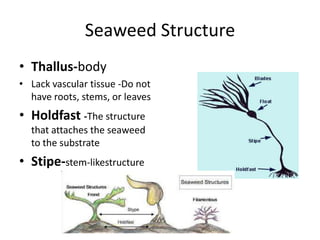
Seaweed Structure
• Thallus-body
• Lack vascular tissue -Do not
  have roots, stems, or leaves
• Holdfast -The structure
  that attaches the seaweed
  to the substrate
• Stipe-stem-likestructure
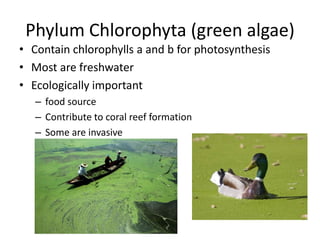
Phylum Chlorophyta (green algae)
• Contain chlorophylls a and b for photosynthesis
• Most are freshwater
• Ecologically important
   – food source
   – Contribute to coral reef formation
   – Some are invasive
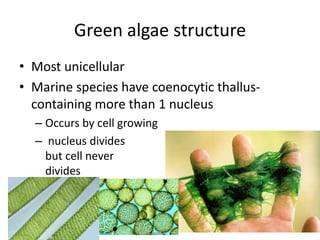
Green algae structure
• Most unicellular
• Marine species have coenocytic thallus-
  containing more than 1 nucleus
  – Occurs by cell growing
  – nucleus divides
    but cell never
    divides
Reproduction of Algae
• Sexual
• Gametes released from gametophyte 2 flagella
• spores released from sporophyte- 4 flagella
Representative species
• Halimeda
• Caluerpa-invasive
CFU: Green Algae
• Are green algae unicellular or multicellular
• Autotrophic or heterotrophic
• What is an important organelle in
  photosynthesis
• How does green algae grow in length?
  – Same cell, division of nucleus
• What is the function of the Stipe?
Red Algae
Phylum Rhodophyta (red algae)
• Primarily marine
• Most diverse among seaweeds
• Cholorphylls a and d, pigments:
  phycoerythrins and phycocyanins
• Not always red in color- can appear yellow to
  black
Structure
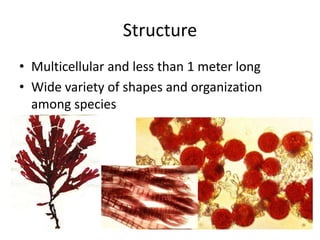
• Multicellular and less than 1 meter long
• Wide variety of shapes and organization
  among species
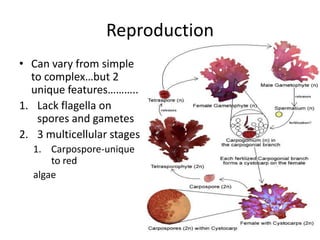
Reproduction
• Can vary from simple
  to complex…but 2
  unique features………..
1. Lack flagella on
   spores and gametes
2. 3 multicellular stages
  1. Carpospore-unique
      to red
  algae
Ecological Roles
• Porphhra- used as food in oriental dishes
• Seasonal food source for
  urchins, mollusks, fish, and crustaceans
• Some grow on other plants or animals
• Help form base of coral reef
• Agar- used as a thickening agent in foods such
  as ice cream, pudding, and salad dressings
• Used in cosmetics for creamy foundations
CFU: Red Algae
•   Heterotrophic or Autotrophic?
•   Multicellular or unicellular
•   What are the two unique stages?
•   What organisms feed on red algae?
Brown Algae
Phaeophyta (brown algae)
• Mostly marine
• Higher diversity than green but less diverse
  than red
• Size: from microscopic to kelps (100 meters)
• Chlorophylls a and c and pigment fucoxanthin
• Mostly in high latitudes
• Large flat leaf-like blades with bladders help
  bouy plant toward light
• Representative species Sargassum, Fucus
reproduction
• Gametophyte is
  eliminated from
  life cycle (difference
  from Chlorophyta and
  Rhodophyta)

• Egg develops
  root-like
  structures
  (rhizoids) after
  fertilization
Ecological role
• Habitats for a variety of marine life
• Harvested for thickening agents used in
  dentistry, cosmetic, and food industries
• Previously iodine was extracted and put into
  table salt (iodized salt) to prevent a goiter
• Excessive nutrients
   – Runoff from fertilizer      Human Impacts
• Causes huge algae
  blooms!
   – When algae dies off
     decomposers consume
     majority of the oxygen in
     the environment
   – Eutrophication
• Kills off fish and marine
  life
CFU: Algae
• What macromolecule allows algae to live in
  marine environments without swelling?
• What causes algae blooms?
• What is this process called?
• What are the harmful effects of algae blooms?
Sea grasses, salt marsh plants,
         mangroves
Salt Marsh Plants and Sea Grasses
• Salt marshes are in Estuaries
  – The kidneys of the coasts
• Nursery for small fish
  – 75% of commercial fish are hatched in estuaries
• Estuaries are severly affected by humans
  – Coastal development
  – Pollution
  – Eutrophication
• Protect us from storms
Phylum Anthophyta
• Seagrasses, salt marsh plants, mangroves
• Ecological Roles- Primary
  producers, habitats, stabilizing sediments
• Help slow down erosion
• Have to deal with extreme changes in salinty
  and oxygen
  Mixing of salt and fresh water
  Eutrophication
Sea grasses (marine flowering plants)
• Related to lilies
• Reproduce by pollination of seed; Male and female flowers on
  separate plants contain pollen
• Literally look like grass
• Food for manatees and sea turtles
• Can live up to 100 meters below sea level
Sea Grasses in Florida
• 12 genra
  – Genra native to Florida
     • Syringodium -
       manateegrass
     • Halophila-paddlegrass
     • Thalassia- turtlegrass
     • Ruppia-
     • Halodule- shoalgrass
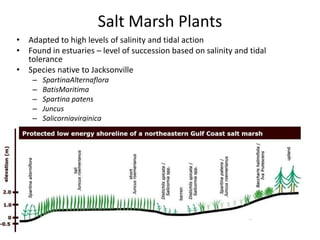
Salt Marsh Plants
• Adapted to high levels of salinity and tidal action
• Found in estuaries – level of succession based on salinity and tidal
  tolerance
• Species native to Jacksonville
    –   SpartinaAlternaflora
    –   BatisMaritima
    –   Spartina patens
    –   Juncus
    –   Salicorniavirginica
Mangroves
• Found in south of St. Augustine to Key West
• 3 genra local to Florida
  – Rhizophora mangle –red mangle-----prop roots
  – Avicennia germinans – black mangle---
    pneumatophores
  – Laguncularia racemosa- white mangle
• Distinctive by their root system and pods
Mangroves: Highly adaptive
• Use active transport to
  regulate water levels in
  their roots
• Live in anaerobic mud
   – Why they stand above
     the water
• Protect coral reefs from
  eutrophication
   – Filter, kidney
Help Protect Coastal Development
                       2004 Indian Ocean
                       Tsunami
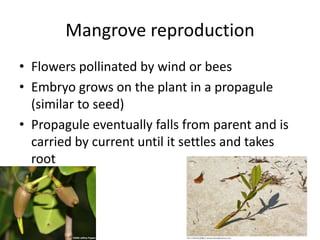
Mangrove reproduction
• Flowers pollinated by wind or bees
• Embryo grows on the plant in a propagule
  (similar to seed)
• Propagule eventually falls from parent and is
  carried by current until it settles and takes
  root
Red Mangrove


Black Mangrove


Red,     White, and Black mangrove        White Mangrove
leaves

Chapter 7 multicellular plants

  • 1.
  • 2.
    Seaweeds Seaweeds!!! Come in allkinds of interesting Shapes and sizes! • some are delicious! • some are poisonous • Some have weird names • Come in all sorts of colors
  • 3.
    Seaweed Structure • Thallus-body •Lack vascular tissue -Do not have roots, stems, or leaves • Holdfast -The structure that attaches the seaweed to the substrate • Stipe-stem-likestructure
  • 4.
    Phylum Chlorophyta (greenalgae) • Contain chlorophylls a and b for photosynthesis • Most are freshwater • Ecologically important – food source – Contribute to coral reef formation – Some are invasive
  • 5.
    Green algae structure •Most unicellular • Marine species have coenocytic thallus- containing more than 1 nucleus – Occurs by cell growing – nucleus divides but cell never divides
  • 6.
    Reproduction of Algae •Sexual • Gametes released from gametophyte 2 flagella • spores released from sporophyte- 4 flagella
  • 7.
  • 8.
    CFU: Green Algae •Are green algae unicellular or multicellular • Autotrophic or heterotrophic • What is an important organelle in photosynthesis • How does green algae grow in length? – Same cell, division of nucleus • What is the function of the Stipe?
  • 9.
  • 10.
    Phylum Rhodophyta (redalgae) • Primarily marine • Most diverse among seaweeds • Cholorphylls a and d, pigments: phycoerythrins and phycocyanins • Not always red in color- can appear yellow to black
  • 11.
    Structure • Multicellular andless than 1 meter long • Wide variety of shapes and organization among species
  • 12.
    Reproduction • Can varyfrom simple to complex…but 2 unique features……….. 1. Lack flagella on spores and gametes 2. 3 multicellular stages 1. Carpospore-unique to red algae
  • 13.
    Ecological Roles • Porphhra-used as food in oriental dishes • Seasonal food source for urchins, mollusks, fish, and crustaceans • Some grow on other plants or animals • Help form base of coral reef • Agar- used as a thickening agent in foods such as ice cream, pudding, and salad dressings • Used in cosmetics for creamy foundations
  • 14.
    CFU: Red Algae • Heterotrophic or Autotrophic? • Multicellular or unicellular • What are the two unique stages? • What organisms feed on red algae?
  • 15.
  • 16.
    Phaeophyta (brown algae) •Mostly marine • Higher diversity than green but less diverse than red • Size: from microscopic to kelps (100 meters) • Chlorophylls a and c and pigment fucoxanthin • Mostly in high latitudes • Large flat leaf-like blades with bladders help bouy plant toward light • Representative species Sargassum, Fucus
  • 17.
    reproduction • Gametophyte is eliminated from life cycle (difference from Chlorophyta and Rhodophyta) • Egg develops root-like structures (rhizoids) after fertilization
  • 18.
    Ecological role • Habitatsfor a variety of marine life • Harvested for thickening agents used in dentistry, cosmetic, and food industries • Previously iodine was extracted and put into table salt (iodized salt) to prevent a goiter
  • 19.
    • Excessive nutrients – Runoff from fertilizer Human Impacts • Causes huge algae blooms! – When algae dies off decomposers consume majority of the oxygen in the environment – Eutrophication • Kills off fish and marine life
  • 20.
    CFU: Algae • Whatmacromolecule allows algae to live in marine environments without swelling? • What causes algae blooms? • What is this process called? • What are the harmful effects of algae blooms?
  • 21.
    Sea grasses, saltmarsh plants, mangroves
  • 22.
    Salt Marsh Plantsand Sea Grasses • Salt marshes are in Estuaries – The kidneys of the coasts • Nursery for small fish – 75% of commercial fish are hatched in estuaries • Estuaries are severly affected by humans – Coastal development – Pollution – Eutrophication • Protect us from storms
  • 23.
    Phylum Anthophyta • Seagrasses,salt marsh plants, mangroves • Ecological Roles- Primary producers, habitats, stabilizing sediments • Help slow down erosion • Have to deal with extreme changes in salinty and oxygen Mixing of salt and fresh water Eutrophication
  • 24.
    Sea grasses (marineflowering plants) • Related to lilies • Reproduce by pollination of seed; Male and female flowers on separate plants contain pollen • Literally look like grass • Food for manatees and sea turtles • Can live up to 100 meters below sea level
  • 25.
    Sea Grasses inFlorida • 12 genra – Genra native to Florida • Syringodium - manateegrass • Halophila-paddlegrass • Thalassia- turtlegrass • Ruppia- • Halodule- shoalgrass
  • 26.
    Salt Marsh Plants •Adapted to high levels of salinity and tidal action • Found in estuaries – level of succession based on salinity and tidal tolerance • Species native to Jacksonville – SpartinaAlternaflora – BatisMaritima – Spartina patens – Juncus – Salicorniavirginica
  • 27.
    Mangroves • Found insouth of St. Augustine to Key West • 3 genra local to Florida – Rhizophora mangle –red mangle-----prop roots – Avicennia germinans – black mangle--- pneumatophores – Laguncularia racemosa- white mangle • Distinctive by their root system and pods
  • 28.
    Mangroves: Highly adaptive •Use active transport to regulate water levels in their roots • Live in anaerobic mud – Why they stand above the water • Protect coral reefs from eutrophication – Filter, kidney
  • 29.
    Help Protect CoastalDevelopment 2004 Indian Ocean Tsunami
  • 30.
    Mangrove reproduction • Flowerspollinated by wind or bees • Embryo grows on the plant in a propagule (similar to seed) • Propagule eventually falls from parent and is carried by current until it settles and takes root
  • 31.
    Red Mangrove Black Mangrove Red, White, and Black mangrove White Mangrove leaves