January 6 th  2011 Mrs. Harris
Brief overview/review of seaweeds and algae Other marine plants Mangrove species & ecology
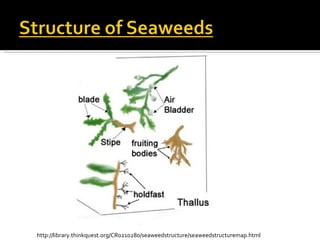
Leaves called blades Stem-like structure called stipe Root shaped bundle at bottom called holdfast – only for anchor, no absorption Gas bladders – bubble like structures that help w/ buoyancy – tiny, grape-like bunches to volleyball-sized floats Whole body called thallus
http://library.thinkquest.org/CR0210280/seaweedstructure/seaweedstructuremap.html
Rhodophyta… red algae Phaeophyta… brown algae Chlorophyta… green algae
Red algae  make up the majority of the world’s seaweeds Cold, deep seas – accessory pigments allow them to be in lower light Like tropical and subtropical regions better Grow slowly – live a long time – tens to hundreds of years Some at surface – dark accessory pigments block some intensity of sun  Ex:  Red Weed http://www.dnrec.state.de.us/MacroAlgae/information/Indentifying.shtml
Protist kingdom produce carrageenen have a pigment, phycoerythrin, that gives most of them a reddish color range in color from dark black (deepest ocean)  to bright red (moderate depths) or green (shallow waters) important member of the coral reef ecosystem Image comes from the UC Berkeley Museum of Paleontology pages
Brown algae - grow the largest of all the algae &  are all multicellular Almost all of 1500 species are marine Like cooler, offshore waters Includes kelps – 40 m average – can grow 50 cm a day! – can be deeper (grow fast to get to light) – ideal depth is ~35m Some annuals, some live up to 7 years  http://taggart.glg.msu.edu/bot335/seaweed.htm
Protist kingdom Giant kelp forests in Pacific Ocean – mainly consist of  Macrocystis Ex.  Sargassum  – grows off SC coast – principal seaweed in Sargasso Sea (off SE coast of US) is found floating on top of water http://images.google.com/images?q=sargassum&svnum=10&hl=en&safe=active&rls=SUNA%2CSUNA%3A2006-07%2CSUNA%3Aen
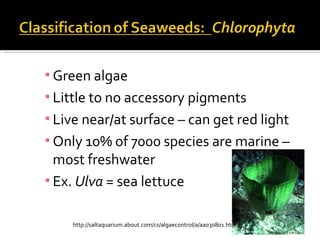
Green algae Little to no accessory pigments Live near/at surface – can get red light Only 10% of 7000 species are marine – most freshwater Ex.  Ulva  = sea lettuce  http://saltaquarium.about.com/cs/algaecontrol/a/aa030801.htm
Plant Kingdom Contain Chlorophyll http://www.hawaii.edu/reefalgae/invasive_algae/chloro/caulerpa_tax_web.JPG
 
Flowering Plants—Plant Kingdom Vascular plants that use flowers and seeds to reproduce – most are land plants Few live in water – those that do, live in shallow, coastal waters  (less than thirty species exist in marine ecosystems) Three types are found in marshes, swamps, bays and oceans.  seagrasses, marsh grasses, and mangrove trees.
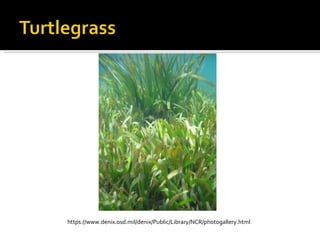
Not true grasses – have leaves, stems and roots to get nutrients – form submerged “meadows” - ~45 species Coasts of N. America, Atlantic coast of Europe, Eastern Asia, temperate Australia, and S. America Support heterotrophs – usually eat it as decaying Emit pollen but in strings that float in water most common = eelgrass ( Zostera ) – also common are turtle grass and manatee grass – named after animals that live and eat there – 90% eelgrass lost in epidemic in 1930-31 – still recovering Phyllospadix  – has flowers and fruit  Very productive   http://www.racerocks.com/racerock/eco/taxalab/phyllospadix.htm
https://www.denix.osd.mil/denix/Public/Library/NCR/photogallery.html
Tangled masses of trees – large flowering plants Never completely submerged but considered marine plants – live in lagoons, bays and estuaries of Indo-Pacific, tropical Africa and tropical Americas Avoid taking up salt or have salt-excreting cells – some excreted through leaves – drop in ocean Require prop roots b/c mud is so soft Roots can get O 2  from air - roots are safe place for many organisms to live – also increase stability of coastal wetlands Seeds germinate on trees – hope to drop while tide is out – force of fall penetrates soil/mud and plant will grow there If tide is in, seed will be carried elsewhere by water and grow there - can colonize mud/sandbars and create new land there
 
Algin (harvested from mucus like covering) used in fabric stiffeners; adhesives; holding oil and water together in salad dressings; clarifying beer and wine; making shoe stains, soaps and shaving creams; and preventing formation of crystals in ice cream Fast food restaurants use carrageenan to replace fat in hamburgers Grow bacteria on agar in labs Keep milk and car waxes homogenized Used in ink
3.3.2 Research three marine plants.  Describe the type of plant, give an example, and include any other information you think is important for a marine biologist to know.  3.3.3 a  Complete part 3 only…write a letter about the importance of mangrove trees

Marine Plants

  • 1.
    January 6 th 2011 Mrs. Harris
  • 2.
    Brief overview/review ofseaweeds and algae Other marine plants Mangrove species & ecology
  • 3.
    Leaves called bladesStem-like structure called stipe Root shaped bundle at bottom called holdfast – only for anchor, no absorption Gas bladders – bubble like structures that help w/ buoyancy – tiny, grape-like bunches to volleyball-sized floats Whole body called thallus
  • 4.
  • 5.
    Rhodophyta… red algaePhaeophyta… brown algae Chlorophyta… green algae
  • 6.
    Red algae make up the majority of the world’s seaweeds Cold, deep seas – accessory pigments allow them to be in lower light Like tropical and subtropical regions better Grow slowly – live a long time – tens to hundreds of years Some at surface – dark accessory pigments block some intensity of sun Ex: Red Weed http://www.dnrec.state.de.us/MacroAlgae/information/Indentifying.shtml
  • 7.
    Protist kingdom producecarrageenen have a pigment, phycoerythrin, that gives most of them a reddish color range in color from dark black (deepest ocean) to bright red (moderate depths) or green (shallow waters) important member of the coral reef ecosystem Image comes from the UC Berkeley Museum of Paleontology pages
  • 8.
    Brown algae -grow the largest of all the algae & are all multicellular Almost all of 1500 species are marine Like cooler, offshore waters Includes kelps – 40 m average – can grow 50 cm a day! – can be deeper (grow fast to get to light) – ideal depth is ~35m Some annuals, some live up to 7 years http://taggart.glg.msu.edu/bot335/seaweed.htm
  • 9.
    Protist kingdom Giantkelp forests in Pacific Ocean – mainly consist of Macrocystis Ex. Sargassum – grows off SC coast – principal seaweed in Sargasso Sea (off SE coast of US) is found floating on top of water http://images.google.com/images?q=sargassum&svnum=10&hl=en&safe=active&rls=SUNA%2CSUNA%3A2006-07%2CSUNA%3Aen
  • 10.
    Green algae Littleto no accessory pigments Live near/at surface – can get red light Only 10% of 7000 species are marine – most freshwater Ex. Ulva = sea lettuce http://saltaquarium.about.com/cs/algaecontrol/a/aa030801.htm
  • 11.
    Plant Kingdom ContainChlorophyll http://www.hawaii.edu/reefalgae/invasive_algae/chloro/caulerpa_tax_web.JPG
  • 12.
  • 13.
    Flowering Plants—Plant KingdomVascular plants that use flowers and seeds to reproduce – most are land plants Few live in water – those that do, live in shallow, coastal waters (less than thirty species exist in marine ecosystems) Three types are found in marshes, swamps, bays and oceans. seagrasses, marsh grasses, and mangrove trees.
  • 14.
    Not true grasses– have leaves, stems and roots to get nutrients – form submerged “meadows” - ~45 species Coasts of N. America, Atlantic coast of Europe, Eastern Asia, temperate Australia, and S. America Support heterotrophs – usually eat it as decaying Emit pollen but in strings that float in water most common = eelgrass ( Zostera ) – also common are turtle grass and manatee grass – named after animals that live and eat there – 90% eelgrass lost in epidemic in 1930-31 – still recovering Phyllospadix – has flowers and fruit Very productive http://www.racerocks.com/racerock/eco/taxalab/phyllospadix.htm
  • 15.
  • 16.
    Tangled masses oftrees – large flowering plants Never completely submerged but considered marine plants – live in lagoons, bays and estuaries of Indo-Pacific, tropical Africa and tropical Americas Avoid taking up salt or have salt-excreting cells – some excreted through leaves – drop in ocean Require prop roots b/c mud is so soft Roots can get O 2 from air - roots are safe place for many organisms to live – also increase stability of coastal wetlands Seeds germinate on trees – hope to drop while tide is out – force of fall penetrates soil/mud and plant will grow there If tide is in, seed will be carried elsewhere by water and grow there - can colonize mud/sandbars and create new land there
  • 17.
  • 18.
    Algin (harvested frommucus like covering) used in fabric stiffeners; adhesives; holding oil and water together in salad dressings; clarifying beer and wine; making shoe stains, soaps and shaving creams; and preventing formation of crystals in ice cream Fast food restaurants use carrageenan to replace fat in hamburgers Grow bacteria on agar in labs Keep milk and car waxes homogenized Used in ink
  • 19.
    3.3.2 Research threemarine plants. Describe the type of plant, give an example, and include any other information you think is important for a marine biologist to know. 3.3.3 a Complete part 3 only…write a letter about the importance of mangrove trees