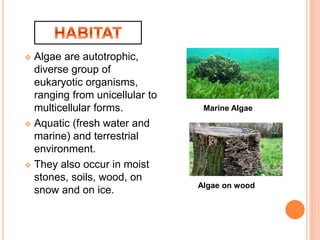
 Algae are autotrophic,
diverse group of
eukaryotic organisms,
ranging from unicellular to
multicellular forms.
 Aquatic (fresh water and
marine) and terrestrial
environment.
 They also occur in moist
stones, soils, wood, on
snow and on ice.
Marine Algae
Algae on wood
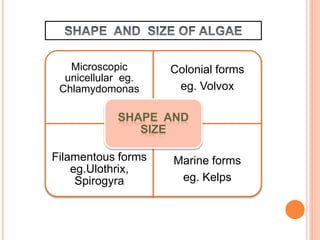
Microscopic
unicellular eg.
Chlamydomonas
Colonial forms
eg. Volvox
Filamentous forms
eg.Ulothrix,
Spirogyra
Marine forms
eg. Kelps
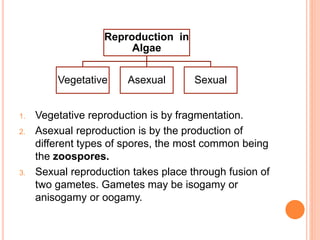
1. Vegetative reproduction is by fragmentation.
2. Asexual reproduction is by the production of
different types of spores, the most common being
the zoospores.
3. Sexual reproduction takes place through fusion of
two gametes. Gametes may be isogamy or
anisogamy or oogamy.
Reproduction in
Algae
Vegetative Asexual Sexual
I. Isogamy - Fusion of two morphologically
identical gametes. e.g. Spirogyra
II. Anisogamy - Fusion of two dissimilar
gametes, i.e., one gamete is smaller than
the other. e.g. some species of
Chlamydomonas
III. Oogamy - Fusion between one large, non-
motile female gamete and a smaller, motile
male gamete. e.g. Volvox, Fucus
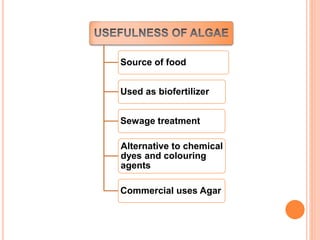
Source of food
Used as biofertilizer
Sewage treatment
Alternative to chemical
dyes and colouring
agents
Commercial uses Agar
1. At least a half of the total carbon dioxide fixation on
earth is carried out by algae through photosynthesis.
2. Major component in aquatic food chain as primary
producers.
3. Porphyra, Laminaria and Sargassum are used as food.
4. Algin (brown algae) and carrageen (red algae) are
used as hydrocolloids, which is a fibrous structure
holds water and used to transport seedling.
5. Agar is used as commercial products.
6. Gelidium, Graularia are used to grow microbes, make
ice creams and jellies.
7. Chlorella and Spirullina are rich in proteins and used
as food supplements.
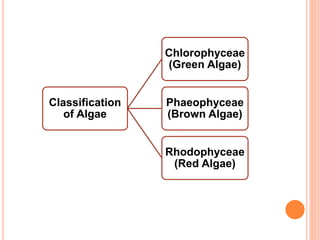
Classification
of Algae
Chlorophyceae
(Green Algae)
Phaeophyceae
(Brown Algae)
Rhodophyceae
(Red Algae)
 Unicellular / colonial / filamentous
 Pigments - chlorophyll a and b
 chloroplasts may be discoid, plate-like,
reticulate, cup-shaped, spiral or ribbon-
shaped
 Store bodies – pyrenoids, oil droplets
 Rigid cell wall made of an inner layer of
cellulose and an outer layer of pectose
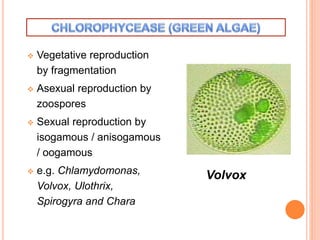
 Vegetative reproduction
by fragmentation
 Asexual reproduction by
zoospores
 Sexual reproduction by
isogamous / anisogamous
/ oogamous
 e.g. Chlamydomonas,
Volvox, Ulothrix,
Spirogyra and Chara
Volvox
 Marine habitats
 Vary in shape and size from simple branched,
filamentous forms (Ectocarpus) to profusely branched
forms kelps about 100 m height.
 Body consists of holdfast, a stalk, stipe and frond.
 Pigments - chlorophyll a, c, carotenoids, xanthophylls,
fucoxanthin
 Food is stored as carbohydrates in the form of
laminarin or mannitol.
 Cell wall covered by algin, a gelatinous coating.
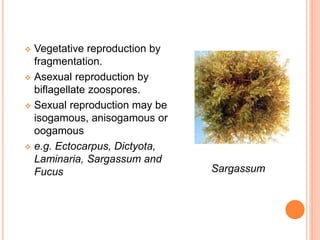
 Vegetative reproduction by
fragmentation.
 Asexual reproduction by
biflagellate zoospores.
 Sexual reproduction may be
isogamous, anisogamous or
oogamous
 e.g. Ectocarpus, Dictyota,
Laminaria, Sargassum and
Fucus Sargassum
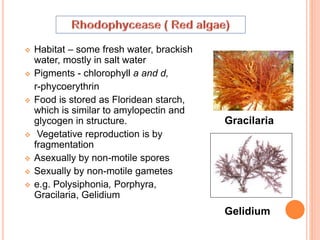
 Habitat – some fresh water, brackish
water, mostly in salt water
 Pigments - chlorophyll a and d,
r-phycoerythrin
 Food is stored as Floridean starch,
which is similar to amylopectin and
glycogen in structure.
 Vegetative reproduction is by
fragmentation
 Asexually by non-motile spores
 Sexually by non-motile gametes
 e.g. Polysiphonia, Porphyra,
Gracilaria, Gelidium
Gracilaria
Gelidium

ALGAE (PLANT KINGDOM)

  • 2.
     Algae areautotrophic, diverse group of eukaryotic organisms, ranging from unicellular to multicellular forms.  Aquatic (fresh water and marine) and terrestrial environment.  They also occur in moist stones, soils, wood, on snow and on ice. Marine Algae Algae on wood
  • 3.
    Microscopic unicellular eg. Chlamydomonas Colonial forms eg.Volvox Filamentous forms eg.Ulothrix, Spirogyra Marine forms eg. Kelps
  • 4.
    1. Vegetative reproductionis by fragmentation. 2. Asexual reproduction is by the production of different types of spores, the most common being the zoospores. 3. Sexual reproduction takes place through fusion of two gametes. Gametes may be isogamy or anisogamy or oogamy. Reproduction in Algae Vegetative Asexual Sexual
  • 5.
    I. Isogamy -Fusion of two morphologically identical gametes. e.g. Spirogyra II. Anisogamy - Fusion of two dissimilar gametes, i.e., one gamete is smaller than the other. e.g. some species of Chlamydomonas III. Oogamy - Fusion between one large, non- motile female gamete and a smaller, motile male gamete. e.g. Volvox, Fucus
  • 6.
    Source of food Usedas biofertilizer Sewage treatment Alternative to chemical dyes and colouring agents Commercial uses Agar
  • 7.
    1. At leasta half of the total carbon dioxide fixation on earth is carried out by algae through photosynthesis. 2. Major component in aquatic food chain as primary producers. 3. Porphyra, Laminaria and Sargassum are used as food. 4. Algin (brown algae) and carrageen (red algae) are used as hydrocolloids, which is a fibrous structure holds water and used to transport seedling. 5. Agar is used as commercial products. 6. Gelidium, Graularia are used to grow microbes, make ice creams and jellies. 7. Chlorella and Spirullina are rich in proteins and used as food supplements.
  • 8.
  • 9.
     Unicellular /colonial / filamentous  Pigments - chlorophyll a and b  chloroplasts may be discoid, plate-like, reticulate, cup-shaped, spiral or ribbon- shaped  Store bodies – pyrenoids, oil droplets  Rigid cell wall made of an inner layer of cellulose and an outer layer of pectose
  • 10.
     Vegetative reproduction byfragmentation  Asexual reproduction by zoospores  Sexual reproduction by isogamous / anisogamous / oogamous  e.g. Chlamydomonas, Volvox, Ulothrix, Spirogyra and Chara Volvox
  • 11.
     Marine habitats Vary in shape and size from simple branched, filamentous forms (Ectocarpus) to profusely branched forms kelps about 100 m height.  Body consists of holdfast, a stalk, stipe and frond.  Pigments - chlorophyll a, c, carotenoids, xanthophylls, fucoxanthin  Food is stored as carbohydrates in the form of laminarin or mannitol.  Cell wall covered by algin, a gelatinous coating.
  • 12.
     Vegetative reproductionby fragmentation.  Asexual reproduction by biflagellate zoospores.  Sexual reproduction may be isogamous, anisogamous or oogamous  e.g. Ectocarpus, Dictyota, Laminaria, Sargassum and Fucus Sargassum
  • 13.
     Habitat –some fresh water, brackish water, mostly in salt water  Pigments - chlorophyll a and d, r-phycoerythrin  Food is stored as Floridean starch, which is similar to amylopectin and glycogen in structure.  Vegetative reproduction is by fragmentation  Asexually by non-motile spores  Sexually by non-motile gametes  e.g. Polysiphonia, Porphyra, Gracilaria, Gelidium Gracilaria Gelidium