Coastal Ecosystems
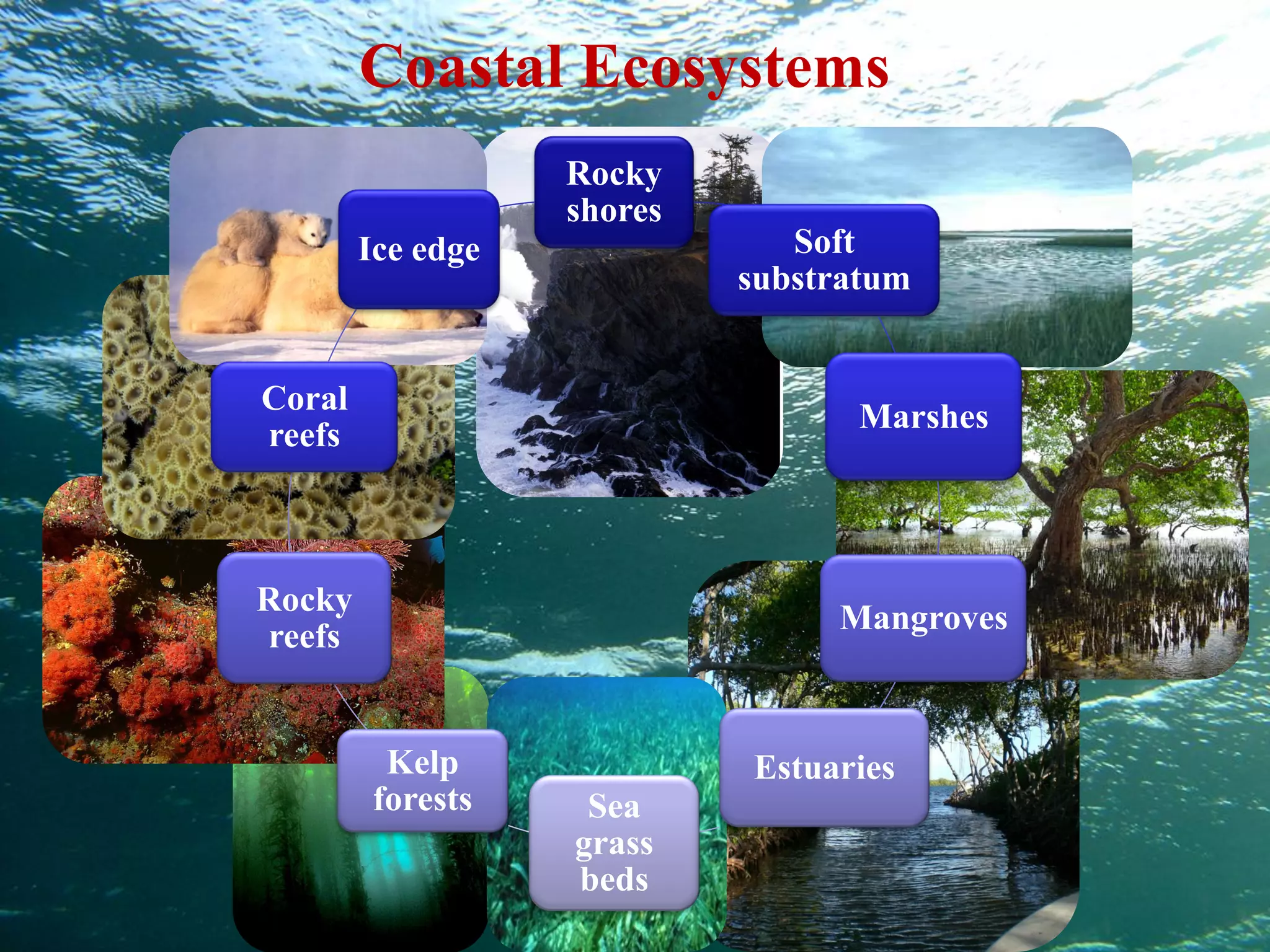
Coastal Ecosystems
                   Rocky
                   shores
        Ice edge               Soft
                            substratum


Coral
                                   Marshes
reefs


Rocky
                                 Mangroves
reefs


         Kelp               Estuaries
        forests     Sea
                   grass
                   beds
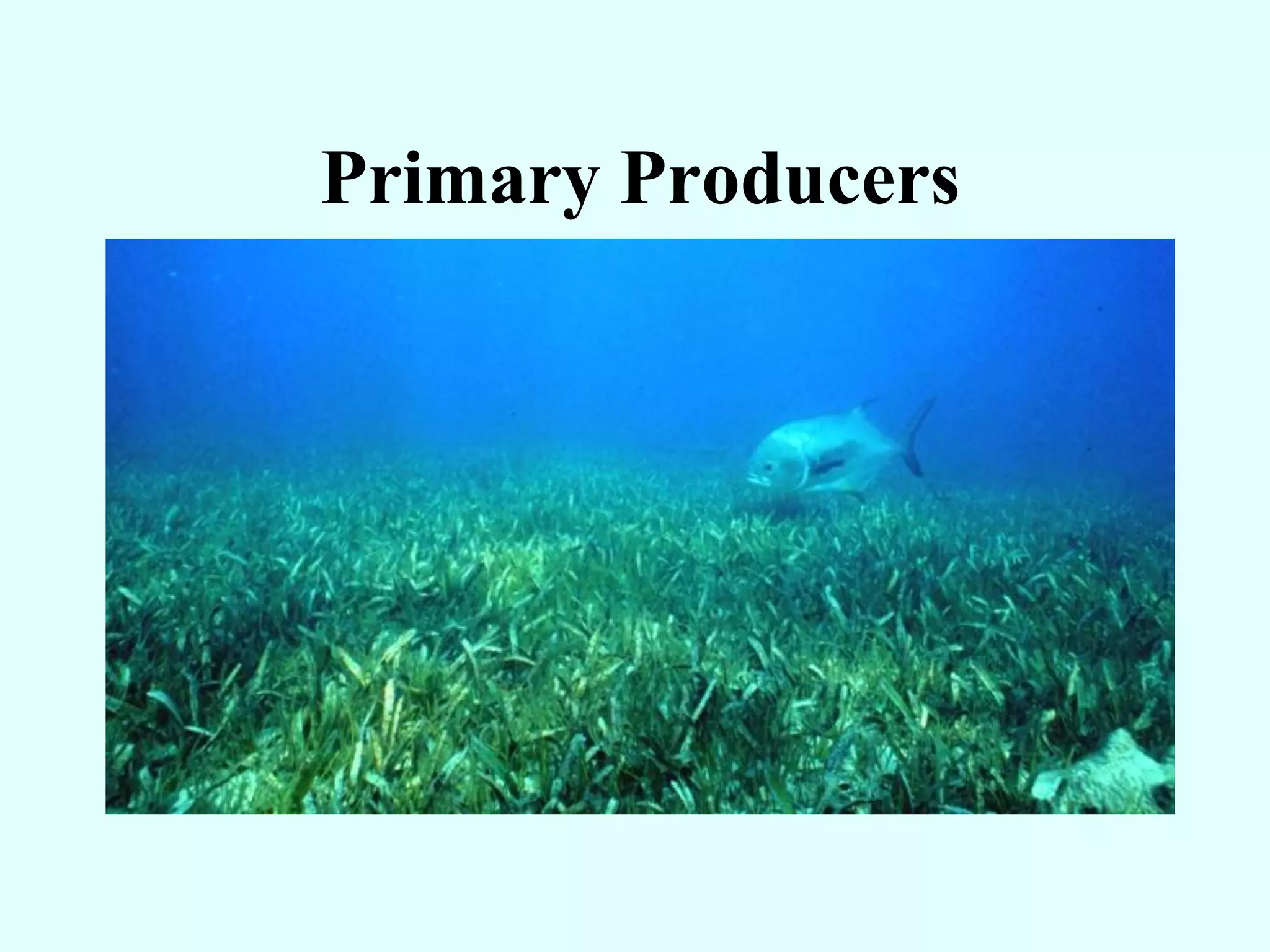
Primary Producers
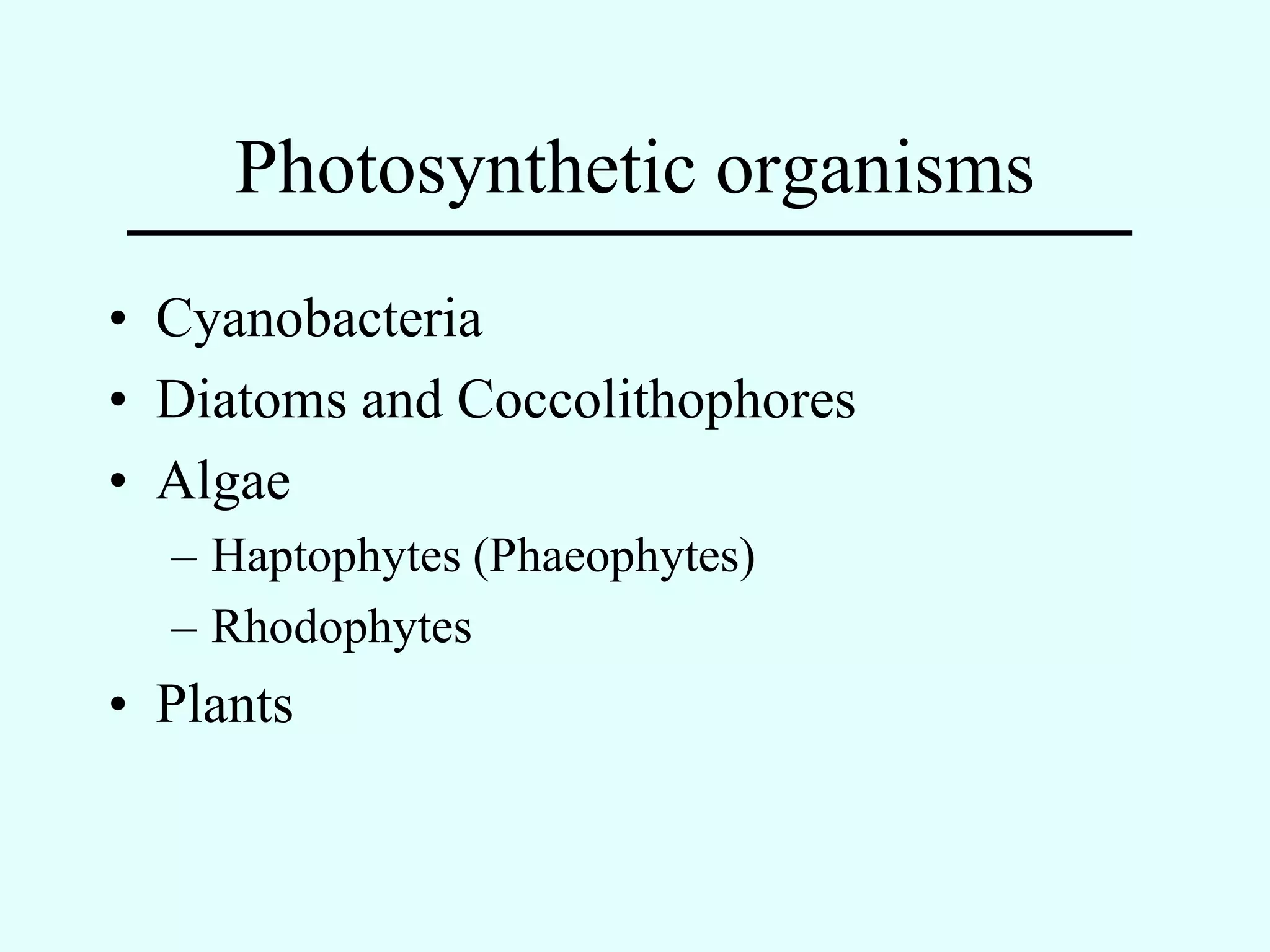
Photosynthetic organisms
• Cyanobacteria
• Diatoms and Coccolithophores
• Algae
  – Haptophytes (Phaeophytes)
  – Rhodophytes
• Plants
Primary Production
 the lowest level of the food chain
 utilize sunlight or chemical nutrients as a source
 of energy (autotrophy)
 primary production = rate of photosynthesis or
 chemosynthesis
  most occurs > 100 m (max = 268 m or 879 ft)

      Primary producers serve as the basis
         for nearly all life in the ocean
Factors Affecting Primary Productivity
• Light
  – polar regions: a single pulse of phytoplankton abundance
    occurs in summer
  – temperate latitudes: primary productivity is maximal in
    spring and autumn
  – tropics: phytoplankton are nutrient-limited year round
• Nutrients
  – oligotrophic
  – eutrophic
  – mesotrophic
• Hydrographic conditions
  – Currents
  – Upwelling
  – Vertical mixing
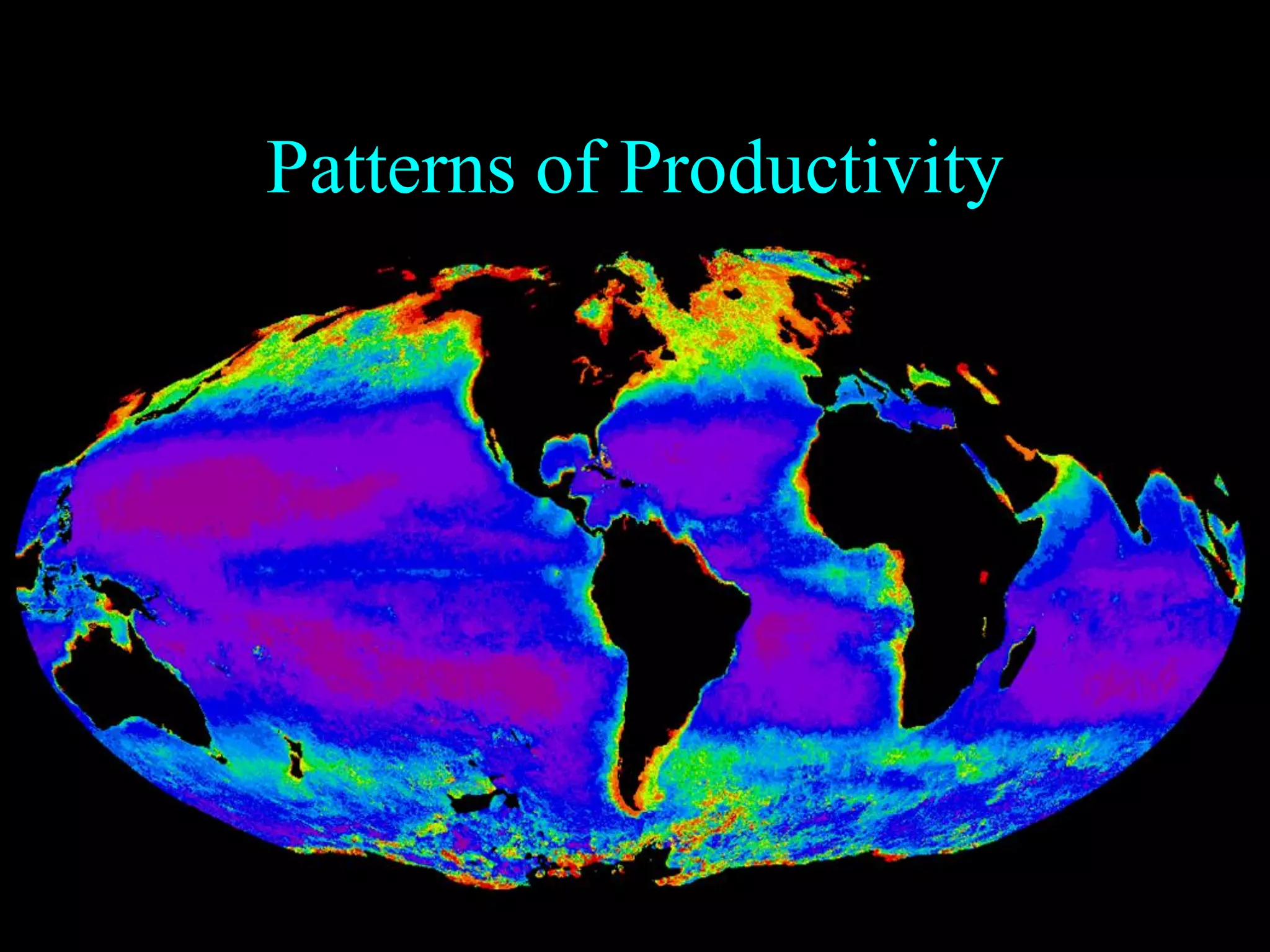
Patterns of Productivity
Estimates of primary production
Total (marine plus terrestrial) global annual net
  primary production (NPP) =
            104.9 Gt C/yr

      Terrestrial = 56.4 Gt or 53.8%
      Oceanic = 48.5 Gt or 46.2%

(From Field et al. 1998. Science 281: 237-240)
Estimates of primary production
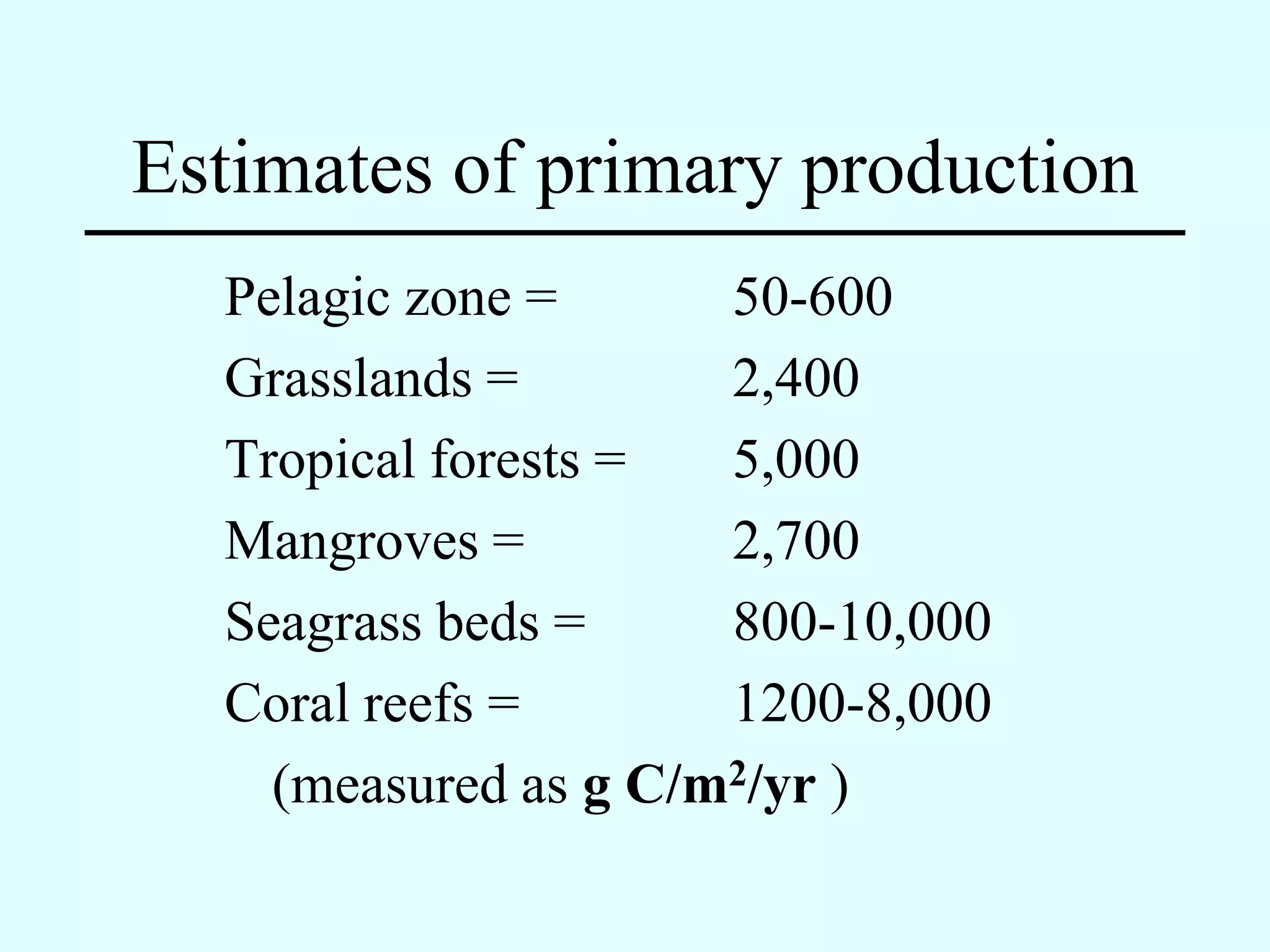
  Pelagic zone =      50-600
  Grasslands =        2,400
  Tropical forests =  5,000
  Mangroves =         2,700
  Seagrass beds =     800-10,000
  Coral reefs =       1200-8,000
    (measured as g C/m2/yr )
Primary Production
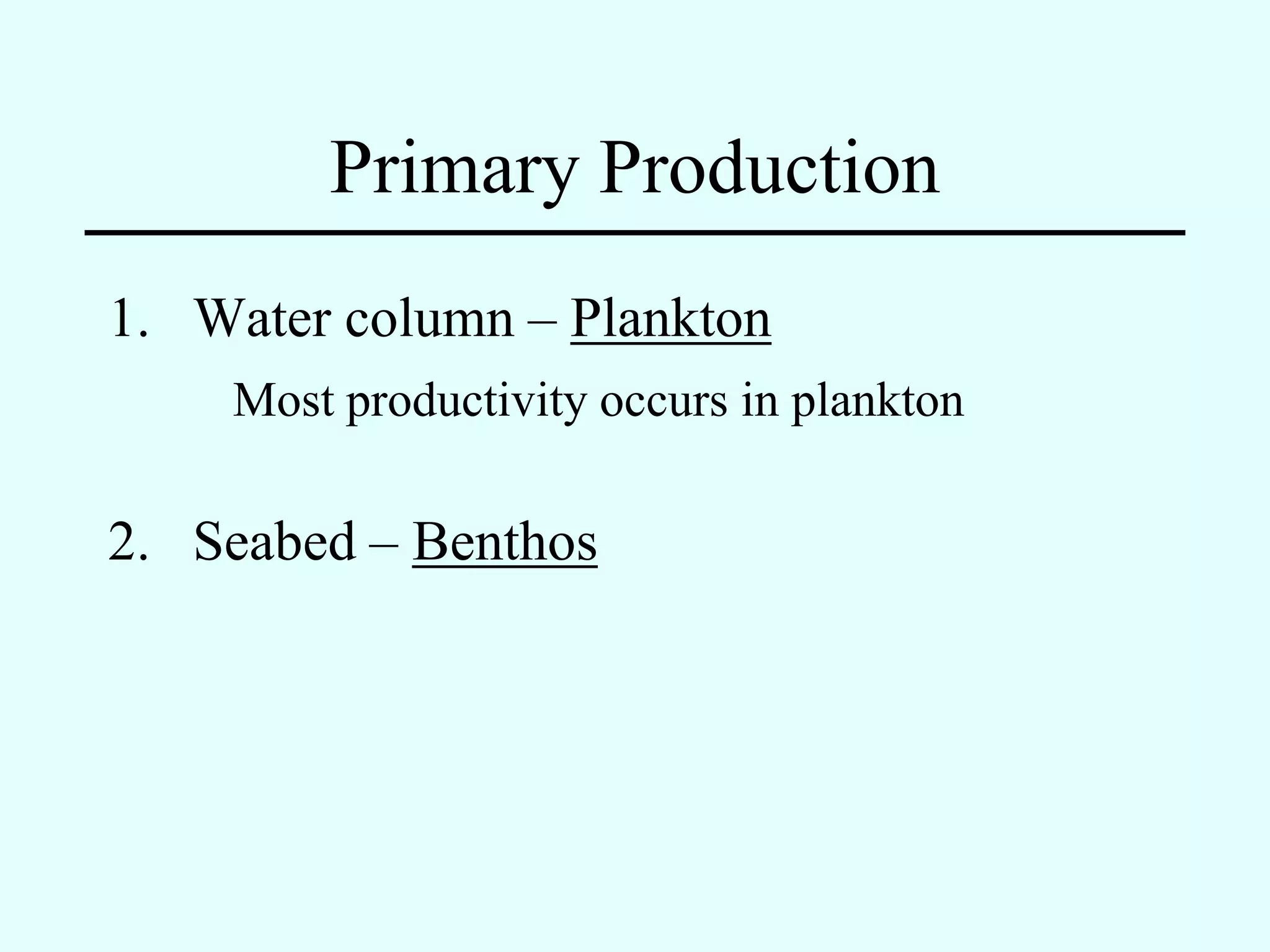
1. Water column – Plankton
    Most productivity occurs in plankton

2. Seabed – Benthos
Plankton
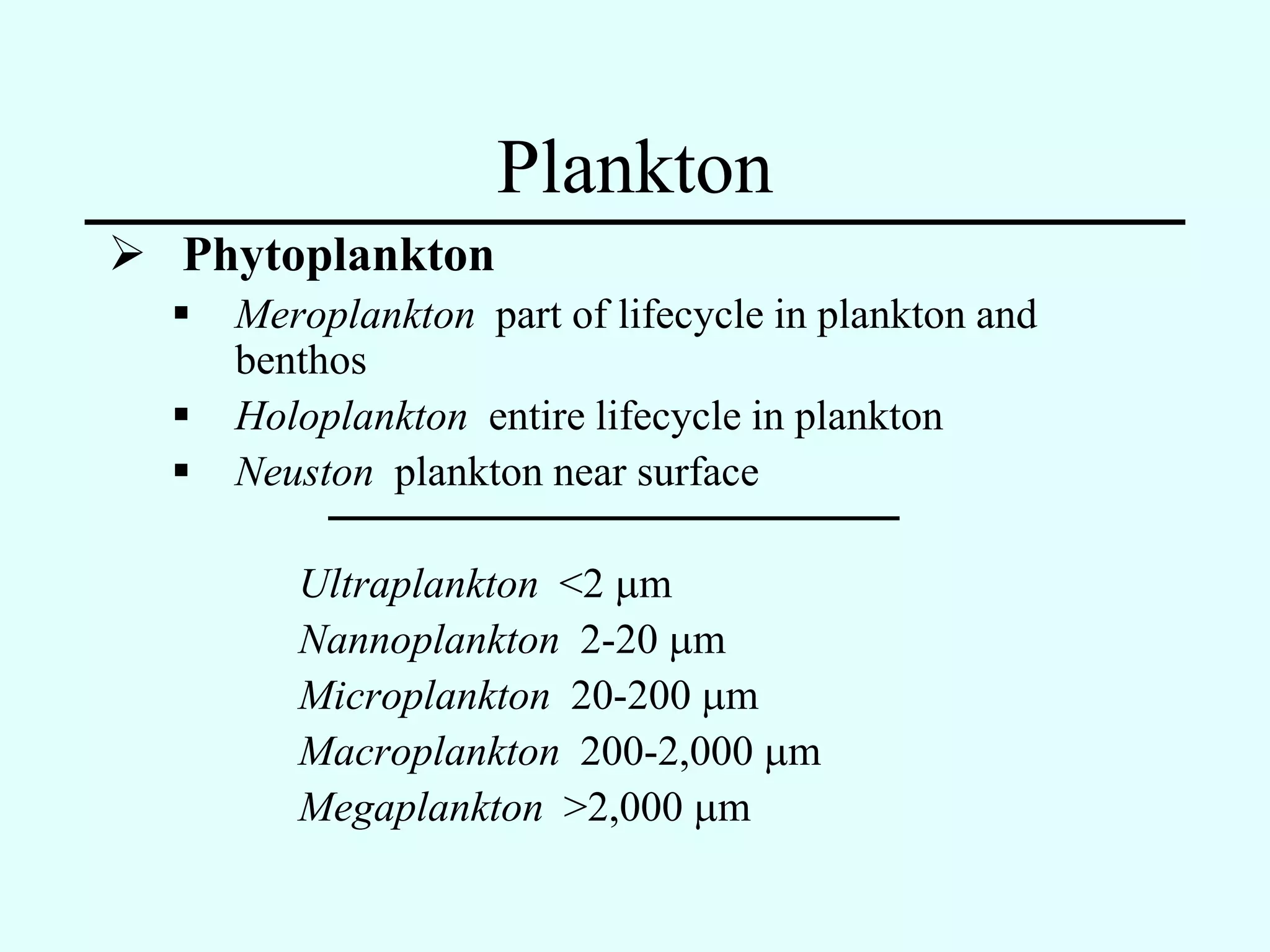
 Phytoplankton
     Meroplankton part of lifecycle in plankton and
      benthos
     Holoplankton entire lifecycle in plankton
     Neuston plankton near surface

         Ultraplankton <2 mm
         Nannoplankton 2-20 mm
         Microplankton 20-200 mm
         Macroplankton 200-2,000 mm
         Megaplankton >2,000 mm
Major Groups of Primary Producers-
         Phytoplankton
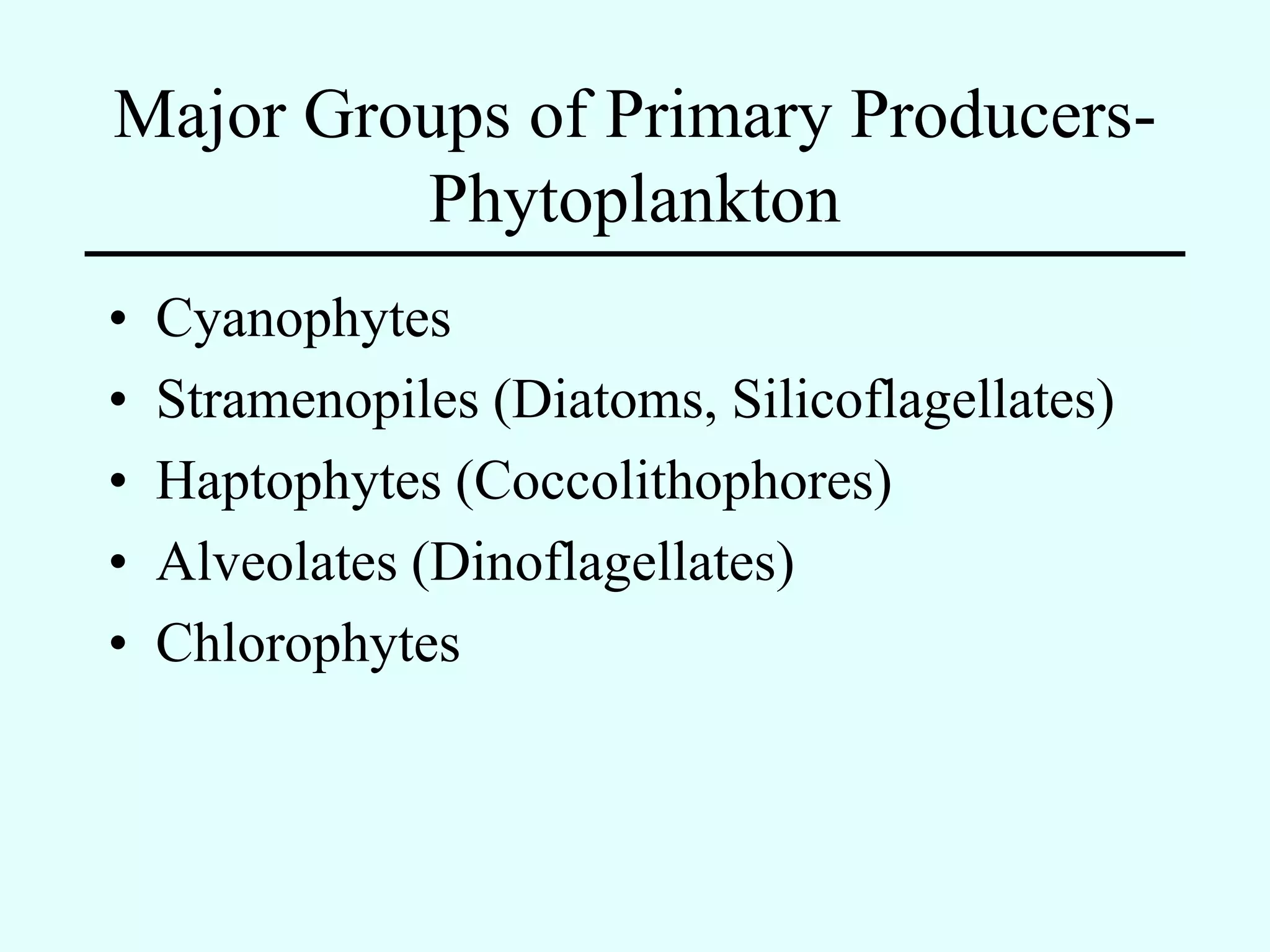
•   Cyanophytes
•   Stramenopiles (Diatoms, Silicoflagellates)
•   Haptophytes (Coccolithophores)
•   Alveolates (Dinoflagellates)
•   Chlorophytes
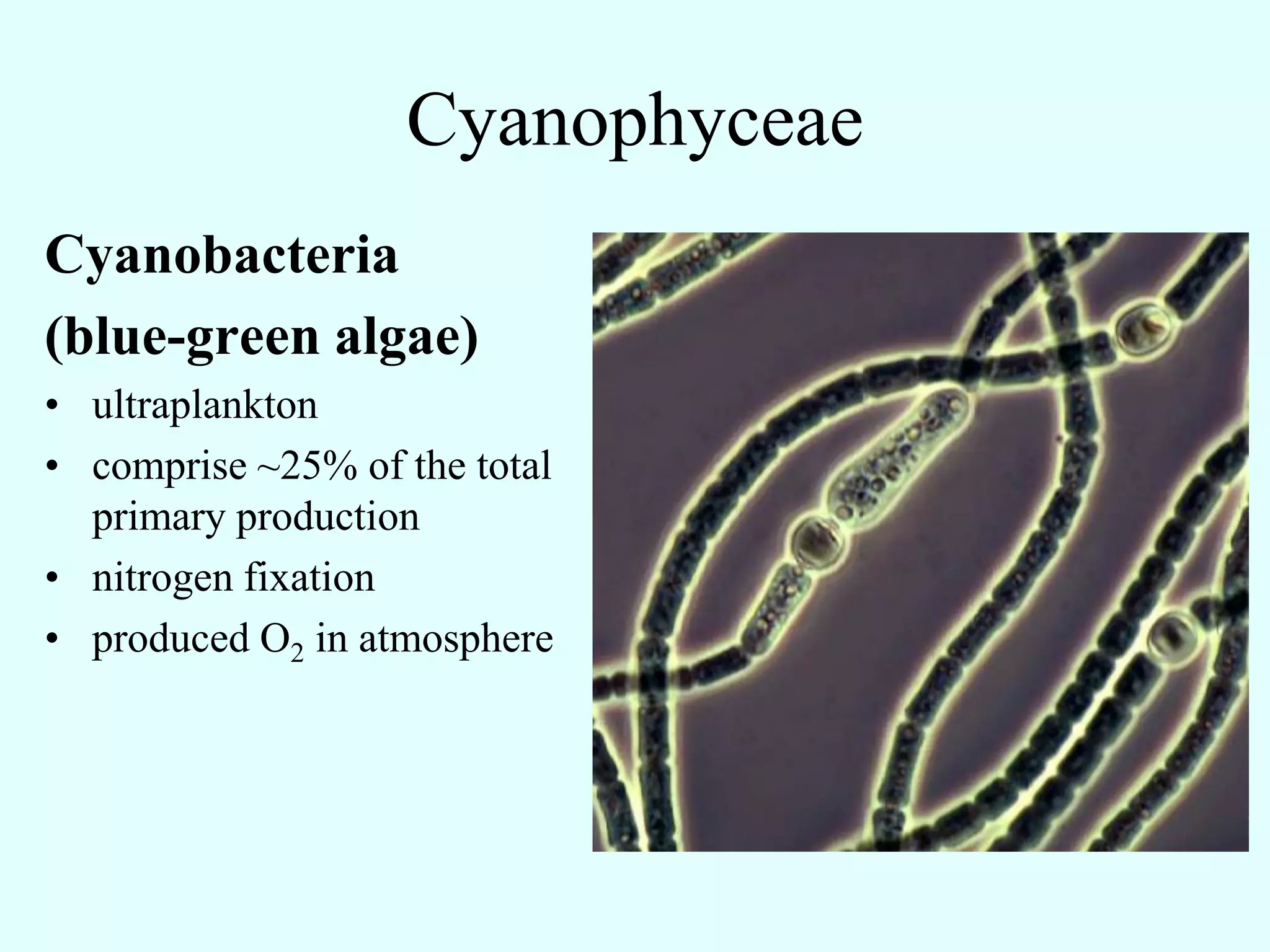
Cyanophyceae
Cyanobacteria
(blue-green algae)
• ultraplankton
• comprise ~25% of the total
  primary production
• nitrogen fixation
• produced O2 in atmosphere
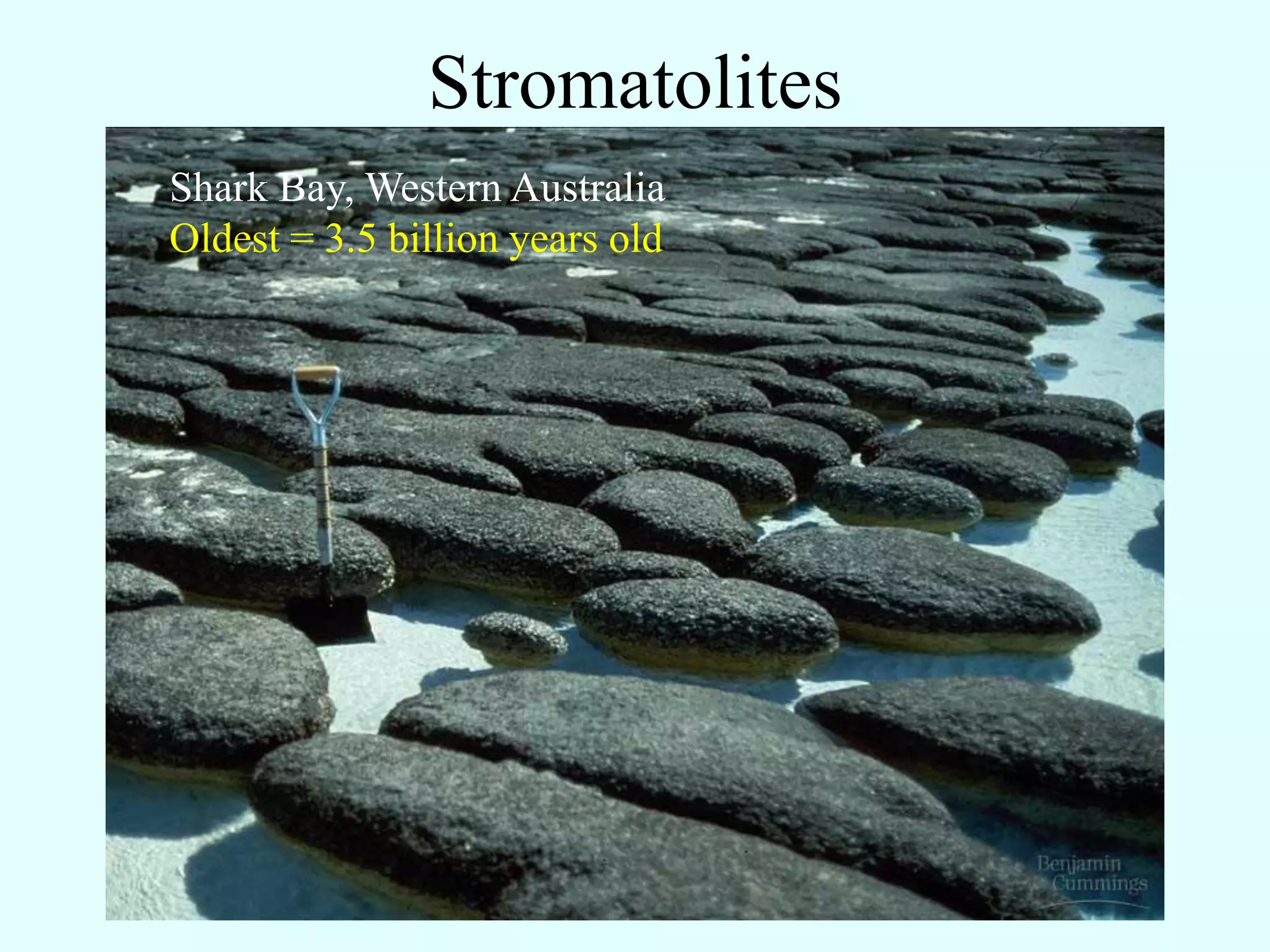
Stromatolites
Shark Bay, Western Australia
Oldest = 3.5 billion years old
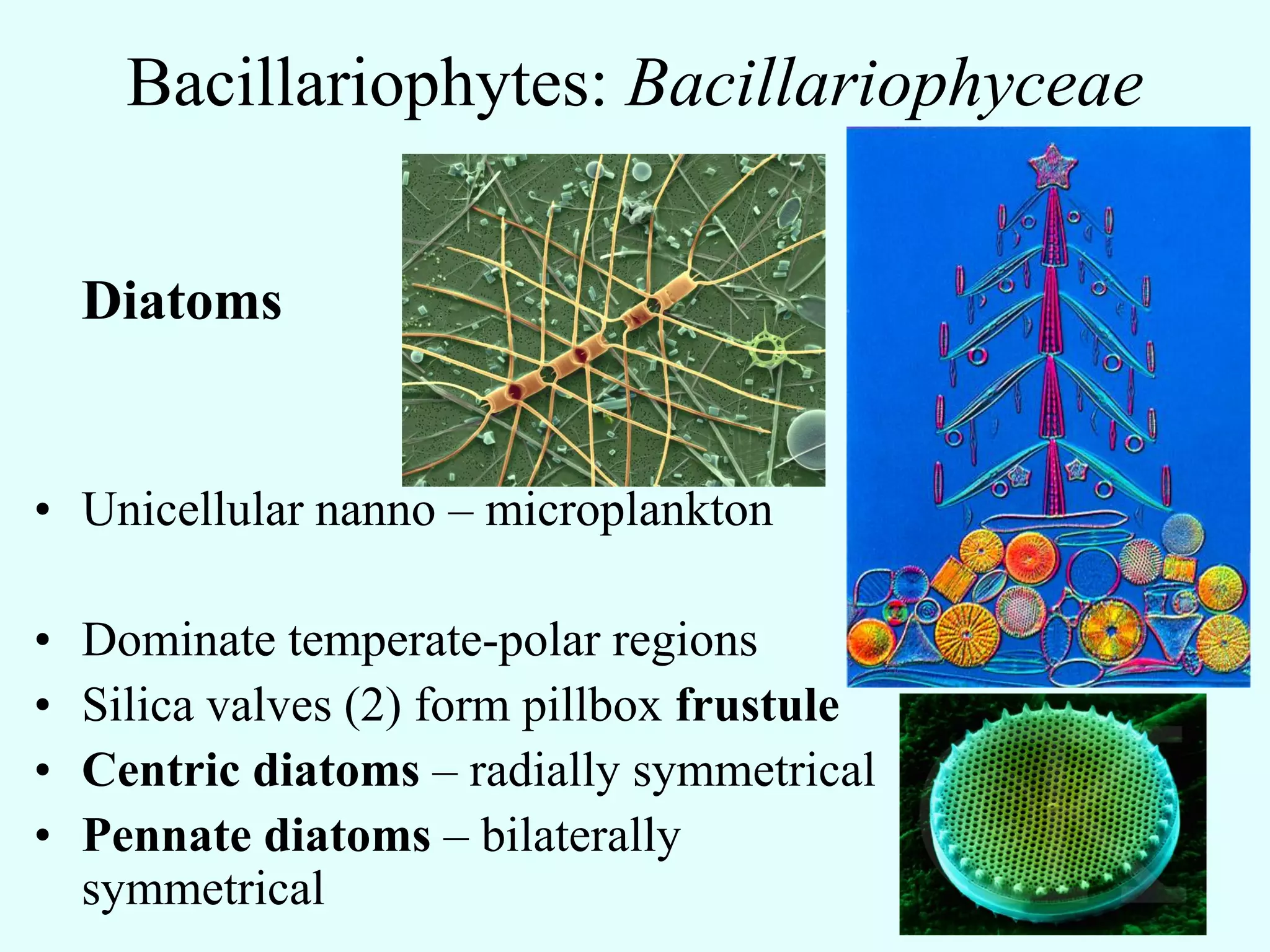
Bacillariophytes: Bacillariophyceae


    Diatoms


• Unicellular nanno – microplankton

•   Dominate temperate-polar regions
•   Silica valves (2) form pillbox frustule
•   Centric diatoms – radially symmetrical
•   Pennate diatoms – bilaterally
    symmetrical
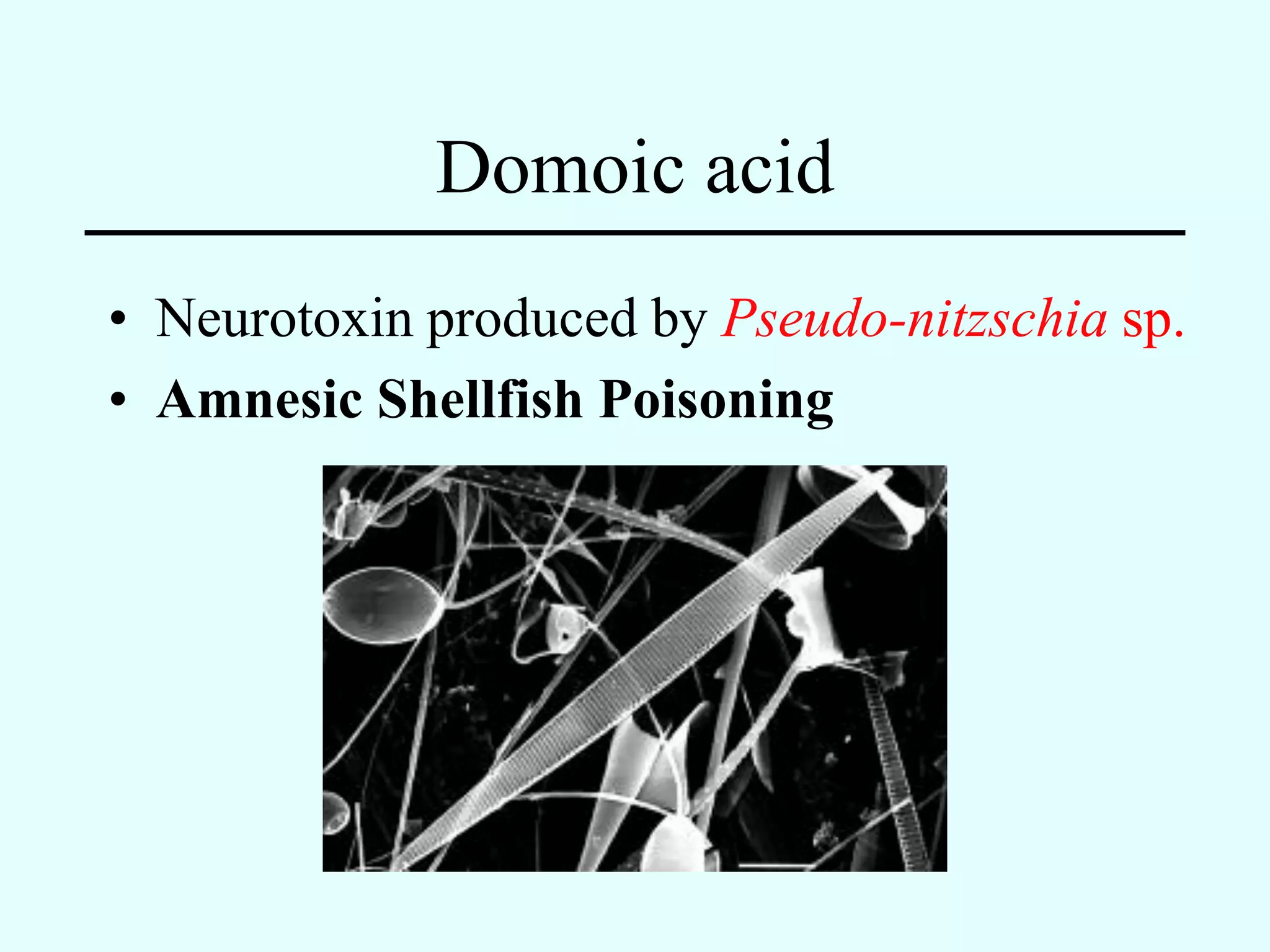
Domoic acid
• Neurotoxin produced by Pseudo-nitzschia sp.
• Amnesic Shellfish Poisoning
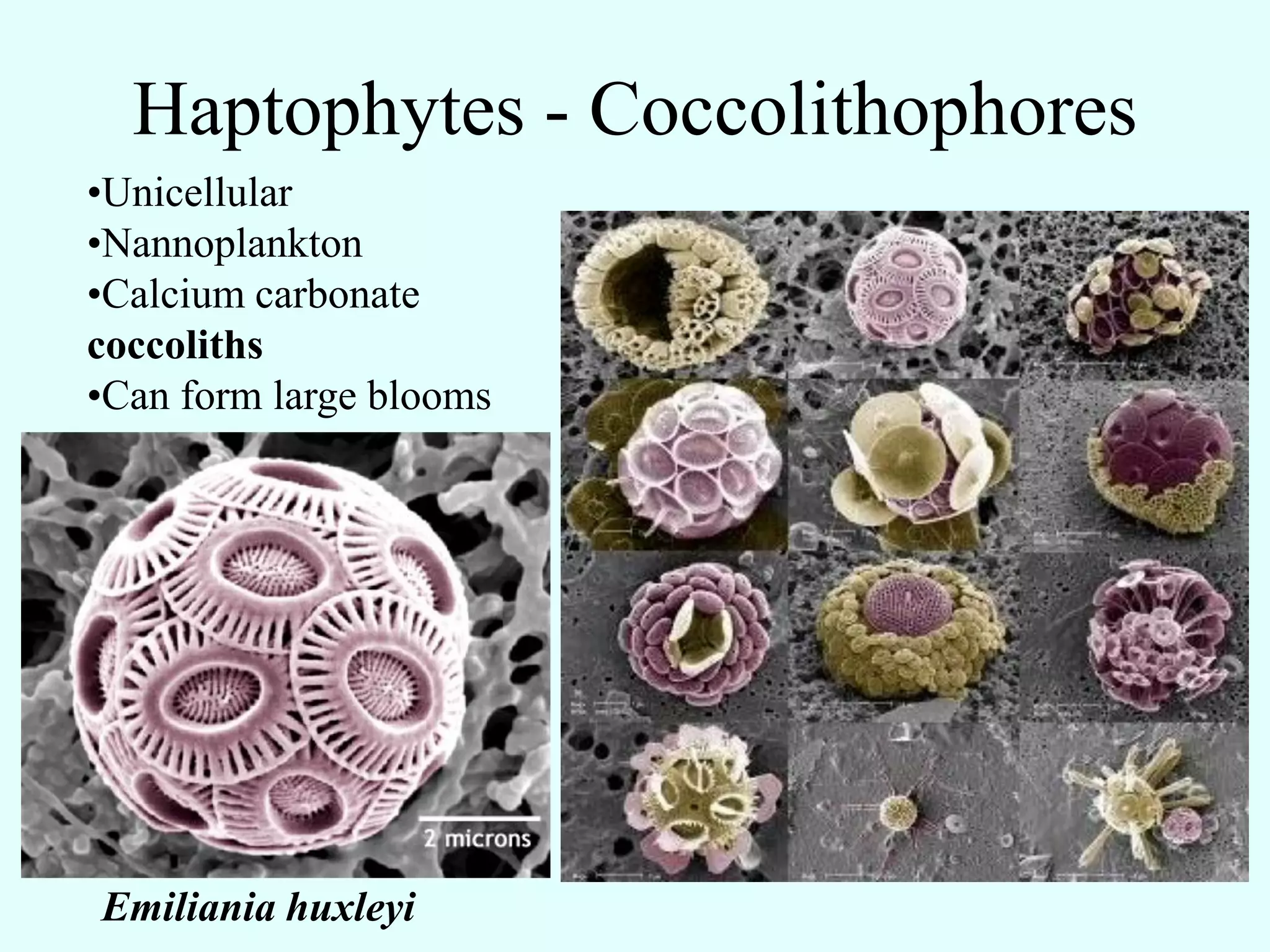
Haptophytes - Coccolithophores
•Unicellular
•Nannoplankton
•Calcium carbonate
coccoliths
•Can form large blooms


Emiliania huxleyi
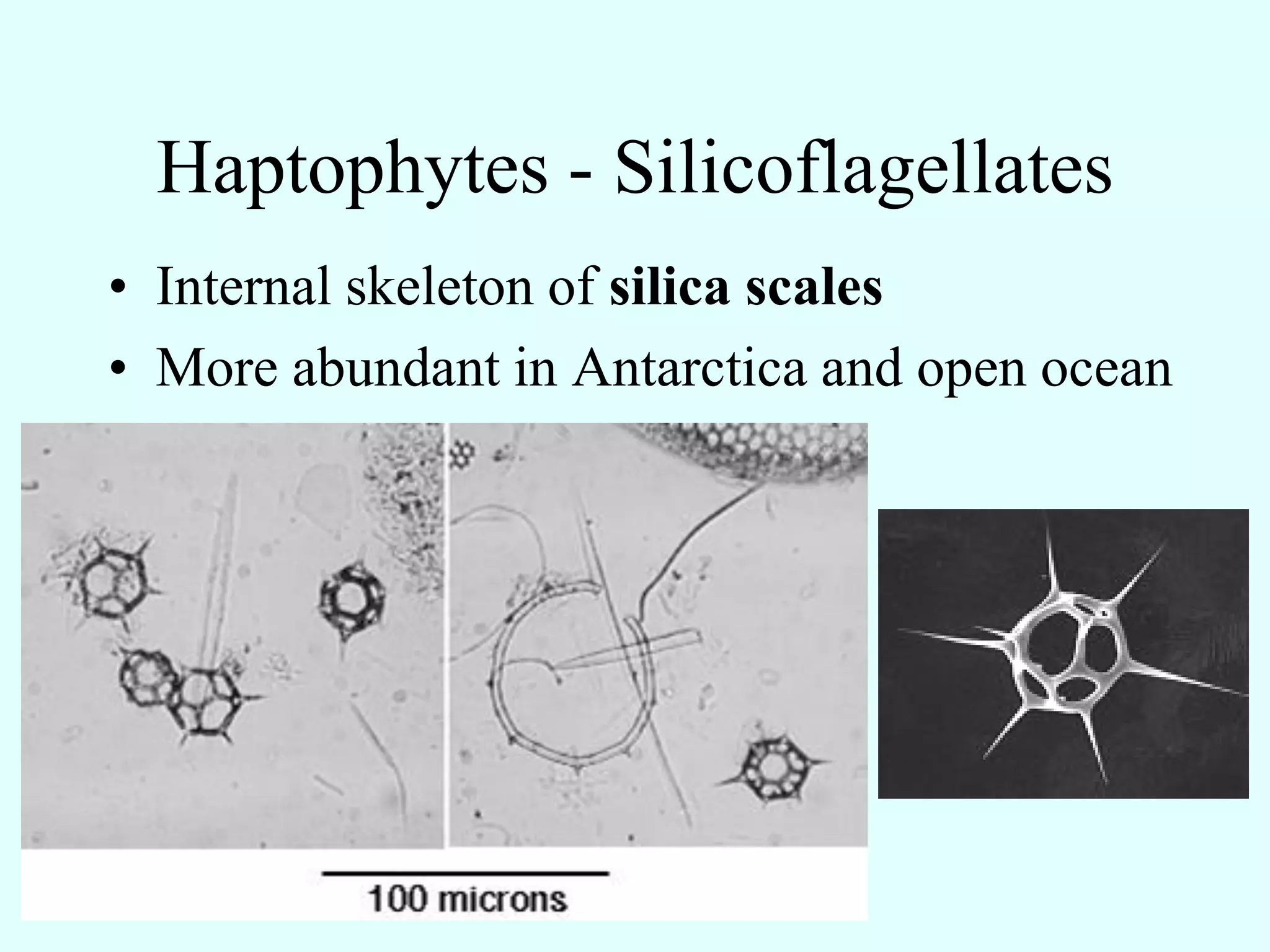
Haptophytes - Silicoflagellates
• Internal skeleton of silica scales
• More abundant in Antarctica and open ocean
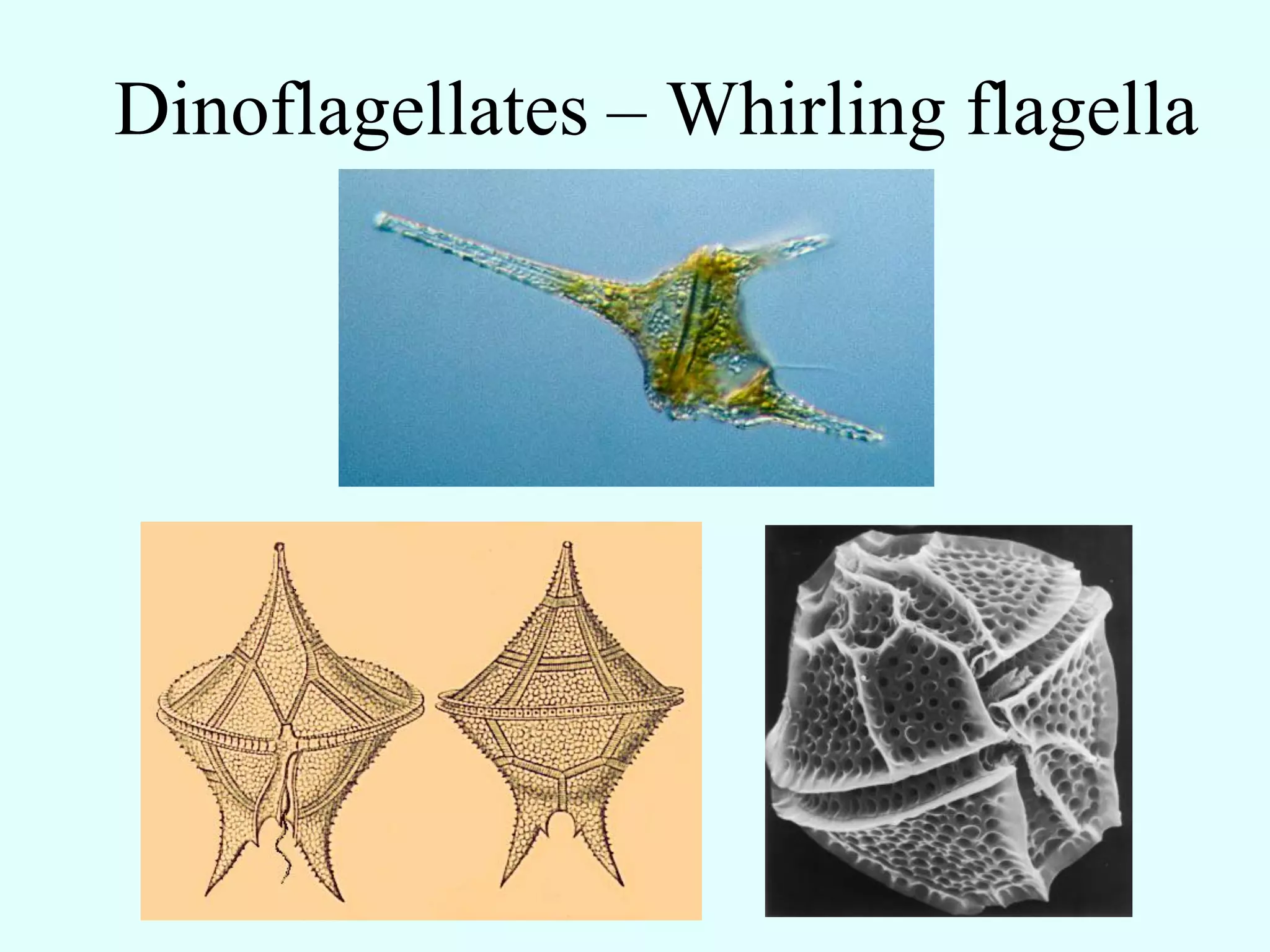
Dinoflagellates – Whirling flagella
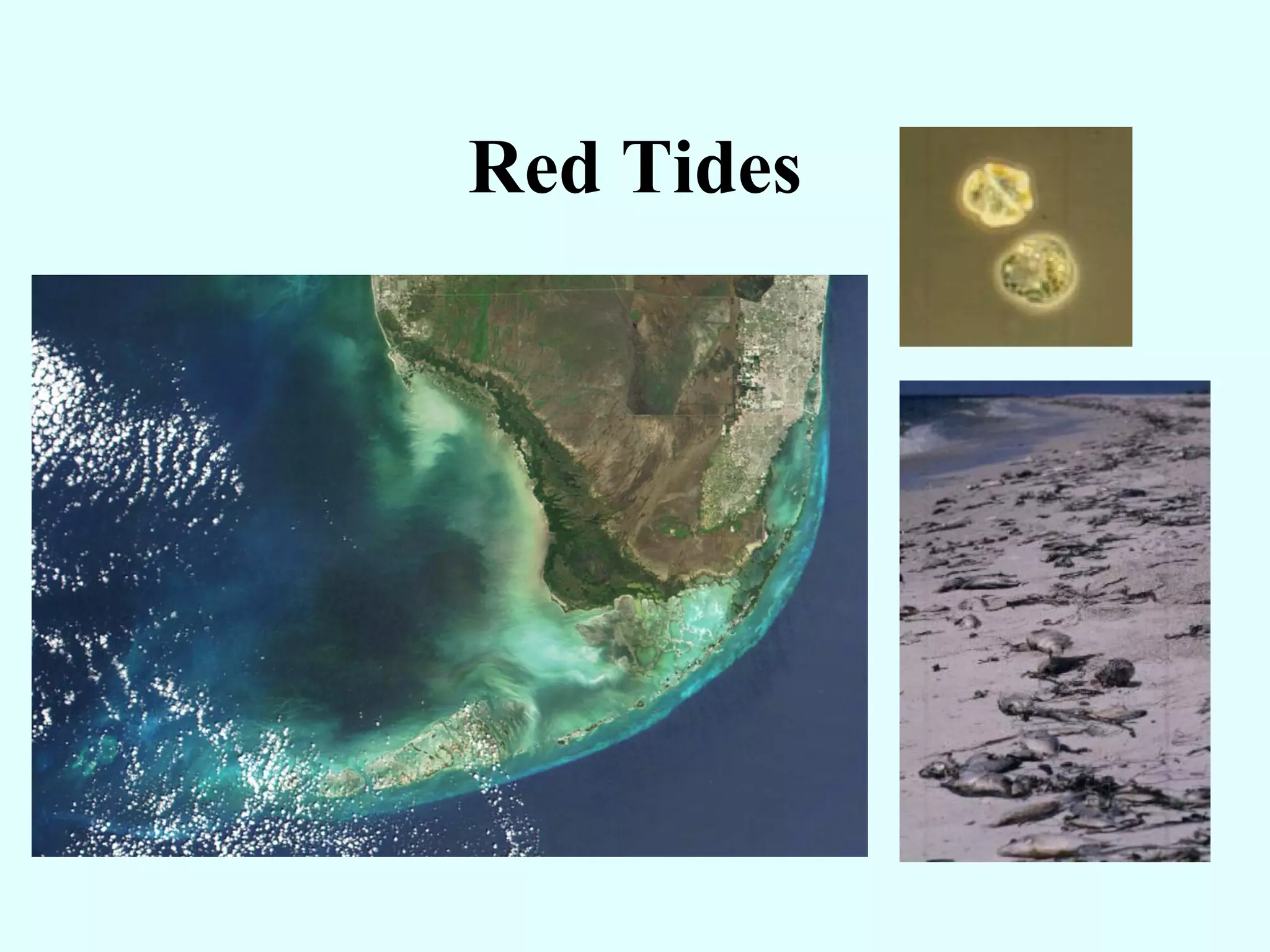
Red Tides
Red Tides
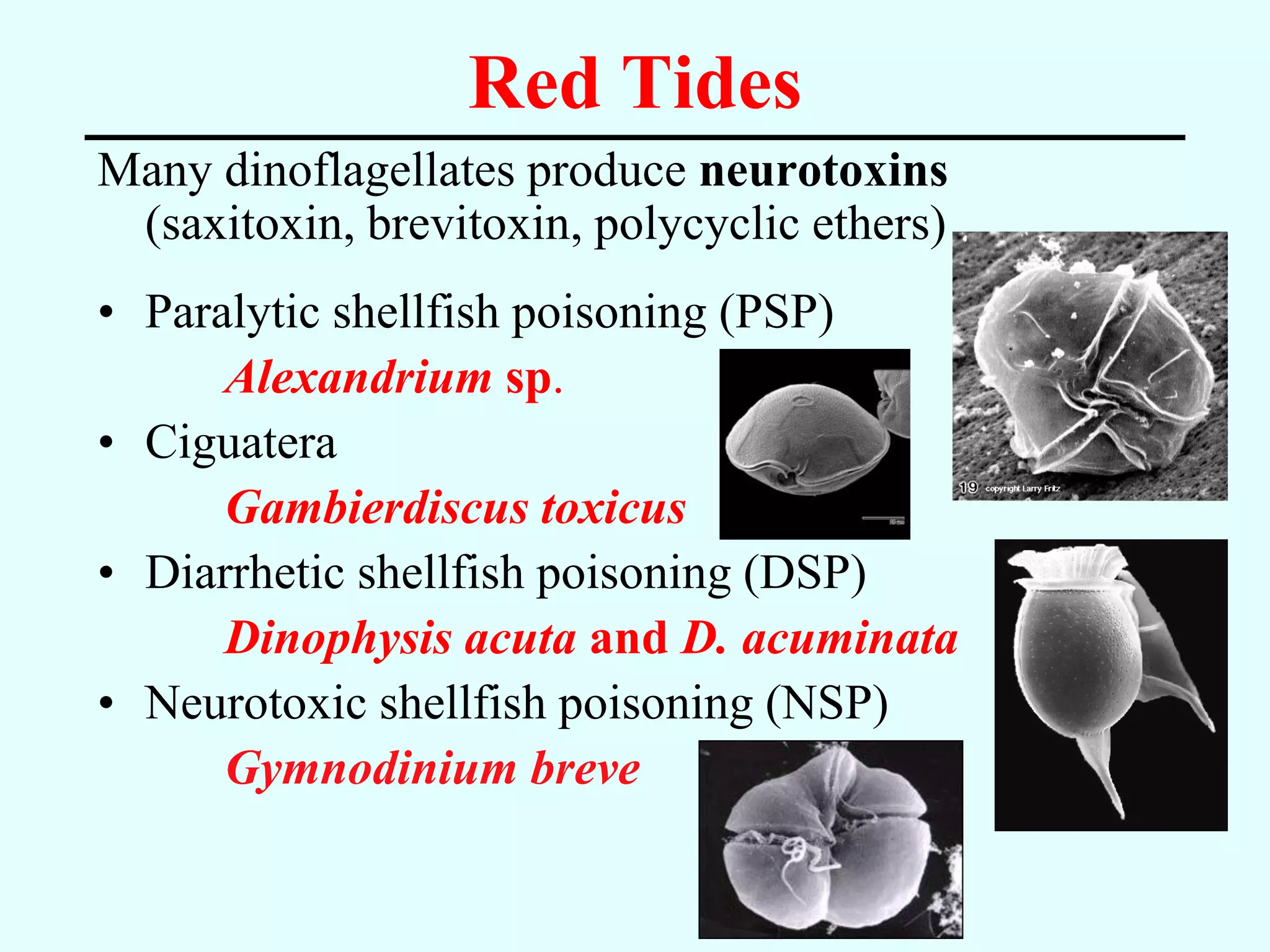
Many dinoflagellates produce neurotoxins
 (saxitoxin, brevitoxin, polycyclic ethers)
• Paralytic shellfish poisoning (PSP)
      Alexandrium sp.
• Ciguatera
      Gambierdiscus toxicus
• Diarrhetic shellfish poisoning (DSP)
      Dinophysis acuta and D. acuminata
• Neurotoxic shellfish poisoning (NSP)
      Gymnodinium breve
Specialized dinoflagellates
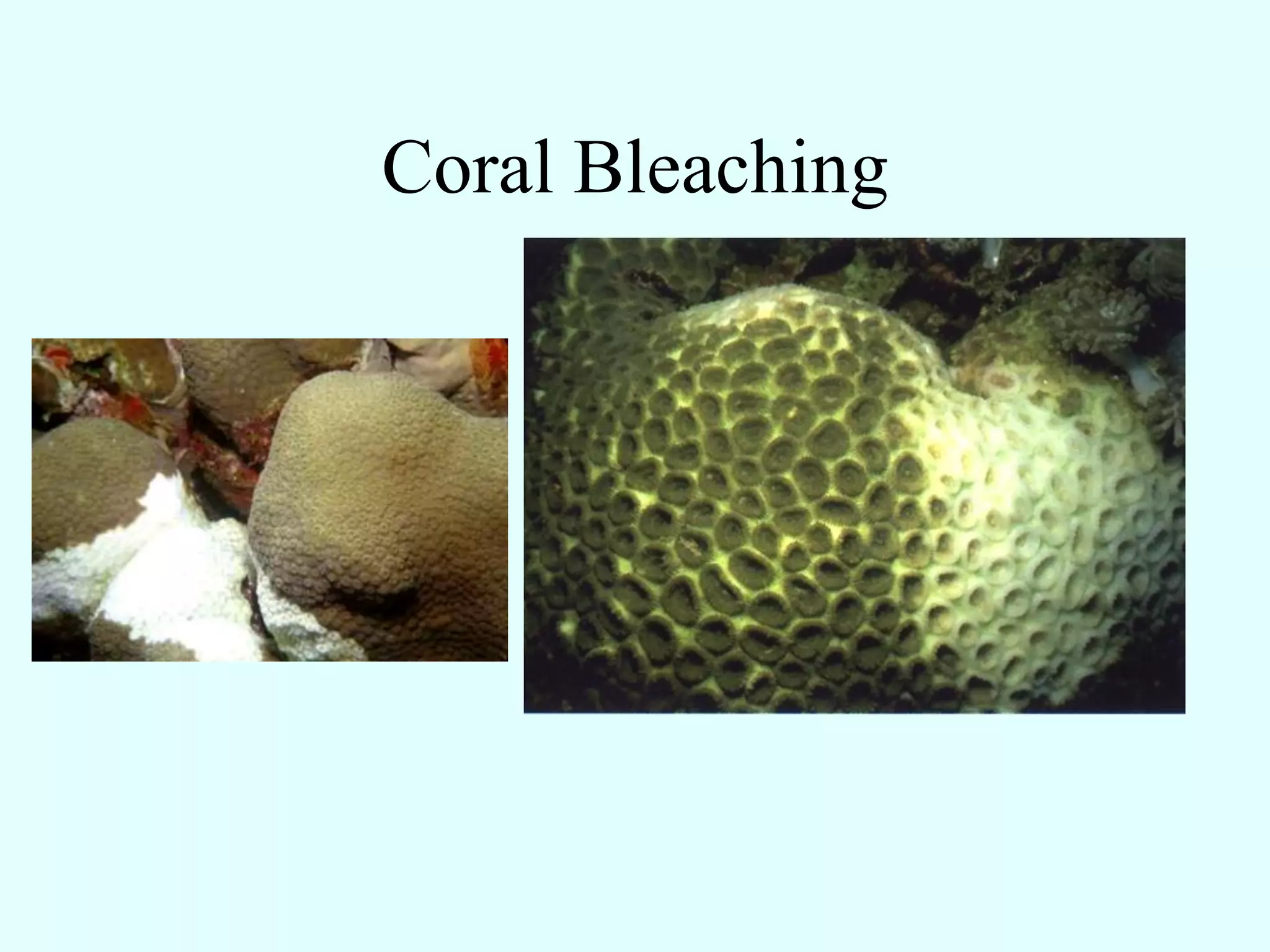
      • Zooxanthellae
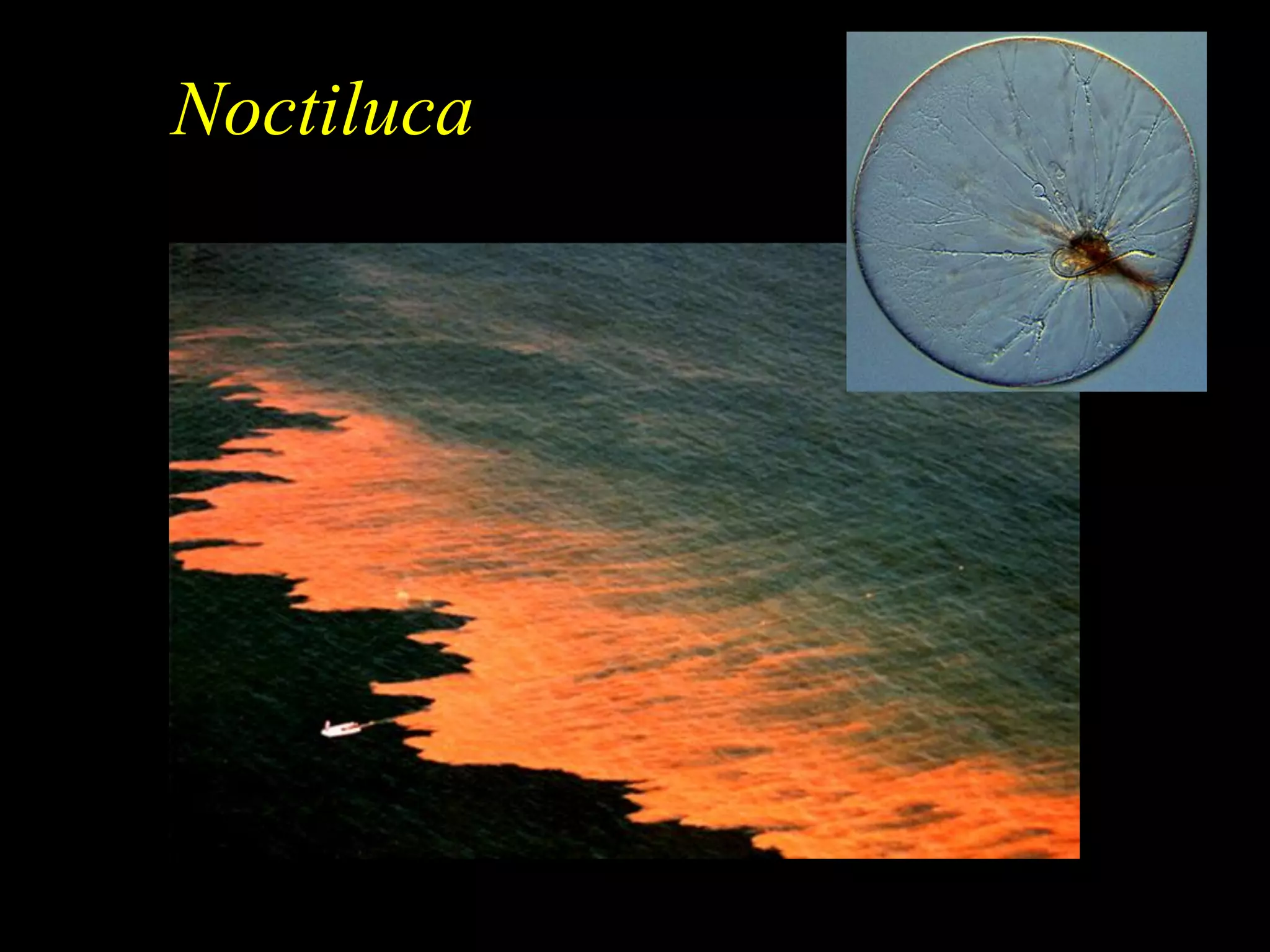
      • Noctiluca
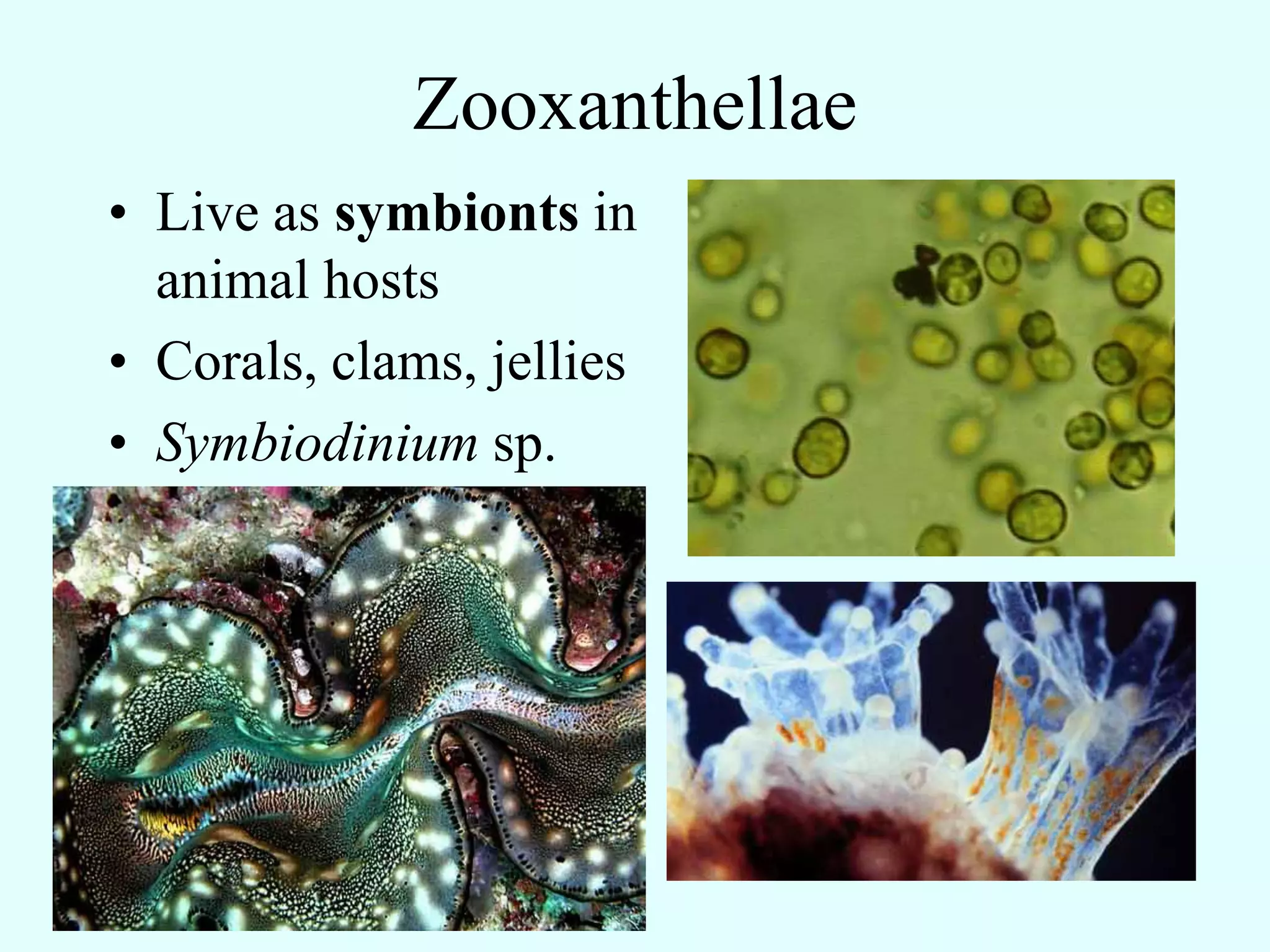
Zooxanthellae
• Live as symbionts in
  animal hosts
• Corals, clams, jellies
• Symbiodinium sp.
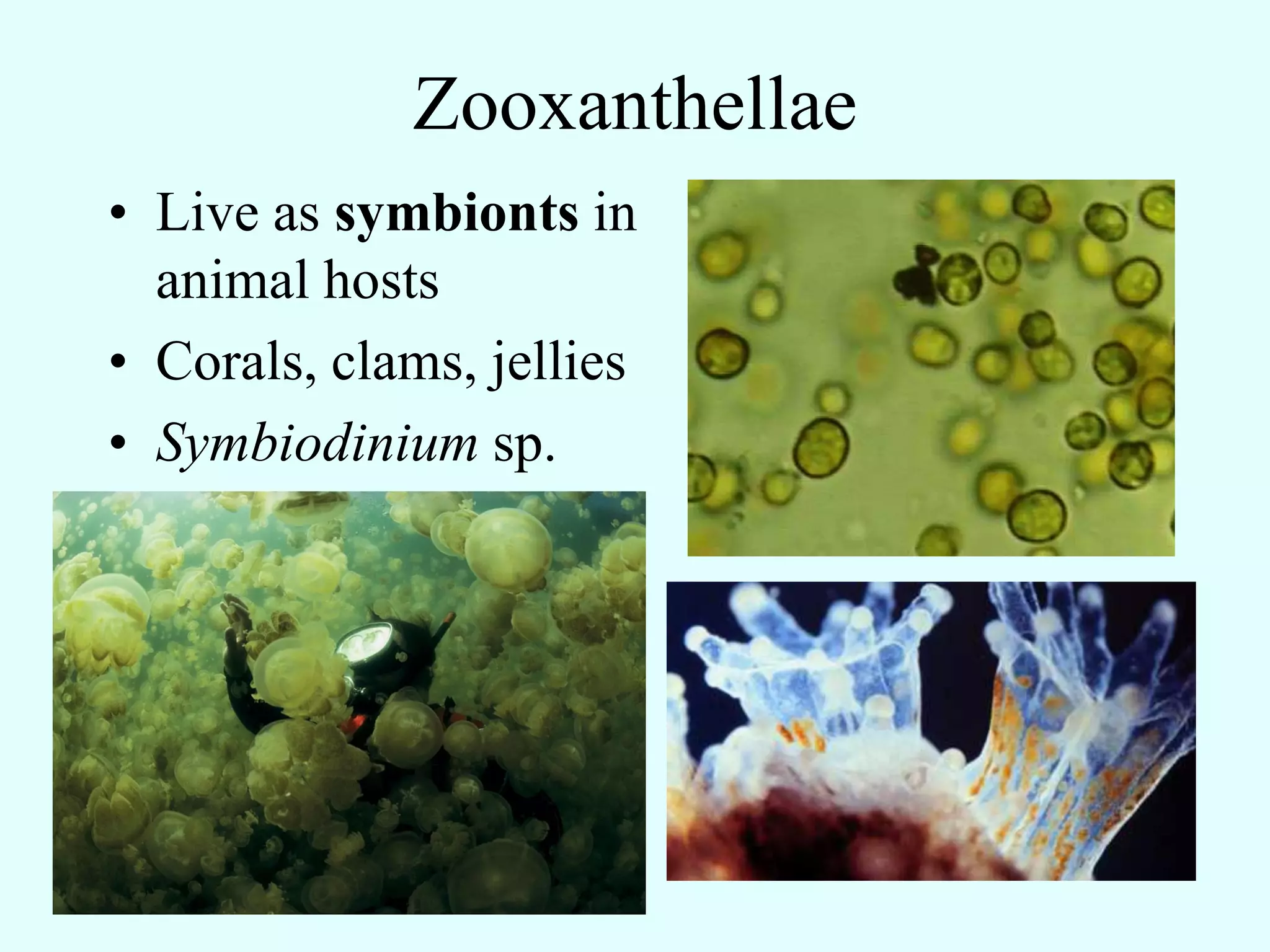
Zooxanthellae
• Live as symbionts in
  animal hosts
• Corals, clams, jellies
• Symbiodinium sp.
Coral Bleaching
Noctiluca
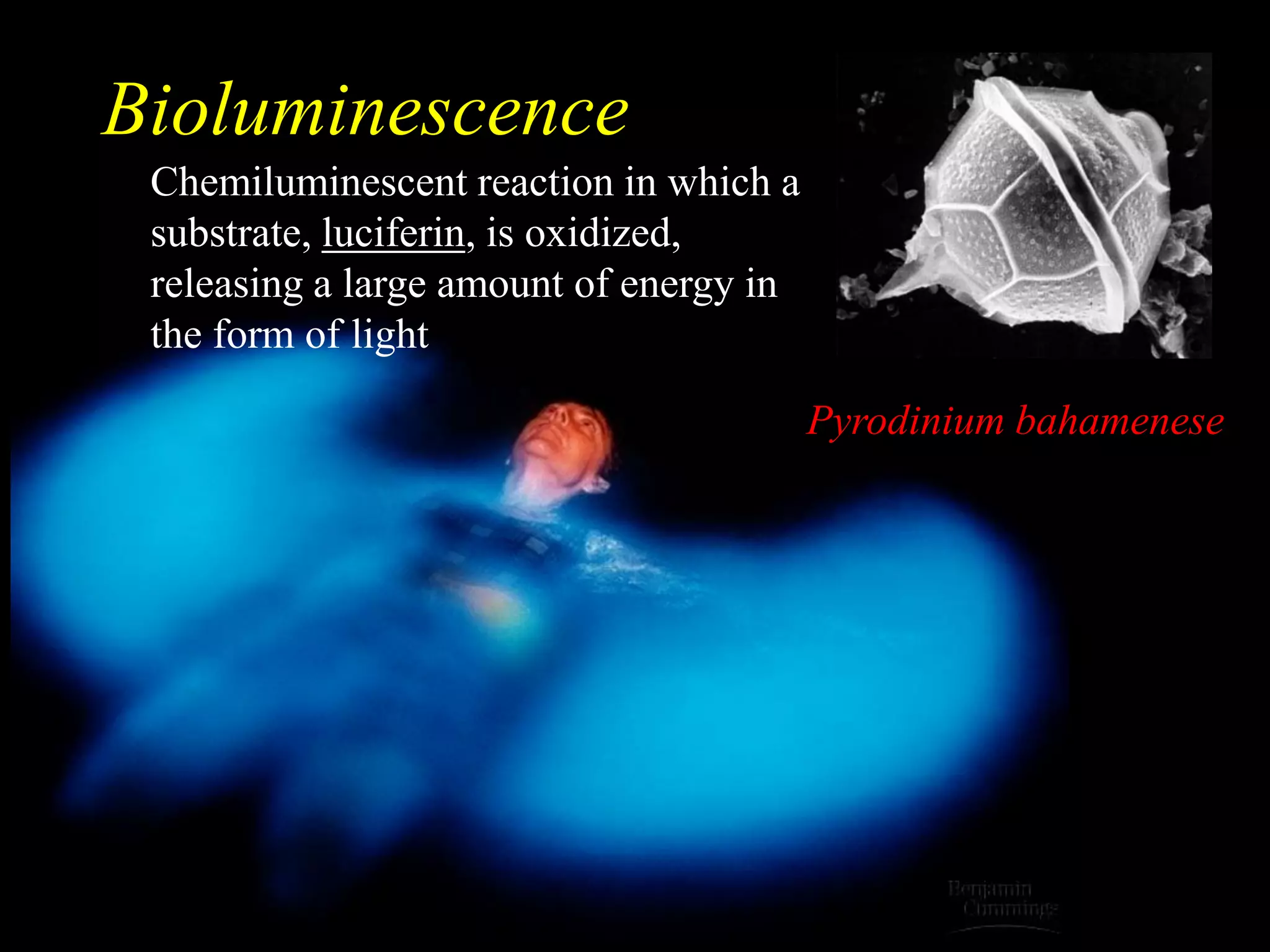
Bioluminescence
 Chemiluminescent reaction in which a
 substrate, luciferin, is oxidized,
 releasing a large amount of energy in
 the form of light

                                         Pyrodinium bahamenese
Benthic primary producers
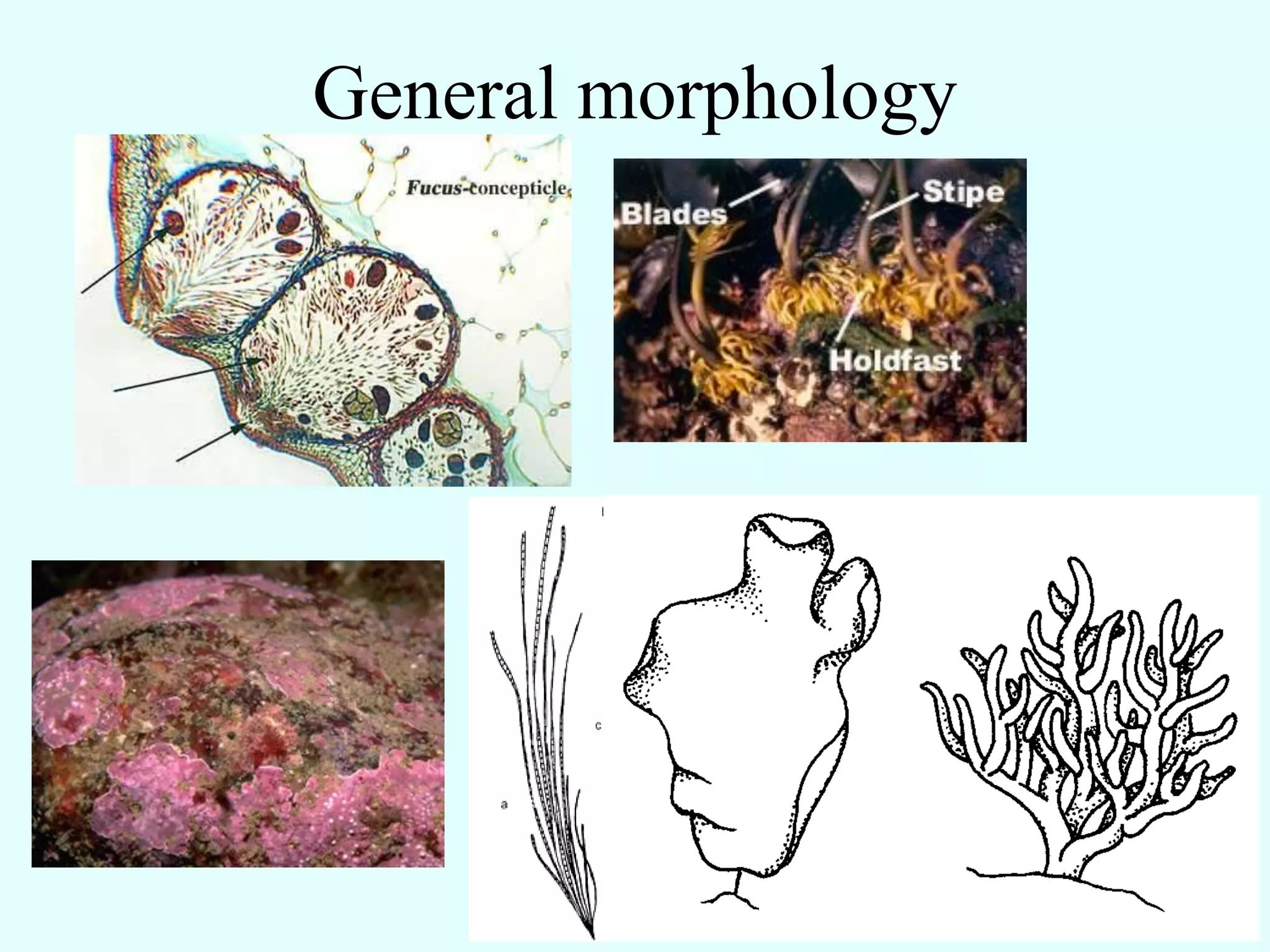
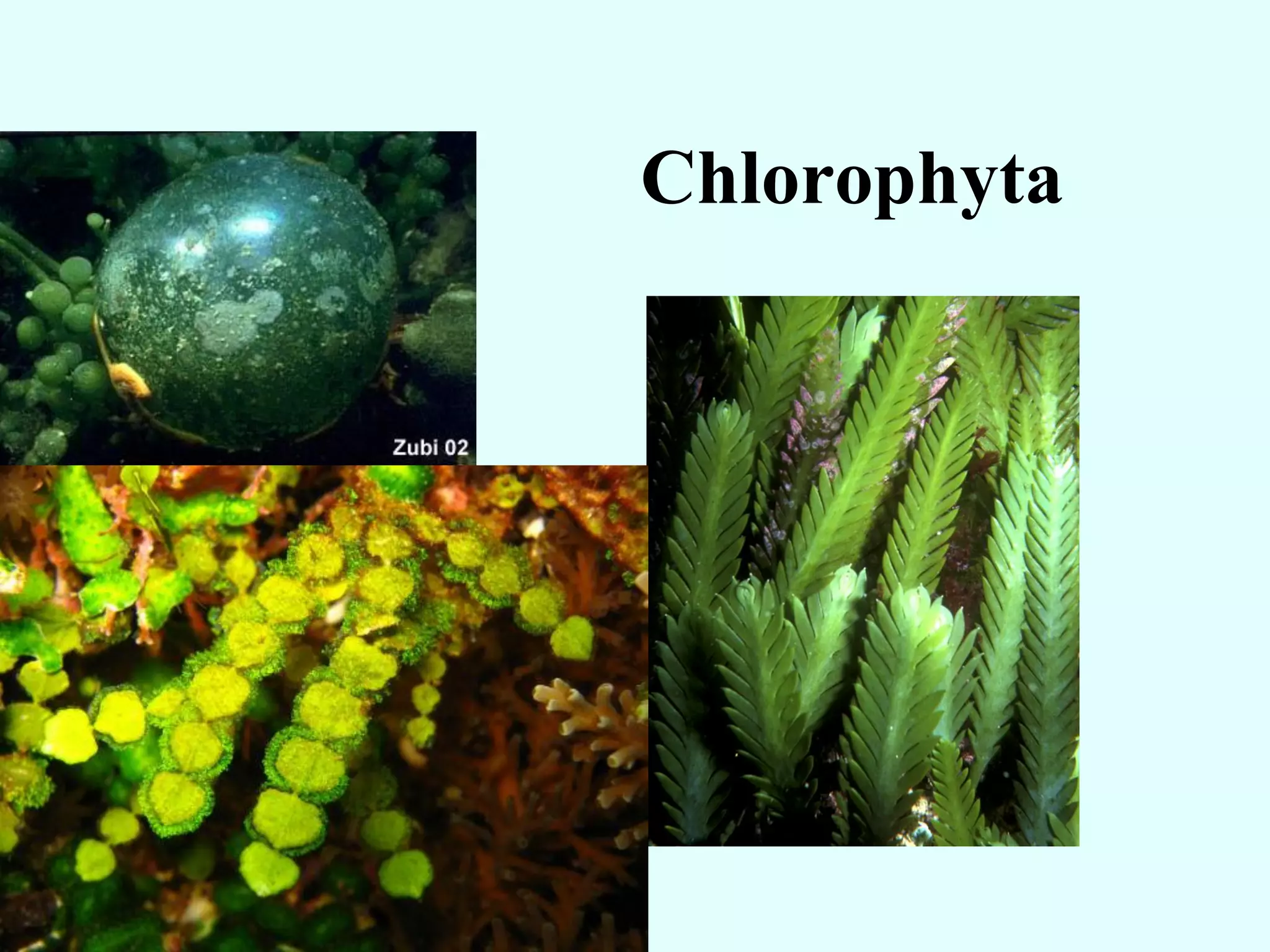
Major lineages of algae and plants:
• Chlorophyta (green algae/plants)
• Heterokonta (stramenopiles - brown algae)
• Rhodophyta (red algae)
General morphology
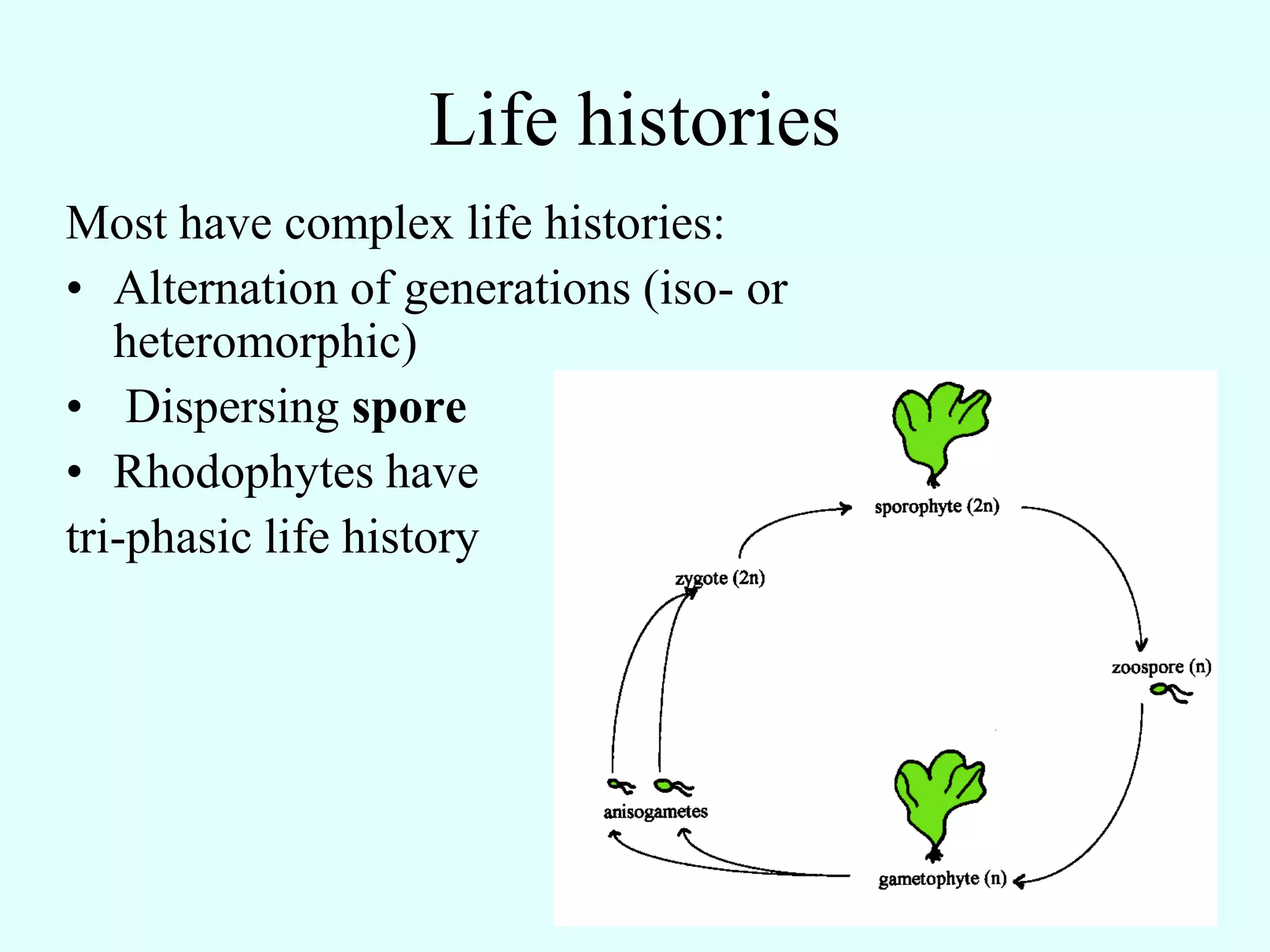
Life histories
Most have complex life histories:
• Alternation of generations (iso- or
   heteromorphic)
• Dispersing spore
• Rhodophytes have
tri-phasic life history
Chlorophyta
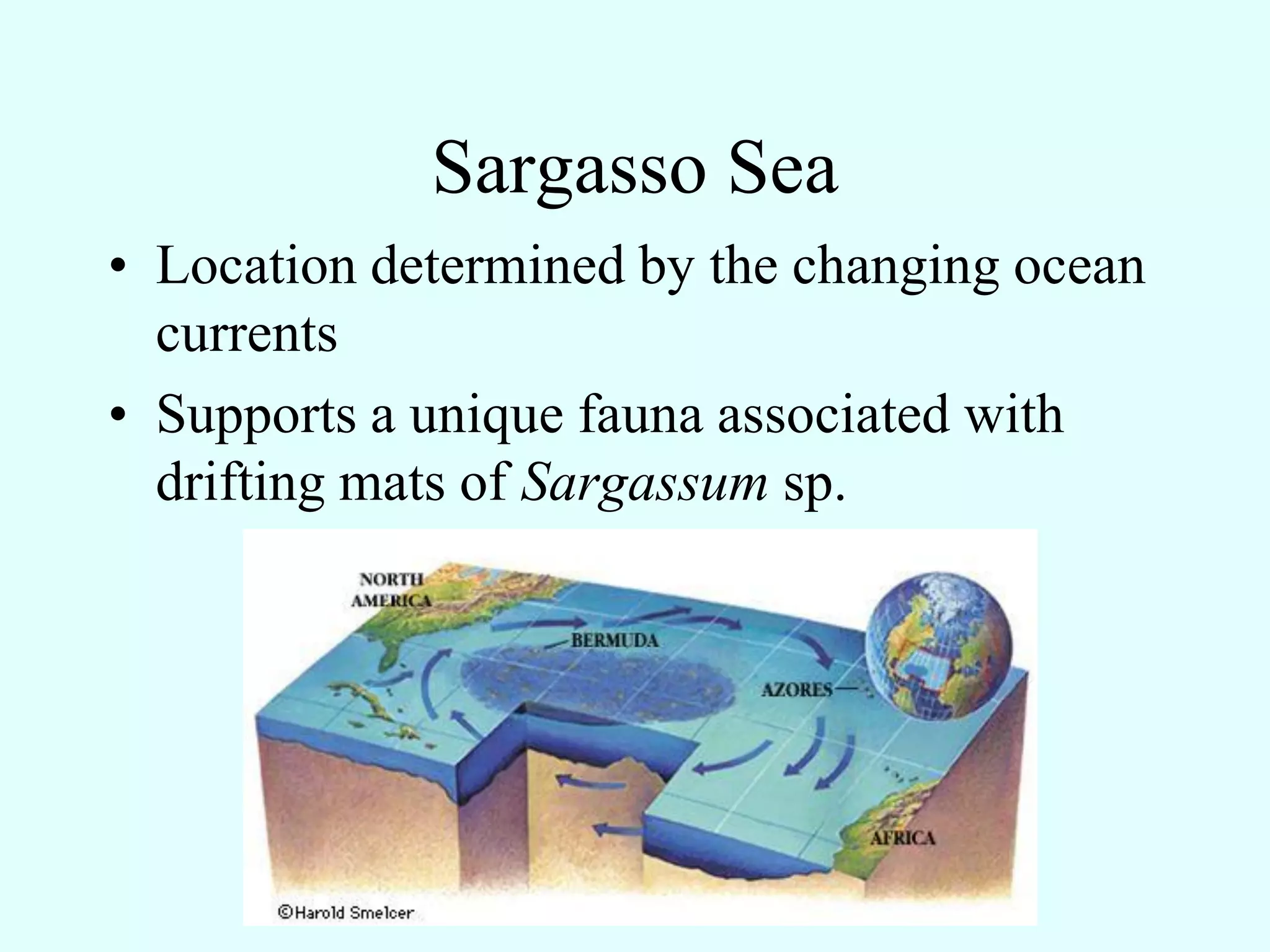
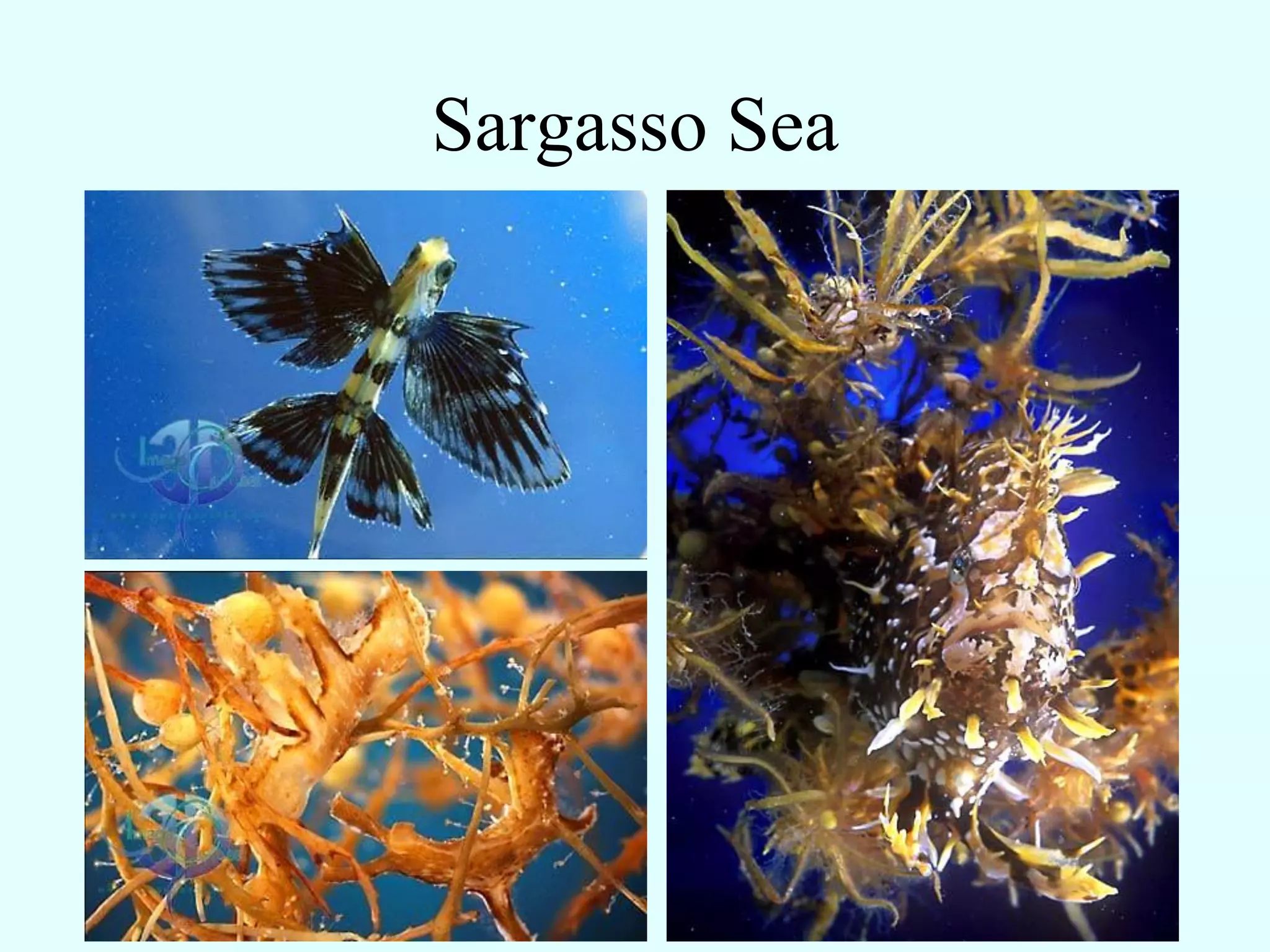
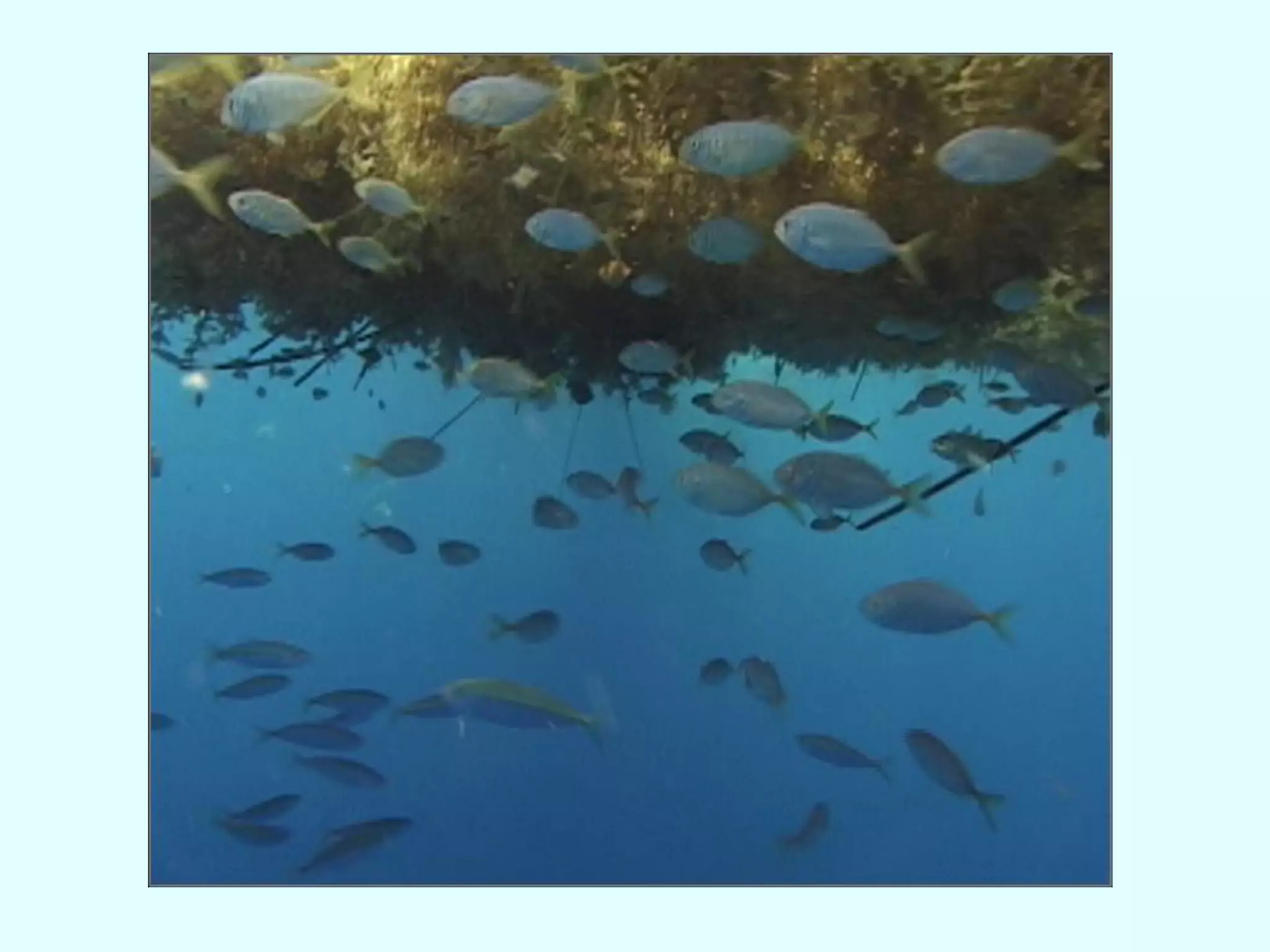
Sargasso Sea
• Location determined by the changing ocean
  currents
• Supports a unique fauna associated with
  drifting mats of Sargassum sp.
Sargasso Sea
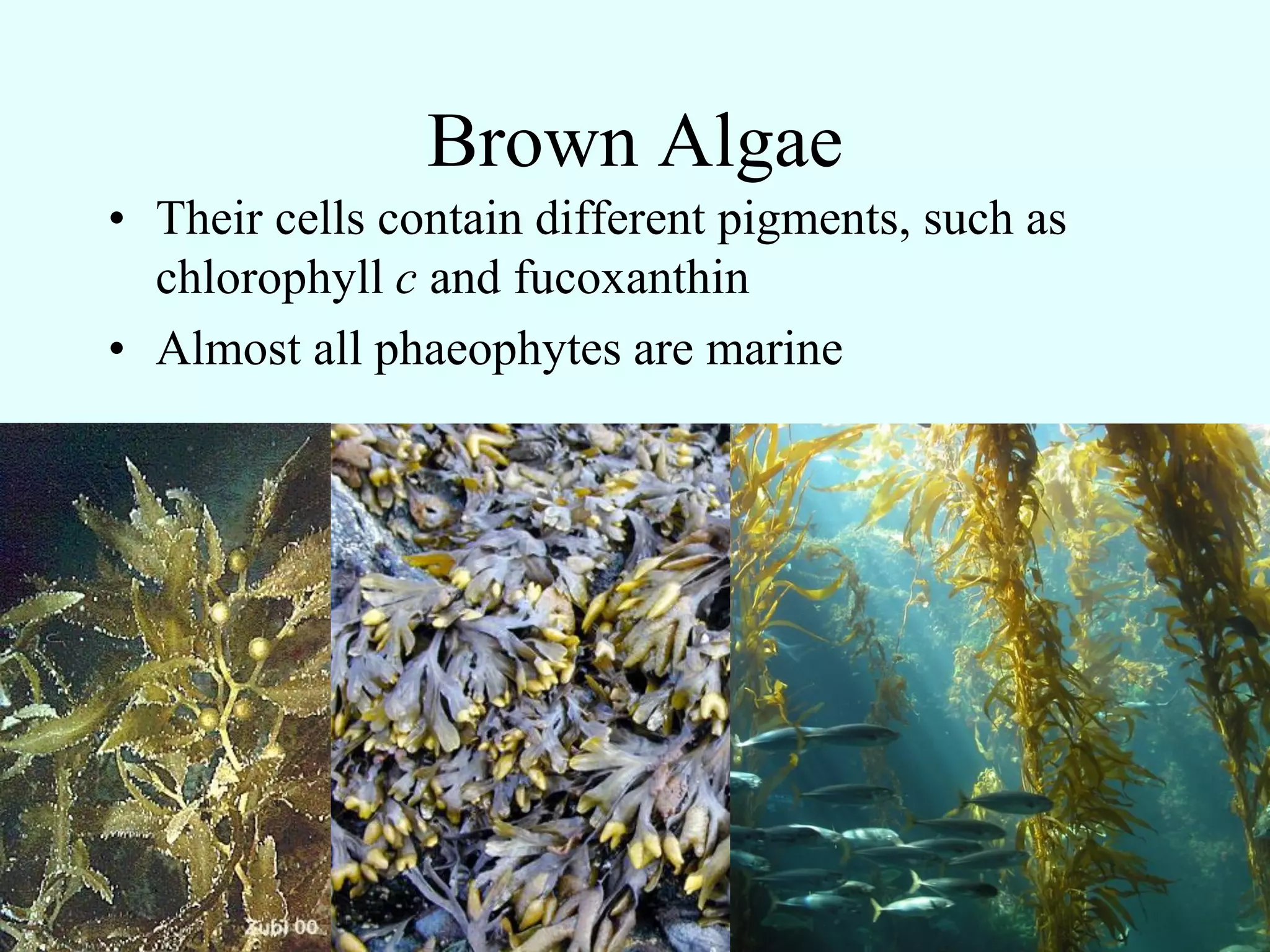
Brown Algae
• Their cells contain different pigments, such as
  chlorophyll c and fucoxanthin
• Almost all phaeophytes are marine
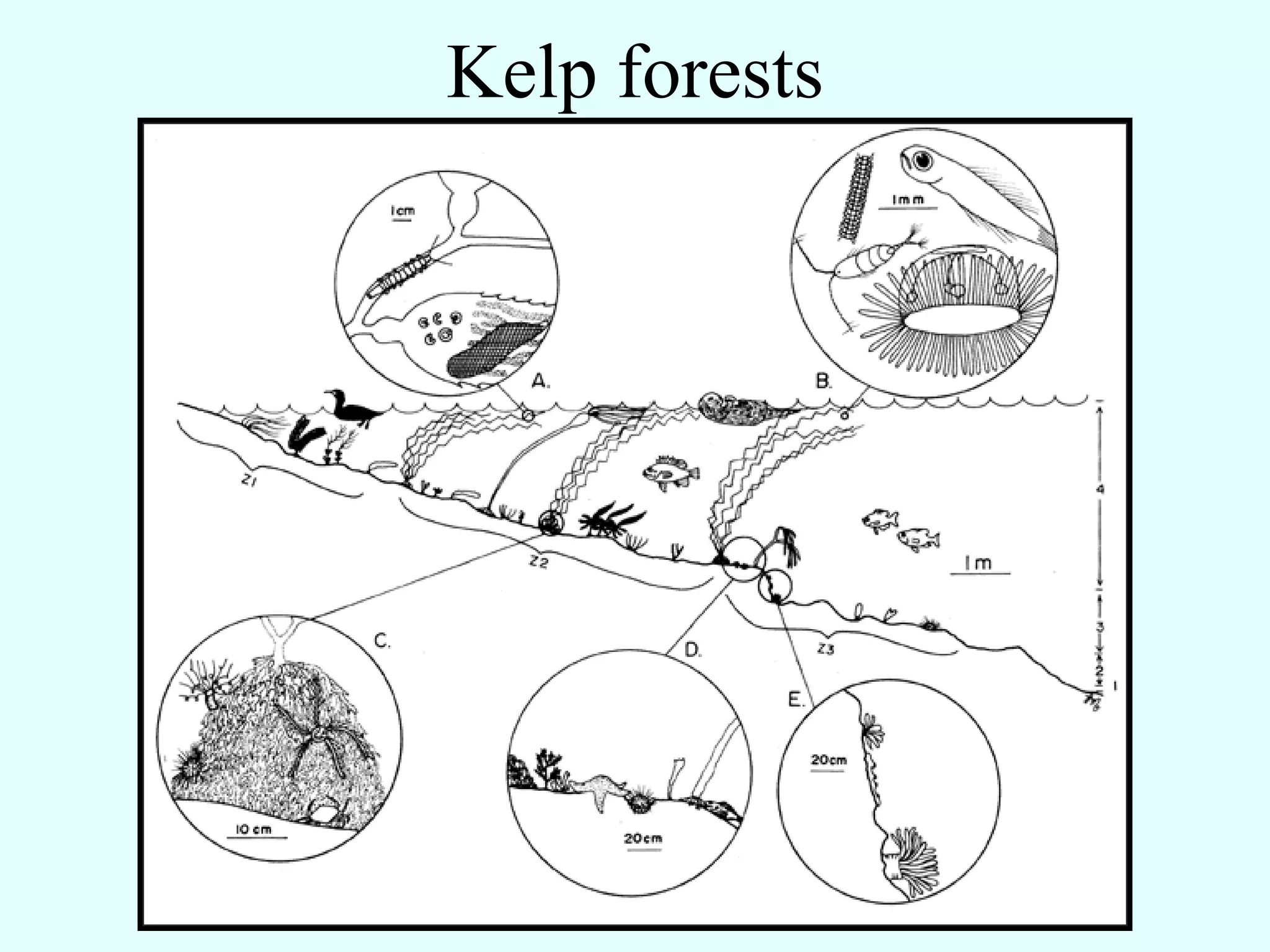
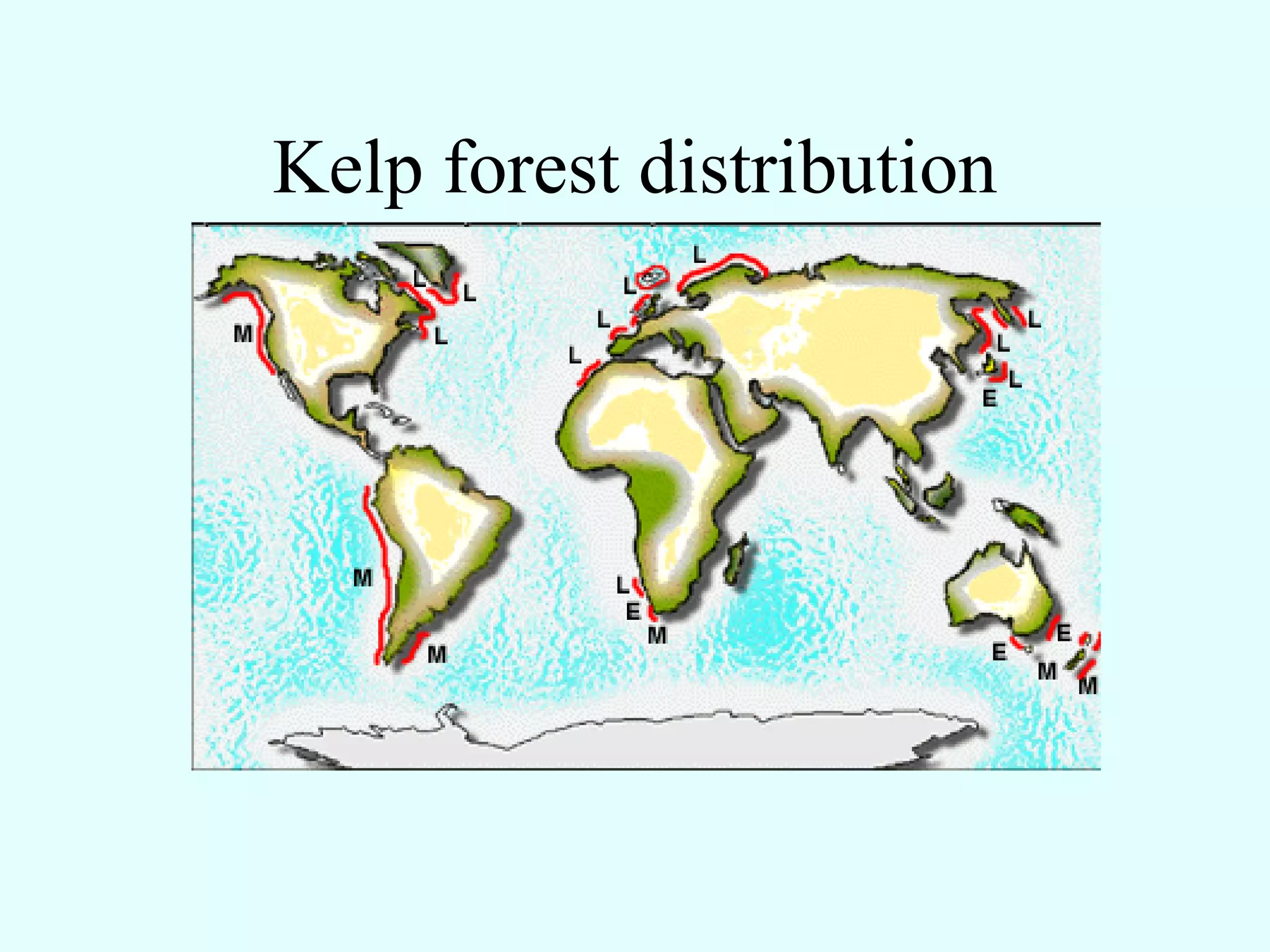
Kelp forests
Kelp forests
Kelp forest distribution
Rhodophyta
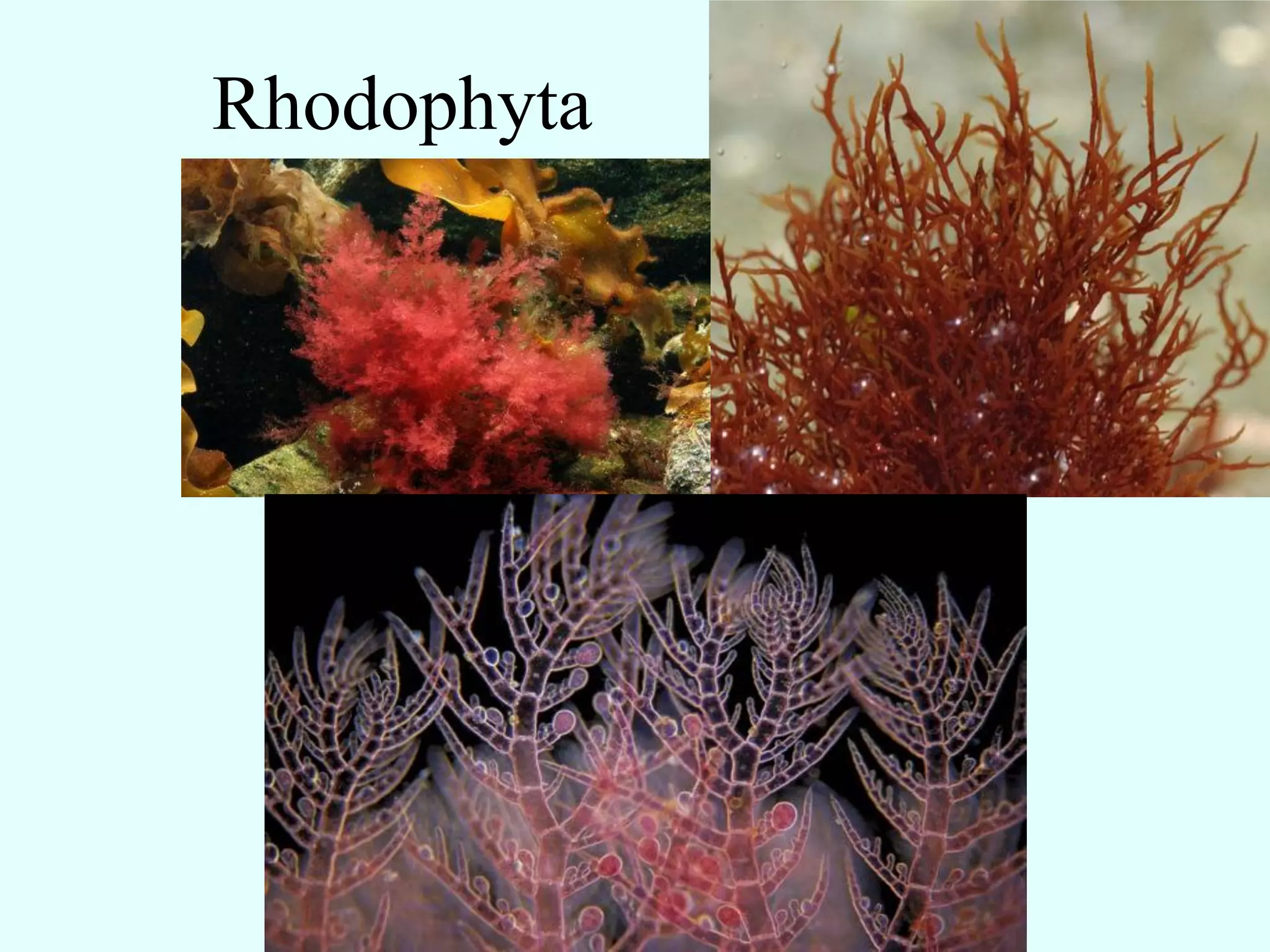
• Highly variable morphologies
• Some members heavily calcified (coralline
  algae) by calcium carbonate in cell walls
• Contain chlorophylls a, d
• Cell wall made of agar or carrageenan
• Store sugars in the form of Floridian starch
Rhodophyta
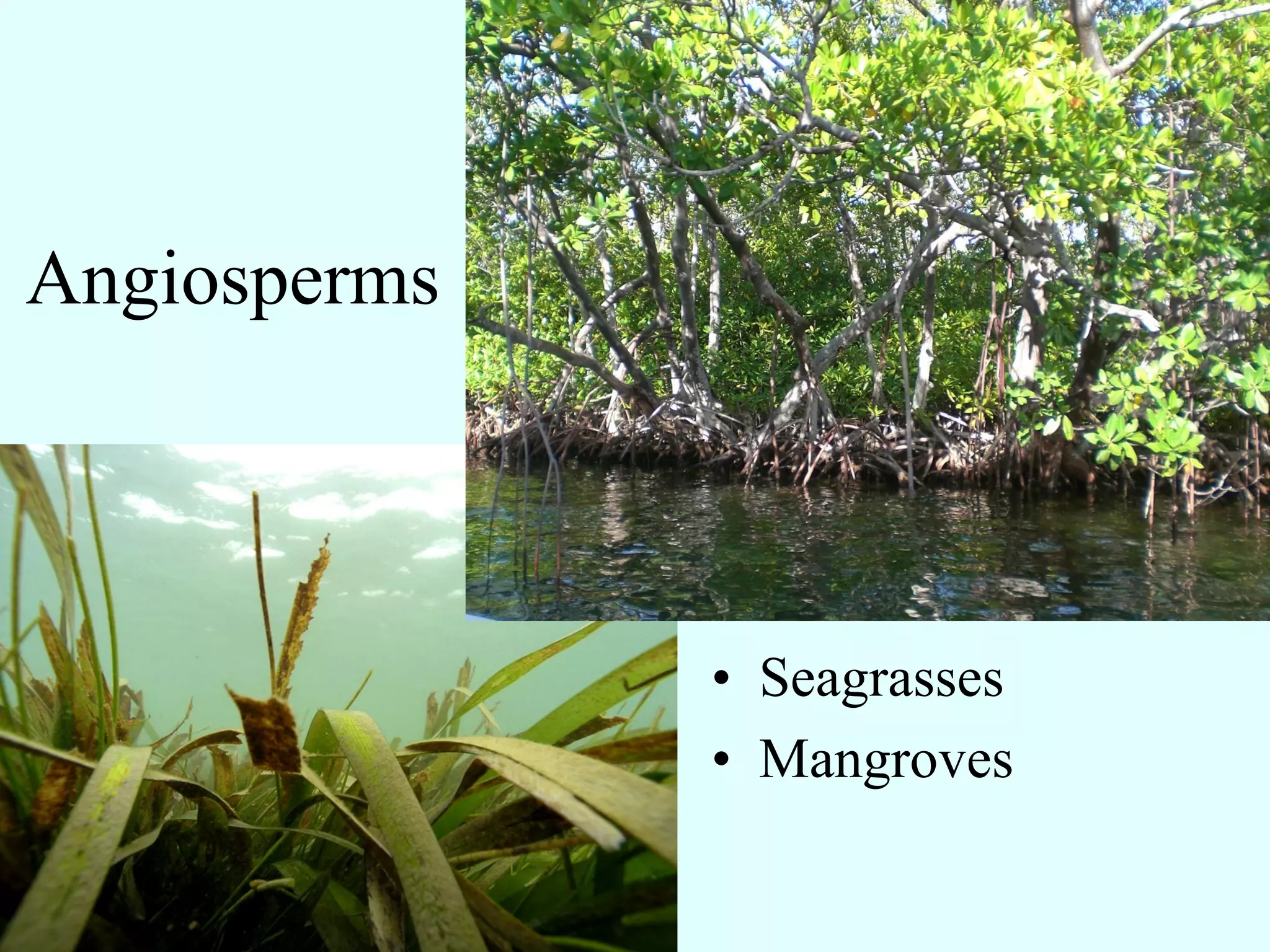
Angiosperms


              • Seagrasses
              • Mangroves
Seagrasses
• 59 species worldwide in 12 genera
• Abundant in Australia, Alaska, S. Europe,
  India, E. Africa, SE Asia, Caribbean, Gulf
  of Mexico
• 7 species found in Caribbean:
    Thalassia, Syringodium, Halodule, Ruppia, Halophila
    engelmanni, H. decipiens, and H. baillonii
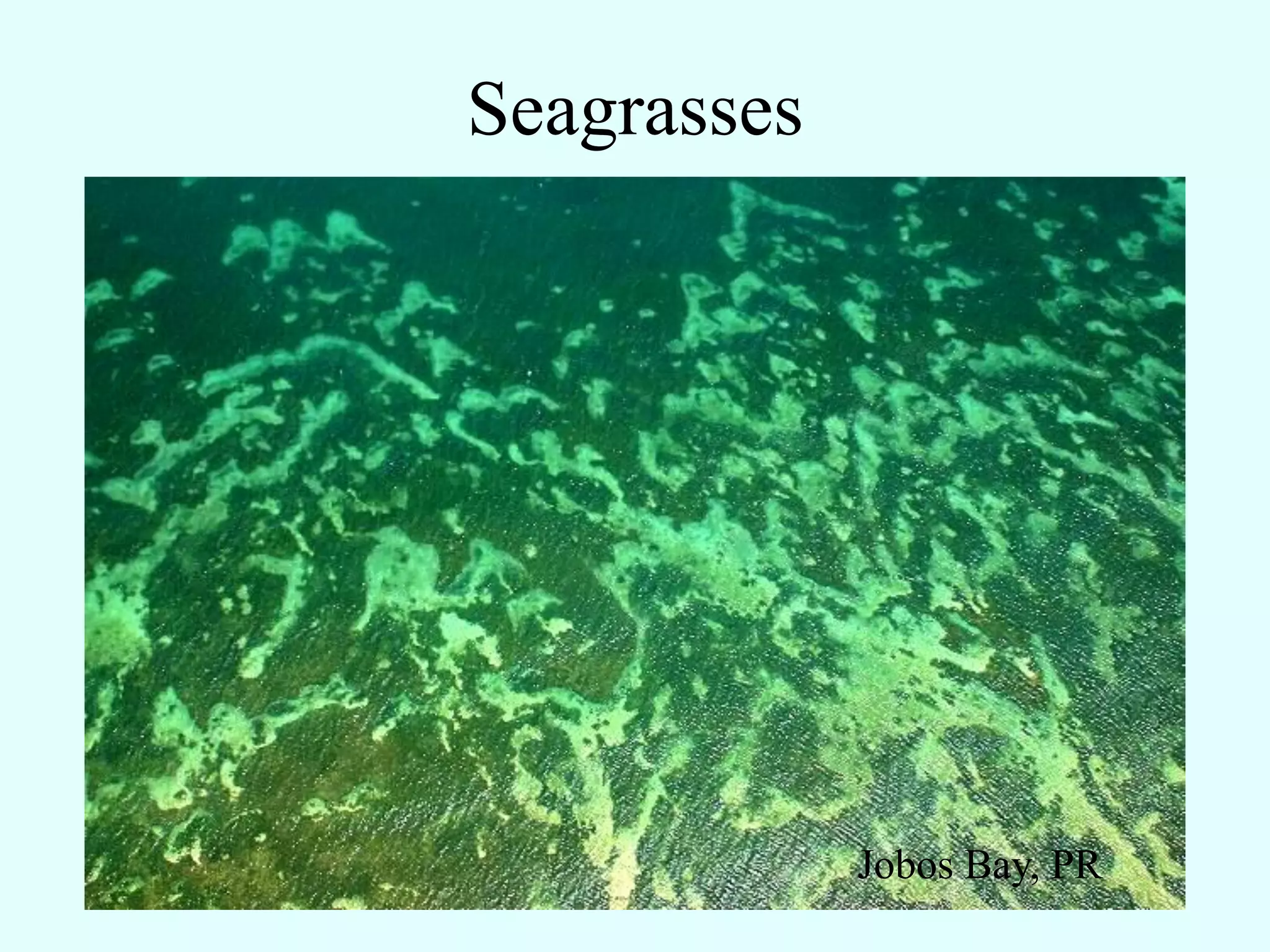
Seagrasses


             Jobos Bay, PR
Functions of seagrass –
      An ecosystem perspective
• Primary production
• Canopy structure
• Epiphyte and epifaunal substratum
• Nutrient, contaminant and sediment filtration and
  trapping
• Below-ground structure
• Nutrient regeneration and recycling
• Wave and current energy damping
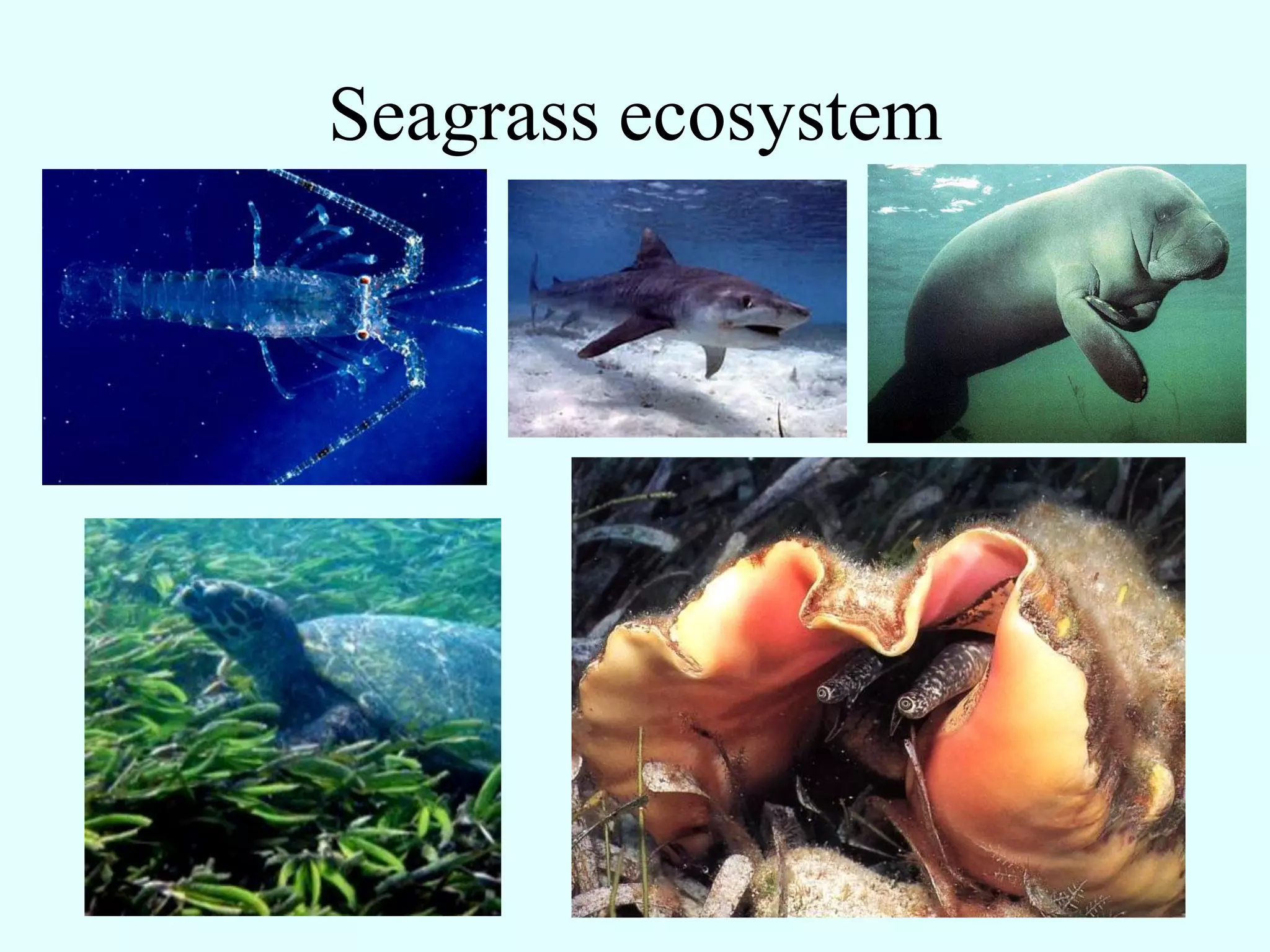
Seagrass ecosystem
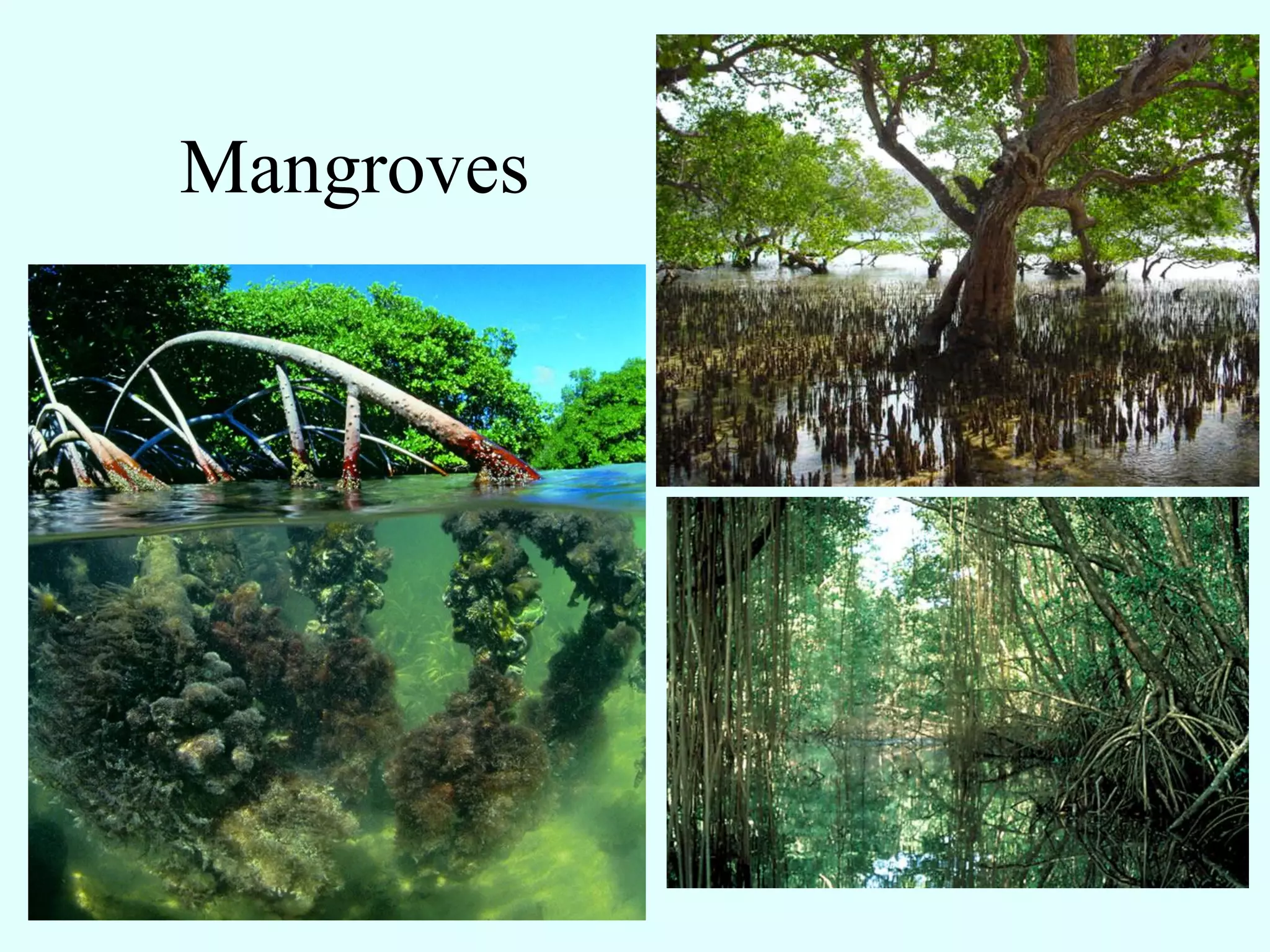
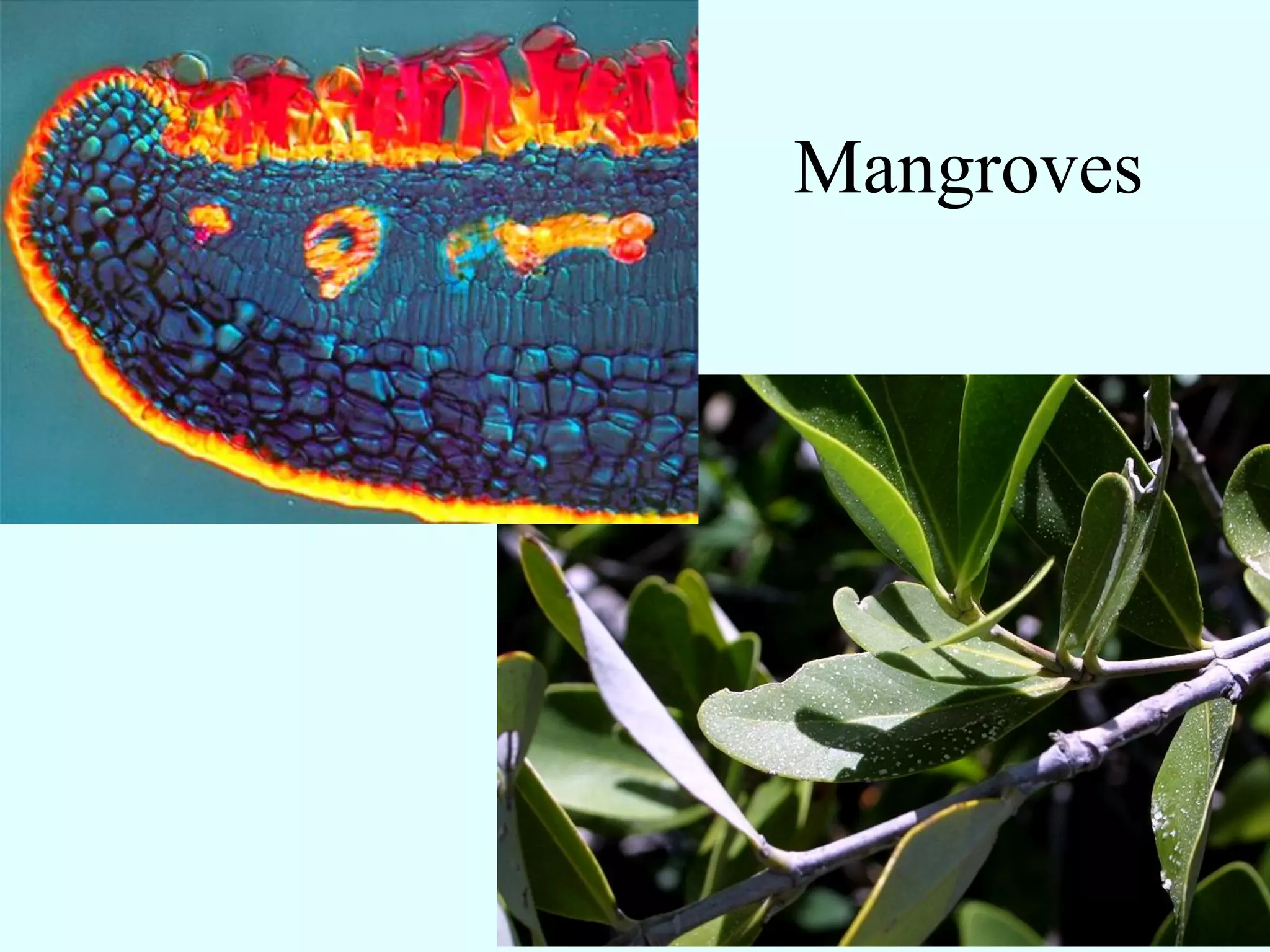
Mangroves
•   Over 60 species worldwide
•   Mainly limited to tropics in the intertidal
•   Indo-West Pacific has highest diversity
•   Important in island formation
•   4 species found in Caribbean:
    Rhizophora mangle (Red mangroves),
    Avicennia germinant (Black mangroves),
    Laguncularia racemosa (White mangroves), and
    Conocarpus erectus (Buttonwood mangroves)
Mangroves
Mangroves
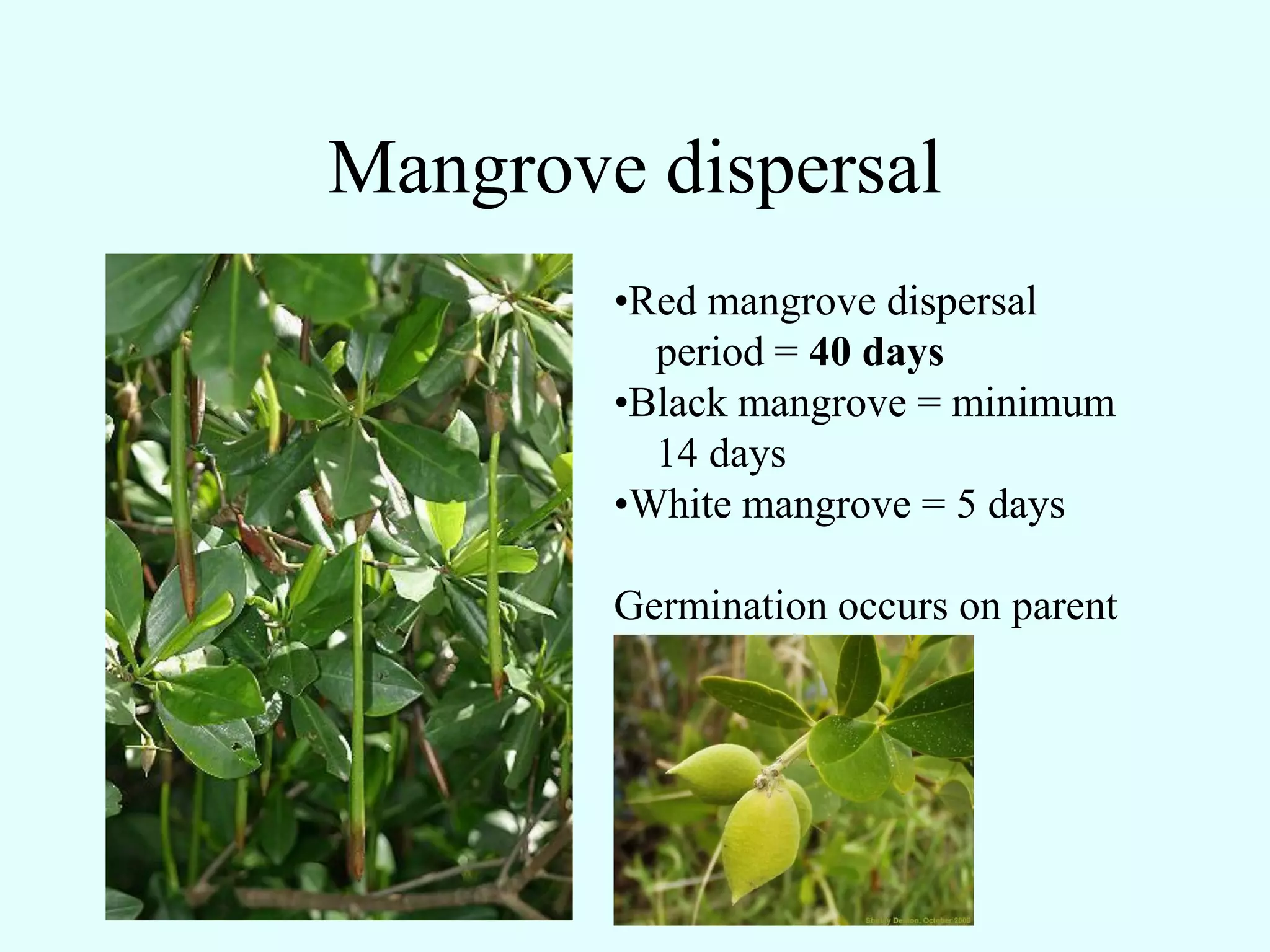
Mangrove dispersal
        •Red mangrove dispersal
          period = 40 days
        •Black mangrove = minimum
          14 days
        •White mangrove = 5 days

        Germination occurs on parent
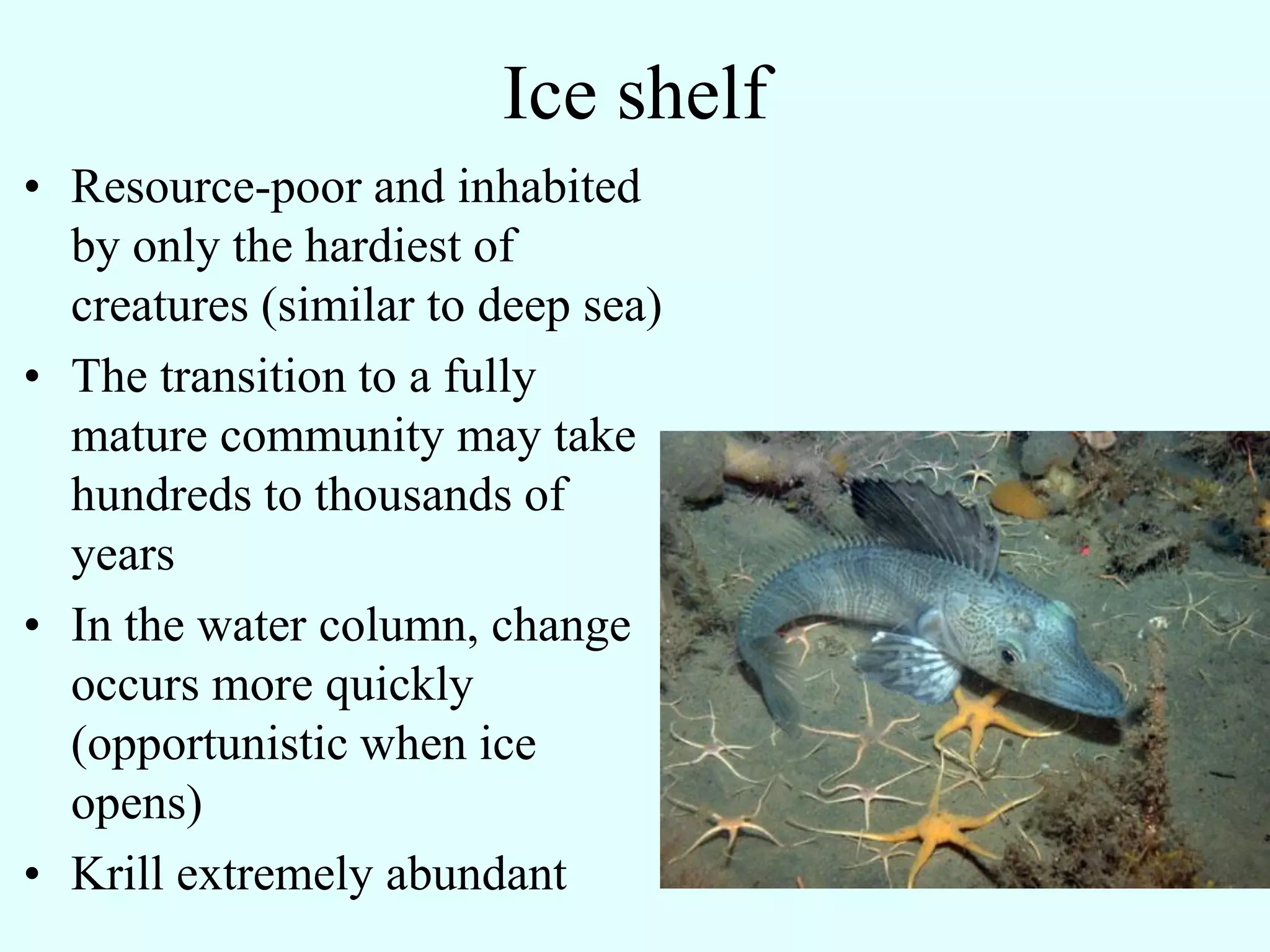
Ice shelf
• Resource-poor and inhabited
  by only the hardiest of
  creatures (similar to deep sea)
• The transition to a fully
  mature community may take
  hundreds to thousands of
  years
• In the water column, change
  occurs more quickly
  (opportunistic when ice
  opens)
• Krill extremely abundant
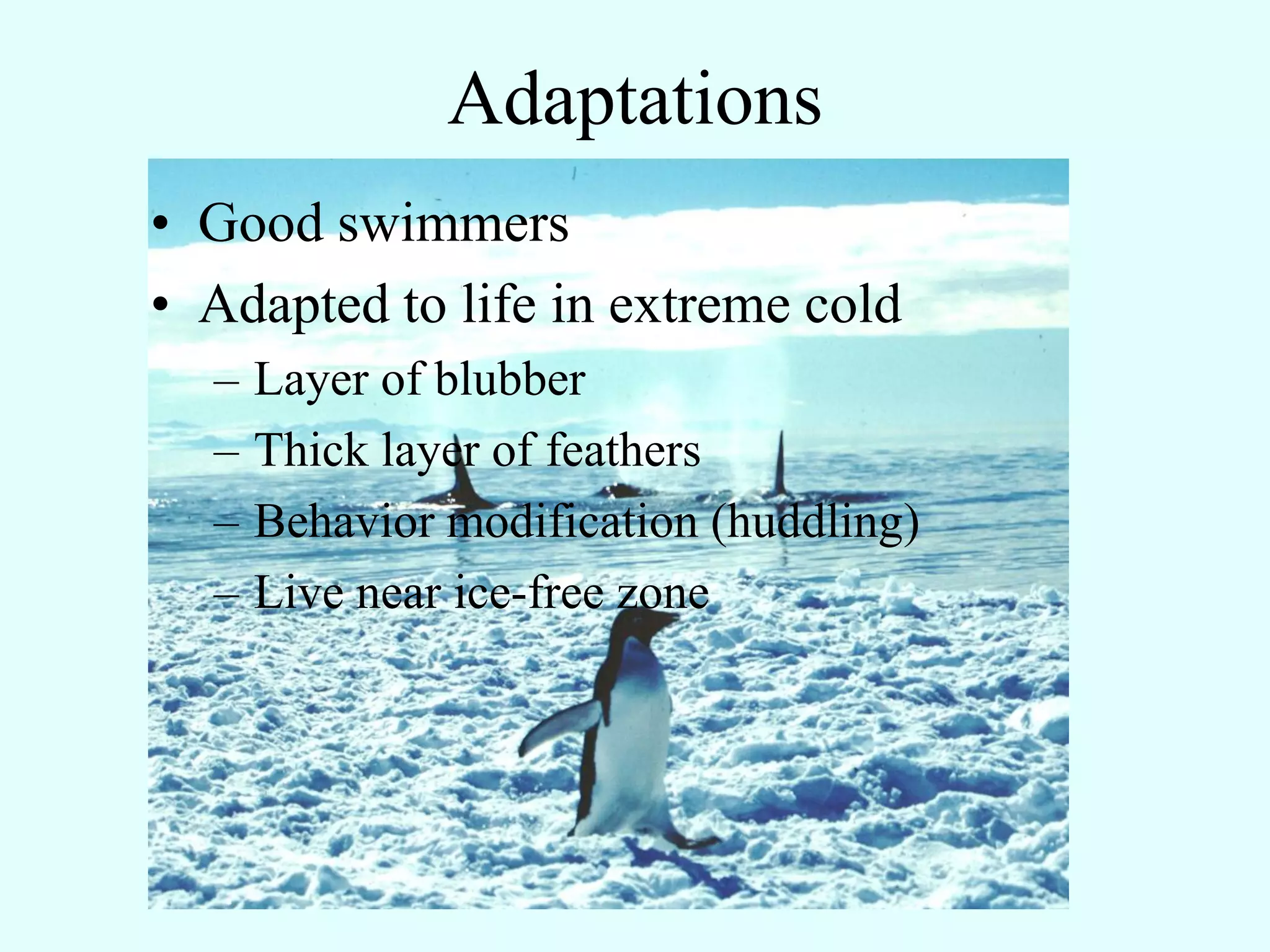
Adaptations
• Good swimmers
• Adapted to life in extreme cold
  –   Layer of blubber
  –   Thick layer of feathers
  –   Behavior modification (huddling)
  –   Live near ice-free zone
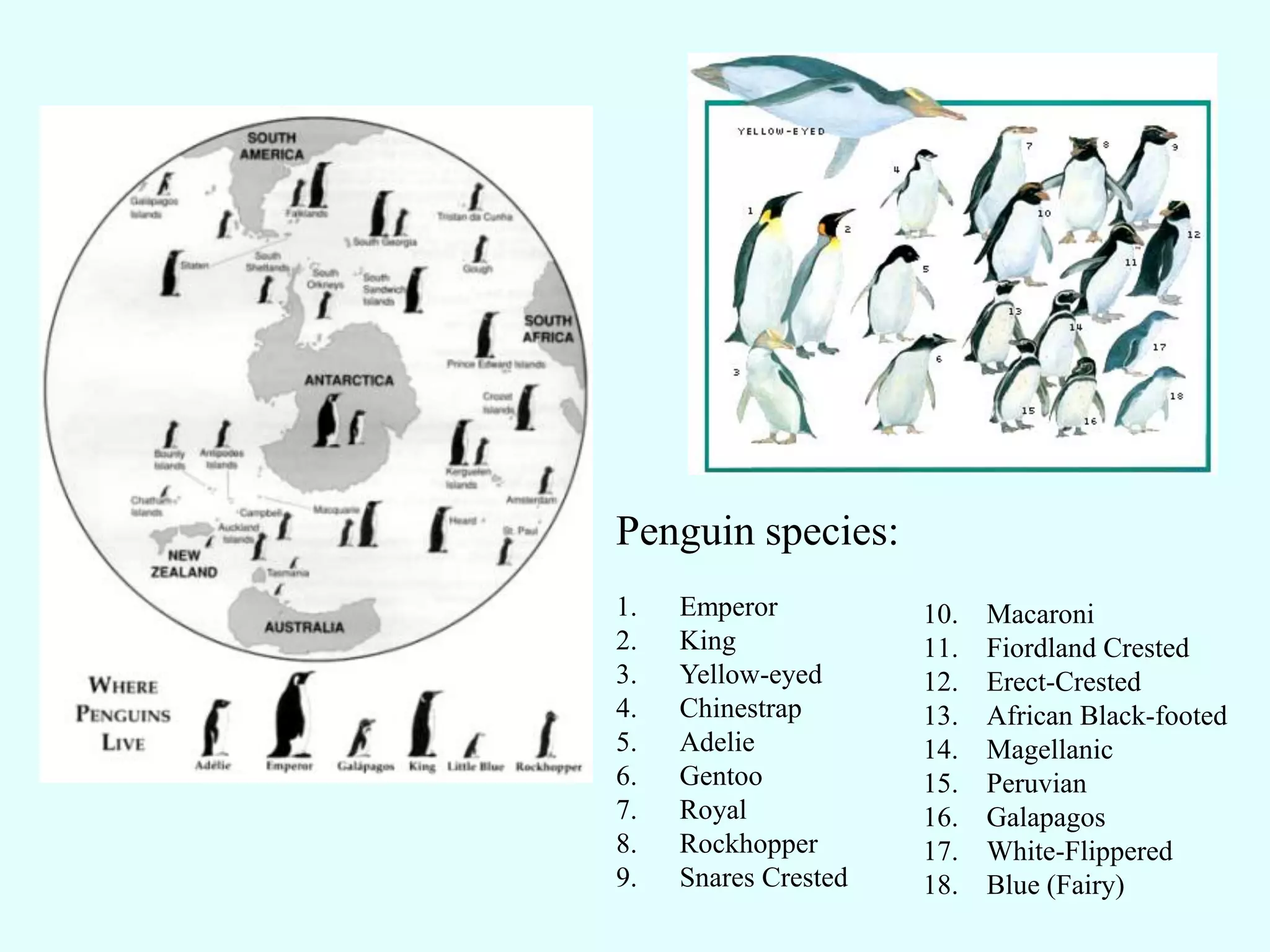
Penguin species:
1.   Emperor          10.   Macaroni
2.   King             11.   Fiordland Crested
3.   Yellow-eyed      12.   Erect-Crested
4.   Chinestrap       13.   African Black-footed
5.   Adelie           14.   Magellanic
6.   Gentoo           15.   Peruvian
7.   Royal            16.   Galapagos
8.   Rockhopper       17.   White-Flippered
9.   Snares Crested   18.   Blue (Fairy)
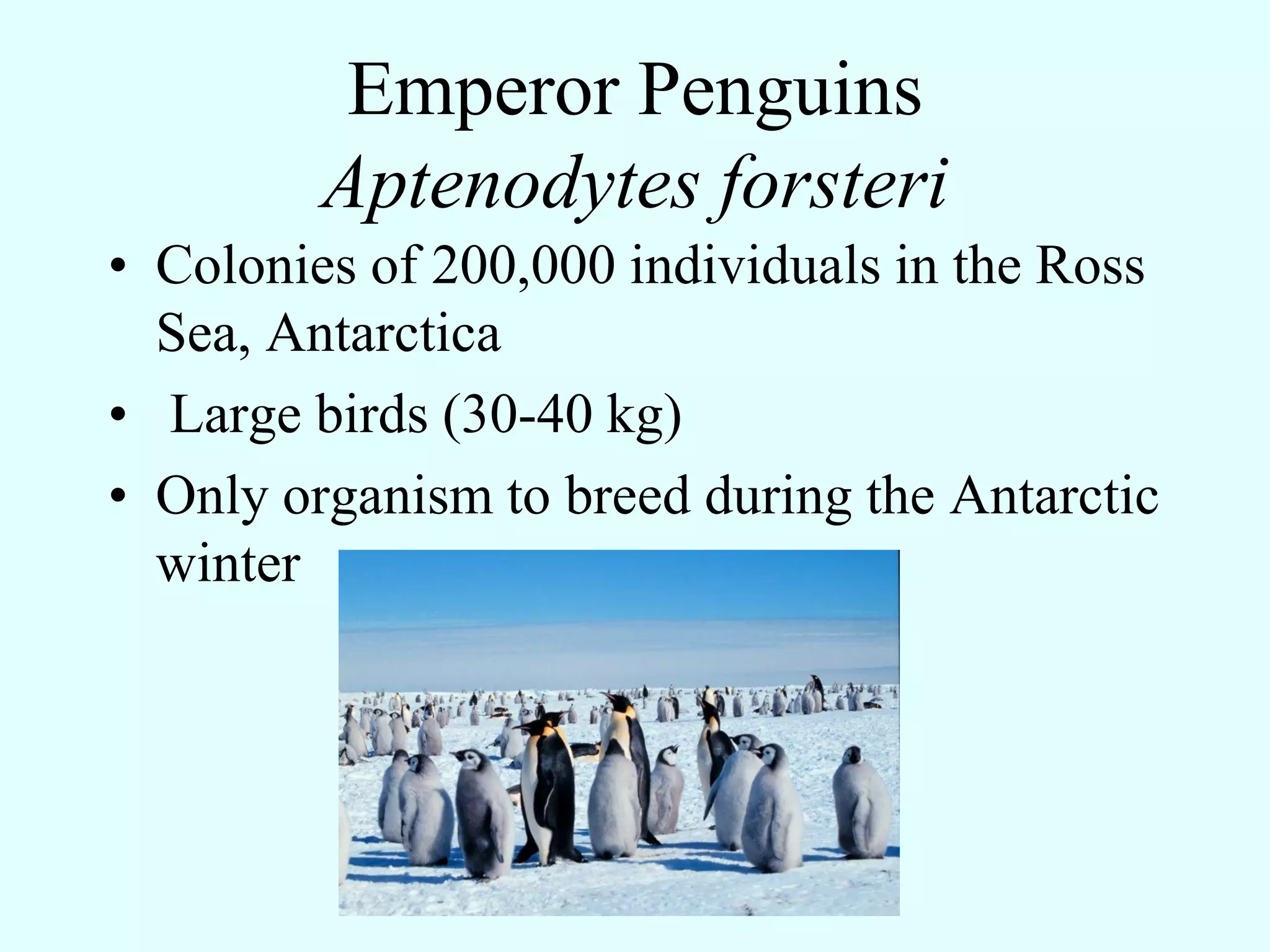
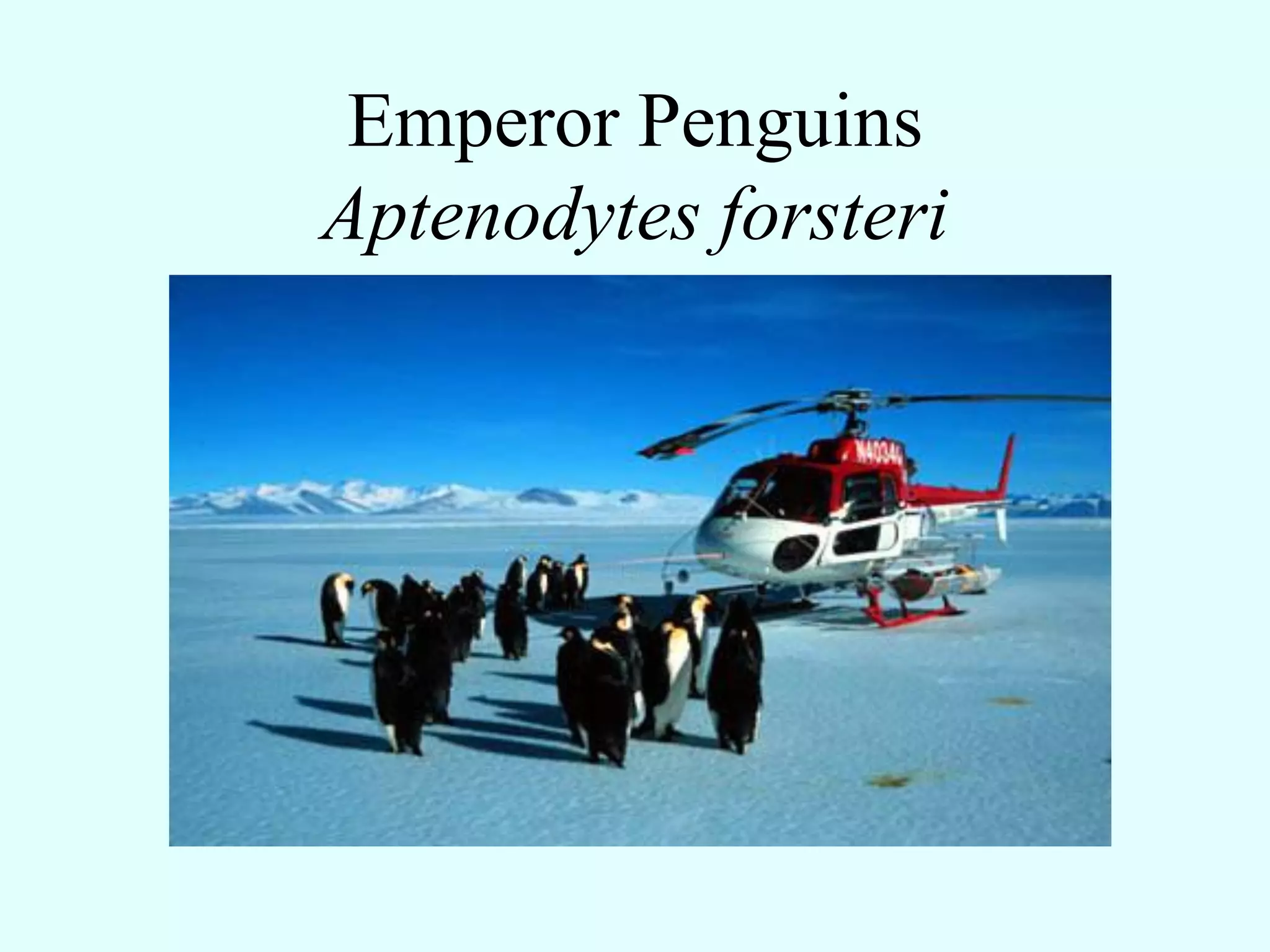
Emperor Penguins
         Aptenodytes forsteri
• Colonies of 200,000 individuals in the Ross
  Sea, Antarctica
• Large birds (30-40 kg)
• Only organism to breed during the Antarctic
  winter
Emperor Penguins
Aptenodytes forsteri
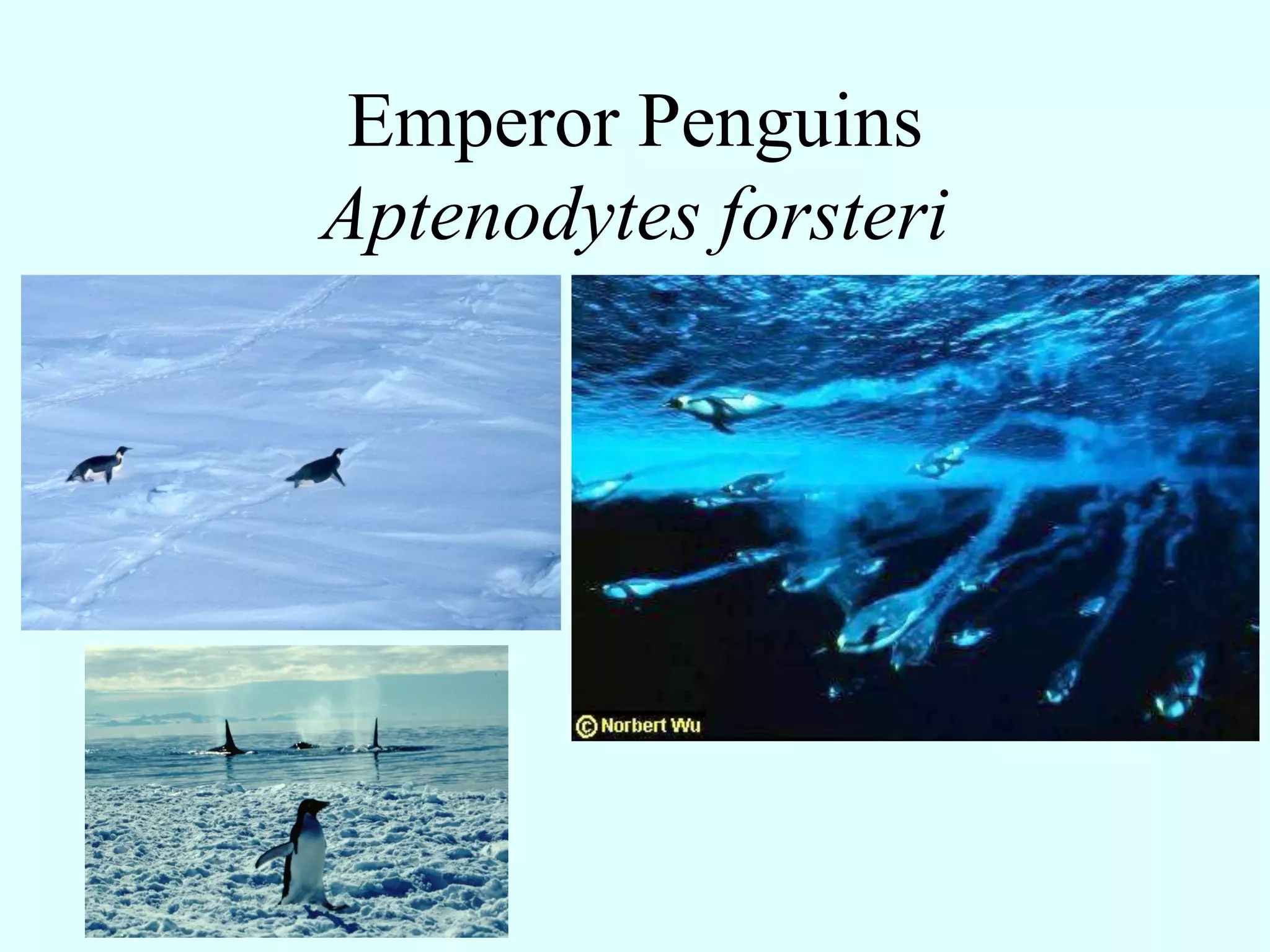
Emperor Penguins
Aptenodytes forsteri
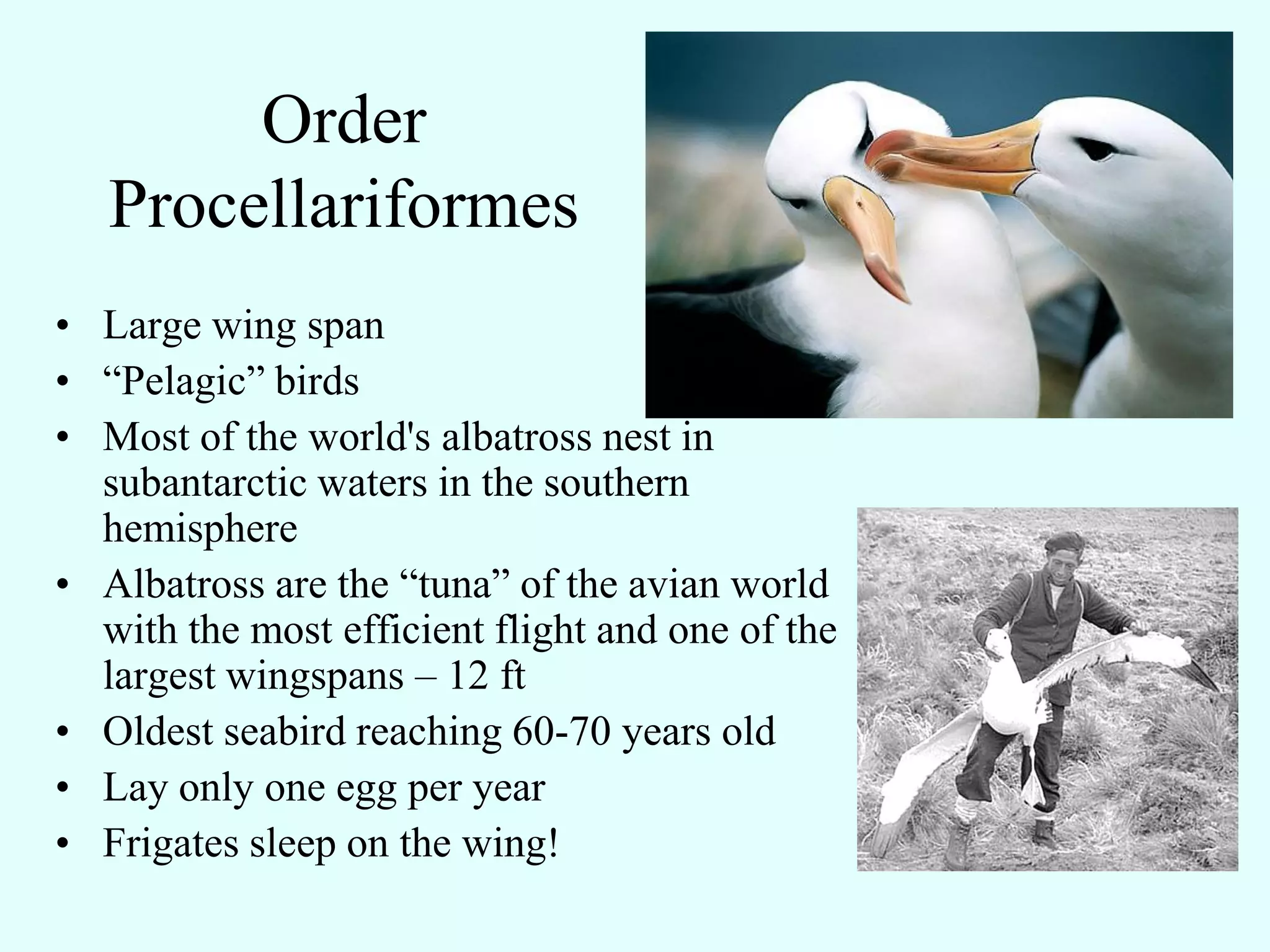
Order
   Procellariformes
• Large wing span
• “Pelagic” birds
• Most of the world's albatross nest in
  subantarctic waters in the southern
  hemisphere
• Albatross are the “tuna” of the avian world
  with the most efficient flight and one of the
  largest wingspans – 12 ft
• Oldest seabird reaching 60-70 years old
• Lay only one egg per year
• Frigates sleep on the wing!
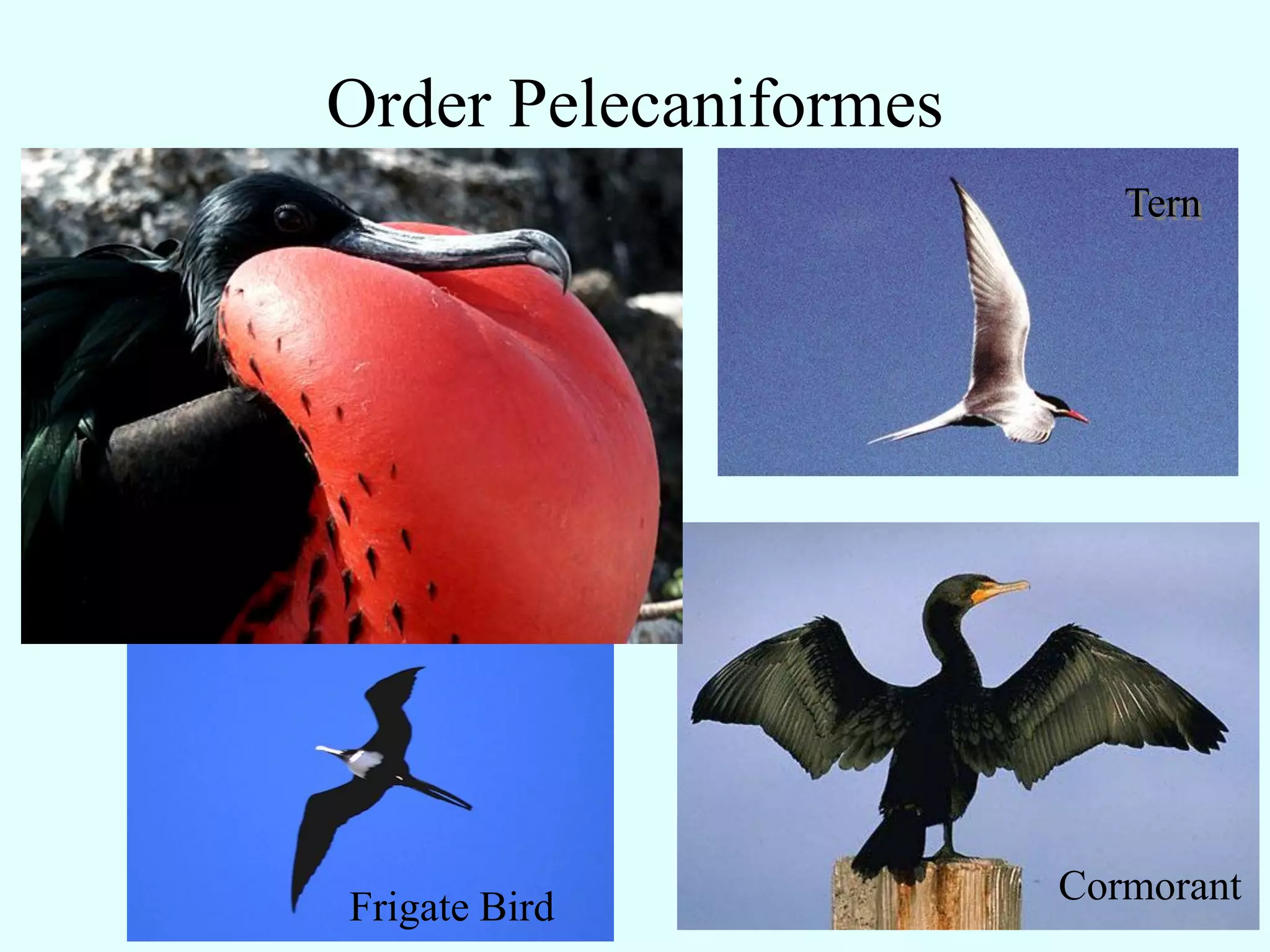
Order Pelecaniformes
                          Tern


                       Cormorant
Frigate Bird
Order
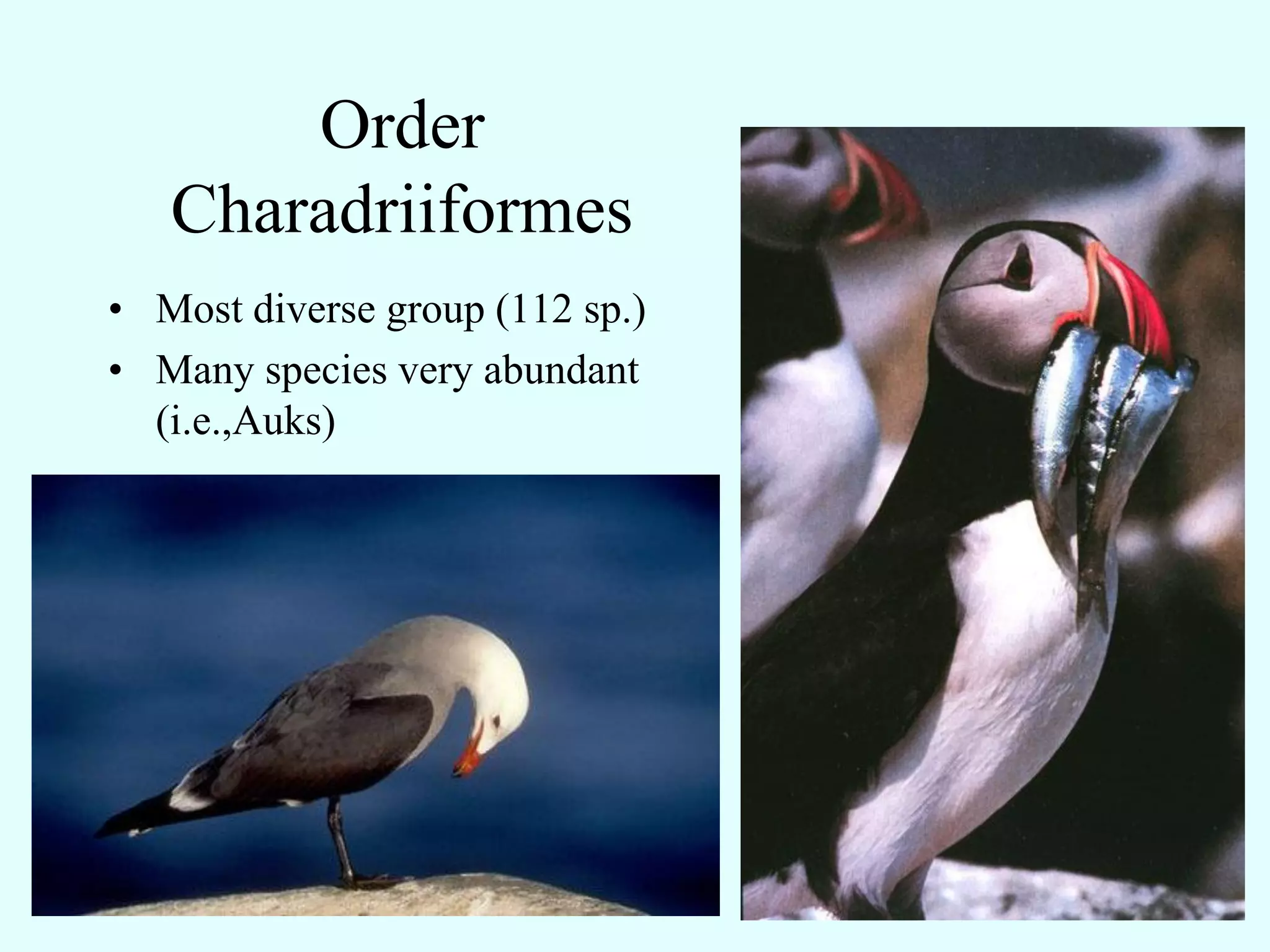
   Charadriiformes
• Most diverse group (112 sp.)
• Many species very abundant
  (i.e.,Auks)
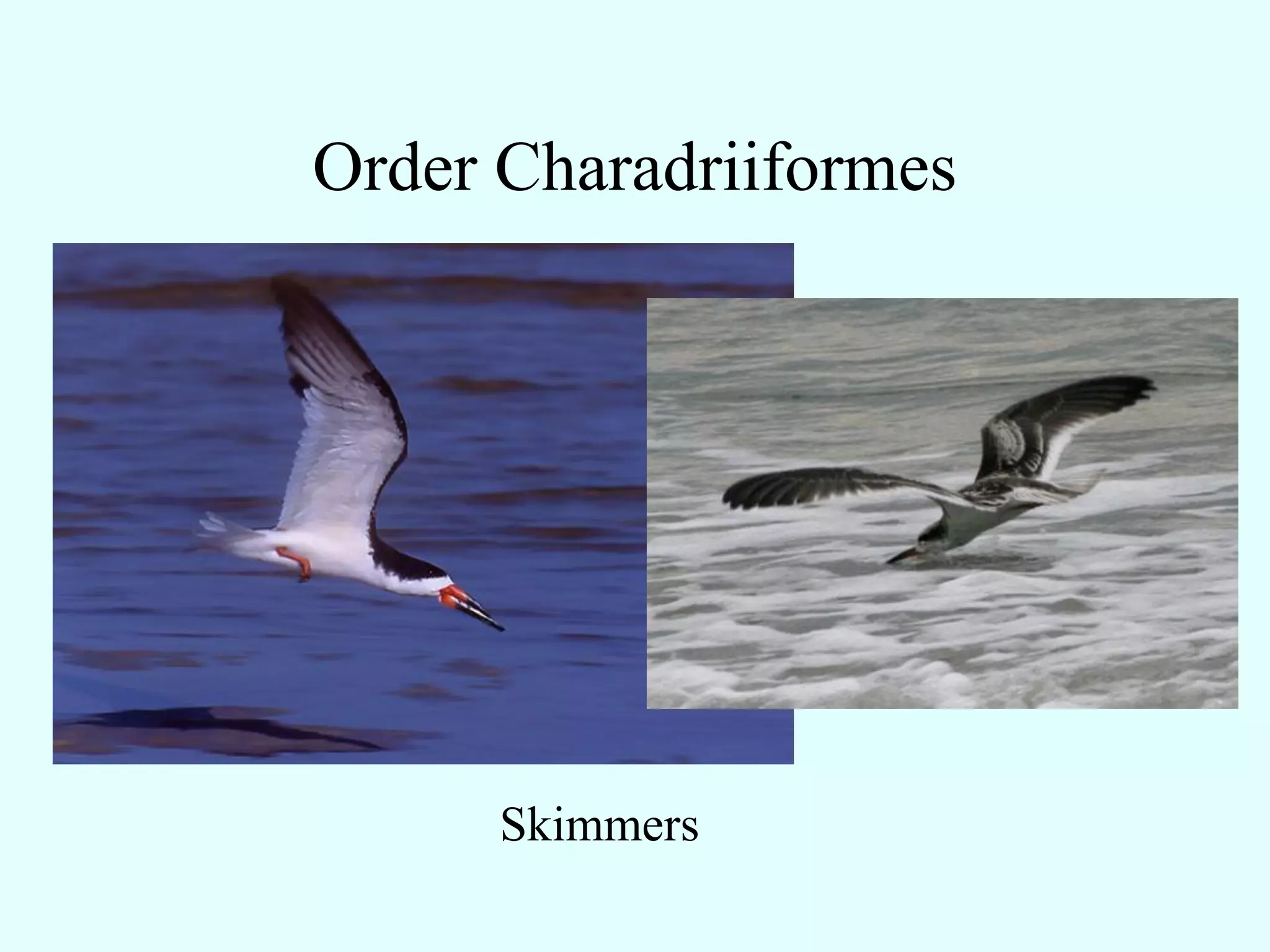
Order Charadriiformes


      Skimmers
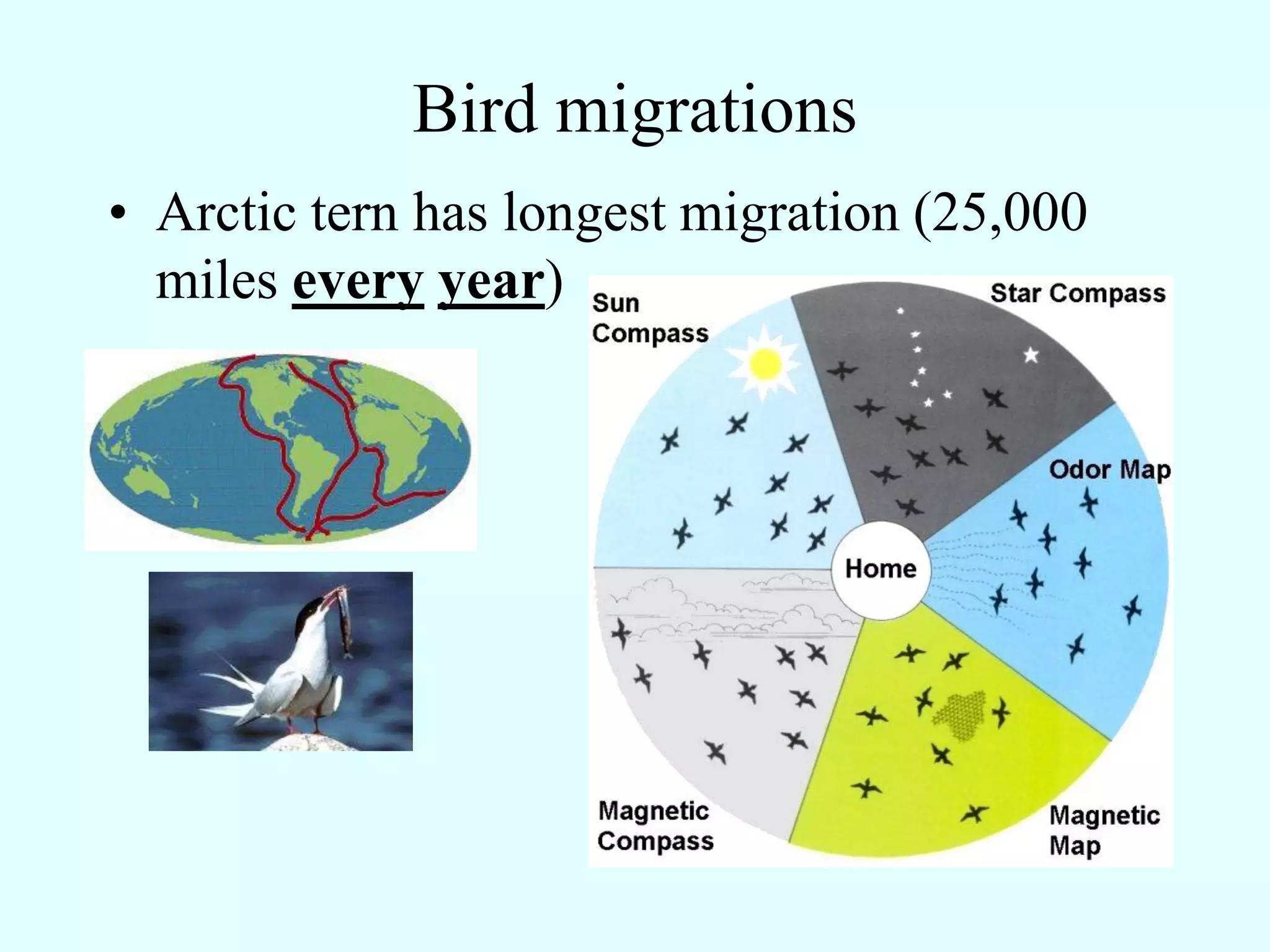
Bird migrations
• Arctic tern has longest migration (25,000
  miles every year)
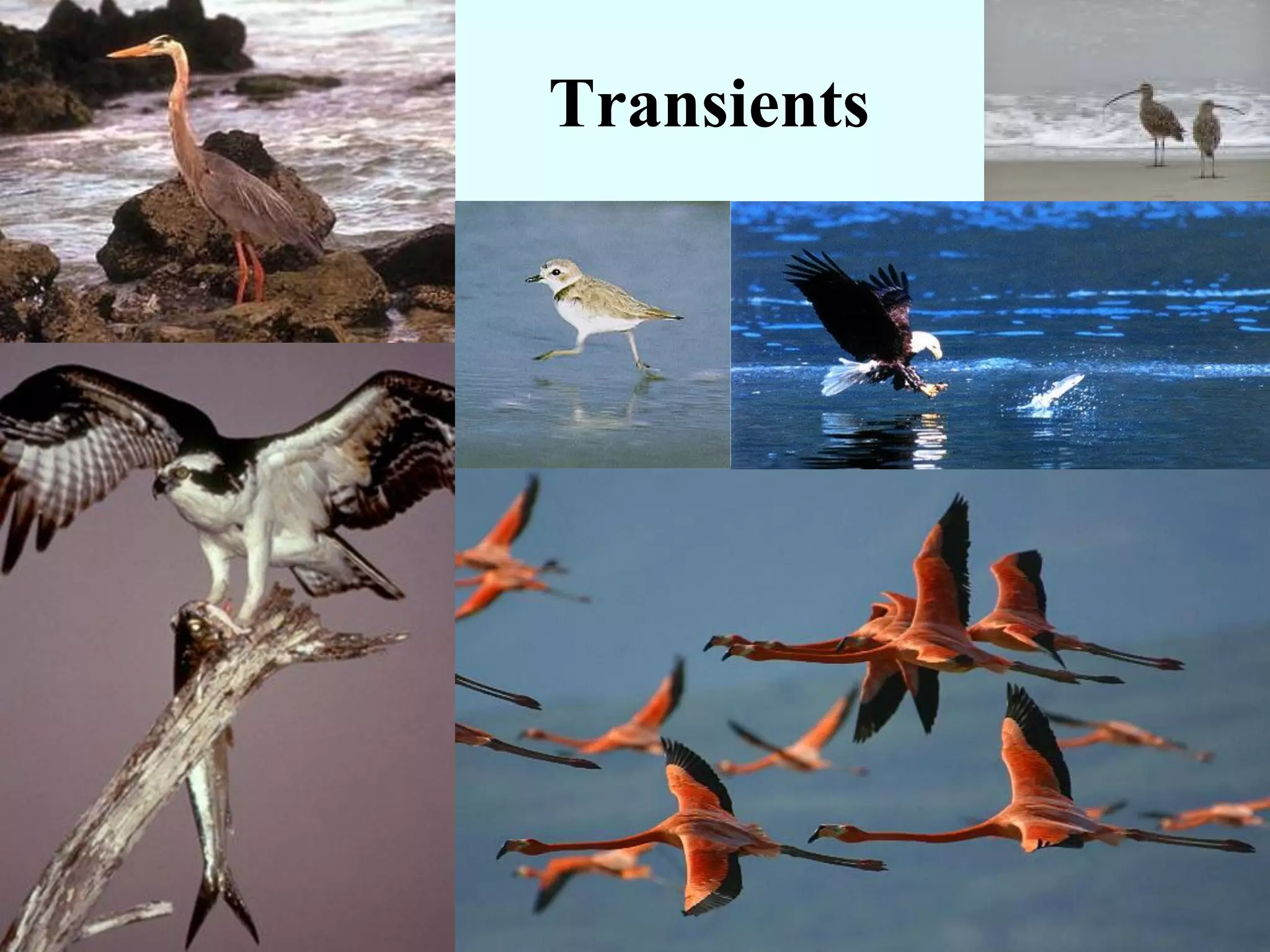
Transients
Marine Mammals
• Order Carnivora
  – Suborder Fissipedia (dogs, cats, weasels, sea otters,
    polar bears)
  – Suborder Pinnipedia (seals and sea lions)
• Order Cetacea (whales and dolphins)
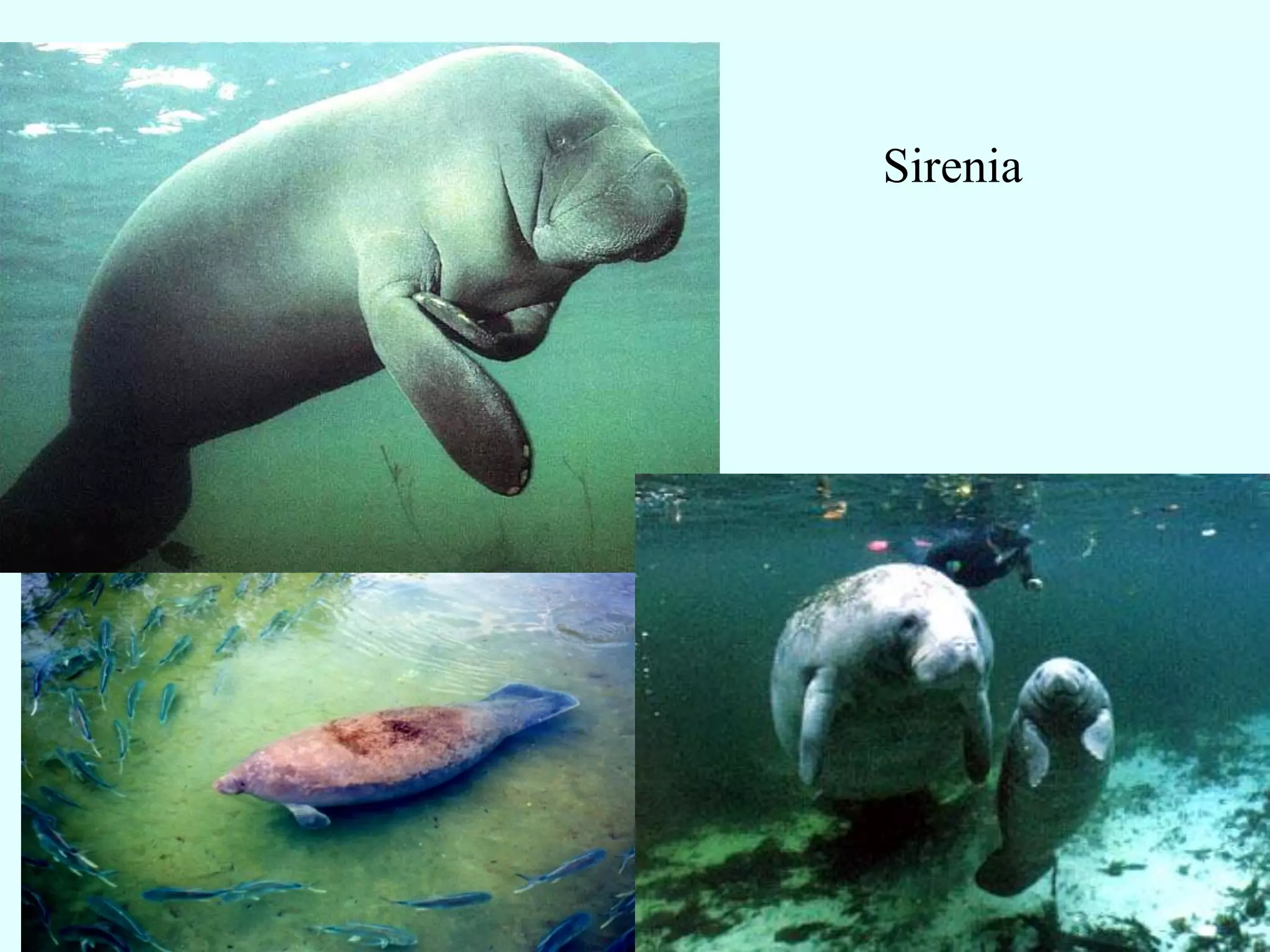
• Order Sirenia
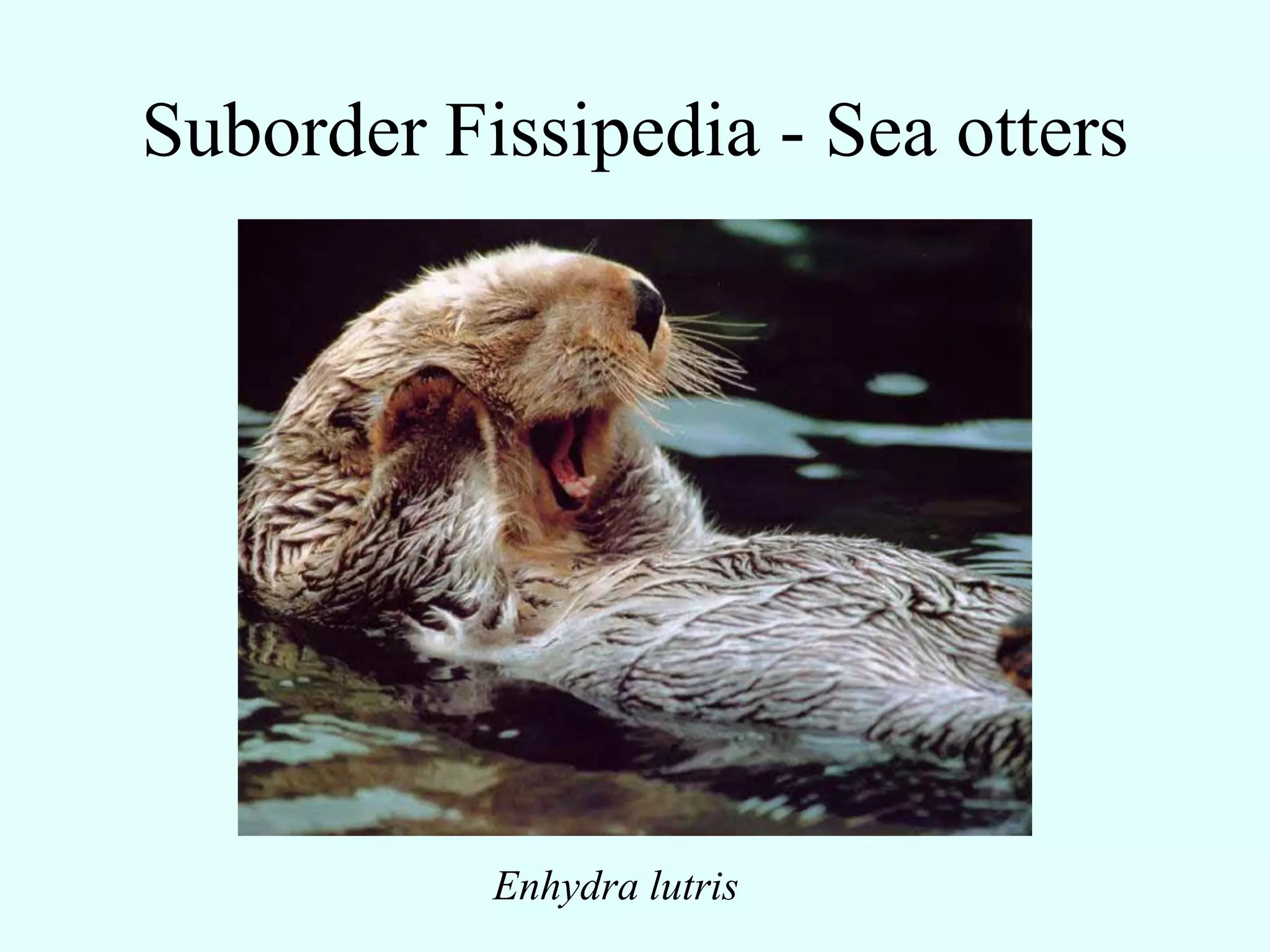
Suborder Fissipedia - Sea otters


           Enhydra lutris
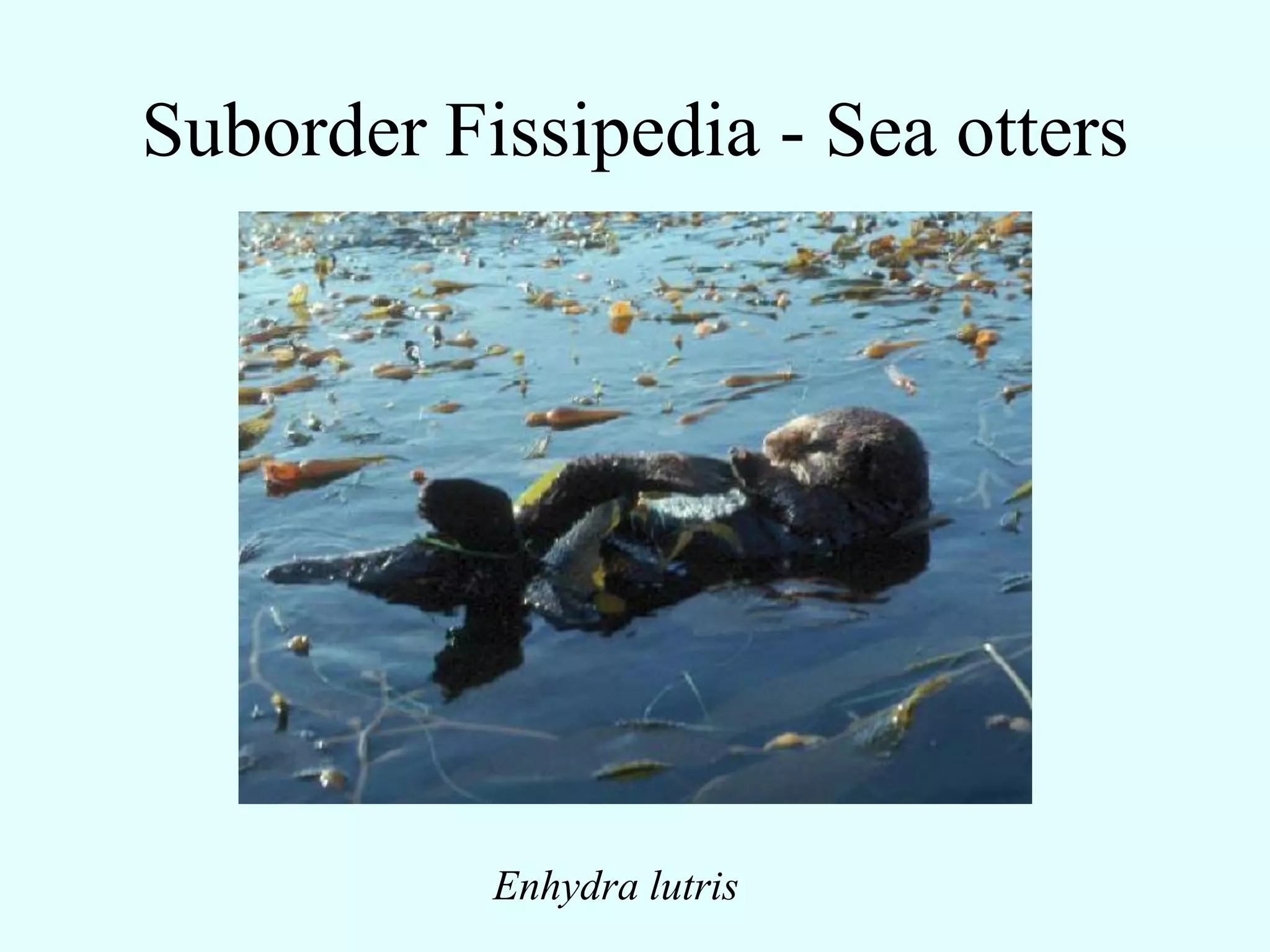
Suborder Fissipedia - Sea otters


           Enhydra lutris
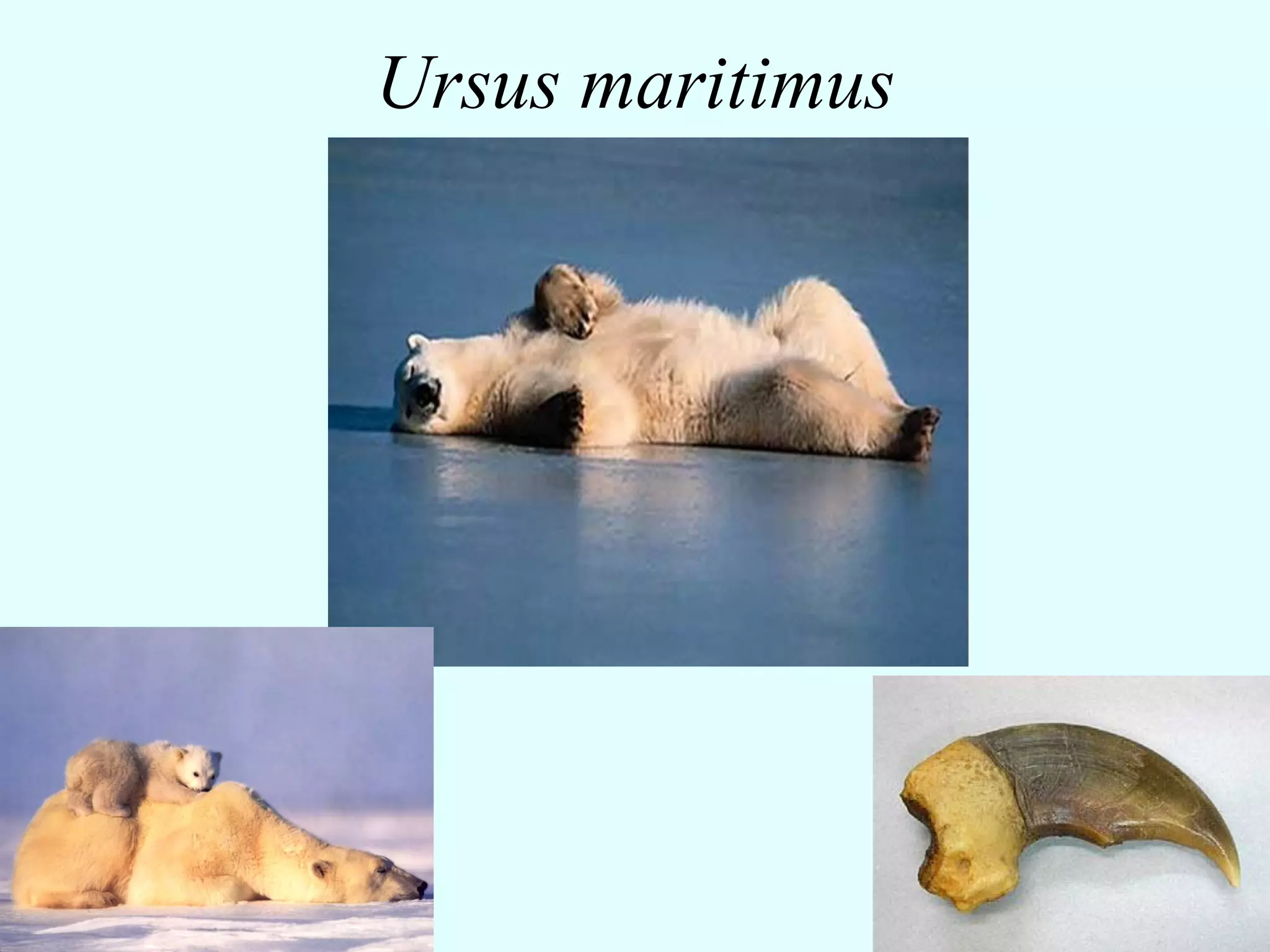
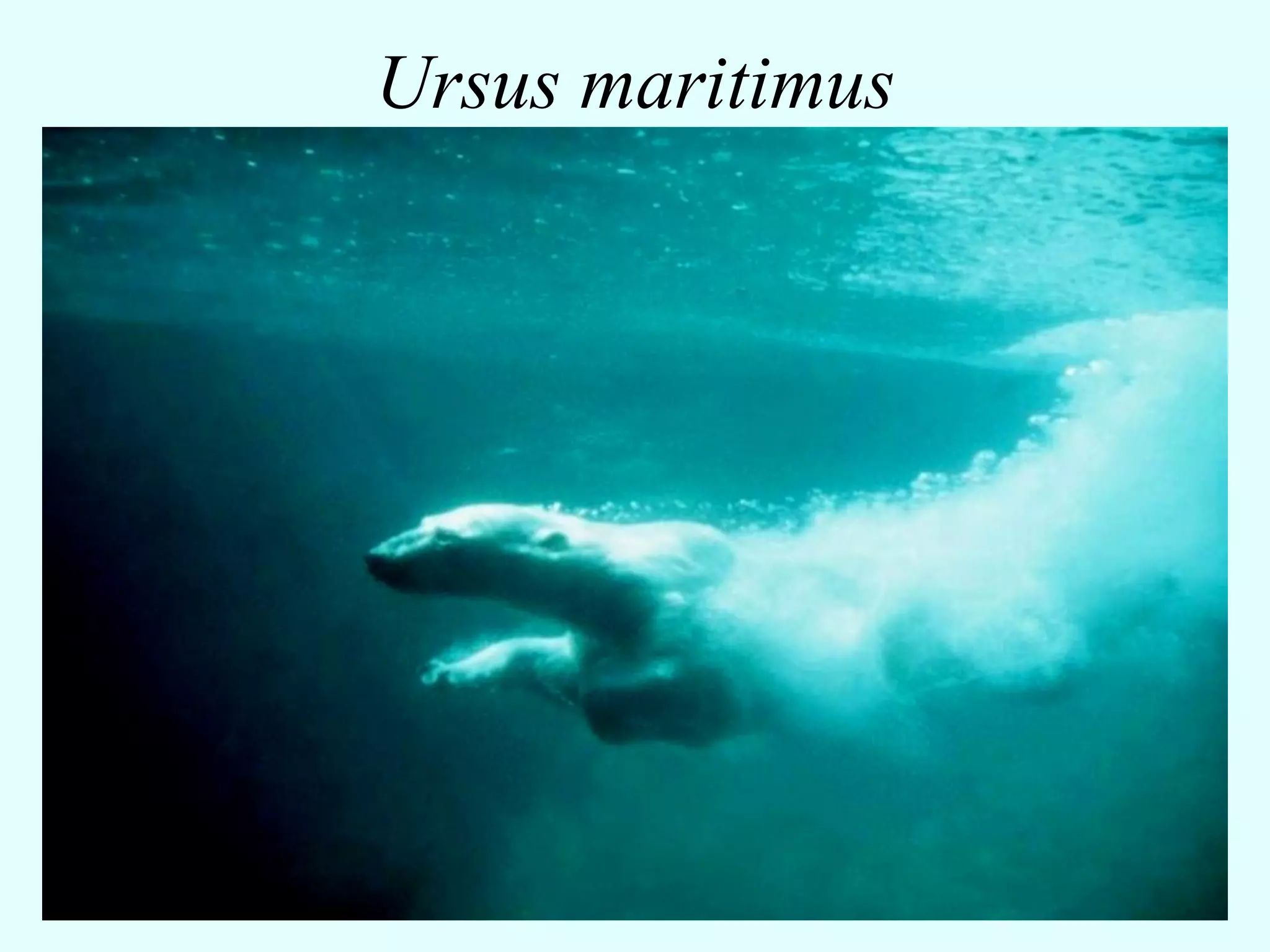
Ursus maritimus
Ursus maritimus
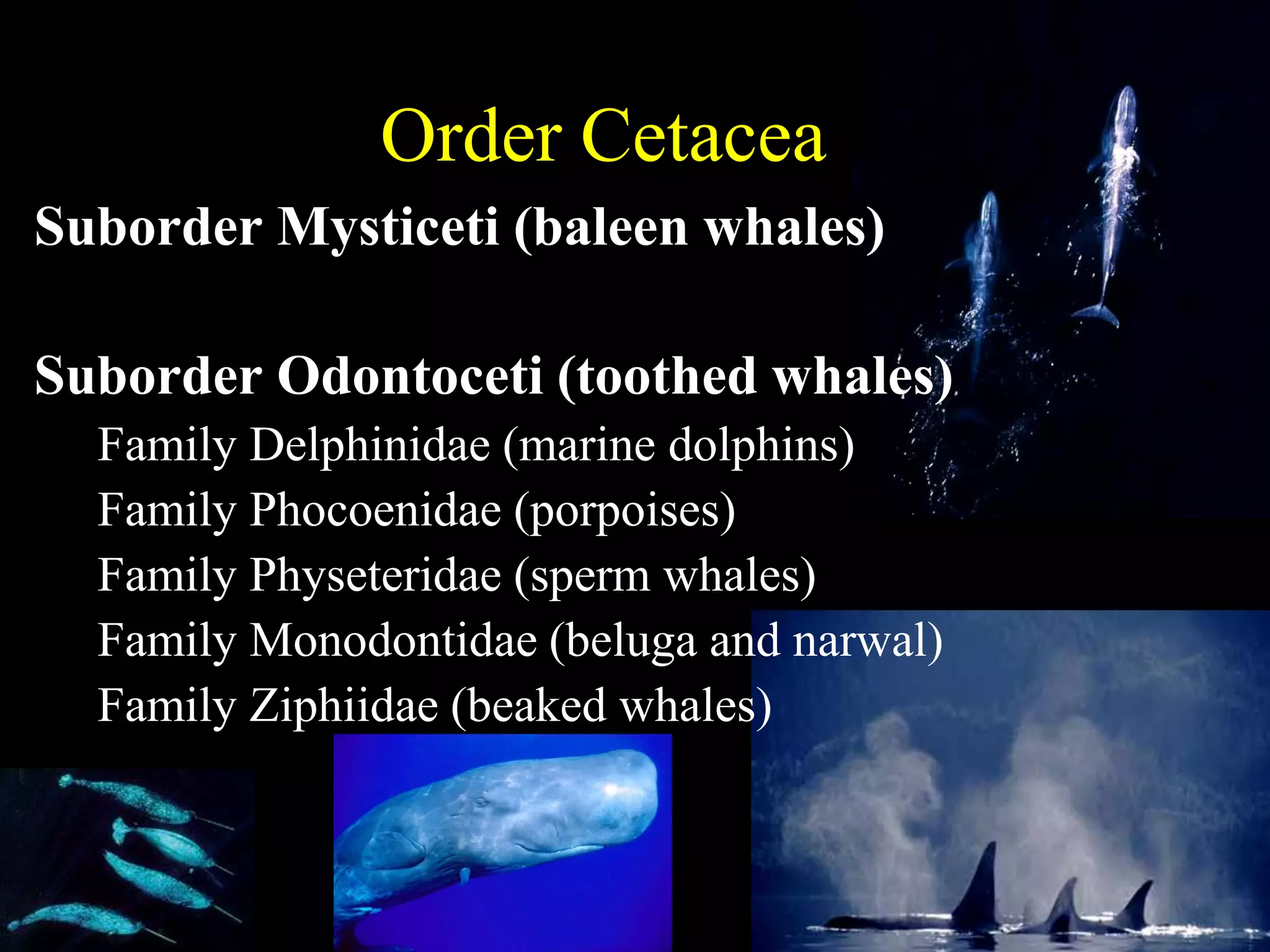
Order Cetacea
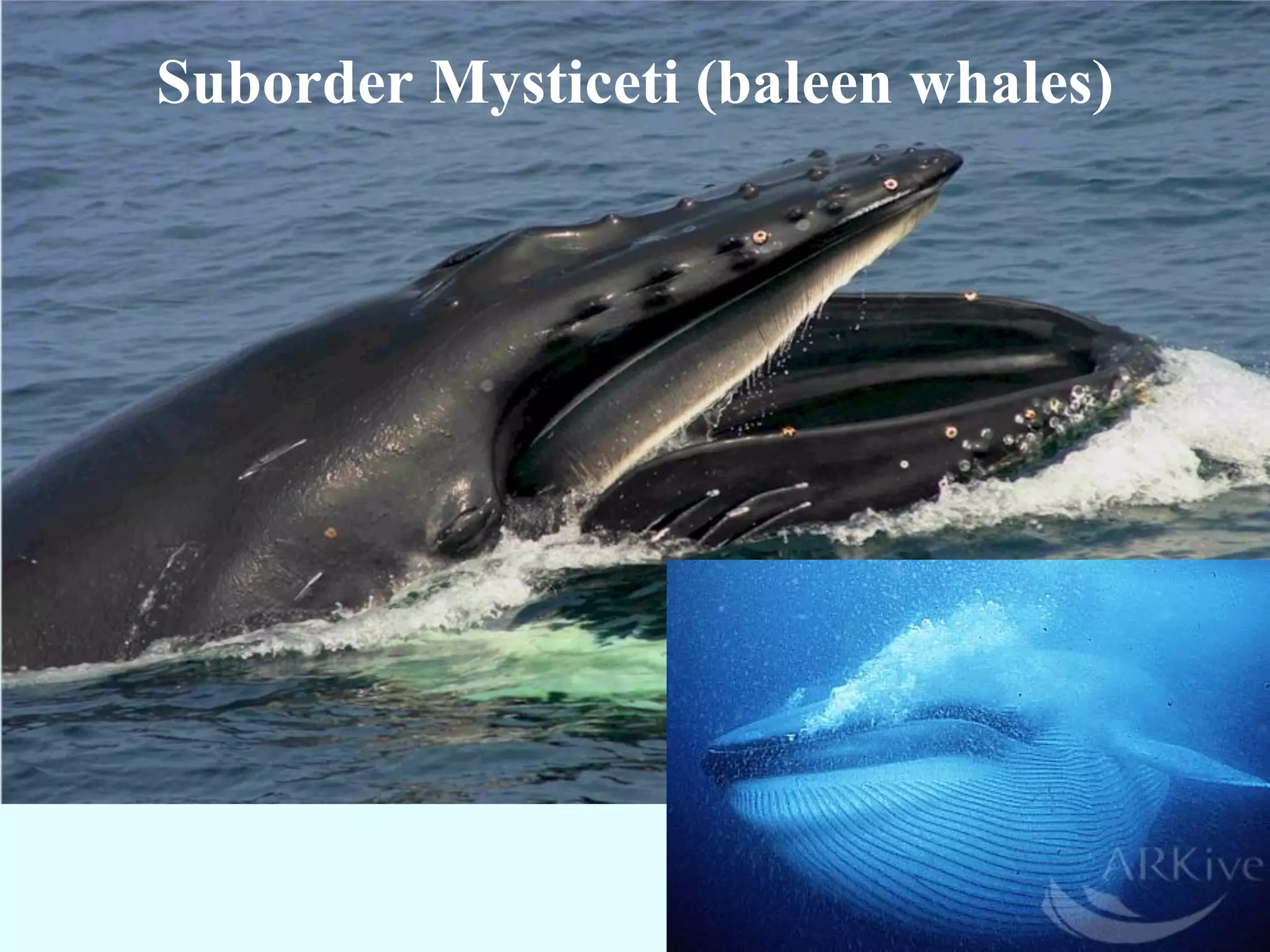
Suborder Mysticeti (baleen whales)

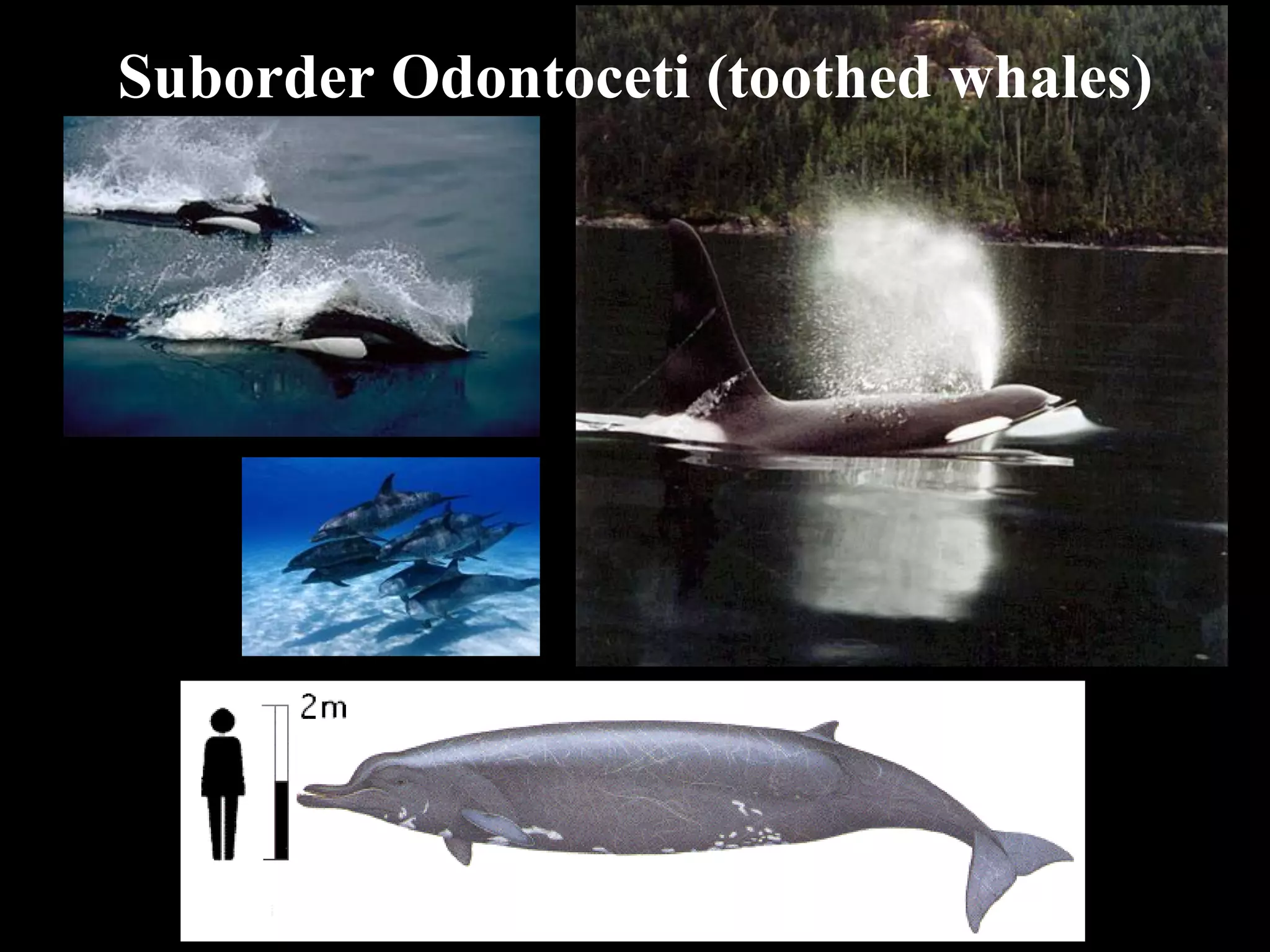
Suborder Odontoceti (toothed whales)
  Family Delphinidae (marine dolphins)
  Family Phocoenidae (porpoises)
  Family Physeteridae (sperm whales)
  Family Monodontidae (beluga and narwal)
  Family Ziphiidae (beaked whales)
Suborder Mysticeti (baleen whales)
Suborder Odontoceti (toothed whales)
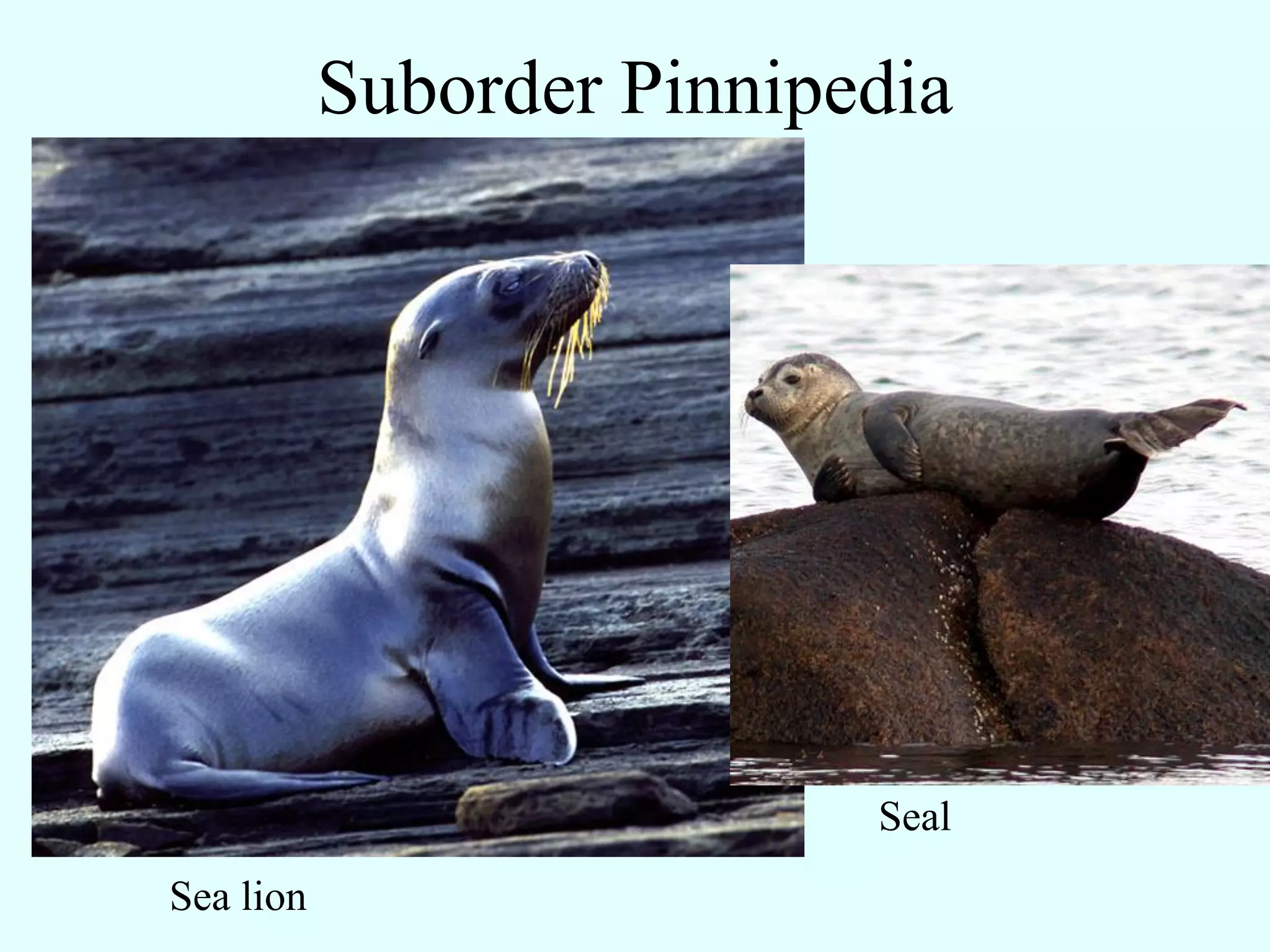
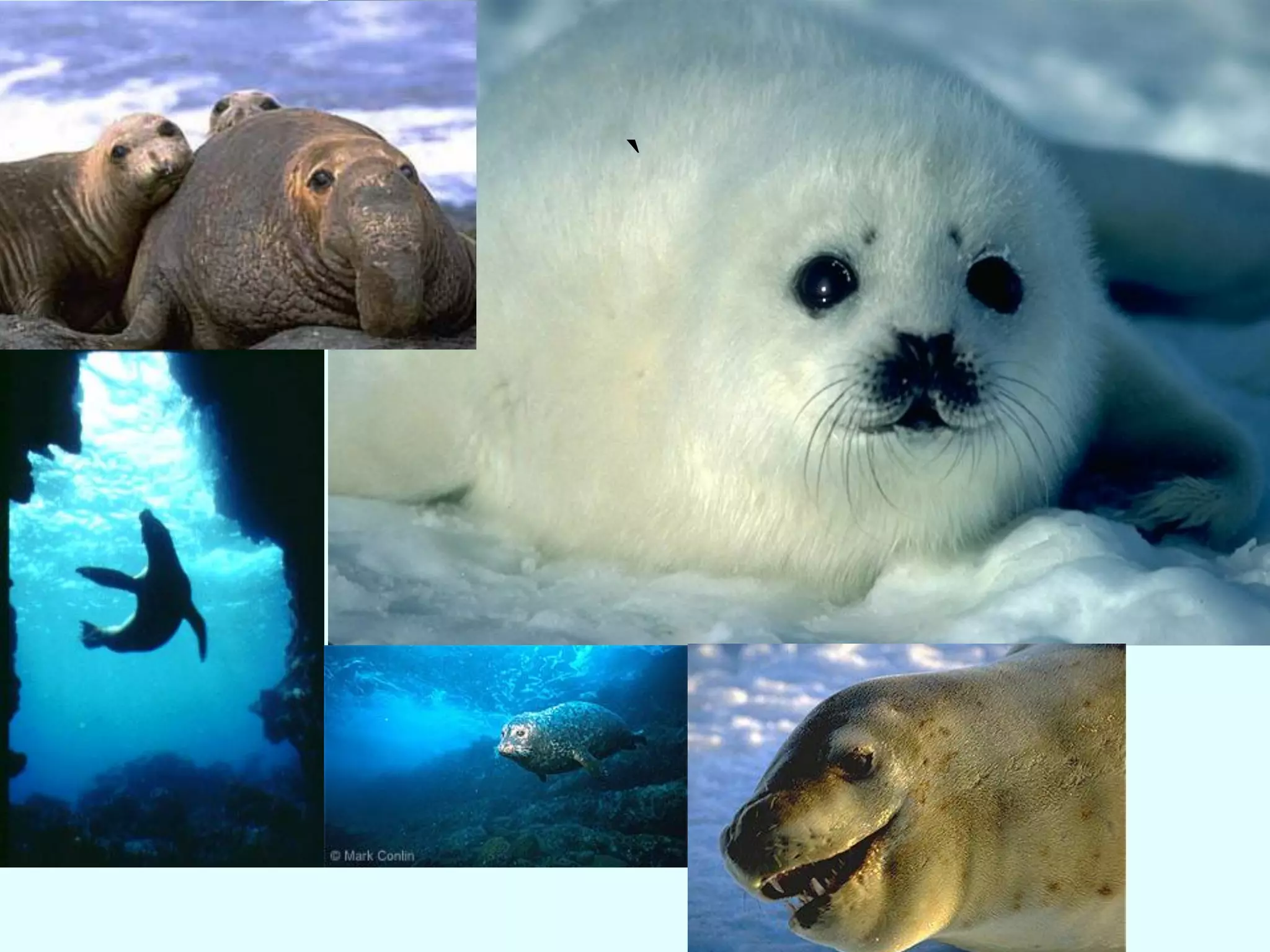
Suborder Pinnipedia


                           Seal
Sea lion
`
Diving Physiology
• Deepest dive by mammal (unaided): 2,250 m,
  Sperm Whale
• Elephant seals spend most of their time submerged
  and can dive to over 1,500 m depth
• Provides access to prey living at great depths (ie,
  Giant Squid)
• Animal must have mechanisms to deal with
  oxygen consumption and build-up of carbon
  dioxide and lactic acid
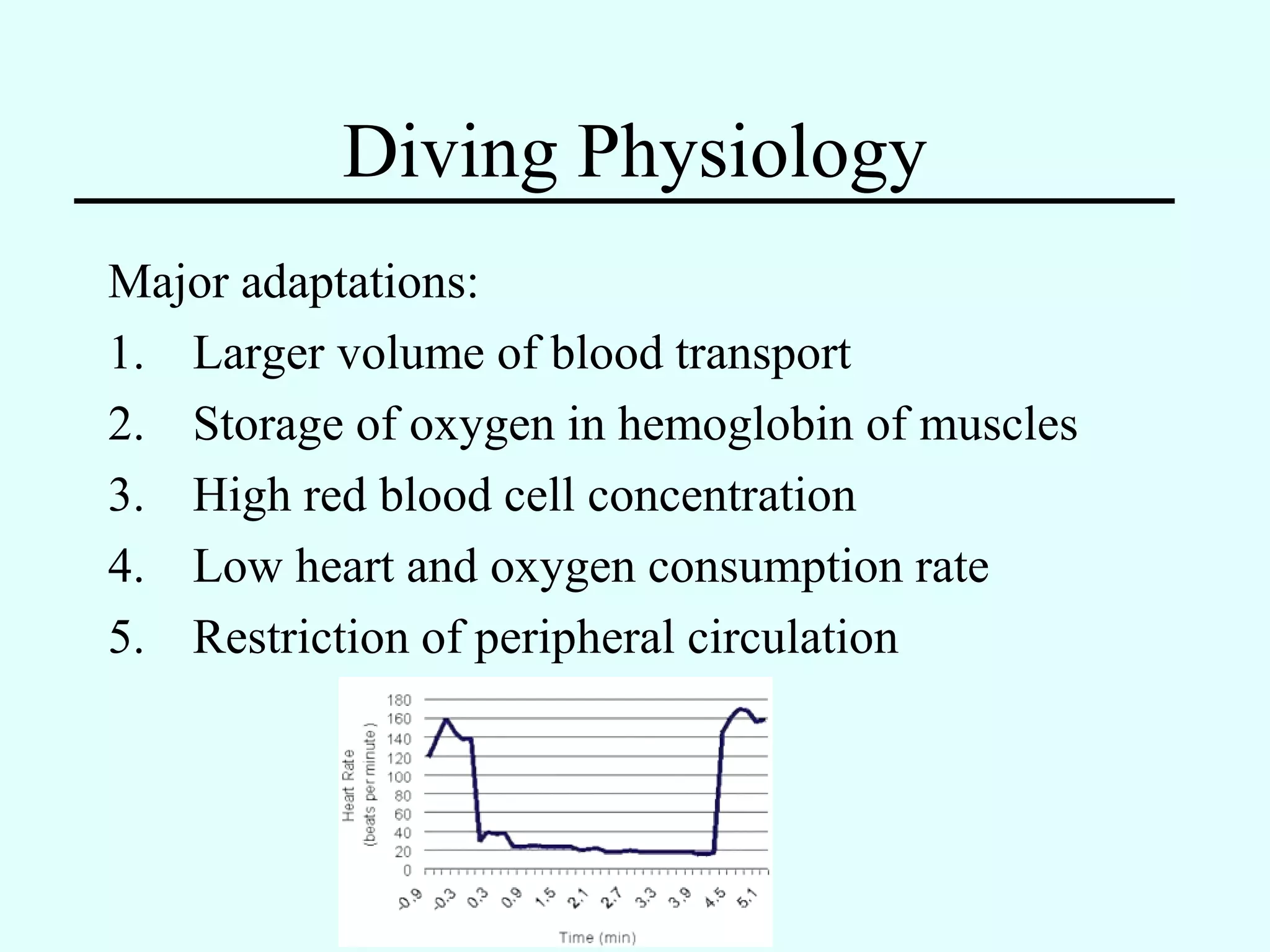
Diving Physiology
Major adaptations:
1. Larger volume of blood transport
2. Storage of oxygen in hemoglobin of muscles
3. High red blood cell concentration
4. Low heart and oxygen consumption rate
5. Restriction of peripheral circulation
Sirenia

Coastal benthic environments

  • 1.
  • 2.
    Coastal Ecosystems Rocky shores Ice edge Soft substratum Coral Marshes reefs Rocky Mangroves reefs Kelp Estuaries forests Sea grass beds
  • 3.
  • 4.
    Photosynthetic organisms • Cyanobacteria •Diatoms and Coccolithophores • Algae – Haptophytes (Phaeophytes) – Rhodophytes • Plants
  • 5.
    Primary Production  thelowest level of the food chain  utilize sunlight or chemical nutrients as a source of energy (autotrophy)  primary production = rate of photosynthesis or chemosynthesis  most occurs > 100 m (max = 268 m or 879 ft) Primary producers serve as the basis for nearly all life in the ocean
  • 6.
    Factors Affecting PrimaryProductivity • Light – polar regions: a single pulse of phytoplankton abundance occurs in summer – temperate latitudes: primary productivity is maximal in spring and autumn – tropics: phytoplankton are nutrient-limited year round • Nutrients – oligotrophic – eutrophic – mesotrophic • Hydrographic conditions – Currents – Upwelling – Vertical mixing
  • 7.
  • 8.
    Estimates of primaryproduction Total (marine plus terrestrial) global annual net primary production (NPP) = 104.9 Gt C/yr Terrestrial = 56.4 Gt or 53.8% Oceanic = 48.5 Gt or 46.2% (From Field et al. 1998. Science 281: 237-240)
  • 9.
    Estimates of primaryproduction Pelagic zone = 50-600 Grasslands = 2,400 Tropical forests = 5,000 Mangroves = 2,700 Seagrass beds = 800-10,000 Coral reefs = 1200-8,000 (measured as g C/m2/yr )
  • 10.
    Primary Production 1. Watercolumn – Plankton Most productivity occurs in plankton 2. Seabed – Benthos
  • 11.
    Plankton  Phytoplankton  Meroplankton part of lifecycle in plankton and benthos  Holoplankton entire lifecycle in plankton  Neuston plankton near surface Ultraplankton <2 mm Nannoplankton 2-20 mm Microplankton 20-200 mm Macroplankton 200-2,000 mm Megaplankton >2,000 mm
  • 12.
    Major Groups ofPrimary Producers- Phytoplankton • Cyanophytes • Stramenopiles (Diatoms, Silicoflagellates) • Haptophytes (Coccolithophores) • Alveolates (Dinoflagellates) • Chlorophytes
  • 13.
    Cyanophyceae Cyanobacteria (blue-green algae) • ultraplankton •comprise ~25% of the total primary production • nitrogen fixation • produced O2 in atmosphere
  • 14.
    Stromatolites Shark Bay, WesternAustralia Oldest = 3.5 billion years old
  • 15.
    Bacillariophytes: Bacillariophyceae Diatoms • Unicellular nanno – microplankton • Dominate temperate-polar regions • Silica valves (2) form pillbox frustule • Centric diatoms – radially symmetrical • Pennate diatoms – bilaterally symmetrical
  • 16.
    Domoic acid • Neurotoxinproduced by Pseudo-nitzschia sp. • Amnesic Shellfish Poisoning
  • 17.
    Haptophytes - Coccolithophores •Unicellular •Nannoplankton •Calciumcarbonate coccoliths •Can form large blooms Emiliania huxleyi
  • 18.
    Haptophytes - Silicoflagellates •Internal skeleton of silica scales • More abundant in Antarctica and open ocean
  • 19.
  • 20.
  • 21.
    Red Tides Many dinoflagellatesproduce neurotoxins (saxitoxin, brevitoxin, polycyclic ethers) • Paralytic shellfish poisoning (PSP) Alexandrium sp. • Ciguatera Gambierdiscus toxicus • Diarrhetic shellfish poisoning (DSP) Dinophysis acuta and D. acuminata • Neurotoxic shellfish poisoning (NSP) Gymnodinium breve
  • 22.
    Specialized dinoflagellates • Zooxanthellae • Noctiluca
  • 23.
    Zooxanthellae • Live assymbionts in animal hosts • Corals, clams, jellies • Symbiodinium sp.
  • 24.
    Zooxanthellae • Live assymbionts in animal hosts • Corals, clams, jellies • Symbiodinium sp.
  • 25.
  • 26.
  • 27.
    Bioluminescence Chemiluminescent reactionin which a substrate, luciferin, is oxidized, releasing a large amount of energy in the form of light Pyrodinium bahamenese
  • 28.
    Benthic primary producers Majorlineages of algae and plants: • Chlorophyta (green algae/plants) • Heterokonta (stramenopiles - brown algae) • Rhodophyta (red algae)
  • 29.
  • 30.
    Life histories Most havecomplex life histories: • Alternation of generations (iso- or heteromorphic) • Dispersing spore • Rhodophytes have tri-phasic life history
  • 31.
  • 32.
    Sargasso Sea • Locationdetermined by the changing ocean currents • Supports a unique fauna associated with drifting mats of Sargassum sp.
  • 33.
  • 35.
    Brown Algae • Theircells contain different pigments, such as chlorophyll c and fucoxanthin • Almost all phaeophytes are marine
  • 36.
  • 37.
  • 38.
  • 39.
    Rhodophyta • Highly variablemorphologies • Some members heavily calcified (coralline algae) by calcium carbonate in cell walls • Contain chlorophylls a, d • Cell wall made of agar or carrageenan • Store sugars in the form of Floridian starch
  • 40.
  • 41.
    Angiosperms • Seagrasses • Mangroves
  • 42.
    Seagrasses • 59 speciesworldwide in 12 genera • Abundant in Australia, Alaska, S. Europe, India, E. Africa, SE Asia, Caribbean, Gulf of Mexico • 7 species found in Caribbean: Thalassia, Syringodium, Halodule, Ruppia, Halophila engelmanni, H. decipiens, and H. baillonii
  • 43.
    Seagrasses Jobos Bay, PR
  • 44.
    Functions of seagrass– An ecosystem perspective • Primary production • Canopy structure • Epiphyte and epifaunal substratum • Nutrient, contaminant and sediment filtration and trapping • Below-ground structure • Nutrient regeneration and recycling • Wave and current energy damping
  • 45.
  • 46.
    Mangroves • Over 60 species worldwide • Mainly limited to tropics in the intertidal • Indo-West Pacific has highest diversity • Important in island formation • 4 species found in Caribbean: Rhizophora mangle (Red mangroves), Avicennia germinant (Black mangroves), Laguncularia racemosa (White mangroves), and Conocarpus erectus (Buttonwood mangroves)
  • 47.
  • 48.
  • 49.
    Mangrove dispersal •Red mangrove dispersal period = 40 days •Black mangrove = minimum 14 days •White mangrove = 5 days Germination occurs on parent
  • 50.
    Ice shelf • Resource-poorand inhabited by only the hardiest of creatures (similar to deep sea) • The transition to a fully mature community may take hundreds to thousands of years • In the water column, change occurs more quickly (opportunistic when ice opens) • Krill extremely abundant
  • 51.
    Adaptations • Good swimmers •Adapted to life in extreme cold – Layer of blubber – Thick layer of feathers – Behavior modification (huddling) – Live near ice-free zone
  • 52.
    Penguin species: 1. Emperor 10. Macaroni 2. King 11. Fiordland Crested 3. Yellow-eyed 12. Erect-Crested 4. Chinestrap 13. African Black-footed 5. Adelie 14. Magellanic 6. Gentoo 15. Peruvian 7. Royal 16. Galapagos 8. Rockhopper 17. White-Flippered 9. Snares Crested 18. Blue (Fairy)
  • 53.
    Emperor Penguins Aptenodytes forsteri • Colonies of 200,000 individuals in the Ross Sea, Antarctica • Large birds (30-40 kg) • Only organism to breed during the Antarctic winter
  • 54.
  • 55.
  • 56.
    Order Procellariformes • Large wing span • “Pelagic” birds • Most of the world's albatross nest in subantarctic waters in the southern hemisphere • Albatross are the “tuna” of the avian world with the most efficient flight and one of the largest wingspans – 12 ft • Oldest seabird reaching 60-70 years old • Lay only one egg per year • Frigates sleep on the wing!
  • 57.
    Order Pelecaniformes Tern Cormorant Frigate Bird
  • 58.
    Order Charadriiformes • Most diverse group (112 sp.) • Many species very abundant (i.e.,Auks)
  • 59.
  • 60.
    Bird migrations • Arctictern has longest migration (25,000 miles every year)
  • 61.
  • 62.
    Marine Mammals • OrderCarnivora – Suborder Fissipedia (dogs, cats, weasels, sea otters, polar bears) – Suborder Pinnipedia (seals and sea lions) • Order Cetacea (whales and dolphins) • Order Sirenia
  • 63.
    Suborder Fissipedia -Sea otters Enhydra lutris
  • 64.
    Suborder Fissipedia -Sea otters Enhydra lutris
  • 65.
  • 66.
  • 67.
    Order Cetacea Suborder Mysticeti(baleen whales) Suborder Odontoceti (toothed whales) Family Delphinidae (marine dolphins) Family Phocoenidae (porpoises) Family Physeteridae (sperm whales) Family Monodontidae (beluga and narwal) Family Ziphiidae (beaked whales)
  • 68.
  • 69.
  • 70.
    Suborder Pinnipedia Seal Sea lion
  • 71.
  • 72.
    Diving Physiology • Deepestdive by mammal (unaided): 2,250 m, Sperm Whale • Elephant seals spend most of their time submerged and can dive to over 1,500 m depth • Provides access to prey living at great depths (ie, Giant Squid) • Animal must have mechanisms to deal with oxygen consumption and build-up of carbon dioxide and lactic acid
  • 73.
    Diving Physiology Major adaptations: 1.Larger volume of blood transport 2. Storage of oxygen in hemoglobin of muscles 3. High red blood cell concentration 4. Low heart and oxygen consumption rate 5. Restriction of peripheral circulation
  • 74.