Chapter 7

Multicellular Primary Producers
• Remember how much seaweed was in your
  household products…..
  – What were some of the product that contained
    algae that you found in your home in Lab 2??
Seaweeds
• Most found attached to a substrate
• Inhibit 2% of seafloor
• Life in the inner continental shelf depend upon
  seaweeds for food
• Abiotic Factors most influential are
  –   Light *****
  –   Temp***** (most diverse in tropical waters)
  –   Tidal exposure
  –   Salinity
  –   Availability of nutrients
Seaweed Structure
• Thallus-body
• Lack vascular tissue -Do not have roots, stems,
  or leaves
• Holdfast -The structure that attaches the
  seaweed to the substrate
• Stipe-stem-like structure
Phylum Chlorophyta (green algae)
• Ecologically important
   – food source
   – Contribute to coral reef
     formation
   – Some are invasive
      • Caulerpa taxifolia
          – https://www.youtube.c
            om/watch?v=aT4LY2Kc
            Ors
Green algae structure/characteristics
• Most unicellular
• Most are freshwater( we saw some out at
  pond)
• Contain chlorophylls a and b for
  photosynthesis
• Marine species have coenocytic thallus-
  containing more than 1 nucleus
  – Occurs by cell growing nucleus divides but cell
    never divides
Reproduction (draw pic in your
         reproductive box)
• Sexual
• Gametes released from gametophyte 2 flagella
• spores released from sporophyte-4 flagella
Representative species
• Halimeda
• Mermans shaving brush
Phylum Rhodophyta (Red algae)
• Primarily marine
• Most diverse among seaweeds
• Not always red in color- can appear yellow to
  black
Structure
• Multicellular and less than 1 meter long
• Wide variety of shapes and organization
  among species
• Chlorophylls a and d, pigments:
  phycoerythrins and phycocyanins
Reproduction
• Can vary from simple
  to complex…but 2
  unique features………..
1. Lack flagella on
   spores and gametes
2. 3 multicellular stages
   (2n)
  1. Carpospore-unique
     to red algae-
  2. Tetrasporophyte
  3. Cystocarp
Ecological Roles/ Representative
                 Species
• Seasonal food source for
  urchins, mollusks, fish, and crustaceans
• Some grow on other plants or animals
• Help form base of coral reef
• Used in cosmetics for creamy foundations
• Representative Species:
  – Porphyra- used as food in oriental dishes
  – Agar- used as a thickening agent in foods such as
    ice cream, pudding, and salad dressings
Phaeophyta (brown algae)

• Mostly marine
• Higher diversity than green
  but less diverse than red
• Size: from microscopic to
  kelps (100 meters)
• Chlorophylls a and c and
  pigment fucoxanthin
• Mostly in high latitudes
• Large flat leaf-like blades
  with bladders help buoy
  plant toward light
• Representative species
  Sargassum, Fucus
Reproduction
• Gametophyte is
  eliminated from
  life cycle (difference
  from Chlorophyta and
  Rhodophyta)

• Egg develops
  root-like
  structures
  (rhizoids) after
  fertilization
Ecological role
• Habitats for a variety of marine life
• Harvested for thickening agents used in
  dentistry, cosmetic, and food industries
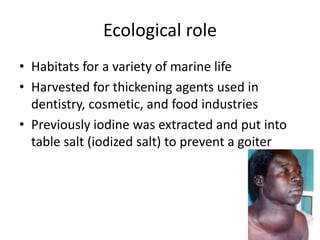
• Previously iodine was extracted and put into
  table salt (iodized salt) to prevent a goiter
Phylum Anthophyta
• Seagrasses, salt marsh plants, mangroves
• Ecological Roles- Primary producers, habitats,
  stabilizing sediments
Sea grasses (marine flowering plants)
• Related to lilies
• Reproduce by pollination of seed; Male and
  female flowers on separate plants contain
  pollen
• 12 genra
  – Genra native to Florida
     •   Syringodium -manateegrass
     •   Halophila-paddlegrass
     •   Thalassia- turtlegrass
     •   Ruppia-
     •   Halodule- shoalgrass
Salt Marsh Plants
• Adapted to high levels of salinity and tidal action
• Found in estuaries – level of succession based on salinity and tidal
  tolerance
• Species native to Jacksonville (will be responsible for these on the test!!!)
    –   Spartina Alternaflora
    –   Batis Maritima
    –   Spartina patens
    –   Juncus
    –   Salicornia virginica
Mangroves
• Found in south of St. Augustine to Key West
• 3 genra local to Florida
  – Rhizophora mangle –red mangle-----prop roots
  – Avicennia germinans – black mangle---
    pneumatophores
  – Laguncularia racemosa- white mangle
• Distinctive by their root system and pods
Mangrove reproduction
• Flowers pollinated by wind or bees
• Embryo grows on the plant in a propagule
  (similar to seed)
• Propagule eventually falls from parent and is
  carried by current until it settles and takes
  root
Red Mangrove

Black Mangrove


Red,     White, and Black mangrove        White Mangrove
leaves

Chapter 7 multicellular plants

  • 1.
  • 2.
    • Remember howmuch seaweed was in your household products….. – What were some of the product that contained algae that you found in your home in Lab 2??
  • 3.
    Seaweeds • Most foundattached to a substrate • Inhibit 2% of seafloor • Life in the inner continental shelf depend upon seaweeds for food • Abiotic Factors most influential are – Light ***** – Temp***** (most diverse in tropical waters) – Tidal exposure – Salinity – Availability of nutrients
  • 4.
    Seaweed Structure • Thallus-body •Lack vascular tissue -Do not have roots, stems, or leaves • Holdfast -The structure that attaches the seaweed to the substrate • Stipe-stem-like structure
  • 5.
    Phylum Chlorophyta (greenalgae) • Ecologically important – food source – Contribute to coral reef formation – Some are invasive • Caulerpa taxifolia – https://www.youtube.c om/watch?v=aT4LY2Kc Ors
  • 6.
    Green algae structure/characteristics •Most unicellular • Most are freshwater( we saw some out at pond) • Contain chlorophylls a and b for photosynthesis • Marine species have coenocytic thallus- containing more than 1 nucleus – Occurs by cell growing nucleus divides but cell never divides
  • 7.
    Reproduction (draw picin your reproductive box) • Sexual • Gametes released from gametophyte 2 flagella • spores released from sporophyte-4 flagella
  • 8.
  • 9.
    Phylum Rhodophyta (Redalgae) • Primarily marine • Most diverse among seaweeds • Not always red in color- can appear yellow to black
  • 10.
    Structure • Multicellular andless than 1 meter long • Wide variety of shapes and organization among species • Chlorophylls a and d, pigments: phycoerythrins and phycocyanins
  • 11.
    Reproduction • Can varyfrom simple to complex…but 2 unique features……….. 1. Lack flagella on spores and gametes 2. 3 multicellular stages (2n) 1. Carpospore-unique to red algae- 2. Tetrasporophyte 3. Cystocarp
  • 12.
    Ecological Roles/ Representative Species • Seasonal food source for urchins, mollusks, fish, and crustaceans • Some grow on other plants or animals • Help form base of coral reef • Used in cosmetics for creamy foundations • Representative Species: – Porphyra- used as food in oriental dishes – Agar- used as a thickening agent in foods such as ice cream, pudding, and salad dressings
  • 13.
    Phaeophyta (brown algae) •Mostly marine • Higher diversity than green but less diverse than red • Size: from microscopic to kelps (100 meters) • Chlorophylls a and c and pigment fucoxanthin • Mostly in high latitudes • Large flat leaf-like blades with bladders help buoy plant toward light • Representative species Sargassum, Fucus
  • 14.
    Reproduction • Gametophyte is eliminated from life cycle (difference from Chlorophyta and Rhodophyta) • Egg develops root-like structures (rhizoids) after fertilization
  • 15.
    Ecological role • Habitatsfor a variety of marine life • Harvested for thickening agents used in dentistry, cosmetic, and food industries • Previously iodine was extracted and put into table salt (iodized salt) to prevent a goiter
  • 16.
    Phylum Anthophyta • Seagrasses,salt marsh plants, mangroves • Ecological Roles- Primary producers, habitats, stabilizing sediments
  • 17.
    Sea grasses (marineflowering plants) • Related to lilies • Reproduce by pollination of seed; Male and female flowers on separate plants contain pollen • 12 genra – Genra native to Florida • Syringodium -manateegrass • Halophila-paddlegrass • Thalassia- turtlegrass • Ruppia- • Halodule- shoalgrass
  • 18.
    Salt Marsh Plants •Adapted to high levels of salinity and tidal action • Found in estuaries – level of succession based on salinity and tidal tolerance • Species native to Jacksonville (will be responsible for these on the test!!!) – Spartina Alternaflora – Batis Maritima – Spartina patens – Juncus – Salicornia virginica
  • 19.
    Mangroves • Found insouth of St. Augustine to Key West • 3 genra local to Florida – Rhizophora mangle –red mangle-----prop roots – Avicennia germinans – black mangle--- pneumatophores – Laguncularia racemosa- white mangle • Distinctive by their root system and pods
  • 20.
    Mangrove reproduction • Flowerspollinated by wind or bees • Embryo grows on the plant in a propagule (similar to seed) • Propagule eventually falls from parent and is carried by current until it settles and takes root
  • 21.
    Red Mangrove Black Mangrove Red, White, and Black mangrove White Mangrove leaves