Chapt 10 Bony Fishes

      Ichthyology
   “the study of fish”
Phylum Chordata
• Class Actinopterygii
   – “modern bony fish”
   – 25,000 species or ½ of all
     vertebrate species
   – So diverse no one
     characteristic can
     differentiate them from
     sharks, skates, and rays
     (cartilaginous fish)
   – Taxonomy of fishes are still
     changing as new technology
     and research reveal new
     characteristics
Phylum Chrodata
• Characteristics
  – Presence of swim bladder or lung
  – Bones
  – Bony scales
  – Fin rays
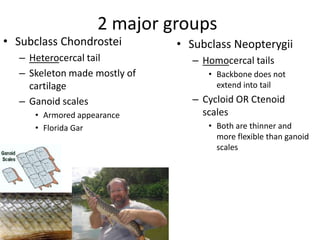
2 major groups
• Subclass Chondrostei        • Subclass Neopterygii
  – Heterocercal tail            – Homocercal tails
  – Skeleton made mostly of         • Backbone does not
    cartilage                         extend into tail
  – Ganoid scales                – Cycloid OR Ctenoid
     • Armored appearance          scales
     • Florida Gar                  • Both are thinner and
                                      more flexible than ganoid
                                      scales
Body Shapes-determined by habitat
• Fusiform- streamlined
  shape for active
  swimmers
• Laterally compressed-
  flattened so can
  maneuver though corals
• Flattened: bottom-
  dwellers
• snakelike: burrowing
  fish
Respiration and Circulation
Respiration
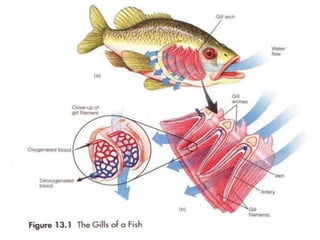
• Gills: receive oxygen and remove CO2, and
  maintain salt balance
  – Made of gill filaments: blood flows in opposite
    direction of incoming H2O
• Water must continuously pass over gills
  – Meets with blood with lower O2 and higher CO2
     • Diffusion moves from where to where?????
  – Fish actually “pump” H2O over gills
Cardiovascular
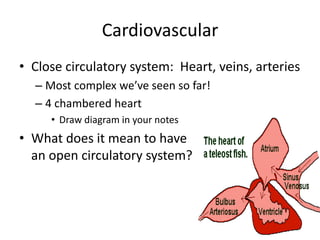
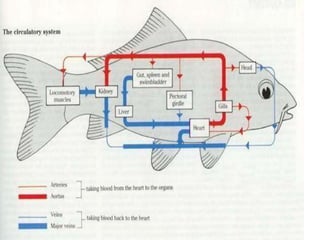
• Close circulatory system: Heart, veins, arteries
  – Most complex we’ve seen so far!
  – 4 chambered heart
     • Draw diagram in your notes
• What does it mean to have
  an open circulatory system?
Swimming and Movement
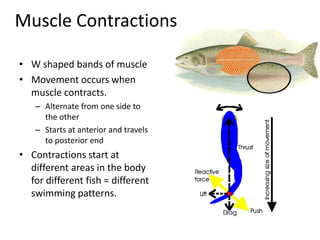
Muscle Contractions

• W shaped bands of muscle
• Movement occurs when
  muscle contracts.
   – Alternate from one side to
     the other
   – Starts at anterior and travels
     to posterior end
• Contractions start at
  different areas in the body
  for different fish = different
  swimming patterns.
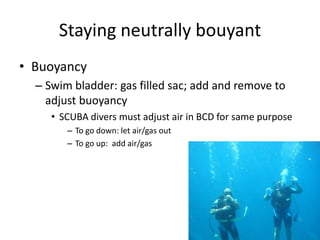
Staying neutrally bouyant
• Buoyancy
  – Swim bladder: gas filled sac; add and remove to
    adjust buoyancy
     • SCUBA divers must adjust air in BCD for same purpose
        – To go down: let air/gas out
        – To go up: add air/gas
Fish Coloration

5 important types you need to know
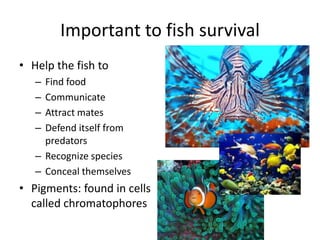
Important to fish survival
• Help the fish to
   – Find food
   – Communicate
   – Attract mates
   – Defend itself from
     predators
   – Recognize species
   – Conceal themselves
• Pigments: found in cells
  called chromatophores
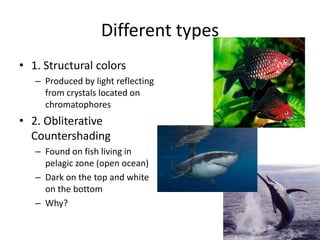
Different types
• 1. Structural colors
   – Produced by light reflecting
     from crystals located on
     chromatophores
• 2. Obliterative
  Countershading
   – Found on fish living in
     pelagic zone (open ocean)
   – Dark on the top and white
     on the bottom
   – Why?
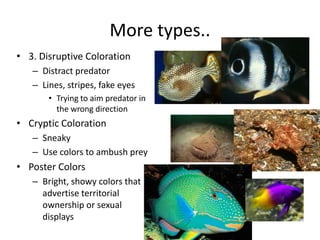
More types..
• 3. Disruptive Coloration
   – Distract predator
   – Lines, stripes, fake eyes
       • Trying to aim predator in
         the wrong direction
• Cryptic Coloration
   – Sneaky
   – Use colors to ambush prey
• Poster Colors
   – Bright, showy colors that
     advertise territorial
     ownership or sexual
     displays
Nervous System & Reproduction
Nervous System
• Brain, spinal cord, nerves
• Senses
  – Olfaction: sense of smell: olfactory pits (nostrils)
  – Taste: receptors on head, jaws, tongue, mouth
    and barbels on some fish (catfish)
  – Hearing: internal ears
  – Sight: Eyes Lack eyelids
     • Most set on sides of face: each eye see own
       independent view.
• Lateral Line: Detect movement in water
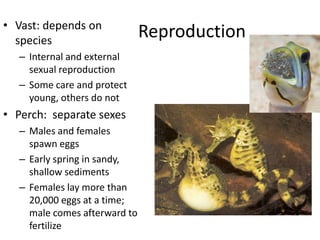
• Vast: depends on
  species
                              Reproduction
  – Internal and external
    sexual reproduction
  – Some care and protect
    young, others do not
• Perch: separate sexes
  – Males and females
    spawn eggs
  – Early spring in sandy,
    shallow sediments
  – Females lay more than
    20,000 eggs at a time;
    male comes afterward to
    fertilize
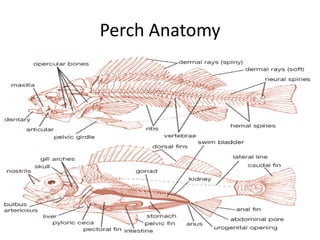
Perch Anatomy

Bony fish powerpoint

  • 1.
    Chapt 10 BonyFishes Ichthyology “the study of fish”
  • 2.
    Phylum Chordata • ClassActinopterygii – “modern bony fish” – 25,000 species or ½ of all vertebrate species – So diverse no one characteristic can differentiate them from sharks, skates, and rays (cartilaginous fish) – Taxonomy of fishes are still changing as new technology and research reveal new characteristics
  • 3.
    Phylum Chrodata • Characteristics – Presence of swim bladder or lung – Bones – Bony scales – Fin rays
  • 4.
    2 major groups •Subclass Chondrostei • Subclass Neopterygii – Heterocercal tail – Homocercal tails – Skeleton made mostly of • Backbone does not cartilage extend into tail – Ganoid scales – Cycloid OR Ctenoid • Armored appearance scales • Florida Gar • Both are thinner and more flexible than ganoid scales
  • 5.
    Body Shapes-determined byhabitat • Fusiform- streamlined shape for active swimmers • Laterally compressed- flattened so can maneuver though corals • Flattened: bottom- dwellers • snakelike: burrowing fish
  • 6.
  • 7.
    Respiration • Gills: receiveoxygen and remove CO2, and maintain salt balance – Made of gill filaments: blood flows in opposite direction of incoming H2O • Water must continuously pass over gills – Meets with blood with lower O2 and higher CO2 • Diffusion moves from where to where????? – Fish actually “pump” H2O over gills
  • 9.
    Cardiovascular • Close circulatorysystem: Heart, veins, arteries – Most complex we’ve seen so far! – 4 chambered heart • Draw diagram in your notes • What does it mean to have an open circulatory system?
  • 11.
  • 12.
    Muscle Contractions • Wshaped bands of muscle • Movement occurs when muscle contracts. – Alternate from one side to the other – Starts at anterior and travels to posterior end • Contractions start at different areas in the body for different fish = different swimming patterns.
  • 13.
    Staying neutrally bouyant •Buoyancy – Swim bladder: gas filled sac; add and remove to adjust buoyancy • SCUBA divers must adjust air in BCD for same purpose – To go down: let air/gas out – To go up: add air/gas
  • 14.
    Fish Coloration 5 importanttypes you need to know
  • 15.
    Important to fishsurvival • Help the fish to – Find food – Communicate – Attract mates – Defend itself from predators – Recognize species – Conceal themselves • Pigments: found in cells called chromatophores
  • 16.
    Different types • 1.Structural colors – Produced by light reflecting from crystals located on chromatophores • 2. Obliterative Countershading – Found on fish living in pelagic zone (open ocean) – Dark on the top and white on the bottom – Why?
  • 17.
    More types.. • 3.Disruptive Coloration – Distract predator – Lines, stripes, fake eyes • Trying to aim predator in the wrong direction • Cryptic Coloration – Sneaky – Use colors to ambush prey • Poster Colors – Bright, showy colors that advertise territorial ownership or sexual displays
  • 18.
    Nervous System &Reproduction
  • 19.
    Nervous System • Brain,spinal cord, nerves • Senses – Olfaction: sense of smell: olfactory pits (nostrils) – Taste: receptors on head, jaws, tongue, mouth and barbels on some fish (catfish) – Hearing: internal ears – Sight: Eyes Lack eyelids • Most set on sides of face: each eye see own independent view. • Lateral Line: Detect movement in water
  • 20.
    • Vast: dependson species Reproduction – Internal and external sexual reproduction – Some care and protect young, others do not • Perch: separate sexes – Males and females spawn eggs – Early spring in sandy, shallow sediments – Females lay more than 20,000 eggs at a time; male comes afterward to fertilize
  • 21.