CHAPTER 6
SEAWEED AND PLANTS
Seaweed and Plants
 Most seaweeds are
considered “plants” or
plant-like
Seaweed and Plants
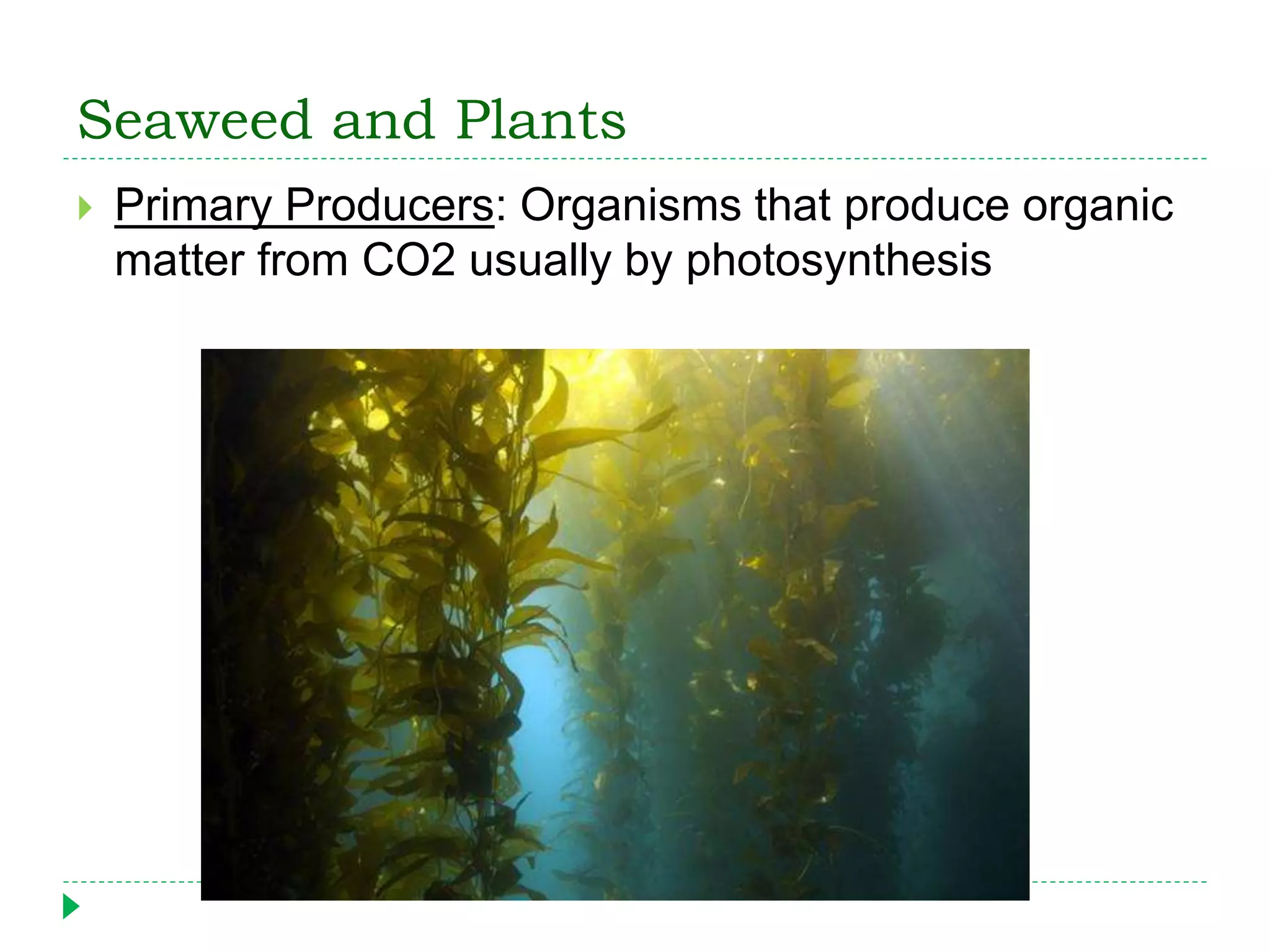
 Primary Producers: Organisms that produce organic
matter from CO2 usually by photosynthesis
Seaweed and Plants
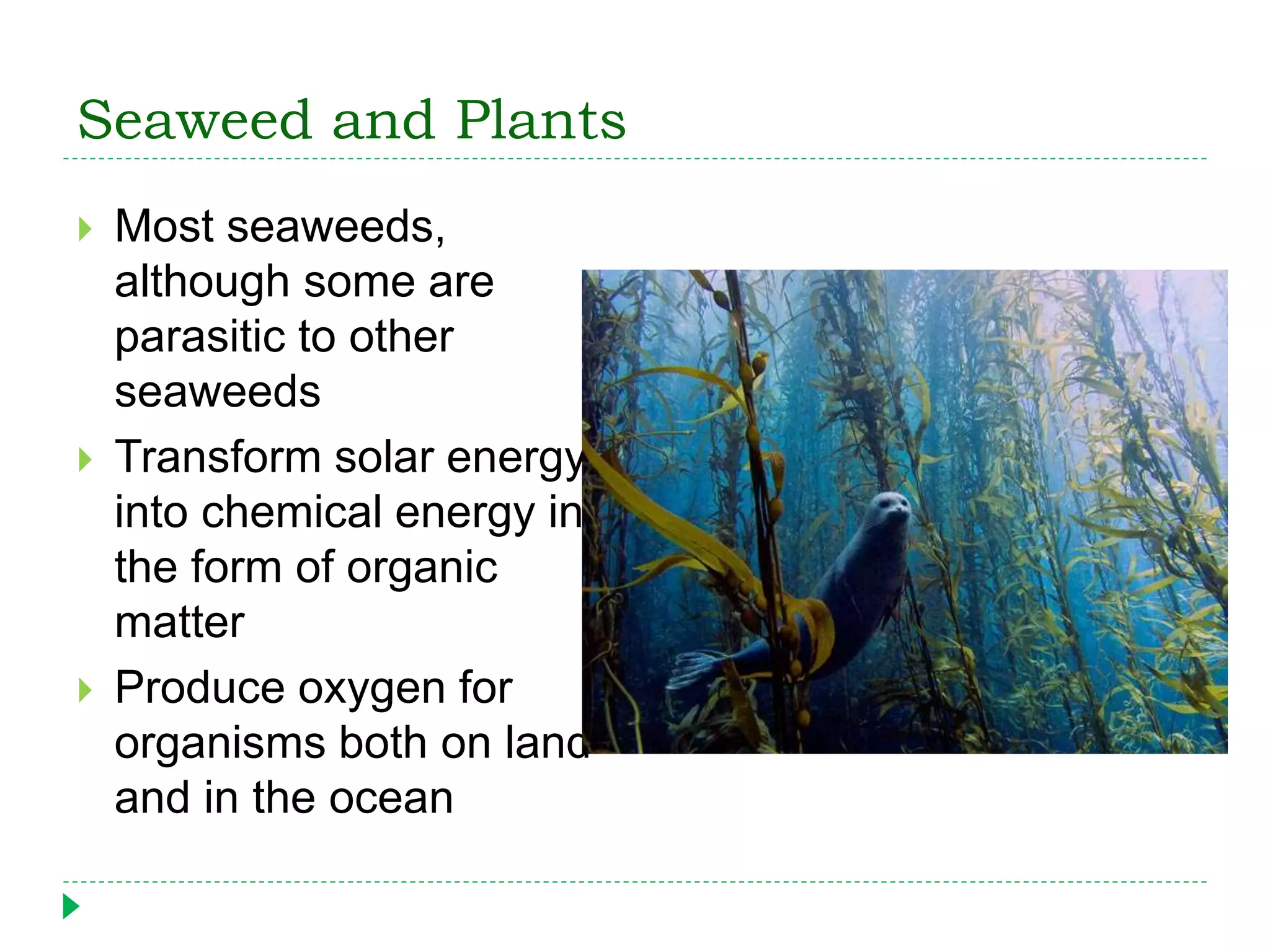
 Most seaweeds,
although some are
parasitic to other
seaweeds
 Transform solar energy
into chemical energy in
the form of organic
matter
 Produce oxygen for
organisms both on land
and in the ocean
Multicellular Algae
The Seaweeds
Multicellular Algae
 Seaweed: large,
multicellular algae
 Most familiar type of
marine algae
 Some biologists prefer
the name
macrophytes or
macroalgae
 All multicellular and
eukaryotic
Multicellular Algae
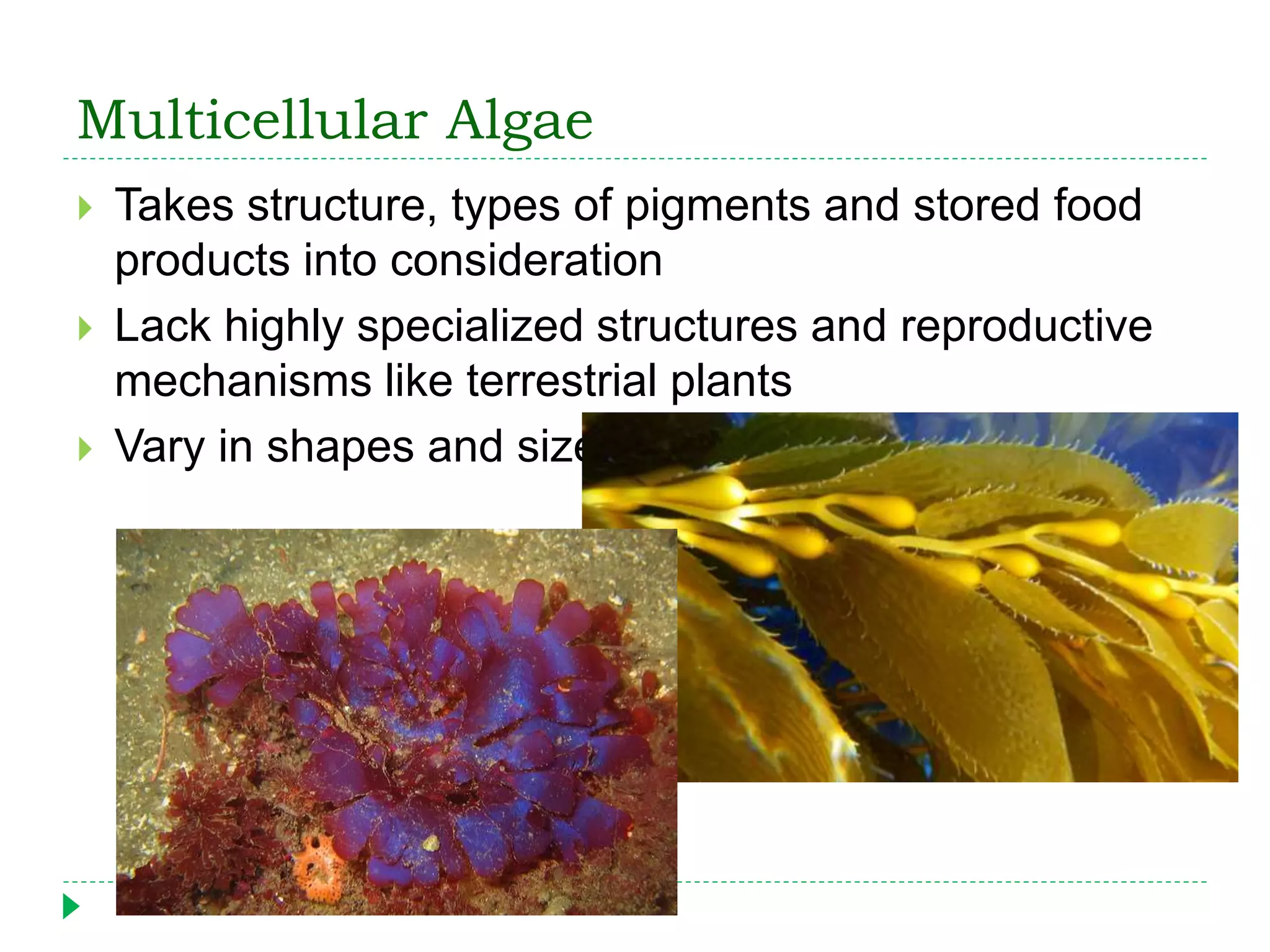
 Takes structure, types of pigments and stored food
products into consideration
 Lack highly specialized structures and reproductive
mechanisms like terrestrial plants
 Vary in shapes and sizes
Multicellular Algae
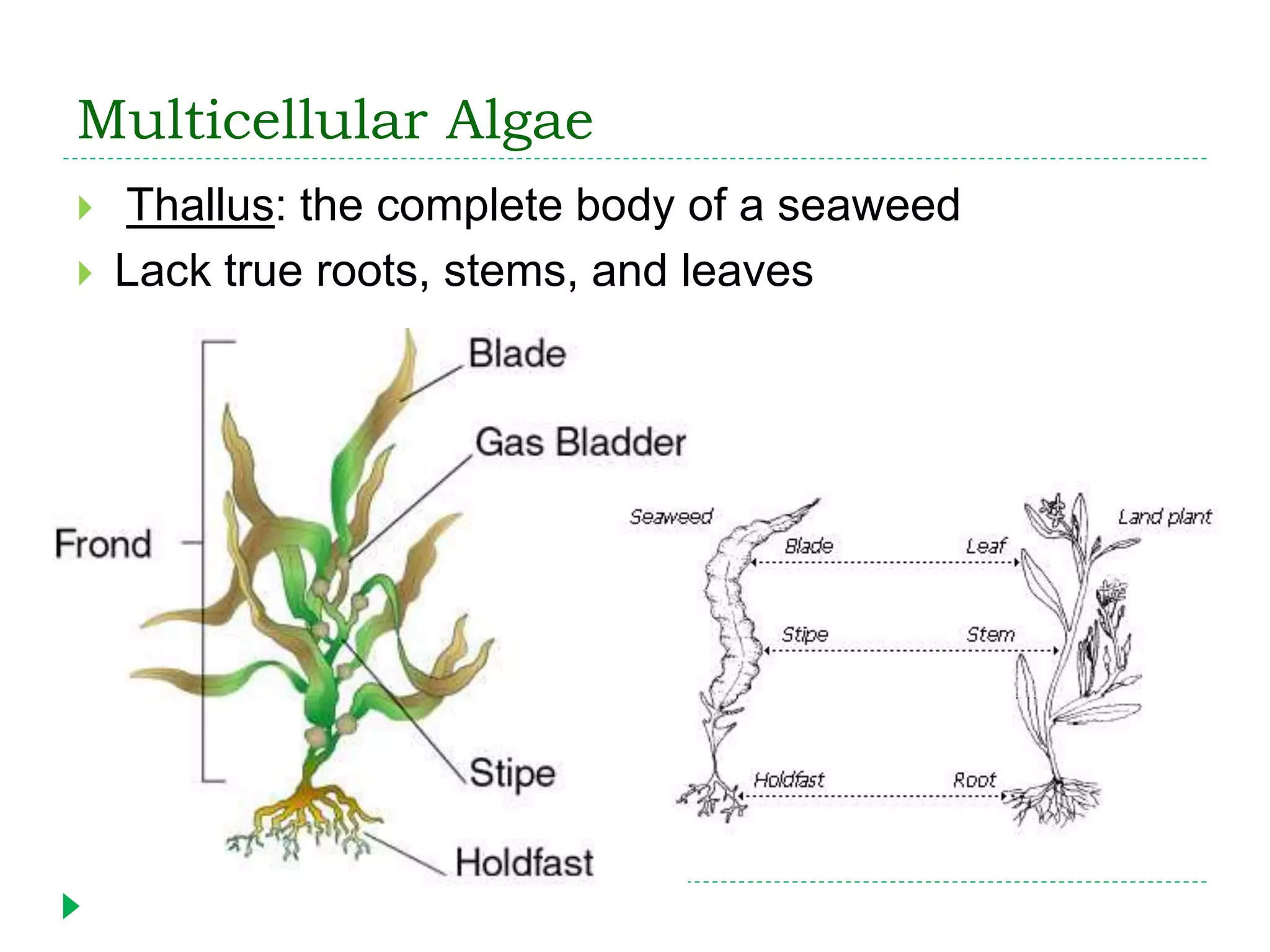
 Thallus: the complete body of a seaweed
 Lack true roots, stems, and leaves
Multicellular Algae
 Blades: The leaf-like, flattened portions of the thallus of
seaweeds
 have a large surface area
 main photosynthetic region
 not true leaves, no veins
 the upper and lower surfaces of blades are identical to each
other
Multicellular Algae
 Pneumatocysts: Gas-filled bladders that sometimes
keep the blades close to the sea surface
 maximizing the exposure of blades to the sunlight
 gases include carbon monoxide
Multicellular Algae
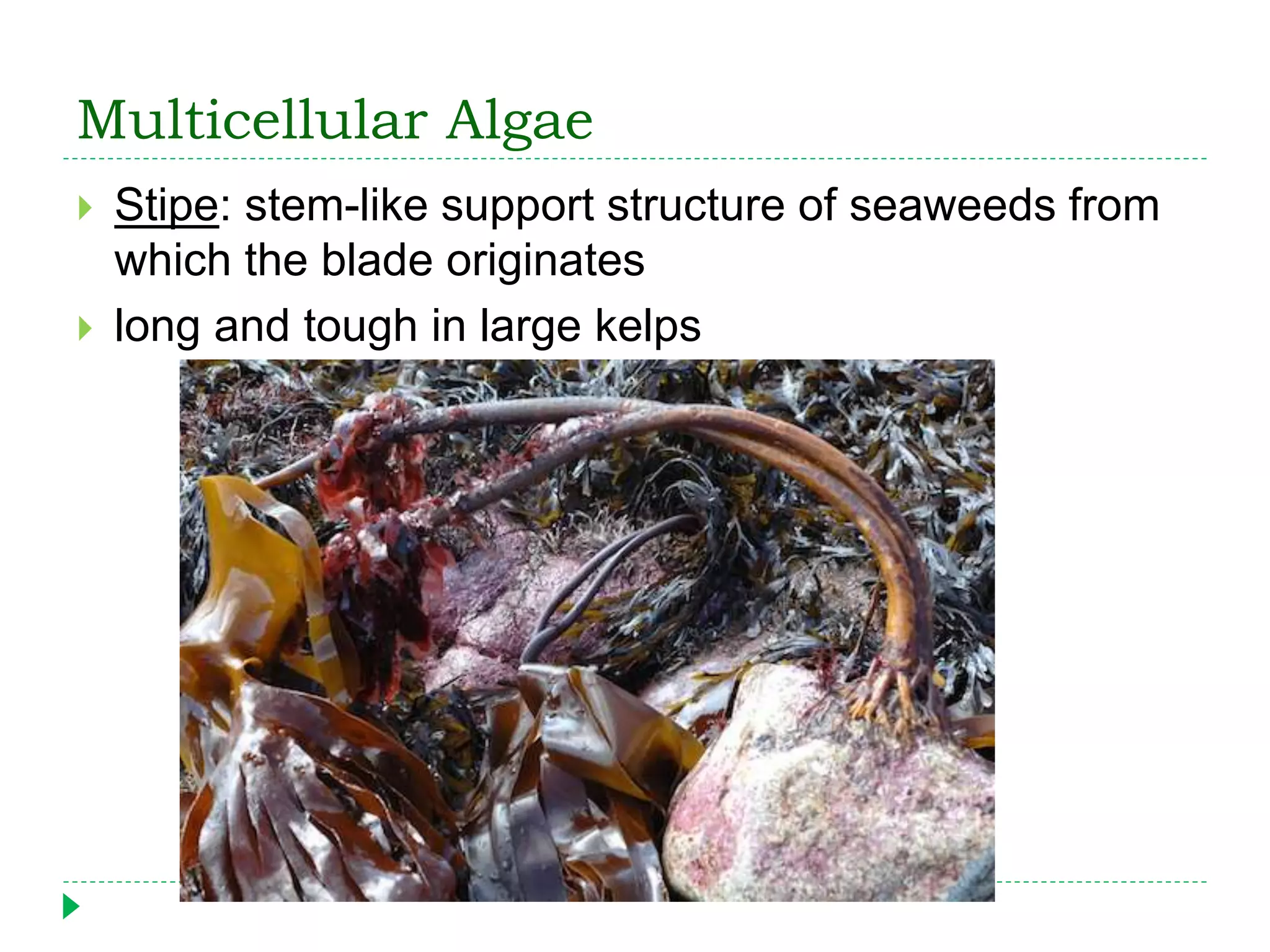
 Stipe: stem-like support structure of seaweeds from
which the blade originates
 long and tough in large kelps
Multicellular Algae
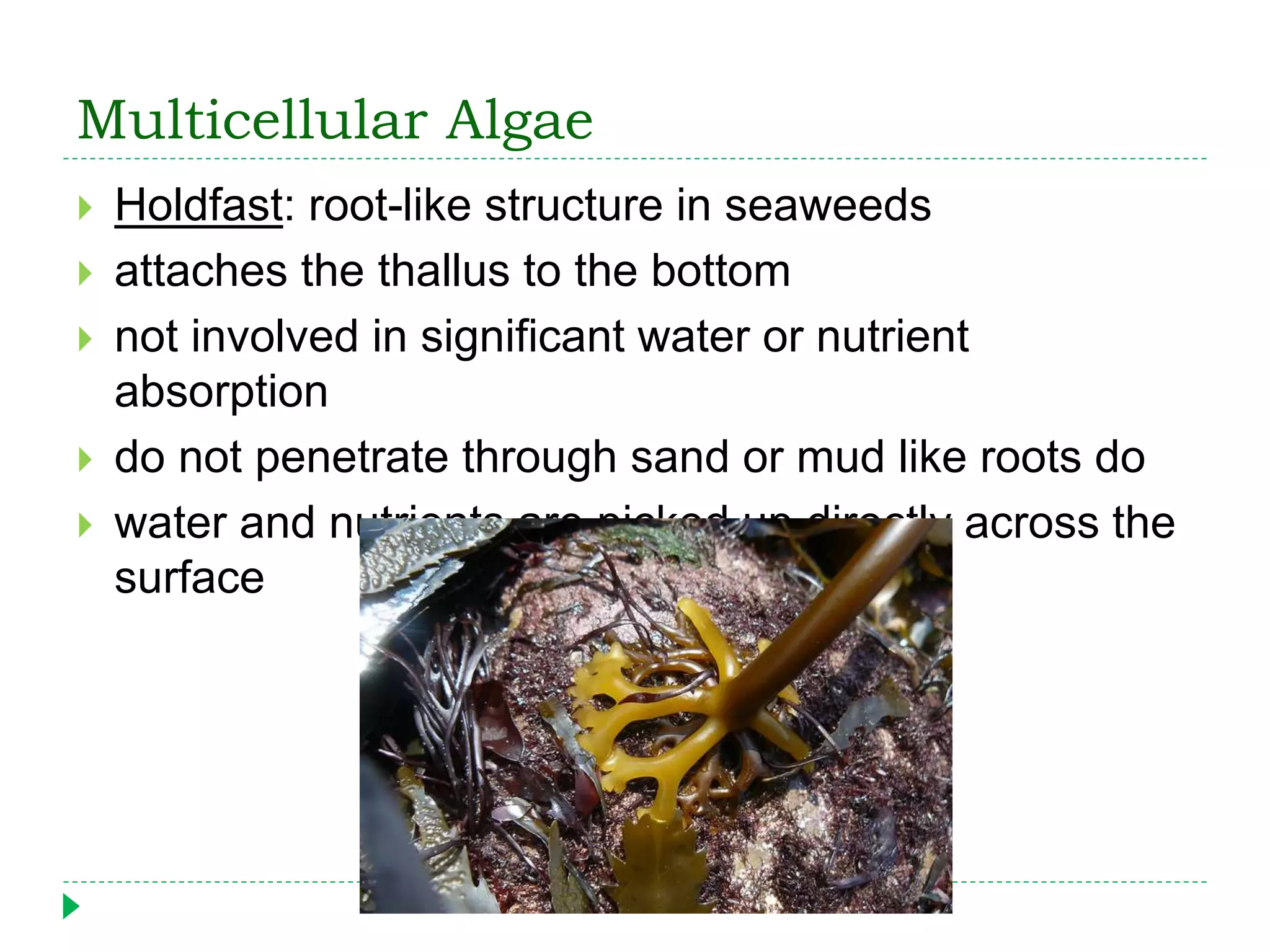
 Holdfast: root-like structure in seaweeds
 attaches the thallus to the bottom
 not involved in significant water or nutrient
absorption
 do not penetrate through sand or mud like roots do
 water and nutrients are picked up directly across the
surface
Multicellular Algae
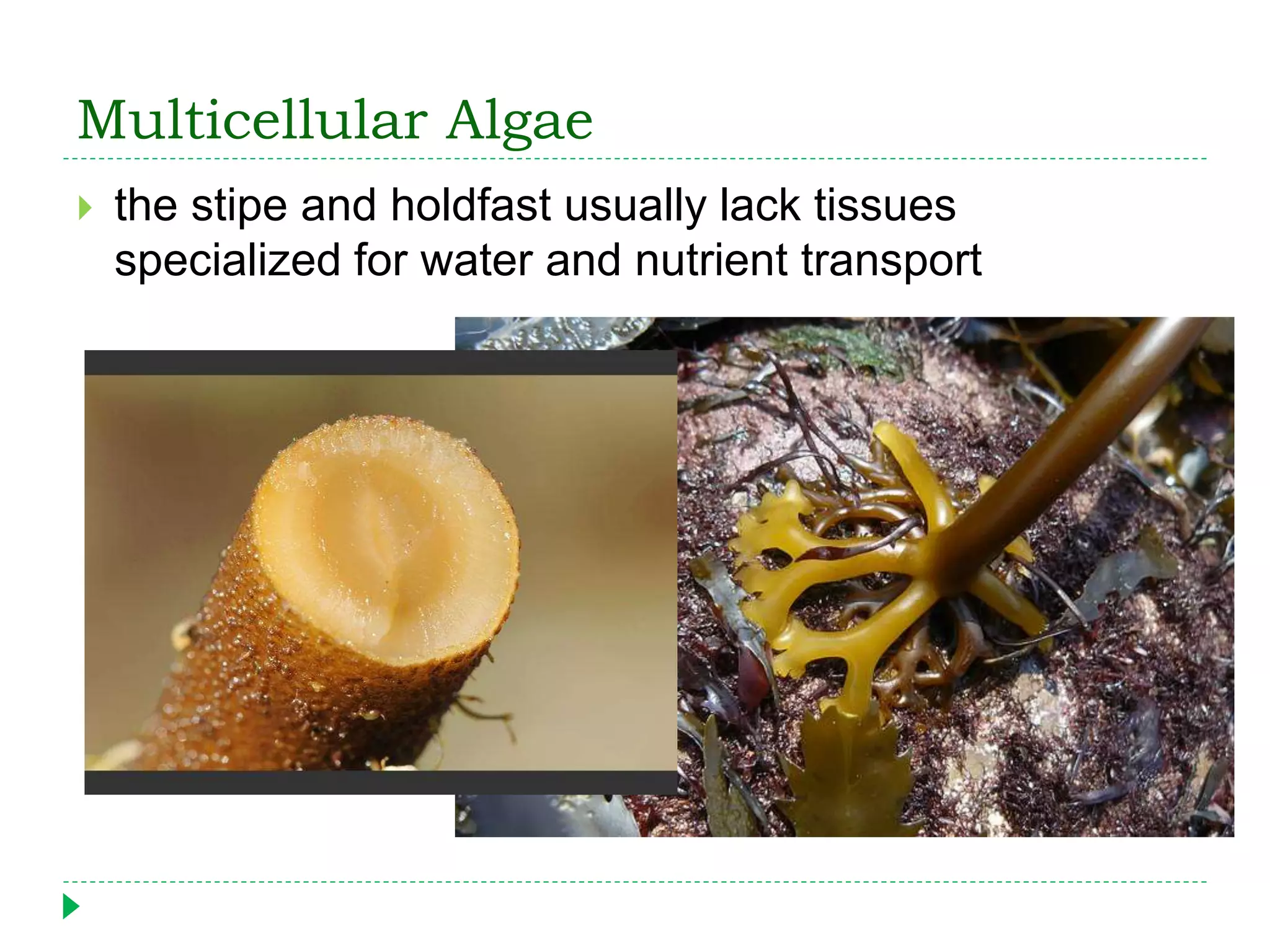
 the stipe and holdfast usually lack tissues
specialized for water and nutrient transport
Types of Seaweed
Types of Seaweed
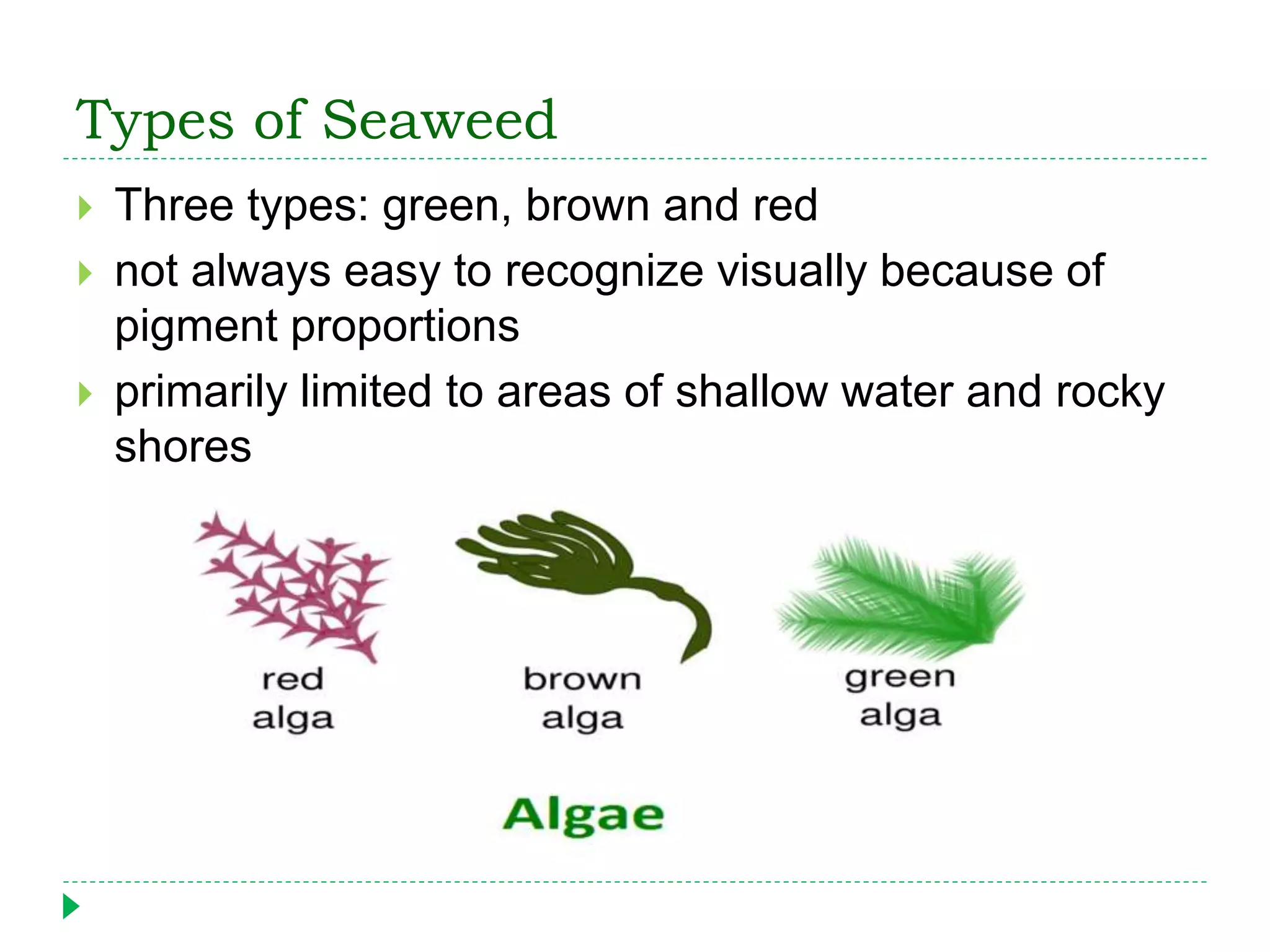
 Three types: green, brown and red
 not always easy to recognize visually because of
pigment proportions
 primarily limited to areas of shallow water and rocky
shores
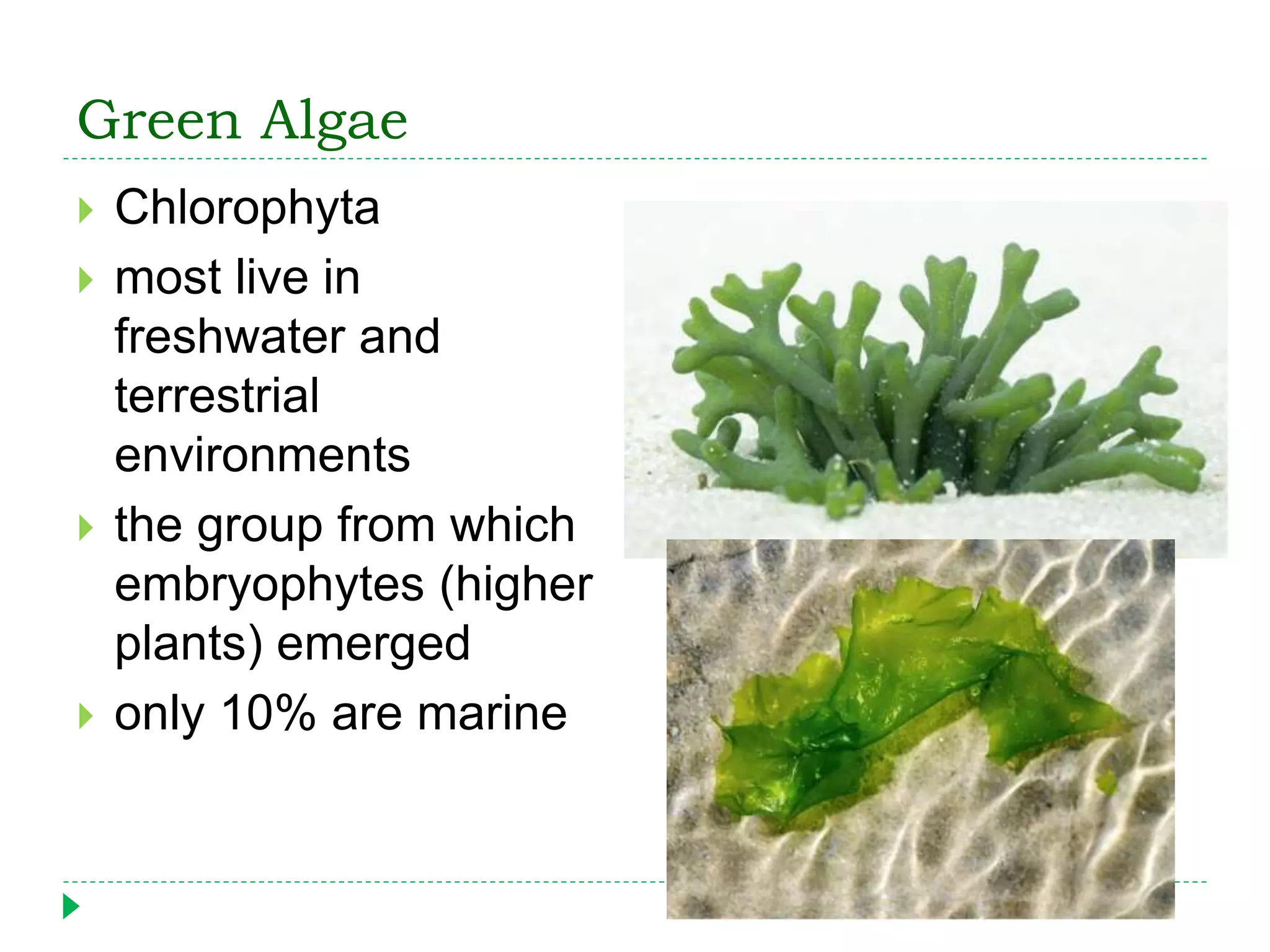
Green Algae
 Chlorophyta
 most live in
freshwater and
terrestrial
environments
 the group from which
embryophytes (higher
plants) emerged
 only 10% are marine
Green Algae
 most have a simple thallus
 pigments and food
reserves are the same as
terrestrial plants
 chlorophyll is not usually
masked
 thallus is usually a bright
green color
 may be branched or
unbranched
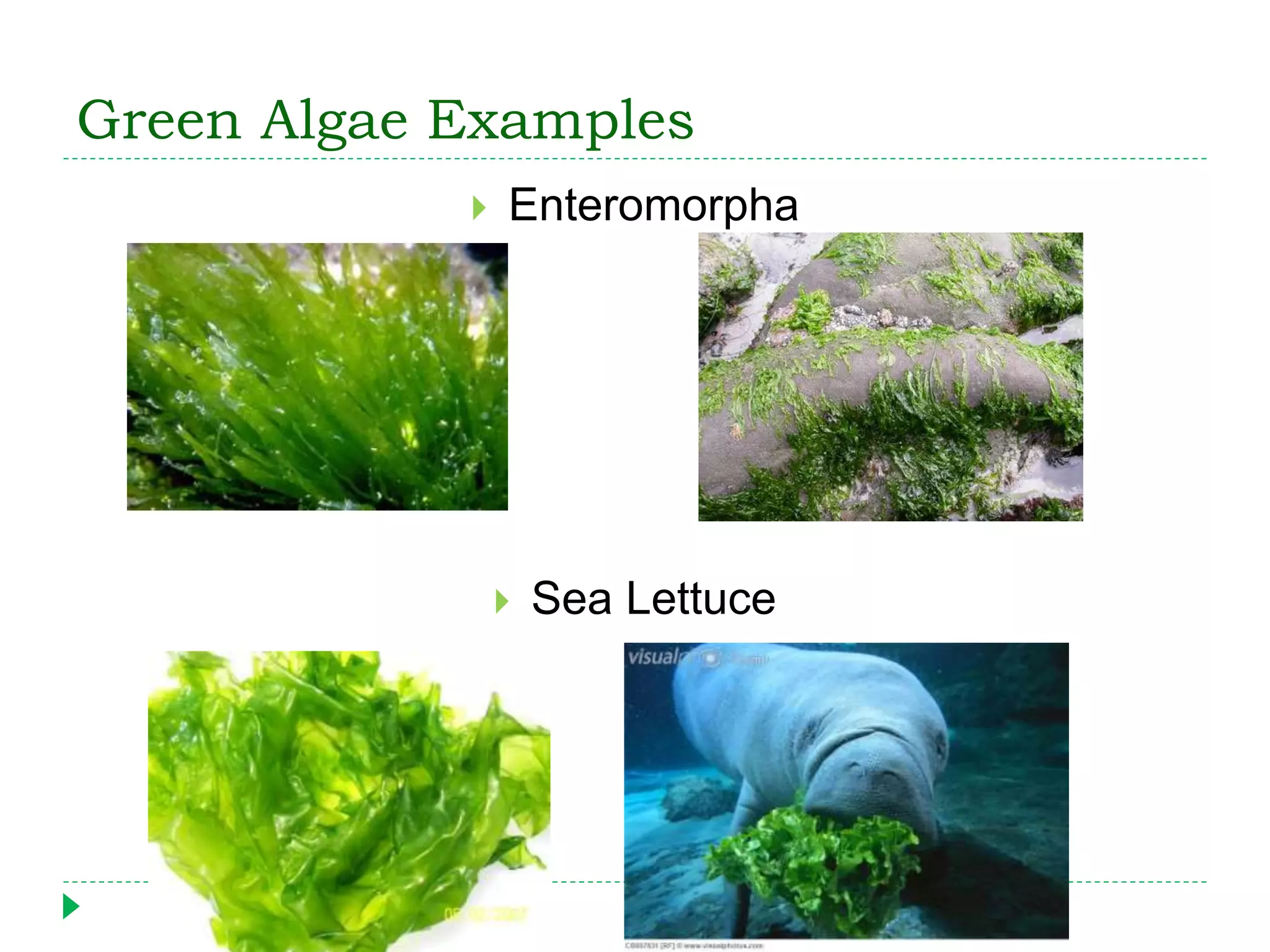
Green Algae Examples
 Enteromorpha
 Sea Lettuce
Green Algae Examples
 Ulva
 Valonia
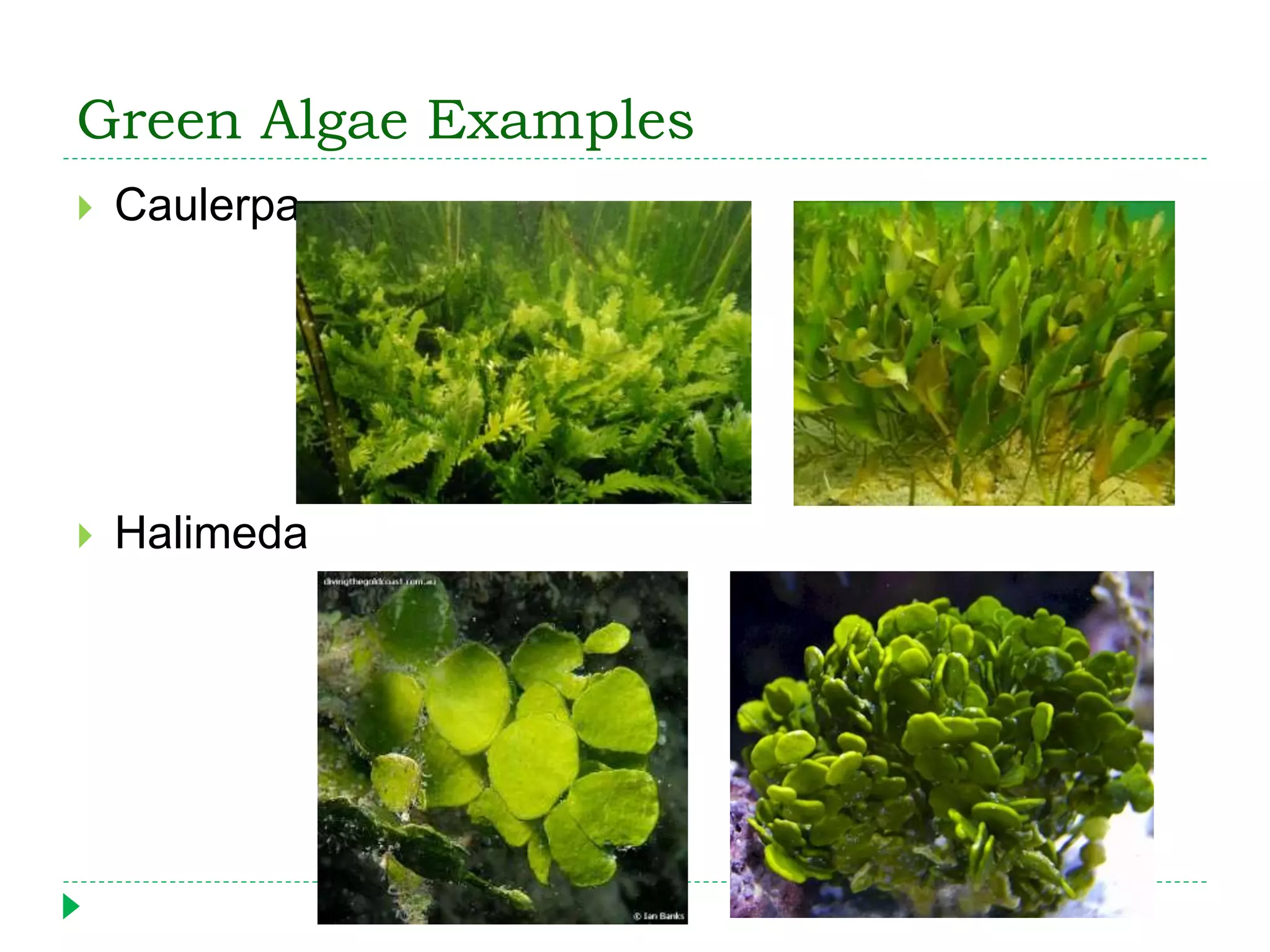
Green Algae Examples
 Caulerpa
 Halimeda
Brown Algae
 Phaeophyta
 color varies from olive green to dark brown
 due to yellow-brown pigments over chlorophyll
 particularly fucoxanthin
Brown Algae
 almost all 1,500 species are marine
 almost always the dominant primary producers on
temperate and polar rocky coasts
Brown Algae
 include largest and
most complex
seaweeds
 belong to the group
Heterokontophyta, a
eukaryotic group
distinguished by
chloroplasts
surrounded by four
membranes
 play an important role
in food supplies and
environment
development
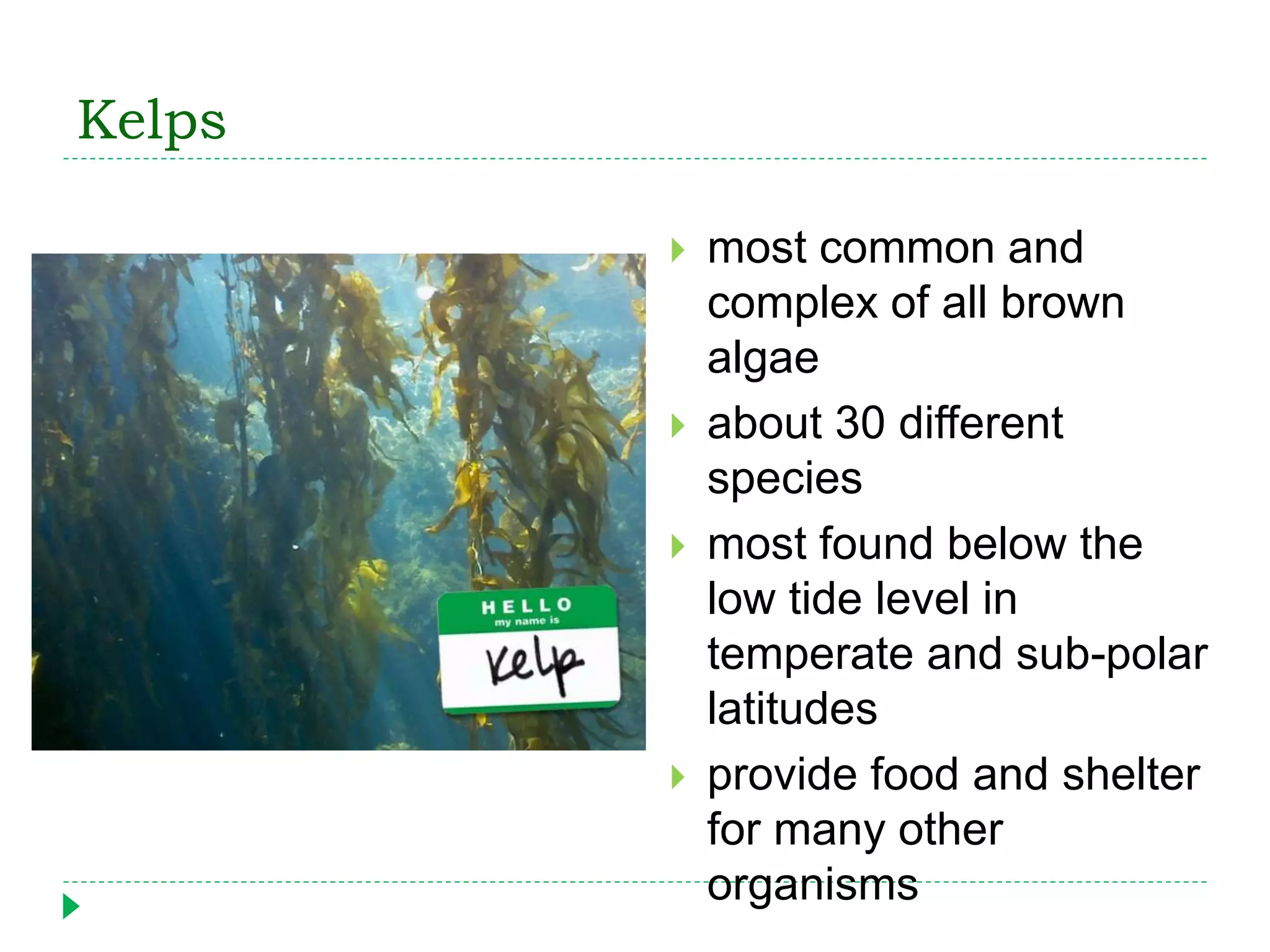
Kelps
 most common and
complex of all brown
algae
 about 30 different
species
 most found below the
low tide level in
temperate and sub-polar
latitudes
 provide food and shelter
for many other
organisms
Kelps
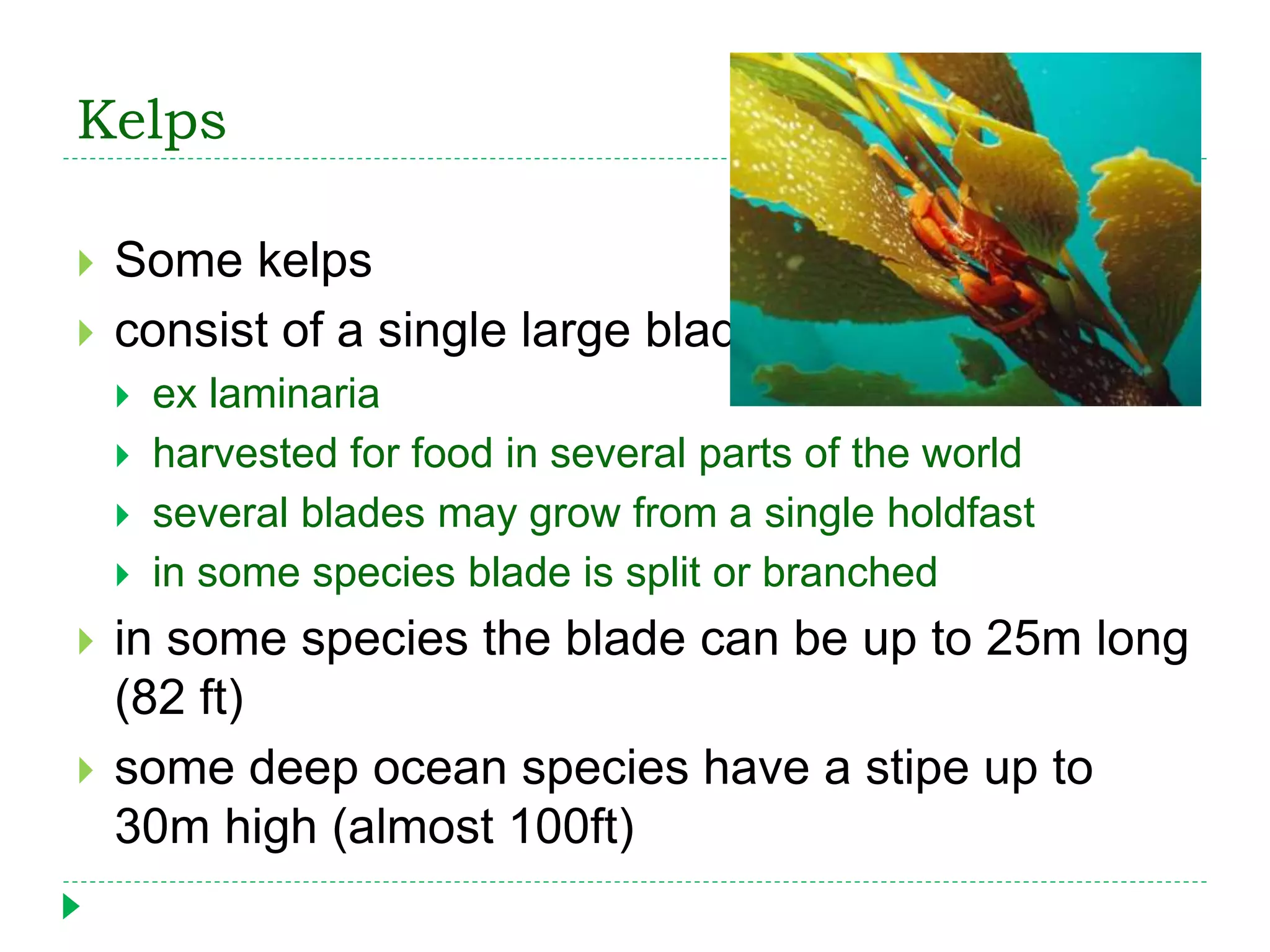
 Some kelps
 consist of a single large blade
 ex laminaria
 harvested for food in several parts of the world
 several blades may grow from a single holdfast
 in some species blade is split or branched
 in some species the blade can be up to 25m long
(82 ft)
 some deep ocean species have a stipe up to
30m high (almost 100ft)
Kelps
 macrocystis
 largest kelp
 enormous holdfast
 several stipes
 elongated blades
 at base of each blade is
a pneumatocyst
 can grow up to 50cm
per day under optimal
conditions
Kelps Forests
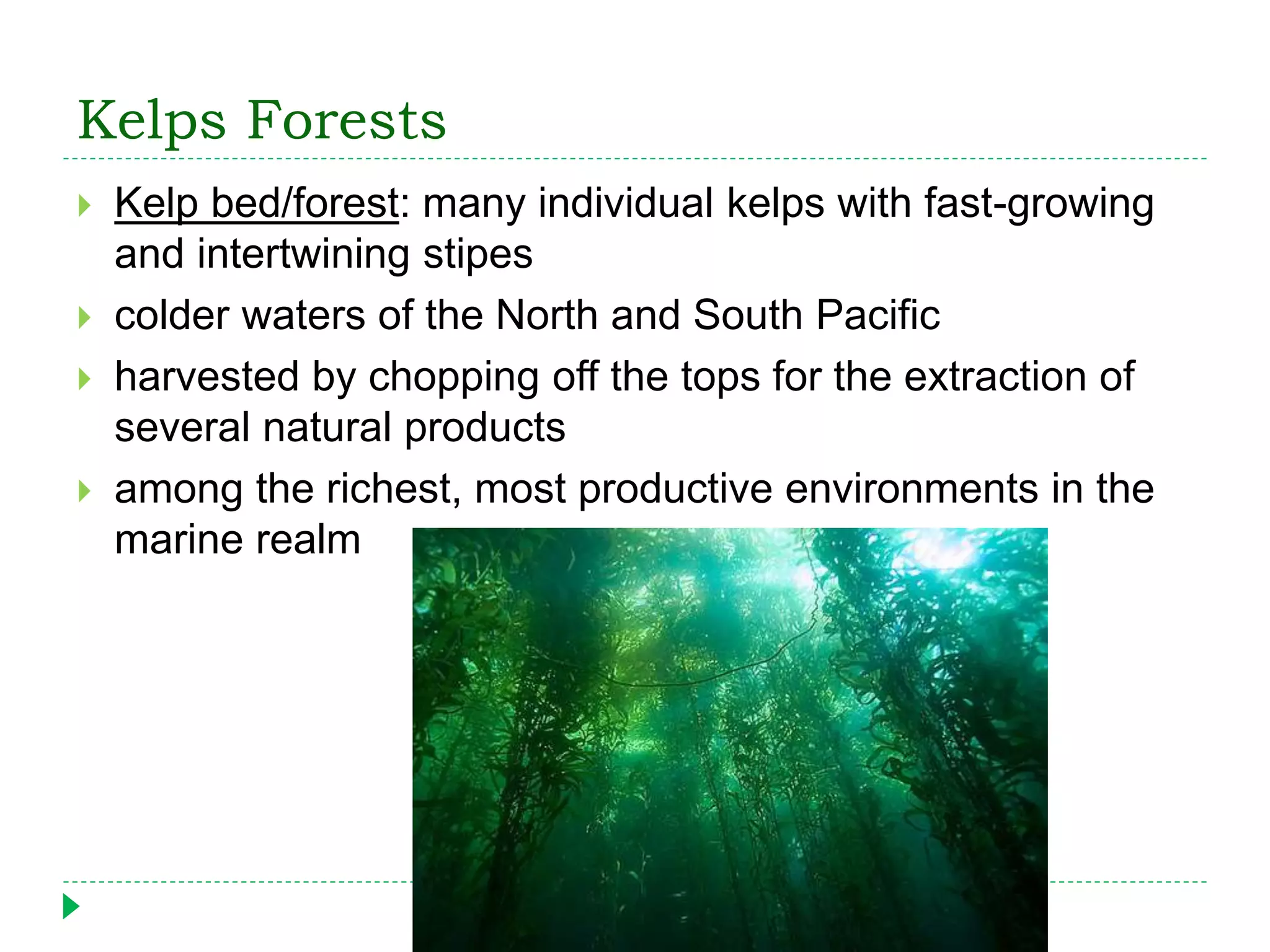
 Kelp bed/forest: many individual kelps with fast-growing
and intertwining stipes
 colder waters of the North and South Pacific
 harvested by chopping off the tops for the extraction of
several natural products
 among the richest, most productive environments in the
marine realm
Kelp Forests
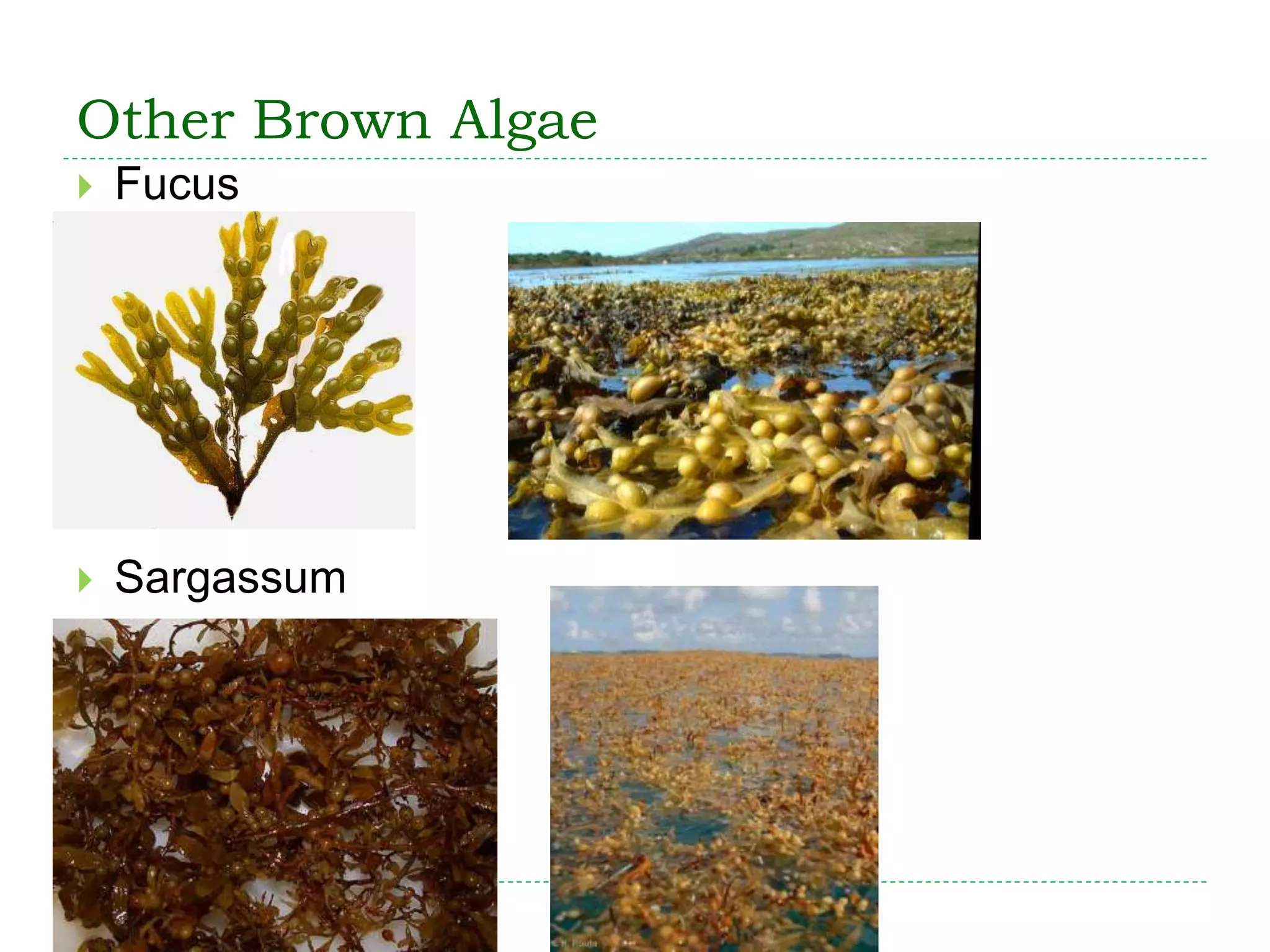
Other Brown Algae
 Fucus
 Sargassum
Red Algae
 Rhodophyta
 more species of red than green and brown
combined
 have red pigments called phycobillins
 mask chlorophyll
 most species are actually red
Red Algae
 very few of the 4,000
species live in
freshwater or soil
 inhabit most shallow-
water marine
environments
 harvested for food and
for the extraction of
various products
Red Algae
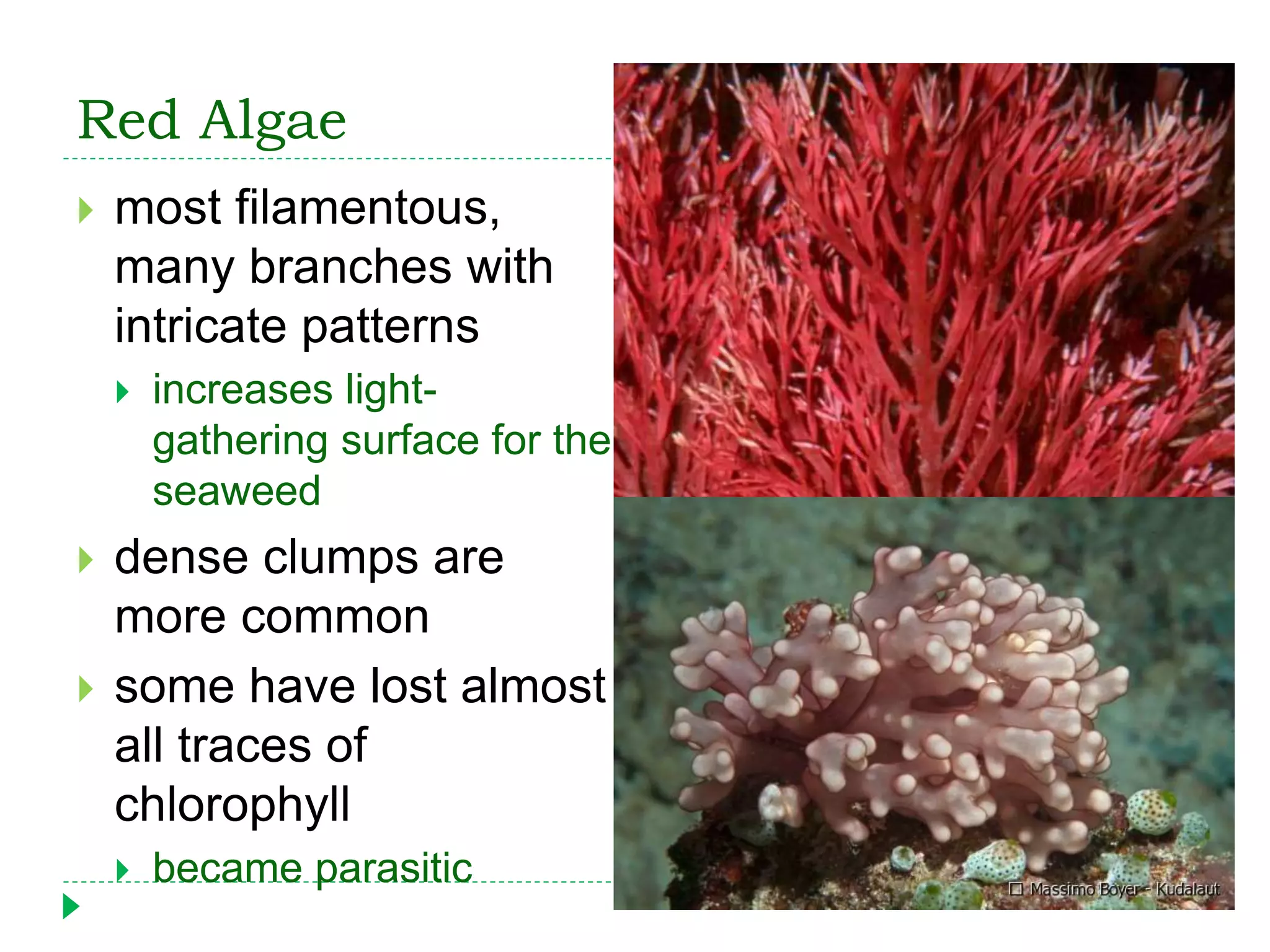
 most filamentous,
many branches with
intricate patterns
 increases light-
gathering surface for the
seaweed
 dense clumps are
more common
 some have lost almost
all traces of
chlorophyll
 became parasitic
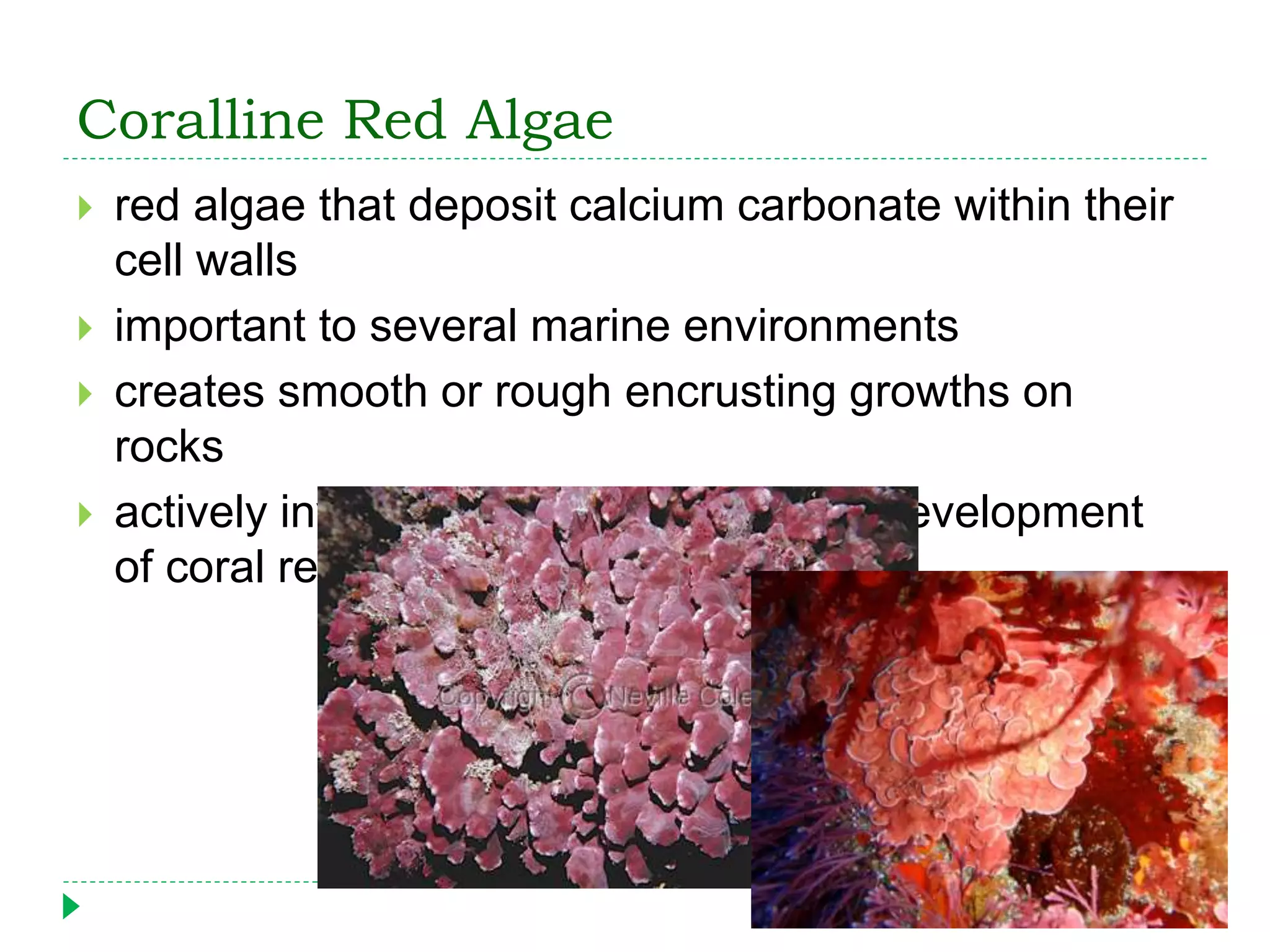
Coralline Red Algae
 red algae that deposit calcium carbonate within their
cell walls
 important to several marine environments
 creates smooth or rough encrusting growths on
rocks
 actively involved in the formation and development
of coral reefs
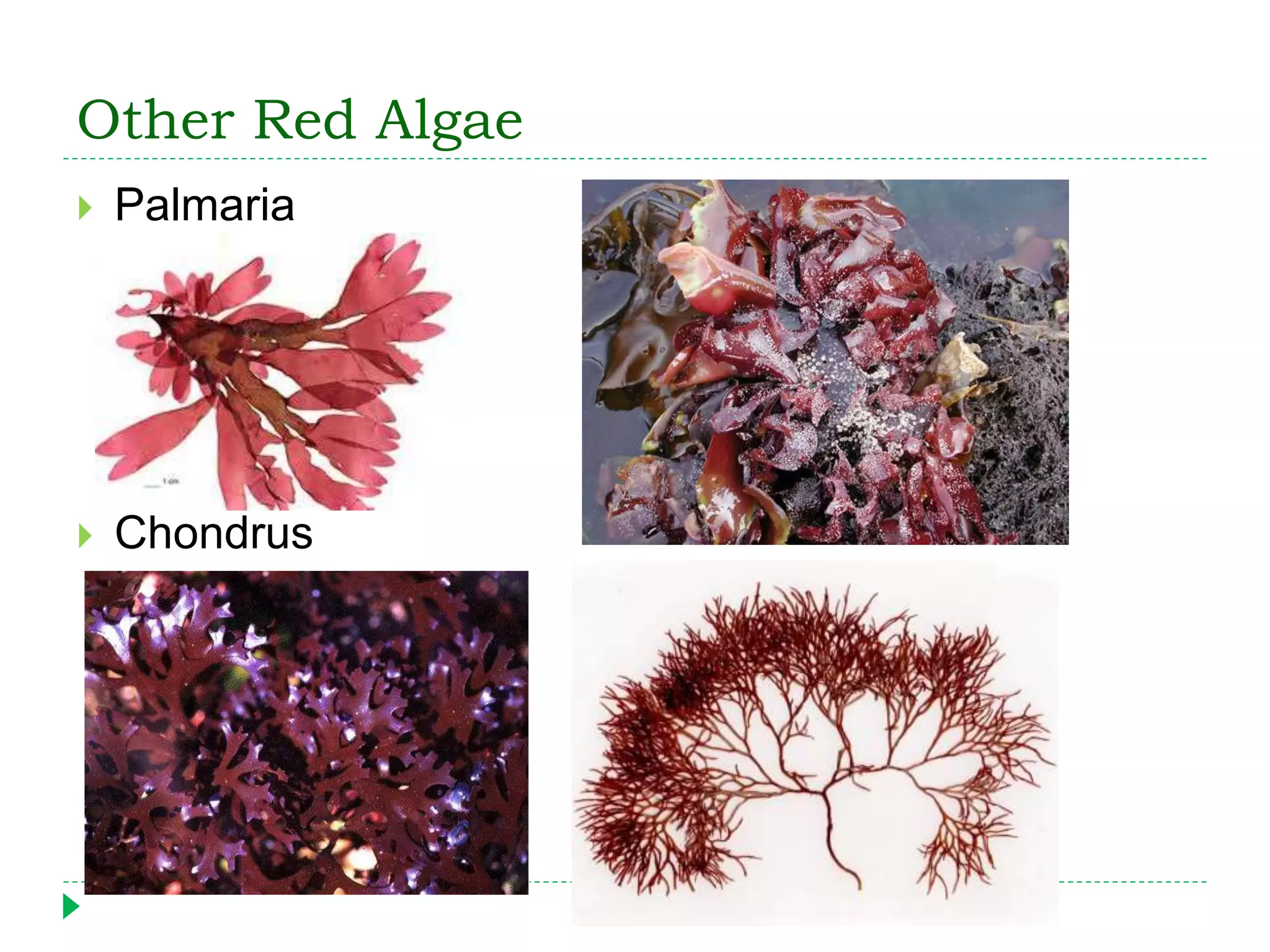
Other Red Algae
 Palmaria
 Chondrus
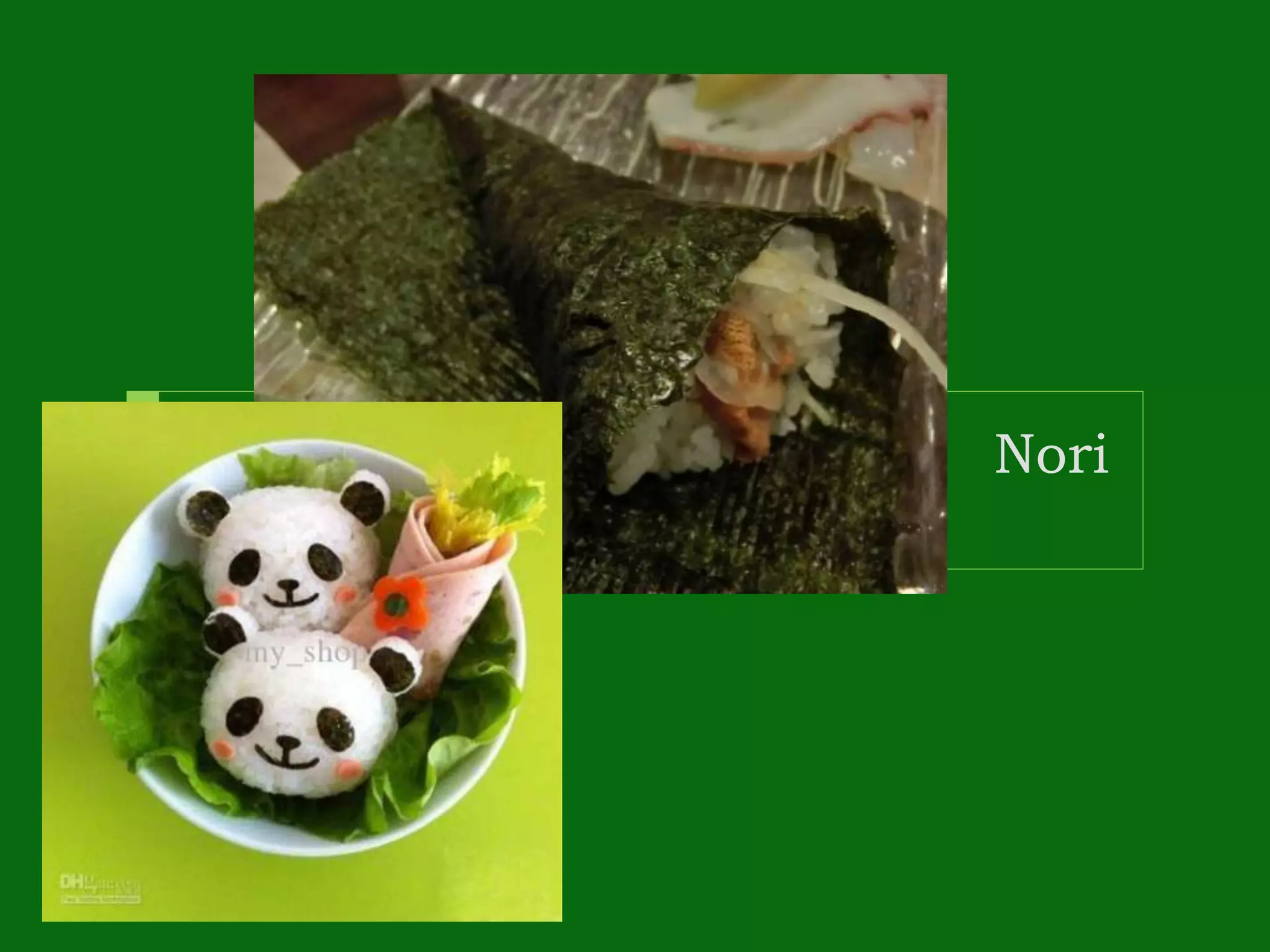
Nori
Nori
 Japanese name for various edible seaweed species
of red algae
 The term nori also commonly used to refer to food
products created from these “sea vegetables”
Nori
 finished products are made by a shredding and rack-
drying process that resembles paper-making
 Japan, Korea and China are the current major
producers valued up to $2 billion per year
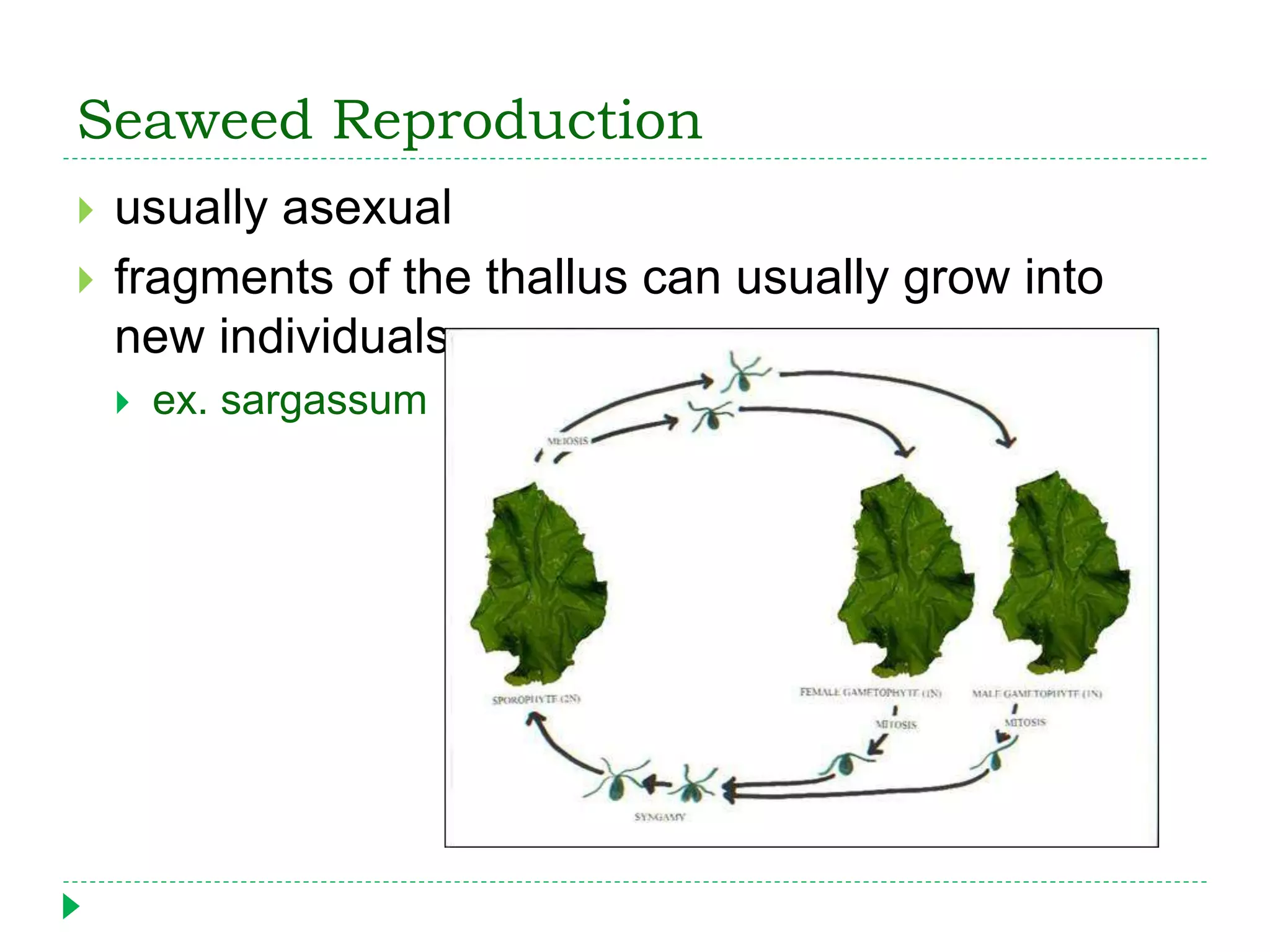
Seaweed Reproduction
 usually asexual
 fragments of the thallus can usually grow into
new individuals
 ex. sargassum
Seaweed Reproduction
 some produce spores
 typically one-celled, reproductive unit capable of giving
rise to a new individual without sexual fusion
Sexual Reproduction
 4 basic types of life
histories:
 diploid sporophyte
 alternation of generation
of three generations
 animal-like reproduction
 haploid thallus
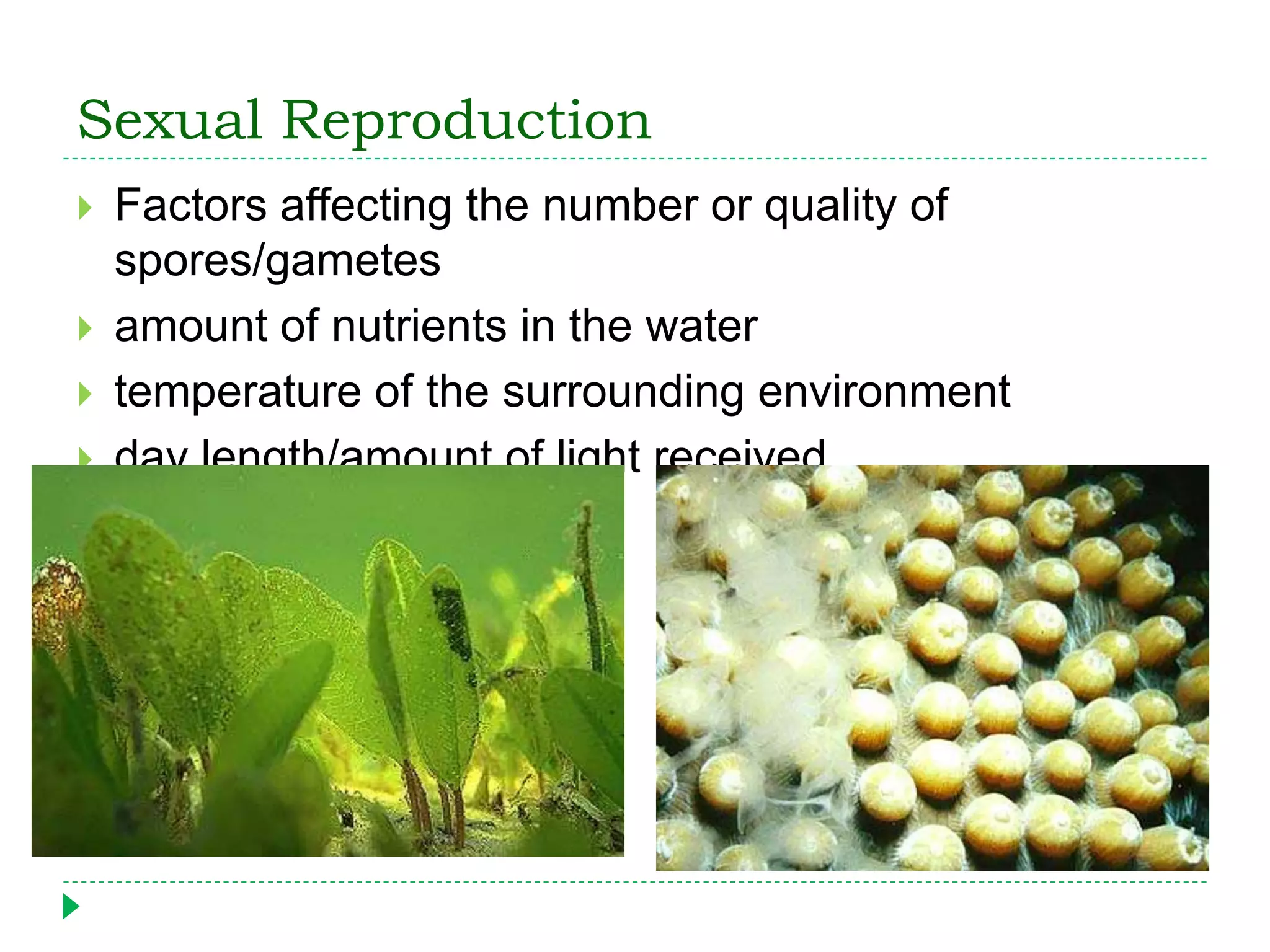
Sexual Reproduction
 Factors affecting the number or quality of
spores/gametes
 amount of nutrients in the water
 temperature of the surrounding environment
 day length/amount of light received
Economic Importance
Economic Importance
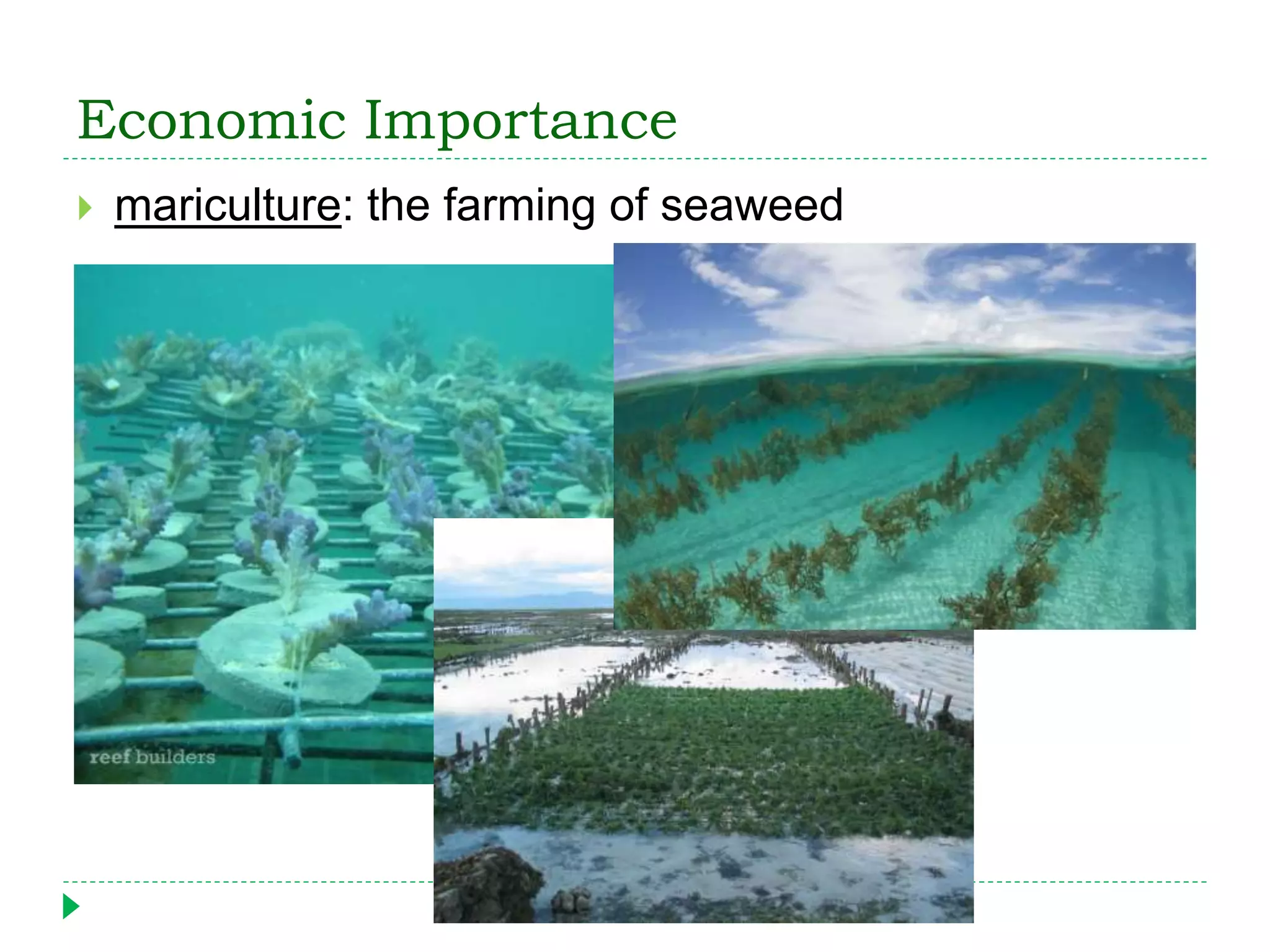
 mariculture: the farming of seaweed
Economic Importance
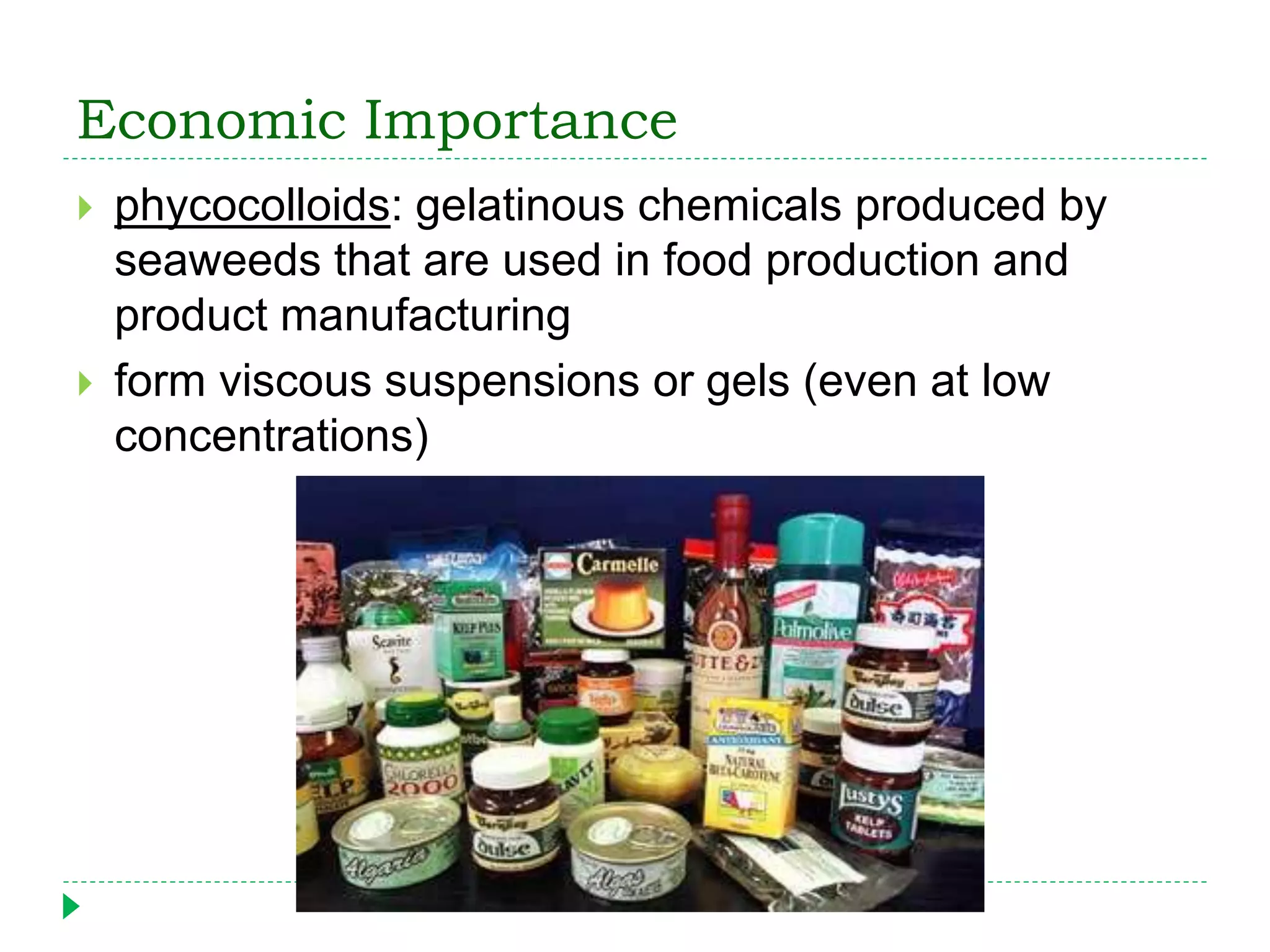
 phycocolloids: gelatinous chemicals produced by
seaweeds that are used in food production and
product manufacturing
 form viscous suspensions or gels (even at low
concentrations)
Algin
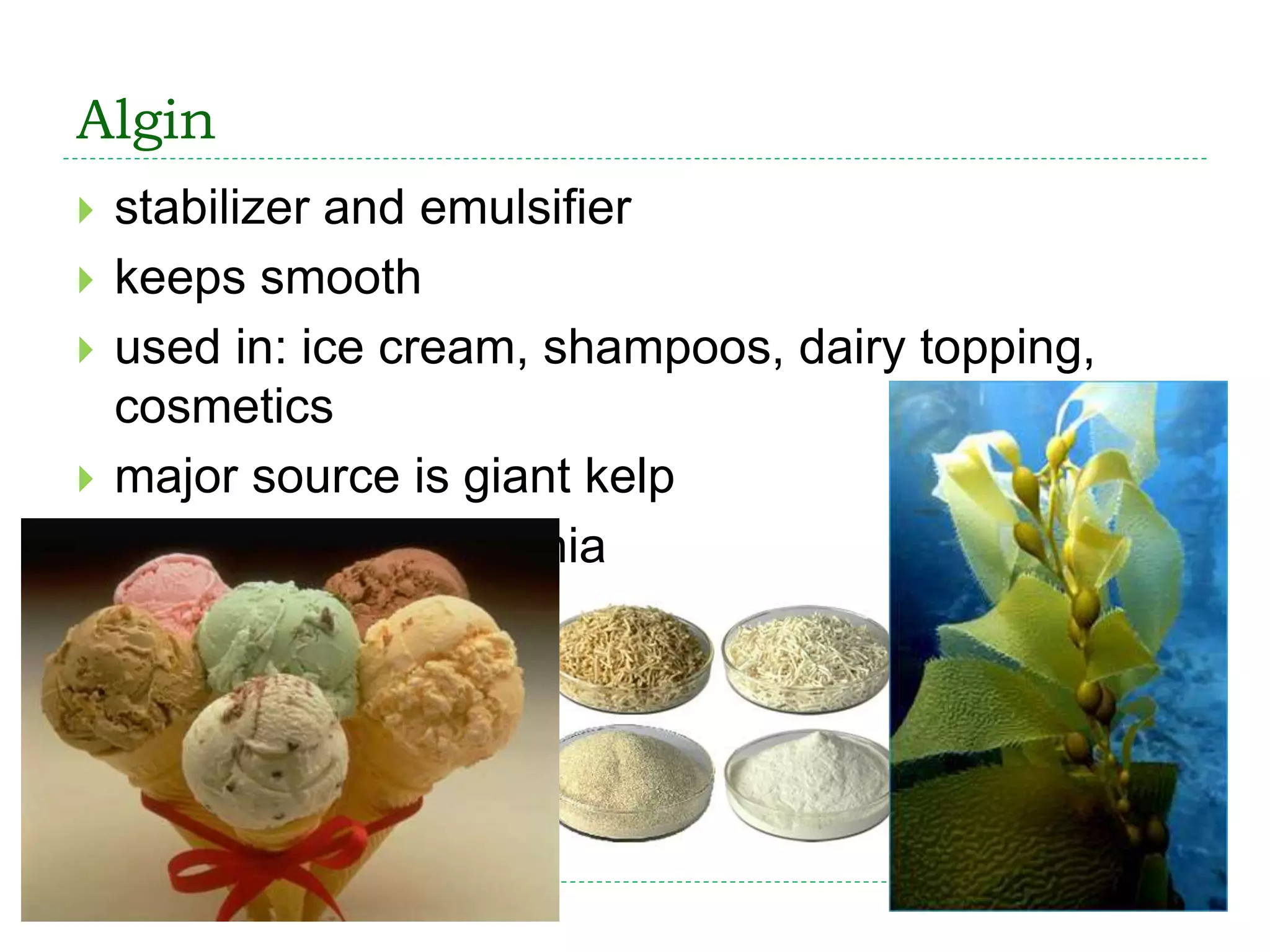
 stabilizer and emulsifier
 keeps smooth
 used in: ice cream, shampoos, dairy topping,
cosmetics
 major source is giant kelp
 harvested in California
Carageenan
 obtained from red algae like Irish moss
 valued as an emulsifier
 used in: dairy products, puddings,
Agar
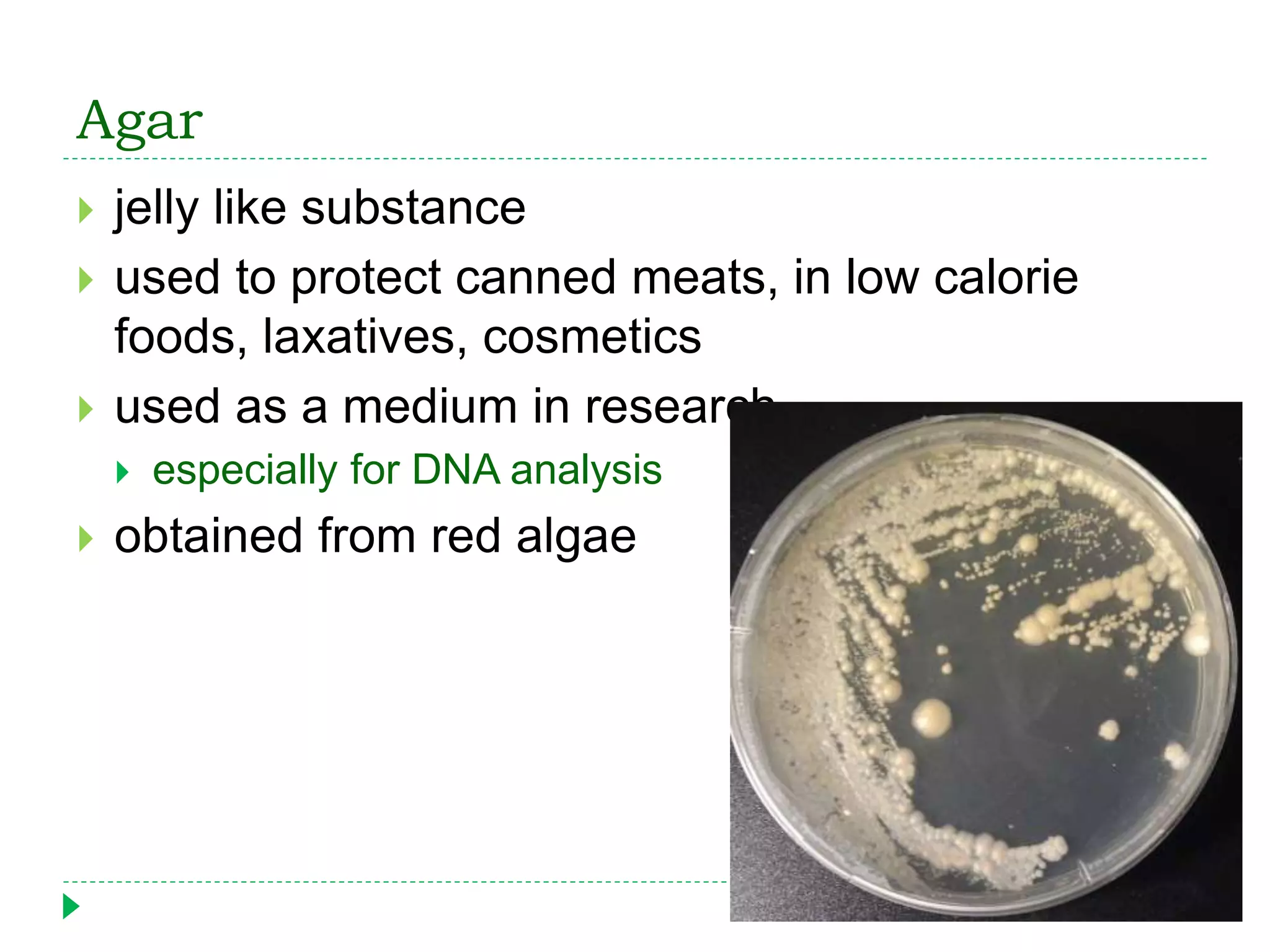
 jelly like substance
 used to protect canned meats, in low calorie
foods, laxatives, cosmetics
 used as a medium in research
 especially for DNA analysis
 obtained from red algae
Angiosperms
Flowering Plants
Angiosperms
 have true roots, stems and leaves
 specialized tissues
 only seagrasses are truly marine
Angiosperms - Seagrasses
 adapted to marine life
 horizontal stems called rhizomes
 pollen carried by currents
 Eelgrass is the most commonly distributed
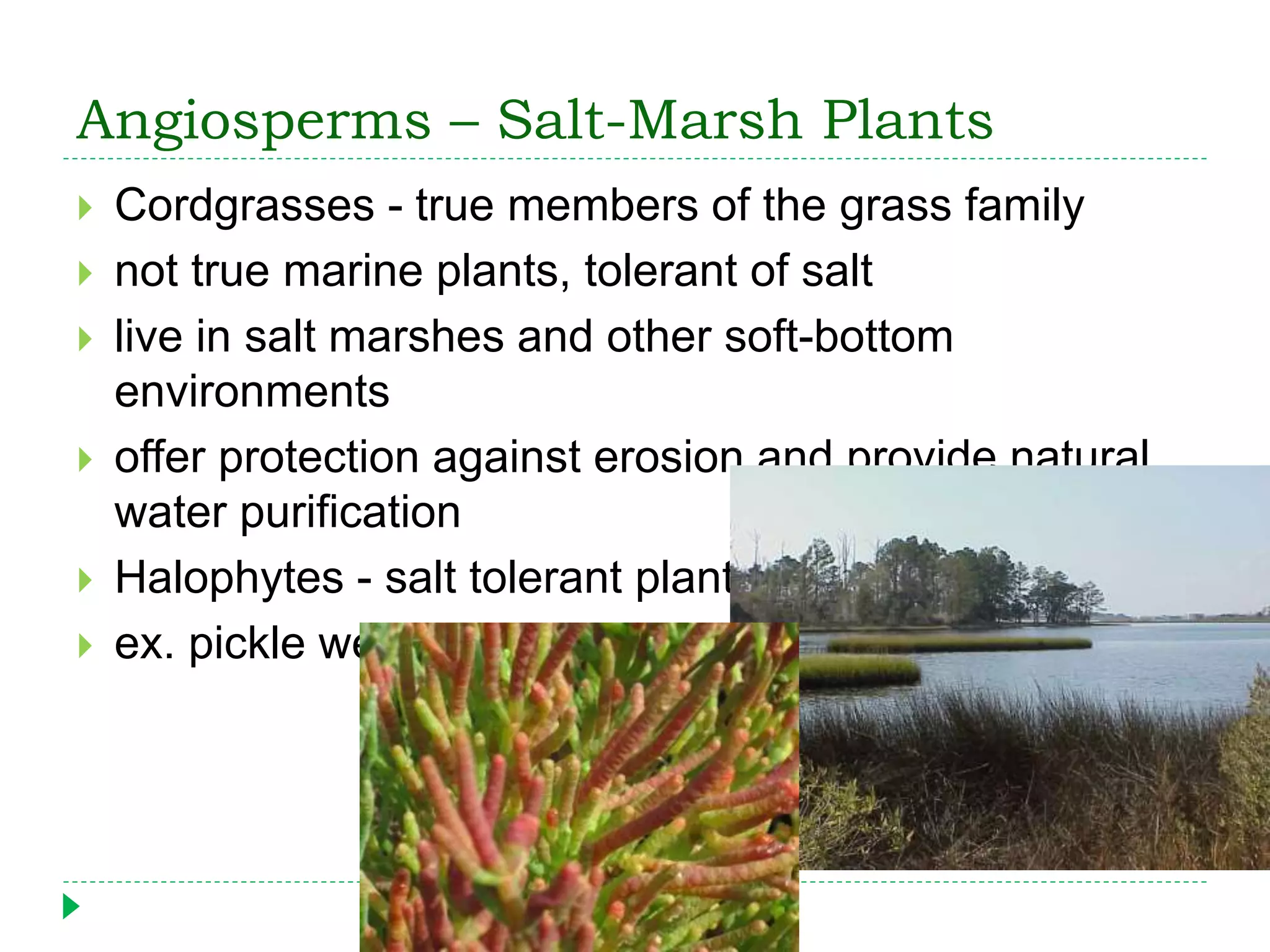
Angiosperms – Salt-Marsh Plants
 Cordgrasses - true members of the grass family
 not true marine plants, tolerant of salt
 live in salt marshes and other soft-bottom
environments
 offer protection against erosion and provide natural
water purification
 Halophytes - salt tolerant plants
 ex. pickle weed
Angiosperms - Mangroves
 Trees and shrubs adapted to live along tropical and
subtropical shores around the world
 land plants that can tolerate salt
 form lush forests in places like Florida
 can survive in both fresh and salt water
environments

Chapter 6 - Seaweed

  • 1.
  • 2.
    Seaweed and Plants Most seaweeds are considered “plants” or plant-like
  • 3.
    Seaweed and Plants Primary Producers: Organisms that produce organic matter from CO2 usually by photosynthesis
  • 4.
    Seaweed and Plants Most seaweeds, although some are parasitic to other seaweeds  Transform solar energy into chemical energy in the form of organic matter  Produce oxygen for organisms both on land and in the ocean
  • 5.
  • 6.
    Multicellular Algae  Seaweed:large, multicellular algae  Most familiar type of marine algae  Some biologists prefer the name macrophytes or macroalgae  All multicellular and eukaryotic
  • 7.
    Multicellular Algae  Takesstructure, types of pigments and stored food products into consideration  Lack highly specialized structures and reproductive mechanisms like terrestrial plants  Vary in shapes and sizes
  • 8.
    Multicellular Algae  Thallus:the complete body of a seaweed  Lack true roots, stems, and leaves
  • 9.
    Multicellular Algae  Blades:The leaf-like, flattened portions of the thallus of seaweeds  have a large surface area  main photosynthetic region  not true leaves, no veins  the upper and lower surfaces of blades are identical to each other
  • 10.
    Multicellular Algae  Pneumatocysts:Gas-filled bladders that sometimes keep the blades close to the sea surface  maximizing the exposure of blades to the sunlight  gases include carbon monoxide
  • 11.
    Multicellular Algae  Stipe:stem-like support structure of seaweeds from which the blade originates  long and tough in large kelps
  • 12.
    Multicellular Algae  Holdfast:root-like structure in seaweeds  attaches the thallus to the bottom  not involved in significant water or nutrient absorption  do not penetrate through sand or mud like roots do  water and nutrients are picked up directly across the surface
  • 13.
    Multicellular Algae  thestipe and holdfast usually lack tissues specialized for water and nutrient transport
  • 14.
  • 15.
    Types of Seaweed Three types: green, brown and red  not always easy to recognize visually because of pigment proportions  primarily limited to areas of shallow water and rocky shores
  • 16.
    Green Algae  Chlorophyta most live in freshwater and terrestrial environments  the group from which embryophytes (higher plants) emerged  only 10% are marine
  • 17.
    Green Algae  mosthave a simple thallus  pigments and food reserves are the same as terrestrial plants  chlorophyll is not usually masked  thallus is usually a bright green color  may be branched or unbranched
  • 18.
    Green Algae Examples Enteromorpha  Sea Lettuce
  • 19.
    Green Algae Examples Ulva  Valonia
  • 20.
    Green Algae Examples Caulerpa  Halimeda
  • 21.
    Brown Algae  Phaeophyta color varies from olive green to dark brown  due to yellow-brown pigments over chlorophyll  particularly fucoxanthin
  • 22.
    Brown Algae  almostall 1,500 species are marine  almost always the dominant primary producers on temperate and polar rocky coasts
  • 23.
    Brown Algae  includelargest and most complex seaweeds  belong to the group Heterokontophyta, a eukaryotic group distinguished by chloroplasts surrounded by four membranes  play an important role in food supplies and environment development
  • 24.
    Kelps  most commonand complex of all brown algae  about 30 different species  most found below the low tide level in temperate and sub-polar latitudes  provide food and shelter for many other organisms
  • 25.
    Kelps  Some kelps consist of a single large blade  ex laminaria  harvested for food in several parts of the world  several blades may grow from a single holdfast  in some species blade is split or branched  in some species the blade can be up to 25m long (82 ft)  some deep ocean species have a stipe up to 30m high (almost 100ft)
  • 26.
    Kelps  macrocystis  largestkelp  enormous holdfast  several stipes  elongated blades  at base of each blade is a pneumatocyst  can grow up to 50cm per day under optimal conditions
  • 27.
    Kelps Forests  Kelpbed/forest: many individual kelps with fast-growing and intertwining stipes  colder waters of the North and South Pacific  harvested by chopping off the tops for the extraction of several natural products  among the richest, most productive environments in the marine realm
  • 28.
  • 29.
    Other Brown Algae Fucus  Sargassum
  • 30.
    Red Algae  Rhodophyta more species of red than green and brown combined  have red pigments called phycobillins  mask chlorophyll  most species are actually red
  • 31.
    Red Algae  veryfew of the 4,000 species live in freshwater or soil  inhabit most shallow- water marine environments  harvested for food and for the extraction of various products
  • 32.
    Red Algae  mostfilamentous, many branches with intricate patterns  increases light- gathering surface for the seaweed  dense clumps are more common  some have lost almost all traces of chlorophyll  became parasitic
  • 33.
    Coralline Red Algae red algae that deposit calcium carbonate within their cell walls  important to several marine environments  creates smooth or rough encrusting growths on rocks  actively involved in the formation and development of coral reefs
  • 34.
    Other Red Algae Palmaria  Chondrus
  • 35.
  • 36.
    Nori  Japanese namefor various edible seaweed species of red algae  The term nori also commonly used to refer to food products created from these “sea vegetables”
  • 37.
    Nori  finished productsare made by a shredding and rack- drying process that resembles paper-making  Japan, Korea and China are the current major producers valued up to $2 billion per year
  • 38.
  • 39.
    Seaweed Reproduction  usuallyasexual  fragments of the thallus can usually grow into new individuals  ex. sargassum
  • 40.
    Seaweed Reproduction  someproduce spores  typically one-celled, reproductive unit capable of giving rise to a new individual without sexual fusion
  • 41.
    Sexual Reproduction  4basic types of life histories:  diploid sporophyte  alternation of generation of three generations  animal-like reproduction  haploid thallus
  • 42.
    Sexual Reproduction  Factorsaffecting the number or quality of spores/gametes  amount of nutrients in the water  temperature of the surrounding environment  day length/amount of light received
  • 43.
  • 44.
  • 45.
    Economic Importance  phycocolloids:gelatinous chemicals produced by seaweeds that are used in food production and product manufacturing  form viscous suspensions or gels (even at low concentrations)
  • 46.
    Algin  stabilizer andemulsifier  keeps smooth  used in: ice cream, shampoos, dairy topping, cosmetics  major source is giant kelp  harvested in California
  • 47.
    Carageenan  obtained fromred algae like Irish moss  valued as an emulsifier  used in: dairy products, puddings,
  • 48.
    Agar  jelly likesubstance  used to protect canned meats, in low calorie foods, laxatives, cosmetics  used as a medium in research  especially for DNA analysis  obtained from red algae
  • 49.
  • 50.
    Angiosperms  have trueroots, stems and leaves  specialized tissues  only seagrasses are truly marine
  • 51.
    Angiosperms - Seagrasses adapted to marine life  horizontal stems called rhizomes  pollen carried by currents  Eelgrass is the most commonly distributed
  • 52.
    Angiosperms – Salt-MarshPlants  Cordgrasses - true members of the grass family  not true marine plants, tolerant of salt  live in salt marshes and other soft-bottom environments  offer protection against erosion and provide natural water purification  Halophytes - salt tolerant plants  ex. pickle weed
  • 53.
    Angiosperms - Mangroves Trees and shrubs adapted to live along tropical and subtropical shores around the world  land plants that can tolerate salt  form lush forests in places like Florida  can survive in both fresh and salt water environments