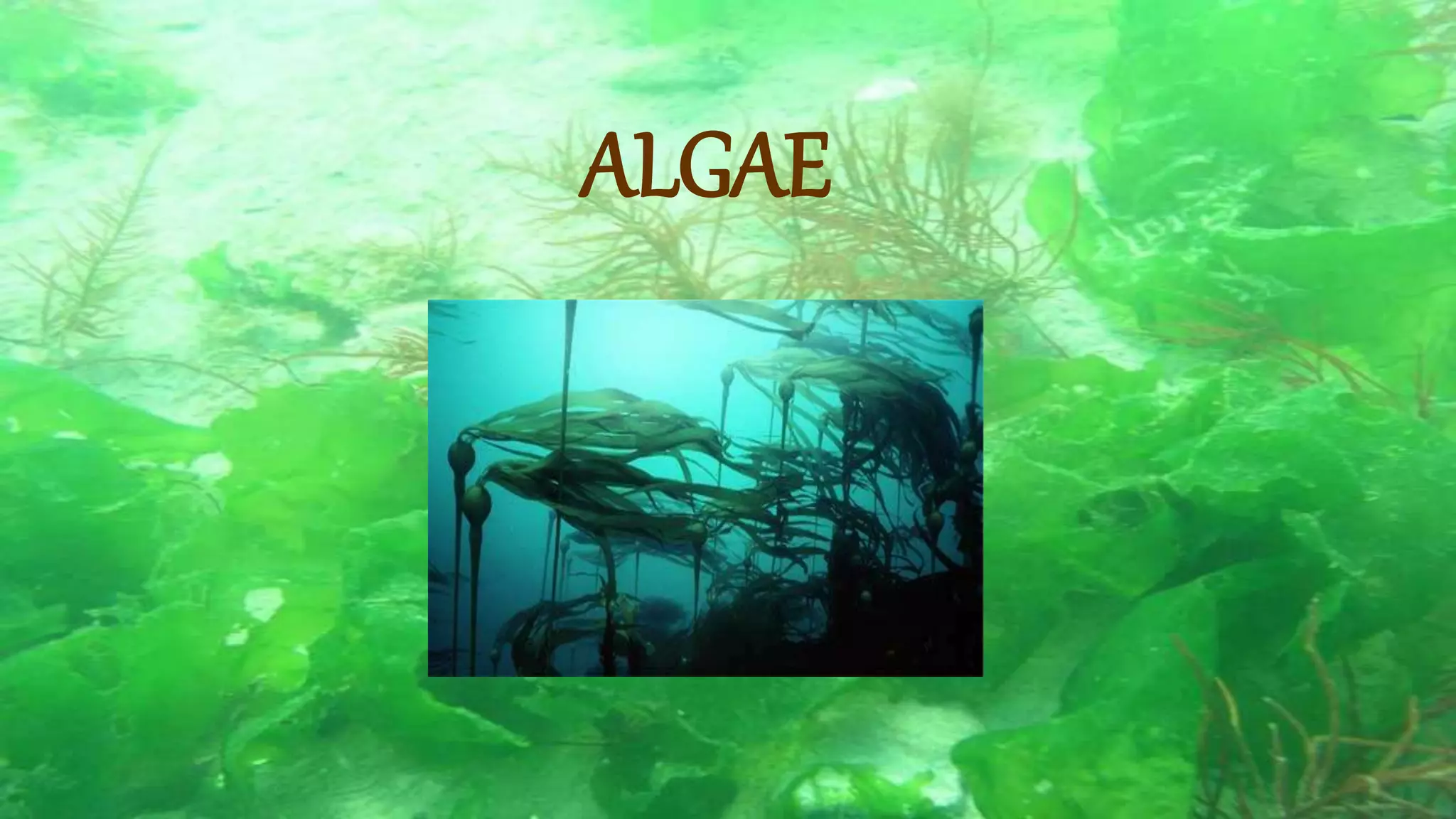
ALGAE
Characteristics
• Range in size from microscopic like single celled organisms to large
seaweeds
• Autotrophic
• Form the reproductive structures – gametangia or gamete chambers
• Aquatic and have flagella at some point in life
• Often contain pyrenoids, organelles that synthesis and store starch
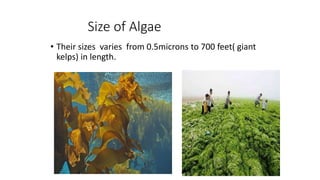
Size of Algae
• Their sizes varies from 0.5microns to 700 feet( giant
kelps) in length.
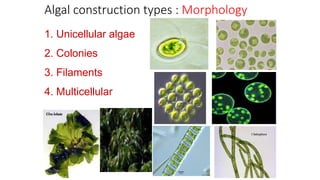
Algal construction types : Morphology
1. Unicellular algae
2. Colonies
3. Filaments
4. Multicellular
Algae - What are they?
• Primitive plants
• No true roots, only attachment
structures (Holdfasts)
• Produce spores (not seeds)– motile or
non-motile
• Most have sexual and asexual
reproduction
• Non-vascular, do not possess an
internal transport system.
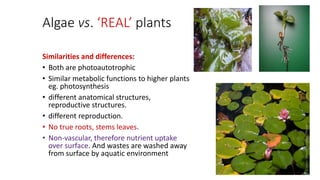
Algae vs. ‘REAL’ plants
Similarities and differences:
• Both are photoautotrophic
• Similar metabolic functions to higher plants
eg. photosynthesis
• different anatomical structures,
reproductive structures.
• different reproduction.
• No true roots, stems leaves.
• Non-vascular, therefore nutrient uptake
over surface. And wastes are washed away
from surface by aquatic environment
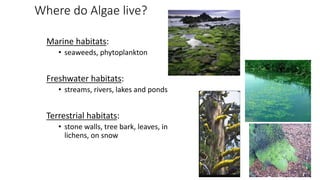
Where do Algae live?
Marine habitats:
• seaweeds, phytoplankton
Freshwater habitats:
• streams, rivers, lakes and ponds
Terrestrial habitats:
• stone walls, tree bark, leaves, in
lichens, on snow
Algal Pigments
Colour of algaes varies due to presence of definite chemical
compounds called as pigments.
 Photosynthetic pigments in algae are of 3kinds,
 Chlorophyll- “a” is common, whereas b, c and d have restricted
distribution.
 Carotenoids -These are fat soluble yellow coloured pigments.
 Phycobilins or biliproteins- include red coloured Phycoerythrins and
blue coloured phycocyanins.
Reproduction
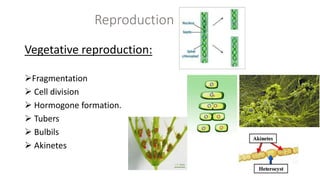
Vegetative reproduction:
Fragmentation
 Cell division
 Hormogone formation.
 Tubers
 Bulbils
 Akinetes
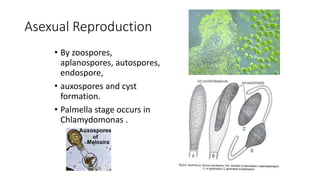
Asexual Reproduction
• By zoospores,
aplanospores, autospores,
endospore,
• auxospores and cyst
formation.
• Palmella stage occurs in
Chlamydomonas .
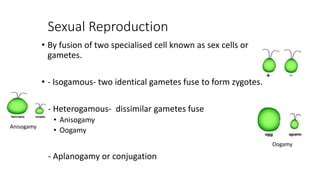
Sexual Reproduction
• By fusion of two specialised cell known as sex cells or
gametes.
• - Isogamous- two identical gametes fuse to form zygotes.
- Heterogamous- dissimilar gametes fuse
• Anisogamy
• Oogamy
- Aplanogamy or conjugation
Oogamy
Anisogamy
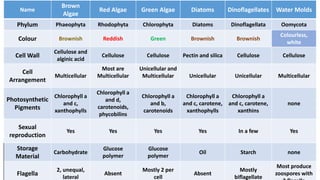
CLASSIFICATION OF ALGAE
• PHYLUM ARE BASED ON
• Primary Photosynthetic Pigment
• Food-storage Substance
• Cell Wall Composition
Name
Brown
Algae
Red Algae Green Algae Diatoms Dinoflagellates Water Molds
Phylum Phaeophyta Rhodophyta Chlorophyta Diatoms Dinoflagellata Oomycota
Colour Brownish Reddish Green Brownish Brownish
Colourless,
white
Cell Wall
Cellulose and
alginic acid
Cellulose Cellulose Pectin and silica Cellulose Cellulose
Cell
Arrangement
Multicellular
Most are
Multicellular
Unicellular and
Multicellular Unicellular Unicellular Multicellular
Photosynthetic
Pigments
Chlorophyll a
and c,
xanthophylls
Chlorophyll a
and d,
carotenoids,
phycobilins
Chlorophyll a
and b,
carotenoids
Chlorophyll a
and c, carotene,
xanthophylls
Chlorophyll a
and c, carotene,
xanthins
none
Sexual
reproduction
Yes Yes Yes Yes In a few Yes
Storage
Material
Carbohydrate
Glucose
polymer
Glucose
polymer
Oil Starch none
Flagella
2, unequal,
lateral
Absent
Mostly 2 per
cell
Absent
Mostly
biflagellate
Most produce
zoospores with
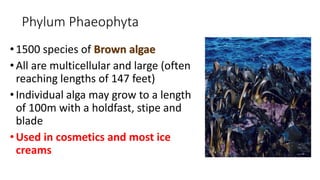
Phylum Phaeophyta
•1500 species of Brown algae
•All are multicellular and large (often
reaching lengths of 147 feet)
•Individual alga may grow to a length
of 100m with a holdfast, stipe and
blade
•Used in cosmetics and most ice
creams
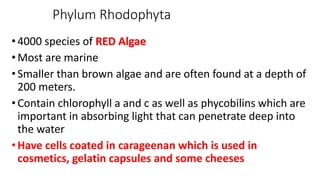
Phylum Rhodophyta
•4000 species of RED Algae
•Most are marine
•Smaller than brown algae and are often found at a depth of
200 meters.
•Contain chlorophyll a and c as well as phycobilins which are
important in absorbing light that can penetrate deep into
the water
•Have cells coated in carageenan which is used in
cosmetics, gelatin capsules and some cheeses
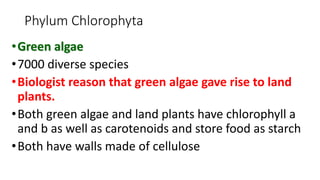
Phylum Chlorophyta
•Green algae
•7000 diverse species
•Biologist reason that green algae gave rise to land
plants.
•Both green algae and land plants have chlorophyll a
and b as well as carotenoids and store food as starch
•Both have walls made of cellulose
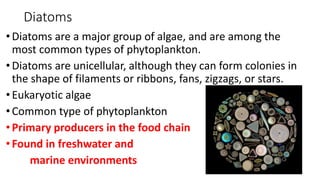
Diatoms
•Diatoms are a major group of algae, and are among the
most common types of phytoplankton.
•Diatoms are unicellular, although they can form colonies in
the shape of filaments or ribbons, fans, zigzags, or stars.
•Eukaryotic algae
•Common type of phytoplankton
•Primary producers in the food chain
•Found in freshwater and
marine environments
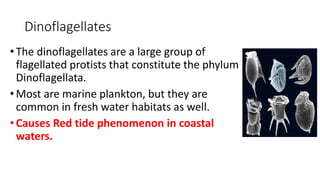
Dinoflagellates
•The dinoflagellates are a large group of
flagellated protists that constitute the phylum
Dinoflagellata.
•Most are marine plankton, but they are
common in fresh water habitats as well.
• Causes Red tide phenomenon in coastal
waters.
Oomycota
• Oomycota or oomycetes form a distinct phylogenetic
lineage of fungus-like eukaryotic microorganisms.
• They are filamentous, microscopic, absorptive
organisms that reproduce both sexually and asexually.
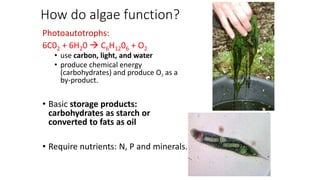
How do algae function?
Photoautotrophs:
6C02 + 6H20  C6H1206 + O2
• use carbon, light, and water
• produce chemical energy
(carbohydrates) and produce O2 as a
by-product.
• Basic storage products:
carbohydrates as starch or
converted to fats as oil
• Require nutrients: N, P and minerals.
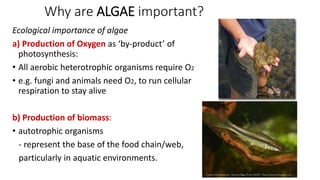
Why are ALGAE important?
Ecological importance of algae
a) Production of Oxygen as ‘by-product’ of
photosynthesis:
• All aerobic heterotrophic organisms require O2
• e.g. fungi and animals need O2, to run cellular
respiration to stay alive
b) Production of biomass:
• autotrophic organisms
- represent the base of the food chain/web,
particularly in aquatic environments.
Why are algae important?
• Primary producers, basis of food webs, “FORESTS/GRASSES OF THE SEA”
• Pioneer Species: on rocky shores, mudflats, hot springs, lichen
communities, 'snow algae'
• O2 production and carbon fixation in aquatic habitats.
Beneficial Aspects of Algae
•Food for humans
•Food for invertebrates and fishes in mariculture
•Animal feed
•Soil fertilizers and conditioners in agriculture
•Treatment of waste water
•Drugs
•Model system for research
•Blooms of freshwater algae
•Red tides and marine blooms
•Toxins accumulated in food chains
•Damage to cave paintings, frescoes, and other works of art
•Fouling of ships and other submerged surfaces
•Fouling of the shells of commercially important bivalves
HARMFUL EFFECTS of Algae
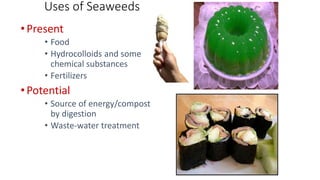
Uses of Seaweeds
•Present
• Food
• Hydrocolloids and some
chemical substances
• Fertilizers
•Potential
• Source of energy/compost
by digestion
• Waste-water treatment
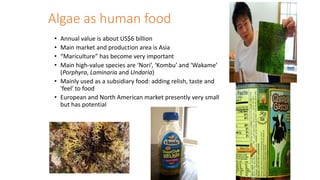
Algae as human food
• Annual value is about US$6 billion
• Main market and production area is Asia
• “Mariculture” has become very important
• Main high-value species are ‘Nori’, ‘Kombu’ and ‘Wakame’
(Porphyra, Laminaria and Undaria)
• Mainly used as a subsidiary food: adding relish, taste and
'feel' to food
• European and North American market presently very small
but has potential

Algae

  • 1.
  • 2.
    Characteristics • Range insize from microscopic like single celled organisms to large seaweeds • Autotrophic • Form the reproductive structures – gametangia or gamete chambers • Aquatic and have flagella at some point in life • Often contain pyrenoids, organelles that synthesis and store starch
  • 3.
    Size of Algae •Their sizes varies from 0.5microns to 700 feet( giant kelps) in length.
  • 4.
    Algal construction types: Morphology 1. Unicellular algae 2. Colonies 3. Filaments 4. Multicellular
  • 5.
    Algae - Whatare they? • Primitive plants • No true roots, only attachment structures (Holdfasts) • Produce spores (not seeds)– motile or non-motile • Most have sexual and asexual reproduction • Non-vascular, do not possess an internal transport system.
  • 6.
    Algae vs. ‘REAL’plants Similarities and differences: • Both are photoautotrophic • Similar metabolic functions to higher plants eg. photosynthesis • different anatomical structures, reproductive structures. • different reproduction. • No true roots, stems leaves. • Non-vascular, therefore nutrient uptake over surface. And wastes are washed away from surface by aquatic environment
  • 7.
    Where do Algaelive? Marine habitats: • seaweeds, phytoplankton Freshwater habitats: • streams, rivers, lakes and ponds Terrestrial habitats: • stone walls, tree bark, leaves, in lichens, on snow
  • 8.
    Algal Pigments Colour ofalgaes varies due to presence of definite chemical compounds called as pigments.  Photosynthetic pigments in algae are of 3kinds,  Chlorophyll- “a” is common, whereas b, c and d have restricted distribution.  Carotenoids -These are fat soluble yellow coloured pigments.  Phycobilins or biliproteins- include red coloured Phycoerythrins and blue coloured phycocyanins.
  • 9.
    Reproduction Vegetative reproduction: Fragmentation  Celldivision  Hormogone formation.  Tubers  Bulbils  Akinetes
  • 10.
    Asexual Reproduction • Byzoospores, aplanospores, autospores, endospore, • auxospores and cyst formation. • Palmella stage occurs in Chlamydomonas .
  • 11.
    Sexual Reproduction • Byfusion of two specialised cell known as sex cells or gametes. • - Isogamous- two identical gametes fuse to form zygotes. - Heterogamous- dissimilar gametes fuse • Anisogamy • Oogamy - Aplanogamy or conjugation Oogamy Anisogamy
  • 12.
    CLASSIFICATION OF ALGAE •PHYLUM ARE BASED ON • Primary Photosynthetic Pigment • Food-storage Substance • Cell Wall Composition
  • 13.
    Name Brown Algae Red Algae GreenAlgae Diatoms Dinoflagellates Water Molds Phylum Phaeophyta Rhodophyta Chlorophyta Diatoms Dinoflagellata Oomycota Colour Brownish Reddish Green Brownish Brownish Colourless, white Cell Wall Cellulose and alginic acid Cellulose Cellulose Pectin and silica Cellulose Cellulose Cell Arrangement Multicellular Most are Multicellular Unicellular and Multicellular Unicellular Unicellular Multicellular Photosynthetic Pigments Chlorophyll a and c, xanthophylls Chlorophyll a and d, carotenoids, phycobilins Chlorophyll a and b, carotenoids Chlorophyll a and c, carotene, xanthophylls Chlorophyll a and c, carotene, xanthins none Sexual reproduction Yes Yes Yes Yes In a few Yes Storage Material Carbohydrate Glucose polymer Glucose polymer Oil Starch none Flagella 2, unequal, lateral Absent Mostly 2 per cell Absent Mostly biflagellate Most produce zoospores with
  • 14.
    Phylum Phaeophyta •1500 speciesof Brown algae •All are multicellular and large (often reaching lengths of 147 feet) •Individual alga may grow to a length of 100m with a holdfast, stipe and blade •Used in cosmetics and most ice creams
  • 15.
    Phylum Rhodophyta •4000 speciesof RED Algae •Most are marine •Smaller than brown algae and are often found at a depth of 200 meters. •Contain chlorophyll a and c as well as phycobilins which are important in absorbing light that can penetrate deep into the water •Have cells coated in carageenan which is used in cosmetics, gelatin capsules and some cheeses
  • 16.
    Phylum Chlorophyta •Green algae •7000diverse species •Biologist reason that green algae gave rise to land plants. •Both green algae and land plants have chlorophyll a and b as well as carotenoids and store food as starch •Both have walls made of cellulose
  • 17.
    Diatoms •Diatoms are amajor group of algae, and are among the most common types of phytoplankton. •Diatoms are unicellular, although they can form colonies in the shape of filaments or ribbons, fans, zigzags, or stars. •Eukaryotic algae •Common type of phytoplankton •Primary producers in the food chain •Found in freshwater and marine environments
  • 18.
    Dinoflagellates •The dinoflagellates area large group of flagellated protists that constitute the phylum Dinoflagellata. •Most are marine plankton, but they are common in fresh water habitats as well. • Causes Red tide phenomenon in coastal waters.
  • 19.
    Oomycota • Oomycota oroomycetes form a distinct phylogenetic lineage of fungus-like eukaryotic microorganisms. • They are filamentous, microscopic, absorptive organisms that reproduce both sexually and asexually.
  • 20.
    How do algaefunction? Photoautotrophs: 6C02 + 6H20  C6H1206 + O2 • use carbon, light, and water • produce chemical energy (carbohydrates) and produce O2 as a by-product. • Basic storage products: carbohydrates as starch or converted to fats as oil • Require nutrients: N, P and minerals.
  • 21.
    Why are ALGAEimportant? Ecological importance of algae a) Production of Oxygen as ‘by-product’ of photosynthesis: • All aerobic heterotrophic organisms require O2 • e.g. fungi and animals need O2, to run cellular respiration to stay alive b) Production of biomass: • autotrophic organisms - represent the base of the food chain/web, particularly in aquatic environments.
  • 22.
    Why are algaeimportant? • Primary producers, basis of food webs, “FORESTS/GRASSES OF THE SEA” • Pioneer Species: on rocky shores, mudflats, hot springs, lichen communities, 'snow algae' • O2 production and carbon fixation in aquatic habitats.
  • 23.
    Beneficial Aspects ofAlgae •Food for humans •Food for invertebrates and fishes in mariculture •Animal feed •Soil fertilizers and conditioners in agriculture •Treatment of waste water •Drugs •Model system for research
  • 24.
    •Blooms of freshwateralgae •Red tides and marine blooms •Toxins accumulated in food chains •Damage to cave paintings, frescoes, and other works of art •Fouling of ships and other submerged surfaces •Fouling of the shells of commercially important bivalves HARMFUL EFFECTS of Algae
  • 25.
    Uses of Seaweeds •Present •Food • Hydrocolloids and some chemical substances • Fertilizers •Potential • Source of energy/compost by digestion • Waste-water treatment
  • 26.
    Algae as humanfood • Annual value is about US$6 billion • Main market and production area is Asia • “Mariculture” has become very important • Main high-value species are ‘Nori’, ‘Kombu’ and ‘Wakame’ (Porphyra, Laminaria and Undaria) • Mainly used as a subsidiary food: adding relish, taste and 'feel' to food • European and North American market presently very small but has potential