
Phylum Mollusca

  Class: Gastropoda
    Class: Bivalvia
 Class: Cephalopods
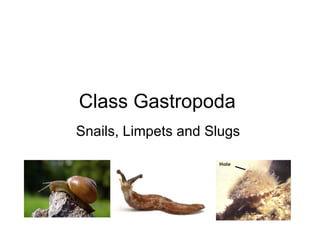
Class Gastropoda
Snails, Limpets and Slugs
Gastropoda
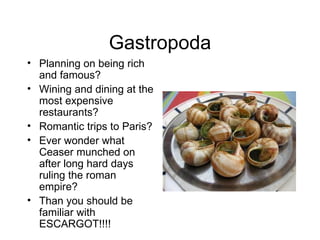
• Planning on being rich
  and famous?
• Wining and dining at the
  most expensive
  restaurants?
• Romantic trips to Paris?
• Ever wonder what
  Ceaser munched on
  after long hard days
  ruling the roman
  empire?
• Than you should be
  familiar with
  ESCARGOT!!!!
General Body Plan:
             Gastropod
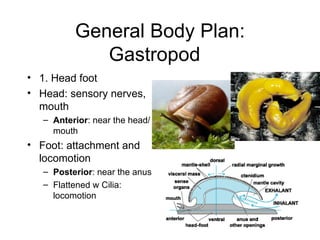
• 1. Head foot
• Head: sensory nerves,
  mouth
   – Anterior: near the head/
     mouth
• Foot: attachment and
  locomotion
   – Posterior: near the anus
   – Flattened w Cilia:
     locomotion
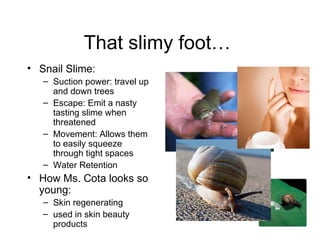
That slimy foot…
• Snail Slime:
   – Suction power: travel up
     and down trees
   – Escape: Emit a nasty
     tasting slime when
     threatened
   – Movement: Allows them
     to easily squeeze
     through tight spaces
   – Water Retention
• How Ms. Cota looks so
  young:
   – Skin regenerating
   – used in skin beauty
     products
General Body Plan of
           mollusks
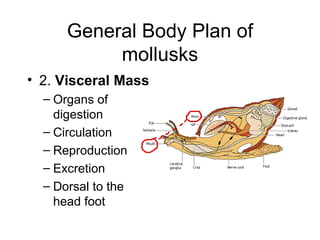
• 2. Visceral Mass
  – Organs of
    digestion
  – Circulation
  – Reproduction
  – Excretion
  – Dorsal to the
    head foot
General Body Plan:
              Gastropod
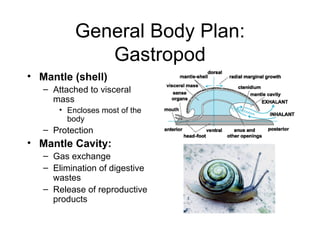
• Mantle (shell)
   – Attached to visceral
     mass
       • Encloses most of the
         body
   – Protection
• Mantle Cavity:
   – Gas exchange
   – Elimination of digestive
     wastes
   – Release of reproductive
     products
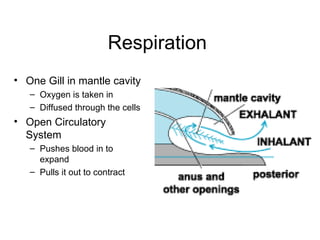
Respiration
• One Gill in mantle cavity
   – Oxygen is taken in
   – Diffused through the cells
• Open Circulatory
  System
   – Pushes blood in to
     expand
   – Pulls it out to contract
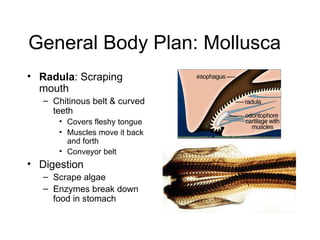
General Body Plan: Mollusca
• Radula: Scraping
  mouth
   – Chitinous belt & curved
     teeth
      • Covers fleshy tongue
      • Muscles move it back
        and forth
      • Conveyor belt
• Digestion
   – Scrape algae
   – Enzymes break down
     food in stomach
CFU
• How do mollusks exchange gasses
  – Filter air through their gills
• Where are these gills located?
  – The mantel
• What is the structure called that scrapes up
  food?
  – A Radula
• All mollusks have:
  – A visceral Mass
  – A head foot
  – A mantel
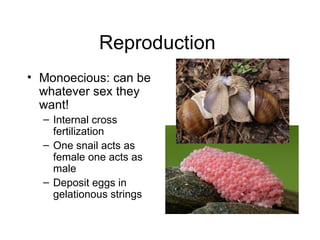
Reproduction
• Monoecious: can be
  whatever sex they
  want!
  – Internal cross
    fertilization
  – One snail acts as
    female one acts as
    male
  – Deposit eggs in
    gelationous strings
Class Bivalvia

Clams, Oysters, Mussles,
       Scallops
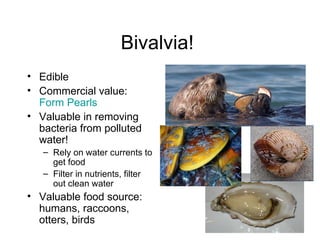
Bivalvia!
• Edible
• Commercial value:
  Form Pearls
• Valuable in removing
  bacteria from polluted
  water!
   – Rely on water currents to
     get food
   – Filter in nutrients, filter
     out clean water
• Valuable food source:
  humans, raccoons,
  otters, birds
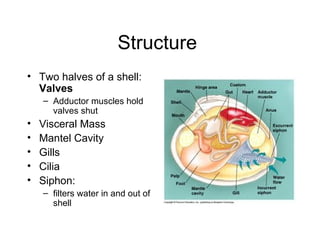
Structure
• Two halves of a shell:
  Valves
    – Adductor muscles hold
      valves shut
•   Visceral Mass
•   Mantel Cavity
•   Gills
•   Cilia
•   Siphon:
    – filters water in and out of
      shell
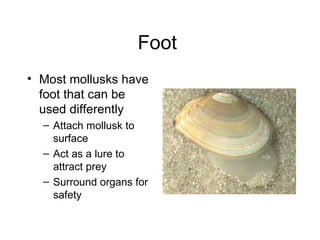
Foot
• Most mollusks have
  foot that can be
  used differently
  – Attach mollusk to
    surface
  – Act as a lure to
    attract prey
  – Surround organs for
    safety
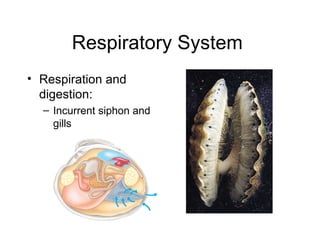
Respiratory System
• Respiration and
  digestion:
  – Incurrent siphon and
    gills
CFU
• What is the technical term for the two halves
  of the shell?
   – Valves
• What structure filters water in and out of the
  shell
   – Siphon
• What is the function of the foot
   – Attach mollusk to substrate, act as lure
• Why are bivalves important to humans?
   – Pearls, food source, pollution filter
• How are humans affecting bivalves?
   – Over harvesting, pollution, loss of current
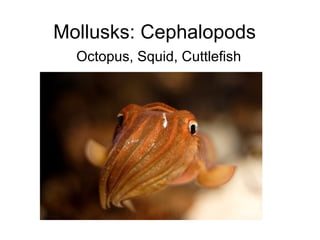
Mollusks: Cephalopods
  Octopus, Squid, Cuttlefish
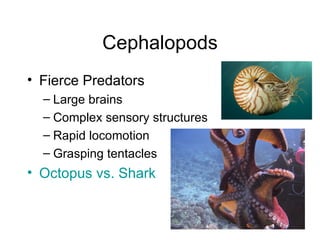
Cephalopods
• Fierce Predators
  – Large brains
  – Complex sensory structures
  – Rapid locomotion
  – Grasping tentacles
• Octopus vs. Shark
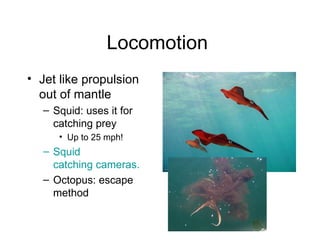
Locomotion
• Jet like propulsion
  out of mantle
   – Squid: uses it for
     catching prey
      • Up to 25 mph!
   – Squid
     catching cameras.
   – Octopus: escape
     method
Nervous/Sensory System
• Very large brain
   – Dedicated to
     movement/control of
     tentacles
   – Very smart: octopus are
     known to problem solve
   – Curious
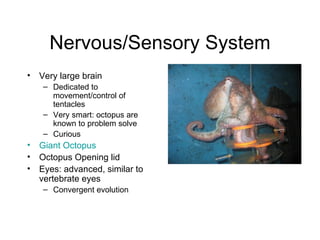
• Giant Octopus
• Octopus Opening lid
• Eyes: advanced, similar to
  vertebrate eyes
   – Convergent evolution
Predator Adaptations
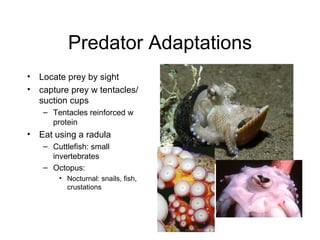
• Locate prey by sight
• capture prey w tentacles/
  suction cups
   – Tentacles reinforced w
     protein
• Eat using a radula
   – Cuttlefish: small
     invertebrates
   – Octopus:
       • Nocturnal: snails, fish,
         crustations
Predator Adaptations
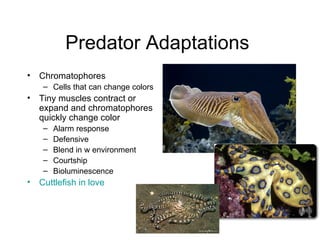
• Chromatophores
    – Cells that can change colors
• Tiny muscles contract or
  expand and chromatophores
  quickly change color
    –   Alarm response
    –   Defensive
    –   Blend in w environment
    –   Courtship
    –   Bioluminescence
• Cuttlefish in love

Mollusks bivalves:gastro:cepha marine

  • 1.
    Phylum Mollusca Class: Gastropoda Class: Bivalvia Class: Cephalopods
  • 2.
  • 3.
    Gastropoda • Planning onbeing rich and famous? • Wining and dining at the most expensive restaurants? • Romantic trips to Paris? • Ever wonder what Ceaser munched on after long hard days ruling the roman empire? • Than you should be familiar with ESCARGOT!!!!
  • 4.
    General Body Plan: Gastropod • 1. Head foot • Head: sensory nerves, mouth – Anterior: near the head/ mouth • Foot: attachment and locomotion – Posterior: near the anus – Flattened w Cilia: locomotion
  • 5.
    That slimy foot… •Snail Slime: – Suction power: travel up and down trees – Escape: Emit a nasty tasting slime when threatened – Movement: Allows them to easily squeeze through tight spaces – Water Retention • How Ms. Cota looks so young: – Skin regenerating – used in skin beauty products
  • 6.
    General Body Planof mollusks • 2. Visceral Mass – Organs of digestion – Circulation – Reproduction – Excretion – Dorsal to the head foot
  • 7.
    General Body Plan: Gastropod • Mantle (shell) – Attached to visceral mass • Encloses most of the body – Protection • Mantle Cavity: – Gas exchange – Elimination of digestive wastes – Release of reproductive products
  • 8.
    Respiration • One Gillin mantle cavity – Oxygen is taken in – Diffused through the cells • Open Circulatory System – Pushes blood in to expand – Pulls it out to contract
  • 9.
    General Body Plan:Mollusca • Radula: Scraping mouth – Chitinous belt & curved teeth • Covers fleshy tongue • Muscles move it back and forth • Conveyor belt • Digestion – Scrape algae – Enzymes break down food in stomach
  • 10.
    CFU • How domollusks exchange gasses – Filter air through their gills • Where are these gills located? – The mantel • What is the structure called that scrapes up food? – A Radula • All mollusks have: – A visceral Mass – A head foot – A mantel
  • 11.
    Reproduction • Monoecious: canbe whatever sex they want! – Internal cross fertilization – One snail acts as female one acts as male – Deposit eggs in gelationous strings
  • 12.
  • 13.
    Bivalvia! • Edible • Commercialvalue: Form Pearls • Valuable in removing bacteria from polluted water! – Rely on water currents to get food – Filter in nutrients, filter out clean water • Valuable food source: humans, raccoons, otters, birds
  • 14.
    Structure • Two halvesof a shell: Valves – Adductor muscles hold valves shut • Visceral Mass • Mantel Cavity • Gills • Cilia • Siphon: – filters water in and out of shell
  • 15.
    Foot • Most molluskshave foot that can be used differently – Attach mollusk to surface – Act as a lure to attract prey – Surround organs for safety
  • 16.
    Respiratory System • Respirationand digestion: – Incurrent siphon and gills
  • 17.
    CFU • What isthe technical term for the two halves of the shell? – Valves • What structure filters water in and out of the shell – Siphon • What is the function of the foot – Attach mollusk to substrate, act as lure • Why are bivalves important to humans? – Pearls, food source, pollution filter • How are humans affecting bivalves? – Over harvesting, pollution, loss of current
  • 18.
    Mollusks: Cephalopods Octopus, Squid, Cuttlefish
  • 19.
    Cephalopods • Fierce Predators – Large brains – Complex sensory structures – Rapid locomotion – Grasping tentacles • Octopus vs. Shark
  • 20.
    Locomotion • Jet likepropulsion out of mantle – Squid: uses it for catching prey • Up to 25 mph! – Squid catching cameras. – Octopus: escape method
  • 21.
    Nervous/Sensory System • Verylarge brain – Dedicated to movement/control of tentacles – Very smart: octopus are known to problem solve – Curious • Giant Octopus • Octopus Opening lid • Eyes: advanced, similar to vertebrate eyes – Convergent evolution
  • 22.
    Predator Adaptations • Locateprey by sight • capture prey w tentacles/ suction cups – Tentacles reinforced w protein • Eat using a radula – Cuttlefish: small invertebrates – Octopus: • Nocturnal: snails, fish, crustations
  • 23.
    Predator Adaptations • Chromatophores – Cells that can change colors • Tiny muscles contract or expand and chromatophores quickly change color – Alarm response – Defensive – Blend in w environment – Courtship – Bioluminescence • Cuttlefish in love