Chapter 9
Phylum Arthropods
 “joined appendages”
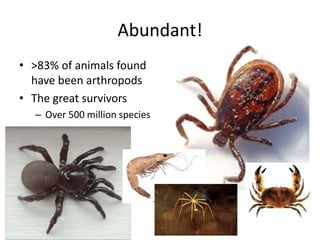
Abundant!
• >83% of animals found
  have been arthropods
• The great survivors
  – Over 500 million species
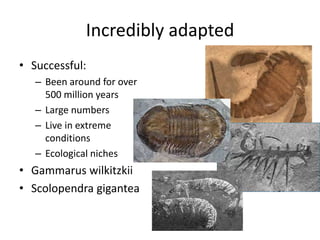
Incredibly adapted
• Successful:
   – Been around for over
     500 million years
   – Large numbers
   – Live in extreme
     conditions
   – Ecological niches
• Gammarus wilkitzkii
• Scolopendra gigantea
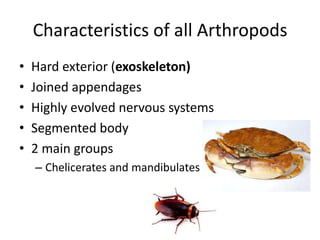
Characteristics of all Arthropods
•   Hard exterior (exoskeleton)
•   Joined appendages
•   Highly evolved nervous systems
•   Segmented body
•   2 main groups
    – Chelicerates and mandibulates
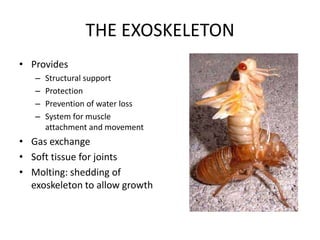
THE EXOSKELETON
• Provides
   –   Structural support
   –   Protection
   –   Prevention of water loss
   –   System for muscle
       attachment and movement
• Gas exchange
• Soft tissue for joints
• Molting: shedding of
  exoskeleton to allow growth
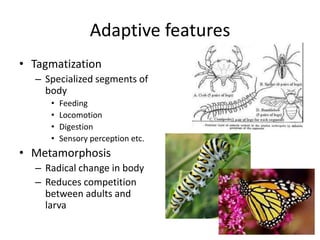
Adaptive features
• Tagmatization
  – Specialized segments of
    body
     •   Feeding
     •   Locomotion
     •   Digestion
     •   Sensory perception etc.
• Metamorphosis
  – Radical change in body
  – Reduces competition
    between adults and
    larva
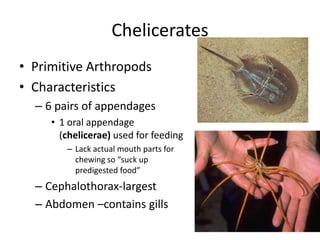
Chelicerates
• Primitive Arthropods
• Characteristics
  – 6 pairs of appendages
     • 1 oral appendage
       (chelicerae) used for feeding
        – Lack actual mouth parts for
          chewing so “suck up
          predigested food”
  – Cephalothorax-largest
  – Abdomen –contains gills
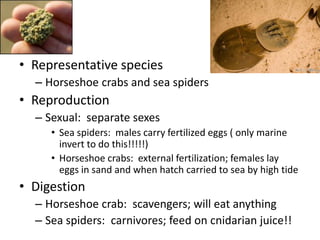
• Representative species
  – Horseshoe crabs and sea spiders
• Reproduction
  – Sexual: separate sexes
     • Sea spiders: males carry fertilized eggs ( only marine
       invert to do this!!!!!)
     • Horseshoe crabs: external fertilization; females lay
       eggs in sand and when hatch carried to sea by high tide
• Digestion
  – Horseshoe crab: scavengers; will eat anything
  – Sea spiders: carnivores; feed on cnidarian juice!!
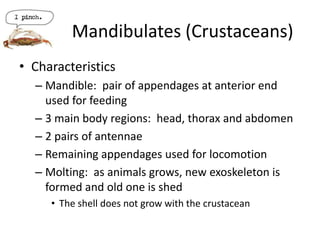
Mandibulates (Crustaceans)
• Characteristics
  – Mandible: pair of appendages at anterior end
    used for feeding
  – 3 main body regions: head, thorax and abdomen
  – 2 pairs of antennae
  – Remaining appendages used for locomotion
  – Molting: as animals grows, new exoskeleton is
    formed and old one is shed
     • The shell does not grow with the crustacean
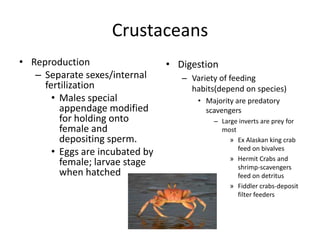
Crustaceans
• Reproduction                   • Digestion
   – Separate sexes/internal        – Variety of feeding
     fertilization                    habits(depend on species)
       • Males special                  • Majority are predatory
         appendage modified               scavengers
         for holding onto                   – Large inverts are prey for
         female and                           most
         depositing sperm.                       » Ex Alaskan king crab
       • Eggs are incubated by                     feed on bivalves
                                                 » Hermit Crabs and
         female; larvae stage                      shrimp-scavengers
         when hatched                              feed on detritus
                                                 » Fiddler crabs-deposit
                                                   filter feeders
Crustaceans
  – Reproduction
    • Sexual
       – Separate sexes
       – Some species internal fertilization/ others spawners
       – Life cycle 6 months to 6 years
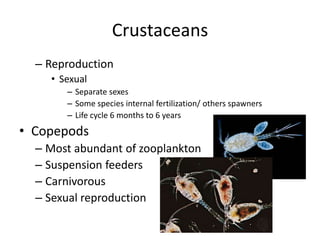
• Copepods
  – Most abundant of zooplankton
  – Suspension feeders
  – Carnivorous
  – Sexual reproduction
Class Cirripedia
                   “barnacles”
• Characteristics
  – Only sessile crustaceans
  – Shell of calcium carbonate
• Digestion
• Filter feeders: use appendage “cirriped”
• Reproduction
  – Hermaphrodites: cross fertilize
  – Larvae move until finds a substrate and metamorphoses
    into adult-> remain sessile
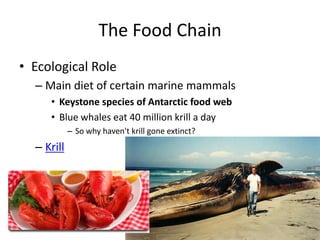
The Food Chain
• Ecological Role
  – Main diet of certain marine mammals
     • Keystone species of Antarctic food web
     • Blue whales eat 40 million krill a day
            – So why haven't krill gone extinct?
  – Krill
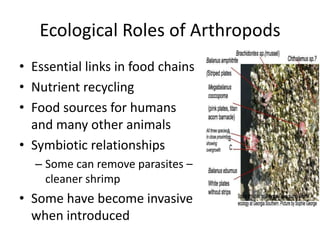
Ecological Roles of Arthropods
• Essential links in food chains
• Nutrient recycling
• Food sources for humans
  and many other animals
• Symbiotic relationships
  – Some can remove parasites –
    cleaner shrimp
• Some have become invasive
  when introduced
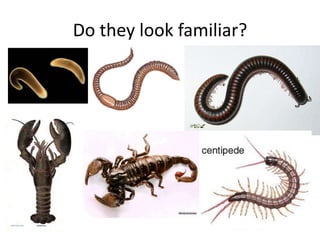
Do they look familiar?
Phylum Arthropoda: Subphylum
Crustacea   Trilobita   Chelicerata   Atelocerata
Subphylums
• Trilobita               • Crustacea
   – Extinct                 –   Lobsters
                             –   Shrimp
• Chelicerata                –   Crabs
   –   Horseshoe crab        –   Water fleas
   –   Sea spiders           –   Copepods
   –   Spiders               –   Barnacles
                             –   Sowbugs
   –   Scorpions
                          • Atelocerata
   –   Harvestmen
                             – Millipedes
   –   Mites and ticks       – Centipedes
                             – Hexapods

Chapter 9 arthropods zoology

  • 1.
    Chapter 9 Phylum Arthropods “joined appendages”
  • 2.
    Abundant! • >83% ofanimals found have been arthropods • The great survivors – Over 500 million species
  • 3.
    Incredibly adapted • Successful: – Been around for over 500 million years – Large numbers – Live in extreme conditions – Ecological niches • Gammarus wilkitzkii • Scolopendra gigantea
  • 4.
    Characteristics of allArthropods • Hard exterior (exoskeleton) • Joined appendages • Highly evolved nervous systems • Segmented body • 2 main groups – Chelicerates and mandibulates
  • 5.
    THE EXOSKELETON • Provides – Structural support – Protection – Prevention of water loss – System for muscle attachment and movement • Gas exchange • Soft tissue for joints • Molting: shedding of exoskeleton to allow growth
  • 6.
    Adaptive features • Tagmatization – Specialized segments of body • Feeding • Locomotion • Digestion • Sensory perception etc. • Metamorphosis – Radical change in body – Reduces competition between adults and larva
  • 7.
    Chelicerates • Primitive Arthropods •Characteristics – 6 pairs of appendages • 1 oral appendage (chelicerae) used for feeding – Lack actual mouth parts for chewing so “suck up predigested food” – Cephalothorax-largest – Abdomen –contains gills
  • 8.
    • Representative species – Horseshoe crabs and sea spiders • Reproduction – Sexual: separate sexes • Sea spiders: males carry fertilized eggs ( only marine invert to do this!!!!!) • Horseshoe crabs: external fertilization; females lay eggs in sand and when hatch carried to sea by high tide • Digestion – Horseshoe crab: scavengers; will eat anything – Sea spiders: carnivores; feed on cnidarian juice!!
  • 9.
    Mandibulates (Crustaceans) • Characteristics – Mandible: pair of appendages at anterior end used for feeding – 3 main body regions: head, thorax and abdomen – 2 pairs of antennae – Remaining appendages used for locomotion – Molting: as animals grows, new exoskeleton is formed and old one is shed • The shell does not grow with the crustacean
  • 10.
    Crustaceans • Reproduction • Digestion – Separate sexes/internal – Variety of feeding fertilization habits(depend on species) • Males special • Majority are predatory appendage modified scavengers for holding onto – Large inverts are prey for female and most depositing sperm. » Ex Alaskan king crab • Eggs are incubated by feed on bivalves » Hermit Crabs and female; larvae stage shrimp-scavengers when hatched feed on detritus » Fiddler crabs-deposit filter feeders
  • 11.
    Crustaceans –Reproduction • Sexual – Separate sexes – Some species internal fertilization/ others spawners – Life cycle 6 months to 6 years • Copepods – Most abundant of zooplankton – Suspension feeders – Carnivorous – Sexual reproduction
  • 12.
    Class Cirripedia “barnacles” • Characteristics – Only sessile crustaceans – Shell of calcium carbonate • Digestion • Filter feeders: use appendage “cirriped” • Reproduction – Hermaphrodites: cross fertilize – Larvae move until finds a substrate and metamorphoses into adult-> remain sessile
  • 13.
    The Food Chain •Ecological Role – Main diet of certain marine mammals • Keystone species of Antarctic food web • Blue whales eat 40 million krill a day – So why haven't krill gone extinct? – Krill
  • 14.
    Ecological Roles ofArthropods • Essential links in food chains • Nutrient recycling • Food sources for humans and many other animals • Symbiotic relationships – Some can remove parasites – cleaner shrimp • Some have become invasive when introduced
  • 15.
    Do they lookfamiliar?
  • 16.
    Phylum Arthropoda: Subphylum Crustacea Trilobita Chelicerata Atelocerata
  • 17.
    Subphylums • Trilobita • Crustacea – Extinct – Lobsters – Shrimp • Chelicerata – Crabs – Horseshoe crab – Water fleas – Sea spiders – Copepods – Spiders – Barnacles – Sowbugs – Scorpions • Atelocerata – Harvestmen – Millipedes – Mites and ticks – Centipedes – Hexapods