Chapter 6:
The Skeletal System
© 2013 John Wiley & Sons, Inc. All rights reserved.
The Skeletal System
 Functions of bone and the skeletal system
 Types of bones
 Bone formation
 Exercise and bone tissue
 Divisions of the skeletal system
 Skull and hyoid bone
 Vertebral column
 Thorax
 Pectoral (shoulder) girdle
 Upper limb
 Pelvic (hip) girdle
 Lower limb
 Comparison of female and male skeletons
 Aging and the skeletal system
© 2013 John Wiley & Sons, Inc. All rights reserved.
Functions of Bone and the Skeletal
System
 Support
 Provides a structural framework for the body
 Protection
 Protects many internal organs from injury
 Assistance in movement
 Provides skeletal muscle attachments
© 2013 John Wiley & Sons, Inc. All rights reserved.
Functions of Bone and the Skeletal
System
 Mineral homeostasis
 Bone tissue stores several minerals, especially
calcium and phosphorus
 Blood cell production
 Within certain bones a connective tissue called
red bone marrow produces red blood cells
 Triglyceride storage
 Yellow bone marrow consists mainly of adipose
cells, which store triglycerides
Types of Bones
 Long bones have greater length than width and consist of a shaft and a
variable number of ends. They are usually somewhat curved for strength.
Long bones include those in the thigh (femur), leg (tibia and fibula), arm
(humerus), forearm (ulna and radius), and fingers and toes (phalanges).
 Short bones are somewhat cube-shaped and nearly equal in length and
width. Examples of short bones include most wrist and ankle bones.
 Flat bones are generally thin, afford considerable protection, and provide
extensive surfaces for muscle attachment. Bones classified as flat bones
include the cranial bones, which protect the brain; the sternum (breastbone)
and ribs, which protect organs in the thorax; and the scapulae (shoulder
blades).
 Irregular bones have complex shapes and cannot be grouped into any of
the previous categories. Such bones include the vertebrae and some facial
bones.
© 2013 John Wiley & Sons, Inc. All rights reserved.
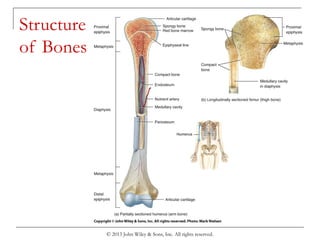
Structure
of Bones
© 2013 John Wiley & Sons, Inc. All rights reserved.
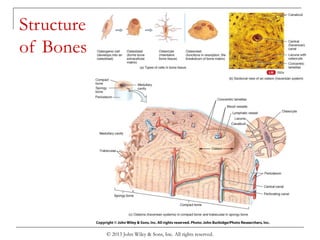
Structure
of Bones
© 2013 John Wiley & Sons, Inc. All rights reserved.
Anatomy Overview:
You must be connected to the internet to run this animation.
• Bone Structure and Tissues
© 2013 John Wiley & Sons, Inc. All rights reserved.
Animation:
You must be connected to the internet to run this animation.
• Bone Growth and Remodeling
© 2013 John Wiley & Sons, Inc. All rights reserved.
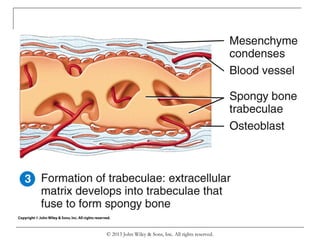
Bone Formation
© 2013 John Wiley & Sons, Inc. All rights reserved.
Bone Formation
© 2013 John Wiley & Sons, Inc. All rights reserved.
Animation:
You must be connected to the internet to run this animation.
• Bone Formation
© 2013 John Wiley & Sons, Inc. All rights reserved.
Bone Formation – Fractures
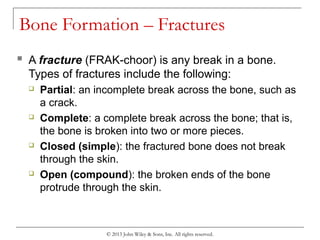
 A fracture (FRAK-choor) is any break in a bone.
Types of fractures include the following:
 Partial: an incomplete break across the bone, such as
a crack.
 Complete: a complete break across the bone; that is,
the bone is broken into two or more pieces.
 Closed (simple): the fractured bone does not break
through the skin.
 Open (compound): the broken ends of the bone
protrude through the skin.
© 2013 John Wiley & Sons, Inc. All rights reserved.
Bone Formation – Fractures
 Repair of a fracture involves several steps
 First, phagocytes begin to remove any dead bone
tissue
 Then, chondroblasts form fibrocartilage at the
fracture site that bridges the broken ends of the
bone
 Next, the fibrocartilage is converted to spongy
bone tissue by osteoblasts
 Finally, bone remodeling occurs, in which dead
portions of bone are absorbed by osteoclasts and
spongy bone is converted to compact bone
© 2013 John Wiley & Sons, Inc. All rights reserved.
Bone Formation
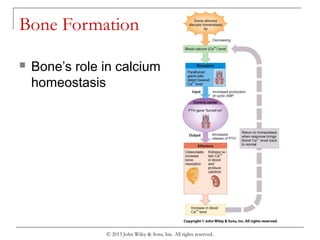
 Bone’s role in calcium
homeostasis
© 2013 John Wiley & Sons, Inc. All rights reserved.
Animation:
You must be connected to the internet to run this animation.
• Regulation of Bone Growth & Blood Calcium
© 2013 John Wiley & Sons, Inc. All rights reserved.
Exercise and Bone Tissue
 Within limits, bone tissue has the ability to alter its
strength in response to mechanical stress
 When placed under stress, bone tissue becomes
stronger through increased deposition of mineral
salts and production of collagen fibers
 Without mechanical stress, bone does not
remodel normally because resorption outpaces
bone formation
 The absence of mechanical stress weakens bone
through decreased numbers of collagen fibers and
demineralization, loss of bone minerals
© 2013 John Wiley & Sons, Inc. All rights reserved.
Exercise and Bone Tissue
© 2013 John Wiley & Sons, Inc. All rights reserved.
Exercise and Bone Tissue
© 2013 John Wiley & Sons, Inc. All rights reserved.
Animation:
You must be connected to the internet to run this animation.
• Bone Dynamics and Tissue
© 2013 John Wiley & Sons, Inc. All rights reserved.
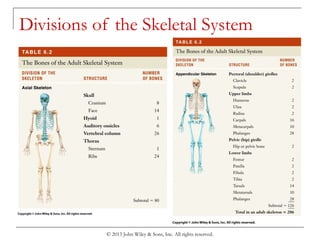
Divisions of the Skeletal System
© 2013 John Wiley & Sons, Inc. All rights reserved.
Divisions of
the Skeletal System
© 2013 John Wiley & Sons, Inc. All rights reserved.
Anatomy Overview:
You must be connected to the internet to run this animation.
• The Skeletal System
© 2013 John Wiley & Sons, Inc. All rights reserved.
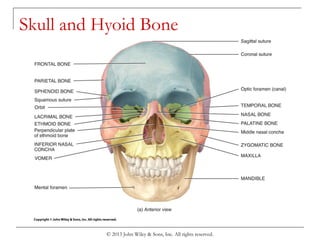
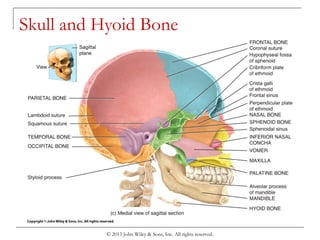
Skull and Hyoid Bone
© 2013 John Wiley & Sons, Inc. All rights reserved.
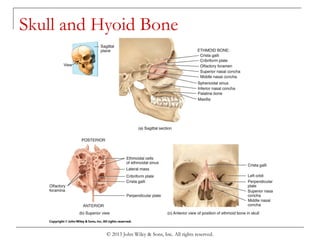
Skull and Hyoid Bone
© 2013 John Wiley & Sons, Inc. All rights reserved.
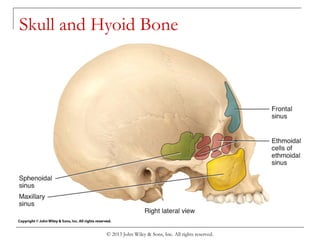
Skull and Hyoid Bone
© 2013 John Wiley & Sons, Inc. All rights reserved.
Skull and Hyoid Bone
© 2013 John Wiley & Sons, Inc. All rights reserved.
Skull and Hyoid Bone
© 2013 John Wiley & Sons, Inc. All rights reserved.
Skull and Hyoid Bone
© 2013 John Wiley & Sons, Inc. All rights reserved.
Skull and Hyoid Bone
© 2013 John Wiley & Sons, Inc. All rights reserved.
Skull and Hyoid Bone
© 2013 John Wiley & Sons, Inc. All rights reserved.
Skull and Hyoid Bone
© 2013 John Wiley & Sons, Inc. All rights reserved.
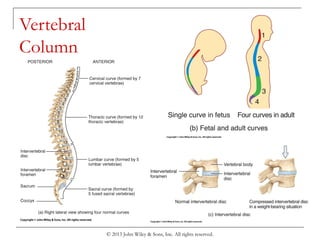
Vertebral
Column
© 2013 John Wiley & Sons, Inc. All rights reserved.
Vertebral
Column
 Cervical
vertebrae
© 2013 John Wiley & Sons, Inc. All rights reserved.
Thoracic Vertebrae
© 2013 John Wiley & Sons, Inc. All rights reserved.
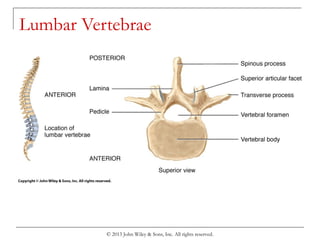
Lumbar Vertebrae
© 2013 John Wiley & Sons, Inc. All rights reserved.
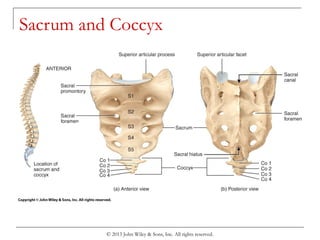
Sacrum and Coccyx
© 2013 John Wiley & Sons, Inc. All rights reserved.
Vertebral Column
 Identify the vertebrae
© 2013 John Wiley & Sons, Inc. All rights reserved.
Thorax
© 2013 John Wiley & Sons, Inc. All rights reserved.
Pectoral (Shoulder) Girdle
© 2013 John Wiley & Sons, Inc. All rights reserved.
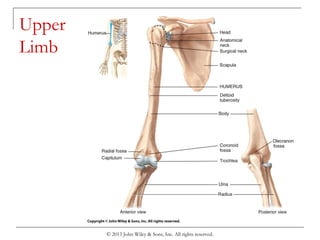
Upper
Limb
© 2013 John Wiley & Sons, Inc. All rights reserved.
Upper
Limb
© 2013 John Wiley & Sons, Inc. All rights reserved.
Upper
Limb
© 2013 John Wiley & Sons, Inc. All rights reserved.
Pelvic (Hip) Girdle
© 2013 John Wiley & Sons, Inc. All rights reserved.
Pelvic (Hip) Girdle
© 2013 John Wiley & Sons, Inc. All rights reserved.
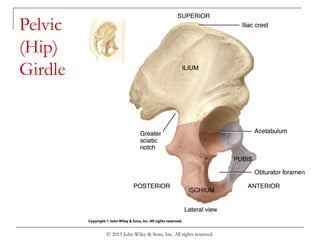
Pelvic
(Hip)
Girdle
© 2013 John Wiley & Sons, Inc. All rights reserved.
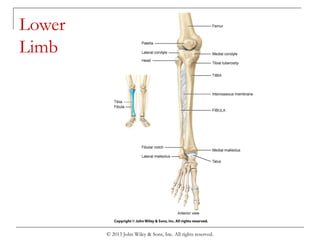
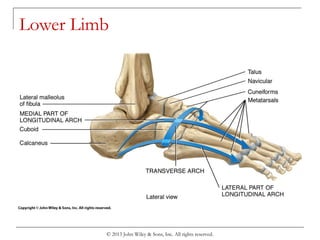
Lower Limb
© 2013 John Wiley & Sons, Inc. All rights reserved.
Lower
Limb
© 2013 John Wiley & Sons, Inc. All rights reserved.
Lower
Limb
© 2013 John Wiley & Sons, Inc. All rights reserved.
Lower Limb
© 2013 John Wiley & Sons, Inc. All rights reserved.
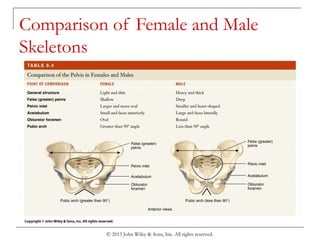
Comparison of Female and Male
Skeletons
© 2013 John Wiley & Sons, Inc. All rights reserved.
Aging and the Skeletal System
End of Chapter 6
Copyright 2013 John Wiley & Sons, Inc. All rights
reserved. Reproduction or translation of this work
beyond that permitted in section 117 of the 1976
United States Copyright Act without express
permission of the copyright owner is unlawful.
Request for further information should be addressed to
the Permission Department, John Wiley & Sons, Inc.
The purchaser may make back-up copies for his/her
own use only and not for distribution or resale. The
Publishers assumes no responsibility for errors,
omissions, or damages caused by the use of these
programs or from the use of the information herein.
© 2013 John Wiley & Sons, Inc. All rights reserved.

Chapter 6 the skeletal system

  • 1.
    Chapter 6: The SkeletalSystem © 2013 John Wiley & Sons, Inc. All rights reserved.
  • 2.
    © 2013 JohnWiley & Sons, Inc. All rights reserved. The Skeletal System  Functions of bone and the skeletal system  Types of bones  Bone formation  Exercise and bone tissue  Divisions of the skeletal system  Skull and hyoid bone  Vertebral column  Thorax  Pectoral (shoulder) girdle  Upper limb  Pelvic (hip) girdle  Lower limb  Comparison of female and male skeletons  Aging and the skeletal system
  • 3.
    © 2013 JohnWiley & Sons, Inc. All rights reserved. Functions of Bone and the Skeletal System  Support  Provides a structural framework for the body  Protection  Protects many internal organs from injury  Assistance in movement  Provides skeletal muscle attachments
  • 4.
    © 2013 JohnWiley & Sons, Inc. All rights reserved. Functions of Bone and the Skeletal System  Mineral homeostasis  Bone tissue stores several minerals, especially calcium and phosphorus  Blood cell production  Within certain bones a connective tissue called red bone marrow produces red blood cells  Triglyceride storage  Yellow bone marrow consists mainly of adipose cells, which store triglycerides
  • 5.
    Types of Bones Long bones have greater length than width and consist of a shaft and a variable number of ends. They are usually somewhat curved for strength. Long bones include those in the thigh (femur), leg (tibia and fibula), arm (humerus), forearm (ulna and radius), and fingers and toes (phalanges).  Short bones are somewhat cube-shaped and nearly equal in length and width. Examples of short bones include most wrist and ankle bones.  Flat bones are generally thin, afford considerable protection, and provide extensive surfaces for muscle attachment. Bones classified as flat bones include the cranial bones, which protect the brain; the sternum (breastbone) and ribs, which protect organs in the thorax; and the scapulae (shoulder blades).  Irregular bones have complex shapes and cannot be grouped into any of the previous categories. Such bones include the vertebrae and some facial bones. © 2013 John Wiley & Sons, Inc. All rights reserved.
  • 6.
    © 2013 JohnWiley & Sons, Inc. All rights reserved. Structure of Bones
  • 7.
    © 2013 JohnWiley & Sons, Inc. All rights reserved. Structure of Bones
  • 8.
    © 2013 JohnWiley & Sons, Inc. All rights reserved. Anatomy Overview: You must be connected to the internet to run this animation. • Bone Structure and Tissues
  • 9.
    © 2013 JohnWiley & Sons, Inc. All rights reserved. Animation: You must be connected to the internet to run this animation. • Bone Growth and Remodeling
  • 10.
    © 2013 JohnWiley & Sons, Inc. All rights reserved. Bone Formation
  • 11.
    © 2013 JohnWiley & Sons, Inc. All rights reserved.
  • 12.
    © 2013 JohnWiley & Sons, Inc. All rights reserved.
  • 13.
    © 2013 JohnWiley & Sons, Inc. All rights reserved.
  • 14.
    © 2013 JohnWiley & Sons, Inc. All rights reserved.
  • 15.
    © 2013 JohnWiley & Sons, Inc. All rights reserved.
  • 16.
    © 2013 JohnWiley & Sons, Inc. All rights reserved. Bone Formation
  • 17.
    © 2013 JohnWiley & Sons, Inc. All rights reserved. Animation: You must be connected to the internet to run this animation. • Bone Formation
  • 18.
    © 2013 JohnWiley & Sons, Inc. All rights reserved. Bone Formation – Fractures  A fracture (FRAK-choor) is any break in a bone. Types of fractures include the following:  Partial: an incomplete break across the bone, such as a crack.  Complete: a complete break across the bone; that is, the bone is broken into two or more pieces.  Closed (simple): the fractured bone does not break through the skin.  Open (compound): the broken ends of the bone protrude through the skin.
  • 19.
    © 2013 JohnWiley & Sons, Inc. All rights reserved. Bone Formation – Fractures  Repair of a fracture involves several steps  First, phagocytes begin to remove any dead bone tissue  Then, chondroblasts form fibrocartilage at the fracture site that bridges the broken ends of the bone  Next, the fibrocartilage is converted to spongy bone tissue by osteoblasts  Finally, bone remodeling occurs, in which dead portions of bone are absorbed by osteoclasts and spongy bone is converted to compact bone
  • 20.
    © 2013 JohnWiley & Sons, Inc. All rights reserved. Bone Formation  Bone’s role in calcium homeostasis
  • 21.
    © 2013 JohnWiley & Sons, Inc. All rights reserved. Animation: You must be connected to the internet to run this animation. • Regulation of Bone Growth & Blood Calcium
  • 22.
    © 2013 JohnWiley & Sons, Inc. All rights reserved. Exercise and Bone Tissue  Within limits, bone tissue has the ability to alter its strength in response to mechanical stress  When placed under stress, bone tissue becomes stronger through increased deposition of mineral salts and production of collagen fibers  Without mechanical stress, bone does not remodel normally because resorption outpaces bone formation  The absence of mechanical stress weakens bone through decreased numbers of collagen fibers and demineralization, loss of bone minerals
  • 23.
    © 2013 JohnWiley & Sons, Inc. All rights reserved. Exercise and Bone Tissue
  • 24.
    © 2013 JohnWiley & Sons, Inc. All rights reserved. Exercise and Bone Tissue
  • 25.
    © 2013 JohnWiley & Sons, Inc. All rights reserved. Animation: You must be connected to the internet to run this animation. • Bone Dynamics and Tissue
  • 26.
    © 2013 JohnWiley & Sons, Inc. All rights reserved. Divisions of the Skeletal System
  • 27.
    © 2013 JohnWiley & Sons, Inc. All rights reserved. Divisions of the Skeletal System
  • 28.
    © 2013 JohnWiley & Sons, Inc. All rights reserved. Anatomy Overview: You must be connected to the internet to run this animation. • The Skeletal System
  • 29.
    © 2013 JohnWiley & Sons, Inc. All rights reserved. Skull and Hyoid Bone
  • 30.
    © 2013 JohnWiley & Sons, Inc. All rights reserved. Skull and Hyoid Bone
  • 31.
    © 2013 JohnWiley & Sons, Inc. All rights reserved. Skull and Hyoid Bone
  • 32.
    © 2013 JohnWiley & Sons, Inc. All rights reserved. Skull and Hyoid Bone
  • 33.
    © 2013 JohnWiley & Sons, Inc. All rights reserved. Skull and Hyoid Bone
  • 34.
    © 2013 JohnWiley & Sons, Inc. All rights reserved. Skull and Hyoid Bone
  • 35.
    © 2013 JohnWiley & Sons, Inc. All rights reserved. Skull and Hyoid Bone
  • 36.
    © 2013 JohnWiley & Sons, Inc. All rights reserved. Skull and Hyoid Bone
  • 37.
    © 2013 JohnWiley & Sons, Inc. All rights reserved. Skull and Hyoid Bone
  • 38.
    © 2013 JohnWiley & Sons, Inc. All rights reserved. Vertebral Column
  • 39.
    © 2013 JohnWiley & Sons, Inc. All rights reserved. Vertebral Column  Cervical vertebrae
  • 40.
    © 2013 JohnWiley & Sons, Inc. All rights reserved. Thoracic Vertebrae
  • 41.
    © 2013 JohnWiley & Sons, Inc. All rights reserved. Lumbar Vertebrae
  • 42.
    © 2013 JohnWiley & Sons, Inc. All rights reserved. Sacrum and Coccyx
  • 43.
    © 2013 JohnWiley & Sons, Inc. All rights reserved. Vertebral Column  Identify the vertebrae
  • 44.
    © 2013 JohnWiley & Sons, Inc. All rights reserved. Thorax
  • 45.
    © 2013 JohnWiley & Sons, Inc. All rights reserved. Pectoral (Shoulder) Girdle
  • 46.
    © 2013 JohnWiley & Sons, Inc. All rights reserved. Upper Limb
  • 47.
    © 2013 JohnWiley & Sons, Inc. All rights reserved. Upper Limb
  • 48.
    © 2013 JohnWiley & Sons, Inc. All rights reserved. Upper Limb
  • 49.
    © 2013 JohnWiley & Sons, Inc. All rights reserved. Pelvic (Hip) Girdle
  • 50.
    © 2013 JohnWiley & Sons, Inc. All rights reserved. Pelvic (Hip) Girdle
  • 51.
    © 2013 JohnWiley & Sons, Inc. All rights reserved. Pelvic (Hip) Girdle
  • 52.
    © 2013 JohnWiley & Sons, Inc. All rights reserved. Lower Limb
  • 53.
    © 2013 JohnWiley & Sons, Inc. All rights reserved. Lower Limb
  • 54.
    © 2013 JohnWiley & Sons, Inc. All rights reserved. Lower Limb
  • 55.
    © 2013 JohnWiley & Sons, Inc. All rights reserved. Lower Limb
  • 56.
    © 2013 JohnWiley & Sons, Inc. All rights reserved. Comparison of Female and Male Skeletons
  • 57.
    © 2013 JohnWiley & Sons, Inc. All rights reserved. Aging and the Skeletal System
  • 58.
    End of Chapter6 Copyright 2013 John Wiley & Sons, Inc. All rights reserved. Reproduction or translation of this work beyond that permitted in section 117 of the 1976 United States Copyright Act without express permission of the copyright owner is unlawful. Request for further information should be addressed to the Permission Department, John Wiley & Sons, Inc. The purchaser may make back-up copies for his/her own use only and not for distribution or resale. The Publishers assumes no responsibility for errors, omissions, or damages caused by the use of these programs or from the use of the information herein. © 2013 John Wiley & Sons, Inc. All rights reserved.