Security Program and
Policies
Principles and Practices
by Sari Stern Greene
Chapter 12: Business Continuity Management
Copyright 2014 Pearson Education, Inc. 2
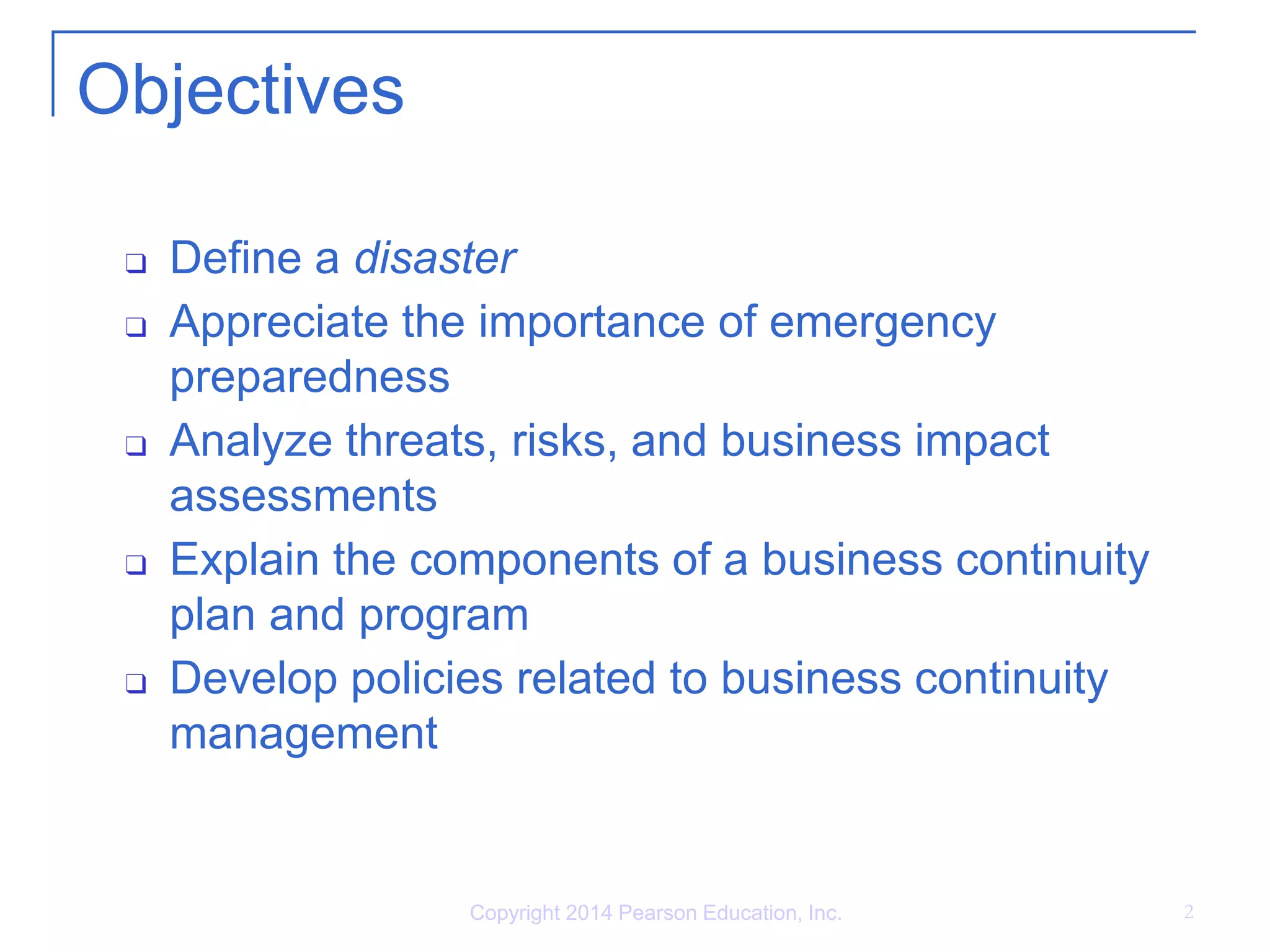
Objectives
❑ Define a disaster
❑ Appreciate the importance of emergency
preparedness
❑ Analyze threats, risks, and business impact
assessments
❑ Explain the components of a business continuity
plan and program
❑ Develop policies related to business continuity
management
Copyright 2014 Pearson Education, Inc. 3
Emergency Preparedness
■ Disaster
❑ Any event that results in damage or destruction,
loss of life, or drastic change to the environment
❑ A disruption of normal business functions where
the expected time for returning to normalcy would
seriously impact the organization’s capability to
maintain operations, including customer
commitments and regulatory compliance
❑ The cause can be environmental, operational,
accidental, or willful
Emergency Preparedness cont.
■ Resilient organization
❑ Has the capability to quickly adapt and recover
from known or unknown change to the
environment
■ Business disruption has an economic and
societal ripple effect
■ Emergency preparedness is a civic duty and
regulatory requirement
❑ Presidential Decision Directive (PDD) 63 Critical
Infrastructure Protection
❑ Federal Continuity Directive 1
Copyright 2014 Pearson Education, Inc. 4
Copyright 2014 Pearson Education, Inc. 5
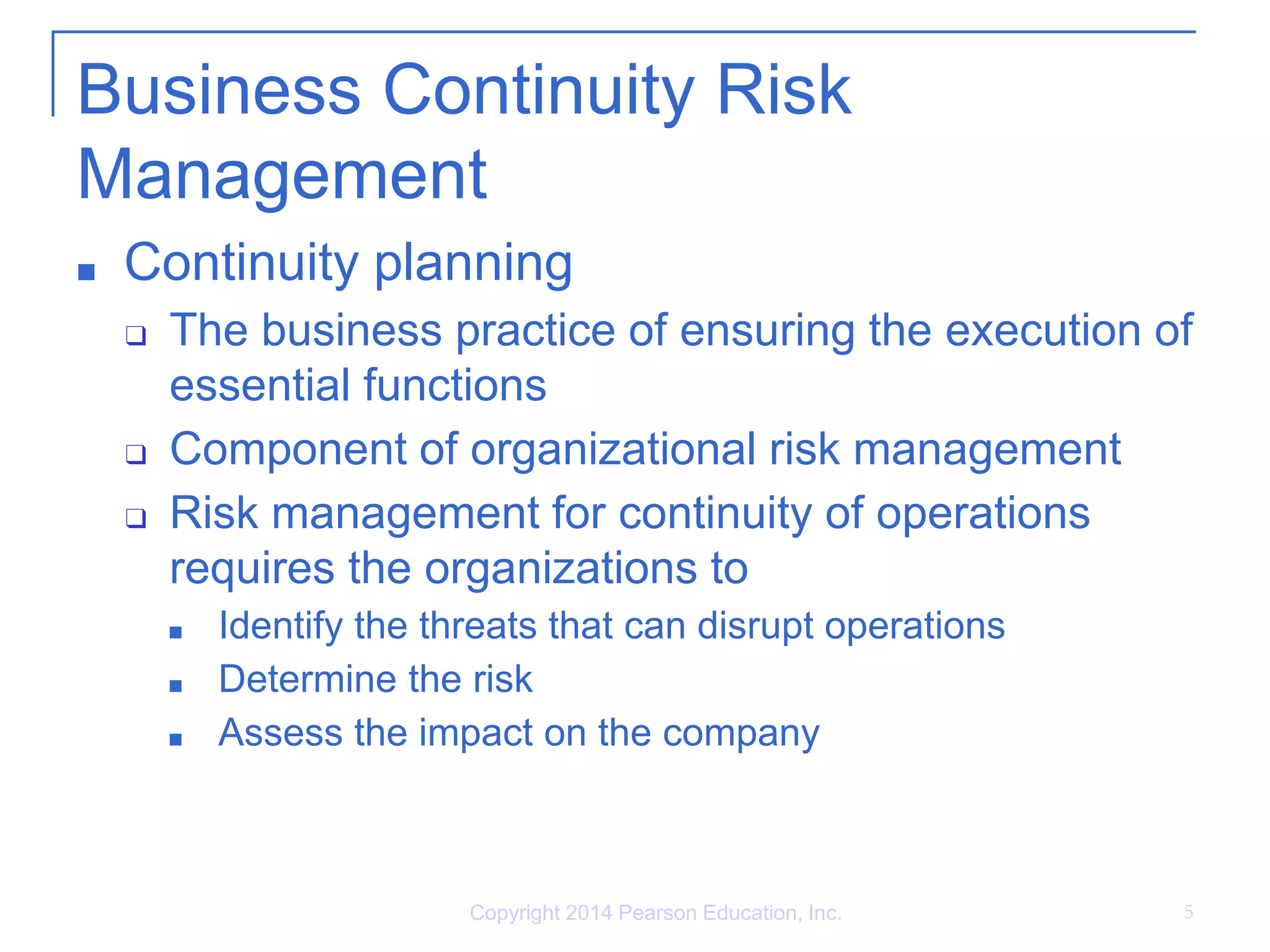
Business Continuity Risk
Management
■ Continuity planning
❑ The business practice of ensuring the execution of
essential functions
❑ Component of organizational risk management
❑ Risk management for continuity of operations
requires the organizations to
■ Identify the threats that can disrupt operations
■ Determine the risk
■ Assess the impact on the company
Business Continuity Risk
Management cont.
■ Business continuity threat assessment
❑ Identify viable threats and predict the likelihood of
occurrence
❑ Threat modeling takes into account historical and
predictive geographic, technological, physical,
environmental, industry, and third-party factors
■ Business continuity threat assessment
❑ Evaluates the sufficiency of controls to prevent a
threat from occurring or to minimize its impact
Copyright 2014 Pearson Education, Inc. 6
Copyright 2014 Pearson Education, Inc. 7
What Is a Business Impact
Assessment?
■ Business Impact Analysis
❑ Identify essential services/processes and recovery
timeframes
❑ It is a multistep collaborative activity that involves
business process owners, stakeholders, and
corporate officers
❑ A BIA incorporates three metrics
■ Maximum tolerable downtime (MTD)
■ Recovery time objective (RTO)
■ Recovery point objective (RPO)
Copyright 2014 Pearson Education, Inc. 8
Business Continuity Plan
■ The objective is to ensure the organization
has the capability to respond and recover
from a disaster
■ Component:
❑ Response plans
❑ Contingency plans
❑ Recovery plans
❑ Resumption plans
Business Continuity Plan cont.
■ Business continuity management involves the
entire organization
❑ Board of Directors provides oversight and
guidance, authorizes the related policy, and is
legally accountable for the actions of the
organization
❑ Executive management provides leadership
❑ Business Continuity Team (BCT) has the authority
to make decisions related to disaster preparation,
response, and recovery
Copyright 2014 Pearson Education, Inc. 9
Copyright 2014 Pearson Education, Inc. 10
Disaster Response Plans
■ Addresses what should be done immediately following a
significant incident
■ Defines who has the authority to declare a disaster
■ Defines who has the authority to contact external entities
■ Defines evacuation procedures
■ Defines emergency communication & notification procedures
■ Upon declaration of a disaster, all BCT members should
report to a designated command and control center
■ Occupant emergency Plan (OEP)
❑ Describes evacuation and shelter-in-place procedures in the
event of a threat or incident to the health and safety of personnel
Disaster Response Plans cont.
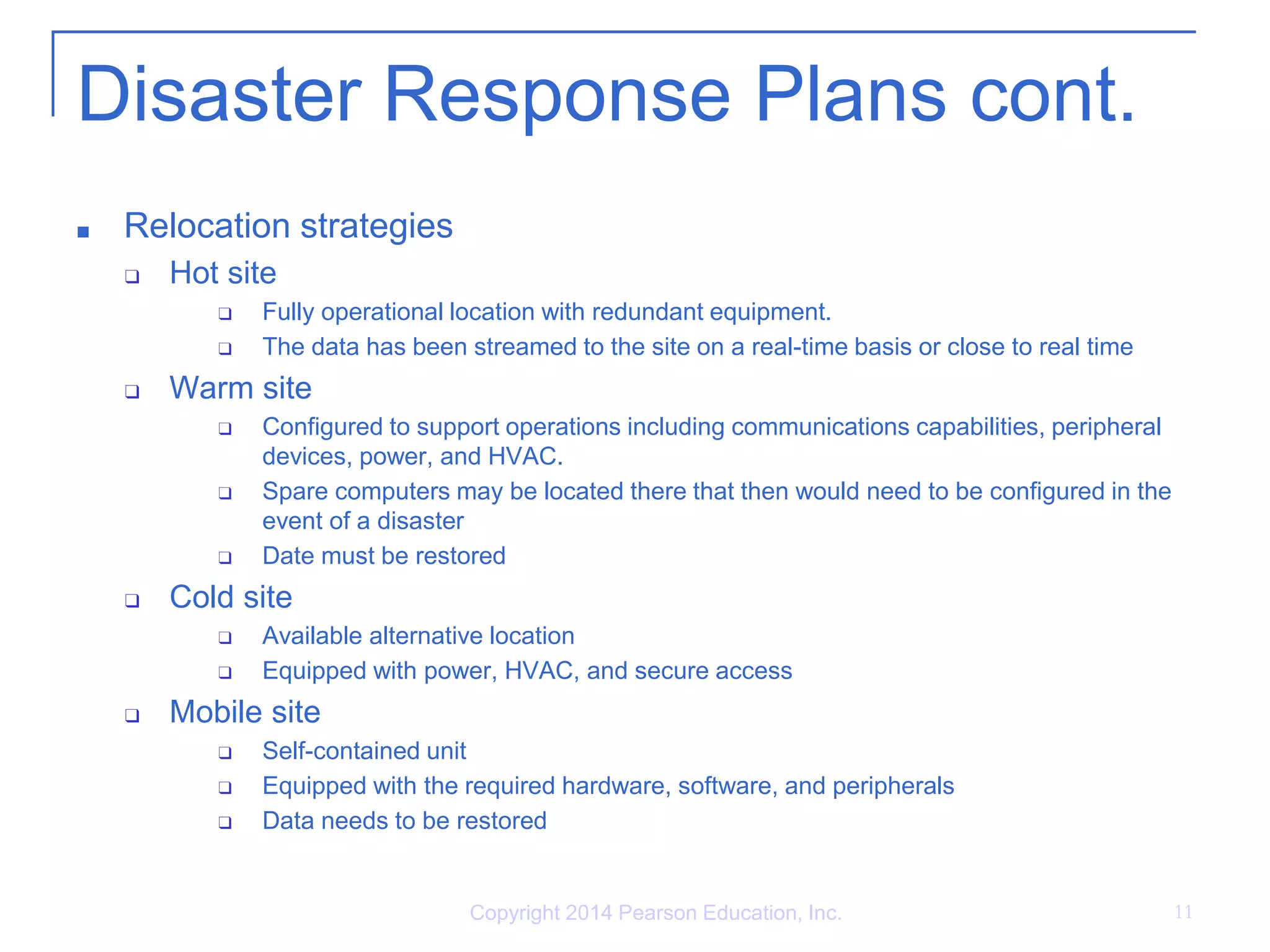
■ Relocation strategies
❑ Hot site
❑ Fully operational location with redundant equipment.
❑ The data has been streamed to the site on a real-time basis or close to real time
❑ Warm site
❑ Configured to support operations including communications capabilities, peripheral
devices, power, and HVAC.
❑ Spare computers may be located there that then would need to be configured in the
event of a disaster
❑ Date must be restored
❑ Cold site
❑ Available alternative location
❑ Equipped with power, HVAC, and secure access
❑ Mobile site
❑ Self-contained unit
❑ Equipped with the required hardware, software, and peripherals
❑ Data needs to be restored
Copyright 2014 Pearson Education, Inc. 11
Operational Contingency Plans
■ Addresses how an organization’s essential
business processes will be delivered during
the recovery process
■ Developed at the departmental level
■ Responsibility of the business process owner
■ The documentation should follow the same
form as the SOPs
Copyright 2014 Pearson Education, Inc. 12
Copyright 2014 Pearson Education, Inc. 13
The Disaster Recovery Phase
■ Recovery strategies
❑ The path to bringing the company back to a
normal business environment
❑ A plan should be in place that breaks down each
category of the overall recovery effort to simplify
the daunting recovery process:
■ Mainframe
■ Network
■ Communications
■ Infrastructure
■ Facilities
Copyright 2014 Pearson Education, Inc. 14
The Disaster Recovery Phase
Cont.
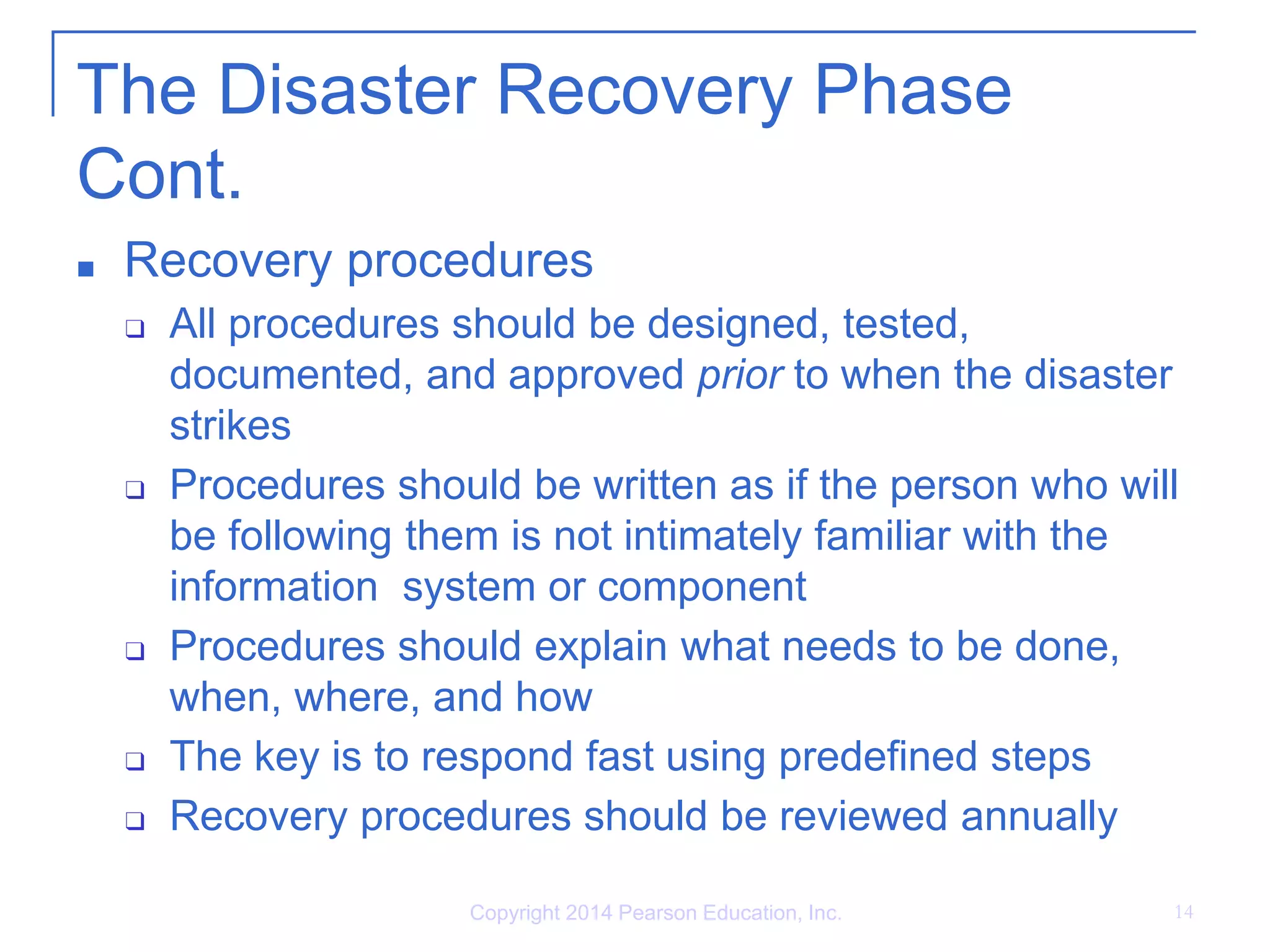
■ Recovery procedures
❑ All procedures should be designed, tested,
documented, and approved prior to when the disaster
strikes
❑ Procedures should be written as if the person who will
be following them is not intimately familiar with the
information system or component
❑ Procedures should explain what needs to be done,
when, where, and how
❑ The key is to respond fast using predefined steps
❑ Recovery procedures should be reviewed annually
Copyright 2014 Pearson Education, Inc. 15
The Resumption Phase
■ The objective is to transition to normal
operations
■ Two major activities
❑ Validation
■ Verifying recovered systems are operating correctly
❑ Deactivation
■ The official notification that the organization is no longer
operating in emergency or disaster mode
Copyright 2014 Pearson Education, Inc. 16
Plan Testing and Maintenance
❑ Proactive testing of the plan is essential
❑ Until tested, the plan is theoretical at best
❑ The tests should prove that the procedures and
the plan are:
■ Relevant
■ Operable under adverse conditions
■ Accurate
❑ Tests are used to discover errors and
inadequacies
Copyright 2014 Pearson Education, Inc. 17
Plan Testing and Maintenance
Cont.
■ Three standard testing methodologies
❑ Tabletop exercise
■ Structured review
■ Simulation
❑ Functional exercises
❑ Full-scale testing
■ Business continuity plan audit
❑ Evaluation of how the business continuity program
in its entirety is being managed
❑ Auditors must be independent
Copyright 2014 Pearson Education, Inc. 18
Plan Maintenance
❑ Business environments are dynamic: The plan
should be reviewed and edited regularly to match
the changes that occur in the company and/or the
industry in which the company is involved
❑ The plan cannot be reviewed without the risk
assessment being reviewed as well
❑ Responsibility for maintaining the plan should be
assigned to a specific role such as the ISO
Copyright 2014 Pearson Education, Inc. 19
Summary
■ A disaster can strike at any time. The organization
must be prepared to respond to continue to provide
services/products to its clients.
■ It is the responsibility of executive management to
insure that threats are evaluated, impact to business
processes recognized, and resources allocated.
■ This requires the creation and maintenance of an
audited business continuity plan and of a set of
ancillary procedures.

Chapter 12: Business Continuity Management

  • 1.
    Security Program and Policies Principlesand Practices by Sari Stern Greene Chapter 12: Business Continuity Management
  • 2.
    Copyright 2014 PearsonEducation, Inc. 2 Objectives ❑ Define a disaster ❑ Appreciate the importance of emergency preparedness ❑ Analyze threats, risks, and business impact assessments ❑ Explain the components of a business continuity plan and program ❑ Develop policies related to business continuity management
  • 3.
    Copyright 2014 PearsonEducation, Inc. 3 Emergency Preparedness ■ Disaster ❑ Any event that results in damage or destruction, loss of life, or drastic change to the environment ❑ A disruption of normal business functions where the expected time for returning to normalcy would seriously impact the organization’s capability to maintain operations, including customer commitments and regulatory compliance ❑ The cause can be environmental, operational, accidental, or willful
  • 4.
    Emergency Preparedness cont. ■Resilient organization ❑ Has the capability to quickly adapt and recover from known or unknown change to the environment ■ Business disruption has an economic and societal ripple effect ■ Emergency preparedness is a civic duty and regulatory requirement ❑ Presidential Decision Directive (PDD) 63 Critical Infrastructure Protection ❑ Federal Continuity Directive 1 Copyright 2014 Pearson Education, Inc. 4
  • 5.
    Copyright 2014 PearsonEducation, Inc. 5 Business Continuity Risk Management ■ Continuity planning ❑ The business practice of ensuring the execution of essential functions ❑ Component of organizational risk management ❑ Risk management for continuity of operations requires the organizations to ■ Identify the threats that can disrupt operations ■ Determine the risk ■ Assess the impact on the company
  • 6.
    Business Continuity Risk Managementcont. ■ Business continuity threat assessment ❑ Identify viable threats and predict the likelihood of occurrence ❑ Threat modeling takes into account historical and predictive geographic, technological, physical, environmental, industry, and third-party factors ■ Business continuity threat assessment ❑ Evaluates the sufficiency of controls to prevent a threat from occurring or to minimize its impact Copyright 2014 Pearson Education, Inc. 6
  • 7.
    Copyright 2014 PearsonEducation, Inc. 7 What Is a Business Impact Assessment? ■ Business Impact Analysis ❑ Identify essential services/processes and recovery timeframes ❑ It is a multistep collaborative activity that involves business process owners, stakeholders, and corporate officers ❑ A BIA incorporates three metrics ■ Maximum tolerable downtime (MTD) ■ Recovery time objective (RTO) ■ Recovery point objective (RPO)
  • 8.
    Copyright 2014 PearsonEducation, Inc. 8 Business Continuity Plan ■ The objective is to ensure the organization has the capability to respond and recover from a disaster ■ Component: ❑ Response plans ❑ Contingency plans ❑ Recovery plans ❑ Resumption plans
  • 9.
    Business Continuity Plancont. ■ Business continuity management involves the entire organization ❑ Board of Directors provides oversight and guidance, authorizes the related policy, and is legally accountable for the actions of the organization ❑ Executive management provides leadership ❑ Business Continuity Team (BCT) has the authority to make decisions related to disaster preparation, response, and recovery Copyright 2014 Pearson Education, Inc. 9
  • 10.
    Copyright 2014 PearsonEducation, Inc. 10 Disaster Response Plans ■ Addresses what should be done immediately following a significant incident ■ Defines who has the authority to declare a disaster ■ Defines who has the authority to contact external entities ■ Defines evacuation procedures ■ Defines emergency communication & notification procedures ■ Upon declaration of a disaster, all BCT members should report to a designated command and control center ■ Occupant emergency Plan (OEP) ❑ Describes evacuation and shelter-in-place procedures in the event of a threat or incident to the health and safety of personnel
  • 11.
    Disaster Response Planscont. ■ Relocation strategies ❑ Hot site ❑ Fully operational location with redundant equipment. ❑ The data has been streamed to the site on a real-time basis or close to real time ❑ Warm site ❑ Configured to support operations including communications capabilities, peripheral devices, power, and HVAC. ❑ Spare computers may be located there that then would need to be configured in the event of a disaster ❑ Date must be restored ❑ Cold site ❑ Available alternative location ❑ Equipped with power, HVAC, and secure access ❑ Mobile site ❑ Self-contained unit ❑ Equipped with the required hardware, software, and peripherals ❑ Data needs to be restored Copyright 2014 Pearson Education, Inc. 11
  • 12.
    Operational Contingency Plans ■Addresses how an organization’s essential business processes will be delivered during the recovery process ■ Developed at the departmental level ■ Responsibility of the business process owner ■ The documentation should follow the same form as the SOPs Copyright 2014 Pearson Education, Inc. 12
  • 13.
    Copyright 2014 PearsonEducation, Inc. 13 The Disaster Recovery Phase ■ Recovery strategies ❑ The path to bringing the company back to a normal business environment ❑ A plan should be in place that breaks down each category of the overall recovery effort to simplify the daunting recovery process: ■ Mainframe ■ Network ■ Communications ■ Infrastructure ■ Facilities
  • 14.
    Copyright 2014 PearsonEducation, Inc. 14 The Disaster Recovery Phase Cont. ■ Recovery procedures ❑ All procedures should be designed, tested, documented, and approved prior to when the disaster strikes ❑ Procedures should be written as if the person who will be following them is not intimately familiar with the information system or component ❑ Procedures should explain what needs to be done, when, where, and how ❑ The key is to respond fast using predefined steps ❑ Recovery procedures should be reviewed annually
  • 15.
    Copyright 2014 PearsonEducation, Inc. 15 The Resumption Phase ■ The objective is to transition to normal operations ■ Two major activities ❑ Validation ■ Verifying recovered systems are operating correctly ❑ Deactivation ■ The official notification that the organization is no longer operating in emergency or disaster mode
  • 16.
    Copyright 2014 PearsonEducation, Inc. 16 Plan Testing and Maintenance ❑ Proactive testing of the plan is essential ❑ Until tested, the plan is theoretical at best ❑ The tests should prove that the procedures and the plan are: ■ Relevant ■ Operable under adverse conditions ■ Accurate ❑ Tests are used to discover errors and inadequacies
  • 17.
    Copyright 2014 PearsonEducation, Inc. 17 Plan Testing and Maintenance Cont. ■ Three standard testing methodologies ❑ Tabletop exercise ■ Structured review ■ Simulation ❑ Functional exercises ❑ Full-scale testing ■ Business continuity plan audit ❑ Evaluation of how the business continuity program in its entirety is being managed ❑ Auditors must be independent
  • 18.
    Copyright 2014 PearsonEducation, Inc. 18 Plan Maintenance ❑ Business environments are dynamic: The plan should be reviewed and edited regularly to match the changes that occur in the company and/or the industry in which the company is involved ❑ The plan cannot be reviewed without the risk assessment being reviewed as well ❑ Responsibility for maintaining the plan should be assigned to a specific role such as the ISO
  • 19.
    Copyright 2014 PearsonEducation, Inc. 19 Summary ■ A disaster can strike at any time. The organization must be prepared to respond to continue to provide services/products to its clients. ■ It is the responsibility of executive management to insure that threats are evaluated, impact to business processes recognized, and resources allocated. ■ This requires the creation and maintenance of an audited business continuity plan and of a set of ancillary procedures.