CHAPTER 6
The Skeletal System:
Bone Tissue
Principles of
Anatomy and
Physiology
14th Edition
Copyright © 2014 John Wiley & Sons, Inc. All rights reserved.
The skeletal system has 6 important
functions:
 Provides support
 Protects the internal organs (brain, heart, etc.)
 Assists body movements (in conjunction with
muscles)
 Stores and releases salts of calcium and
phosphorus
 Participates in blood cell production
(hemopoiesis)
 Stores triglycerides in adipose cells of yellow
marrow
Introduction
Copyright © 2014 John Wiley & Sons, Inc. All rights reserved.
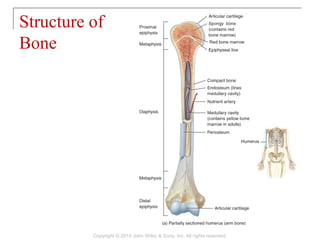
A long bone consists of several parts:
 Diaphysis (bone shaft)
 2 epiphyses (both ends of the bone at the joints)
 2 metaphyses (region between diaphysis and epiphysis)
 Articular cartilage covering both epiphyses
 Periosteum (connective tissue surrounding the
diaphysis)
 Medullary cavity (hollow space within diaphysis)
 Endosteum (thin membrane lining the medulary cavity)
Structure of Bone
Copyright © 2014 John Wiley & Sons, Inc. All rights reserved.
Structure of
Bone
Copyright © 2014 John Wiley & Sons, Inc. All rights reserved.
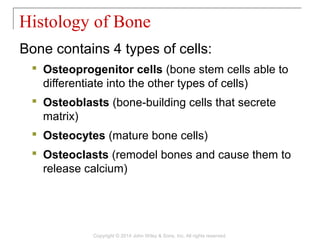
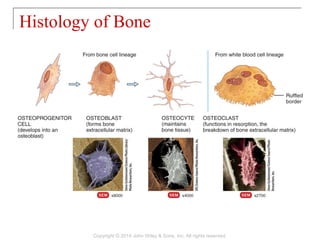
Bone contains 4 types of cells:
 Osteoprogenitor cells (bone stem cells able to
differentiate into the other types of cells)
 Osteoblasts (bone-building cells that secrete
matrix)
 Osteocytes (mature bone cells)
 Osteoclasts (remodel bones and cause them to
release calcium)
Histology of Bone
Copyright © 2014 John Wiley & Sons, Inc. All rights reserved.
Histology of Bone
Copyright © 2014 John Wiley & Sons, Inc. All rights reserved.
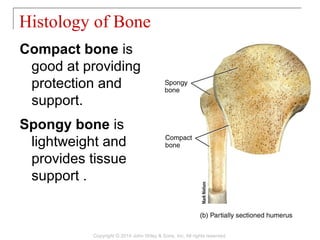
Compact bone is
good at providing
protection and
support.
Spongy bone is
lightweight and
provides tissue
support .
Histology of Bone
Copyright © 2014 John Wiley & Sons, Inc. All rights reserved.
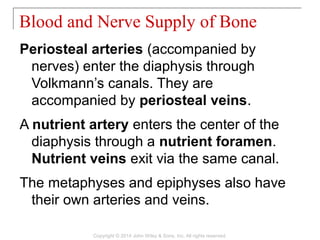
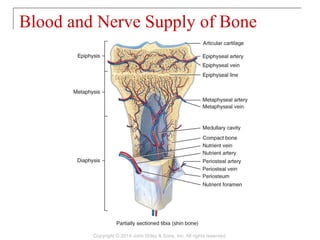
Periosteal arteries (accompanied by
nerves) enter the diaphysis through
Volkmann’s canals. They are
accompanied by periosteal veins.
A nutrient artery enters the center of the
diaphysis through a nutrient foramen.
Nutrient veins exit via the same canal.
The metaphyses and epiphyses also have
their own arteries and veins.
Blood and Nerve Supply of Bone
Copyright © 2014 John Wiley & Sons, Inc. All rights reserved.
Blood and Nerve Supply of Bone
Copyright © 2014 John Wiley & Sons, Inc. All rights reserved.
Ossification (osteogenesis) is the process
of bone formation.
Bones form in 4 situations:
 During embryological and fetal development
 When bones grow before adulthood
 When bones remodel
 When fractures heal
Bone Formation
Copyright © 2014 John Wiley & Sons, Inc. All rights reserved.
Ossification takes place in 2 forms:
Intramembranous and endochondral.
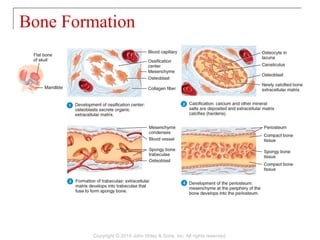
Intramembranous ossification occurs in flat
bones when a connective tissue
membrane is replaced by bone.
Bone Formation
Copyright © 2014 John Wiley & Sons, Inc. All rights reserved.
Bone Formation
Copyright © 2014 John Wiley & Sons, Inc. All rights reserved.
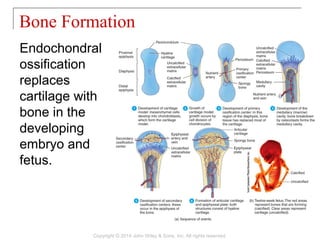
Endochondral
ossification
replaces
cartilage with
bone in the
developing
embryo and
fetus.
Bone Formation
Copyright © 2014 John Wiley & Sons, Inc. All rights reserved.
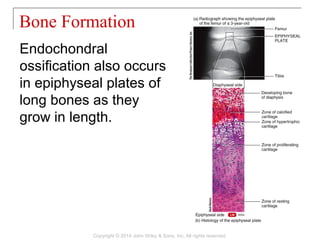
Endochondral
ossification also occurs
in epiphyseal plates of
long bones as they
grow in length.
Bone Formation
Copyright © 2014 John Wiley & Sons, Inc. All rights reserved.
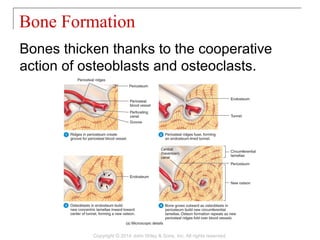
Bones thicken thanks to the cooperative
action of osteoblasts and osteoclasts.
Bone Formation
Copyright © 2014 John Wiley & Sons, Inc. All rights reserved.
Bone Growth and Remodeling
Interactions Animation:
You must be connected to the Internet and in Slideshow Mode
to run this animation.
Copyright © 2014 John Wiley & Sons, Inc. All rights reserved.
Bone Dynamics and Tissue
Bone Remodeling and Rescription
Interactions Animation:
You must be connected to the Internet and in Slideshow Mode
to run this animation.
Copyright © 2014 John Wiley & Sons, Inc. All rights reserved.
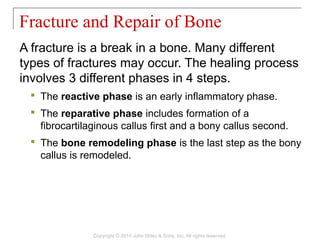
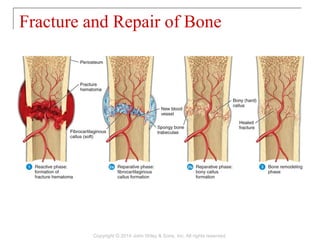
A fracture is a break in a bone. Many different
types of fractures may occur. The healing process
involves 3 different phases in 4 steps.
 The reactive phase is an early inflammatory phase.
 The reparative phase includes formation of a
fibrocartilaginous callus first and a bony callus second.
 The bone remodeling phase is the last step as the bony
callus is remodeled.
Fracture and Repair of Bone
Copyright © 2014 John Wiley & Sons, Inc. All rights reserved.
Fracture and Repair of Bone
Copyright © 2014 John Wiley & Sons, Inc. All rights reserved.
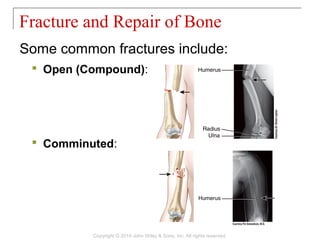
Some common fractures include:
 Open (Compound):
 Comminuted:
Fracture and Repair of Bone
Copyright © 2014 John Wiley & Sons, Inc. All rights reserved.
Some common fractures include:
 Greenstick:
 Impacted:
Fracture and Repair of Bone
Copyright © 2014 John Wiley & Sons, Inc. All rights reserved.
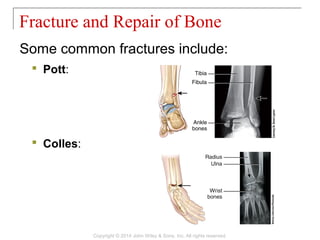
Some common fractures include:
 Pott:
 Colles:
Fracture and Repair of Bone
Copyright © 2014 John Wiley & Sons, Inc. All rights reserved.
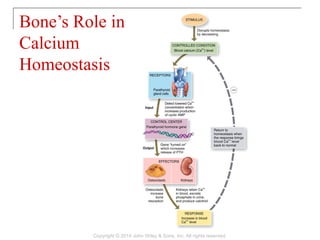
Bones store 99% of the body’s calcium. The
parathyroid gland secretes Parathyroid
hormone (PTH) when calcium levels drop.
Osteoclasts are stimulated to increase bone
resorption and calcium is released. PTH
also stimulates the production of calcitriol
by the kidneys to increase calcium
absorption in the intestines.
Bone’s Role in Calcium Homeostasis
Copyright © 2014 John Wiley & Sons, Inc. All rights reserved.
Bone’s Role in
Calcium
Homeostasis
Copyright © 2014 John Wiley & Sons, Inc. All rights reserved.
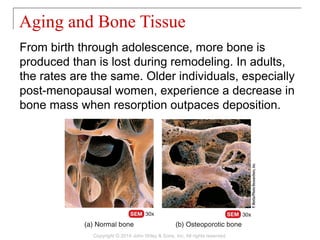
From birth through adolescence, more bone is
produced than is lost during remodeling. In adults,
the rates are the same. Older individuals, especially
post-menopausal women, experience a decrease in
bone mass when resorption outpaces deposition.
Aging and Bone Tissue
Copyright © 2014 John Wiley & Sons, Inc. All rights reserved.
Copyright 2014 John Wiley & Sons, Inc.
All rights reserved. Reproduction or translation of this
work beyond that permitted in section 117 of the 1976
United States Copyright Act without express permission
of the copyright owner is unlawful. Request for further
information should be addressed to the Permission
Department, John Wiley & Sons, Inc. The purchaser
may make back-up copies for his/her own use only and
not for distribution or resale. The Publisher assumes no
responsibility for errors, omissions, or damages caused
by the use of these programs or from the use of the
information herein.
End of Chapter 6
Copyright © 2014 John Wiley & Sons, Inc. All rights reserved.

06 [chapter 6 the skeletal system bone tissue]

  • 1.
    CHAPTER 6 The SkeletalSystem: Bone Tissue Principles of Anatomy and Physiology 14th Edition Copyright © 2014 John Wiley & Sons, Inc. All rights reserved.
  • 2.
    The skeletal systemhas 6 important functions:  Provides support  Protects the internal organs (brain, heart, etc.)  Assists body movements (in conjunction with muscles)  Stores and releases salts of calcium and phosphorus  Participates in blood cell production (hemopoiesis)  Stores triglycerides in adipose cells of yellow marrow Introduction Copyright © 2014 John Wiley & Sons, Inc. All rights reserved.
  • 3.
    A long boneconsists of several parts:  Diaphysis (bone shaft)  2 epiphyses (both ends of the bone at the joints)  2 metaphyses (region between diaphysis and epiphysis)  Articular cartilage covering both epiphyses  Periosteum (connective tissue surrounding the diaphysis)  Medullary cavity (hollow space within diaphysis)  Endosteum (thin membrane lining the medulary cavity) Structure of Bone Copyright © 2014 John Wiley & Sons, Inc. All rights reserved.
  • 4.
    Structure of Bone Copyright ©2014 John Wiley & Sons, Inc. All rights reserved.
  • 5.
    Bone contains 4types of cells:  Osteoprogenitor cells (bone stem cells able to differentiate into the other types of cells)  Osteoblasts (bone-building cells that secrete matrix)  Osteocytes (mature bone cells)  Osteoclasts (remodel bones and cause them to release calcium) Histology of Bone Copyright © 2014 John Wiley & Sons, Inc. All rights reserved.
  • 6.
    Histology of Bone Copyright© 2014 John Wiley & Sons, Inc. All rights reserved.
  • 7.
    Compact bone is goodat providing protection and support. Spongy bone is lightweight and provides tissue support . Histology of Bone Copyright © 2014 John Wiley & Sons, Inc. All rights reserved.
  • 8.
    Periosteal arteries (accompaniedby nerves) enter the diaphysis through Volkmann’s canals. They are accompanied by periosteal veins. A nutrient artery enters the center of the diaphysis through a nutrient foramen. Nutrient veins exit via the same canal. The metaphyses and epiphyses also have their own arteries and veins. Blood and Nerve Supply of Bone Copyright © 2014 John Wiley & Sons, Inc. All rights reserved.
  • 9.
    Blood and NerveSupply of Bone Copyright © 2014 John Wiley & Sons, Inc. All rights reserved.
  • 10.
    Ossification (osteogenesis) isthe process of bone formation. Bones form in 4 situations:  During embryological and fetal development  When bones grow before adulthood  When bones remodel  When fractures heal Bone Formation Copyright © 2014 John Wiley & Sons, Inc. All rights reserved.
  • 11.
    Ossification takes placein 2 forms: Intramembranous and endochondral. Intramembranous ossification occurs in flat bones when a connective tissue membrane is replaced by bone. Bone Formation Copyright © 2014 John Wiley & Sons, Inc. All rights reserved.
  • 12.
    Bone Formation Copyright ©2014 John Wiley & Sons, Inc. All rights reserved.
  • 13.
    Endochondral ossification replaces cartilage with bone inthe developing embryo and fetus. Bone Formation Copyright © 2014 John Wiley & Sons, Inc. All rights reserved.
  • 14.
    Endochondral ossification also occurs inepiphyseal plates of long bones as they grow in length. Bone Formation Copyright © 2014 John Wiley & Sons, Inc. All rights reserved.
  • 15.
    Bones thicken thanksto the cooperative action of osteoblasts and osteoclasts. Bone Formation Copyright © 2014 John Wiley & Sons, Inc. All rights reserved.
  • 16.
    Bone Growth andRemodeling Bone Growth and Remodeling Interactions Animation: You must be connected to the Internet and in Slideshow Mode to run this animation. Copyright © 2014 John Wiley & Sons, Inc. All rights reserved.
  • 17.
    Bone Dynamics andTissue Bone Remodeling and Rescription Interactions Animation: You must be connected to the Internet and in Slideshow Mode to run this animation. Copyright © 2014 John Wiley & Sons, Inc. All rights reserved.
  • 18.
    A fracture isa break in a bone. Many different types of fractures may occur. The healing process involves 3 different phases in 4 steps.  The reactive phase is an early inflammatory phase.  The reparative phase includes formation of a fibrocartilaginous callus first and a bony callus second.  The bone remodeling phase is the last step as the bony callus is remodeled. Fracture and Repair of Bone Copyright © 2014 John Wiley & Sons, Inc. All rights reserved.
  • 19.
    Fracture and Repairof Bone Copyright © 2014 John Wiley & Sons, Inc. All rights reserved.
  • 20.
    Some common fracturesinclude:  Open (Compound):  Comminuted: Fracture and Repair of Bone Copyright © 2014 John Wiley & Sons, Inc. All rights reserved.
  • 21.
    Some common fracturesinclude:  Greenstick:  Impacted: Fracture and Repair of Bone Copyright © 2014 John Wiley & Sons, Inc. All rights reserved.
  • 22.
    Some common fracturesinclude:  Pott:  Colles: Fracture and Repair of Bone Copyright © 2014 John Wiley & Sons, Inc. All rights reserved.
  • 23.
    Bones store 99%of the body’s calcium. The parathyroid gland secretes Parathyroid hormone (PTH) when calcium levels drop. Osteoclasts are stimulated to increase bone resorption and calcium is released. PTH also stimulates the production of calcitriol by the kidneys to increase calcium absorption in the intestines. Bone’s Role in Calcium Homeostasis Copyright © 2014 John Wiley & Sons, Inc. All rights reserved.
  • 24.
    Bone’s Role in Calcium Homeostasis Copyright© 2014 John Wiley & Sons, Inc. All rights reserved.
  • 25.
    From birth throughadolescence, more bone is produced than is lost during remodeling. In adults, the rates are the same. Older individuals, especially post-menopausal women, experience a decrease in bone mass when resorption outpaces deposition. Aging and Bone Tissue Copyright © 2014 John Wiley & Sons, Inc. All rights reserved.
  • 26.
    Copyright 2014 JohnWiley & Sons, Inc. All rights reserved. Reproduction or translation of this work beyond that permitted in section 117 of the 1976 United States Copyright Act without express permission of the copyright owner is unlawful. Request for further information should be addressed to the Permission Department, John Wiley & Sons, Inc. The purchaser may make back-up copies for his/her own use only and not for distribution or resale. The Publisher assumes no responsibility for errors, omissions, or damages caused by the use of these programs or from the use of the information herein. End of Chapter 6 Copyright © 2014 John Wiley & Sons, Inc. All rights reserved.

Editor's Notes

  • #3 <number>
  • #4 <number>
  • #6 <number>
  • #8 <number>
  • #9 <number>
  • #10 The periosteum is only found on areas where there is no articular cartilage <number>
  • #11 <number>
  • #12 <number>
  • #13 <number>
  • #14 <number>
  • #15 <number>
  • #16 Discuss only a typical long bone at this point. Later, other bone types will be discussed. <number>
  • #17 <number>
  • #18 <number>
  • #19 <number>
  • #20 <number>
  • #21 <number>
  • #22 <number>
  • #23 <number>