Principles of Human Anatomy and Physiology, 11e 1
Chapter 4
The Tissue Level of Organization
Lecture Outline
INTRODUCTION
• A tissue is a group of similar cells that usually have a similar
embryological origin and are specialized for a particular
function.
• The nature of the extracellular material that surrounds the
connections between the cells that compose the tissue
influence the structure and properties of a specific tissue.
• Pathologists, physicians who specialize in laboratory studies
of cells and tissues, aid other physicians in making
diagnoses; they also perform autopsies.
Principles of Human Anatomy and Physiology, 11e 3
Chapter 4 The Tissue Level of
Organization
• Histology
– the study of tissues
TYPES OF TISSUES AND THEIR ORIGINS
Four principal types based on function and structure
• Epithelial tissue
– covers body surfaces, lines hollow organs, body cavities,
and ducts; and forms glands.
• Connective tissue
– protects and supports the body and its organs, binds
organs together, stores energy reserves as fat, and
provides immunity.
• Muscle tissue
– is responsible for movement and generation of force.
• Nervous tissue
– initiates and transmits action potentials (nerve impulses)
that help coordinate body activities.
Origin of Tissues
• Primary germ layers within the embryo
– endoderm
– mesoderm
– Ectoderm
• Tissue derivations
– epithelium from all 3 germ layers
– connective tissue & muscle from mesoderm
– nerve tissue from ectoderm
– Table 29.1 provides a list of structures derived
from the primary germ layers.
DEVELOPMENT
• Normally, most cells within a tissue remain in place,
anchored to
– other cells
– a basement membranes
– connective tissues
• Exceptions include phagocytes and embryonic cells involved
in differentiation and growth.
Biopsy
• Removal of living tissue for microscopic examination
– surgery
– needle biopsy
• Useful for diagnosis, especially cancer
• Tissue preserved, sectioned and stained before microscopic
viewing
CELL JUNCTIONS
• Cell junctions are points of contact between adjacent
plasma membranes.
• Depending on their structure, cell junctions may serve one
of three functions.
– Some cell junctions form fluid-tight seals between cells.
– Other cell junctions anchor cells together or to
extracellular material.
– Still others act as channels, which allow ions and
molecules to pass from cell to cell within a tissue.
CELL JUNCTIONS
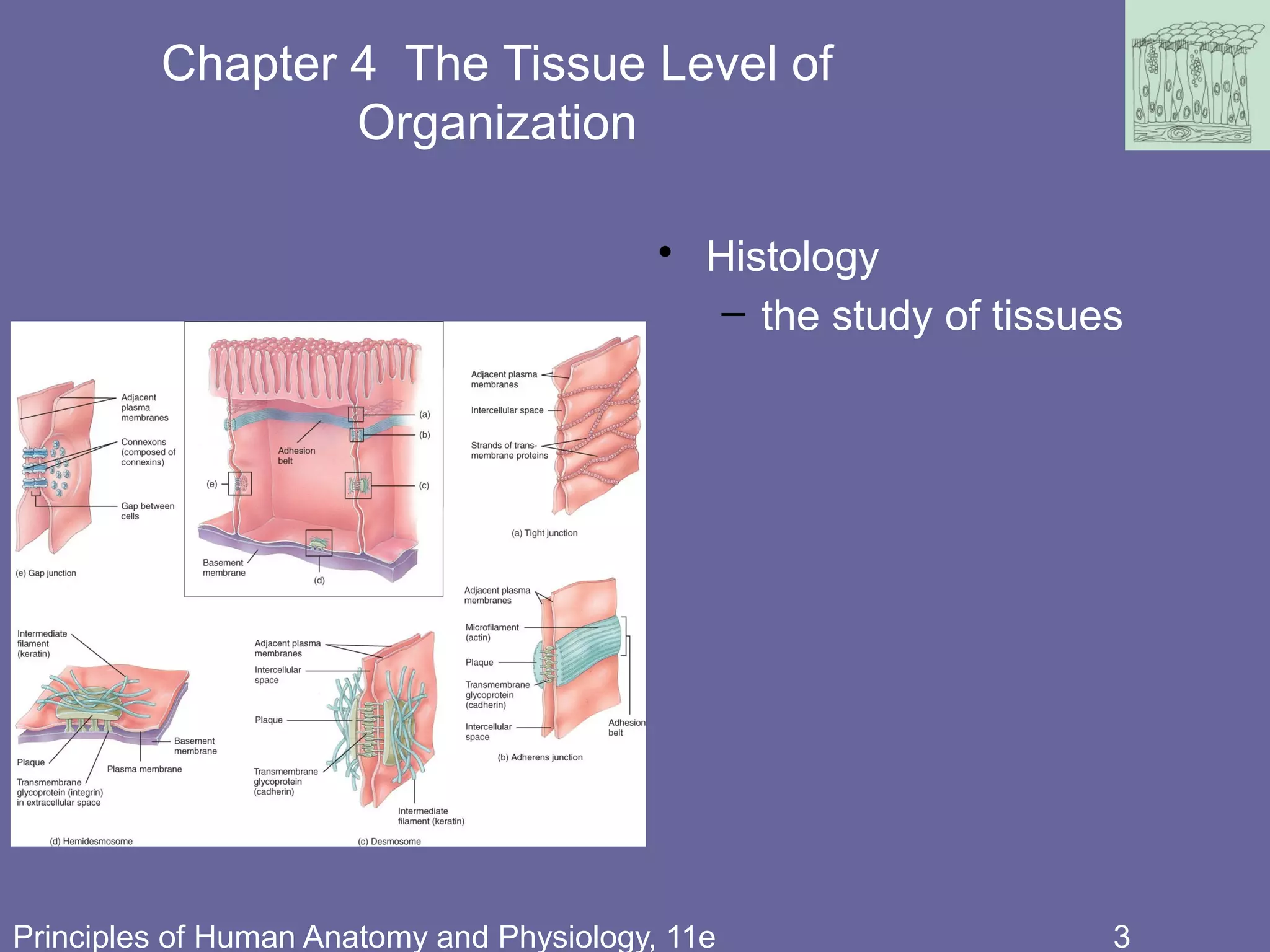
• The five most
important kinds of
cell junctions are
tight junctions,
adherens
junctions,
desmosomes,
hemidesmosomes,
and gap junctions
(Figure 4.1)
Principles of Human Anatomy and Physiology, 11e 10
Cell Junctions
• Tight junctions
• Adherens junctions
• Gap junctions
• Desmosomes
• Hemidesmosomes
Principles of Human Anatomy and Physiology, 11e 11
Tight Junctions
• Watertight seal between cells
• Plasma membranes fused with
a strip of proteins
• Common between cells that line
GI and bladder
Principles of Human Anatomy and Physiology, 11e 12
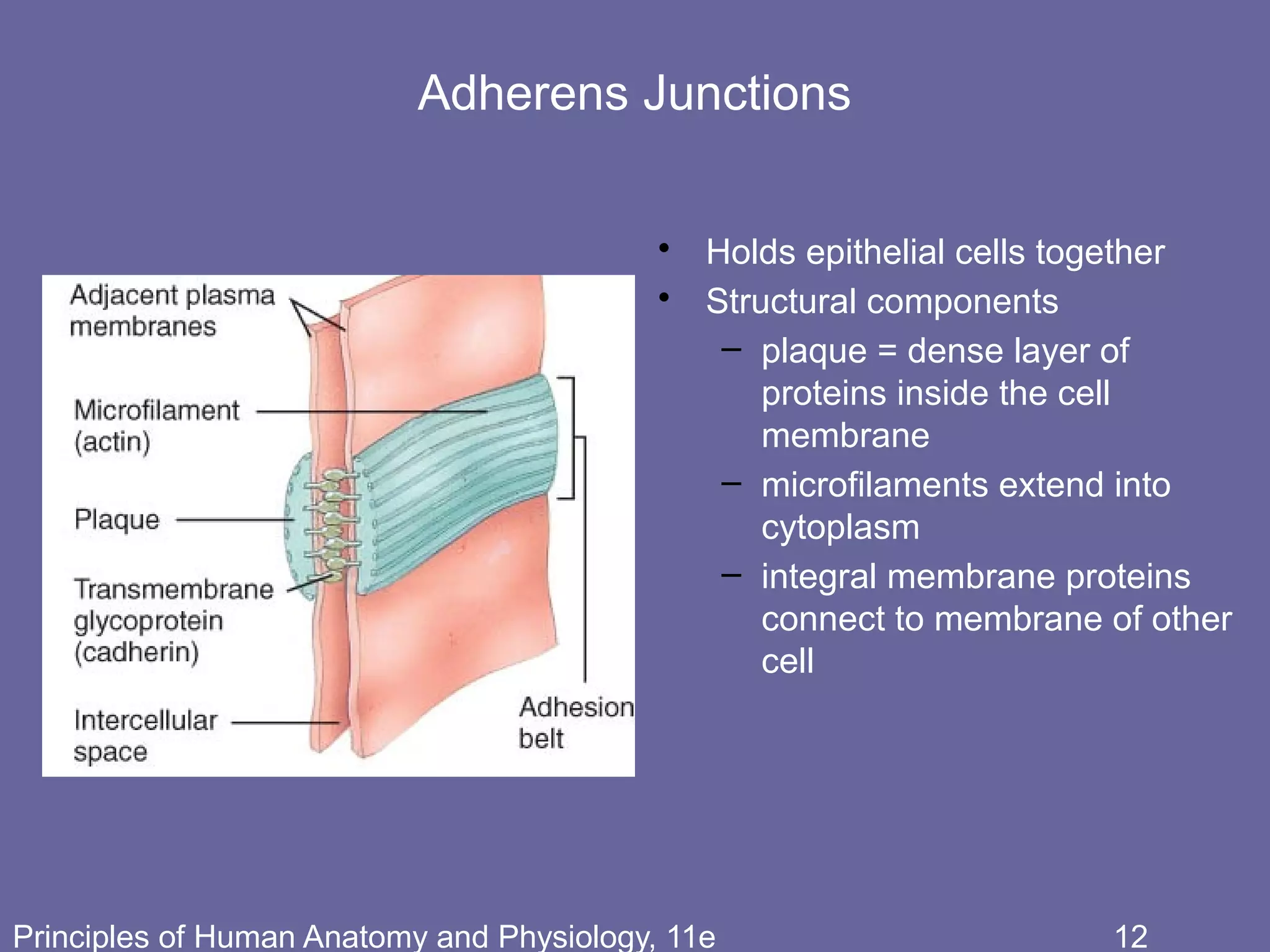
Adherens Junctions
• Holds epithelial cells together
• Structural components
– plaque = dense layer of
proteins inside the cell
membrane
– microfilaments extend into
cytoplasm
– integral membrane proteins
connect to membrane of other
cell
Principles of Human Anatomy and Physiology, 11e 13
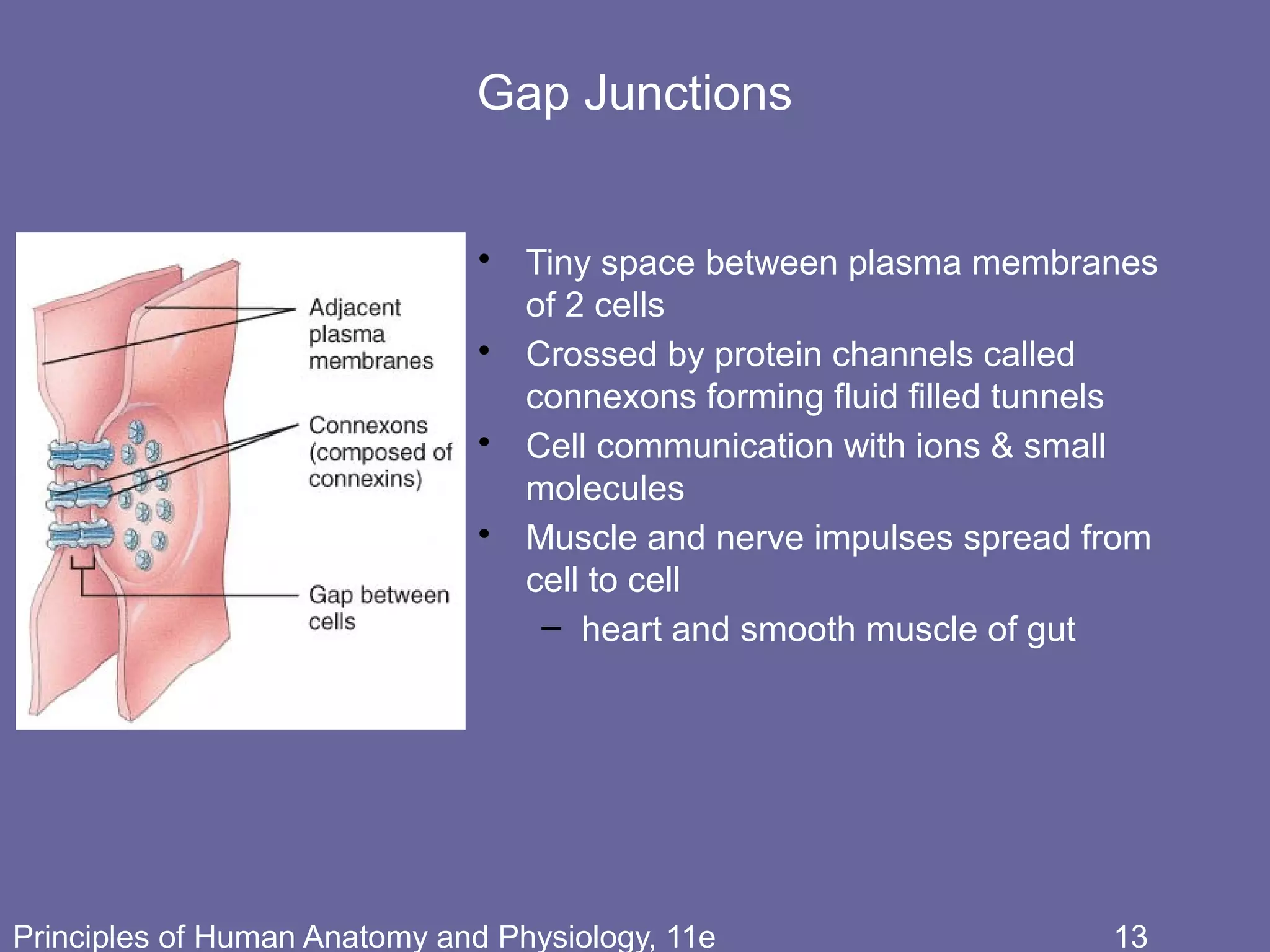
Gap Junctions
• Tiny space between plasma membranes
of 2 cells
• Crossed by protein channels called
connexons forming fluid filled tunnels
• Cell communication with ions & small
molecules
• Muscle and nerve impulses spread from
cell to cell
– heart and smooth muscle of gut
Principles of Human Anatomy and Physiology, 11e 14
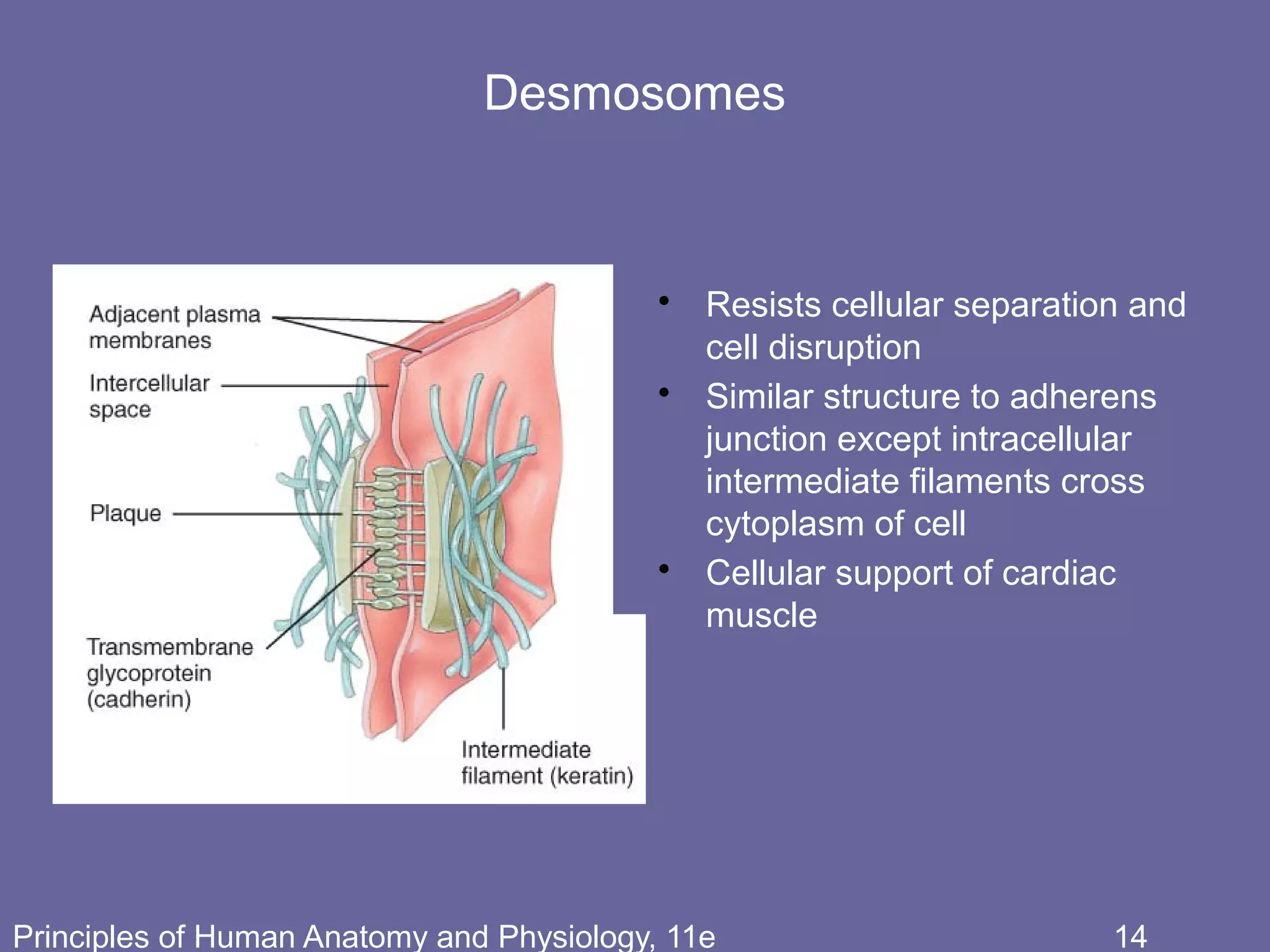
Desmosomes
• Resists cellular separation and
cell disruption
• Similar structure to adherens
junction except intracellular
intermediate filaments cross
cytoplasm of cell
• Cellular support of cardiac
muscle
Principles of Human Anatomy and Physiology, 11e 15
Hemidesmosomes
• Half a desmosome
• Connect cells to extracellular
material
– basement membrane
EPITHELIAL TISSUES
Epithelial Tissue -- General Features
• Closely packed cells with little extracellular material
– Many cell junctions often provide secure attachment.
• Cells sit on basement membrane
– Apical (upper) free surface
– Basal surface against basement membrane
• Avascular---without blood vessels
– nutrients and wast must move by diffusion
• Good nerve supply
• Rapid cell division (high mitotic rate)
• Functions
– protection, filtration, lubrication, secretion, digestion,
absorption, transportation, excretion, sensory
reception, and reproduction.
Principles of Human Anatomy and Physiology, 11e 18
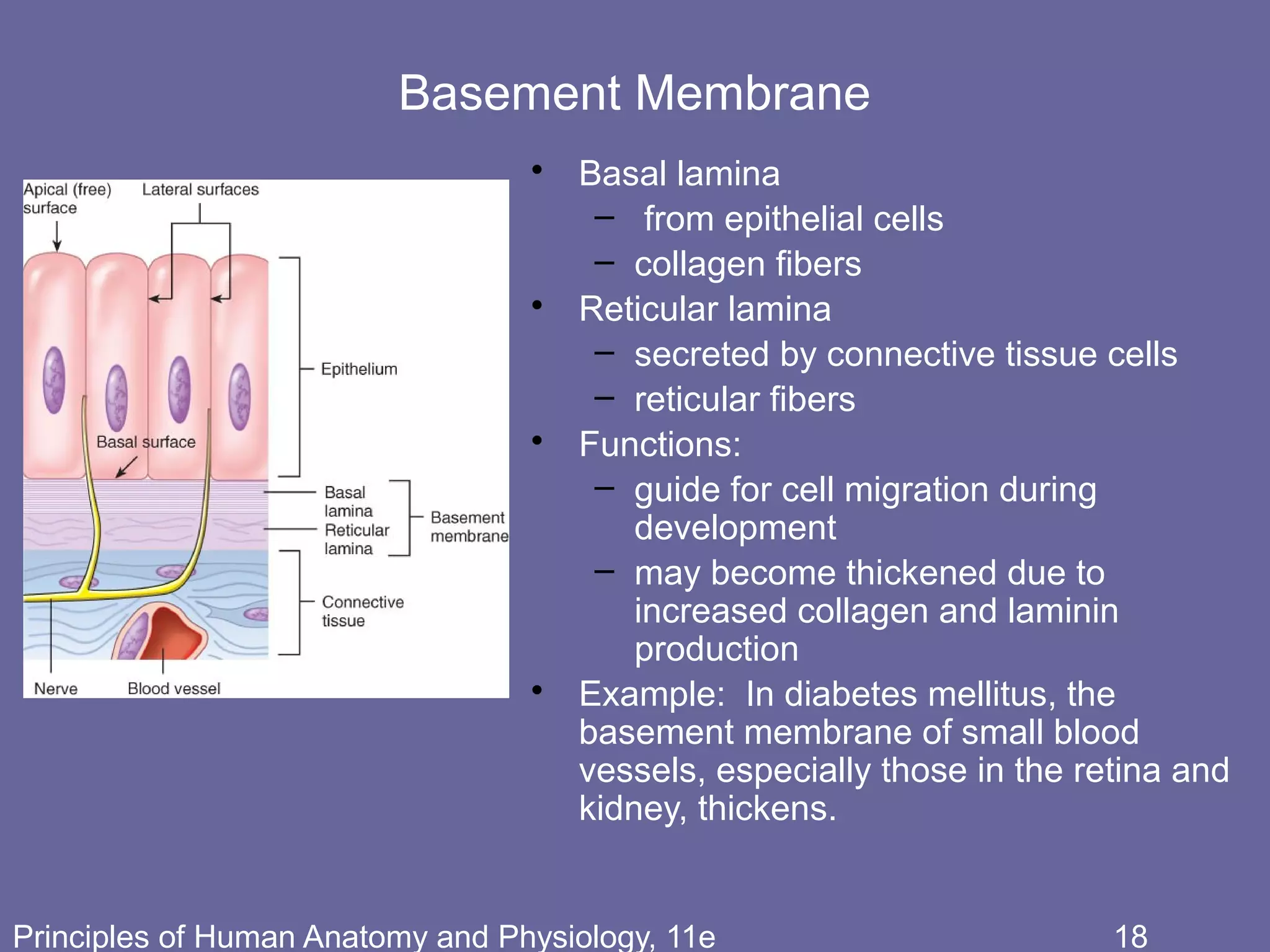
Basement Membrane
• Basal lamina
– from epithelial cells
– collagen fibers
• Reticular lamina
– secreted by connective tissue cells
– reticular fibers
• Functions:
– guide for cell migration during
development
– may become thickened due to
increased collagen and laminin
production
• Example: In diabetes mellitus, the
basement membrane of small blood
vessels, especially those in the retina and
kidney, thickens.
Types of Epithelium
• Covering and lining epithelium
– epidermis of skin
– lining of blood vessels and ducts
– lining respiratory, reproductive, urinary & GI tract
• Glandular epithelium
– secreting portion of glands
– thyroid, adrenal, and sweat glands
Classification of Epithelium
• Classified by arrangement of cells into layers
– simple = one cell layer thick
– stratified = two or more cell layers thick
– pseudostratified = cells contact BM but all cells don’t
reach apical surface
– nuclei are located at multiple levels so it looks
multilayered
• Classified by shape of surface cells (Table 4.1)
– squamous =flat
– cuboidal = cube-shaped
– columnar = tall column
– transitional = shape varies with tissue stretching
Epithelium
Simple Epithelium
• Simple squamous epithelium consists of a single layer of
flat, scale-like cells (Table 4.1A)
– adapted for diffusion and filtration (found in lungs and
kidneys)
– Endothelium lines the heart and blood vessels.
– Mesothelium lines the thoracic and abdominopelvic
cavities and covers the organs within them.
• Simple cuboidal epithelium consists of a simple layer of
cube-shaped cells
– adapted for secretion and absorption (Table 4.1B).
Simple Epithelium
• Simple columnar epithelium consists of a single layer of
rectangular cells and can exist in two forms
– Ciliated simple columnar epithelium contains cells with
hair-like processes called cilia (Table 4.1D)
– provides motility and helps to move fluids or particles
along a surface
– Nonciliated simple columnar epithelium contains microvilli
(Figure 3.2) (Table 4.1C)
– increase surface area and the rate of absorption
– goblet cells (unicellular glands) that secrete mucus are
generally found with both types of simple columnar
epithelium
Principles of Human Anatomy and Physiology, 11e 24
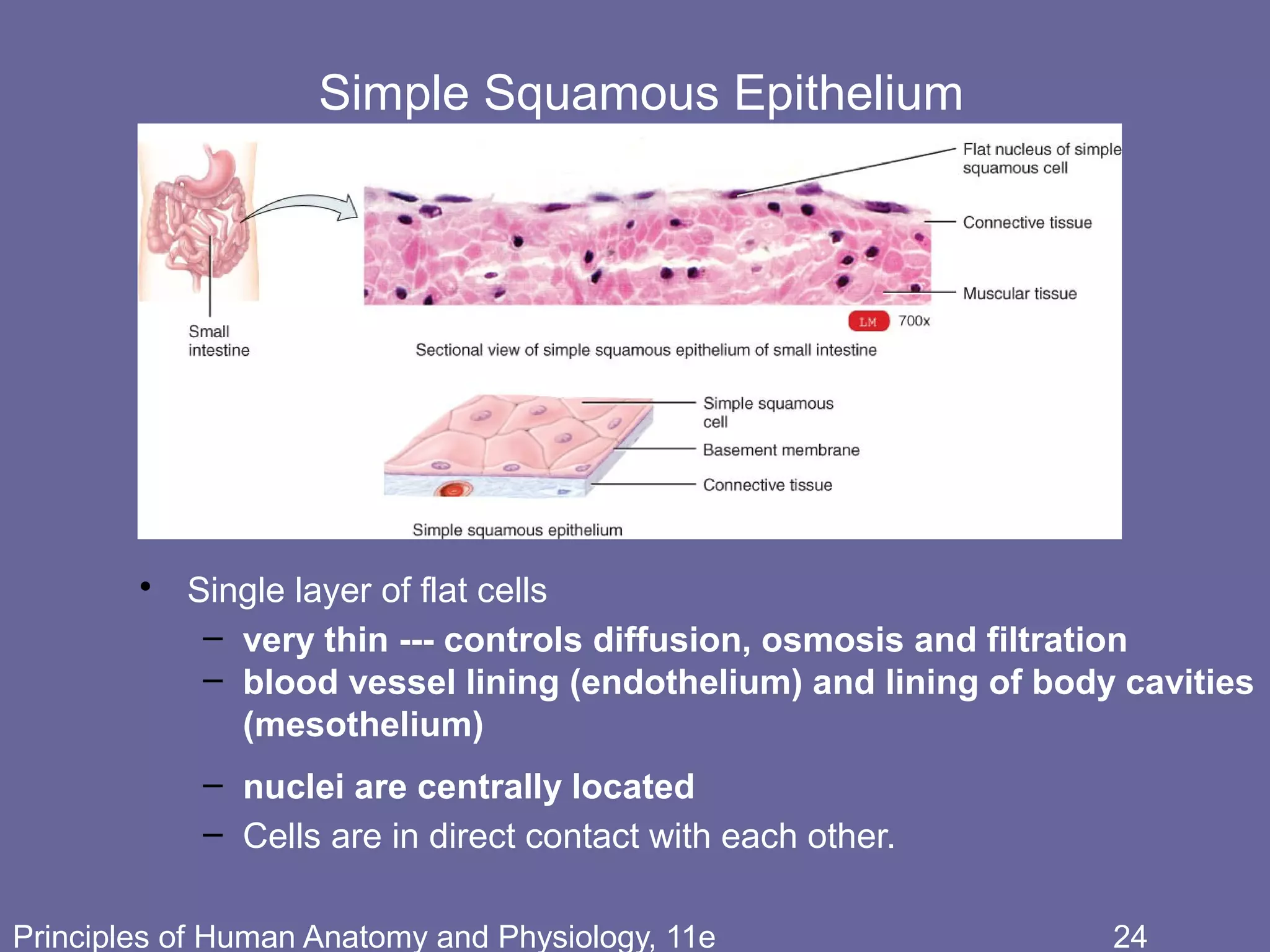
Simple Squamous Epithelium
• Single layer of flat cells
– very thin --- controls diffusion, osmosis and filtration
– blood vessel lining (endothelium) and lining of body cavities
(mesothelium)
– nuclei are centrally located
– Cells are in direct contact with each other.
Examples of Simple Squamous
• Section of intestinal showing
serosa
• Surface view of lining of
peritoneal cavity
Principles of Human Anatomy and Physiology, 11e 26
Simple Cuboidal Epithelium
• Single layer of cube-shaped cells viewed from the side
– nuclei are round and centrally located
– lines tubes of kidney
– adapted for absorption or secretion
Principles of Human Anatomy and Physiology, 11e 27
Example of Simple Cuboidal
• X-Sectional view of kidney tubules
Principles of Human Anatomy and Physiology, 11e 28
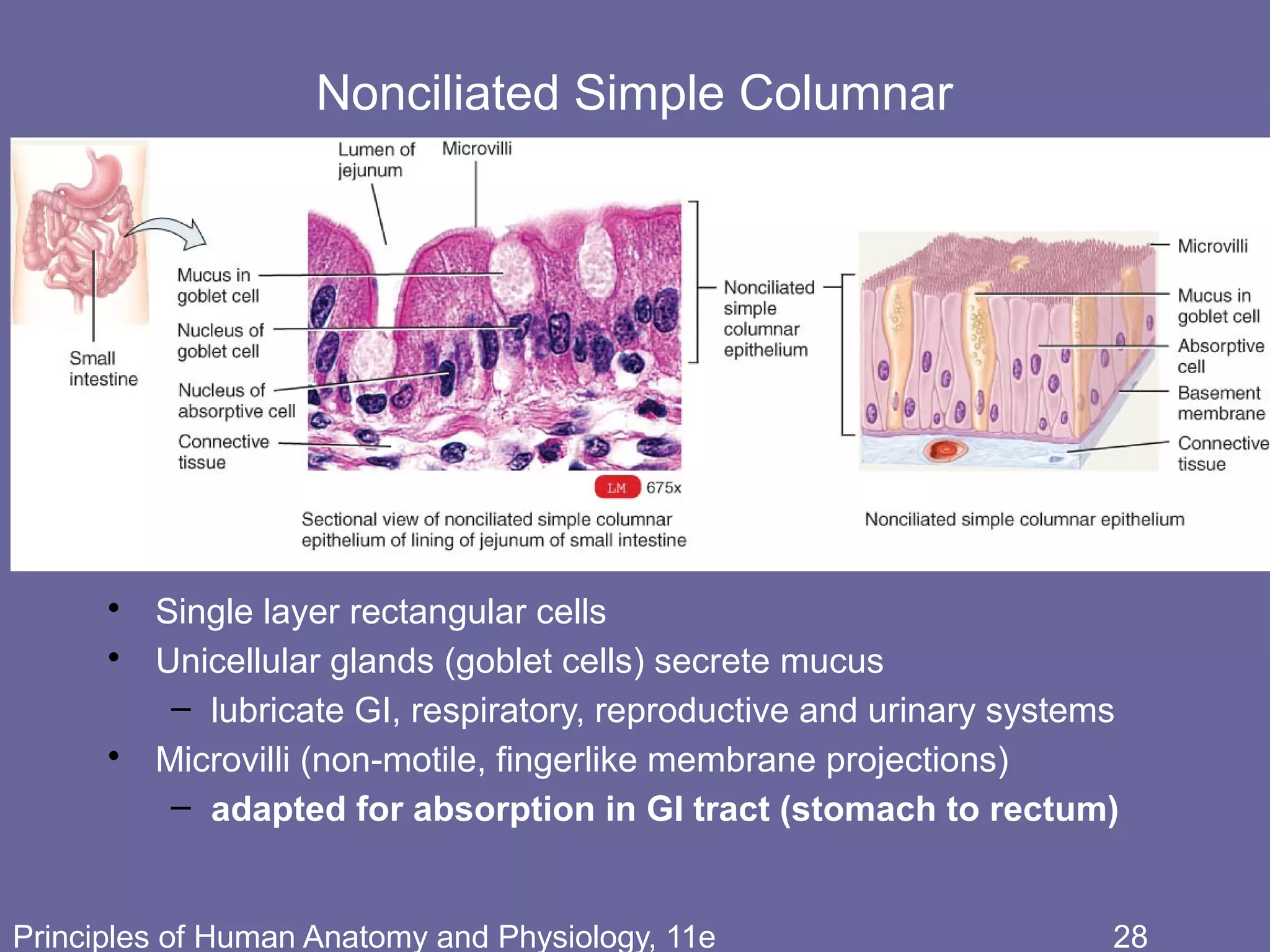
Nonciliated Simple Columnar
• Single layer rectangular cells
• Unicellular glands (goblet cells) secrete mucus
– lubricate GI, respiratory, reproductive and urinary systems
• Microvilli (non-motile, fingerlike membrane projections)
– adapted for absorption in GI tract (stomach to rectum)
Principles of Human Anatomy and Physiology, 11e 29
Ex. Nonciliated Simple Columnar
• Section from small intestine
Principles of Human Anatomy and Physiology, 11e 30
Ciliated Simple Columnar Epithelium
• Single layer rectangular cells with cilia
• Unicellular glands (goblet cells) secrete mucus
• Cilia (motile membrane extensions) move mucous
– found in respiratory system and in uterine tubes
Principles of Human Anatomy and Physiology, 11e 31
Ex. Ciliated Simple Columnar
• Section of uterine tube
Pseudostratified Epithelium
• Pseudostratified epithelium (Table 4.1E) appears to have
several layers because the nuclei are at various levels.
• All cells are attached to the basement membrane but some
do not reach the apical surface.
• In pseudostratified ciliated columnar epithelium, the cells
that reach the surface either secrete mucus (goblet cells) or
bear cilia that sweep away mucus and trapped foreign
particles.
• Pseudostratified nonciliated columnar epithelium contains
no cilia or goblet cells.
Principles of Human Anatomy and Physiology, 11e 33
• Single cell layer of cells of variable height
– Nuclei are located at varying depths (appear layered.)
– Found in respiratory system, male urethra & epididymis
Pseudostratified Ciliated Columnar Epithelium
Stratified Epithelium
• Epithelia have at least two layers of cells.
– more durable and protective
– name depends on the shape of the surface (apical) cells
• Stratified squamous epithelium consists of several layers of
– top layer of cells is flat
– deeper layers of cells vary cuboidal to columnar (Table
4.1F).
– basal cells replicate by mitosis
• Keratinized stratified squamous epithelium
– a tough layer of keratin (a protein resistant to friction and
repels bacteria) is deposited in the surface cells.
• Nonkeratinized epithelium remains moist.
Stratified Epithelium
• Stratified cuboidal epithelium (Table 4.1G)
– rare tissue consisting of two or more layers of cube-shaped
cells whose function is mainly protective.
• Stratified columnar epithelium (Table 4.1H) consists of layers of
cells
– top layer is columnar
– somewhat rare
– adapted for protection and secretion
• Transitional epithelium (Table 4.1I) consists of several layers of
variable shape.
– capable of stretching / permits distention of an organ
– lines the urinary bladder
– lines portions of the ureters and the urethra.
Principles of Human Anatomy and Physiology, 11e 36
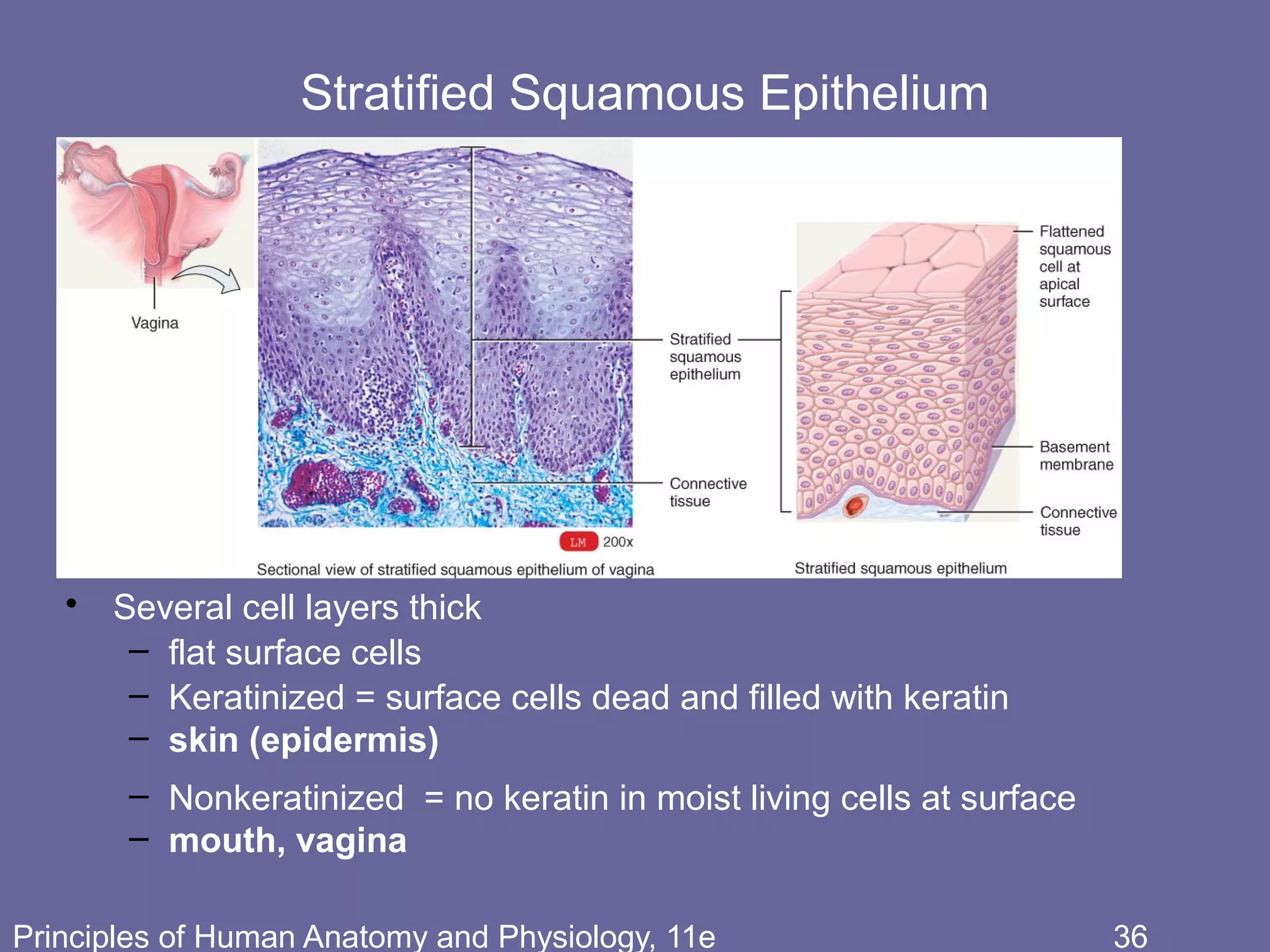
Stratified Squamous Epithelium
• Several cell layers thick
– flat surface cells
– Keratinized = surface cells dead and filled with keratin
– skin (epidermis)
– Nonkeratinized = no keratin in moist living cells at surface
– mouth, vagina
Papanicolaou Smear (Pap smear)
• Collect sloughed off cells of uterus and vaginal walls
• Detect cellular changes (precancerous cells)
• Recommended annually for women over 18 or if
sexually active
Principles of Human Anatomy and Physiology, 11e 38
Stratified Cuboidal Epithelium
• Multilayered
• Surface cells cuboidal
– rare
– sweat gland ducts
– male urethra
Principles of Human Anatomy and Physiology, 11e 39
Stratified Columnar Epithelium
• Multilayered
– columnar surface cells
– rare
– very large ducts
– part of male urethra
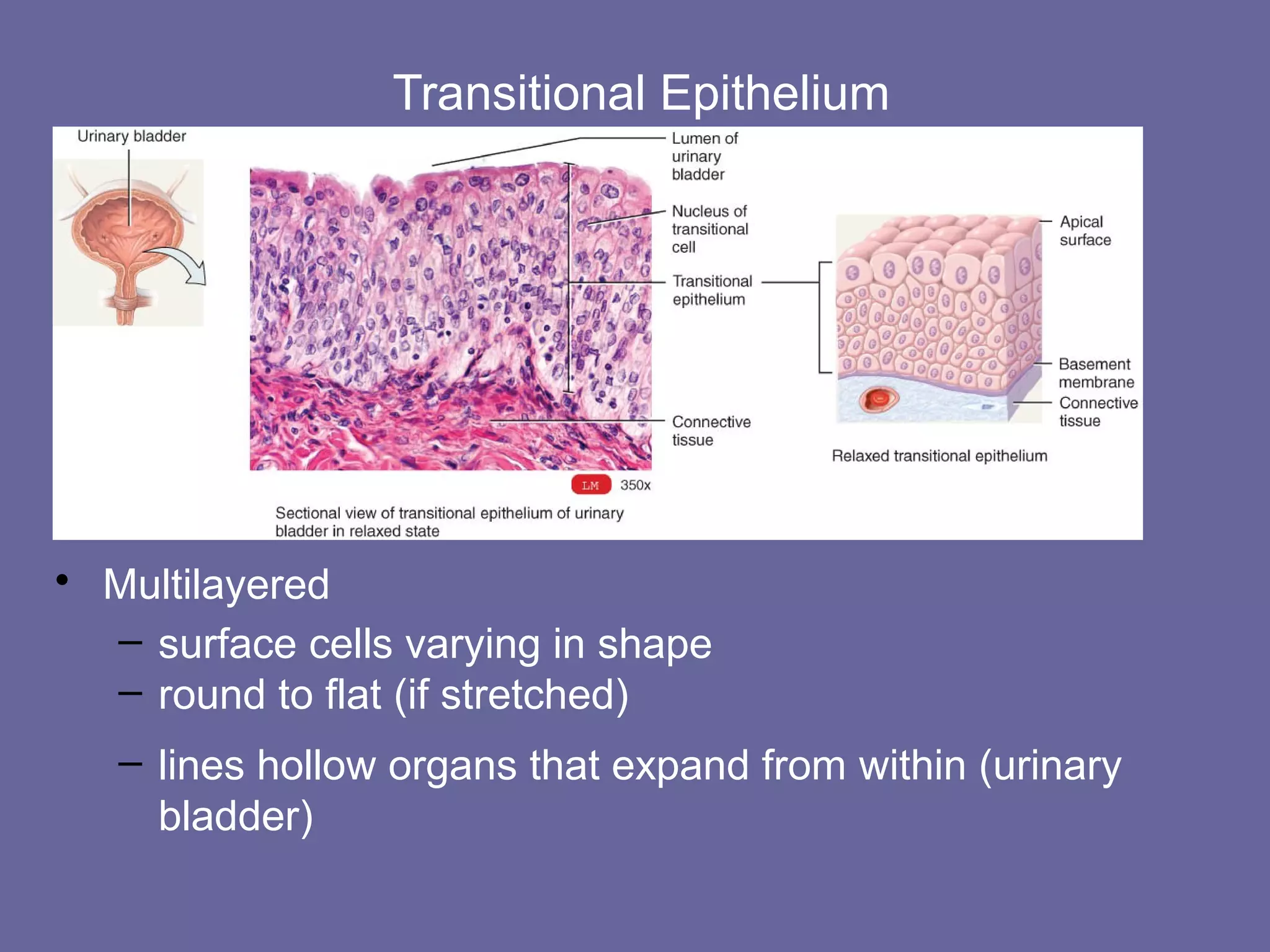
• Multilayered
– surface cells varying in shape
– round to flat (if stretched)
– lines hollow organs that expand from within (urinary
bladder)
Transitional Epithelium
Glandular Epithelium
• gland:
– a single cell or a mass of epithelial cells adapted for
secretion
– derived from epithelial cells that sank below the surface
during development
• Endocrine glands are ductless (Table 4.2A).
• Exocrine glands secrete their products into ducts that empty
at the surface of covering and lining epithelium or directly
onto a free surface (Table 4.2B).
Glandular Epithelium
• Exocrine glands
– cells that secrete---sweat, ear wax, saliva, digestive
enzymes onto free surface of epithelial layer
– connected to the surface by tubes (ducts)
– unicellular glands or multicellular glands
• Endocrine glands
– secrete hormones into the bloodstream
– hormones help maintain homeostasis
Simple Cuboidal Epithelium
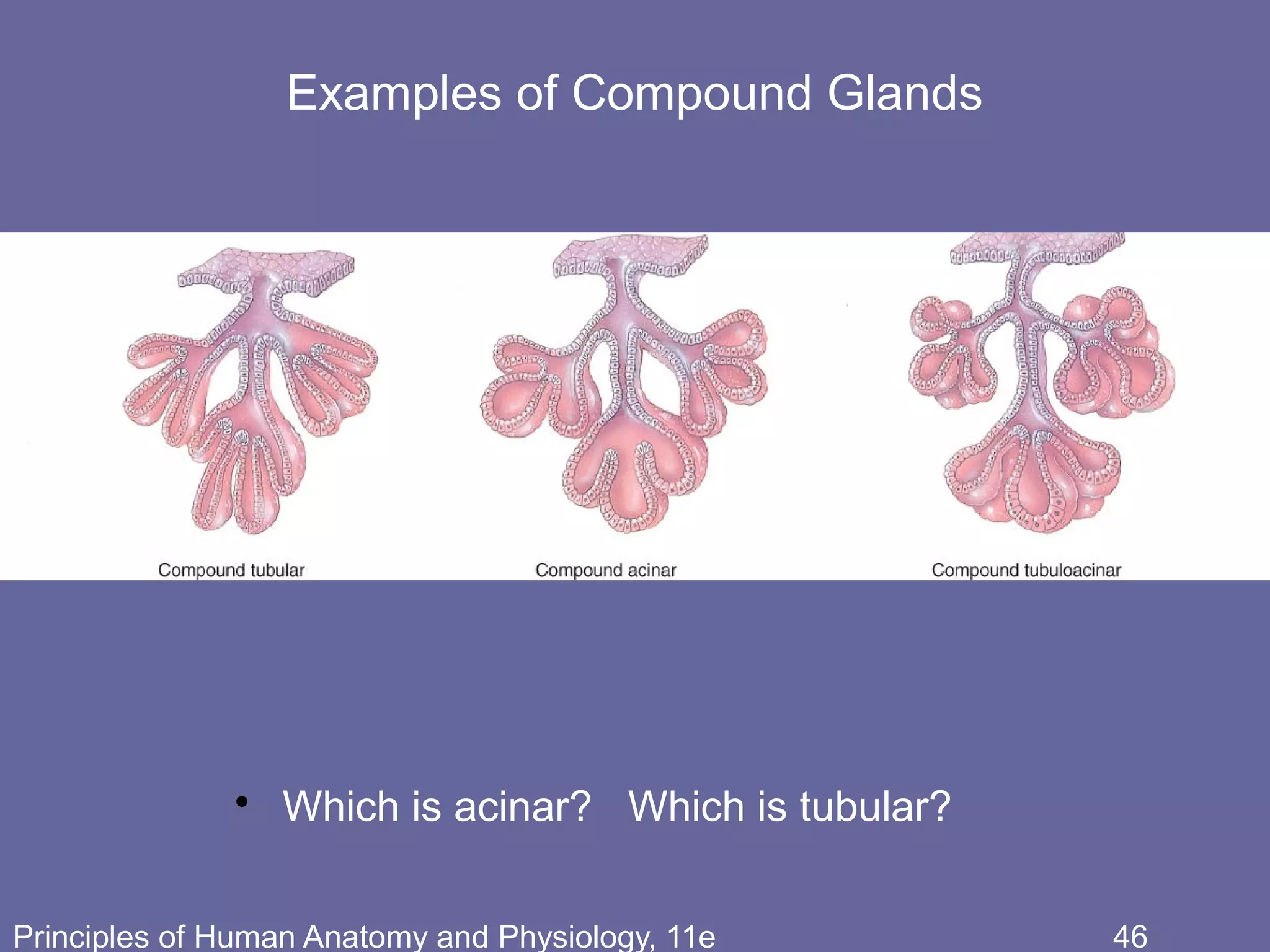
Structural Classification of Exocrine Glands
• Unicellular (single-celled) glands
– goblet cells
• Multicellular glands
– branched (compound) or unbranched (simple)
– tubular or acinar (flask-like) shape
Principles of Human Anatomy and Physiology, 11e 45
Examples of Simple Glands
• Unbranched ducts = simple glands
• Duct areas are blue
Principles of Human Anatomy and Physiology, 11e 46
Examples of Compound Glands
• Which is acinar? Which is tubular?
Principles of Human Anatomy and Physiology, 11e 47
Duct of Multicellular Glands
• Sweat gland duct
• Stratified cuboidal epithelium
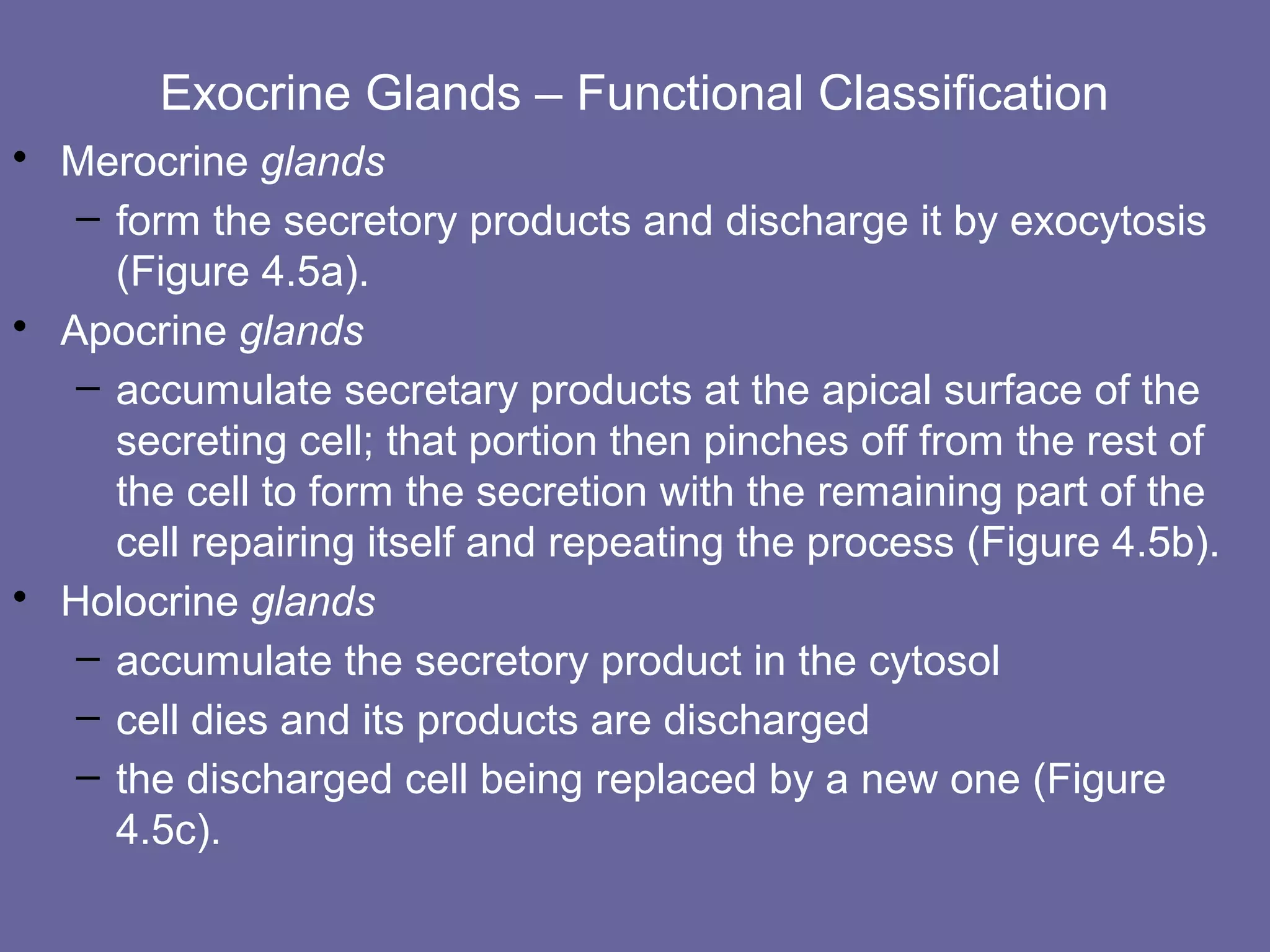
Exocrine Glands – Functional Classification
• Merocrine glands
– form the secretory products and discharge it by exocytosis
(Figure 4.5a).
• Apocrine glands
– accumulate secretary products at the apical surface of the
secreting cell; that portion then pinches off from the rest of
the cell to form the secretion with the remaining part of the
cell repairing itself and repeating the process (Figure 4.5b).
• Holocrine glands
– accumulate the secretory product in the cytosol
– cell dies and its products are discharged
– the discharged cell being replaced by a new one (Figure
4.5c).
Principles of Human Anatomy and Physiology, 11e 49
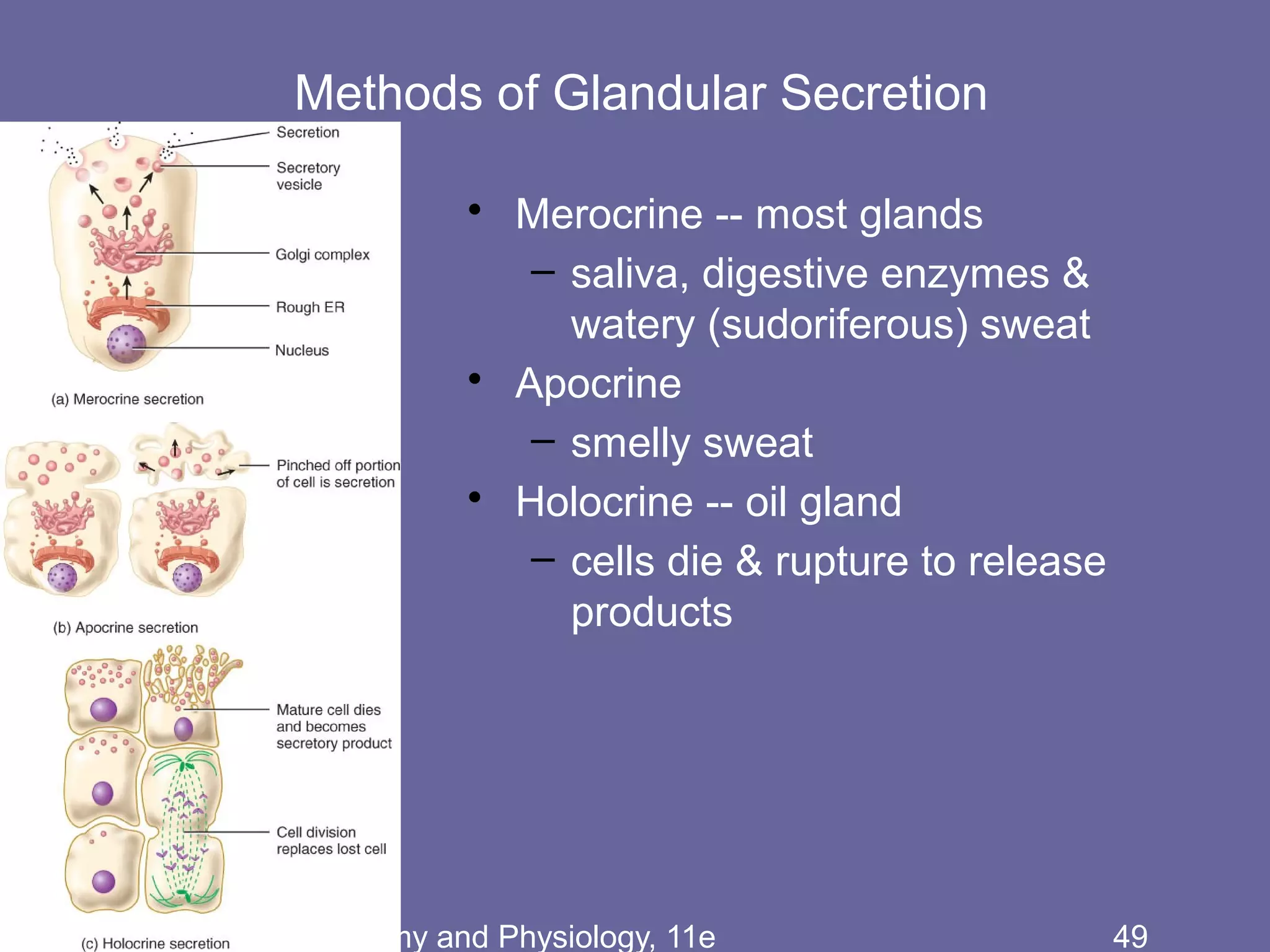
• Merocrine -- most glands
– saliva, digestive enzymes &
watery (sudoriferous) sweat
• Apocrine
– smelly sweat
• Holocrine -- oil gland
– cells die & rupture to release
products
Methods of Glandular Secretion

04 [chapter 4 the tissue level of organization][11e]

  • 1.
    Principles of HumanAnatomy and Physiology, 11e 1 Chapter 4 The Tissue Level of Organization Lecture Outline
  • 2.
    INTRODUCTION • A tissueis a group of similar cells that usually have a similar embryological origin and are specialized for a particular function. • The nature of the extracellular material that surrounds the connections between the cells that compose the tissue influence the structure and properties of a specific tissue. • Pathologists, physicians who specialize in laboratory studies of cells and tissues, aid other physicians in making diagnoses; they also perform autopsies.
  • 3.
    Principles of HumanAnatomy and Physiology, 11e 3 Chapter 4 The Tissue Level of Organization • Histology – the study of tissues
  • 4.
    TYPES OF TISSUESAND THEIR ORIGINS Four principal types based on function and structure • Epithelial tissue – covers body surfaces, lines hollow organs, body cavities, and ducts; and forms glands. • Connective tissue – protects and supports the body and its organs, binds organs together, stores energy reserves as fat, and provides immunity. • Muscle tissue – is responsible for movement and generation of force. • Nervous tissue – initiates and transmits action potentials (nerve impulses) that help coordinate body activities.
  • 5.
    Origin of Tissues •Primary germ layers within the embryo – endoderm – mesoderm – Ectoderm • Tissue derivations – epithelium from all 3 germ layers – connective tissue & muscle from mesoderm – nerve tissue from ectoderm – Table 29.1 provides a list of structures derived from the primary germ layers.
  • 6.
    DEVELOPMENT • Normally, mostcells within a tissue remain in place, anchored to – other cells – a basement membranes – connective tissues • Exceptions include phagocytes and embryonic cells involved in differentiation and growth.
  • 7.
    Biopsy • Removal ofliving tissue for microscopic examination – surgery – needle biopsy • Useful for diagnosis, especially cancer • Tissue preserved, sectioned and stained before microscopic viewing
  • 8.
    CELL JUNCTIONS • Celljunctions are points of contact between adjacent plasma membranes. • Depending on their structure, cell junctions may serve one of three functions. – Some cell junctions form fluid-tight seals between cells. – Other cell junctions anchor cells together or to extracellular material. – Still others act as channels, which allow ions and molecules to pass from cell to cell within a tissue.
  • 9.
    CELL JUNCTIONS • Thefive most important kinds of cell junctions are tight junctions, adherens junctions, desmosomes, hemidesmosomes, and gap junctions (Figure 4.1)
  • 10.
    Principles of HumanAnatomy and Physiology, 11e 10 Cell Junctions • Tight junctions • Adherens junctions • Gap junctions • Desmosomes • Hemidesmosomes
  • 11.
    Principles of HumanAnatomy and Physiology, 11e 11 Tight Junctions • Watertight seal between cells • Plasma membranes fused with a strip of proteins • Common between cells that line GI and bladder
  • 12.
    Principles of HumanAnatomy and Physiology, 11e 12 Adherens Junctions • Holds epithelial cells together • Structural components – plaque = dense layer of proteins inside the cell membrane – microfilaments extend into cytoplasm – integral membrane proteins connect to membrane of other cell
  • 13.
    Principles of HumanAnatomy and Physiology, 11e 13 Gap Junctions • Tiny space between plasma membranes of 2 cells • Crossed by protein channels called connexons forming fluid filled tunnels • Cell communication with ions & small molecules • Muscle and nerve impulses spread from cell to cell – heart and smooth muscle of gut
  • 14.
    Principles of HumanAnatomy and Physiology, 11e 14 Desmosomes • Resists cellular separation and cell disruption • Similar structure to adherens junction except intracellular intermediate filaments cross cytoplasm of cell • Cellular support of cardiac muscle
  • 15.
    Principles of HumanAnatomy and Physiology, 11e 15 Hemidesmosomes • Half a desmosome • Connect cells to extracellular material – basement membrane
  • 16.
  • 17.
    Epithelial Tissue --General Features • Closely packed cells with little extracellular material – Many cell junctions often provide secure attachment. • Cells sit on basement membrane – Apical (upper) free surface – Basal surface against basement membrane • Avascular---without blood vessels – nutrients and wast must move by diffusion • Good nerve supply • Rapid cell division (high mitotic rate) • Functions – protection, filtration, lubrication, secretion, digestion, absorption, transportation, excretion, sensory reception, and reproduction.
  • 18.
    Principles of HumanAnatomy and Physiology, 11e 18 Basement Membrane • Basal lamina – from epithelial cells – collagen fibers • Reticular lamina – secreted by connective tissue cells – reticular fibers • Functions: – guide for cell migration during development – may become thickened due to increased collagen and laminin production • Example: In diabetes mellitus, the basement membrane of small blood vessels, especially those in the retina and kidney, thickens.
  • 19.
    Types of Epithelium •Covering and lining epithelium – epidermis of skin – lining of blood vessels and ducts – lining respiratory, reproductive, urinary & GI tract • Glandular epithelium – secreting portion of glands – thyroid, adrenal, and sweat glands
  • 20.
    Classification of Epithelium •Classified by arrangement of cells into layers – simple = one cell layer thick – stratified = two or more cell layers thick – pseudostratified = cells contact BM but all cells don’t reach apical surface – nuclei are located at multiple levels so it looks multilayered • Classified by shape of surface cells (Table 4.1) – squamous =flat – cuboidal = cube-shaped – columnar = tall column – transitional = shape varies with tissue stretching
  • 21.
  • 22.
    Simple Epithelium • Simplesquamous epithelium consists of a single layer of flat, scale-like cells (Table 4.1A) – adapted for diffusion and filtration (found in lungs and kidneys) – Endothelium lines the heart and blood vessels. – Mesothelium lines the thoracic and abdominopelvic cavities and covers the organs within them. • Simple cuboidal epithelium consists of a simple layer of cube-shaped cells – adapted for secretion and absorption (Table 4.1B).
  • 23.
    Simple Epithelium • Simplecolumnar epithelium consists of a single layer of rectangular cells and can exist in two forms – Ciliated simple columnar epithelium contains cells with hair-like processes called cilia (Table 4.1D) – provides motility and helps to move fluids or particles along a surface – Nonciliated simple columnar epithelium contains microvilli (Figure 3.2) (Table 4.1C) – increase surface area and the rate of absorption – goblet cells (unicellular glands) that secrete mucus are generally found with both types of simple columnar epithelium
  • 24.
    Principles of HumanAnatomy and Physiology, 11e 24 Simple Squamous Epithelium • Single layer of flat cells – very thin --- controls diffusion, osmosis and filtration – blood vessel lining (endothelium) and lining of body cavities (mesothelium) – nuclei are centrally located – Cells are in direct contact with each other.
  • 25.
    Examples of SimpleSquamous • Section of intestinal showing serosa • Surface view of lining of peritoneal cavity
  • 26.
    Principles of HumanAnatomy and Physiology, 11e 26 Simple Cuboidal Epithelium • Single layer of cube-shaped cells viewed from the side – nuclei are round and centrally located – lines tubes of kidney – adapted for absorption or secretion
  • 27.
    Principles of HumanAnatomy and Physiology, 11e 27 Example of Simple Cuboidal • X-Sectional view of kidney tubules
  • 28.
    Principles of HumanAnatomy and Physiology, 11e 28 Nonciliated Simple Columnar • Single layer rectangular cells • Unicellular glands (goblet cells) secrete mucus – lubricate GI, respiratory, reproductive and urinary systems • Microvilli (non-motile, fingerlike membrane projections) – adapted for absorption in GI tract (stomach to rectum)
  • 29.
    Principles of HumanAnatomy and Physiology, 11e 29 Ex. Nonciliated Simple Columnar • Section from small intestine
  • 30.
    Principles of HumanAnatomy and Physiology, 11e 30 Ciliated Simple Columnar Epithelium • Single layer rectangular cells with cilia • Unicellular glands (goblet cells) secrete mucus • Cilia (motile membrane extensions) move mucous – found in respiratory system and in uterine tubes
  • 31.
    Principles of HumanAnatomy and Physiology, 11e 31 Ex. Ciliated Simple Columnar • Section of uterine tube
  • 32.
    Pseudostratified Epithelium • Pseudostratifiedepithelium (Table 4.1E) appears to have several layers because the nuclei are at various levels. • All cells are attached to the basement membrane but some do not reach the apical surface. • In pseudostratified ciliated columnar epithelium, the cells that reach the surface either secrete mucus (goblet cells) or bear cilia that sweep away mucus and trapped foreign particles. • Pseudostratified nonciliated columnar epithelium contains no cilia or goblet cells.
  • 33.
    Principles of HumanAnatomy and Physiology, 11e 33 • Single cell layer of cells of variable height – Nuclei are located at varying depths (appear layered.) – Found in respiratory system, male urethra & epididymis Pseudostratified Ciliated Columnar Epithelium
  • 34.
    Stratified Epithelium • Epitheliahave at least two layers of cells. – more durable and protective – name depends on the shape of the surface (apical) cells • Stratified squamous epithelium consists of several layers of – top layer of cells is flat – deeper layers of cells vary cuboidal to columnar (Table 4.1F). – basal cells replicate by mitosis • Keratinized stratified squamous epithelium – a tough layer of keratin (a protein resistant to friction and repels bacteria) is deposited in the surface cells. • Nonkeratinized epithelium remains moist.
  • 35.
    Stratified Epithelium • Stratifiedcuboidal epithelium (Table 4.1G) – rare tissue consisting of two or more layers of cube-shaped cells whose function is mainly protective. • Stratified columnar epithelium (Table 4.1H) consists of layers of cells – top layer is columnar – somewhat rare – adapted for protection and secretion • Transitional epithelium (Table 4.1I) consists of several layers of variable shape. – capable of stretching / permits distention of an organ – lines the urinary bladder – lines portions of the ureters and the urethra.
  • 36.
    Principles of HumanAnatomy and Physiology, 11e 36 Stratified Squamous Epithelium • Several cell layers thick – flat surface cells – Keratinized = surface cells dead and filled with keratin – skin (epidermis) – Nonkeratinized = no keratin in moist living cells at surface – mouth, vagina
  • 37.
    Papanicolaou Smear (Papsmear) • Collect sloughed off cells of uterus and vaginal walls • Detect cellular changes (precancerous cells) • Recommended annually for women over 18 or if sexually active
  • 38.
    Principles of HumanAnatomy and Physiology, 11e 38 Stratified Cuboidal Epithelium • Multilayered • Surface cells cuboidal – rare – sweat gland ducts – male urethra
  • 39.
    Principles of HumanAnatomy and Physiology, 11e 39 Stratified Columnar Epithelium • Multilayered – columnar surface cells – rare – very large ducts – part of male urethra
  • 40.
    • Multilayered – surfacecells varying in shape – round to flat (if stretched) – lines hollow organs that expand from within (urinary bladder) Transitional Epithelium
  • 41.
    Glandular Epithelium • gland: –a single cell or a mass of epithelial cells adapted for secretion – derived from epithelial cells that sank below the surface during development • Endocrine glands are ductless (Table 4.2A). • Exocrine glands secrete their products into ducts that empty at the surface of covering and lining epithelium or directly onto a free surface (Table 4.2B).
  • 42.
    Glandular Epithelium • Exocrineglands – cells that secrete---sweat, ear wax, saliva, digestive enzymes onto free surface of epithelial layer – connected to the surface by tubes (ducts) – unicellular glands or multicellular glands • Endocrine glands – secrete hormones into the bloodstream – hormones help maintain homeostasis
  • 43.
  • 44.
    Structural Classification ofExocrine Glands • Unicellular (single-celled) glands – goblet cells • Multicellular glands – branched (compound) or unbranched (simple) – tubular or acinar (flask-like) shape
  • 45.
    Principles of HumanAnatomy and Physiology, 11e 45 Examples of Simple Glands • Unbranched ducts = simple glands • Duct areas are blue
  • 46.
    Principles of HumanAnatomy and Physiology, 11e 46 Examples of Compound Glands • Which is acinar? Which is tubular?
  • 47.
    Principles of HumanAnatomy and Physiology, 11e 47 Duct of Multicellular Glands • Sweat gland duct • Stratified cuboidal epithelium
  • 48.
    Exocrine Glands –Functional Classification • Merocrine glands – form the secretory products and discharge it by exocytosis (Figure 4.5a). • Apocrine glands – accumulate secretary products at the apical surface of the secreting cell; that portion then pinches off from the rest of the cell to form the secretion with the remaining part of the cell repairing itself and repeating the process (Figure 4.5b). • Holocrine glands – accumulate the secretory product in the cytosol – cell dies and its products are discharged – the discharged cell being replaced by a new one (Figure 4.5c).
  • 49.
    Principles of HumanAnatomy and Physiology, 11e 49 • Merocrine -- most glands – saliva, digestive enzymes & watery (sudoriferous) sweat • Apocrine – smelly sweat • Holocrine -- oil gland – cells die & rupture to release products Methods of Glandular Secretion