Copyright © 2014 John Wiley & Sons, Inc. All rights reserved.
CHAPTER 20
The Cardiovascular System: The Heart
Principles of
Anatomy and
Physiology
14th Edition
The purpose of the chapter is to:
1. Learn about the components of the
cardiovascular system
2. Focus on the anatomy and physiology of the
heart
3. Learn about the cardiac cycle
4. Discuss the various factors that influence heart
rate and force of contraction
Introduction
Copyright © 2014 John Wiley & Sons, Inc. All rights reserved.
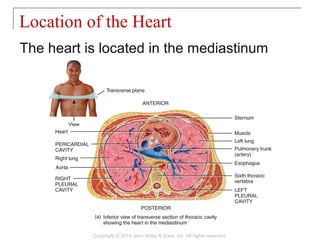
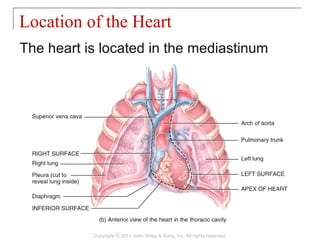
The heart is located in the mediastinum
Location of the Heart
Copyright © 2014 John Wiley & Sons, Inc. All rights reserved.
The heart is located in the mediastinum
Location of the Heart
Copyright © 2014 John Wiley & Sons, Inc. All rights reserved.
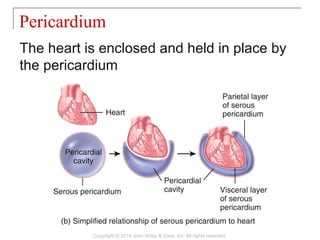
The heart is enclosed and held in place by
the pericardium
Pericardium
Copyright © 2014 John Wiley & Sons, Inc. All rights reserved.
 The pericardium consists of an outer
fibrous pericardium and an inner serous
pericardium
 The serous pericardium has 2 layers:
1. Visceral
2. Parietal
 The visceral and parietal layers are
separated by the serous cavity, a fluid-
filled space
Pericardium
Copyright © 2014 John Wiley & Sons, Inc. All rights reserved.
Anatomy Overview:
Cardiac Muscle
Copyright © 2014 John Wiley & Sons, Inc. All rights reserved.
 Cardiac Muscle
You must be connected to the Internet and in Slideshow Mode to
run this animation.
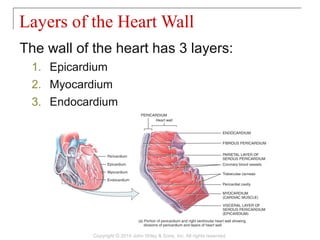
The wall of the heart has 3 layers:
1. Epicardium
2. Myocardium
3. Endocardium
Layers of the Heart Wall
Copyright © 2014 John Wiley & Sons, Inc. All rights reserved.
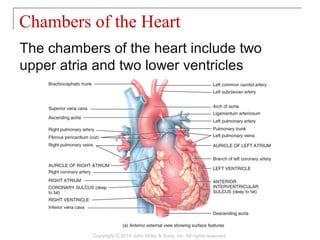
The chambers of the heart include two
upper atria and two lower ventricles
Chambers of the Heart
Copyright © 2014 John Wiley & Sons, Inc. All rights reserved.
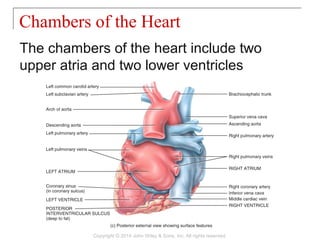
The chambers of the heart include two
upper atria and two lower ventricles
Chambers of the Heart
Copyright © 2014 John Wiley & Sons, Inc. All rights reserved.
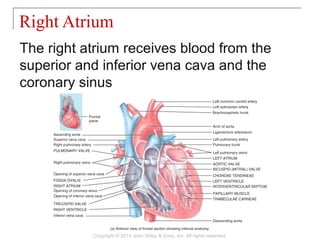
The right atrium receives blood from the
superior and inferior vena cava and the
coronary sinus
Right Atrium
Copyright © 2014 John Wiley & Sons, Inc. All rights reserved.
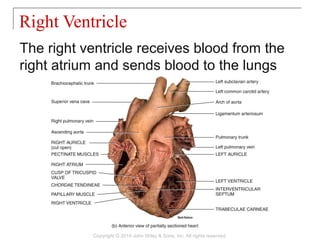
The right ventricle receives blood from the
right atrium and sends blood to the lungs
Right Ventricle
Copyright © 2014 John Wiley & Sons, Inc. All rights reserved.
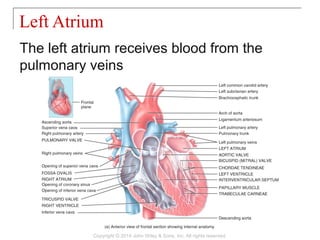
The left atrium receives blood from the
pulmonary veins
Left Atrium
Copyright © 2014 John Wiley & Sons, Inc. All rights reserved.
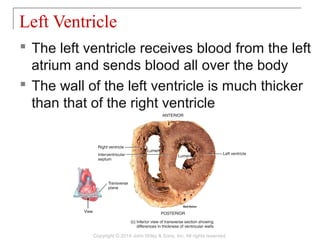
 The left ventricle receives blood from the left
atrium and sends blood all over the body
 The wall of the left ventricle is much thicker
than that of the right ventricle
Left Ventricle
Copyright © 2014 John Wiley & Sons, Inc. All rights reserved.
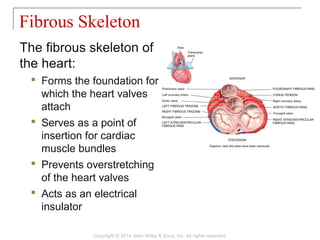
The fibrous skeleton of
the heart:
 Forms the foundation for
which the heart valves
attach
 Serves as a point of
insertion for cardiac
muscle bundles
 Prevents overstretching
of the heart valves
 Acts as an electrical
insulator
Fibrous Skeleton
Copyright © 2014 John Wiley & Sons, Inc. All rights reserved.
The valves of the heart open and close in
response to pressure changes as the heart
contracts and relaxes
 Right and left atrioventricular valves
 Prevent back flow from the ventricles into the atria
 Right and left semilunar valves
 Prevent back flow from the arteries into the ventricles
Heart Valves and Circulation of Blood
Copyright © 2014 John Wiley & Sons, Inc. All rights reserved.
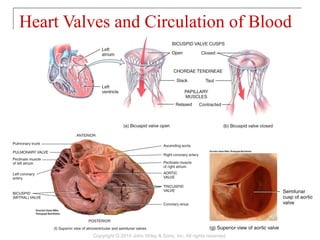
Heart Valves and Circulation of Blood
Copyright © 2014 John Wiley & Sons, Inc. All rights reserved.
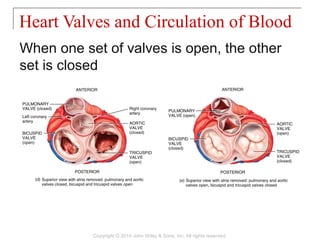
When one set of valves is open, the other
set is closed
Heart Valves and Circulation of Blood
Copyright © 2014 John Wiley & Sons, Inc. All rights reserved.
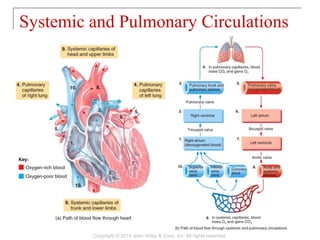
Systemic and Pulmonary Circulations
Copyright © 2014 John Wiley & Sons, Inc. All rights reserved.
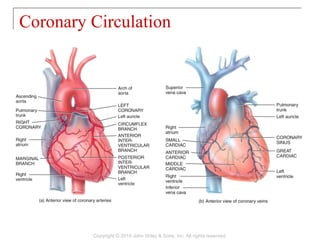
Coronary Circulation
Copyright © 2014 John Wiley & Sons, Inc. All rights reserved.
 The Cardiovascular System
Anatomy Overview:
You must be connected to the Internet and in Slideshow Mode to
run this animation.
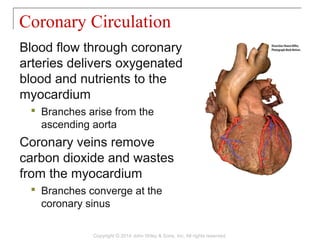
Blood flow through coronary
arteries delivers oxygenated
blood and nutrients to the
myocardium
 Branches arise from the
ascending aorta
Coronary veins remove
carbon dioxide and wastes
from the myocardium
 Branches converge at the
coronary sinus
Coronary Circulation
Copyright © 2014 John Wiley & Sons, Inc. All rights reserved.
Coronary Circulation
Copyright © 2014 John Wiley & Sons, Inc. All rights reserved.
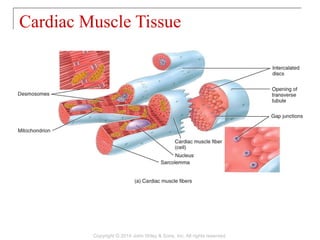
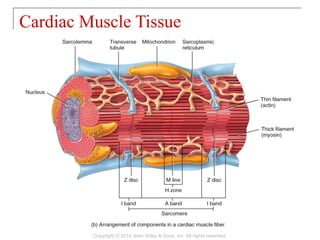
Cardiac Muscle Tissue
Copyright © 2014 John Wiley & Sons, Inc. All rights reserved.
Cardiac Muscle Tissue
Copyright © 2014 John Wiley & Sons, Inc. All rights reserved.
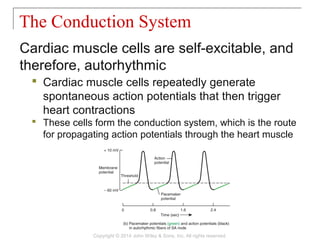
Cardiac muscle cells are self-excitable, and
therefore, autorhythmic
 Cardiac muscle cells repeatedly generate
spontaneous action potentials that then trigger
heart contractions
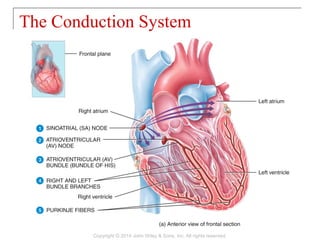
 These cells form the conduction system, which is the route
for propagating action potentials through the heart muscle
The Conduction System
Copyright © 2014 John Wiley & Sons, Inc. All rights reserved.
The Conduction System
Copyright © 2014 John Wiley & Sons, Inc. All rights reserved.
The Conduction System
Copyright © 2014 John Wiley & Sons, Inc. All rights reserved.
 Cardiac Conduction
Interactions Animation:
You must be connected to the Internet and in Slideshow Mode to
run this animation.
 The autorhythmic fibers in the SA node
are the natural pacemaker of the heart
because they initiate action potentials
most often
 Signals from the nervous system and
hormones (like epinephrine) can modify
the heart rate and force of contraction but
they do not set the fundamental rhythm
Influences on the Conduction System
Copyright © 2014 John Wiley & Sons, Inc. All rights reserved.
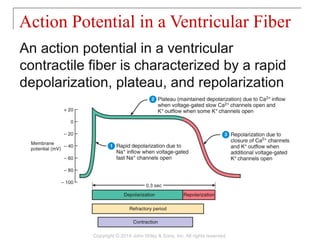
An action potential in a ventricular
contractile fiber is characterized by a rapid
depolarization, plateau, and repolarization
Action Potential in a Ventricular Fiber
Copyright © 2014 John Wiley & Sons, Inc. All rights reserved.
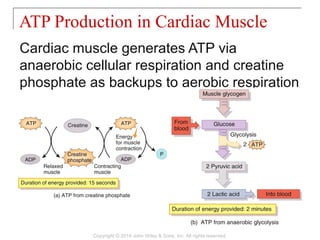
Cardiac muscle generates ATP via
anaerobic cellular respiration and creatine
phosphate as backups to aerobic respiration
ATP Production in Cardiac Muscle
Copyright © 2014 John Wiley & Sons, Inc. All rights reserved.
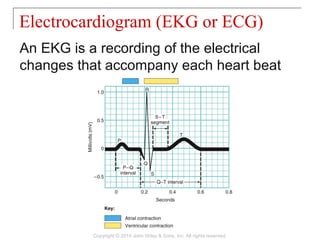
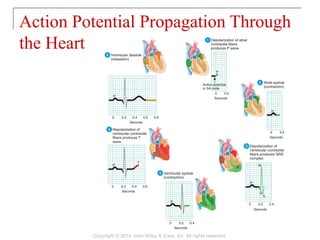
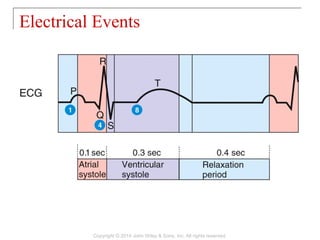
An EKG is a recording of the electrical
changes that accompany each heart beat
Electrocardiogram (EKG or ECG)
Copyright © 2014 John Wiley & Sons, Inc. All rights reserved.
Action Potential Propagation Through
the Heart
Copyright © 2014 John Wiley & Sons, Inc. All rights reserved.
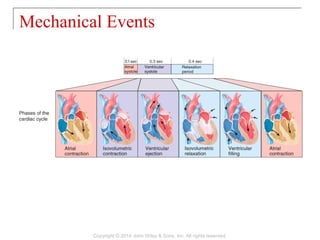
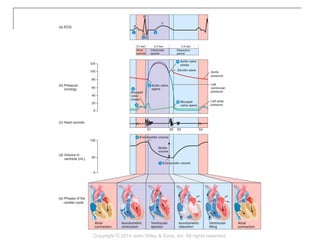
One cardiac cycle consists of the
contraction (systole) and relaxation
(diastole) of both atria, rapidly followed by
the systole and diastole of both ventricles
 Electrical events
 Pressure changes
 Heart sounds
 Volume changes
 Mechanical events
The Cardiac Cycle
Copyright © 2014 John Wiley & Sons, Inc. All rights reserved.
The Cardiac Cycle
Copyright © 2014 John Wiley & Sons, Inc. All rights reserved.
 Cardiac Cycle
Interactions Animation:
You must be connected to the Internet and in Slideshow Mode to
run this animation.
Electrical Events
Copyright © 2014 John Wiley & Sons, Inc. All rights reserved.
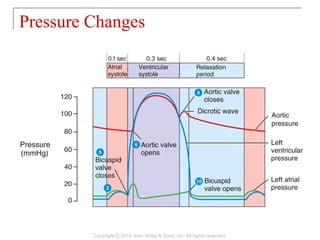
Pressure Changes
Copyright © 2014 John Wiley & Sons, Inc. All rights reserved.
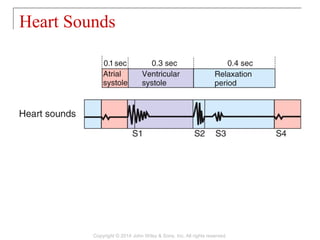
Heart Sounds
Copyright © 2014 John Wiley & Sons, Inc. All rights reserved.
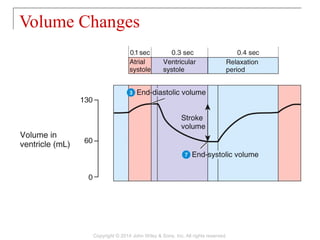
Volume Changes
Copyright © 2014 John Wiley & Sons, Inc. All rights reserved.
Mechanical Events
Copyright © 2014 John Wiley & Sons, Inc. All rights reserved.
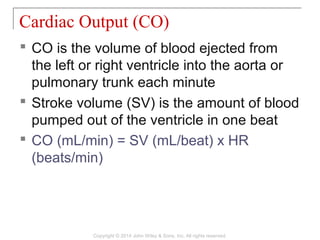
 CO is the volume of blood ejected from
the left or right ventricle into the aorta or
pulmonary trunk each minute
 Stroke volume (SV) is the amount of blood
pumped out of the ventricle in one beat
 CO (mL/min) = SV (mL/beat) x HR
(beats/min)
Cardiac Output (CO)
Copyright © 2014 John Wiley & Sons, Inc. All rights reserved.
Cardiac Output and the Factors That
Influence It
Copyright © 2014 John Wiley & Sons, Inc. All rights reserved.
 Cardiac Output
Interactions Animation:
You must be connected to the Internet and in Slideshow Mode to
run this animation.
3 factors regulate stroke volume:
1. Preload
2. Contractility
3. Afterload
Regulation of Stroke Volume
Copyright © 2014 John Wiley & Sons, Inc. All rights reserved.
Several factors regulate heart rate:
 Autonomic nervous system
 Hormones
 Ions
 Age
 Gender
 Physical fitness
 Temperature
Regulation of Heart Rate
Copyright © 2014 John Wiley & Sons, Inc. All rights reserved.
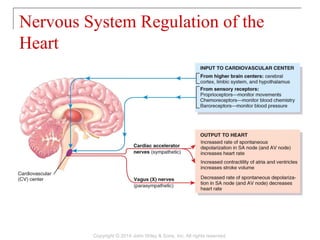
Nervous System Regulation of the
Heart
Copyright © 2014 John Wiley & Sons, Inc. All rights reserved.
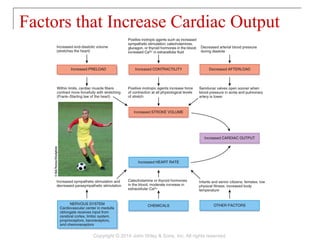
Factors that Increase Cardiac Output
Copyright © 2014 John Wiley & Sons, Inc. All rights reserved.
Regular aerobic exercise can:
 Increase cardiac output
 Increase HDL
 Decrease triglycerides
 Improve lung function
 Decrease blood pressure
 Assist in weight control
Exercise and the Heart
Copyright © 2014 John Wiley & Sons, Inc. All rights reserved.
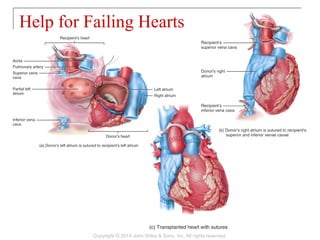
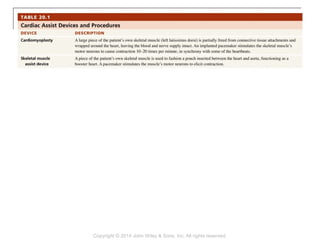
Help for Failing Hearts
Copyright © 2014 John Wiley & Sons, Inc. All rights reserved.
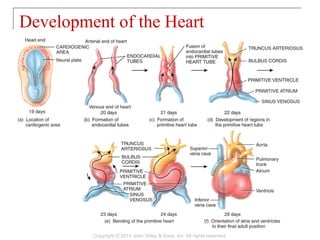
Development of the Heart
Copyright © 2014 John Wiley & Sons, Inc. All rights reserved.
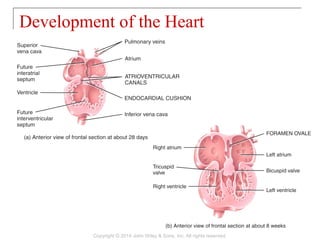
Development of the Heart
Copyright © 2014 John Wiley & Sons, Inc. All rights reserved.
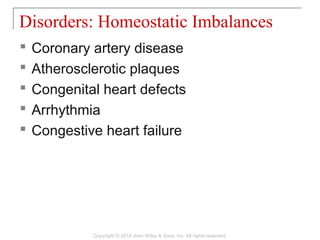
 Coronary artery disease
 Atherosclerotic plaques
 Congenital heart defects
 Arrhythmia
 Congestive heart failure
Disorders: Homeostatic Imbalances
Copyright © 2014 John Wiley & Sons, Inc. All rights reserved.
Copyright 2014 John Wiley & Sons, Inc.
All rights reserved. Reproduction or translation of this work beyond that
permitted in section 117 of the 1976 United States Copyright Act without
express permission of the copyright owner is unlawful. Request for further
information should be addressed to the Permission Department, John Wiley &
Sons, Inc. The purchaser may make back-up copies for his/her own use only
and not for distribution or resale. The Publisher assumes no responsibility for
errors, omissions, or damages caused by the use of these programs or from the
use of the information herein.
End of Chapter 20
Copyright © 2014 John Wiley & Sons, Inc. All rights reserved.

20 [chapter 20 the cardiovascular system the heart]

  • 1.
    Copyright © 2014John Wiley & Sons, Inc. All rights reserved. CHAPTER 20 The Cardiovascular System: The Heart Principles of Anatomy and Physiology 14th Edition
  • 2.
    The purpose ofthe chapter is to: 1. Learn about the components of the cardiovascular system 2. Focus on the anatomy and physiology of the heart 3. Learn about the cardiac cycle 4. Discuss the various factors that influence heart rate and force of contraction Introduction Copyright © 2014 John Wiley & Sons, Inc. All rights reserved.
  • 3.
    The heart islocated in the mediastinum Location of the Heart Copyright © 2014 John Wiley & Sons, Inc. All rights reserved.
  • 4.
    The heart islocated in the mediastinum Location of the Heart Copyright © 2014 John Wiley & Sons, Inc. All rights reserved.
  • 5.
    The heart isenclosed and held in place by the pericardium Pericardium Copyright © 2014 John Wiley & Sons, Inc. All rights reserved.
  • 6.
     The pericardiumconsists of an outer fibrous pericardium and an inner serous pericardium  The serous pericardium has 2 layers: 1. Visceral 2. Parietal  The visceral and parietal layers are separated by the serous cavity, a fluid- filled space Pericardium Copyright © 2014 John Wiley & Sons, Inc. All rights reserved.
  • 7.
    Anatomy Overview: Cardiac Muscle Copyright© 2014 John Wiley & Sons, Inc. All rights reserved.  Cardiac Muscle You must be connected to the Internet and in Slideshow Mode to run this animation.
  • 8.
    The wall ofthe heart has 3 layers: 1. Epicardium 2. Myocardium 3. Endocardium Layers of the Heart Wall Copyright © 2014 John Wiley & Sons, Inc. All rights reserved.
  • 9.
    The chambers ofthe heart include two upper atria and two lower ventricles Chambers of the Heart Copyright © 2014 John Wiley & Sons, Inc. All rights reserved.
  • 10.
    The chambers ofthe heart include two upper atria and two lower ventricles Chambers of the Heart Copyright © 2014 John Wiley & Sons, Inc. All rights reserved.
  • 11.
    The right atriumreceives blood from the superior and inferior vena cava and the coronary sinus Right Atrium Copyright © 2014 John Wiley & Sons, Inc. All rights reserved.
  • 12.
    The right ventriclereceives blood from the right atrium and sends blood to the lungs Right Ventricle Copyright © 2014 John Wiley & Sons, Inc. All rights reserved.
  • 13.
    The left atriumreceives blood from the pulmonary veins Left Atrium Copyright © 2014 John Wiley & Sons, Inc. All rights reserved.
  • 14.
     The leftventricle receives blood from the left atrium and sends blood all over the body  The wall of the left ventricle is much thicker than that of the right ventricle Left Ventricle Copyright © 2014 John Wiley & Sons, Inc. All rights reserved.
  • 15.
    The fibrous skeletonof the heart:  Forms the foundation for which the heart valves attach  Serves as a point of insertion for cardiac muscle bundles  Prevents overstretching of the heart valves  Acts as an electrical insulator Fibrous Skeleton Copyright © 2014 John Wiley & Sons, Inc. All rights reserved.
  • 16.
    The valves ofthe heart open and close in response to pressure changes as the heart contracts and relaxes  Right and left atrioventricular valves  Prevent back flow from the ventricles into the atria  Right and left semilunar valves  Prevent back flow from the arteries into the ventricles Heart Valves and Circulation of Blood Copyright © 2014 John Wiley & Sons, Inc. All rights reserved.
  • 17.
    Heart Valves andCirculation of Blood Copyright © 2014 John Wiley & Sons, Inc. All rights reserved.
  • 18.
    When one setof valves is open, the other set is closed Heart Valves and Circulation of Blood Copyright © 2014 John Wiley & Sons, Inc. All rights reserved.
  • 19.
    Systemic and PulmonaryCirculations Copyright © 2014 John Wiley & Sons, Inc. All rights reserved.
  • 20.
    Coronary Circulation Copyright ©2014 John Wiley & Sons, Inc. All rights reserved.  The Cardiovascular System Anatomy Overview: You must be connected to the Internet and in Slideshow Mode to run this animation.
  • 21.
    Blood flow throughcoronary arteries delivers oxygenated blood and nutrients to the myocardium  Branches arise from the ascending aorta Coronary veins remove carbon dioxide and wastes from the myocardium  Branches converge at the coronary sinus Coronary Circulation Copyright © 2014 John Wiley & Sons, Inc. All rights reserved.
  • 22.
    Coronary Circulation Copyright ©2014 John Wiley & Sons, Inc. All rights reserved.
  • 23.
    Cardiac Muscle Tissue Copyright© 2014 John Wiley & Sons, Inc. All rights reserved.
  • 24.
    Cardiac Muscle Tissue Copyright© 2014 John Wiley & Sons, Inc. All rights reserved.
  • 25.
    Cardiac muscle cellsare self-excitable, and therefore, autorhythmic  Cardiac muscle cells repeatedly generate spontaneous action potentials that then trigger heart contractions  These cells form the conduction system, which is the route for propagating action potentials through the heart muscle The Conduction System Copyright © 2014 John Wiley & Sons, Inc. All rights reserved.
  • 26.
    The Conduction System Copyright© 2014 John Wiley & Sons, Inc. All rights reserved.
  • 27.
    The Conduction System Copyright© 2014 John Wiley & Sons, Inc. All rights reserved.  Cardiac Conduction Interactions Animation: You must be connected to the Internet and in Slideshow Mode to run this animation.
  • 28.
     The autorhythmicfibers in the SA node are the natural pacemaker of the heart because they initiate action potentials most often  Signals from the nervous system and hormones (like epinephrine) can modify the heart rate and force of contraction but they do not set the fundamental rhythm Influences on the Conduction System Copyright © 2014 John Wiley & Sons, Inc. All rights reserved.
  • 29.
    An action potentialin a ventricular contractile fiber is characterized by a rapid depolarization, plateau, and repolarization Action Potential in a Ventricular Fiber Copyright © 2014 John Wiley & Sons, Inc. All rights reserved.
  • 30.
    Cardiac muscle generatesATP via anaerobic cellular respiration and creatine phosphate as backups to aerobic respiration ATP Production in Cardiac Muscle Copyright © 2014 John Wiley & Sons, Inc. All rights reserved.
  • 31.
    An EKG isa recording of the electrical changes that accompany each heart beat Electrocardiogram (EKG or ECG) Copyright © 2014 John Wiley & Sons, Inc. All rights reserved.
  • 32.
    Action Potential PropagationThrough the Heart Copyright © 2014 John Wiley & Sons, Inc. All rights reserved.
  • 33.
    One cardiac cycleconsists of the contraction (systole) and relaxation (diastole) of both atria, rapidly followed by the systole and diastole of both ventricles  Electrical events  Pressure changes  Heart sounds  Volume changes  Mechanical events The Cardiac Cycle Copyright © 2014 John Wiley & Sons, Inc. All rights reserved.
  • 34.
    The Cardiac Cycle Copyright© 2014 John Wiley & Sons, Inc. All rights reserved.  Cardiac Cycle Interactions Animation: You must be connected to the Internet and in Slideshow Mode to run this animation.
  • 35.
    Electrical Events Copyright ©2014 John Wiley & Sons, Inc. All rights reserved.
  • 36.
    Pressure Changes Copyright ©2014 John Wiley & Sons, Inc. All rights reserved.
  • 37.
    Heart Sounds Copyright ©2014 John Wiley & Sons, Inc. All rights reserved.
  • 38.
    Volume Changes Copyright ©2014 John Wiley & Sons, Inc. All rights reserved.
  • 39.
    Mechanical Events Copyright ©2014 John Wiley & Sons, Inc. All rights reserved.
  • 40.
    Copyright © 2014John Wiley & Sons, Inc. All rights reserved.
  • 41.
     CO isthe volume of blood ejected from the left or right ventricle into the aorta or pulmonary trunk each minute  Stroke volume (SV) is the amount of blood pumped out of the ventricle in one beat  CO (mL/min) = SV (mL/beat) x HR (beats/min) Cardiac Output (CO) Copyright © 2014 John Wiley & Sons, Inc. All rights reserved.
  • 42.
    Cardiac Output andthe Factors That Influence It Copyright © 2014 John Wiley & Sons, Inc. All rights reserved.  Cardiac Output Interactions Animation: You must be connected to the Internet and in Slideshow Mode to run this animation.
  • 43.
    3 factors regulatestroke volume: 1. Preload 2. Contractility 3. Afterload Regulation of Stroke Volume Copyright © 2014 John Wiley & Sons, Inc. All rights reserved.
  • 44.
    Several factors regulateheart rate:  Autonomic nervous system  Hormones  Ions  Age  Gender  Physical fitness  Temperature Regulation of Heart Rate Copyright © 2014 John Wiley & Sons, Inc. All rights reserved.
  • 45.
    Nervous System Regulationof the Heart Copyright © 2014 John Wiley & Sons, Inc. All rights reserved.
  • 46.
    Factors that IncreaseCardiac Output Copyright © 2014 John Wiley & Sons, Inc. All rights reserved.
  • 47.
    Regular aerobic exercisecan:  Increase cardiac output  Increase HDL  Decrease triglycerides  Improve lung function  Decrease blood pressure  Assist in weight control Exercise and the Heart Copyright © 2014 John Wiley & Sons, Inc. All rights reserved.
  • 48.
    Help for FailingHearts Copyright © 2014 John Wiley & Sons, Inc. All rights reserved.
  • 49.
    Copyright © 2014John Wiley & Sons, Inc. All rights reserved.
  • 50.
    Copyright © 2014John Wiley & Sons, Inc. All rights reserved.
  • 51.
    Copyright © 2014John Wiley & Sons, Inc. All rights reserved.
  • 52.
    Development of theHeart Copyright © 2014 John Wiley & Sons, Inc. All rights reserved.
  • 53.
    Development of theHeart Copyright © 2014 John Wiley & Sons, Inc. All rights reserved.
  • 54.
     Coronary arterydisease  Atherosclerotic plaques  Congenital heart defects  Arrhythmia  Congestive heart failure Disorders: Homeostatic Imbalances Copyright © 2014 John Wiley & Sons, Inc. All rights reserved.
  • 55.
    Copyright 2014 JohnWiley & Sons, Inc. All rights reserved. Reproduction or translation of this work beyond that permitted in section 117 of the 1976 United States Copyright Act without express permission of the copyright owner is unlawful. Request for further information should be addressed to the Permission Department, John Wiley & Sons, Inc. The purchaser may make back-up copies for his/her own use only and not for distribution or resale. The Publisher assumes no responsibility for errors, omissions, or damages caused by the use of these programs or from the use of the information herein. End of Chapter 20 Copyright © 2014 John Wiley & Sons, Inc. All rights reserved.

Editor's Notes

  • #2 <number>