By
Muhammad Iqbal Khan
SS Biology
Email ID: mikhan1313@yahoo.com
0923135448175
The Skeletal System
Function
 Support
 Internal framework of body
 Ex: Legs support body trunk, rib cage supports chest wall
 Protection
 Protects soft body organs (skull protects brain, ribs protect heart and lungs, etc)
 Movement*
 Muscles use bones as levers to move body
 NOT a function skeletal system can do on it’s own
 Storage
 Fat storage
 In yellow marrow
 Mineral storage
 Calcium, phosphorus, and others.
 Blood cell formation
 Hematopoeisis
 Occurs in bone marrow of long bones
Bones
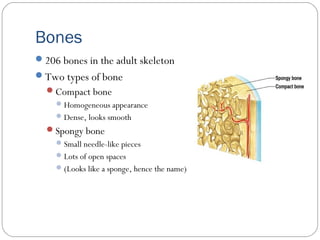
206 bones in the adult skeleton
Two types of bone
Compact bone
Homogeneous appearance
Dense, looks smooth
Spongy bone
Small needle-like pieces
Lots of open spaces
(Looks like a sponge, hence the name)
Bone Classification
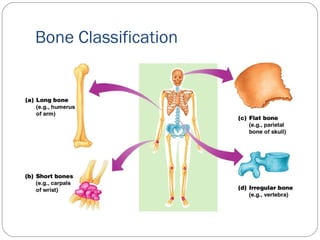
Long Bones
Longer than wide
Contain shaft with head at
each end
Mostly compact bone
Limbs (not ankle or wrist
bones)
Short Bones
Cube-shaped
Mostly spongy bone
Wrist and ankle bones
Patella (kneecap)
Flat Bones
Thin, flat, usually curved
Two layers of compact bone
with spongy bone in between
Skull, ribs, breastbone
Irregular Bones
Don’t fit into the other
categories
Vertebrae, hip bones
Bone Classification
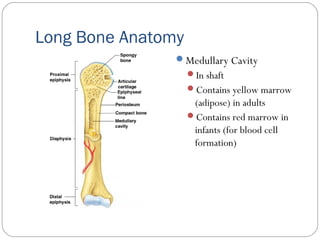
Long Bone Anatomy
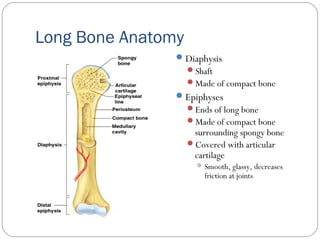
Diaphysis
Shaft
Made of compact bone
Epiphyses
Ends of long bone
Made of compact bone
surrounding spongy bone
Covered with articular
cartilage
Smooth, glassy, decreases
friction at joints
Long Bone Anatomy
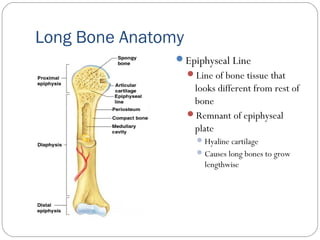
Epiphyseal Line
Line of bone tissue that
looks different from rest of
bone
Remnant of epiphyseal
plate
Hyaline cartilage
Causes long bones to grow
lengthwise
Long Bone Anatomy
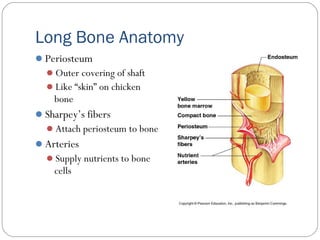
Periosteum
Outer covering of shaft
Like “skin” on chicken
bone
Sharpey’s fibers
Attach periosteum to bone
Arteries
Supply nutrients to bone
cells
Long Bone Anatomy
Medullary Cavity
In shaft
Contains yellow marrow
(adipose) in adults
Contains red marrow in
infants (for blood cell
formation)
Microscopic Anatomy of Bone
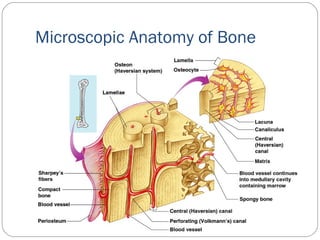
Osteon (Haversian system)
A “unit” of bone
Central (Haversian) canal
Opening in center of osteon
Contains blood vessels
Perforating (Volkman’s) canal
Perpendicular to central canal
Contains blood vessels and nerves
Microscopic Anatomy of Bone
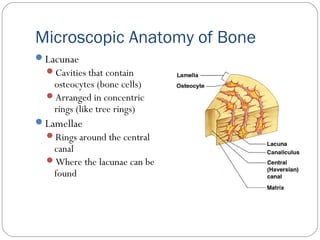
Lacunae
Cavities that contain
osteocytes (bone cells)
Arranged in concentric
rings (like tree rings)
Lamellae
Rings around the central
canal
Where the lacunae can be
found
Microscopic Anatomy of Bone
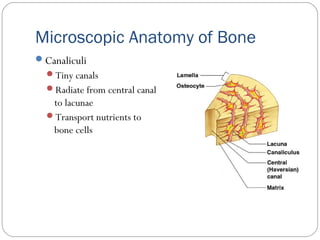
Canaliculi
Tiny canals
Radiate from central canal
to lacunae
Transport nutrients to
bone cells
Other Facts
Bone is one of the hardest parts of the body
Very lightweight
Can resist tension
Calcium salts make it hard
Collagen fibers make it strong and flexible
Bone Formation
In embryos…
Skeleton made of hyaline cartilage
Gets replaced by bone with age
Cartilage remains in a few places…
Bridge of nose
Parts of ribs
Joints
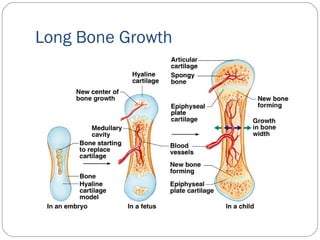
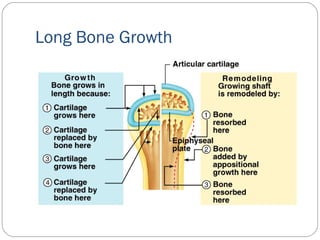
Bone Growth
Epiphyseal plates allow for growth of long bone
during childhood
New cartilage is continuously formed
Older cartilage becomes ossified
Cartilage is broken down
Bone replaces cartilage
Bones remodeled, lengthened until growth stops
Bones change shape somewhat
Bones grow in width
Long Bone Growth
Long Bone Growth
Types of Bone Cells
Osteocyte
Mature bone cell
Osteoblast
“Bone builders”
Osteoclast
“Bone destroyers”
Break down bone matrix to remodel and/or release calcium
Bone Remodeling
Bone remodeling is done by osteoblasts and osteoclasts
Essential for bones to keep normal proportions and strength
Bones get larger/thicker when…
Large muscles are attached to them
Need more bone to attach the large muscle to
Bones get smaller/weaker when…
Physical inactivity
Non-use of musclesatrophy
Small muscles don’t need large bones to attach to
 Bones remodeled to become smaller
Fractures
A break in a bone
Types of Fractures
Simple (closed) fracture
Bone breaks cleanly, does not penetrate skin
Compound (open) Fracture
When bone ends penetrate through skin
Treated by reduction and immobilization
Realignment of bone ends
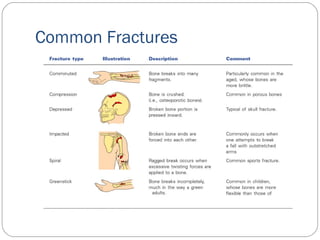
Common Fractures
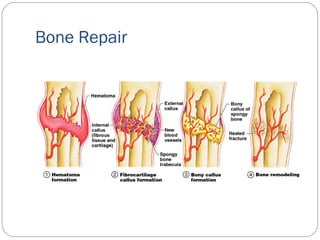
Bone Repair
Hematoma forms
Blood vessels rupture when
bone breaks
Blood filled swelling
Cells without nutrients die
Fibrocartilage callus forms
Made of connective tissue
Splints the break
Phagocytes dispose of dead
tissue
Bony callus forms
Osteoblasts/clasts move in,
create callus of spongy bone
Remodeling
Osteoblasts/clasts remodel in
response to stress on the bone
Helps strengthen bone
Creates a permanent “patch” at
the site
Often, a healed fracture can be
stronger than the rest of the
bone
Bone Repair
Axial Skeleton
Makes up longitudinal part of the body
Three parts
Skull
Vertebral column
Bony thorax
**Note: notes on specific bones are not included. Make sure you
are using your textbook to help identify shapes/functions of
bones!!
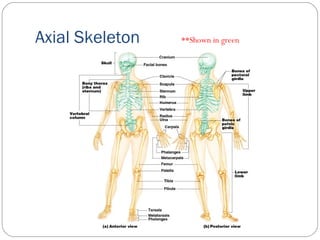
Axial Skeleton **Shown in green
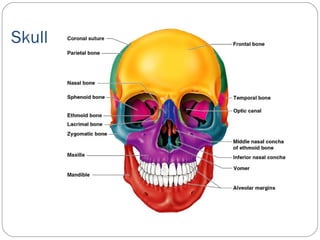
Skull
Formed by two sets of bones
Cranium
Encloses/protects brain
Facial bones
Holds eyes forward (anterior position)
Allow facial muscles to show feelings
Sutures
Interlocking, immovable joints holding most skullbones
together
Mandible-only freely movable bone in skull
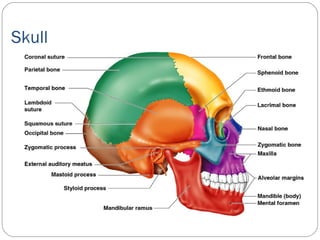
Skull
Skull
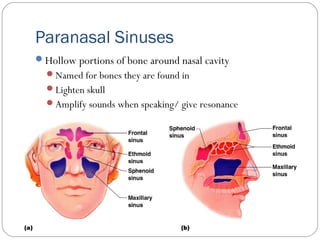
Paranasal Sinuses
Hollow portions of bone around nasal cavity
Named for bones they are found in
Lighten skull
Amplify sounds when speaking/ give resonance
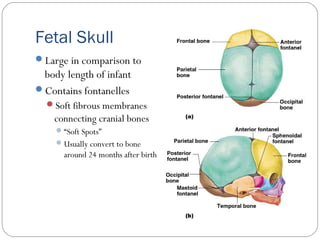
Fetal Skull
Large in comparison to
body length of infant
Contains fontanelles
Soft fibrous membranes
connecting cranial bones
“Soft Spots”
Usually convert to bone
around 24 months after birth
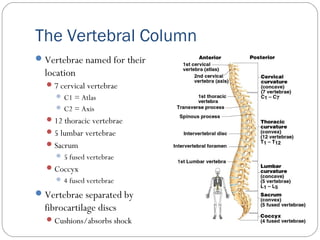
The Vertebral Column
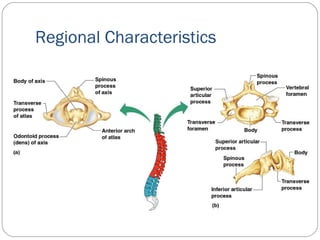
Vertebrae named for their
location
7 cervical vertebrae
 C1 = Atlas
 C2 = Axis
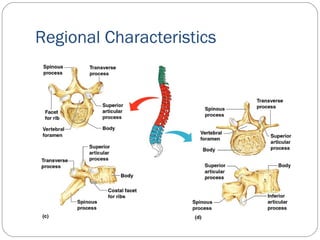
12 thoracic vertebrae
5 lumbar vertebrae
Sacrum
 5 fused vertebrae
Coccyx
 4 fused vertebrae
Vertebrae separated by
fibrocartilage discs
Cushions/absorbs shock
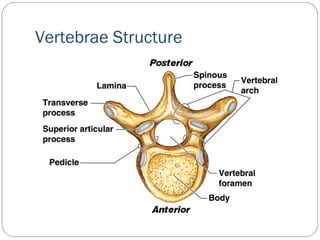
Vertebrae Structure
Regional Characteristics
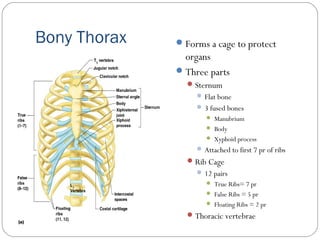
Bony Thorax Forms a cage to protect
organs
Three parts
Sternum
 Flat bone
 3 fused bones
 Manubrium
 Body
 Xyphoid process
 Attached to first 7 pr of ribs
Rib Cage
 12 pairs
 True Ribs= 7 pr
 False Ribs = 5 pr
 Floating Ribs = 2 pr
Thoracic vertebrae
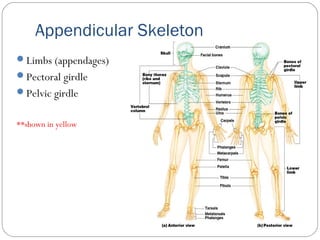
Appendicular Skeleton
Limbs (appendages)
Pectoral girdle
Pelvic girdle
**shown in yellow
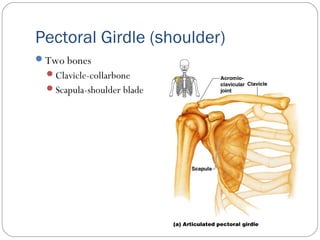
Pectoral Girdle (shoulder)
Two bones
Clavicle-collarbone
Scapula-shoulder blade
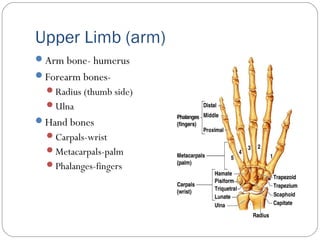
Upper Limb (arm)
Arm bone- humerus
Forearm bones-
Radius (thumb side)
Ulna
Hand bones
Carpals-wrist
Metacarpals-palm
Phalanges-fingers
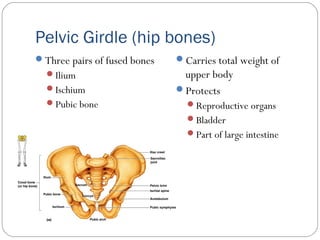
Pelvic Girdle (hip bones)
Three pairs of fused bones
Ilium
Ischium
Pubic bone
Carries total weight of
upper body
Protects
Reproductive organs
Bladder
Part of large intestine
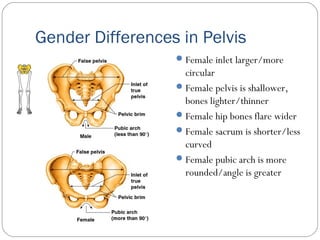
Gender Differences in Pelvis
Female inlet larger/more
circular
Female pelvis is shallower,
bones lighter/thinner
Female hip bones flare wider
Female sacrum is shorter/less
curved
Female pubic arch is more
rounded/angle is greater
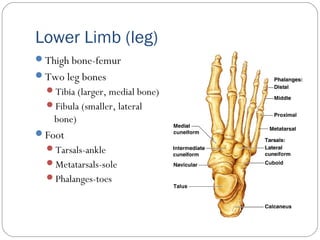
Lower Limb (leg)
Thigh bone-femur
Two leg bones
Tibia (larger, medial bone)
Fibula (smaller, lateral
bone)
Foot
Tarsals-ankle
Metatarsals-sole
Phalanges-toes
Joints
Articulations of bones
Functions
Hold bones together
Mobility
Classified by
structure/function
**we’ll use structural classification
Fibrous joints
Immovable
EX: sutures of skull
Cartilaginous joints
Immovable OR slightly
movable
EX:Pubic symphysis and
Vertebrae
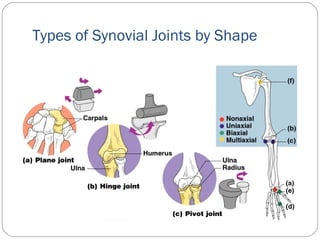
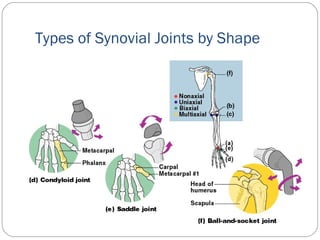
Synovial joints
Freely movable
**Be familiar with types of synovial
joints (illustrations to follow)
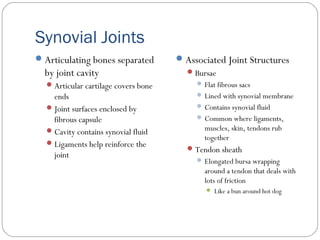
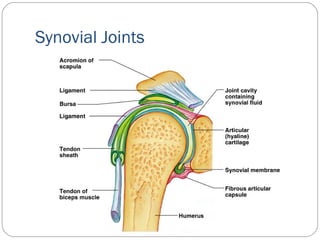
Synovial Joints
Articulating bones separated
by joint cavity
Articular cartilage covers bone
ends
Joint surfaces enclosed by
fibrous capsule
Cavity contains synovial fluid
Ligaments help reinforce the
joint
Associated Joint Structures
Bursae
 Flat fibrous sacs
 Lined with synovial membrane
 Contains synovial fluid
 Common where ligaments,
muscles, skin, tendons rub
together
Tendon sheath
 Elongated bursa wrapping
around a tendon that deals with
lots of friction
 Like a bun around hot dog
Synovial Joints
Types of Synovial Joints by Shape

The skeletal system

  • 1.
    By Muhammad Iqbal Khan SSBiology Email ID: mikhan1313@yahoo.com 0923135448175 The Skeletal System
  • 2.
    Function  Support  Internalframework of body  Ex: Legs support body trunk, rib cage supports chest wall  Protection  Protects soft body organs (skull protects brain, ribs protect heart and lungs, etc)  Movement*  Muscles use bones as levers to move body  NOT a function skeletal system can do on it’s own  Storage  Fat storage  In yellow marrow  Mineral storage  Calcium, phosphorus, and others.  Blood cell formation  Hematopoeisis  Occurs in bone marrow of long bones
  • 3.
    Bones 206 bones inthe adult skeleton Two types of bone Compact bone Homogeneous appearance Dense, looks smooth Spongy bone Small needle-like pieces Lots of open spaces (Looks like a sponge, hence the name)
  • 4.
    Bone Classification Long Bones Longerthan wide Contain shaft with head at each end Mostly compact bone Limbs (not ankle or wrist bones) Short Bones Cube-shaped Mostly spongy bone Wrist and ankle bones Patella (kneecap) Flat Bones Thin, flat, usually curved Two layers of compact bone with spongy bone in between Skull, ribs, breastbone Irregular Bones Don’t fit into the other categories Vertebrae, hip bones
  • 5.
  • 6.
    Long Bone Anatomy Diaphysis Shaft Madeof compact bone Epiphyses Ends of long bone Made of compact bone surrounding spongy bone Covered with articular cartilage Smooth, glassy, decreases friction at joints
  • 7.
    Long Bone Anatomy EpiphysealLine Line of bone tissue that looks different from rest of bone Remnant of epiphyseal plate Hyaline cartilage Causes long bones to grow lengthwise
  • 8.
    Long Bone Anatomy Periosteum Outercovering of shaft Like “skin” on chicken bone Sharpey’s fibers Attach periosteum to bone Arteries Supply nutrients to bone cells
  • 9.
    Long Bone Anatomy MedullaryCavity In shaft Contains yellow marrow (adipose) in adults Contains red marrow in infants (for blood cell formation)
  • 10.
    Microscopic Anatomy ofBone Osteon (Haversian system) A “unit” of bone Central (Haversian) canal Opening in center of osteon Contains blood vessels Perforating (Volkman’s) canal Perpendicular to central canal Contains blood vessels and nerves
  • 11.
  • 12.
    Microscopic Anatomy ofBone Lacunae Cavities that contain osteocytes (bone cells) Arranged in concentric rings (like tree rings) Lamellae Rings around the central canal Where the lacunae can be found
  • 13.
    Microscopic Anatomy ofBone Canaliculi Tiny canals Radiate from central canal to lacunae Transport nutrients to bone cells
  • 14.
    Other Facts Bone isone of the hardest parts of the body Very lightweight Can resist tension Calcium salts make it hard Collagen fibers make it strong and flexible
  • 15.
    Bone Formation In embryos… Skeletonmade of hyaline cartilage Gets replaced by bone with age Cartilage remains in a few places… Bridge of nose Parts of ribs Joints
  • 16.
    Bone Growth Epiphyseal platesallow for growth of long bone during childhood New cartilage is continuously formed Older cartilage becomes ossified Cartilage is broken down Bone replaces cartilage Bones remodeled, lengthened until growth stops Bones change shape somewhat Bones grow in width
  • 17.
  • 18.
  • 19.
    Types of BoneCells Osteocyte Mature bone cell Osteoblast “Bone builders” Osteoclast “Bone destroyers” Break down bone matrix to remodel and/or release calcium
  • 20.
    Bone Remodeling Bone remodelingis done by osteoblasts and osteoclasts Essential for bones to keep normal proportions and strength Bones get larger/thicker when… Large muscles are attached to them Need more bone to attach the large muscle to Bones get smaller/weaker when… Physical inactivity Non-use of musclesatrophy Small muscles don’t need large bones to attach to  Bones remodeled to become smaller
  • 21.
    Fractures A break ina bone Types of Fractures Simple (closed) fracture Bone breaks cleanly, does not penetrate skin Compound (open) Fracture When bone ends penetrate through skin Treated by reduction and immobilization Realignment of bone ends
  • 22.
  • 23.
    Bone Repair Hematoma forms Bloodvessels rupture when bone breaks Blood filled swelling Cells without nutrients die Fibrocartilage callus forms Made of connective tissue Splints the break Phagocytes dispose of dead tissue Bony callus forms Osteoblasts/clasts move in, create callus of spongy bone Remodeling Osteoblasts/clasts remodel in response to stress on the bone Helps strengthen bone Creates a permanent “patch” at the site Often, a healed fracture can be stronger than the rest of the bone
  • 24.
  • 25.
    Axial Skeleton Makes uplongitudinal part of the body Three parts Skull Vertebral column Bony thorax **Note: notes on specific bones are not included. Make sure you are using your textbook to help identify shapes/functions of bones!!
  • 26.
  • 27.
    Skull Formed by twosets of bones Cranium Encloses/protects brain Facial bones Holds eyes forward (anterior position) Allow facial muscles to show feelings Sutures Interlocking, immovable joints holding most skullbones together Mandible-only freely movable bone in skull
  • 28.
  • 29.
  • 30.
    Paranasal Sinuses Hollow portionsof bone around nasal cavity Named for bones they are found in Lighten skull Amplify sounds when speaking/ give resonance
  • 31.
    Fetal Skull Large incomparison to body length of infant Contains fontanelles Soft fibrous membranes connecting cranial bones “Soft Spots” Usually convert to bone around 24 months after birth
  • 32.
    The Vertebral Column Vertebraenamed for their location 7 cervical vertebrae  C1 = Atlas  C2 = Axis 12 thoracic vertebrae 5 lumbar vertebrae Sacrum  5 fused vertebrae Coccyx  4 fused vertebrae Vertebrae separated by fibrocartilage discs Cushions/absorbs shock
  • 33.
  • 34.
  • 35.
  • 36.
    Bony Thorax Formsa cage to protect organs Three parts Sternum  Flat bone  3 fused bones  Manubrium  Body  Xyphoid process  Attached to first 7 pr of ribs Rib Cage  12 pairs  True Ribs= 7 pr  False Ribs = 5 pr  Floating Ribs = 2 pr Thoracic vertebrae
  • 37.
    Appendicular Skeleton Limbs (appendages) Pectoralgirdle Pelvic girdle **shown in yellow
  • 38.
    Pectoral Girdle (shoulder) Twobones Clavicle-collarbone Scapula-shoulder blade
  • 39.
    Upper Limb (arm) Armbone- humerus Forearm bones- Radius (thumb side) Ulna Hand bones Carpals-wrist Metacarpals-palm Phalanges-fingers
  • 40.
    Pelvic Girdle (hipbones) Three pairs of fused bones Ilium Ischium Pubic bone Carries total weight of upper body Protects Reproductive organs Bladder Part of large intestine
  • 41.
    Gender Differences inPelvis Female inlet larger/more circular Female pelvis is shallower, bones lighter/thinner Female hip bones flare wider Female sacrum is shorter/less curved Female pubic arch is more rounded/angle is greater
  • 42.
    Lower Limb (leg) Thighbone-femur Two leg bones Tibia (larger, medial bone) Fibula (smaller, lateral bone) Foot Tarsals-ankle Metatarsals-sole Phalanges-toes
  • 43.
    Joints Articulations of bones Functions Holdbones together Mobility Classified by structure/function **we’ll use structural classification Fibrous joints Immovable EX: sutures of skull Cartilaginous joints Immovable OR slightly movable EX:Pubic symphysis and Vertebrae Synovial joints Freely movable **Be familiar with types of synovial joints (illustrations to follow)
  • 44.
    Synovial Joints Articulating bonesseparated by joint cavity Articular cartilage covers bone ends Joint surfaces enclosed by fibrous capsule Cavity contains synovial fluid Ligaments help reinforce the joint Associated Joint Structures Bursae  Flat fibrous sacs  Lined with synovial membrane  Contains synovial fluid  Common where ligaments, muscles, skin, tendons rub together Tendon sheath  Elongated bursa wrapping around a tendon that deals with lots of friction  Like a bun around hot dog
  • 45.
  • 46.
    Types of SynovialJoints by Shape
  • 47.
    Types of SynovialJoints by Shape