CHAPTER 7
The Skeletal System:
The Axial Skeleton
Principles of
Anatomy and
Physiology
14th Edition
Copyright © 2014 John Wiley & Sons, Inc. All rights reserved.
The human skeleton consists of 206 named
bones grouped into two principal divisions:
 Axial skeleton (80 bones)
 Appendicular skeleton (126 bones)
Divisions of the Skeletal System
Copyright © 2014 John Wiley & Sons, Inc. All rights reserved.
The axial skeleton:
 Skull bones, auditory ossicles (ear bones), hyoid
bone, ribs, sternum (breastbone), and bones of
the vertebral column.
The appendicular skeleton:
 Bones of the upper and lower limbs (extremities)
and the bones forming the girdles that connect the
limbs to the axial skeleton.
Divisions of the Skeletal System
Copyright © 2014 John Wiley & Sons, Inc. All rights reserved.
The Skeletal System
Divisions of the Skeletal System
Copyright © 2014 John Wiley & Sons, Inc. All rights reserved.
Anatomy Overview:
You must be connected to the Internet and in Slideshow Mode
to run this animation.
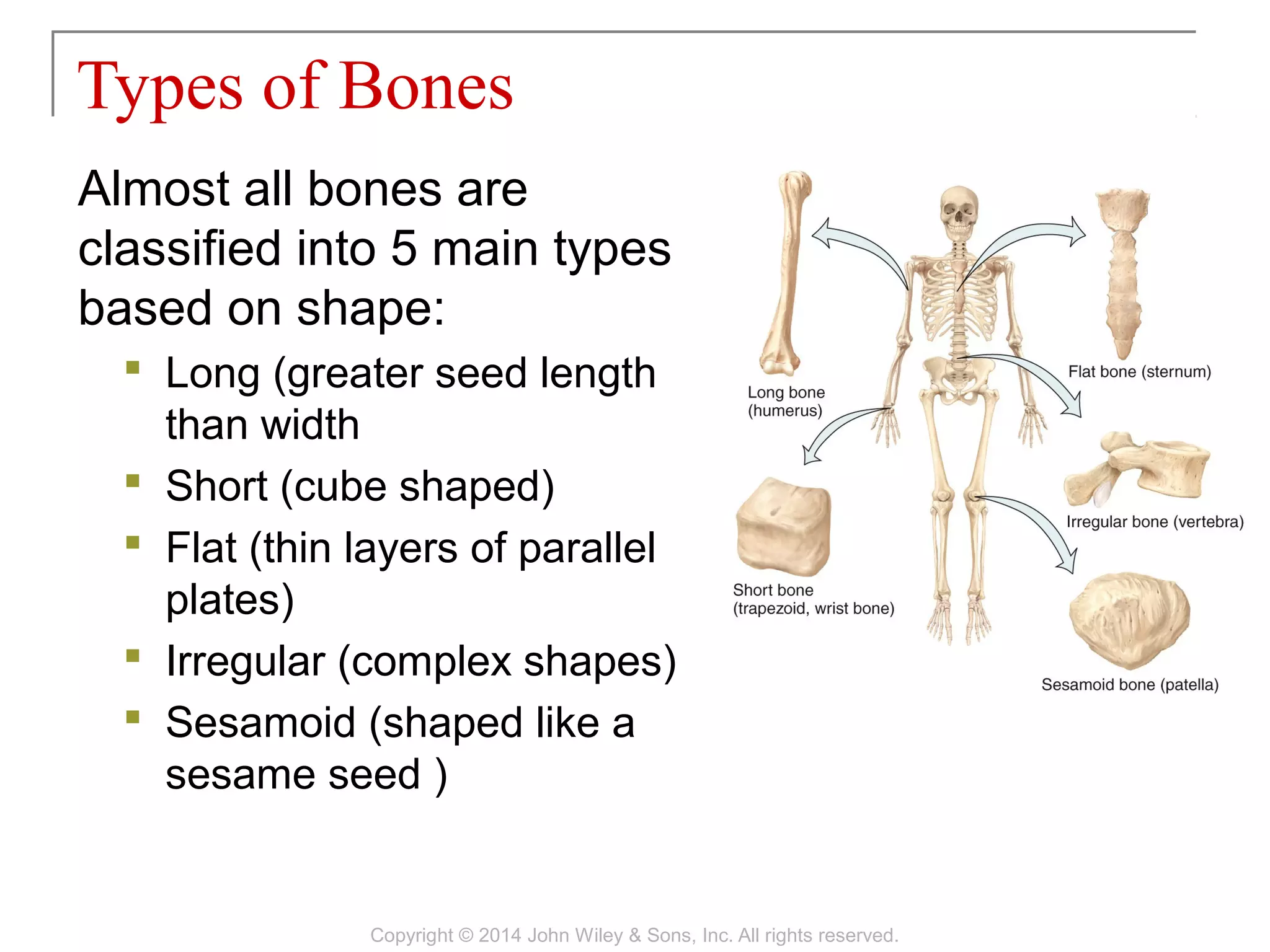
Almost all bones are
classified into 5 main types
based on shape:
 Long (greater seed length
than width
 Short (cube shaped)
 Flat (thin layers of parallel
plates)
 Irregular (complex shapes)
 Sesamoid (shaped like a
sesame seed )
Types of Bones
Copyright © 2014 John Wiley & Sons, Inc. All rights reserved.
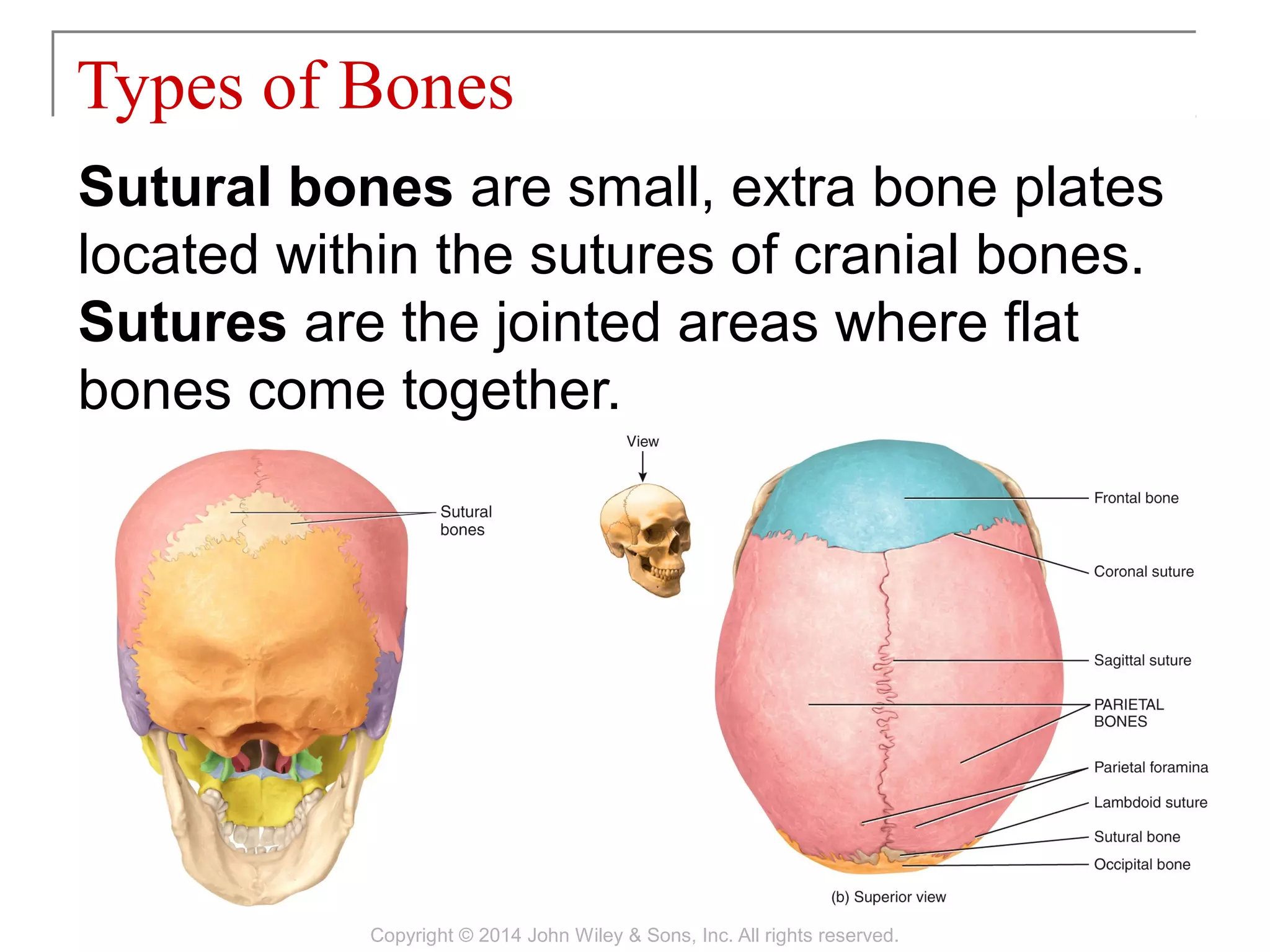
Sutural bones are small, extra bone plates
located within the sutures of cranial bones.
Sutures are the jointed areas where flat
bones come together.
Types of Bones
Copyright © 2014 John Wiley & Sons, Inc. All rights reserved.
Bones have characteristic surface markings –
structural features adapted for specific functions.
There are two major types of surface markings:
 Depressions and openings
 Allow the passage of soft tissues
 Form joints
 Processes
 Projections or outgrowths that form joints
 Serve as attachment points for ligaments and tendons
Bone Surface Markings
Copyright © 2014 John Wiley & Sons, Inc. All rights reserved.
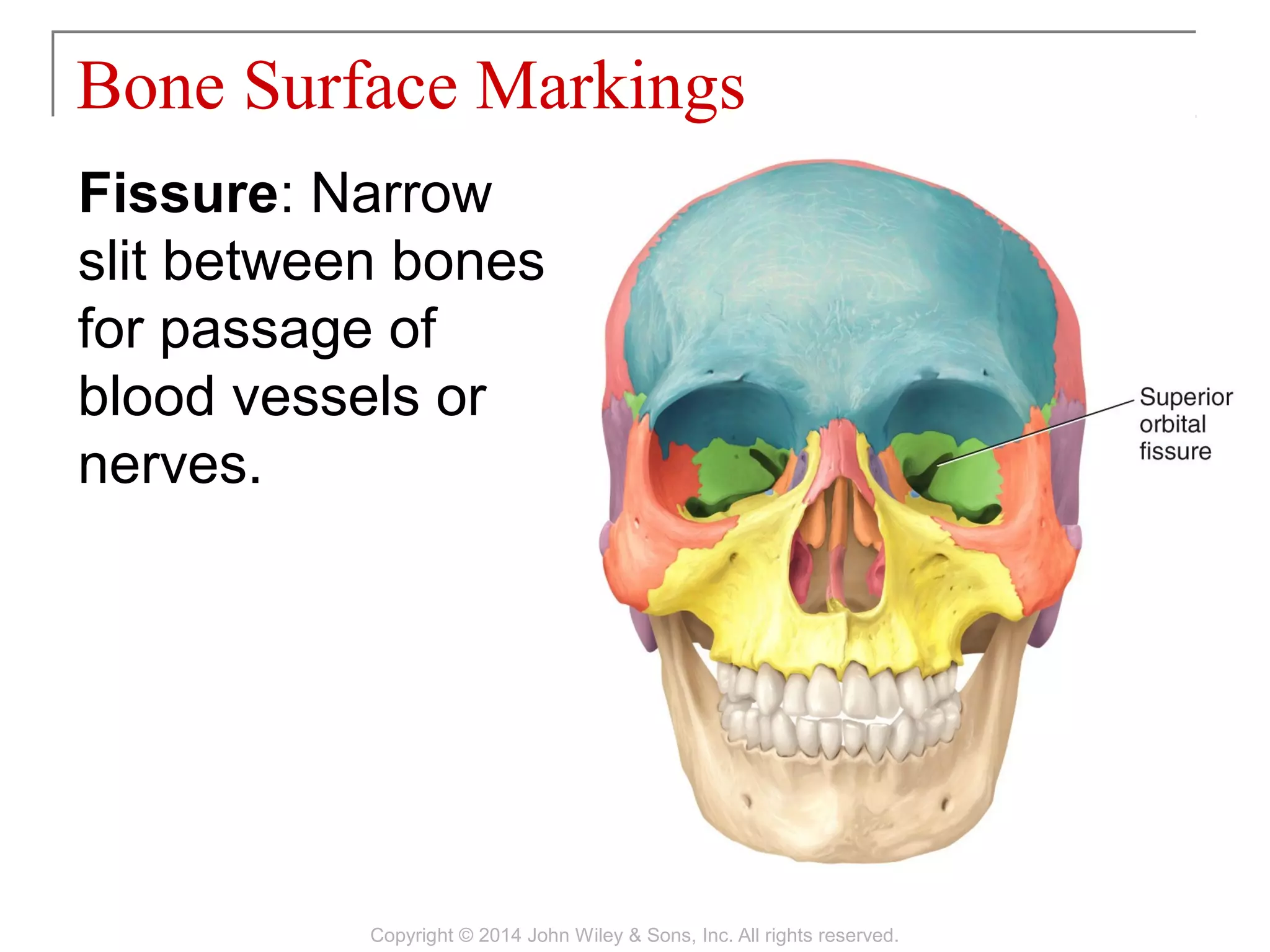
Fissure: Narrow
slit between bones
for passage of
blood vessels or
nerves.
Bone Surface Markings
Copyright © 2014 John Wiley & Sons, Inc. All rights reserved.
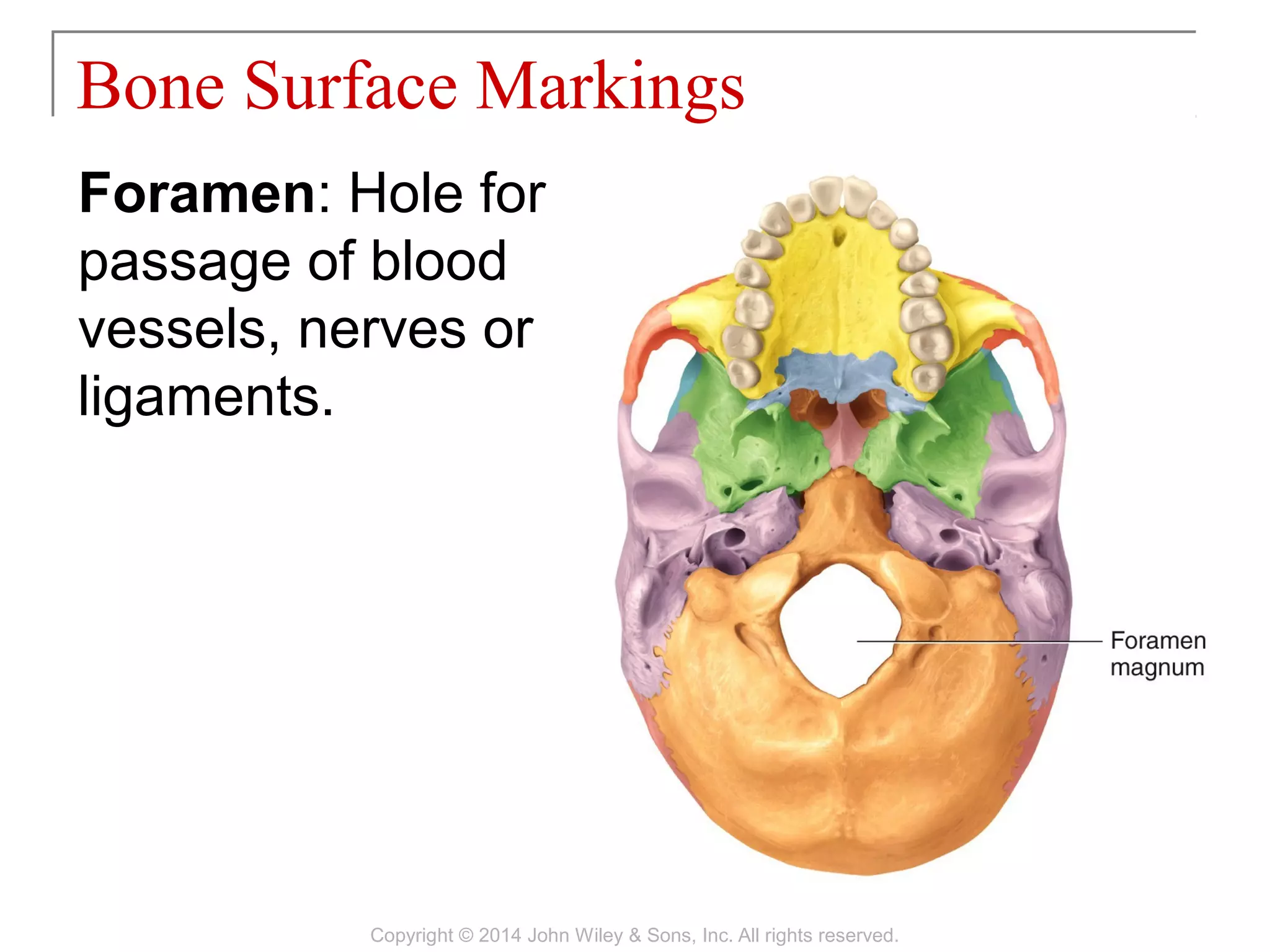
Foramen: Hole for
passage of blood
vessels, nerves or
ligaments.
Bone Surface Markings
Copyright © 2014 John Wiley & Sons, Inc. All rights reserved.
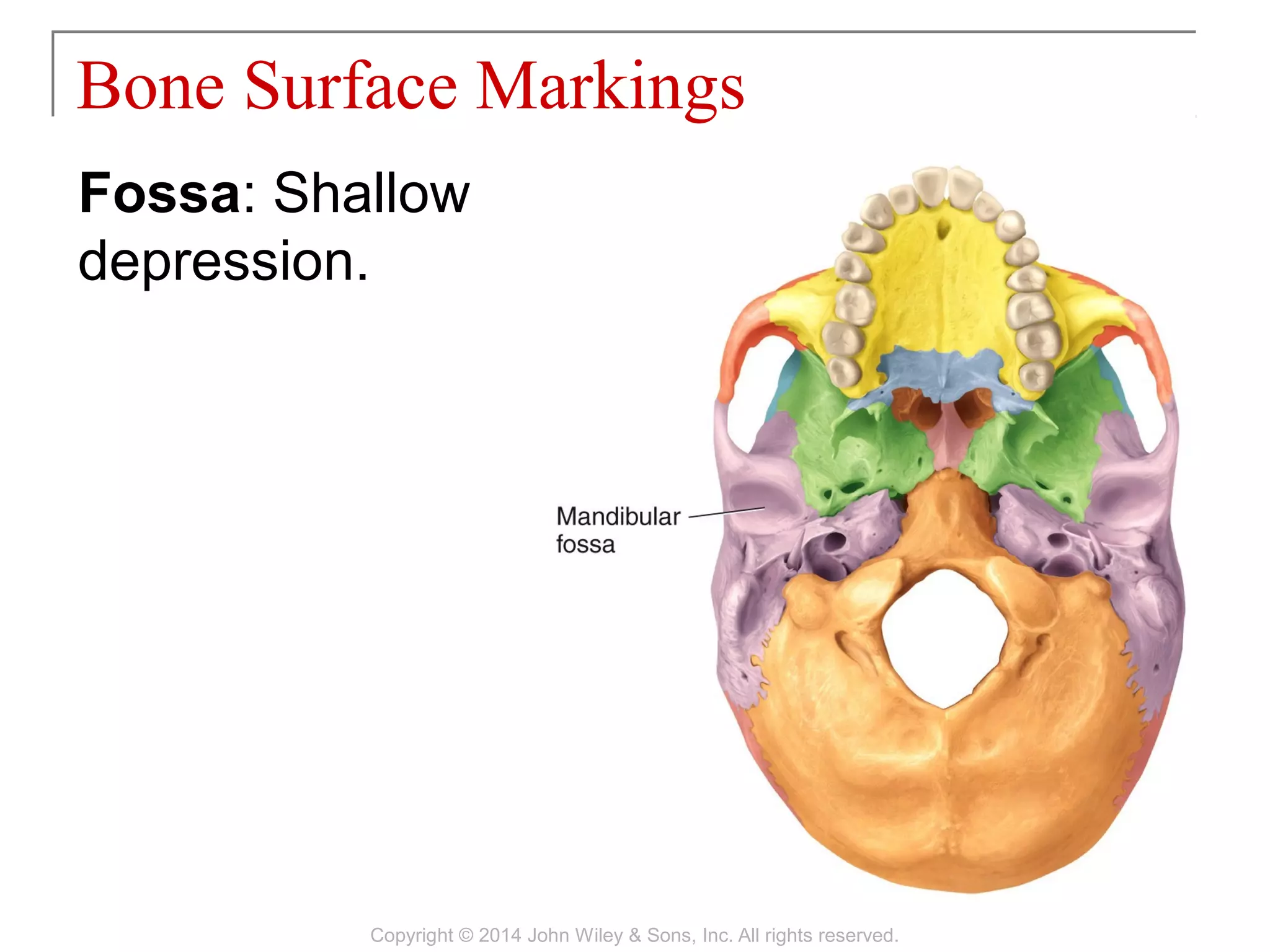
Fossa: Shallow
depression.
Bone Surface Markings
Copyright © 2014 John Wiley & Sons, Inc. All rights reserved.
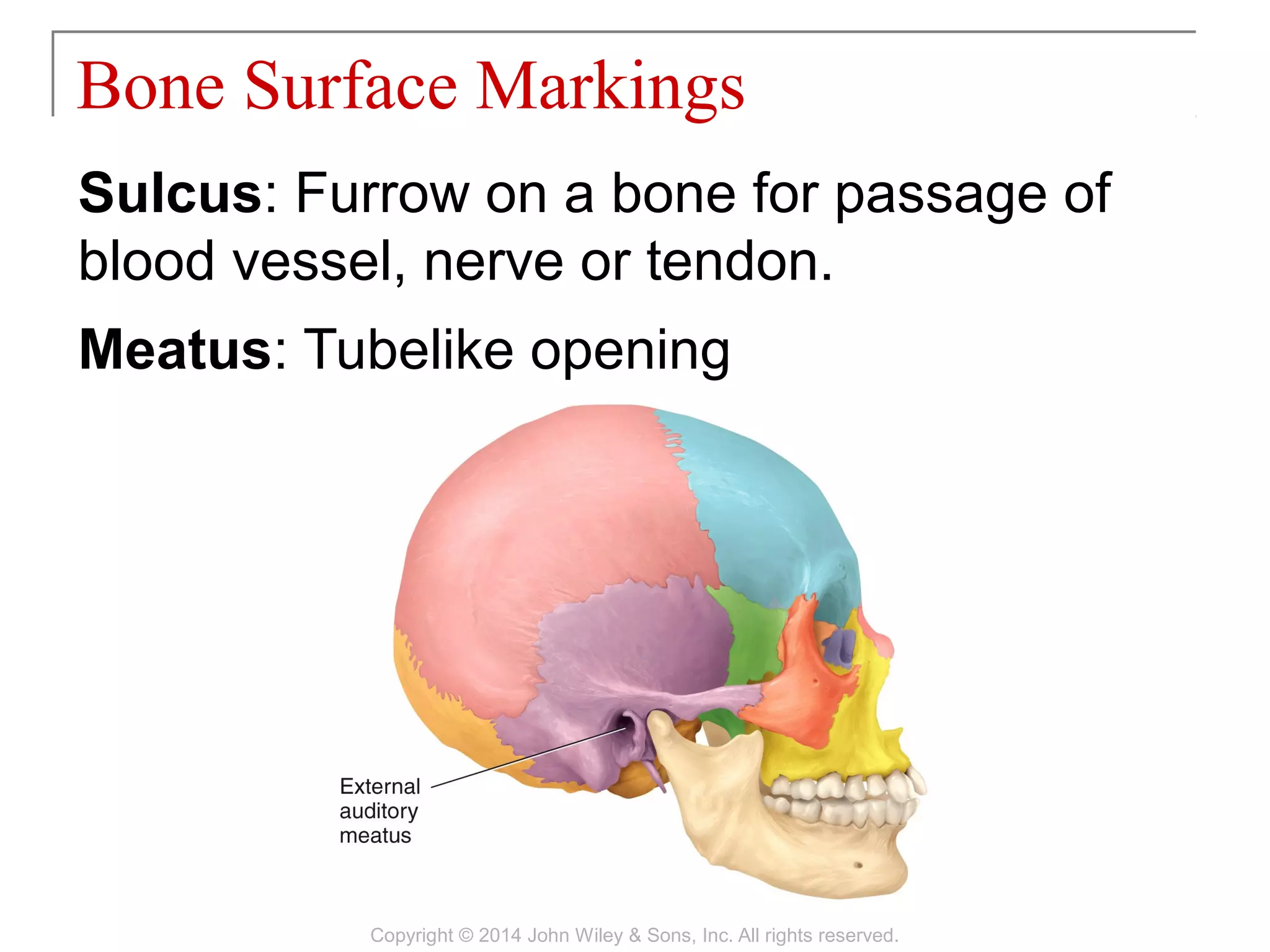
Sulcus: Furrow on a bone for passage of
blood vessel, nerve or tendon.
Meatus: Tubelike opening
Bone Surface Markings
Copyright © 2014 John Wiley & Sons, Inc. All rights reserved.
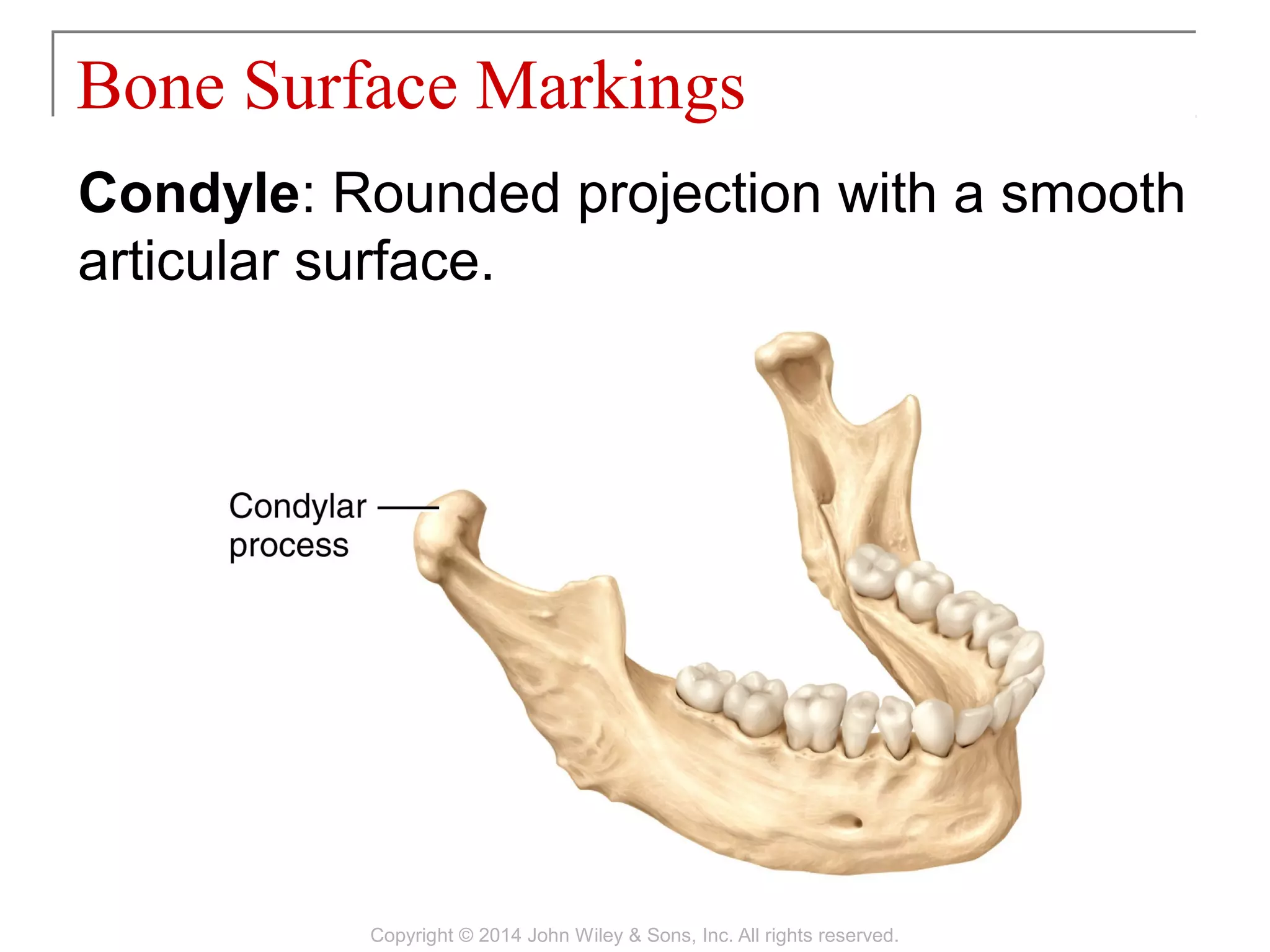
Condyle: Rounded projection with a smooth
articular surface.
Bone Surface Markings
Copyright © 2014 John Wiley & Sons, Inc. All rights reserved.
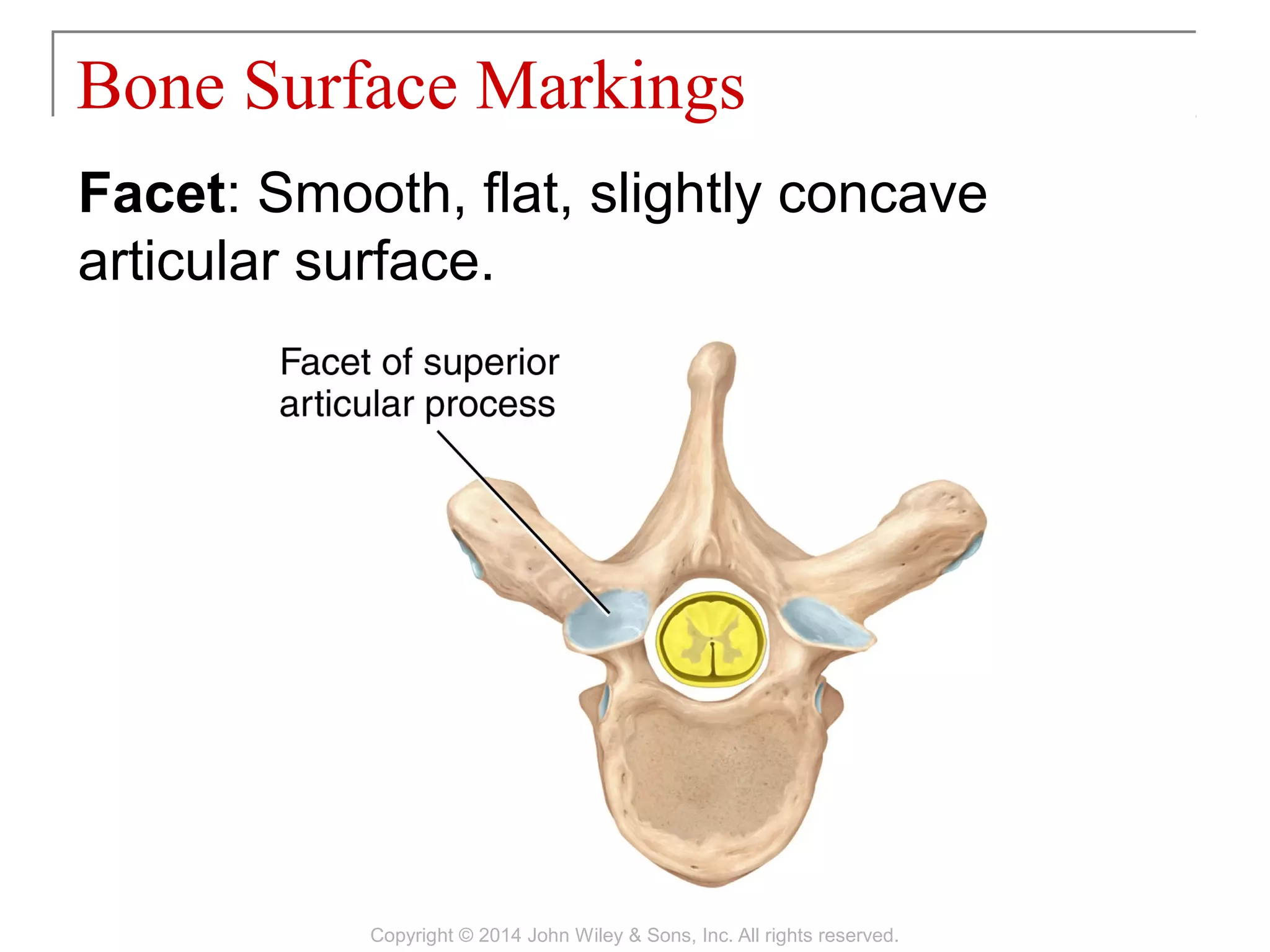
Facet: Smooth, flat, slightly concave
articular surface.
Bone Surface Markings
Copyright © 2014 John Wiley & Sons, Inc. All rights reserved.
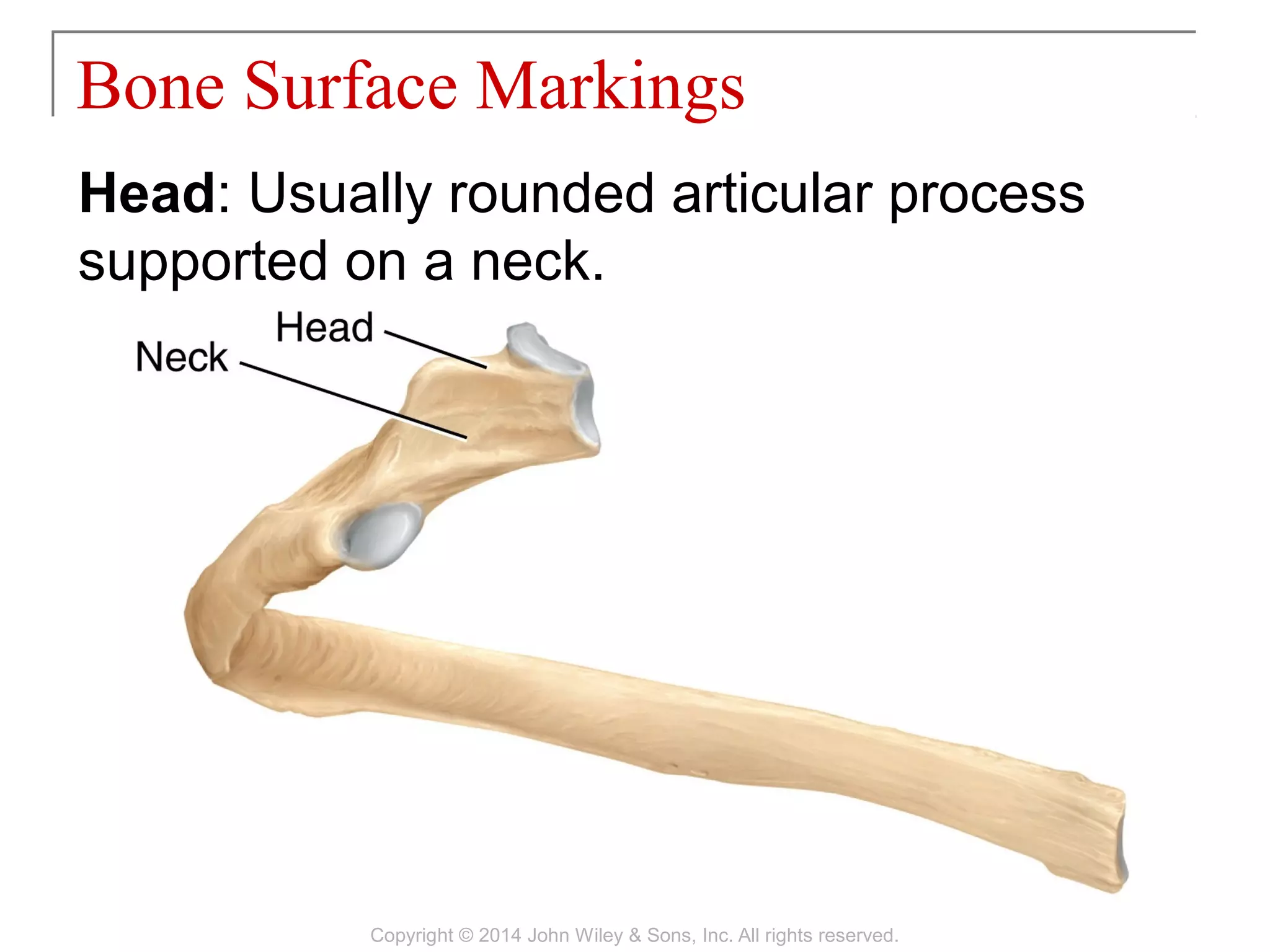
Head: Usually rounded articular process
supported on a neck.
Bone Surface Markings
Copyright © 2014 John Wiley & Sons, Inc. All rights reserved.
Crest:
Prominent ridge
or elongated
process.
Bone Surface Markings
Copyright © 2014 John Wiley & Sons, Inc. All rights reserved.
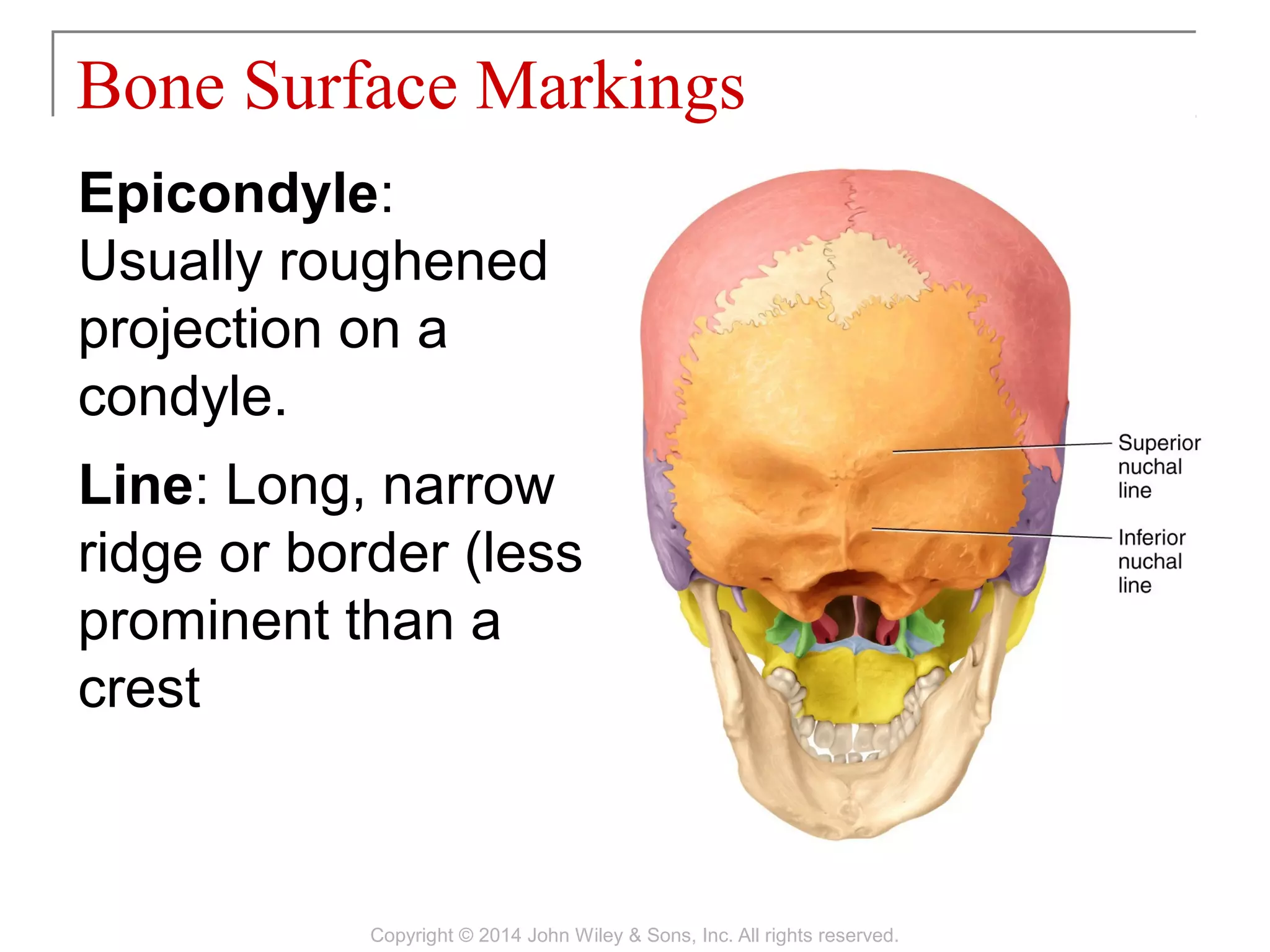
Epicondyle:
Usually roughened
projection on a
condyle.
Line: Long, narrow
ridge or border (less
prominent than a
crest
Bone Surface Markings
Copyright © 2014 John Wiley & Sons, Inc. All rights reserved.
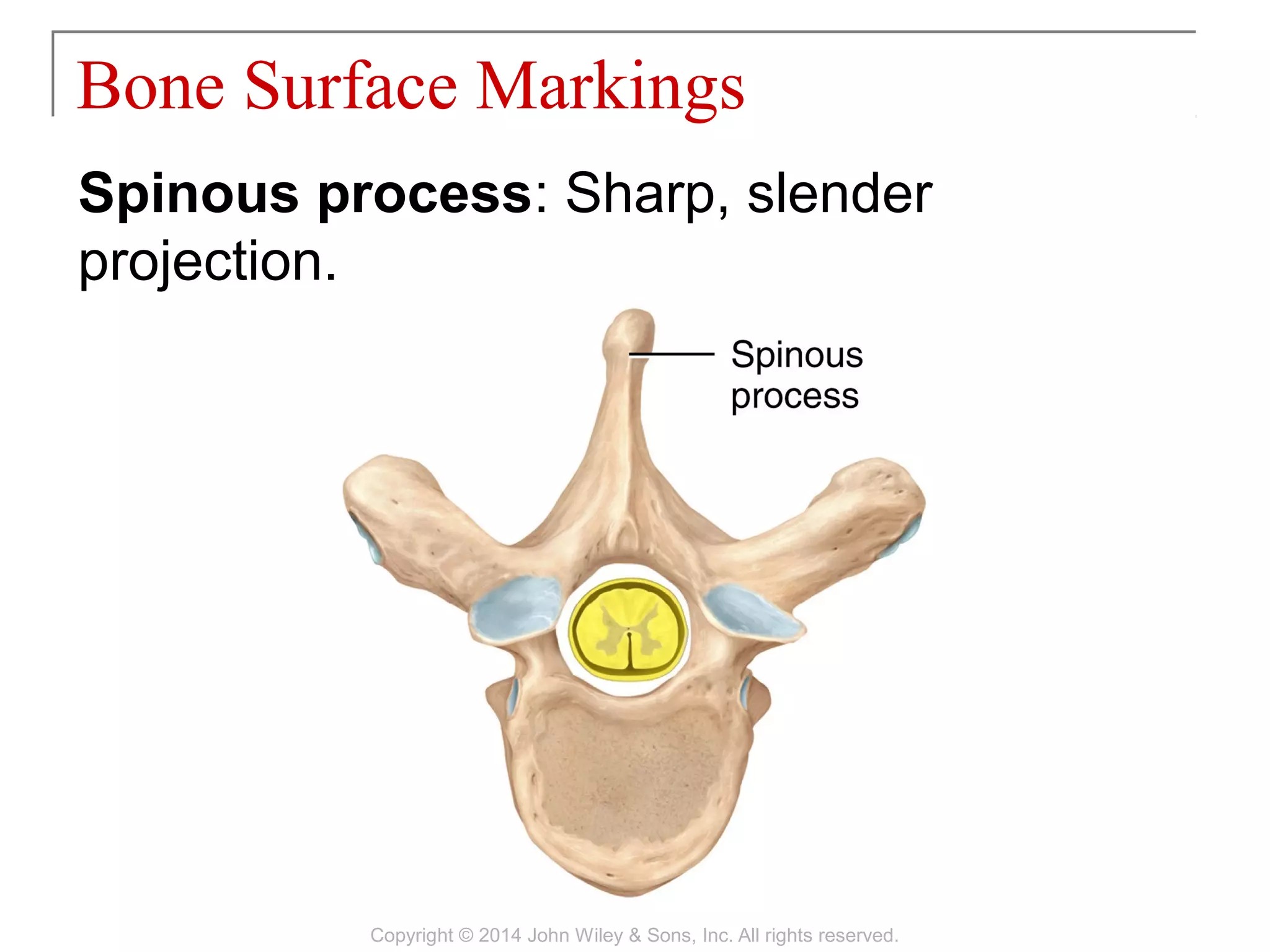
Spinous process: Sharp, slender
projection.
Bone Surface Markings
Copyright © 2014 John Wiley & Sons, Inc. All rights reserved.
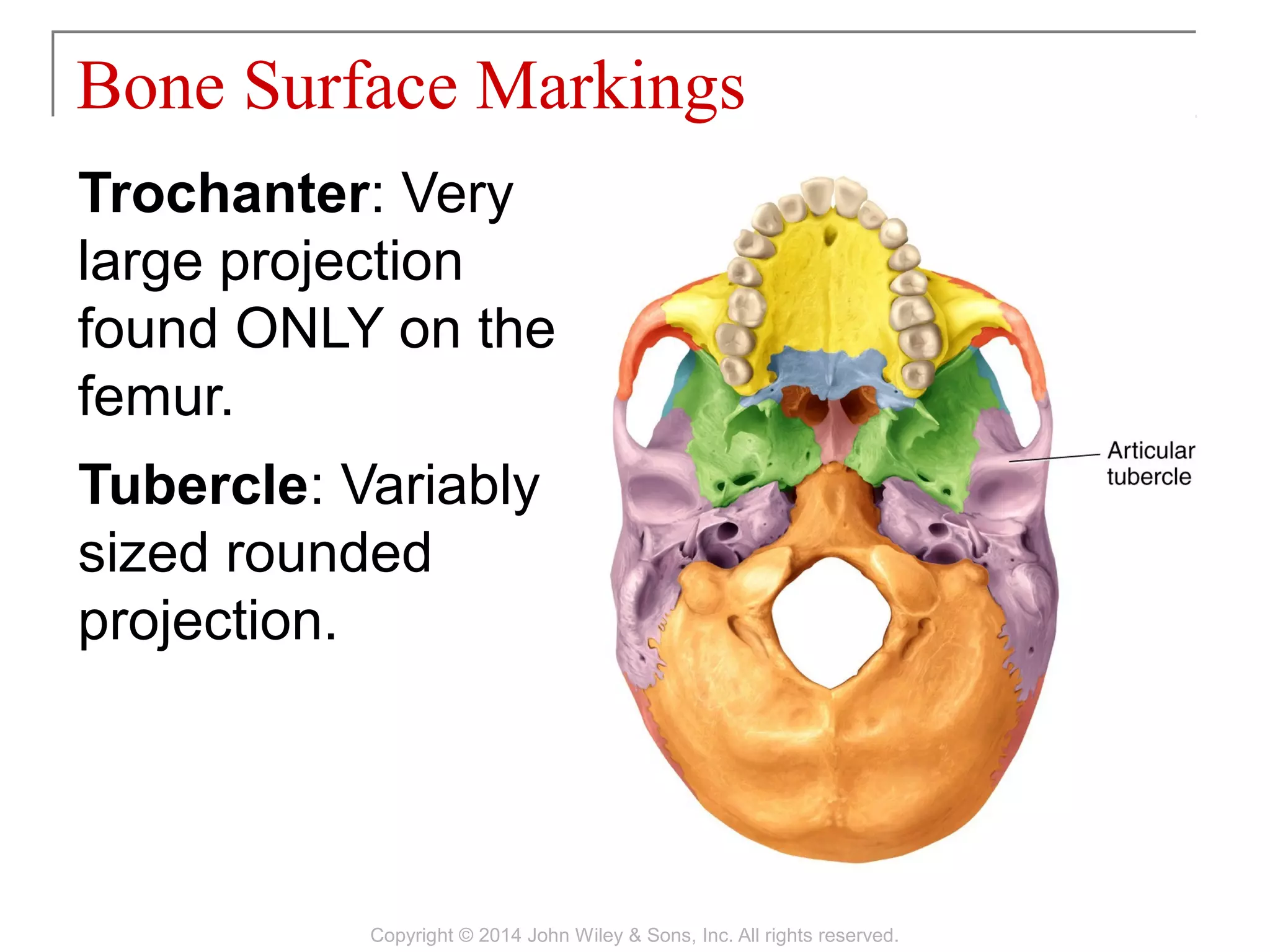
Trochanter: Very
large projection
found ONLY on the
femur.
Tubercle: Variably
sized rounded
projection.
Bone Surface Markings
Copyright © 2014 John Wiley & Sons, Inc. All rights reserved.
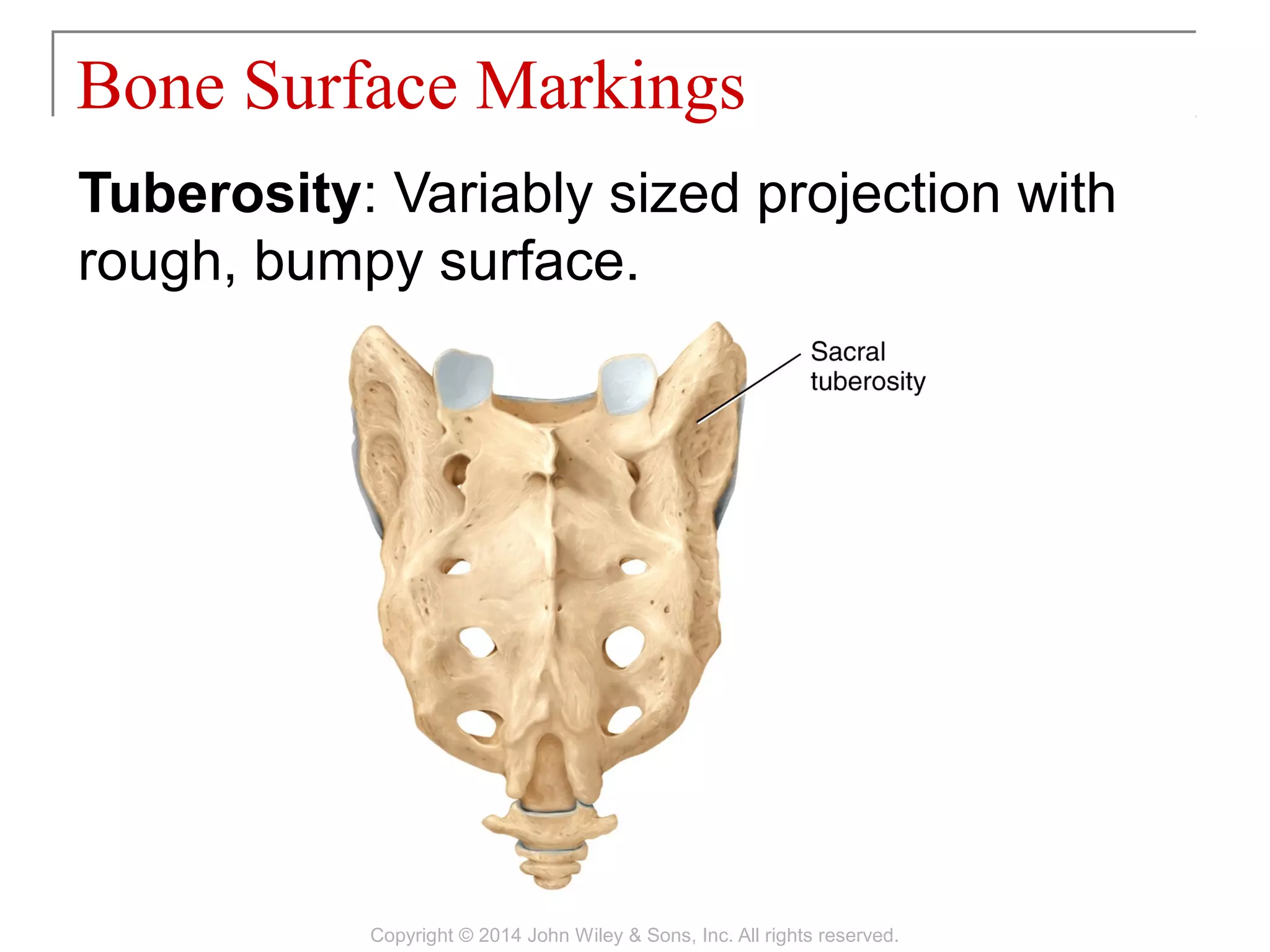
Tuberosity: Variably sized projection with
rough, bumpy surface.
Bone Surface Markings
Copyright © 2014 John Wiley & Sons, Inc. All rights reserved.
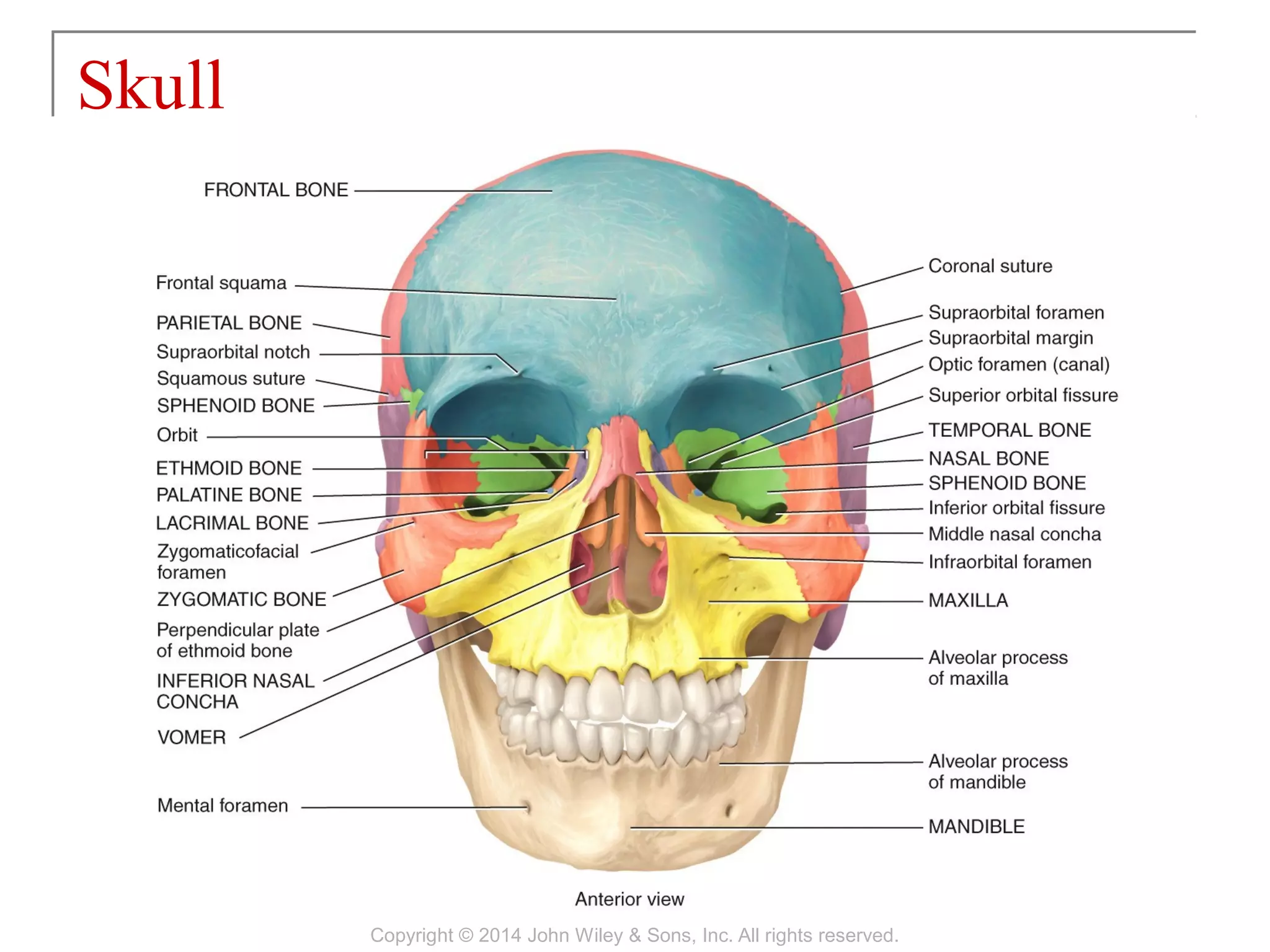
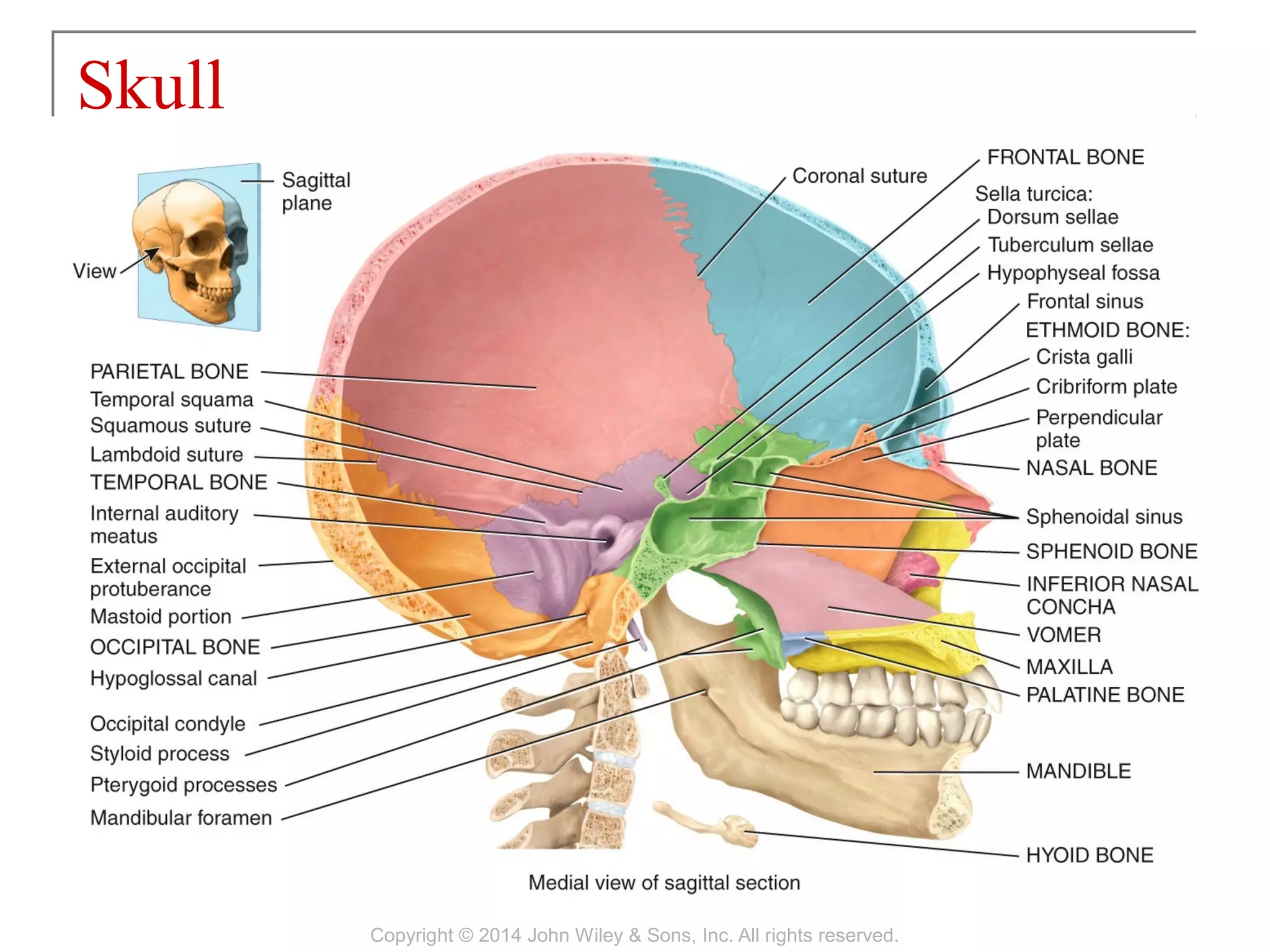
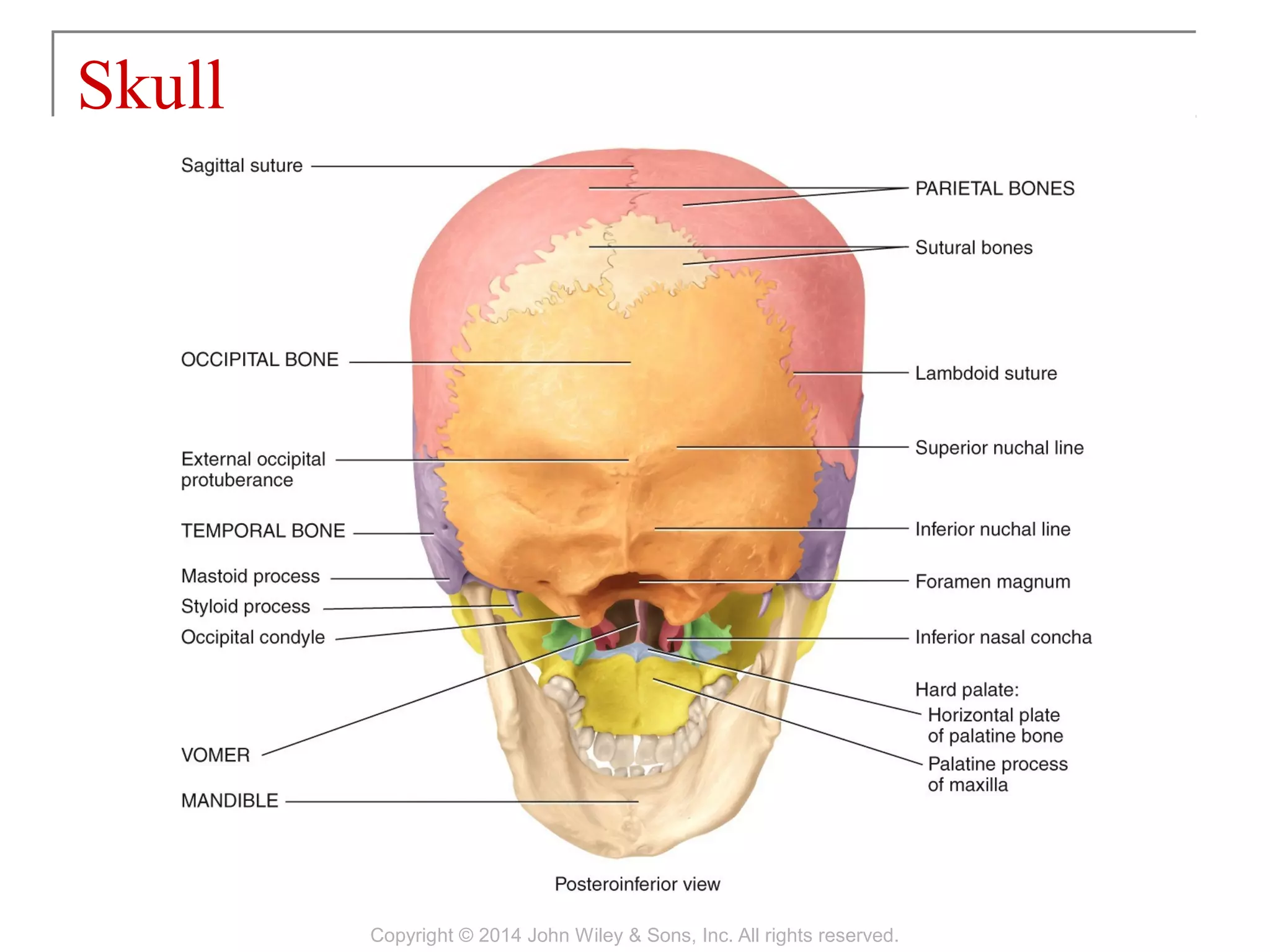
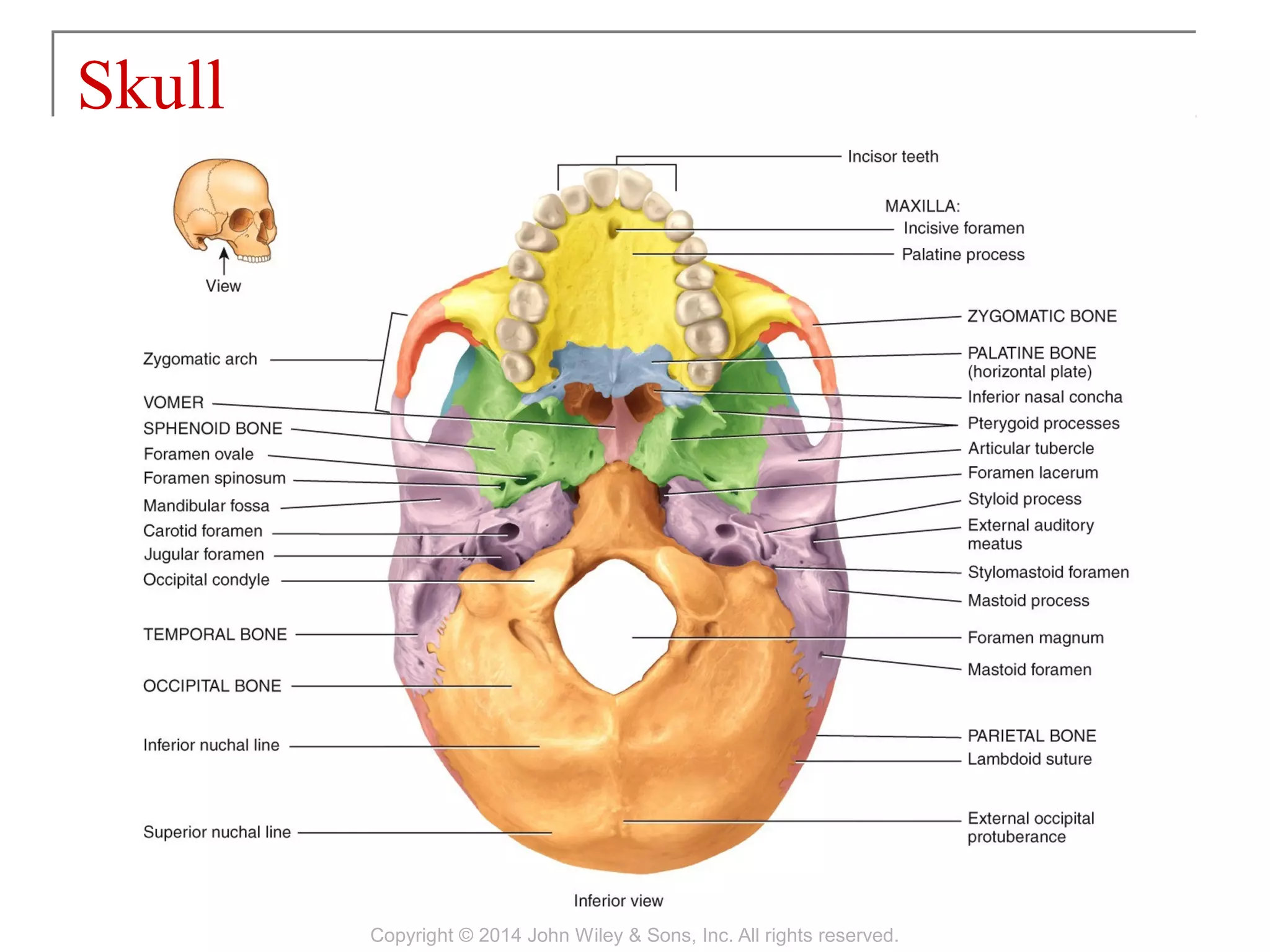
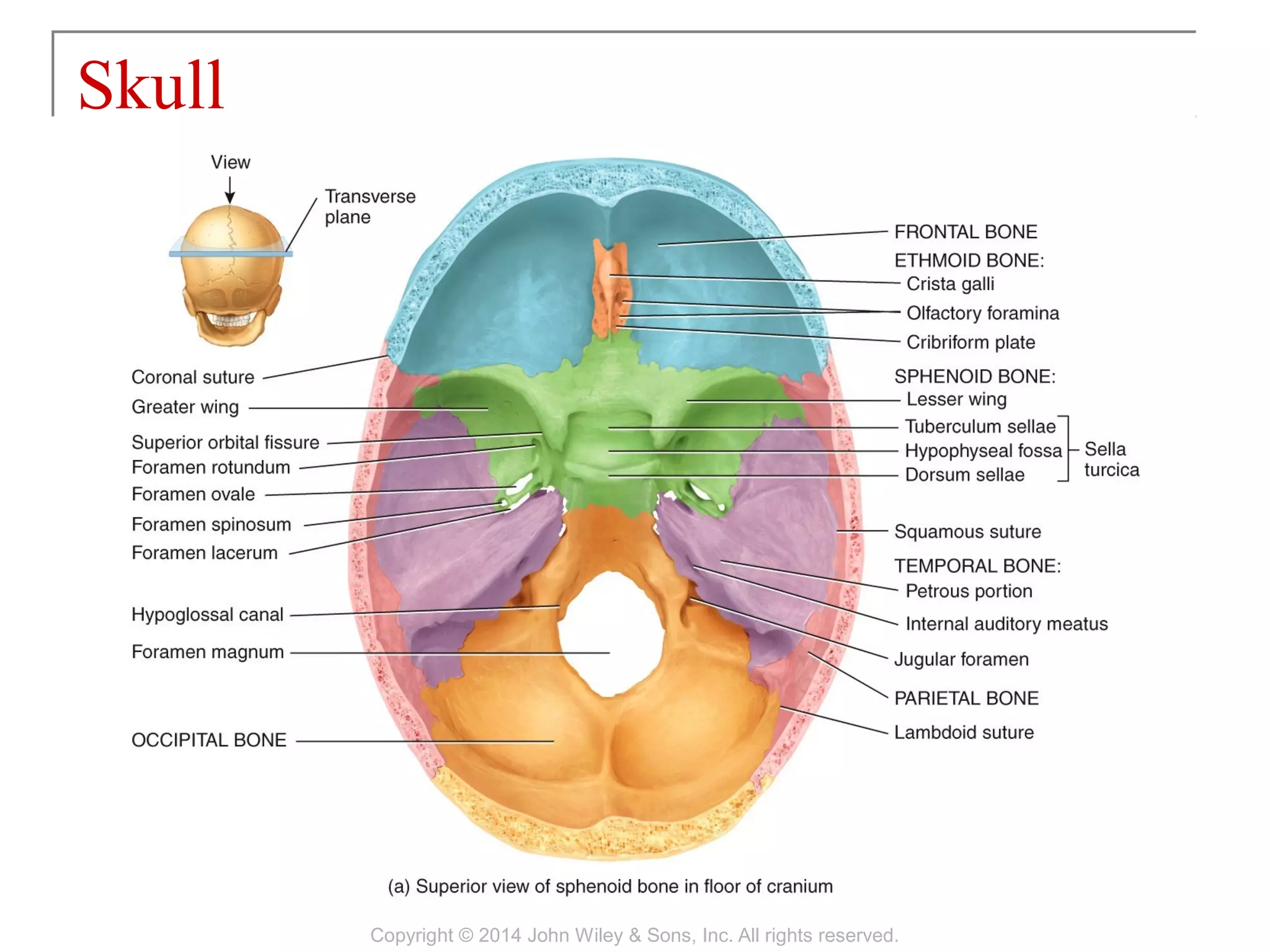
The skull contains 22 bones, not including
the 3 middle ear bones in both ears.
Associated with these bones are a number
of processes, ridges, lines, depressions and
foramen.
Skull
Copyright © 2014 John Wiley & Sons, Inc. All rights reserved.
Skull
Copyright © 2014 John Wiley & Sons, Inc. All rights reserved.
Skull
Copyright © 2014 John Wiley & Sons, Inc. All rights reserved.
Skull
Copyright © 2014 John Wiley & Sons, Inc. All rights reserved.
Skull
Copyright © 2014 John Wiley & Sons, Inc. All rights reserved.
Skull
Copyright © 2014 John Wiley & Sons, Inc. All rights reserved.
Skull
Copyright © 2014 John Wiley & Sons, Inc. All rights reserved.
The mandible (lower jawbone) is the largest
and strongest facial bone. Other than the
middle ear bones (auditory ossicles) it is the
only moveable skull bone.
The Mandible
Copyright © 2014 John Wiley & Sons, Inc. All rights reserved.
The paranasal sinuses are mucous
membrane-lined cavities in the frontal,
maxillary, sphenoid and ethmoid bones.
They are used as resonating (echo)
chambers to enhance the voice as well
as structures that increase the surface
area of the nasal mucosa and help to
moisten it as well.
The Paranasal Sinuses
Copyright © 2014 John Wiley & Sons, Inc. All rights reserved.
The Paranasal Sinuses
Copyright © 2014 John Wiley & Sons, Inc. All rights reserved.
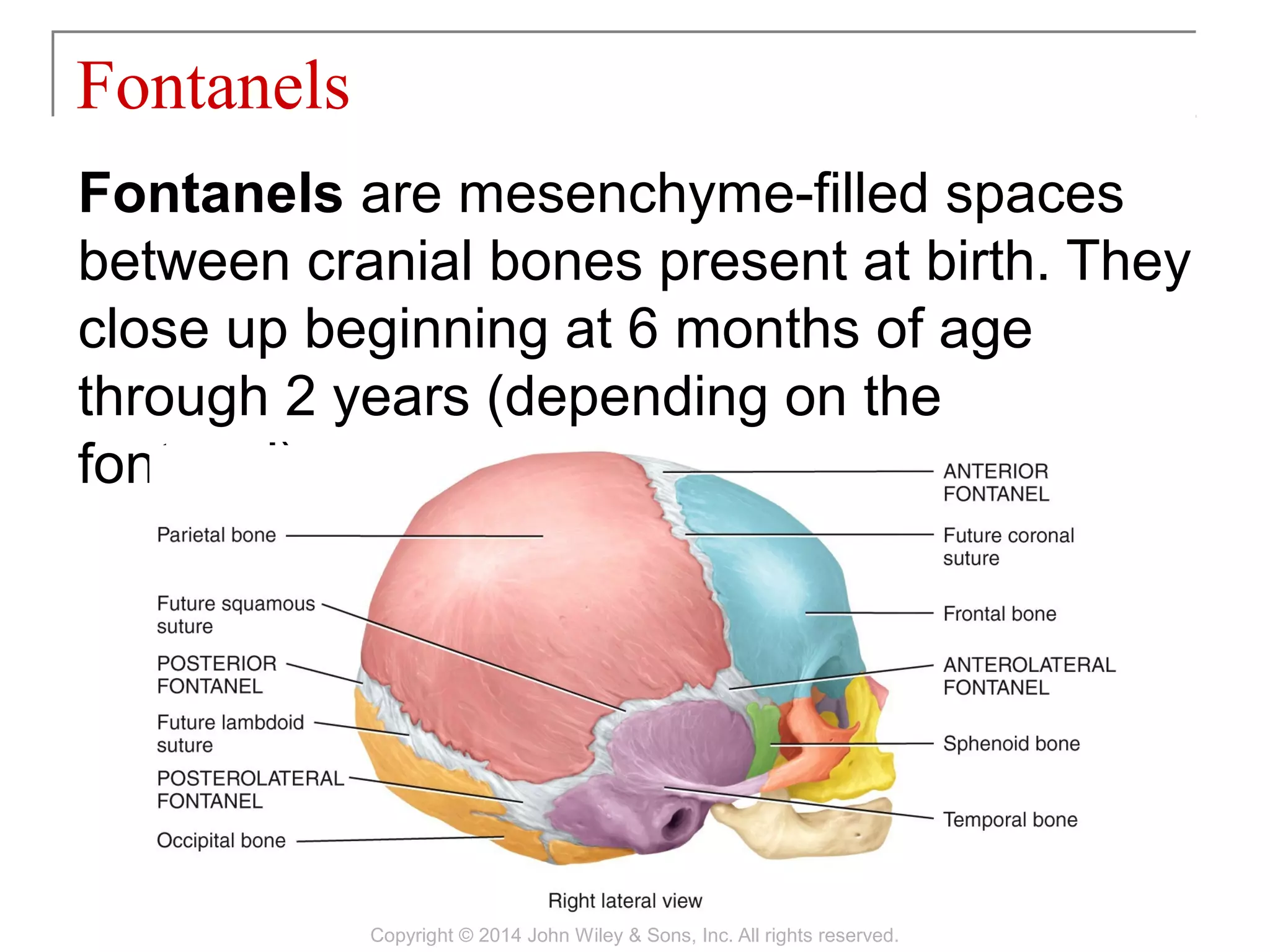
Fontanels are mesenchyme-filled spaces
between cranial bones present at birth. They
close up beginning at 6 months of age
through 2 years (depending on the
fontanel).
Fontanels
Copyright © 2014 John Wiley & Sons, Inc. All rights reserved.
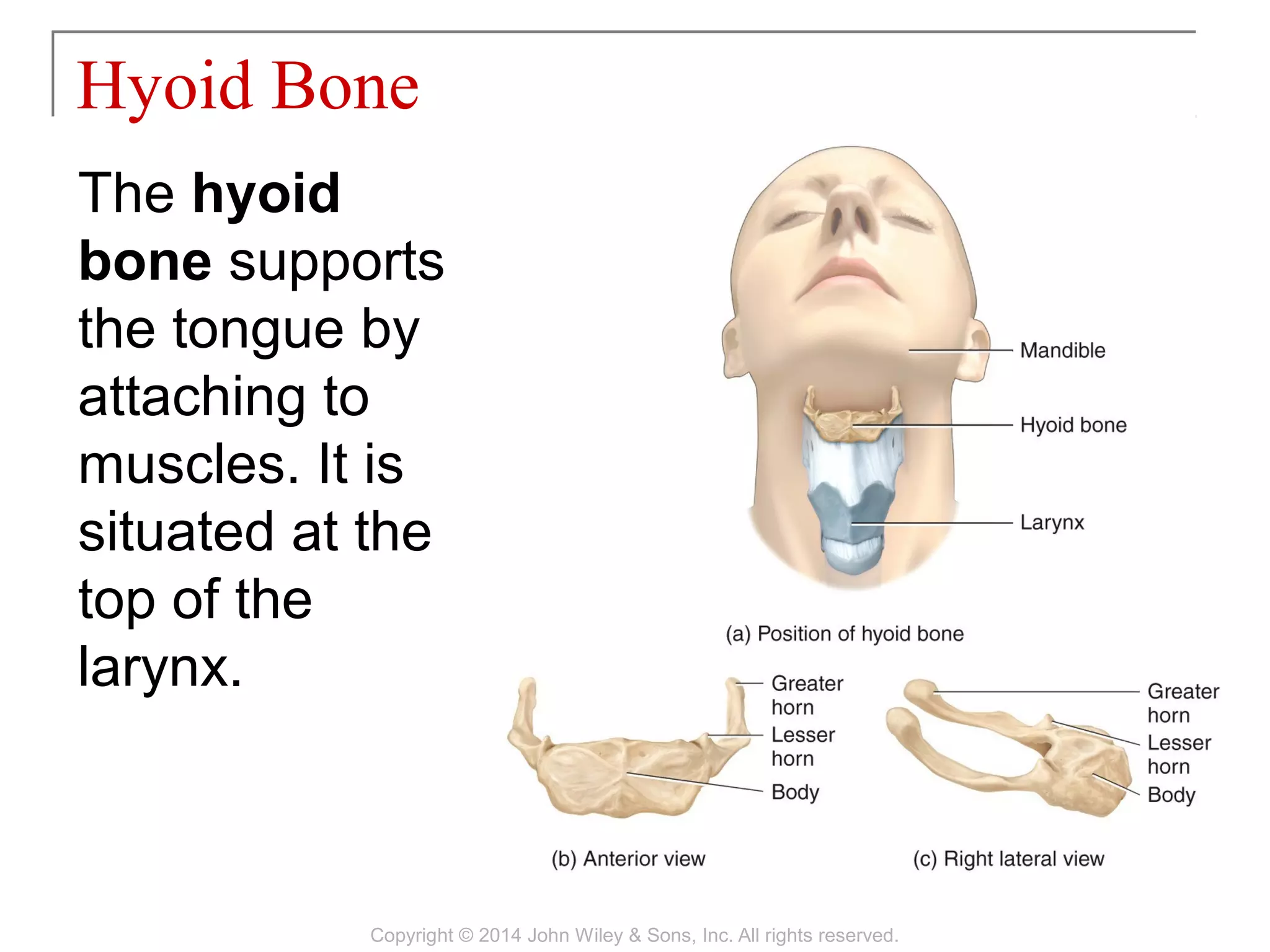
The hyoid
bone supports
the tongue by
attaching to
muscles. It is
situated at the
top of the
larynx.
Hyoid Bone
Copyright © 2014 John Wiley & Sons, Inc. All rights reserved.
The vertebral column is also
known as the spinal column,
backbone and spine. It is
made up of 26 vertebrae
divided into 5 regions. The
lower regions, the sacrum
(made up of 5 fused
vertebrae) and the coccyx
(made up of 4 fused
vertebrae) are not individual
bones as are the other 24
vertebrae. The column
protects the spinal cord.
The Vertebral Column
Copyright © 2014 John Wiley & Sons, Inc. All rights reserved.
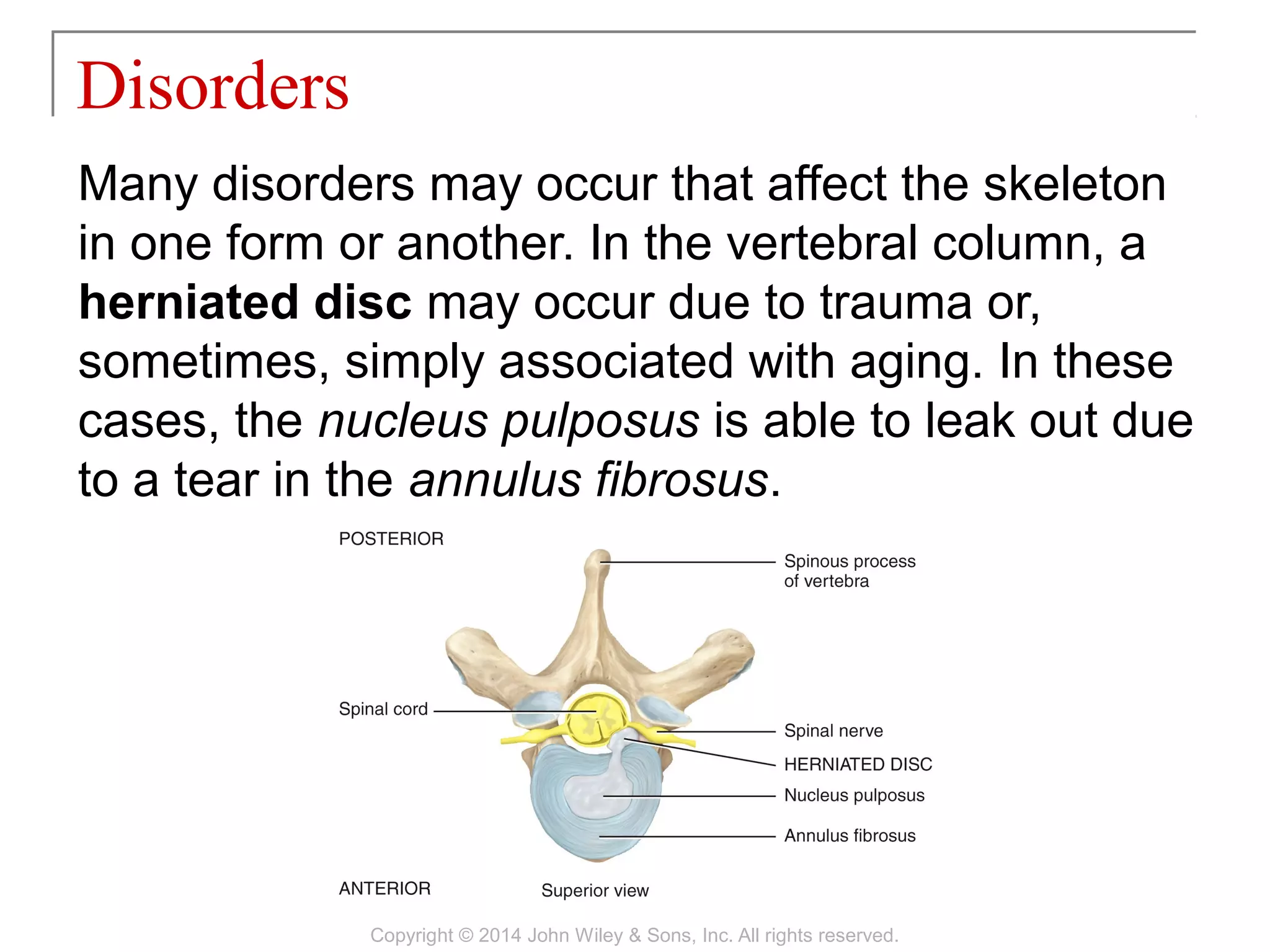
Intervertebral discs separate the vertebrae
from one another. They are located between
the bodies of the vertebrae from the second
cervical to the sacrum. Each disc has an outer
ring of fibrocartilage (annulus fibrosus) which
surrounds soft, pulpy nucleus (nucleus
pulposus). The top and bottom of each disc
has a layer of hyaline cartilage. They are used
to absorb shock and create spaces between
vertebrae.
The Vertebral Column
Copyright © 2014 John Wiley & Sons, Inc. All rights reserved.
The Vertebral Column
Copyright © 2014 John Wiley & Sons, Inc. All rights reserved.
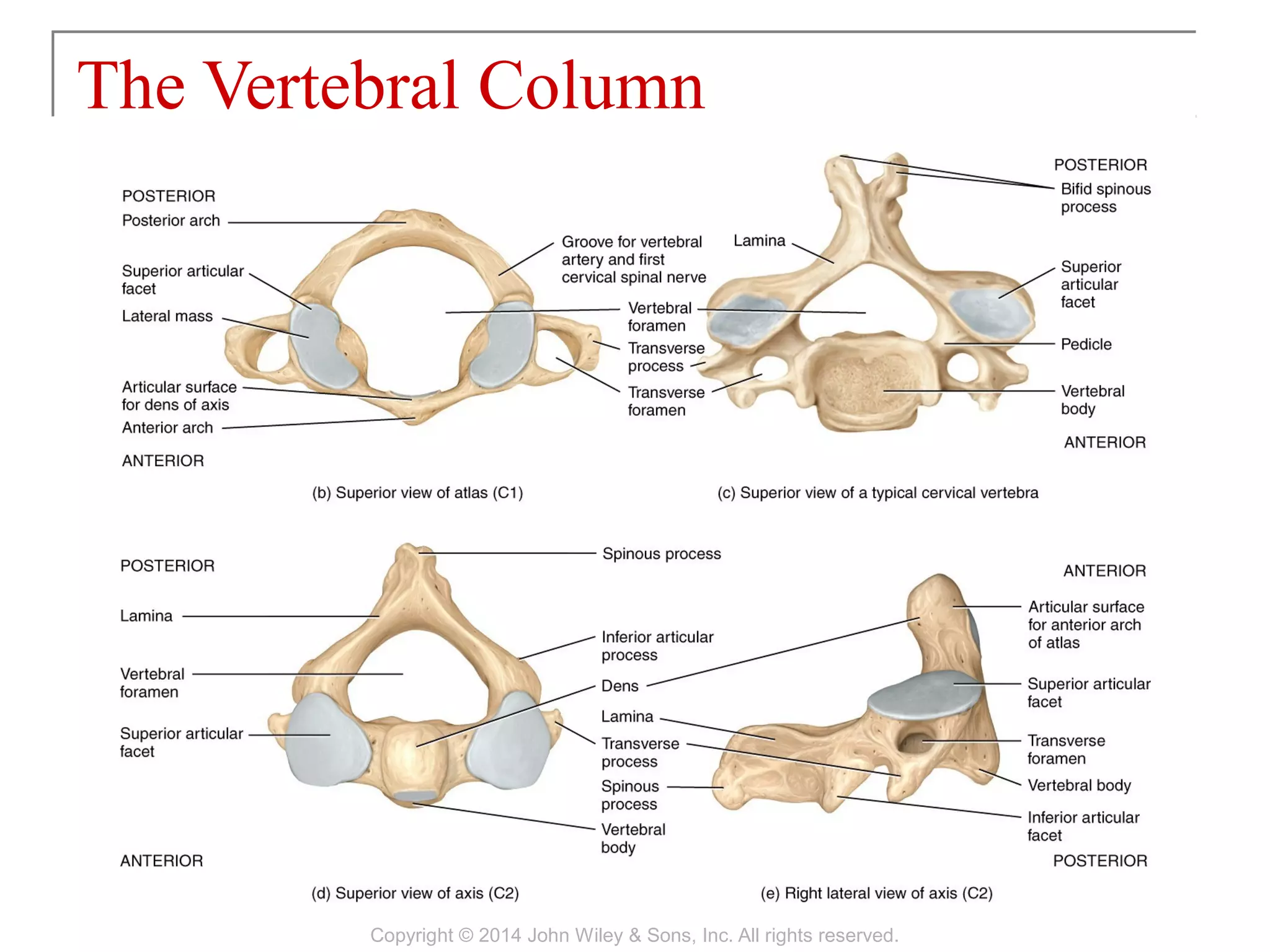
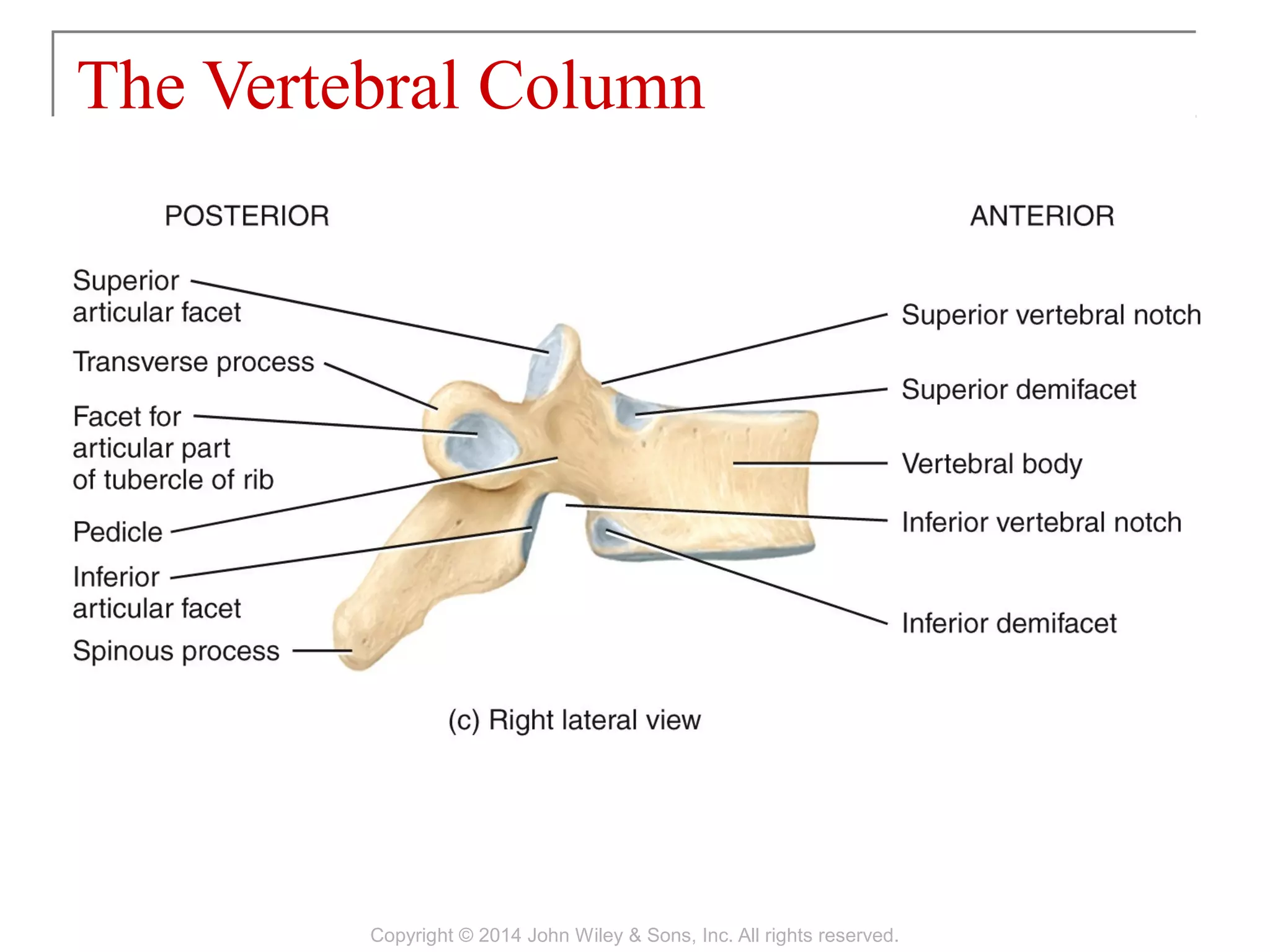
A typical vertebra is composed of several
parts. Vertebrae from each region, in
addition to containing common structures,
have unique structures that help to identify
which type they are. In addition, the first 2
cervical vertebrae are different from the
others in shape and function.
The Vertebral Column
Copyright © 2014 John Wiley & Sons, Inc. All rights reserved.
The Vertebral Column
Copyright © 2014 John Wiley & Sons, Inc. All rights reserved.
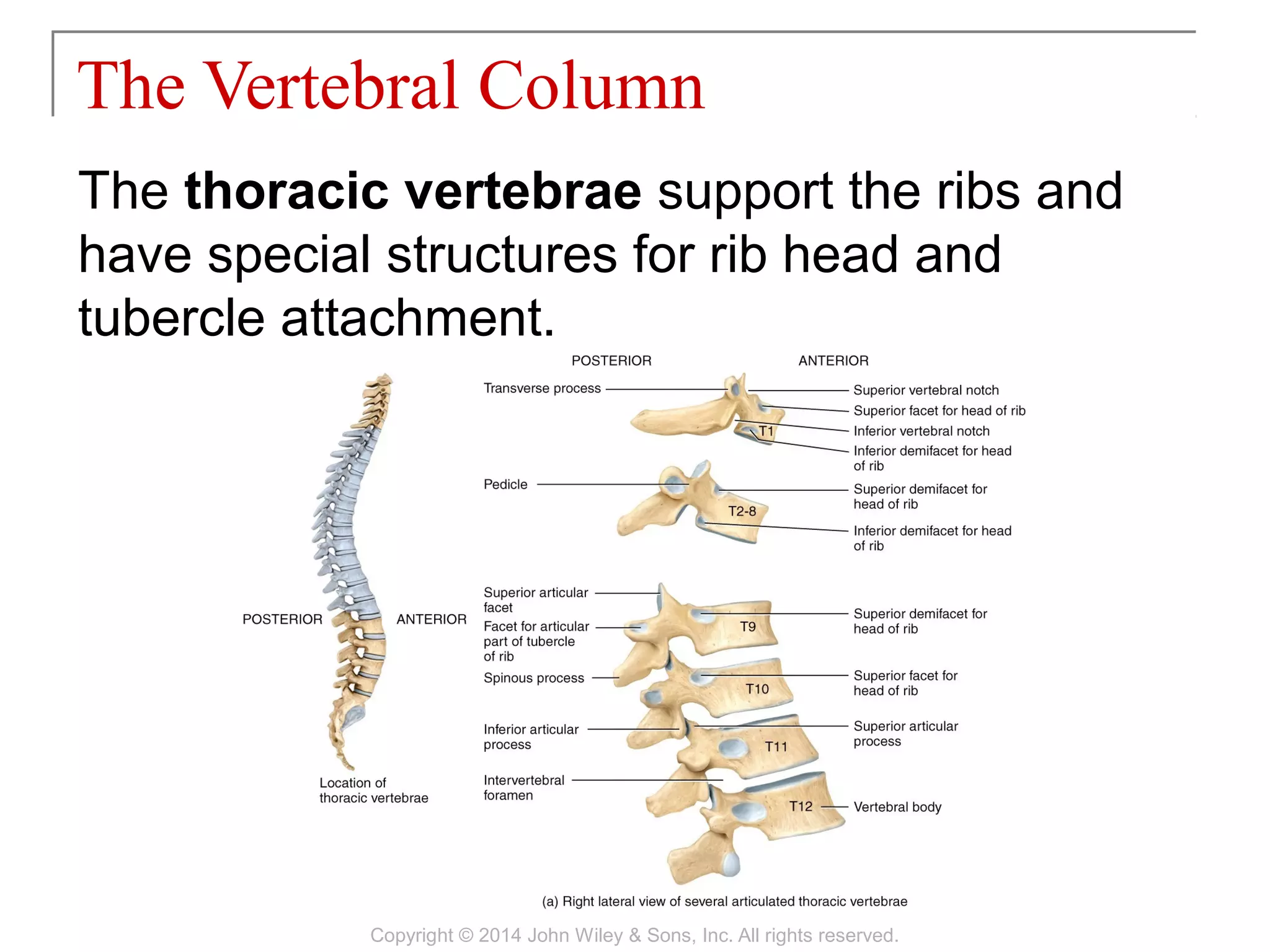
The thoracic vertebrae support the ribs and
have special structures for rib head and
tubercle attachment.
The Vertebral Column
Copyright © 2014 John Wiley & Sons, Inc. All rights reserved.
The Vertebral Column
Copyright © 2014 John Wiley & Sons, Inc. All rights reserved.
The lumbar vertebrae are the largest and
strongest in the vertebral column. They
support the body’s weight. There are no
special structures that are specifically
associated with these vertebrae.
The Vertebral Column
Copyright © 2014 John Wiley & Sons, Inc. All rights reserved.
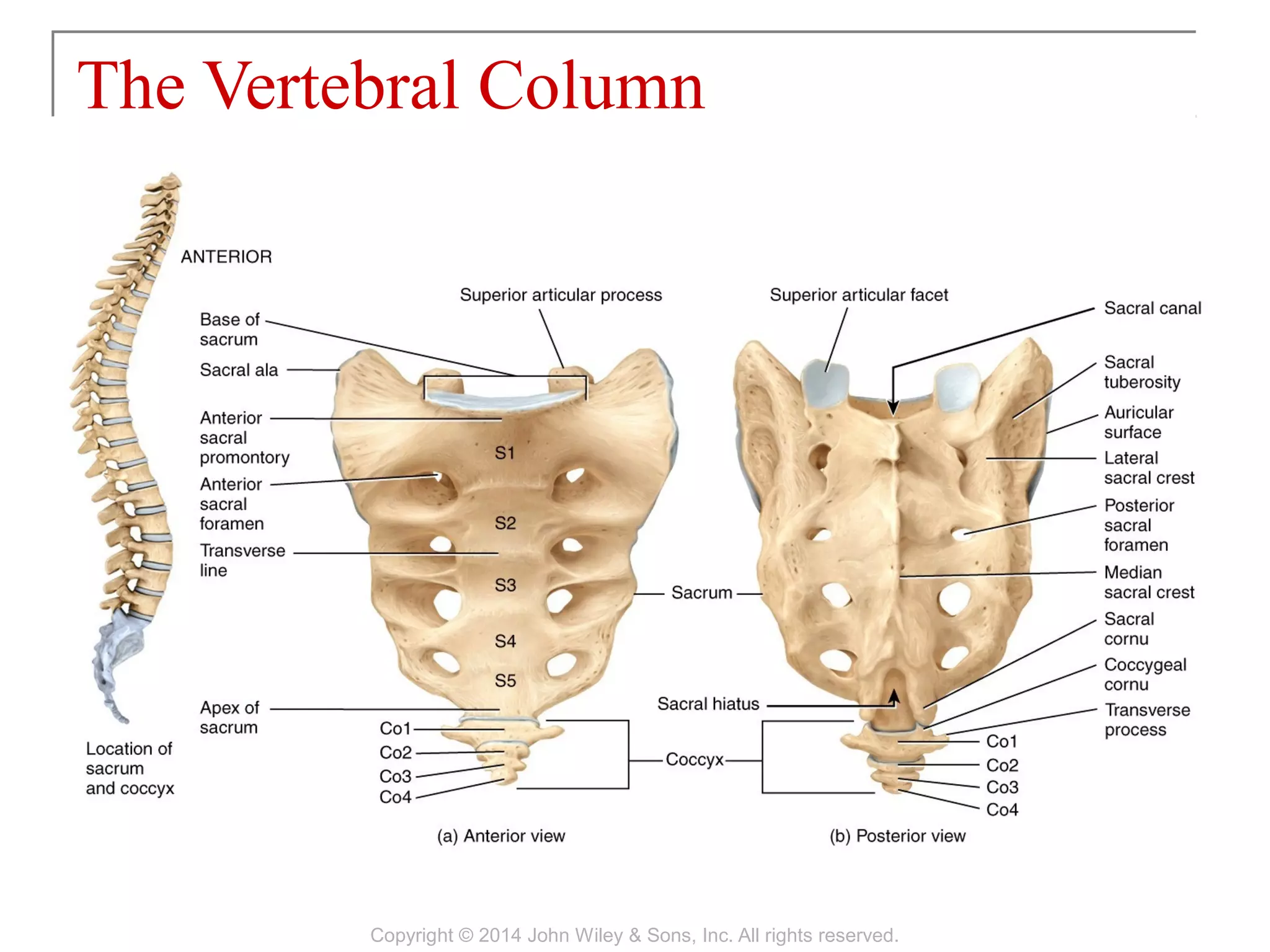
The triangular-shaped sacrum is composed
of 5 vertebrae that begin to fuse together
between 16 and 18 years of age. The
process ends at around 30 years of age. It
is part of the pelvic girdle.
The coccyx is also triangular in shape and
is composed of 4 vertebrae that fuse
together between 20 and 30 years of age.
The Vertebral Column
Copyright © 2014 John Wiley & Sons, Inc. All rights reserved.
The Vertebral Column
Copyright © 2014 John Wiley & Sons, Inc. All rights reserved.
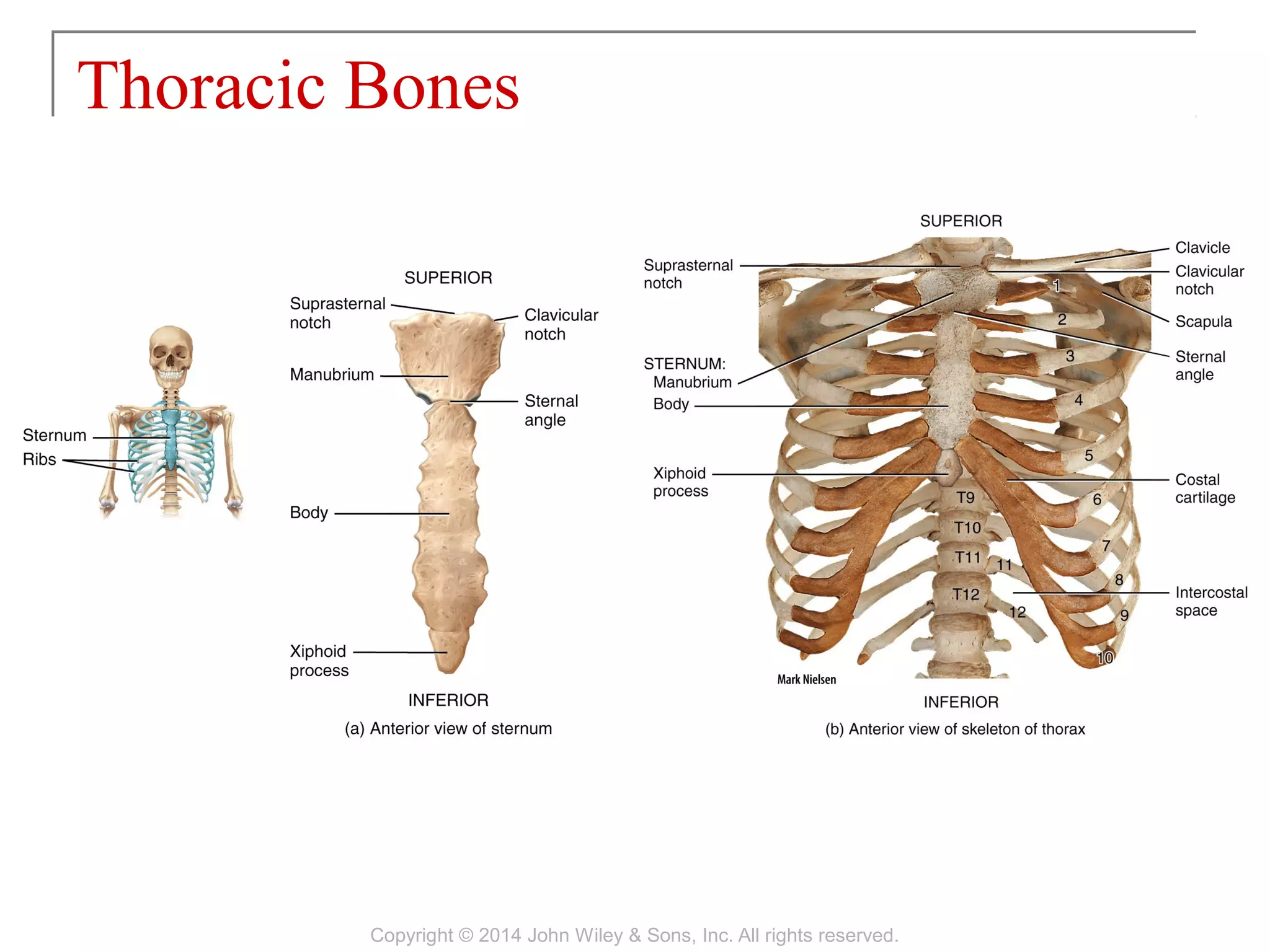
The sternum, or breastbone, is flat and is
located in the center of the anterior thoracic
wall. It is divided into three segments: The
upper manubrium, the middle body and the
lower xiphoid process. The three bones
usually fuse by 25 years of age. The
sternum articulates with the clavicles and
the costal cartilages from the ribs.
Thoracic Bones
Copyright © 2014 John Wiley & Sons, Inc. All rights reserved.
Thoracic Bones
Copyright © 2014 John Wiley & Sons, Inc. All rights reserved.
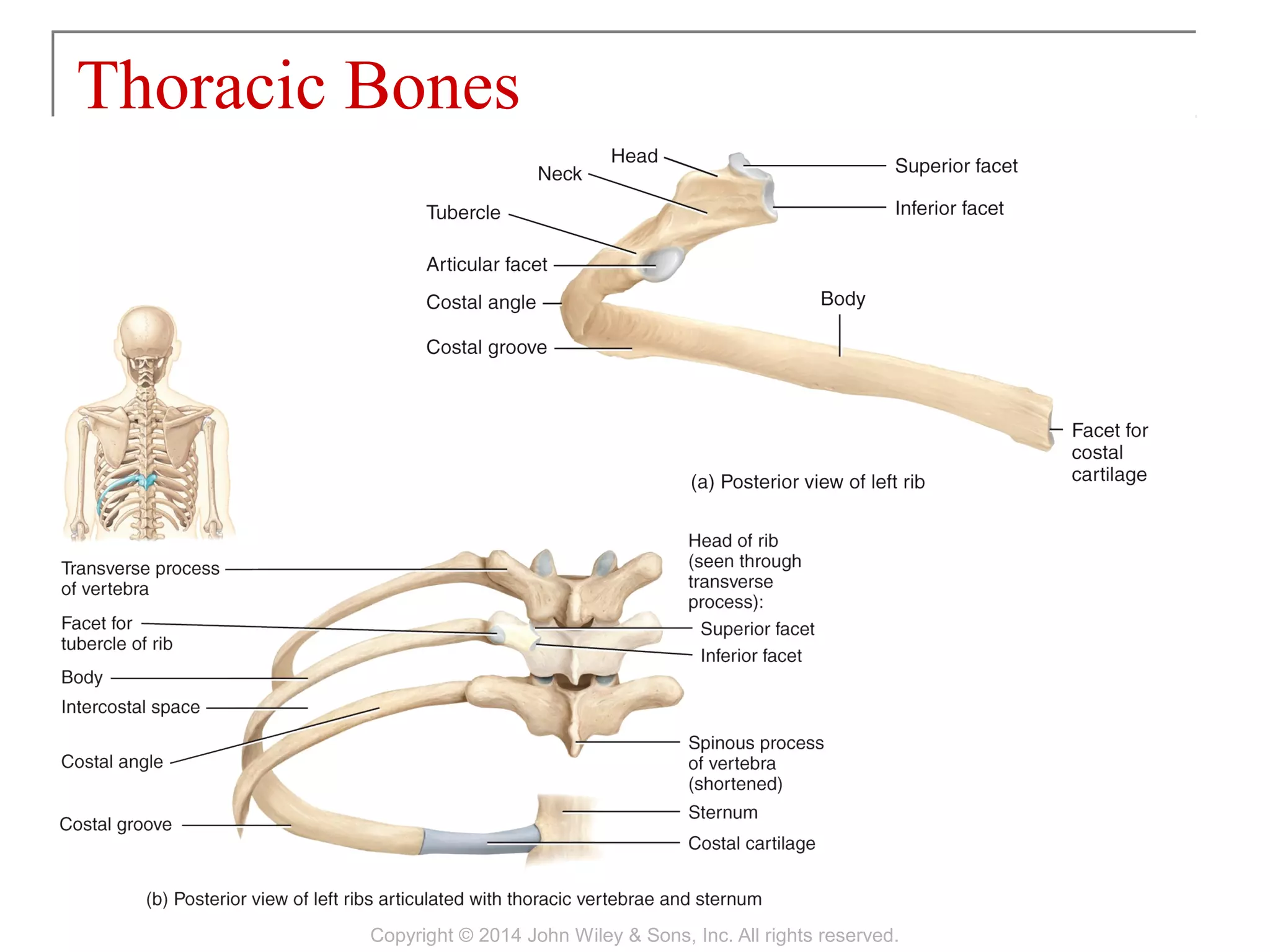
The ribs provide support to the thoracic cavity.
There are twelve pairs that extend from the thoracic
vertebrae to the sternum. The bony portion ends a
few inches from the sternum and is connected to
costal (hyaline) cartilage which attaches to the
sternum. The first 7 pairs are called the true ribs
because their cartilage is directly connected to the
sternum. The next 5 pairs are called false ribs
because their cartilage is indirectly connected to the
sternum (pairs 8–10) or not connected at all (pairs
11 and 12)
Thoracic Bones
Copyright © 2014 John Wiley & Sons, Inc. All rights reserved.
Thoracic Bones
Copyright © 2014 John Wiley & Sons, Inc. All rights reserved.
Many disorders may occur that affect the skeleton
in one form or another. In the vertebral column, a
herniated disc may occur due to trauma or,
sometimes, simply associated with aging. In these
cases, the nucleus pulposus is able to leak out due
to a tear in the annulus fibrosus.
Disorders
Copyright © 2014 John Wiley & Sons, Inc. All rights reserved.
At times, the normal curves of the spinal
column may become exaggerated. There
are many causes for these changes. These
curve-related pathologies include:
 Scoliosis (increased lateral curvature)
 Kyphosis (increased thoracic curve-bent forward)
 Lordosis (increased lumbar curve-bent
backwards)
Disorders
Copyright © 2014 John Wiley & Sons, Inc. All rights reserved.
Disorders
Copyright © 2014 John Wiley & Sons, Inc. All rights reserved.
Spina bifida is a congenital defect of the
vertebral column where the laminae do not
develop normally. The degrees of this
deformity vary from minor (spina bifida occulta)
to severe (spina bifida with
meningomyelocele). In the latter case, a
cystlike sac containing the meninges,
cerebrospinal fluid and the spinal cord and/or
its nerve roots protrudes from the spinal
column.
Disorders
Copyright © 2014 John Wiley & Sons, Inc. All rights reserved.
Spina bifida with meningomyelocele
Disorders
Copyright © 2014 John Wiley & Sons, Inc. All rights reserved.
Copyright 2014 John Wiley & Sons, Inc.
All rights reserved. Reproduction or translation of this
work beyond that permitted in section 117 of the 1976
United States Copyright Act without express
permission of the copyright owner is unlawful. Request
for further information should be addressed to the
Permission Department, John Wiley & Sons, Inc. The
purchaser may make back-up copies for his/her own
use only and not for distribution or resale. The
Publisher assumes no responsibility for errors,
omissions, or damages caused by the use of these
programs or from the use of the information herein.
End of Chapter 7
Copyright © 2014 John Wiley & Sons, Inc. All rights reserved.

07 [chapter 7 the skeletal system the axial skeleton]

  • 1.
    CHAPTER 7 The SkeletalSystem: The Axial Skeleton Principles of Anatomy and Physiology 14th Edition Copyright © 2014 John Wiley & Sons, Inc. All rights reserved.
  • 2.
    The human skeletonconsists of 206 named bones grouped into two principal divisions:  Axial skeleton (80 bones)  Appendicular skeleton (126 bones) Divisions of the Skeletal System Copyright © 2014 John Wiley & Sons, Inc. All rights reserved.
  • 3.
    The axial skeleton: Skull bones, auditory ossicles (ear bones), hyoid bone, ribs, sternum (breastbone), and bones of the vertebral column. The appendicular skeleton:  Bones of the upper and lower limbs (extremities) and the bones forming the girdles that connect the limbs to the axial skeleton. Divisions of the Skeletal System Copyright © 2014 John Wiley & Sons, Inc. All rights reserved.
  • 4.
    The Skeletal System Divisionsof the Skeletal System Copyright © 2014 John Wiley & Sons, Inc. All rights reserved. Anatomy Overview: You must be connected to the Internet and in Slideshow Mode to run this animation.
  • 5.
    Almost all bonesare classified into 5 main types based on shape:  Long (greater seed length than width  Short (cube shaped)  Flat (thin layers of parallel plates)  Irregular (complex shapes)  Sesamoid (shaped like a sesame seed ) Types of Bones Copyright © 2014 John Wiley & Sons, Inc. All rights reserved.
  • 6.
    Sutural bones aresmall, extra bone plates located within the sutures of cranial bones. Sutures are the jointed areas where flat bones come together. Types of Bones Copyright © 2014 John Wiley & Sons, Inc. All rights reserved.
  • 7.
    Bones have characteristicsurface markings – structural features adapted for specific functions. There are two major types of surface markings:  Depressions and openings  Allow the passage of soft tissues  Form joints  Processes  Projections or outgrowths that form joints  Serve as attachment points for ligaments and tendons Bone Surface Markings Copyright © 2014 John Wiley & Sons, Inc. All rights reserved.
  • 8.
    Fissure: Narrow slit betweenbones for passage of blood vessels or nerves. Bone Surface Markings Copyright © 2014 John Wiley & Sons, Inc. All rights reserved.
  • 9.
    Foramen: Hole for passageof blood vessels, nerves or ligaments. Bone Surface Markings Copyright © 2014 John Wiley & Sons, Inc. All rights reserved.
  • 10.
    Fossa: Shallow depression. Bone SurfaceMarkings Copyright © 2014 John Wiley & Sons, Inc. All rights reserved.
  • 11.
    Sulcus: Furrow ona bone for passage of blood vessel, nerve or tendon. Meatus: Tubelike opening Bone Surface Markings Copyright © 2014 John Wiley & Sons, Inc. All rights reserved.
  • 12.
    Condyle: Rounded projectionwith a smooth articular surface. Bone Surface Markings Copyright © 2014 John Wiley & Sons, Inc. All rights reserved.
  • 13.
    Facet: Smooth, flat,slightly concave articular surface. Bone Surface Markings Copyright © 2014 John Wiley & Sons, Inc. All rights reserved.
  • 14.
    Head: Usually roundedarticular process supported on a neck. Bone Surface Markings Copyright © 2014 John Wiley & Sons, Inc. All rights reserved.
  • 15.
    Crest: Prominent ridge or elongated process. BoneSurface Markings Copyright © 2014 John Wiley & Sons, Inc. All rights reserved.
  • 16.
    Epicondyle: Usually roughened projection ona condyle. Line: Long, narrow ridge or border (less prominent than a crest Bone Surface Markings Copyright © 2014 John Wiley & Sons, Inc. All rights reserved.
  • 17.
    Spinous process: Sharp,slender projection. Bone Surface Markings Copyright © 2014 John Wiley & Sons, Inc. All rights reserved.
  • 18.
    Trochanter: Very large projection foundONLY on the femur. Tubercle: Variably sized rounded projection. Bone Surface Markings Copyright © 2014 John Wiley & Sons, Inc. All rights reserved.
  • 19.
    Tuberosity: Variably sizedprojection with rough, bumpy surface. Bone Surface Markings Copyright © 2014 John Wiley & Sons, Inc. All rights reserved.
  • 20.
    The skull contains22 bones, not including the 3 middle ear bones in both ears. Associated with these bones are a number of processes, ridges, lines, depressions and foramen. Skull Copyright © 2014 John Wiley & Sons, Inc. All rights reserved.
  • 21.
    Skull Copyright © 2014John Wiley & Sons, Inc. All rights reserved.
  • 22.
    Skull Copyright © 2014John Wiley & Sons, Inc. All rights reserved.
  • 23.
    Skull Copyright © 2014John Wiley & Sons, Inc. All rights reserved.
  • 24.
    Skull Copyright © 2014John Wiley & Sons, Inc. All rights reserved.
  • 25.
    Skull Copyright © 2014John Wiley & Sons, Inc. All rights reserved.
  • 26.
    Skull Copyright © 2014John Wiley & Sons, Inc. All rights reserved.
  • 27.
    The mandible (lowerjawbone) is the largest and strongest facial bone. Other than the middle ear bones (auditory ossicles) it is the only moveable skull bone. The Mandible Copyright © 2014 John Wiley & Sons, Inc. All rights reserved.
  • 28.
    The paranasal sinusesare mucous membrane-lined cavities in the frontal, maxillary, sphenoid and ethmoid bones. They are used as resonating (echo) chambers to enhance the voice as well as structures that increase the surface area of the nasal mucosa and help to moisten it as well. The Paranasal Sinuses Copyright © 2014 John Wiley & Sons, Inc. All rights reserved.
  • 29.
    The Paranasal Sinuses Copyright© 2014 John Wiley & Sons, Inc. All rights reserved.
  • 30.
    Fontanels are mesenchyme-filledspaces between cranial bones present at birth. They close up beginning at 6 months of age through 2 years (depending on the fontanel). Fontanels Copyright © 2014 John Wiley & Sons, Inc. All rights reserved.
  • 31.
    The hyoid bone supports thetongue by attaching to muscles. It is situated at the top of the larynx. Hyoid Bone Copyright © 2014 John Wiley & Sons, Inc. All rights reserved.
  • 32.
    The vertebral columnis also known as the spinal column, backbone and spine. It is made up of 26 vertebrae divided into 5 regions. The lower regions, the sacrum (made up of 5 fused vertebrae) and the coccyx (made up of 4 fused vertebrae) are not individual bones as are the other 24 vertebrae. The column protects the spinal cord. The Vertebral Column Copyright © 2014 John Wiley & Sons, Inc. All rights reserved.
  • 33.
    Intervertebral discs separatethe vertebrae from one another. They are located between the bodies of the vertebrae from the second cervical to the sacrum. Each disc has an outer ring of fibrocartilage (annulus fibrosus) which surrounds soft, pulpy nucleus (nucleus pulposus). The top and bottom of each disc has a layer of hyaline cartilage. They are used to absorb shock and create spaces between vertebrae. The Vertebral Column Copyright © 2014 John Wiley & Sons, Inc. All rights reserved.
  • 34.
    The Vertebral Column Copyright© 2014 John Wiley & Sons, Inc. All rights reserved.
  • 35.
    A typical vertebrais composed of several parts. Vertebrae from each region, in addition to containing common structures, have unique structures that help to identify which type they are. In addition, the first 2 cervical vertebrae are different from the others in shape and function. The Vertebral Column Copyright © 2014 John Wiley & Sons, Inc. All rights reserved.
  • 36.
    The Vertebral Column Copyright© 2014 John Wiley & Sons, Inc. All rights reserved.
  • 37.
    The thoracic vertebraesupport the ribs and have special structures for rib head and tubercle attachment. The Vertebral Column Copyright © 2014 John Wiley & Sons, Inc. All rights reserved.
  • 38.
    The Vertebral Column Copyright© 2014 John Wiley & Sons, Inc. All rights reserved.
  • 39.
    The lumbar vertebraeare the largest and strongest in the vertebral column. They support the body’s weight. There are no special structures that are specifically associated with these vertebrae. The Vertebral Column Copyright © 2014 John Wiley & Sons, Inc. All rights reserved.
  • 40.
    The triangular-shaped sacrumis composed of 5 vertebrae that begin to fuse together between 16 and 18 years of age. The process ends at around 30 years of age. It is part of the pelvic girdle. The coccyx is also triangular in shape and is composed of 4 vertebrae that fuse together between 20 and 30 years of age. The Vertebral Column Copyright © 2014 John Wiley & Sons, Inc. All rights reserved.
  • 41.
    The Vertebral Column Copyright© 2014 John Wiley & Sons, Inc. All rights reserved.
  • 42.
    The sternum, orbreastbone, is flat and is located in the center of the anterior thoracic wall. It is divided into three segments: The upper manubrium, the middle body and the lower xiphoid process. The three bones usually fuse by 25 years of age. The sternum articulates with the clavicles and the costal cartilages from the ribs. Thoracic Bones Copyright © 2014 John Wiley & Sons, Inc. All rights reserved.
  • 43.
    Thoracic Bones Copyright ©2014 John Wiley & Sons, Inc. All rights reserved.
  • 44.
    The ribs providesupport to the thoracic cavity. There are twelve pairs that extend from the thoracic vertebrae to the sternum. The bony portion ends a few inches from the sternum and is connected to costal (hyaline) cartilage which attaches to the sternum. The first 7 pairs are called the true ribs because their cartilage is directly connected to the sternum. The next 5 pairs are called false ribs because their cartilage is indirectly connected to the sternum (pairs 8–10) or not connected at all (pairs 11 and 12) Thoracic Bones Copyright © 2014 John Wiley & Sons, Inc. All rights reserved.
  • 45.
    Thoracic Bones Copyright ©2014 John Wiley & Sons, Inc. All rights reserved.
  • 46.
    Many disorders mayoccur that affect the skeleton in one form or another. In the vertebral column, a herniated disc may occur due to trauma or, sometimes, simply associated with aging. In these cases, the nucleus pulposus is able to leak out due to a tear in the annulus fibrosus. Disorders Copyright © 2014 John Wiley & Sons, Inc. All rights reserved.
  • 47.
    At times, thenormal curves of the spinal column may become exaggerated. There are many causes for these changes. These curve-related pathologies include:  Scoliosis (increased lateral curvature)  Kyphosis (increased thoracic curve-bent forward)  Lordosis (increased lumbar curve-bent backwards) Disorders Copyright © 2014 John Wiley & Sons, Inc. All rights reserved.
  • 48.
    Disorders Copyright © 2014John Wiley & Sons, Inc. All rights reserved.
  • 49.
    Spina bifida isa congenital defect of the vertebral column where the laminae do not develop normally. The degrees of this deformity vary from minor (spina bifida occulta) to severe (spina bifida with meningomyelocele). In the latter case, a cystlike sac containing the meninges, cerebrospinal fluid and the spinal cord and/or its nerve roots protrudes from the spinal column. Disorders Copyright © 2014 John Wiley & Sons, Inc. All rights reserved.
  • 50.
    Spina bifida withmeningomyelocele Disorders Copyright © 2014 John Wiley & Sons, Inc. All rights reserved.
  • 51.
    Copyright 2014 JohnWiley & Sons, Inc. All rights reserved. Reproduction or translation of this work beyond that permitted in section 117 of the 1976 United States Copyright Act without express permission of the copyright owner is unlawful. Request for further information should be addressed to the Permission Department, John Wiley & Sons, Inc. The purchaser may make back-up copies for his/her own use only and not for distribution or resale. The Publisher assumes no responsibility for errors, omissions, or damages caused by the use of these programs or from the use of the information herein. End of Chapter 7 Copyright © 2014 John Wiley & Sons, Inc. All rights reserved.

Editor's Notes

  • #2 <number>
  • #5 <number>
  • #6 <number>
  • #7 <number>