CHAPTER FIVE
TEXT
CHAPTER HIGHLIGHTS
• Text tradition.
• Codes for computer text.
• Font technologies.
• Multimedia text.
• Guidelines for use of text in multimedia.
2
POWERS OF TEXT
• Multimedia developers value text for:
– Universality
– Clarity
– Efficiency
– Powers of abstraction, engagement, and
suggestion.
• Developers can explore new uses for text in a
media-rich environment.
3
TEXT TRADITION
Text properties are grounded in the print
tradition.
• Typeface is a family of characters sharing a
common design.
– Arial
– Chicago
– New York
– Palatino
4
5
TEXT TRADITION
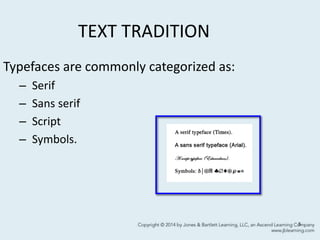
Typefaces are commonly categorized as:
– Serif
– Sans serif
– Script
– Symbols.
TEXT TRADITION
• Style: appearance of characters such as:
– Bold
– Italic
– Underline.
• Point size: measure of type size.
6
Point is approximately 1/72 of
an inch.
Pica is 12 points
6 picas = 1 inch.
TEXT TRADITION
• Font
– Complete set of characters of a particular typeface,
style, and size.
– Monospaced fonts: same width assigned to each
character.
– Proportional fonts: adjust width based on shape.
• Case
– Upper and lower case.
7
A a
TEXT TRADITION
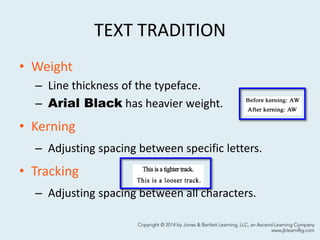
• Weight
– Line thickness of the typeface.
– Arial Black has heavier weight.
• Kerning
– Adjusting spacing between specific letters.
• Tracking
– Adjusting spacing between all characters.
8
TEXT TRADITION
• Condensed/extended text
– Narrow width of text / widen width of text.
• Leading
– Spacing between lines.
• Alignment & Justification
– Alignment positions text relative to document's
margins.
– Justification adjusts line length to produce straight
edges on left and right margins.
9
COMPUTER TEXT
10
FROM PRINTED CHARACTERS TO
DIGITAL TEXT.
COMPUTER TEXT CODES
• Coding schemes assign a group of binary
numbers to represent a digital character.
• ASCII
– 7-bit code = 128 characters.
– Extended ASCII or ASCII-8
= 256 characters.
• All computers understand ASCII.
11
American Standard Code for Information Interchange
COMPUTER TEXT CODES
• RTF (Rich Text Format)
– Developed by Microsoft for cross platform text
files.
– Reproduces the formatting of original file.
• Unicode
– New standard 16 bit code that provides for more
than 65,000 characters.
– Goal is to include multilingual text
in a digital coding standard.
12
View IT
Unicode
project.
FONT TECHNOLOGIES
• Two techniques for displaying text on
computer:
– Bitmapped fonts
– Outline fonts.
13
BITMAPPED FONTS
• Pixels that make the letter are described by a
binary code, or a "mapping" of the character.
– Every character is stored as a bitmapped letter,
number, or symbol.
– Require large memory and storage capacity.
14
BITMAPPED FONTS
• Advantages
– Precise control over letter appearance.
– Letters can be edited at pixel level.
• Disadvantages
– Letters can't be easily scaled.
– Requires separate bitmaps for each typeface, style,
and point size to be used.
– Requires large storage capacities.
– Limits flexibility in use of text fonts to those stored on
the computer.
15
OUTLINE FONTS
• Store a description of the character to be
displayed.
– Description is a series of commands to create the
letter on the computer display.
• Outline font technology:
– Adobe Postscript
– TrueType.
16
OUTLINE FONTS
• Advantages
– Fonts are easily scaled.
– Requires smaller storage capacity.
• Disadvantages
– Commands can't be edited to create unique
characters.
– Font families are controlled through license of
Postscript and TrueType fonts.
17
JAGGIES and TEXT
• Text is displayed on a monitor as a pattern of
pixels.
– Pixels are generally very small squares.
– Squares can display straight lines with smooth
edges.
– Squares that display curved or diagonal lines
produce a stair-stepped effect called JAGGIES.
18
ANTI-ALIASING THE JAGGIES
• Jaggies produce an alias of the true character.
• Anti-aliasing creates a smooth edge by
blending the color of the text with the color of
the background.
19
INSTALLED FONTS — THE PROBLEM
• ASCII and Unicode are standard.
• Fonts are not standardized across computer
platforms.
– If the font is not available on the computer, it will
substitute one that is.
– The result may not be acceptable.
• Solution
– Use only widely available fonts.
– Package the unique font with the application.
20
MULTIMEDIA TEXT
• Two main forms:
– Editable: text produced by word processors or text
editors.
• Easy to alter content.
• Can search and spell check.
– Graphics: image of text that can be manipulated
to produce a wide range of artistic effects.
• Make original word picture.
• Solves problem of installed fonts.
21
MULTIMEDIA TEXT and SOUND
• Speech recognition: software analyzes human
speech and converts words to editable text.
– Requires specialized "intelligent" software.
– Accuracy may depend on training and speaker's
voice.
• Speech synthesis: software analyzes text and
reproduces it as spoken words.
22
TEXT & INTERACTIVITY
• Hypertext is linked text.
– User interacts with links to trace relationships of
words and ideas created by the author.
• Structure consists of:
– Nodes
– Link anchor
– Link markers
• Hypermedia is an information structure based
on linked media.
23
Hyperlink
text can
take you
places.
TEXT FOR THE WWW
• HTML: hypertext markup language.
– Contains "tags" used to specify the structure of the
document and format the text and media.
– Browser interprets the "tags" and displays the "page"
on a client computer.
• HTML limitations:
– Limited set of tags to create a page.
– Difficult to precisely define a page appearance.
• Some browsers and client computers may present the html
page differently from other browsers.
24
CSS & XHTML
• Cascading Style Sheets (CSS).
– An addition to HTML
– Separates content of page from formatting
commands
– Easier to edit and maintain consistent appearance
of a site.
• eXtensible HTML (XHTML)
– A blending of HTML and XML
– XML supports more powerful data manipulation.
– XHTML improves page display on mobile devices.
25
PORTABLE DOCUMENT FORMAT
• PDF files maintain original formatting of
documents across computer platforms.
– Platform and application independent.
– Support multiple media and user interaction.
– Require a reader program to view the file and an
application to convert a document to pdf format.
• Adobe Acrobat Reader is a free download.
• PDFCreator is a free open source converter.
26
ADDING TEXT TO MULTIMEDIA
APPLICATION
Several methods to incorporate text in an
authoring application.
– Direct entry in a text box or text field.
– Copy and paste from existing text source.
– File import for large text files.
– Scan text with OCR application for text that exists
only in print media.
• Optical Character Recognition accuracy will vary based
on fonts and quality of source material.
27
GUIDELINES for TEXT
in Multimedia Applications
• Be selective.
• Be brief.
• Make text readable.
• Be consistent.
• Be careful
• Be respectful.
• Combine text with other media.
• Make text interactive.
28
WRAP UP
• Traditional text features.
• Computer text codes.
• Font technologies.
• Multimedia text.
• Adding text to multimedia applications.
• Guidelines for using text.
29
KEY TERM CHECK UP
30
Alignment
Anti-aliasing
ASCII
Bitmapped fonts
Browser
Case
Condensedtext
Editable text
Extendedtext
Font
Font technologies
Graphics text
HTML
Hypermedia
Hypertext
Jaggies
Justification
Kerning
Leading
Link anchor
Link markers
Monospaced font
Nodes
OCR
Outline fonts
PDF
Point
Proportional font
RTF
Sans serif
Serif
Speech recognition
Speech synthesis
Style
Tracking
Typeface
Unicode
Weight
XHTML
XML

Chapter Five

  • 1.
  • 2.
    CHAPTER HIGHLIGHTS • Texttradition. • Codes for computer text. • Font technologies. • Multimedia text. • Guidelines for use of text in multimedia. 2
  • 3.
    POWERS OF TEXT •Multimedia developers value text for: – Universality – Clarity – Efficiency – Powers of abstraction, engagement, and suggestion. • Developers can explore new uses for text in a media-rich environment. 3
  • 4.
    TEXT TRADITION Text propertiesare grounded in the print tradition. • Typeface is a family of characters sharing a common design. – Arial – Chicago – New York – Palatino 4
  • 5.
    5 TEXT TRADITION Typefaces arecommonly categorized as: – Serif – Sans serif – Script – Symbols.
  • 6.
    TEXT TRADITION • Style:appearance of characters such as: – Bold – Italic – Underline. • Point size: measure of type size. 6 Point is approximately 1/72 of an inch. Pica is 12 points 6 picas = 1 inch.
  • 7.
    TEXT TRADITION • Font –Complete set of characters of a particular typeface, style, and size. – Monospaced fonts: same width assigned to each character. – Proportional fonts: adjust width based on shape. • Case – Upper and lower case. 7 A a
  • 8.
    TEXT TRADITION • Weight –Line thickness of the typeface. – Arial Black has heavier weight. • Kerning – Adjusting spacing between specific letters. • Tracking – Adjusting spacing between all characters. 8
  • 9.
    TEXT TRADITION • Condensed/extendedtext – Narrow width of text / widen width of text. • Leading – Spacing between lines. • Alignment & Justification – Alignment positions text relative to document's margins. – Justification adjusts line length to produce straight edges on left and right margins. 9
  • 10.
    COMPUTER TEXT 10 FROM PRINTEDCHARACTERS TO DIGITAL TEXT.
  • 11.
    COMPUTER TEXT CODES •Coding schemes assign a group of binary numbers to represent a digital character. • ASCII – 7-bit code = 128 characters. – Extended ASCII or ASCII-8 = 256 characters. • All computers understand ASCII. 11 American Standard Code for Information Interchange
  • 12.
    COMPUTER TEXT CODES •RTF (Rich Text Format) – Developed by Microsoft for cross platform text files. – Reproduces the formatting of original file. • Unicode – New standard 16 bit code that provides for more than 65,000 characters. – Goal is to include multilingual text in a digital coding standard. 12 View IT Unicode project.
  • 13.
    FONT TECHNOLOGIES • Twotechniques for displaying text on computer: – Bitmapped fonts – Outline fonts. 13
  • 14.
    BITMAPPED FONTS • Pixelsthat make the letter are described by a binary code, or a "mapping" of the character. – Every character is stored as a bitmapped letter, number, or symbol. – Require large memory and storage capacity. 14
  • 15.
    BITMAPPED FONTS • Advantages –Precise control over letter appearance. – Letters can be edited at pixel level. • Disadvantages – Letters can't be easily scaled. – Requires separate bitmaps for each typeface, style, and point size to be used. – Requires large storage capacities. – Limits flexibility in use of text fonts to those stored on the computer. 15
  • 16.
    OUTLINE FONTS • Storea description of the character to be displayed. – Description is a series of commands to create the letter on the computer display. • Outline font technology: – Adobe Postscript – TrueType. 16
  • 17.
    OUTLINE FONTS • Advantages –Fonts are easily scaled. – Requires smaller storage capacity. • Disadvantages – Commands can't be edited to create unique characters. – Font families are controlled through license of Postscript and TrueType fonts. 17
  • 18.
    JAGGIES and TEXT •Text is displayed on a monitor as a pattern of pixels. – Pixels are generally very small squares. – Squares can display straight lines with smooth edges. – Squares that display curved or diagonal lines produce a stair-stepped effect called JAGGIES. 18
  • 19.
    ANTI-ALIASING THE JAGGIES •Jaggies produce an alias of the true character. • Anti-aliasing creates a smooth edge by blending the color of the text with the color of the background. 19
  • 20.
    INSTALLED FONTS —THE PROBLEM • ASCII and Unicode are standard. • Fonts are not standardized across computer platforms. – If the font is not available on the computer, it will substitute one that is. – The result may not be acceptable. • Solution – Use only widely available fonts. – Package the unique font with the application. 20
  • 21.
    MULTIMEDIA TEXT • Twomain forms: – Editable: text produced by word processors or text editors. • Easy to alter content. • Can search and spell check. – Graphics: image of text that can be manipulated to produce a wide range of artistic effects. • Make original word picture. • Solves problem of installed fonts. 21
  • 22.
    MULTIMEDIA TEXT andSOUND • Speech recognition: software analyzes human speech and converts words to editable text. – Requires specialized "intelligent" software. – Accuracy may depend on training and speaker's voice. • Speech synthesis: software analyzes text and reproduces it as spoken words. 22
  • 23.
    TEXT & INTERACTIVITY •Hypertext is linked text. – User interacts with links to trace relationships of words and ideas created by the author. • Structure consists of: – Nodes – Link anchor – Link markers • Hypermedia is an information structure based on linked media. 23 Hyperlink text can take you places.
  • 24.
    TEXT FOR THEWWW • HTML: hypertext markup language. – Contains "tags" used to specify the structure of the document and format the text and media. – Browser interprets the "tags" and displays the "page" on a client computer. • HTML limitations: – Limited set of tags to create a page. – Difficult to precisely define a page appearance. • Some browsers and client computers may present the html page differently from other browsers. 24
  • 25.
    CSS & XHTML •Cascading Style Sheets (CSS). – An addition to HTML – Separates content of page from formatting commands – Easier to edit and maintain consistent appearance of a site. • eXtensible HTML (XHTML) – A blending of HTML and XML – XML supports more powerful data manipulation. – XHTML improves page display on mobile devices. 25
  • 26.
    PORTABLE DOCUMENT FORMAT •PDF files maintain original formatting of documents across computer platforms. – Platform and application independent. – Support multiple media and user interaction. – Require a reader program to view the file and an application to convert a document to pdf format. • Adobe Acrobat Reader is a free download. • PDFCreator is a free open source converter. 26
  • 27.
    ADDING TEXT TOMULTIMEDIA APPLICATION Several methods to incorporate text in an authoring application. – Direct entry in a text box or text field. – Copy and paste from existing text source. – File import for large text files. – Scan text with OCR application for text that exists only in print media. • Optical Character Recognition accuracy will vary based on fonts and quality of source material. 27
  • 28.
    GUIDELINES for TEXT inMultimedia Applications • Be selective. • Be brief. • Make text readable. • Be consistent. • Be careful • Be respectful. • Combine text with other media. • Make text interactive. 28
  • 29.
    WRAP UP • Traditionaltext features. • Computer text codes. • Font technologies. • Multimedia text. • Adding text to multimedia applications. • Guidelines for using text. 29
  • 30.
    KEY TERM CHECKUP 30 Alignment Anti-aliasing ASCII Bitmapped fonts Browser Case Condensedtext Editable text Extendedtext Font Font technologies Graphics text HTML Hypermedia Hypertext Jaggies Justification Kerning Leading Link anchor Link markers Monospaced font Nodes OCR Outline fonts PDF Point Proportional font RTF Sans serif Serif Speech recognition Speech synthesis Style Tracking Typeface Unicode Weight XHTML XML