Copyright © 2006 Pearson Education, Inc., publishing as Benjamin Cummings
Human
Anatomy
& Physiology
SEVENTH EDITION
Elaine N. Marieb
Katja Hoehn
PowerPoint® Lecture Slides
prepared by Vince Austin,
Bluegrass Technical
and Community College
CHAPTER
7The Skeleton
P A R T A
Copyright © 2006 Pearson Education, Inc., publishing as Benjamin Cummings
Skeleton
 The skeleton is subdivided into two divisions:
1. The Axial Skeleton: the bones that form the
longitudinal axis of the body. And they are
composed of eighty bones segregated into three
regions: Skull, Vertebral column, and Bony thorax.
2. Appendicular skeleton: the bones of the limbs and
girdles.
Copyright © 2006 Pearson Education, Inc., publishing as Benjamin Cummings
Function of the Bones
1. Support: form the internal framework that supports the body
and protect its soft organ. (i.e. rib cage supports the thoracic
wall)
2. Protection: bones protect soft body organs (i.e. skull protect
the brain)
3. Movement: skeletal muscles attached to bones by tendons,
use the bones as lever to move the body and its part
4. Storage: fat is stored in marrow cavities of bones, minerals
are stored in bones, (i.e. calcium and phosphorous).
5. Blood cell formation: blood cell formation or hematopoiesis,
occurs within the marrow cavities of certain bones.
Copyright © 2006 Pearson Education, Inc., publishing as Benjamin Cummings
Classification of Bones
 The adult skeleton composed of 206 bones.
 There are two basic type of Bone tissue:
1. Compact bone: is dense and looks smooth and
homogeneous.
2. Spongy bone: is composed of small needlelike
pieces of bone and lots of open space
Copyright © 2006 Pearson Education, Inc., publishing as Benjamin Cummings
Bones are classified according to shape into
four groups:
1. Long: long bones are typically longer than they are wide,
have a shaft with heads at both ends. Mostly compact bones
(i.e. femur, tibia, fibula)
2. Short: cube-shaped and contain mostly spongy bone. (i.e.
bones of the wrist, ankle, patella)
3. Flat: thin, flattened, and usually curved, have two thin
layers of compact bone sandwiching a layer of spongy bone
between them (i.e. skull, sternum, ribs)
4. Irregular: bones that do not fit in one of the preceding
categories. ( i.e. vertebrae, and hip bones).
Copyright © 2006 Pearson Education, Inc., publishing as Benjamin Cummings
1. Bones of the Axial Skeleton
Figure 7.1
Copyright © 2006 Pearson Education, Inc., publishing as Benjamin Cummings
The Skull
 The skull, the body’s most complex bony structure,
is formed by the cranium and facial bones
 Cranium – protects the brain and is the site of
attachment for head and neck muscles
 Facial bones
 Supply the framework of the face, the sense
organs, and the teeth
 Provide openings for the passage of air and food
 Anchor the facial muscles of expression
Copyright © 2006 Pearson Education, Inc., publishing as Benjamin Cummings
Anatomy of the Cranium
 Eight cranial bones – two parietal, two temporal,
frontal, occipital, sphenoid, and ethmoid
 Cranial bones are thin and remarkably strong for
their weight
Copyright © 2006 Pearson Education, Inc., publishing as Benjamin Cummings
Frontal Bone
 Forms the anterior portion of the cranium
 Articulates posteriorly with the parietal bones via
the coronal suture
Copyright © 2006 Pearson Education, Inc., publishing as Benjamin Cummings
Frontal Bone
Figure 7.2a
Copyright © 2006 Pearson Education, Inc., publishing as Benjamin Cummings
Parietal Bones and Major Associated Sutures
 Form most of the superior and lateral aspects of the
skull
Figure 7.3a
Copyright © 2006 Pearson Education, Inc., publishing as Benjamin Cummings
Parietal Bones and Major Associated Sutures
 Four sutures mark the articulations of the parietal
bones
 Coronal suture – articulation between parietal
bones and frontal bone anteriorly
 Sagittal suture – where right and left parietal
bones meet superiorly
 Lambdoid suture – where parietal bones meet the
occipital bone posteriorly
 Squamosal or squamous suture – where parietal
and temporal bones meet
Copyright © 2006 Pearson Education, Inc., publishing as Benjamin Cummings
Occipital Bone and Its Major Markings
 Forms most of skull’s
posterior wall and base
 Major markings
include the posterior
cranial fossa, foramen
magnum, occipital
condyles, and the
hypoglossal canal
Figure 7.2b
Copyright © 2006 Pearson Education, Inc., publishing as Benjamin Cummings
Temporal Bones
 Form the inferolateral aspects of the skull and parts
of the cranial floor
 Divided into four major regions – squamous,
tympanic, mastoid, and petrous
 Major markings include the zygomatic, styloid,
and mastoid processes, and the mandibular and
middle cranial fossae
Copyright © 2006 Pearson Education, Inc., publishing as Benjamin Cummings
Sphenoid Bone
 Butterfly-shaped bone that spans the width of the
middle cranial fossa
 Forms the central wedge that articulates with all
other cranial bones
 Consists of a central body, greater wings, lesser
wings, and pterygoid processes
Copyright © 2006 Pearson Education, Inc., publishing as Benjamin Cummings
Ethmoid Bone
 Most deep of the skull bones; lies between the
sphenoid and nasal bones
 Forms most of the bony area between the nasal
cavity and the orbits
Copyright © 2006 Pearson Education, Inc., publishing as Benjamin Cummings
Ethmoid Bone, JUST KNOW THE SHAP
NOTHING FROM THE NAMES
Figure 7.7
Copyright © 2006 Pearson Education, Inc., publishing as Benjamin Cummings
Facial Bones
 Fourteen bones of which only the mandible and
vomer are unpaired
 The paired bones are the maxillae, zygomatics,
nasals, lacrimals, palatines, and inferior conchae
Copyright © 2006 Pearson Education, Inc., publishing as Benjamin Cummings
Mandible and Its Markings
 The mandible (lower jawbone) is the largest,
strongest bone of the face
Copyright © 2006 Pearson Education, Inc., publishing as Benjamin Cummings
Mandible and Its Markings
Figure 7.8a
Copyright © 2006 Pearson Education, Inc., publishing as Benjamin Cummings
Maxillary Bones
 Medially fused bones that make up the upper jaw
and the central portion of the facial skeleton
 Facial keystone bones that articulate with all other
facial bones except the mandible
Copyright © 2006 Pearson Education, Inc., publishing as Benjamin Cummings
Maxillary Bone
Figure 7.8b
Copyright © 2006 Pearson Education, Inc., publishing as Benjamin Cummings
Zygomatic Bones
 Irregularly shaped bones (cheekbones) that form
the prominences of the cheeks and the inferolateral
margins of the orbits
Copyright © 2006 Pearson Education, Inc., publishing as Benjamin Cummings
Other Facial Bones
 Nasal bones – thin medially fused bones that form
the bridge of the nose
 Lacrimal bones – contribute to the medial walls of
the orbit and contain a deep groove called the
lacrimal fossa that houses the lacrimal sac
 Palatine bones – two bone plates that form portions
of the hard palate, the posterolateral walls of the
nasal cavity, and a small part of the orbits
 Vomer – plow-shaped bone that forms part of the
nasal septum
Copyright © 2006 Pearson Education, Inc., publishing as Benjamin Cummings
Anterior Aspects of the Skull
Figure 7.2a
(a)
Parietal bone
Frontal squama
of frontal bone
Nasal bone
Sphenoid bone
(greater wing)
Temporal bone
Ethmoid bone
Lacrimal bone
Zygomatic bone
Maxilla
Mandible
Mandibular symphysis
Frontal bone
Frontonasal suture
Supraorbital margin
Vomer bone
Optic canal
Ethmoid
bone
Copyright © 2006 Pearson Education, Inc., publishing as Benjamin Cummings
Posterior Aspects of the Skull
Figure 7.2b
(b)
Lambdoid
suture
Occipital bone
Occipitomastoid
suture Occipital
condyle
Mastoid
process
Parietal bone
Sagittal suture
Sutural
bone
Copyright © 2006 Pearson Education, Inc., publishing as Benjamin Cummings
Midsagittal Lateral Aspects of the Skull
Figure 7.3b
(b)
Parietal bone
Coronal suture
Frontal bone
Frontal sinus
Sphenoid bone
(greater wing)
Nasal bone
Sphenoid sinus
Ethmoid bone
(perpendicular plate)
Vomer bone
Maxilla
Mandible
I
Lambdoid suture
Occipital
bone
Occipitomastoid
suture
Squamous
suture
Temporal
bone
Copyright © 2006 Pearson Education, Inc., publishing as Benjamin Cummings
Inferior Portion of the Skull
Figure 7.4b
(b)
(c)
Frontal boneOlfactory foramina
Lesser wing
Sphenoid
Temporal bone
(petrous part)
Parietal bone
Occipital bone
Foramen magnum
Greater wing
Ethmoid
bone
Optic canal
Hypoglossal canal
Anterior
cranial
fossa
Middle
cranial
fossa
Posterior
cranial
fossa
Copyright © 2006 Pearson Education, Inc., publishing as Benjamin Cummings
Human
Anatomy
& Physiology
SEVENTH EDITION
Elaine N. Marieb
Katja Hoehn
PowerPoint® Lecture Slides
prepared by Vince Austin,
Bluegrass Technical
and Community College
CHAPTER
7The Skeleton
P A R T B
Copyright © 2006 Pearson Education, Inc., publishing as Benjamin Cummings
Orbits
 Bony cavities in which the eyes are firmly encased
and cushioned by fatty tissue
 Formed by parts of seven bones – frontal,
sphenoid, zygomatic, maxilla, palatine, lacrimal,
and ethmoid
Copyright © 2006 Pearson Education, Inc., publishing as Benjamin Cummings
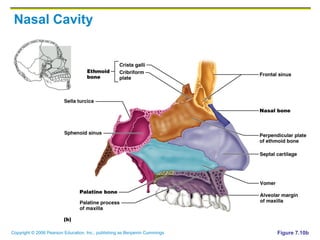
Nasal Cavity
 Constructed of bone and hyaline cartilage
 Roof – formed by the cribriform plate of the
ethmoid
 Lateral walls – formed by the superior and middle
conchae of the ethmoid, the perpendicular plate of
the palatine, and the inferior nasal conchae
 Floor – formed by palatine process of the maxillae
and palatine bone
Copyright © 2006 Pearson Education, Inc., publishing as Benjamin Cummings
Nasal Cavity
Figure 7.10b
Copyright © 2006 Pearson Education, Inc., publishing as Benjamin Cummings
Paranasal Sinuses
 Mucosa-lined, air-filled sacs found in five skull
bones – the frontal, sphenoid, ethmoid, and paired
maxillary bones
 Air enters the paranasal sinuses from the nasal
cavity and mucus drains into the nasal cavity from
the sinuses
 Lighten the skull and enhance the resonance of the
voice
Copyright © 2006 Pearson Education, Inc., publishing as Benjamin Cummings
Paranasal Sinuses
Figure 7.11
Copyright © 2006 Pearson Education, Inc., publishing as Benjamin Cummings
Vertebral Column
 Formed from 26 irregular bones (vertebrae)
connected in such a way that a flexible curved
structure results
 Cervical vertebrae – 7 bones of the neck
 Thoracic vertebrae – 12 bones of the torso
 Lumbar vertebrae – 5 bones of the lower back
 Sacrum – bone inferior to the lumbar vertebrae that
articulates with the hip bones
Copyright © 2006 Pearson Education, Inc., publishing as Benjamin Cummings
Vertebral Column
Figure 7.13
Copyright © 2006 Pearson Education, Inc., publishing as Benjamin Cummings
Vertebral Column: Intervertebral Discs
 Cushion-like pad composed of two parts
 Nucleus pulposus – inner gelatinous nucleus that
gives the disc its elasticity and compressibility
 Annulus fibrosus – surrounds the nucleus pulposus
with a collar composed of collagen and
fibrocartilage
Copyright © 2006 Pearson Education, Inc., publishing as Benjamin Cummings
Vertebral Column: Intervertebral Discs
Figure 7.14b
Copyright © 2006 Pearson Education, Inc., publishing as Benjamin Cummings
General Structure of Vertebrae
 Body or centrum – disc-shaped, weight-bearing
region
 Vertebral arch – composed of pedicles and laminae
that, along with the centrum, enclose the vertebral
foramen
 Vertebral foramina – make up the vertebral canal
through which the spinal cord passes
Copyright © 2006 Pearson Education, Inc., publishing as Benjamin Cummings
General Structure of Vertebrae
 Spinous processes project posteriorly, and
transverse processes project laterally
 Superior and inferior articular processes – protrude
superiorly and inferiorly from the pedicle-lamina
junctions
 Intervertebral foramina – lateral openings formed
from notched areas on the superior and inferior
borders of adjacent pedicles
Copyright © 2006 Pearson Education, Inc., publishing as Benjamin Cummings
General Structure of Vertebrae
Figure 7.15
Copyright © 2006 Pearson Education, Inc., publishing as Benjamin Cummings
Cervical Vertebrae
 Seven vertebrae (C1-C7) are the smallest, lightest
vertebrae
 C3-C7 are distinguished with an oval body, short
spinous processes, and large, triangular vertebral
foramina
 Each transverse process contains a transverse
foramen
Copyright © 2006 Pearson Education, Inc., publishing as Benjamin Cummings
Cervical Vertebrae
Table 7.2.2
Copyright © 2006 Pearson Education, Inc., publishing as Benjamin Cummings
Cervical Vertebrae: The Atlas (C1)
 The atlas has no body and no spinous process
 It consists of anterior and posterior arches, and two
lateral masses
 The superior surfaces of lateral masses articulate
with the occipital condyles
Copyright © 2006 Pearson Education, Inc., publishing as Benjamin Cummings
Cervical Vertebrae: The Atlas (C1)
Figure 7.16a, b
Copyright © 2006 Pearson Education, Inc., publishing as Benjamin Cummings
Cervical Vertebrae: The Axis (C2)
 The axis has a body, spine, and vertebral arches as
do other cervical vertebrae
 Unique to the axis is the dens, or odontoid process,
which projects superiorly from the body and is
cradled in the anterior arch of the atlas
 The dens is a pivot for the rotation of the atlas
Copyright © 2006 Pearson Education, Inc., publishing as Benjamin Cummings
Cervical Vertebrae: The Axis (C2)
Figure 7.16c
Copyright © 2006 Pearson Education, Inc., publishing as Benjamin Cummings
Cervical Vertebrae: The Atlas (C2)
Figure 7.17a
Copyright © 2006 Pearson Education, Inc., publishing as Benjamin Cummings
Regional Characteristics of Vertebrae
Table 7.2.2
Copyright © 2006 Pearson Education, Inc., publishing as Benjamin Cummings
Thoracic Vertebrae
 There are twelve vertebrae (T1-T12) all of which
articulate with ribs
 Major markings include two facets and two
demifacets on the heart-shaped body, the circular
vertebral foramen, transverse processes, and a long
spinous process
 The location of the articulate facets prevents
flexion and extension, but allows rotation of this
area of the spine
Copyright © 2006 Pearson Education, Inc., publishing as Benjamin Cummings
Thoracic Vertebrae
Figure 7.17b
Copyright © 2006 Pearson Education, Inc., publishing as Benjamin Cummings
Lumbar Vertebrae
 The five lumbar vertebrae (L1-L5) are located in
the small of the back and have an enhanced
weight-bearing function
 They have short, thick pedicles and laminae, flat
hatchet-shaped spinous processes, and a triangular-
shaped vertebral foramen
 Orientation of articular facets locks the lumbar
vertebrae together to provide stability
Copyright © 2006 Pearson Education, Inc., publishing as Benjamin Cummings
Lumbar Vertebrae
Figure 7.17c
Copyright © 2006 Pearson Education, Inc., publishing as Benjamin Cummings
Sacrum
 Sacrum
 Consists of five fused vertebrae (S1-S5), which
shape the posterior wall of the pelvis
 It articulates with L5 superiorly, and with the
auricular surfaces of the hip bones
 Major markings include the sacral promontory,
transverse lines, alae, dorsal sacral foramina, sacral
canal, and sacral hiatus
Copyright © 2006 Pearson Education, Inc., publishing as Benjamin Cummings
Coccyx
 Coccyx (Tailbone)
 The coccyx is made up of four (in some cases three
to five) fused vertebrae that articulate superiorly
with the sacrum
Copyright © 2006 Pearson Education, Inc., publishing as Benjamin Cummings
Sacrum and Coccyx: Anterior View
Figure 7.18a
Copyright © 2006 Pearson Education, Inc., publishing as Benjamin Cummings
Sacrum and Coccyx: Posterior View
Figure 7.18b
Copyright © 2006 Pearson Education, Inc., publishing as Benjamin Cummings
Bony Thorax (Thoracic Cage)
 The thoracic cage is composed of the thoracic
vertebrae dorsally, the ribs laterally, and the
sternum and costal cartilages anteriorly
Copyright © 2006 Pearson Education, Inc., publishing as Benjamin Cummings
Bony Thorax (Thoracic Cage)
 Functions
 Forms a protective cage around the heart, lungs,
and great blood vessels
 Supports the shoulder girdles and upper limbs
 Provides attachment for many neck, back, chest,
and shoulder muscles
 Uses intercostal muscles to lift and depress the
thorax during breathing
Copyright © 2006 Pearson Education, Inc., publishing as Benjamin Cummings
Bony Thorax (Thoracic Cage)
Figure 7.19a
Copyright © 2006 Pearson Education, Inc., publishing as Benjamin Cummings
Bony Thorax (Thoracic Cage)
Figure 7.19b
Copyright © 2006 Pearson Education, Inc., publishing as Benjamin Cummings
Sternum (Breastbone)
 A dagger-shaped, flat bone that lies in the anterior
midline of the thorax
 Results from the fusion of three bones – the
superior manubrium, the body, and the inferior
xiphoid process
Copyright © 2006 Pearson Education, Inc., publishing as Benjamin Cummings
Ribs
 There are twelve pair of ribs forming the flaring
sides of the thoracic cage
 All ribs attach posteriorly to the thoracic vertebrae
 The superior 7 pair (true, or vertebrosternal ribs)
attach directly to the sternum via costal cartilages
 Ribs 8-10 (false, or vertebrocondral ribs) attach
indirectly to the sternum via costal cartilage
 Ribs 11-12 (floating, or vertebral ribs) have no
anterior attachment
Copyright © 2006 Pearson Education, Inc., publishing as Benjamin Cummings
Ribs
Figure 7.19a
Copyright © 2006 Pearson Education, Inc., publishing as Benjamin Cummings
Structure of a Typical True Rib
 Bowed, flat bone consisting of a head, neck,
tubercle, and shaft
Figure 7.20a
Copyright © 2006 Pearson Education, Inc., publishing as Benjamin Cummings
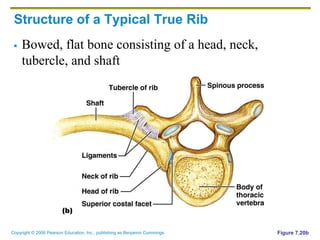
Structure of a Typical True Rib
 Bowed, flat bone consisting of a head, neck,
tubercle, and shaft
Figure 7.20b
Copyright © 2006 Pearson Education, Inc., publishing as Benjamin Cummings
2. Appendicular Skeleton
 The appendicular skeleton is made up of the bones
of the limbs and their girdles
 Pectoral girdles attach the upper limbs to the body
trunk
 Pelvic girdle secures the lower limbs
Copyright © 2006 Pearson Education, Inc., publishing as Benjamin Cummings
Pectoral Girdles (Shoulder Girdles)
 The pectoral girdles consist of the anterior
clavicles and the posterior scapulae
 They attach the upper limbs to the axial skeleton in
a manner that allows for maximum movement
 They provide attachment points for muscles that
move the upper limbs
Copyright © 2006 Pearson Education, Inc., publishing as Benjamin Cummings
Pectoral Girdles (Shoulder Girdles)
Figure 7.22a
Copyright © 2006 Pearson Education, Inc., publishing as Benjamin Cummings
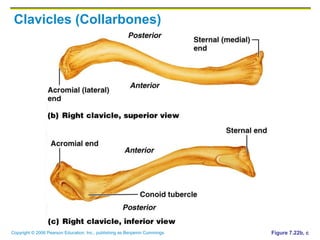
Clavicles (Collarbones)
 Slender, doubly curved long bones lying across the
superior thorax
 The acromial (lateral) end articulates with the
scapula, and the sternal (medial) end articulates
with the sternum
 Provide attachment points for numerous muscles,
and act as braces to hold the scapulae and arms out
laterally away from the body
Copyright © 2006 Pearson Education, Inc., publishing as Benjamin Cummings
Clavicles (Collarbones)
Figure 7.22b, c
Copyright © 2006 Pearson Education, Inc., publishing as Benjamin Cummings
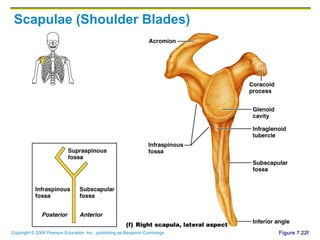
Scapulae (Shoulder Blades)
 Triangular, flat bones lying on the dorsal surface of
the rib cage, between the second and seventh ribs
 Scapulae have three borders and three angles
 Major markings include the suprascapular notch,
the supraspinous and infraspinous fossae, the
spine, the acromion, and the coracoid process
Copyright © 2006 Pearson Education, Inc., publishing as Benjamin Cummings
Scapulae (Shoulder Blades)
Figure 7.22d
Copyright © 2006 Pearson Education, Inc., publishing as Benjamin Cummings
Scapulae (Shoulder Blades)
Figure 7.22e
Copyright © 2006 Pearson Education, Inc., publishing as Benjamin Cummings
Scapulae (Shoulder Blades)
Figure 7.22f
Copyright © 2006 Pearson Education, Inc., publishing as Benjamin Cummings
Human
Anatomy
& Physiology
SEVENTH EDITION
Elaine N. Marieb
Katja Hoehn
PowerPoint® Lecture Slides
prepared by Vince Austin,
Bluegrass Technical
and Community College
CHAPTER
7The Skeleton
P A R T D
Copyright © 2006 Pearson Education, Inc., publishing as Benjamin Cummings
The Upper Limb
 The upper limb consists of the arm (brachium),
forearm (antebrachium), and hand (manus)
 Thirty-seven bones form the skeletal framework of
each upper limb
Copyright © 2006 Pearson Education, Inc., publishing as Benjamin Cummings
Arm
 The humerus is the sole bone of the arm
 It articulates with the scapula at the shoulder, and
the radius and ulna at the elbow
Copyright © 2006 Pearson Education, Inc., publishing as Benjamin Cummings
Arm
 Major markings
 Proximal humerus includes the head, anatomical
and surgical necks, greater and lesser tubercles,
and the intertubercular groove
 Distal humerus includes the capitulum, trochlea,
medial and lateral epicondyles, and the coronoid
and olecranon fossae
 Medial portion includes the radial groove and the
deltoid process
Copyright © 2006 Pearson Education, Inc., publishing as Benjamin Cummings
Humerus of the Arm
Figure 7.23
Copyright © 2006 Pearson Education, Inc., publishing as Benjamin Cummings
Forearm
 The bones of the forearm are the radius and ulna
 They articulate proximally with the humerus and
distally with the wrist bones
 They also articulate with each other proximally
and distally at small radioulnar joints
 Interosseous membrane connects the two bones
along their entire length
Copyright © 2006 Pearson Education, Inc., publishing as Benjamin Cummings
Bones of the Forearm
Figure 7.24
Copyright © 2006 Pearson Education, Inc., publishing as Benjamin Cummings
Ulna
 The ulna lies medially in the forearm and is
slightly longer than the radius
 Forms the major portion of the elbow joint with the
humerus
 Its major markings include the olecranon, coronoid
process, trochlear notch, radial notch, and the
styloid process
Copyright © 2006 Pearson Education, Inc., publishing as Benjamin Cummings
Radius
 The radius lies opposite (lateral to) the ulna and is
thin at its proximal end, widened distally
 The superior surface of the head articulates with
the capitulum of the humerus
 Medially, the head articulates with the radial notch
of the ulna
 Major markings include the radial tuberosity, ulnar
notch, and styloid process
Copyright © 2006 Pearson Education, Inc., publishing as Benjamin Cummings
Radius and Ulna
Figure 7.24
Copyright © 2006 Pearson Education, Inc., publishing as Benjamin Cummings
Hand
 Skeleton of the hand
contains wrist bones
(carpals), bones of the
palm (metacarpals),
and bones of the
fingers (phalanges)
Figure 7.26a
Copyright © 2006 Pearson Education, Inc., publishing as Benjamin Cummings
Carpus (Wrist)
 Consists of eight bones
 Scaphoid, lunate, triquetral, and pisiform
proximally
 Trapezium, trapezoid, capitate, and hamate distally
Copyright © 2006 Pearson Education, Inc., publishing as Benjamin Cummings
Metacarpus (Palm)
 Five numbered (1-5) metacarpal bones radiate
from the wrist to form the palm
 Their bases articulate with the carpals proximally,
and with each other medially and laterally
 Heads articulate with the phalanges
Copyright © 2006 Pearson Education, Inc., publishing as Benjamin Cummings
Phalanges (Fingers)
 Each hand contains 14 miniature long bones called
phalanges
 Fingers (digits) are numbered 1-5, beginning with
the thumb (pollex)
 Each finger (except the thumb) has three phalanges
– distal, middle, and proximal
 The thumb has no middle phalanx
Copyright © 2006 Pearson Education, Inc., publishing as Benjamin Cummings
Pelvic Girdle (Hip)
 The hip is formed by a pair of hip bones (os coxae,
or coxal)
 Together with the sacrum and the coccyx, these
bones form the bony pelvis
Copyright © 2006 Pearson Education, Inc., publishing as Benjamin Cummings
Pelvic Girdle (Hip)
 The pelvis
 Attaches the lower limbs to the axial skeleton with
the strongest ligaments of the body
 Transmits weight of the upper body to the lower
limbs
 Supports the visceral organs of the pelvis
Copyright © 2006 Pearson Education, Inc., publishing as Benjamin Cummings
Pelvic Girdle (Hip)
Figure 7.27a
Copyright © 2006 Pearson Education, Inc., publishing as Benjamin Cummings
Ilium
 The ilium is a large flaring bone that forms the
superior region of the coxal bone
 It consists of a body and a superior winglike
portion called the ala
 The broad posterolateral surface is called the
gluteal surface
Copyright © 2006 Pearson Education, Inc., publishing as Benjamin Cummings
Ilium
 The auricular surface articulates with the sacrum
(sacroiliac joint)
 Major markings include the iliac crests, four
spines, greater sciatic notch, iliac fossa, arcuate
line, and the pelvic brim
Copyright © 2006 Pearson Education, Inc., publishing as Benjamin Cummings
Ilium: Lateral View
Figure 7.27b
Copyright © 2006 Pearson Education, Inc., publishing as Benjamin Cummings
Ilium: Medial View
Figure 7.27c
Copyright © 2006 Pearson Education, Inc., publishing as Benjamin Cummings
Ischium
 The ischium forms the posteroinferior part of the
hip bone
 The thick body articulates with the ilium, and the
thinner ramus articulates with the pubis
 Major markings include the ischial spine, lesser
sciatic notch, and the ischial tuberosity
Copyright © 2006 Pearson Education, Inc., publishing as Benjamin Cummings
Pubis
 The pubic bone forms the anterior portion of the
hip bone
 It articulates with the ischium and the ilium
Copyright © 2006 Pearson Education, Inc., publishing as Benjamin Cummings
Pubis: Lateral View
Figure 7.27b
Copyright © 2006 Pearson Education, Inc., publishing as Benjamin Cummings
Pubis: Medial View
Figure 7.27c
Copyright © 2006 Pearson Education, Inc., publishing as Benjamin Cummings
Comparison of Male and Female Pelvic
Structure
 Female pelvis
 Tilted forward, adapted for childbearing
 True pelvis defines birth canal
 Cavity of the true pelvis is broad, shallow, and has
greater capacity
Copyright © 2006 Pearson Education, Inc., publishing as Benjamin Cummings
Comparison of Male and Female Pelvic
Structure
 Male pelvis
 Tilted less forward
 Adapted for support of heavier male build and
stronger muscles
 Cavity of true pelvis is narrow and deep
Copyright © 2006 Pearson Education, Inc., publishing as Benjamin Cummings
Comparison of Male and Female Pelvic
Structure
Image from Table 7.4
Copyright © 2006 Pearson Education, Inc., publishing as Benjamin Cummings
Characteristic Female Male
Bone thickness Lighter, thinner, and smoother
Heavier, thicker, and more
prominent markings
Pubic arch/angle 80˚–90˚ 50˚–60˚
Acetabula Small; farther apart Large; closer together
Sacrum
Wider, shorter; sacral curvature is
accentuated
Narrow, longer; sacral
promontory more ventral
Coccyx More movable; straighter
Less movable; curves
ventrally
Comparison of Male and Female Pelvic
Structure
Copyright © 2006 Pearson Education, Inc., publishing as Benjamin Cummings
The Lower Limb
 The three segments of the lower limb are the thigh,
leg, and foot
 They carry the weight of the erect body, and are
subjected to exceptional forces when one jumps or
runs
Copyright © 2006 Pearson Education, Inc., publishing as Benjamin Cummings
Femur
 The sole bone of the thigh is the femur, the largest
and strongest bone in the body
 It articulates proximally with the hip and distally
with the tibia and fibula
 Major markings include the head, greater and
lesser trochanters, lateral and medial condyles and
epicondyles, patellar surface, and the intercondylar
notch
Copyright © 2006 Pearson Education, Inc., publishing as Benjamin Cummings
Femur
Figure 7.28b
Copyright © 2006 Pearson Education, Inc., publishing as Benjamin Cummings
Leg
 The tibia and fibula form the skeleton of the leg
 They are connected to each other by the
interosseous membrane
 They articulate with the femur proximally and with
the ankle bones distally
 They also articulate with each other via the
immovable tibiofibular joints
Copyright © 2006 Pearson Education, Inc., publishing as Benjamin Cummings
Tibia
 Receives the weight of the body from the femur
and transmits it to the foot
 Major markings include medial and lateral
condyles, the tibial tuberosity, anterior crest, and
medial malleolus,
Copyright © 2006 Pearson Education, Inc., publishing as Benjamin Cummings
Tibia and Fibula
Figure 7.29
Copyright © 2006 Pearson Education, Inc., publishing as Benjamin Cummings
Fibula
 Sticklike bone with slightly expanded ends located
laterally to the tibia
 Major markings include the head and lateral
malleolus
Copyright © 2006 Pearson Education, Inc., publishing as Benjamin Cummings
Foot
 The skeleton of the foot
includes the tarsus,
metatarsus, and the
phalanges (toes)
 The foot supports body
weight and acts as a
lever to propel the body
forward in walking and
running
Figure 7.31a
Copyright © 2006 Pearson Education, Inc., publishing as Benjamin Cummings
Tarsals
 Composed of seven bones that form the posterior
half of the foot
 Body weight is carried primarily on the talus and
calcaneus
 Talus articulates with the tibia and fibula
superiorly, and the calcaneus inferiorly
Copyright © 2006 Pearson Education, Inc., publishing as Benjamin Cummings
Tarsals
Figure 7.31b, c
Copyright © 2006 Pearson Education, Inc., publishing as Benjamin Cummings
Calcaneus
 Forms the heel of the foot
 Carries the talus on its superior surface
 Point of attachment for the calcaneal (Achilles)
tendon of the calf muscles
Copyright © 2006 Pearson Education, Inc., publishing as Benjamin Cummings
Metatarsals and Phalanges
 Metatarsals
 Five (1-5) long bones that articulate with the
proximal phalanges
 The enlarged head of metatarsal 1 forms the “ball
of the foot”
 Phalanges
 The 14 bones of the toes
 Each digit has three phalanges except the hallux,
which has no middle phalanx
Copyright © 2006 Pearson Education, Inc., publishing as Benjamin Cummings
Metatarsals and Phalanges
Figure 7.31a

Skeletal system

  • 1.
    Copyright © 2006Pearson Education, Inc., publishing as Benjamin Cummings Human Anatomy & Physiology SEVENTH EDITION Elaine N. Marieb Katja Hoehn PowerPoint® Lecture Slides prepared by Vince Austin, Bluegrass Technical and Community College CHAPTER 7The Skeleton P A R T A
  • 2.
    Copyright © 2006Pearson Education, Inc., publishing as Benjamin Cummings Skeleton  The skeleton is subdivided into two divisions: 1. The Axial Skeleton: the bones that form the longitudinal axis of the body. And they are composed of eighty bones segregated into three regions: Skull, Vertebral column, and Bony thorax. 2. Appendicular skeleton: the bones of the limbs and girdles.
  • 3.
    Copyright © 2006Pearson Education, Inc., publishing as Benjamin Cummings Function of the Bones 1. Support: form the internal framework that supports the body and protect its soft organ. (i.e. rib cage supports the thoracic wall) 2. Protection: bones protect soft body organs (i.e. skull protect the brain) 3. Movement: skeletal muscles attached to bones by tendons, use the bones as lever to move the body and its part 4. Storage: fat is stored in marrow cavities of bones, minerals are stored in bones, (i.e. calcium and phosphorous). 5. Blood cell formation: blood cell formation or hematopoiesis, occurs within the marrow cavities of certain bones.
  • 4.
    Copyright © 2006Pearson Education, Inc., publishing as Benjamin Cummings Classification of Bones  The adult skeleton composed of 206 bones.  There are two basic type of Bone tissue: 1. Compact bone: is dense and looks smooth and homogeneous. 2. Spongy bone: is composed of small needlelike pieces of bone and lots of open space
  • 5.
    Copyright © 2006Pearson Education, Inc., publishing as Benjamin Cummings
  • 6.
    Copyright © 2006Pearson Education, Inc., publishing as Benjamin Cummings Bones are classified according to shape into four groups: 1. Long: long bones are typically longer than they are wide, have a shaft with heads at both ends. Mostly compact bones (i.e. femur, tibia, fibula) 2. Short: cube-shaped and contain mostly spongy bone. (i.e. bones of the wrist, ankle, patella) 3. Flat: thin, flattened, and usually curved, have two thin layers of compact bone sandwiching a layer of spongy bone between them (i.e. skull, sternum, ribs) 4. Irregular: bones that do not fit in one of the preceding categories. ( i.e. vertebrae, and hip bones).
  • 7.
    Copyright © 2006Pearson Education, Inc., publishing as Benjamin Cummings 1. Bones of the Axial Skeleton Figure 7.1
  • 8.
    Copyright © 2006Pearson Education, Inc., publishing as Benjamin Cummings The Skull  The skull, the body’s most complex bony structure, is formed by the cranium and facial bones  Cranium – protects the brain and is the site of attachment for head and neck muscles  Facial bones  Supply the framework of the face, the sense organs, and the teeth  Provide openings for the passage of air and food  Anchor the facial muscles of expression
  • 9.
    Copyright © 2006Pearson Education, Inc., publishing as Benjamin Cummings Anatomy of the Cranium  Eight cranial bones – two parietal, two temporal, frontal, occipital, sphenoid, and ethmoid  Cranial bones are thin and remarkably strong for their weight
  • 10.
    Copyright © 2006Pearson Education, Inc., publishing as Benjamin Cummings Frontal Bone  Forms the anterior portion of the cranium  Articulates posteriorly with the parietal bones via the coronal suture
  • 11.
    Copyright © 2006Pearson Education, Inc., publishing as Benjamin Cummings Frontal Bone Figure 7.2a
  • 12.
    Copyright © 2006Pearson Education, Inc., publishing as Benjamin Cummings Parietal Bones and Major Associated Sutures  Form most of the superior and lateral aspects of the skull Figure 7.3a
  • 13.
    Copyright © 2006Pearson Education, Inc., publishing as Benjamin Cummings Parietal Bones and Major Associated Sutures  Four sutures mark the articulations of the parietal bones  Coronal suture – articulation between parietal bones and frontal bone anteriorly  Sagittal suture – where right and left parietal bones meet superiorly  Lambdoid suture – where parietal bones meet the occipital bone posteriorly  Squamosal or squamous suture – where parietal and temporal bones meet
  • 14.
    Copyright © 2006Pearson Education, Inc., publishing as Benjamin Cummings Occipital Bone and Its Major Markings  Forms most of skull’s posterior wall and base  Major markings include the posterior cranial fossa, foramen magnum, occipital condyles, and the hypoglossal canal Figure 7.2b
  • 15.
    Copyright © 2006Pearson Education, Inc., publishing as Benjamin Cummings Temporal Bones  Form the inferolateral aspects of the skull and parts of the cranial floor  Divided into four major regions – squamous, tympanic, mastoid, and petrous  Major markings include the zygomatic, styloid, and mastoid processes, and the mandibular and middle cranial fossae
  • 16.
    Copyright © 2006Pearson Education, Inc., publishing as Benjamin Cummings Sphenoid Bone  Butterfly-shaped bone that spans the width of the middle cranial fossa  Forms the central wedge that articulates with all other cranial bones  Consists of a central body, greater wings, lesser wings, and pterygoid processes
  • 17.
    Copyright © 2006Pearson Education, Inc., publishing as Benjamin Cummings Ethmoid Bone  Most deep of the skull bones; lies between the sphenoid and nasal bones  Forms most of the bony area between the nasal cavity and the orbits
  • 18.
    Copyright © 2006Pearson Education, Inc., publishing as Benjamin Cummings Ethmoid Bone, JUST KNOW THE SHAP NOTHING FROM THE NAMES Figure 7.7
  • 19.
    Copyright © 2006Pearson Education, Inc., publishing as Benjamin Cummings Facial Bones  Fourteen bones of which only the mandible and vomer are unpaired  The paired bones are the maxillae, zygomatics, nasals, lacrimals, palatines, and inferior conchae
  • 20.
    Copyright © 2006Pearson Education, Inc., publishing as Benjamin Cummings Mandible and Its Markings  The mandible (lower jawbone) is the largest, strongest bone of the face
  • 21.
    Copyright © 2006Pearson Education, Inc., publishing as Benjamin Cummings Mandible and Its Markings Figure 7.8a
  • 22.
    Copyright © 2006Pearson Education, Inc., publishing as Benjamin Cummings Maxillary Bones  Medially fused bones that make up the upper jaw and the central portion of the facial skeleton  Facial keystone bones that articulate with all other facial bones except the mandible
  • 23.
    Copyright © 2006Pearson Education, Inc., publishing as Benjamin Cummings Maxillary Bone Figure 7.8b
  • 24.
    Copyright © 2006Pearson Education, Inc., publishing as Benjamin Cummings Zygomatic Bones  Irregularly shaped bones (cheekbones) that form the prominences of the cheeks and the inferolateral margins of the orbits
  • 25.
    Copyright © 2006Pearson Education, Inc., publishing as Benjamin Cummings Other Facial Bones  Nasal bones – thin medially fused bones that form the bridge of the nose  Lacrimal bones – contribute to the medial walls of the orbit and contain a deep groove called the lacrimal fossa that houses the lacrimal sac  Palatine bones – two bone plates that form portions of the hard palate, the posterolateral walls of the nasal cavity, and a small part of the orbits  Vomer – plow-shaped bone that forms part of the nasal septum
  • 26.
    Copyright © 2006Pearson Education, Inc., publishing as Benjamin Cummings Anterior Aspects of the Skull Figure 7.2a (a) Parietal bone Frontal squama of frontal bone Nasal bone Sphenoid bone (greater wing) Temporal bone Ethmoid bone Lacrimal bone Zygomatic bone Maxilla Mandible Mandibular symphysis Frontal bone Frontonasal suture Supraorbital margin Vomer bone Optic canal Ethmoid bone
  • 27.
    Copyright © 2006Pearson Education, Inc., publishing as Benjamin Cummings Posterior Aspects of the Skull Figure 7.2b (b) Lambdoid suture Occipital bone Occipitomastoid suture Occipital condyle Mastoid process Parietal bone Sagittal suture Sutural bone
  • 28.
    Copyright © 2006Pearson Education, Inc., publishing as Benjamin Cummings Midsagittal Lateral Aspects of the Skull Figure 7.3b (b) Parietal bone Coronal suture Frontal bone Frontal sinus Sphenoid bone (greater wing) Nasal bone Sphenoid sinus Ethmoid bone (perpendicular plate) Vomer bone Maxilla Mandible I Lambdoid suture Occipital bone Occipitomastoid suture Squamous suture Temporal bone
  • 29.
    Copyright © 2006Pearson Education, Inc., publishing as Benjamin Cummings Inferior Portion of the Skull Figure 7.4b (b) (c) Frontal boneOlfactory foramina Lesser wing Sphenoid Temporal bone (petrous part) Parietal bone Occipital bone Foramen magnum Greater wing Ethmoid bone Optic canal Hypoglossal canal Anterior cranial fossa Middle cranial fossa Posterior cranial fossa
  • 30.
    Copyright © 2006Pearson Education, Inc., publishing as Benjamin Cummings Human Anatomy & Physiology SEVENTH EDITION Elaine N. Marieb Katja Hoehn PowerPoint® Lecture Slides prepared by Vince Austin, Bluegrass Technical and Community College CHAPTER 7The Skeleton P A R T B
  • 31.
    Copyright © 2006Pearson Education, Inc., publishing as Benjamin Cummings Orbits  Bony cavities in which the eyes are firmly encased and cushioned by fatty tissue  Formed by parts of seven bones – frontal, sphenoid, zygomatic, maxilla, palatine, lacrimal, and ethmoid
  • 32.
    Copyright © 2006Pearson Education, Inc., publishing as Benjamin Cummings Nasal Cavity  Constructed of bone and hyaline cartilage  Roof – formed by the cribriform plate of the ethmoid  Lateral walls – formed by the superior and middle conchae of the ethmoid, the perpendicular plate of the palatine, and the inferior nasal conchae  Floor – formed by palatine process of the maxillae and palatine bone
  • 33.
    Copyright © 2006Pearson Education, Inc., publishing as Benjamin Cummings Nasal Cavity Figure 7.10b
  • 34.
    Copyright © 2006Pearson Education, Inc., publishing as Benjamin Cummings Paranasal Sinuses  Mucosa-lined, air-filled sacs found in five skull bones – the frontal, sphenoid, ethmoid, and paired maxillary bones  Air enters the paranasal sinuses from the nasal cavity and mucus drains into the nasal cavity from the sinuses  Lighten the skull and enhance the resonance of the voice
  • 35.
    Copyright © 2006Pearson Education, Inc., publishing as Benjamin Cummings Paranasal Sinuses Figure 7.11
  • 36.
    Copyright © 2006Pearson Education, Inc., publishing as Benjamin Cummings Vertebral Column  Formed from 26 irregular bones (vertebrae) connected in such a way that a flexible curved structure results  Cervical vertebrae – 7 bones of the neck  Thoracic vertebrae – 12 bones of the torso  Lumbar vertebrae – 5 bones of the lower back  Sacrum – bone inferior to the lumbar vertebrae that articulates with the hip bones
  • 37.
    Copyright © 2006Pearson Education, Inc., publishing as Benjamin Cummings Vertebral Column Figure 7.13
  • 38.
    Copyright © 2006Pearson Education, Inc., publishing as Benjamin Cummings Vertebral Column: Intervertebral Discs  Cushion-like pad composed of two parts  Nucleus pulposus – inner gelatinous nucleus that gives the disc its elasticity and compressibility  Annulus fibrosus – surrounds the nucleus pulposus with a collar composed of collagen and fibrocartilage
  • 39.
    Copyright © 2006Pearson Education, Inc., publishing as Benjamin Cummings Vertebral Column: Intervertebral Discs Figure 7.14b
  • 40.
    Copyright © 2006Pearson Education, Inc., publishing as Benjamin Cummings General Structure of Vertebrae  Body or centrum – disc-shaped, weight-bearing region  Vertebral arch – composed of pedicles and laminae that, along with the centrum, enclose the vertebral foramen  Vertebral foramina – make up the vertebral canal through which the spinal cord passes
  • 41.
    Copyright © 2006Pearson Education, Inc., publishing as Benjamin Cummings General Structure of Vertebrae  Spinous processes project posteriorly, and transverse processes project laterally  Superior and inferior articular processes – protrude superiorly and inferiorly from the pedicle-lamina junctions  Intervertebral foramina – lateral openings formed from notched areas on the superior and inferior borders of adjacent pedicles
  • 42.
    Copyright © 2006Pearson Education, Inc., publishing as Benjamin Cummings General Structure of Vertebrae Figure 7.15
  • 43.
    Copyright © 2006Pearson Education, Inc., publishing as Benjamin Cummings Cervical Vertebrae  Seven vertebrae (C1-C7) are the smallest, lightest vertebrae  C3-C7 are distinguished with an oval body, short spinous processes, and large, triangular vertebral foramina  Each transverse process contains a transverse foramen
  • 44.
    Copyright © 2006Pearson Education, Inc., publishing as Benjamin Cummings Cervical Vertebrae Table 7.2.2
  • 45.
    Copyright © 2006Pearson Education, Inc., publishing as Benjamin Cummings Cervical Vertebrae: The Atlas (C1)  The atlas has no body and no spinous process  It consists of anterior and posterior arches, and two lateral masses  The superior surfaces of lateral masses articulate with the occipital condyles
  • 46.
    Copyright © 2006Pearson Education, Inc., publishing as Benjamin Cummings Cervical Vertebrae: The Atlas (C1) Figure 7.16a, b
  • 47.
    Copyright © 2006Pearson Education, Inc., publishing as Benjamin Cummings Cervical Vertebrae: The Axis (C2)  The axis has a body, spine, and vertebral arches as do other cervical vertebrae  Unique to the axis is the dens, or odontoid process, which projects superiorly from the body and is cradled in the anterior arch of the atlas  The dens is a pivot for the rotation of the atlas
  • 48.
    Copyright © 2006Pearson Education, Inc., publishing as Benjamin Cummings Cervical Vertebrae: The Axis (C2) Figure 7.16c
  • 49.
    Copyright © 2006Pearson Education, Inc., publishing as Benjamin Cummings Cervical Vertebrae: The Atlas (C2) Figure 7.17a
  • 50.
    Copyright © 2006Pearson Education, Inc., publishing as Benjamin Cummings Regional Characteristics of Vertebrae Table 7.2.2
  • 51.
    Copyright © 2006Pearson Education, Inc., publishing as Benjamin Cummings Thoracic Vertebrae  There are twelve vertebrae (T1-T12) all of which articulate with ribs  Major markings include two facets and two demifacets on the heart-shaped body, the circular vertebral foramen, transverse processes, and a long spinous process  The location of the articulate facets prevents flexion and extension, but allows rotation of this area of the spine
  • 52.
    Copyright © 2006Pearson Education, Inc., publishing as Benjamin Cummings Thoracic Vertebrae Figure 7.17b
  • 53.
    Copyright © 2006Pearson Education, Inc., publishing as Benjamin Cummings Lumbar Vertebrae  The five lumbar vertebrae (L1-L5) are located in the small of the back and have an enhanced weight-bearing function  They have short, thick pedicles and laminae, flat hatchet-shaped spinous processes, and a triangular- shaped vertebral foramen  Orientation of articular facets locks the lumbar vertebrae together to provide stability
  • 54.
    Copyright © 2006Pearson Education, Inc., publishing as Benjamin Cummings Lumbar Vertebrae Figure 7.17c
  • 55.
    Copyright © 2006Pearson Education, Inc., publishing as Benjamin Cummings Sacrum  Sacrum  Consists of five fused vertebrae (S1-S5), which shape the posterior wall of the pelvis  It articulates with L5 superiorly, and with the auricular surfaces of the hip bones  Major markings include the sacral promontory, transverse lines, alae, dorsal sacral foramina, sacral canal, and sacral hiatus
  • 56.
    Copyright © 2006Pearson Education, Inc., publishing as Benjamin Cummings Coccyx  Coccyx (Tailbone)  The coccyx is made up of four (in some cases three to five) fused vertebrae that articulate superiorly with the sacrum
  • 57.
    Copyright © 2006Pearson Education, Inc., publishing as Benjamin Cummings Sacrum and Coccyx: Anterior View Figure 7.18a
  • 58.
    Copyright © 2006Pearson Education, Inc., publishing as Benjamin Cummings Sacrum and Coccyx: Posterior View Figure 7.18b
  • 59.
    Copyright © 2006Pearson Education, Inc., publishing as Benjamin Cummings Bony Thorax (Thoracic Cage)  The thoracic cage is composed of the thoracic vertebrae dorsally, the ribs laterally, and the sternum and costal cartilages anteriorly
  • 60.
    Copyright © 2006Pearson Education, Inc., publishing as Benjamin Cummings Bony Thorax (Thoracic Cage)  Functions  Forms a protective cage around the heart, lungs, and great blood vessels  Supports the shoulder girdles and upper limbs  Provides attachment for many neck, back, chest, and shoulder muscles  Uses intercostal muscles to lift and depress the thorax during breathing
  • 61.
    Copyright © 2006Pearson Education, Inc., publishing as Benjamin Cummings Bony Thorax (Thoracic Cage) Figure 7.19a
  • 62.
    Copyright © 2006Pearson Education, Inc., publishing as Benjamin Cummings Bony Thorax (Thoracic Cage) Figure 7.19b
  • 63.
    Copyright © 2006Pearson Education, Inc., publishing as Benjamin Cummings Sternum (Breastbone)  A dagger-shaped, flat bone that lies in the anterior midline of the thorax  Results from the fusion of three bones – the superior manubrium, the body, and the inferior xiphoid process
  • 64.
    Copyright © 2006Pearson Education, Inc., publishing as Benjamin Cummings Ribs  There are twelve pair of ribs forming the flaring sides of the thoracic cage  All ribs attach posteriorly to the thoracic vertebrae  The superior 7 pair (true, or vertebrosternal ribs) attach directly to the sternum via costal cartilages  Ribs 8-10 (false, or vertebrocondral ribs) attach indirectly to the sternum via costal cartilage  Ribs 11-12 (floating, or vertebral ribs) have no anterior attachment
  • 65.
    Copyright © 2006Pearson Education, Inc., publishing as Benjamin Cummings Ribs Figure 7.19a
  • 66.
    Copyright © 2006Pearson Education, Inc., publishing as Benjamin Cummings Structure of a Typical True Rib  Bowed, flat bone consisting of a head, neck, tubercle, and shaft Figure 7.20a
  • 67.
    Copyright © 2006Pearson Education, Inc., publishing as Benjamin Cummings Structure of a Typical True Rib  Bowed, flat bone consisting of a head, neck, tubercle, and shaft Figure 7.20b
  • 68.
    Copyright © 2006Pearson Education, Inc., publishing as Benjamin Cummings 2. Appendicular Skeleton  The appendicular skeleton is made up of the bones of the limbs and their girdles  Pectoral girdles attach the upper limbs to the body trunk  Pelvic girdle secures the lower limbs
  • 69.
    Copyright © 2006Pearson Education, Inc., publishing as Benjamin Cummings Pectoral Girdles (Shoulder Girdles)  The pectoral girdles consist of the anterior clavicles and the posterior scapulae  They attach the upper limbs to the axial skeleton in a manner that allows for maximum movement  They provide attachment points for muscles that move the upper limbs
  • 70.
    Copyright © 2006Pearson Education, Inc., publishing as Benjamin Cummings Pectoral Girdles (Shoulder Girdles) Figure 7.22a
  • 71.
    Copyright © 2006Pearson Education, Inc., publishing as Benjamin Cummings Clavicles (Collarbones)  Slender, doubly curved long bones lying across the superior thorax  The acromial (lateral) end articulates with the scapula, and the sternal (medial) end articulates with the sternum  Provide attachment points for numerous muscles, and act as braces to hold the scapulae and arms out laterally away from the body
  • 72.
    Copyright © 2006Pearson Education, Inc., publishing as Benjamin Cummings Clavicles (Collarbones) Figure 7.22b, c
  • 73.
    Copyright © 2006Pearson Education, Inc., publishing as Benjamin Cummings Scapulae (Shoulder Blades)  Triangular, flat bones lying on the dorsal surface of the rib cage, between the second and seventh ribs  Scapulae have three borders and three angles  Major markings include the suprascapular notch, the supraspinous and infraspinous fossae, the spine, the acromion, and the coracoid process
  • 74.
    Copyright © 2006Pearson Education, Inc., publishing as Benjamin Cummings Scapulae (Shoulder Blades) Figure 7.22d
  • 75.
    Copyright © 2006Pearson Education, Inc., publishing as Benjamin Cummings Scapulae (Shoulder Blades) Figure 7.22e
  • 76.
    Copyright © 2006Pearson Education, Inc., publishing as Benjamin Cummings Scapulae (Shoulder Blades) Figure 7.22f
  • 77.
    Copyright © 2006Pearson Education, Inc., publishing as Benjamin Cummings Human Anatomy & Physiology SEVENTH EDITION Elaine N. Marieb Katja Hoehn PowerPoint® Lecture Slides prepared by Vince Austin, Bluegrass Technical and Community College CHAPTER 7The Skeleton P A R T D
  • 78.
    Copyright © 2006Pearson Education, Inc., publishing as Benjamin Cummings The Upper Limb  The upper limb consists of the arm (brachium), forearm (antebrachium), and hand (manus)  Thirty-seven bones form the skeletal framework of each upper limb
  • 79.
    Copyright © 2006Pearson Education, Inc., publishing as Benjamin Cummings Arm  The humerus is the sole bone of the arm  It articulates with the scapula at the shoulder, and the radius and ulna at the elbow
  • 80.
    Copyright © 2006Pearson Education, Inc., publishing as Benjamin Cummings Arm  Major markings  Proximal humerus includes the head, anatomical and surgical necks, greater and lesser tubercles, and the intertubercular groove  Distal humerus includes the capitulum, trochlea, medial and lateral epicondyles, and the coronoid and olecranon fossae  Medial portion includes the radial groove and the deltoid process
  • 81.
    Copyright © 2006Pearson Education, Inc., publishing as Benjamin Cummings Humerus of the Arm Figure 7.23
  • 82.
    Copyright © 2006Pearson Education, Inc., publishing as Benjamin Cummings Forearm  The bones of the forearm are the radius and ulna  They articulate proximally with the humerus and distally with the wrist bones  They also articulate with each other proximally and distally at small radioulnar joints  Interosseous membrane connects the two bones along their entire length
  • 83.
    Copyright © 2006Pearson Education, Inc., publishing as Benjamin Cummings Bones of the Forearm Figure 7.24
  • 84.
    Copyright © 2006Pearson Education, Inc., publishing as Benjamin Cummings Ulna  The ulna lies medially in the forearm and is slightly longer than the radius  Forms the major portion of the elbow joint with the humerus  Its major markings include the olecranon, coronoid process, trochlear notch, radial notch, and the styloid process
  • 85.
    Copyright © 2006Pearson Education, Inc., publishing as Benjamin Cummings Radius  The radius lies opposite (lateral to) the ulna and is thin at its proximal end, widened distally  The superior surface of the head articulates with the capitulum of the humerus  Medially, the head articulates with the radial notch of the ulna  Major markings include the radial tuberosity, ulnar notch, and styloid process
  • 86.
    Copyright © 2006Pearson Education, Inc., publishing as Benjamin Cummings Radius and Ulna Figure 7.24
  • 87.
    Copyright © 2006Pearson Education, Inc., publishing as Benjamin Cummings Hand  Skeleton of the hand contains wrist bones (carpals), bones of the palm (metacarpals), and bones of the fingers (phalanges) Figure 7.26a
  • 88.
    Copyright © 2006Pearson Education, Inc., publishing as Benjamin Cummings Carpus (Wrist)  Consists of eight bones  Scaphoid, lunate, triquetral, and pisiform proximally  Trapezium, trapezoid, capitate, and hamate distally
  • 89.
    Copyright © 2006Pearson Education, Inc., publishing as Benjamin Cummings Metacarpus (Palm)  Five numbered (1-5) metacarpal bones radiate from the wrist to form the palm  Their bases articulate with the carpals proximally, and with each other medially and laterally  Heads articulate with the phalanges
  • 90.
    Copyright © 2006Pearson Education, Inc., publishing as Benjamin Cummings Phalanges (Fingers)  Each hand contains 14 miniature long bones called phalanges  Fingers (digits) are numbered 1-5, beginning with the thumb (pollex)  Each finger (except the thumb) has three phalanges – distal, middle, and proximal  The thumb has no middle phalanx
  • 91.
    Copyright © 2006Pearson Education, Inc., publishing as Benjamin Cummings Pelvic Girdle (Hip)  The hip is formed by a pair of hip bones (os coxae, or coxal)  Together with the sacrum and the coccyx, these bones form the bony pelvis
  • 92.
    Copyright © 2006Pearson Education, Inc., publishing as Benjamin Cummings Pelvic Girdle (Hip)  The pelvis  Attaches the lower limbs to the axial skeleton with the strongest ligaments of the body  Transmits weight of the upper body to the lower limbs  Supports the visceral organs of the pelvis
  • 93.
    Copyright © 2006Pearson Education, Inc., publishing as Benjamin Cummings Pelvic Girdle (Hip) Figure 7.27a
  • 94.
    Copyright © 2006Pearson Education, Inc., publishing as Benjamin Cummings Ilium  The ilium is a large flaring bone that forms the superior region of the coxal bone  It consists of a body and a superior winglike portion called the ala  The broad posterolateral surface is called the gluteal surface
  • 95.
    Copyright © 2006Pearson Education, Inc., publishing as Benjamin Cummings Ilium  The auricular surface articulates with the sacrum (sacroiliac joint)  Major markings include the iliac crests, four spines, greater sciatic notch, iliac fossa, arcuate line, and the pelvic brim
  • 96.
    Copyright © 2006Pearson Education, Inc., publishing as Benjamin Cummings Ilium: Lateral View Figure 7.27b
  • 97.
    Copyright © 2006Pearson Education, Inc., publishing as Benjamin Cummings Ilium: Medial View Figure 7.27c
  • 98.
    Copyright © 2006Pearson Education, Inc., publishing as Benjamin Cummings Ischium  The ischium forms the posteroinferior part of the hip bone  The thick body articulates with the ilium, and the thinner ramus articulates with the pubis  Major markings include the ischial spine, lesser sciatic notch, and the ischial tuberosity
  • 99.
    Copyright © 2006Pearson Education, Inc., publishing as Benjamin Cummings Pubis  The pubic bone forms the anterior portion of the hip bone  It articulates with the ischium and the ilium
  • 100.
    Copyright © 2006Pearson Education, Inc., publishing as Benjamin Cummings Pubis: Lateral View Figure 7.27b
  • 101.
    Copyright © 2006Pearson Education, Inc., publishing as Benjamin Cummings Pubis: Medial View Figure 7.27c
  • 102.
    Copyright © 2006Pearson Education, Inc., publishing as Benjamin Cummings Comparison of Male and Female Pelvic Structure  Female pelvis  Tilted forward, adapted for childbearing  True pelvis defines birth canal  Cavity of the true pelvis is broad, shallow, and has greater capacity
  • 103.
    Copyright © 2006Pearson Education, Inc., publishing as Benjamin Cummings Comparison of Male and Female Pelvic Structure  Male pelvis  Tilted less forward  Adapted for support of heavier male build and stronger muscles  Cavity of true pelvis is narrow and deep
  • 104.
    Copyright © 2006Pearson Education, Inc., publishing as Benjamin Cummings Comparison of Male and Female Pelvic Structure Image from Table 7.4
  • 105.
    Copyright © 2006Pearson Education, Inc., publishing as Benjamin Cummings Characteristic Female Male Bone thickness Lighter, thinner, and smoother Heavier, thicker, and more prominent markings Pubic arch/angle 80˚–90˚ 50˚–60˚ Acetabula Small; farther apart Large; closer together Sacrum Wider, shorter; sacral curvature is accentuated Narrow, longer; sacral promontory more ventral Coccyx More movable; straighter Less movable; curves ventrally Comparison of Male and Female Pelvic Structure
  • 106.
    Copyright © 2006Pearson Education, Inc., publishing as Benjamin Cummings The Lower Limb  The three segments of the lower limb are the thigh, leg, and foot  They carry the weight of the erect body, and are subjected to exceptional forces when one jumps or runs
  • 107.
    Copyright © 2006Pearson Education, Inc., publishing as Benjamin Cummings Femur  The sole bone of the thigh is the femur, the largest and strongest bone in the body  It articulates proximally with the hip and distally with the tibia and fibula  Major markings include the head, greater and lesser trochanters, lateral and medial condyles and epicondyles, patellar surface, and the intercondylar notch
  • 108.
    Copyright © 2006Pearson Education, Inc., publishing as Benjamin Cummings Femur Figure 7.28b
  • 109.
    Copyright © 2006Pearson Education, Inc., publishing as Benjamin Cummings Leg  The tibia and fibula form the skeleton of the leg  They are connected to each other by the interosseous membrane  They articulate with the femur proximally and with the ankle bones distally  They also articulate with each other via the immovable tibiofibular joints
  • 110.
    Copyright © 2006Pearson Education, Inc., publishing as Benjamin Cummings Tibia  Receives the weight of the body from the femur and transmits it to the foot  Major markings include medial and lateral condyles, the tibial tuberosity, anterior crest, and medial malleolus,
  • 111.
    Copyright © 2006Pearson Education, Inc., publishing as Benjamin Cummings Tibia and Fibula Figure 7.29
  • 112.
    Copyright © 2006Pearson Education, Inc., publishing as Benjamin Cummings Fibula  Sticklike bone with slightly expanded ends located laterally to the tibia  Major markings include the head and lateral malleolus
  • 113.
    Copyright © 2006Pearson Education, Inc., publishing as Benjamin Cummings Foot  The skeleton of the foot includes the tarsus, metatarsus, and the phalanges (toes)  The foot supports body weight and acts as a lever to propel the body forward in walking and running Figure 7.31a
  • 114.
    Copyright © 2006Pearson Education, Inc., publishing as Benjamin Cummings Tarsals  Composed of seven bones that form the posterior half of the foot  Body weight is carried primarily on the talus and calcaneus  Talus articulates with the tibia and fibula superiorly, and the calcaneus inferiorly
  • 115.
    Copyright © 2006Pearson Education, Inc., publishing as Benjamin Cummings Tarsals Figure 7.31b, c
  • 116.
    Copyright © 2006Pearson Education, Inc., publishing as Benjamin Cummings Calcaneus  Forms the heel of the foot  Carries the talus on its superior surface  Point of attachment for the calcaneal (Achilles) tendon of the calf muscles
  • 117.
    Copyright © 2006Pearson Education, Inc., publishing as Benjamin Cummings Metatarsals and Phalanges  Metatarsals  Five (1-5) long bones that articulate with the proximal phalanges  The enlarged head of metatarsal 1 forms the “ball of the foot”  Phalanges  The 14 bones of the toes  Each digit has three phalanges except the hallux, which has no middle phalanx
  • 118.
    Copyright © 2006Pearson Education, Inc., publishing as Benjamin Cummings Metatarsals and Phalanges Figure 7.31a