Can	We	Eliminate	Algal	Bloom?
Project	Presentation	by	Team	6A
Jan.	16,	2018
Harmful Algal Blooms
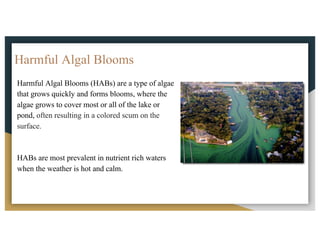
Harmful Algal Blooms (HABs) are a type of algae
that grows quickly and forms blooms, where the
algae grows to cover most or all of the lake or
pond, often resulting in a colored scum on the
surface.
HABs are most prevalent in nutrient rich waters
when the weather is hot and calm.
Algal	bloom	happens	because	excess	nutrients	are	in	waters.		Sunlight,	slow-moving	
water,	and	higher	levels	of	nutrients	like	nitrogen	(which	is	used	to	make	fertilizers)	
and	phosphorus	(which	is	used	in	detergents)	cause	extreme	growth	of	algae	and	
aquatic	plants.
Stormwater	runoff is	one	of	the	largest	single	contributors	of	this	nutrient	pollution	
to	our	water	systems.	Water	that	travels	along	solid	surfaces	pick	up	pollutants	
such	as	fertilizers,	pesticides	and	feces	and	carry	them	into	streams,	rivers,	ponds,	
lakes	and	wetlands.	
What Causes Algal Bloom?
Impact of Algal bloom: Human Health
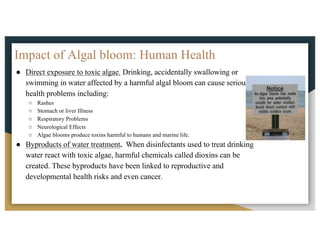
● Direct exposure to toxic algae. Drinking, accidentally swallowing or
swimming in water affected by a harmful algal bloom can cause serious
health problems including:
○ Rashes
○ Stomach or liver Illness
○ Respiratory Problems
○ Neurological Effects
○ Algae blooms produce toxins harmful to humans and marine life.
● Byproducts of water treatment. When disinfectants used to treat drinking
water react with toxic algae, harmful chemicals called dioxins can be
created. These byproducts have been linked to reproductive and
developmental health risks and even cancer.
Impact of Algal bloom: Environmental
● Harmful algal blooms sometimes create toxins that can kill fish and other animals.
After being consumed by small fish and shellfish, these toxins move up the food
chain and hurt larger animals like sea lions, turtles, dolphins, birds, manatees, and
fish.
● Even if algal blooms are not toxic, they can hurt aquatic life by blocking out
sunlight and clogging fish gills.
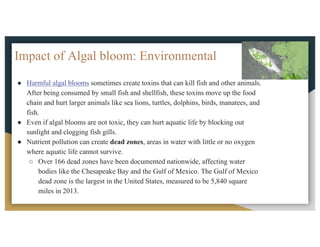
● Nutrient pollution can create dead zones, areas in water with little or no oxygen
where aquatic life cannot survive.
○ Over 166 dead zones have been documented nationwide, affecting water
bodies like the Chesapeake Bay and the Gulf of Mexico. The Gulf of Mexico
dead zone is the largest in the United States, measured to be 5,840 square
miles in 2013.
Impact of Algal bloom: Economy
● Drinking water costs. Nitrates and algal blooms in drinking water sources
can drastically increase treatment costs. Nitrate-removal systems in
Minnesota caused supply costs to rise from 5-10 cents per 1000 gallons to
over $4 per 1000 gallons. It can also cost billions of dollars to clean up
polluted water bodies.
● Tourism losses. The tourism industry loses close to $1 billion each year,
mostly through losses in fishing and boating activities.
● Commercial fishing and shellfish losses. Annual losses to these industries
from nutrient pollution are estimated to be in the tens of millions of dollars.
● Real estate losses. Clean water can raise the value of a nearby home by up
to 25 percent.
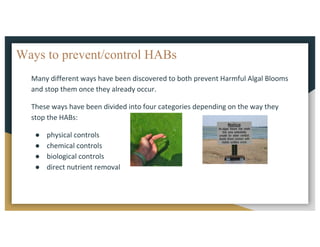
Ways to prevent/control HABs
Many	different	ways	have	been	discovered	to	both	prevent	Harmful	Algal	Blooms	
and	stop	them	once	they	already	occur.		
These	ways	have	been	divided	into	four	categories	depending	on	the	way	they	
stop	the	HABs:		
● physical	controls
● chemical	controls	
● biological	controls	
● direct	nutrient	removal
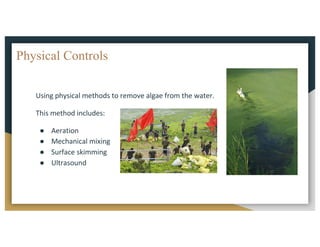
Physical Controls
Using	physical	methods	to	remove	algae	from	the	water.
This	method	includes:
● Aeration
● Mechanical	mixing
● Surface	skimming
● Ultrasound
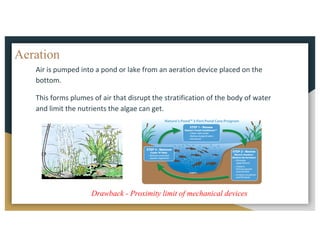
Aeration
Air	is	pumped	into	a	pond	or	lake	from	an	aeration	device	placed	on	the	
bottom.		
This	forms	plumes	of	air	that	disrupt	the	stratification	of	the	body	of	water	
and	limit	the	nutrients	the	algae	can	get.
Drawback - Proximity limit of mechanical devices
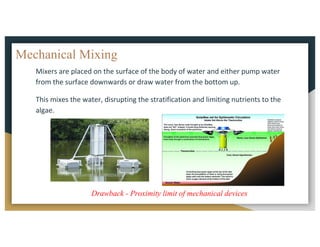
Mechanical Mixing
Mixers	are	placed	on	the	surface	of	the	body	of	water	and	either	pump	water	
from	the	surface	downwards	or	draw	water	from	the	bottom	up.
This	mixes	the	water,	disrupting	the	stratification	and	limiting	nutrients	to	the	
algae.		
Drawback - Proximity limit of mechanical devices
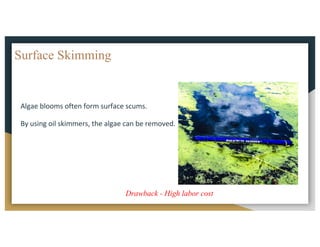
Surface Skimming
Algae	blooms	often	form	surface	scums.
By	using	oil	skimmers,	the	algae	can	be	removed.	
Drawback - High labor cost
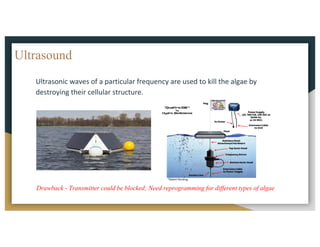
Ultrasound
Ultrasonic	waves	of	a	particular	frequency	are	used	to	kill	the	algae	by	
destroying	their	cellular	structure.		
Drawback - Transmitter could be blocked; Need reprogramming for different types of algae
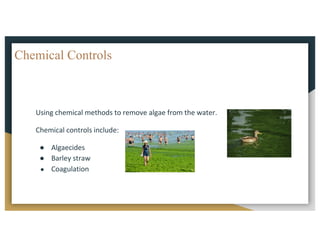
Chemical Controls
Using	chemical	methods	to	remove	algae	from	the	water.
Chemical	controls	include:
● Algaecides
● Barley	straw
● Coagulation
Algaecides
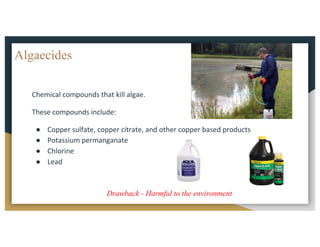
Chemical	compounds	that	kill	algae.
These	compounds	include:
● Copper	sulfate,	copper	citrate,	and	other	copper	based	products
● Potassium	permanganate
● Chlorine
● Lead	
Drawback - Harmful to the environment
Barley Straw
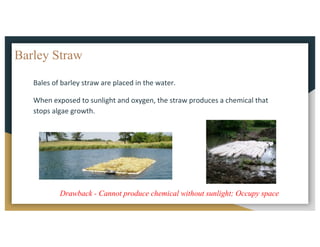
Bales	of	barley	straw	are	placed	in	the	water.
When	exposed	to	sunlight	and	oxygen,	the	straw	produces	a	chemical	that	
stops	algae	growth.
Drawback - Cannot produce chemical without sunlight; Occupy space
Coagulation
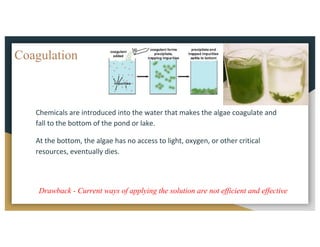
Chemicals	are	introduced	into	the	water	that	makes	the	algae	coagulate	and	
fall	to	the	bottom	of	the	pond	or	lake.		
At	the	bottom,	the	algae	has	no	access	to	light,	oxygen,	or	other	critical	
resources,	eventually	dies.		
Drawback - Current ways of applying the solution are not efficient and effective
Appendix: Triple Strike (Coagulation)
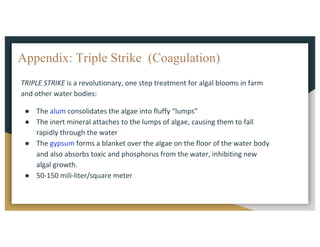
TRIPLE	STRIKE is	a	revolutionary,	one	step	treatment	for	algal	blooms	in	farm	
and	other	water	bodies:
● The	alum consolidates	the	algae	into	fluffy	“lumps”
● The	inert	mineral	attaches	to	the	lumps	of	algae,	causing	them	to	fall	
rapidly	through	the	water
● The	gypsum forms	a	blanket	over	the	algae	on	the	floor	of	the	water	body	
and	also	absorbs	toxic	and	phosphorus	from	the	water,	inhibiting	new	
algal	growth.
● 50-150	mili-liter/square	meter
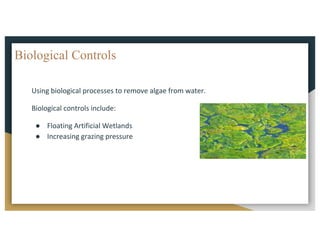
Biological Controls
Using	biological	processes	to	remove	algae	from	water.
Biological	controls	include:
● Floating	Artificial	Wetlands
● Increasing	grazing	pressure
Floating Artificial Wetlands
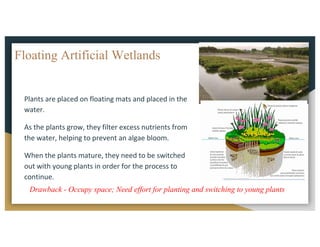
Plants	are	placed	on	floating	mats	and	placed	in	the	
water.		
As	the	plants	grow,	they	filter	excess	nutrients	from	
the	water,	helping	to	prevent	an	algae	bloom.		
When	the	plants	mature,	they	need	to	be	switched	
out	with	young	plants	in	order	for	the	process	to	
continue.
Drawback - Occupy space; Need effort for planting and switching to young plants
Increasing Grazing Pressure
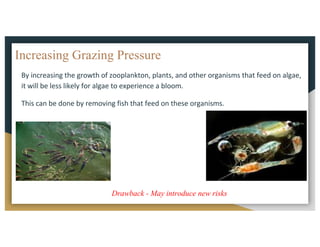
By	increasing	the	growth	of	zooplankton,	plants,	and	other	organisms	that	feed	on	algae,	
it	will	be	less	likely	for	algae	to	experience	a	bloom.		
This	can	be	done	by	removing	fish	that	feed	on	these	organisms.
Drawback - May introduce new risks
Direct Nutrient Removal
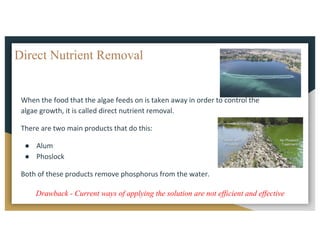
When	the	food	that	the	algae	feeds	on	is	taken	away	in	order	to	control	the	
algae	growth,	it	is	called	direct	nutrient	removal.		
There	are	two	main	products	that	do	this:
● Alum
● Phoslock
Both	of	these	products	remove	phosphorus	from	the	water.		
Drawback - Current ways of applying the solution are not efficient and effective
References
http://www.waterrf.org/knowledge/source-water-protection-and-
management/FactSheets/SourceWater_FactSheet_algae.pdf
https://www.epa.gov/nutrientpollution/effects
http://making-biodiesel-books.com/about-algae/algae-bioreactors/
http://dnr.wi.gov/lakes/bluegreenalgae/
https://www.pitchcare.com/shop/aquatic-algae-control/triple-strike-revolutionary-algae-control.html
https://link.springer.com/chapter/10.1007/978-94-007-5479-9_16
https://www.aquaread.com/need-help/what-are-you-measuring/blue-green-algae/
http://www.green-flow.co.il/Documents/TRIPLESTRIKE/Triple%20Strike%20Flyer.pdf
Appendix: Sensor for detecting algae
● Conducting	a	blue	green	algae	test	using	fluorometers	is	possible	because	the	pigments	within	the	
bacteria	are	fluorescent.	This	means	that	when	light	of	a	certain	wavelength	is	emitted,	the	algae	
absorbs	the	light	energy	and	emits	a	light	of	their	own.	A	fluorometer	is	a	form	of	blue	green	algae	
sensor	that	enables	concentrations	of	it	to	be	tested	in	the	field,	which	means	that	it’s	not	
necessary	to	collect	samples	for	analysis	in	a	laboratory.	Laboratory	analysis	can	be	a	lengthy	
process	and	delay	control	actions.	Using	a	fluorometer	to	detect	it	provides	instant	results.
(https://www.aquaread.com/need-help/what-are-you-measuring/blue-green-algae/
● A fluorometer or fluorimeter is a device used to measure parameters of fluorescence: its
intensity and wavelength distribution of emission spectrum after excitation by a certain
spectrum of light. These parameters are used to identify the presence and the amount of
specific molecules in a medium.

Algae bloom control