Seaweed
Farming
What is a seaweed?
How do we culture it?
What is the advantage of
its culture?
What does it contribute?
What is its importance?
Overview:
I. Seaweed Definition
II. Seaweed Farming Definition
III. Specie Focus (Eucheuma)
IV. Site Selection
V. Site Preparation
VI. Diff. Culture Methods
VII. Farm Management
VIII. Benefits of Seaweed
IX. Uses of Seaweeds
I. Seaweed Defined:
Seaweeds are marine
macro & micro algae,
they are plant-like organisms
that generally live attached to
rock or other hard substrata in
coastal areas.
Major Seaweed Classification:
According to pigments
 Phaeophyta
(brown algae)
 Rhodophyta
(red algae)
 Chlorophyta
(green algae)
II. Seaweed Farming Defined:
is the practice of cultivating
and harvesting seaweed.
In its simplest form,
it consists of the management
of naturally found batches.
In its most advanced form,
it consists of fully controlling
the life cycle of the algae.
Did you know that…
… Seaweed grows fast!
The weight of your seaweed can
become 10 times heavier in 6 to 8
weeks.
In other words,
if you have a 150 gram plant to start,
after 6 to 8 weeks that plant will
weigh about 1.5 kilograms.
Did you know that…
Thus,
Eucheuma seaweed has a very
fast growth;
a clear advantage for the
farmers!
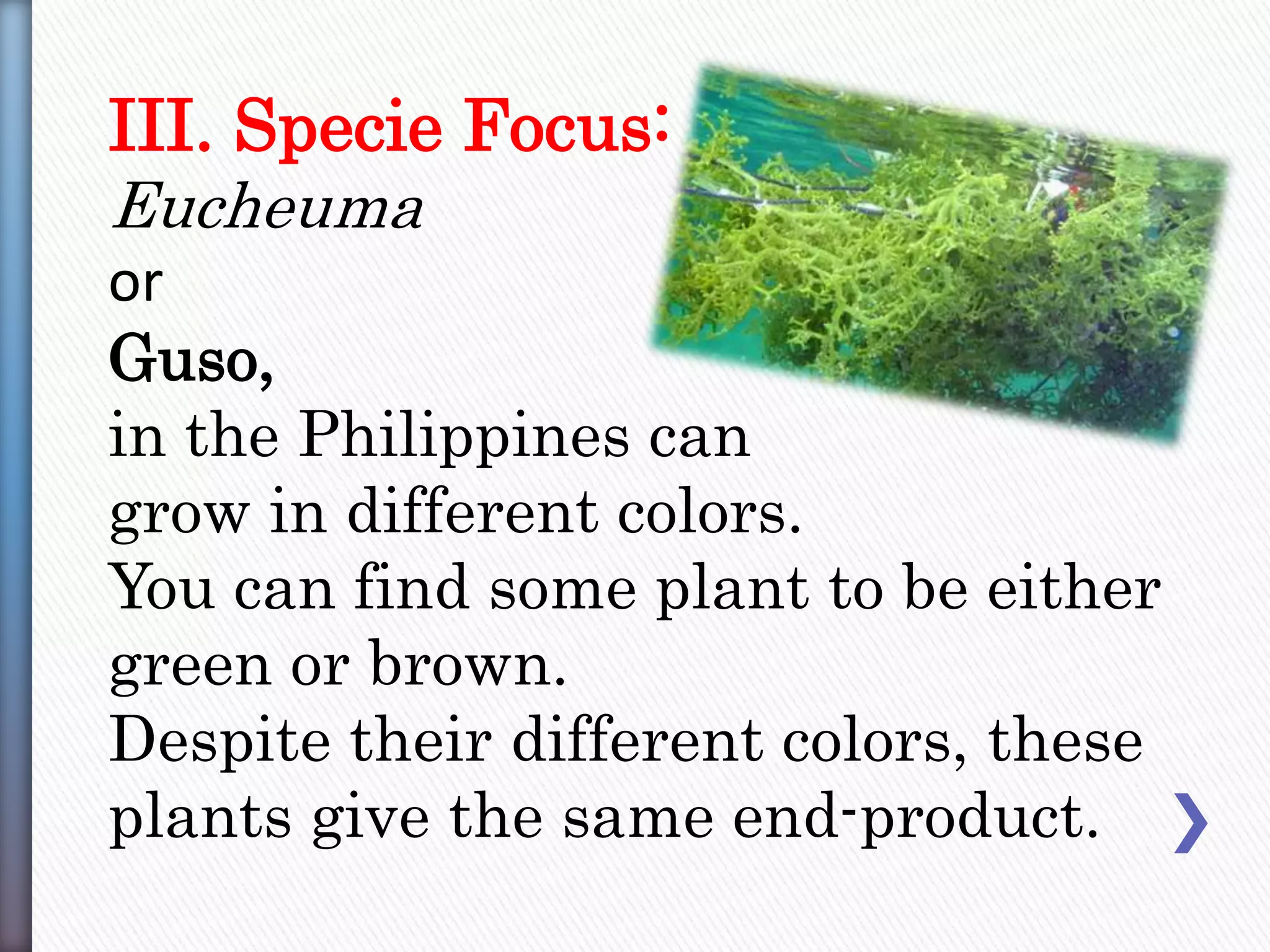
III. Specie Focus:
Eucheuma
or
Guso,
in the Philippines can
grow in different colors.
You can find some plant to be either
green or brown.
Despite their different colors, these
plants give the same end-product.
III. Specie Focus:
Eucheuma
Eucheuma seaweed has no
roots but some of its branches can
attach to corals and grow.
Even though seaweed grows
in all directions, most of its
branches grow up toward the sea
surface.
IV. Site Selection:
1.
Choose a location where there is a
good water movement or where
there is a rapid water turnover.
Hence, H2O current speed should be
between 20 to 40 m/min.
IV. Site Selection:
2.
Area should be sheltered from
very strong wave action, current
and winds.
3…
Avoid areas that are near the
mouth of rivers or where there is
a heavy freshwater runoff.
IV. Site Selection:
…3.
Eucheuma is a purely marine alga.
Salinity of the farm area should be
from 27 -35 parts/thousand.
4.
The area should have a water
temperature range between 25°C
and 30°C.
IV. Site Selection:
5.
Water depth in the farm should not
be less than 2 feet during the
lowest tide and more than 7 feet
during high tide.
6.
The ground should be stable
enough to permit easy installation
of stakes or bamboos.
IV. Site Selection:
7.
Farm bottom composition should
be sandy and rocky depending
upon the variety of Eucheuma.
8.
If possible, choose areas where
Eucheuma is endemic. However,
the absence of such is not
necessarily a negative sign.
IV. Site Selection:
9.
Take note of the other marine plants
and animals that are associated with
Eucheuma, for they are good indicators
of possible site for its farming.
10.
Consider also the availability of labor,
materials, accessibility to
transportation and communication as
well.
V. Preparation of the Plant Site:
Steps to follow acc. To BFAR
1.
Cut all grasses and remove all
obstacles from the area.
V. Preparation of the Plant Site:
Steps to follow acc. To BFAR
2.
Remove the rocks, stones,
starfishes, sea urchins & other
predators.
V. Preparation of the Plant
Site:
Steps to follow acc. To BFAR
3.
Construct a farm house w/ a drying
platform on the selected site.
V. Preparation of the Plant Site:
Steps to follow acc. To BFAR
4.
Prepare rattan/buri baskets or
seed-bin for holding seed stocks.
Preparation of the Plant Site:
Steps to follow acc. To BFAR
5.
Also prepare other culture materials
such as nylon monolines, nylon nets,
etc.
Methods of Culture:
1. Net method
1.1 Floating bamboo
method
1.2 Mangrove stakes and
nets
2. Bottom monoline method
3. Floating monoline method
VI. Methods of Culture:
1. Net method
• It is the first commercially
adapted technique in Eucheuma
culture.
• Planting unit is a rectangular
net measuring 2.5 × 5 m with a
diagonal meshwork having a 25
cm bar length.
VI. Methods of Culture:
•Net is made up of monofilament
nylon or standed polypropylene lines
(110–150 lbs test) for the margin and
30–100 lbs test for the meshwork.
•Each net unit has 127 mesh
intersections. Eucheuma seedlings
are tied at these places using soft
plastic straws (tie-tie).
Net Method
VI. Methods of Culture:
1.2. Floating bamboo method
a. Tie each corner of a 2.5 × 5 m net
to a large coral with a cord so that
the net is stretched tightly.
VI. Methods of Culture:
b. Cut one meter piece of bamboo and
tie one piece to each corner of the net.
c. Add additional net to the previously
constructed one.
Floating Bamboo
Method “Lantay”
VI. Methods of Culture:
1.3. Mangrove stakes and nets
a. Install mangrove stake bipod and
tripod 6 meters apart in rows with
11 bipods or tripods in each row.
b. The rows should be 6 meters apart
(11 rows can hold 20 nets). (BFAR
Handouts).
c. Attach 2.5 × 5 meters net to the
bipods and tripods.
Make sure all nets are stretched
tightly and are at least 2 feet above
the bottom but below the lowest tide
level.
VI. Methods of Culture:
Methods of Culture:
2. Bottom Monoline Method
The fixed, off-bottom monoline method
or bottom line method of cultivation is
commonly used in commercial farms.
Methods of Culture:
3. Floating Monoline Method
Opposite of bottom monoline method.
Images
Floating Monoline
Bottom Monoline
VII. Management of Eucheuma
Farm
1) Seed selection and preparation
 Careful selection of seedlings is a
must. Healthy strong branches
should be chosen.
 Good seedlings are usually found
at the center and near the tip of a
healthy plant.
VII. Management of Eucheuma
Farm
The ways to prepare the seedlings are:
a. Use a clean and sharp stainless
knife to cut the branches in order to
leave a smooth surface.
VII. Management of Eucheuma
Farm
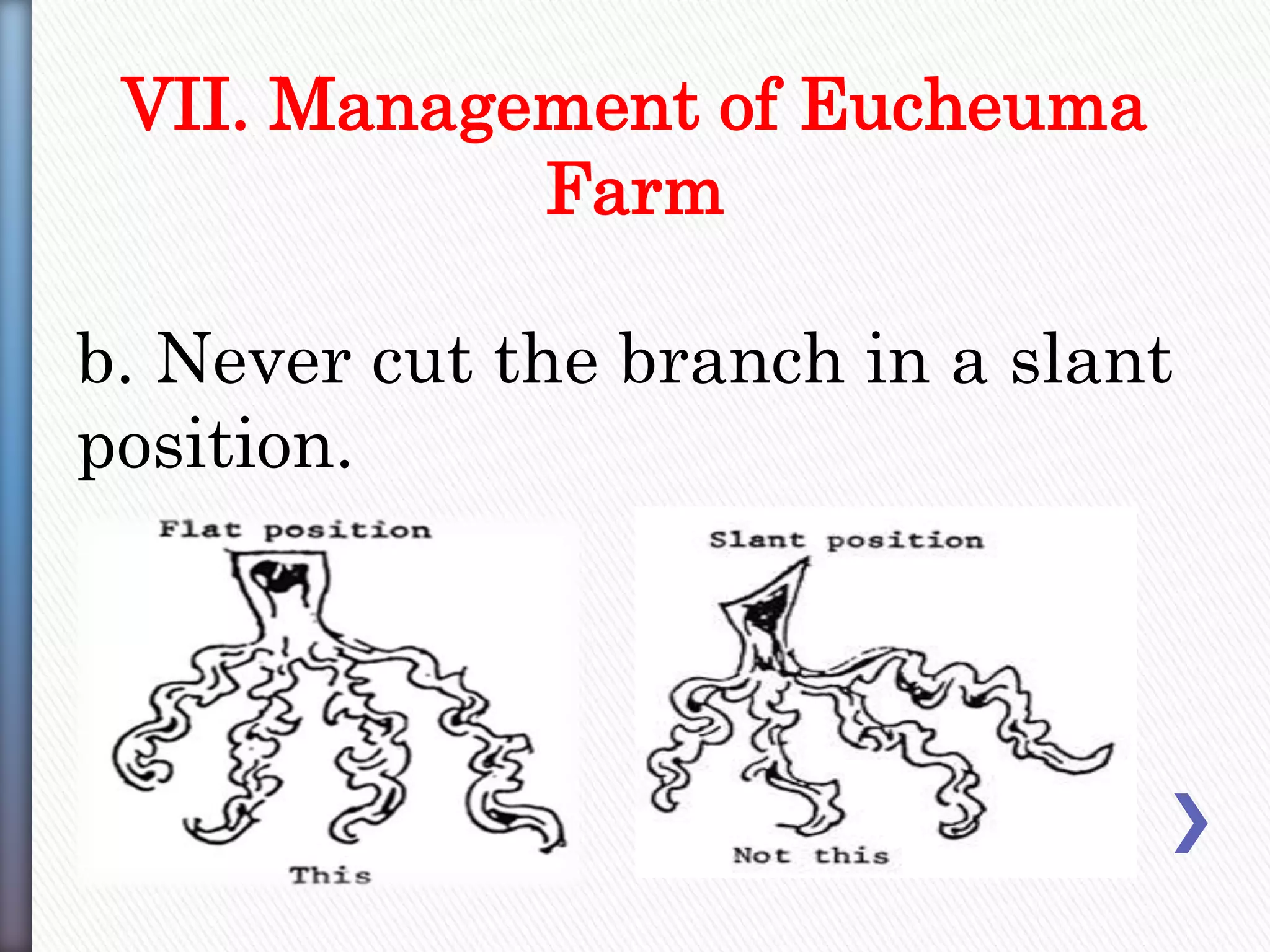
b. Never cut the branch in a slant
position.
VII. Management of Eucheuma
Farm
C. Do not produce seedlings with
any cuts at its branches.
VII. Management of Eucheuma
Farm
2) Tying of seedlings
 Use of soft, flexible, not easily
shredded and medium-sized
plastic.
 Tying length will be 6 inches
(15.3 cm).
VII. Management of
Eucheuma Farm
The following are the
ways to tie seedlings:
a. Seedlings should
be tied at the strongest
point where they are
well-balanced for free
movement.
Avoid breakage of the
branches.
VII. Management of Eucheuma
Farm
b. Tie the seedlings properly with
enough allowance for growth.
VII. Management of Eucheuma
Farm
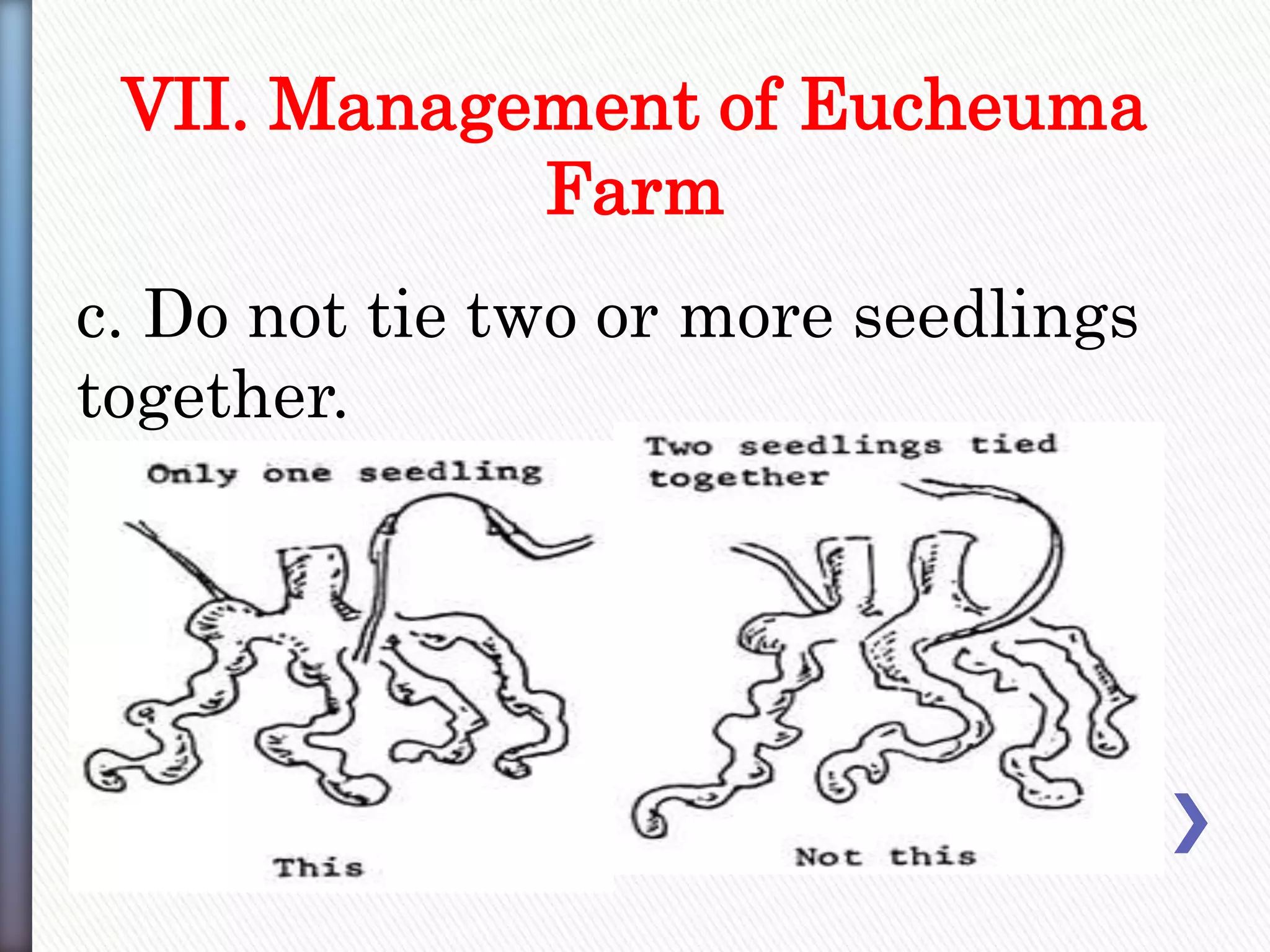
c. Do not tie two or more seedlings
together.
VII. Management of Eucheuma
Farm
3. Harvesting of Seaweed
• Harvesting can also be made a
part of the maintenance procedure.
• Eucheuma are harvestable when
they reach the weight between
750–850 g.
VII. Management of Eucheuma
Farm
3.1 Pre-harvest activities
 Prepare all the necessary
harvesting materials such as
baskets, sacks, knife and
goggles.
 Prepare the drying area.
VII. Management of Eucheuma
Farm
3.2 Harvesting Procedures
a. Go row by row through the farm,
harvest each plant by pruning.
Remove branches from each plant
using a sharp stainless knife.
Leave about 200 g on each plant for
regeneration.
VII. Management of Eucheuma
Farm
b. In total harvesting, just cut the
allowance portion of the tie in-
between the plant and the nylon line.
c.Using scoop nets, scoop harvested
plants.
d. Collect all harvested plants in the
banca.
VII. Management of Eucheuma
Farm
e. Paddle the banca to the drying
area when it is already full.
f. Unload, weigh and keep a record
of all the harvests before spreading
them to dry.
VIII. Benefits of Seaweeds
• Blood Purifying:
The chemical composition of
seaweeds is so close to human blood
plasma, that they are excellent at
regulating and purifying our blood.
• High in Calcium:
They can contain up to 10 times
more calcium than milk and 8 times
as much as beef.
VIII. Benefits of Seaweeds
• Alkalizing:
Helps our blood to neutralize the
over-acidic effects of our modern diet.
• Have Powerful Chelating Properties:
Offers protection from a wide array
of environmental toxins, including heavy
metals, pollutants&radiation by-
products, by converting them to harmless
salts that the body can eliminate easily.
VIII. Benefits of Seaweeds
• Contain Anti-oxidants:
Seaweeds contain lignans
(naturally occurring chemical
compounds) which have anti cancer
properties.
• Detoxifying:
They are rich in chlorophyll which
is a powerful, natural detoxifier that
helps to draw out waste products.
VIII. Benefits of Seaweeds
• Boost Weight loss:
Seaweeds play a role in boosting weight
loss and deterring cellulite build-up.
Their naturally high concentration of
iodine, helps to stimulate the thyroid
gland, which is responsible for
maintaining a healthy metabolism.
At the same time, its' minerals act like
electrolytes to break the chemical bonds
that seal the fat cells, allowing trapped
wastes to escape.
IX. Uses of Seaweeds
 Food
e.g.1 veggie salad
(lato, Caulerpa racemosa)
e.g.2 Nori
(P. yezoensis and P. tenera)
Seaweed is good for the health, it is
reach with Carbohydrates, Protein,
Minerals &Vitamins A, B1,B2,B3&C
Images:
IX. Uses of Seaweed
 Animal Feeds
e.g seaweed meal
(Ascophyllum&Laminaria)
 Fertilizers
e.g. Liquid seaweed manure
-promote resistance to plant disease& pests
-induce fruit bearing
-increase germination rates ALSO
Seaweed is used to promote growth and
soil condition, except for N,P,K,
properties that already helps.
IX. Uses of Seaweed
 Commercial Use
e.g.1 Body Cream
The seaweed and seaweed extracts
are good for the skin
because it is beyond dispute
according to cosmeticians and
beauticians.
IX. Uses of Seaweeds
 Commercial Use
e.g.2 Alginates
Is widely used as a stabilizer or as an
emulsifier, or both, and became very
popular with the textile printing
industry over the years.
e.g.3 Agar (gulaman)
Is use as a solid substrate for the
growth of bacteria and fungi. Also, it
could be utilize as food (dessert).
IX. Uses of Seaweeds
 Commercial Use
e.g.4 Carrageenans
Are ideal food additives:
they have a range of gelling and
emulsifying properties ranging from a
soft slime to a brittle gel that one
could nearly walk upon.
Images
IX. Uses of Seaweed
 Medical Use
e.g. Seaweed Baths
Many people swear by the
efficacy of seaweed baths in the
treatment of rheumatism and
arthritis.
Kilcullen’s Seaweed Baths
Thank You.
Questions?

Seaweed Faming

  • 1.
  • 2.
    What is aseaweed? How do we culture it? What is the advantage of its culture? What does it contribute? What is its importance?
  • 3.
    Overview: I. Seaweed Definition II.Seaweed Farming Definition III. Specie Focus (Eucheuma) IV. Site Selection V. Site Preparation VI. Diff. Culture Methods VII. Farm Management VIII. Benefits of Seaweed IX. Uses of Seaweeds
  • 4.
    I. Seaweed Defined: Seaweedsare marine macro & micro algae, they are plant-like organisms that generally live attached to rock or other hard substrata in coastal areas.
  • 5.
    Major Seaweed Classification: Accordingto pigments  Phaeophyta (brown algae)  Rhodophyta (red algae)  Chlorophyta (green algae)
  • 6.
    II. Seaweed FarmingDefined: is the practice of cultivating and harvesting seaweed. In its simplest form, it consists of the management of naturally found batches. In its most advanced form, it consists of fully controlling the life cycle of the algae.
  • 7.
    Did you knowthat… … Seaweed grows fast! The weight of your seaweed can become 10 times heavier in 6 to 8 weeks. In other words, if you have a 150 gram plant to start, after 6 to 8 weeks that plant will weigh about 1.5 kilograms.
  • 8.
    Did you knowthat… Thus, Eucheuma seaweed has a very fast growth; a clear advantage for the farmers!
  • 9.
    III. Specie Focus: Eucheuma or Guso, inthe Philippines can grow in different colors. You can find some plant to be either green or brown. Despite their different colors, these plants give the same end-product.
  • 10.
    III. Specie Focus: Eucheuma Eucheumaseaweed has no roots but some of its branches can attach to corals and grow. Even though seaweed grows in all directions, most of its branches grow up toward the sea surface.
  • 11.
    IV. Site Selection: 1. Choosea location where there is a good water movement or where there is a rapid water turnover. Hence, H2O current speed should be between 20 to 40 m/min.
  • 12.
    IV. Site Selection: 2. Areashould be sheltered from very strong wave action, current and winds. 3… Avoid areas that are near the mouth of rivers or where there is a heavy freshwater runoff.
  • 13.
    IV. Site Selection: …3. Eucheumais a purely marine alga. Salinity of the farm area should be from 27 -35 parts/thousand. 4. The area should have a water temperature range between 25°C and 30°C.
  • 14.
    IV. Site Selection: 5. Waterdepth in the farm should not be less than 2 feet during the lowest tide and more than 7 feet during high tide. 6. The ground should be stable enough to permit easy installation of stakes or bamboos.
  • 15.
    IV. Site Selection: 7. Farmbottom composition should be sandy and rocky depending upon the variety of Eucheuma. 8. If possible, choose areas where Eucheuma is endemic. However, the absence of such is not necessarily a negative sign.
  • 16.
    IV. Site Selection: 9. Takenote of the other marine plants and animals that are associated with Eucheuma, for they are good indicators of possible site for its farming. 10. Consider also the availability of labor, materials, accessibility to transportation and communication as well.
  • 17.
    V. Preparation ofthe Plant Site: Steps to follow acc. To BFAR 1. Cut all grasses and remove all obstacles from the area.
  • 18.
    V. Preparation ofthe Plant Site: Steps to follow acc. To BFAR 2. Remove the rocks, stones, starfishes, sea urchins & other predators.
  • 19.
    V. Preparation ofthe Plant Site: Steps to follow acc. To BFAR 3. Construct a farm house w/ a drying platform on the selected site.
  • 20.
    V. Preparation ofthe Plant Site: Steps to follow acc. To BFAR 4. Prepare rattan/buri baskets or seed-bin for holding seed stocks.
  • 21.
    Preparation of thePlant Site: Steps to follow acc. To BFAR 5. Also prepare other culture materials such as nylon monolines, nylon nets, etc.
  • 22.
    Methods of Culture: 1.Net method 1.1 Floating bamboo method 1.2 Mangrove stakes and nets 2. Bottom monoline method 3. Floating monoline method
  • 23.
    VI. Methods ofCulture: 1. Net method • It is the first commercially adapted technique in Eucheuma culture. • Planting unit is a rectangular net measuring 2.5 × 5 m with a diagonal meshwork having a 25 cm bar length.
  • 24.
    VI. Methods ofCulture: •Net is made up of monofilament nylon or standed polypropylene lines (110–150 lbs test) for the margin and 30–100 lbs test for the meshwork. •Each net unit has 127 mesh intersections. Eucheuma seedlings are tied at these places using soft plastic straws (tie-tie).
  • 25.
  • 26.
    VI. Methods ofCulture: 1.2. Floating bamboo method a. Tie each corner of a 2.5 × 5 m net to a large coral with a cord so that the net is stretched tightly.
  • 27.
    VI. Methods ofCulture: b. Cut one meter piece of bamboo and tie one piece to each corner of the net. c. Add additional net to the previously constructed one.
  • 28.
  • 29.
    VI. Methods ofCulture: 1.3. Mangrove stakes and nets a. Install mangrove stake bipod and tripod 6 meters apart in rows with 11 bipods or tripods in each row.
  • 30.
    b. The rowsshould be 6 meters apart (11 rows can hold 20 nets). (BFAR Handouts). c. Attach 2.5 × 5 meters net to the bipods and tripods. Make sure all nets are stretched tightly and are at least 2 feet above the bottom but below the lowest tide level. VI. Methods of Culture:
  • 31.
    Methods of Culture: 2.Bottom Monoline Method The fixed, off-bottom monoline method or bottom line method of cultivation is commonly used in commercial farms.
  • 32.
    Methods of Culture: 3.Floating Monoline Method Opposite of bottom monoline method.
  • 33.
  • 34.
    VII. Management ofEucheuma Farm 1) Seed selection and preparation  Careful selection of seedlings is a must. Healthy strong branches should be chosen.  Good seedlings are usually found at the center and near the tip of a healthy plant.
  • 35.
    VII. Management ofEucheuma Farm The ways to prepare the seedlings are: a. Use a clean and sharp stainless knife to cut the branches in order to leave a smooth surface.
  • 36.
    VII. Management ofEucheuma Farm b. Never cut the branch in a slant position.
  • 37.
    VII. Management ofEucheuma Farm C. Do not produce seedlings with any cuts at its branches.
  • 38.
    VII. Management ofEucheuma Farm 2) Tying of seedlings  Use of soft, flexible, not easily shredded and medium-sized plastic.  Tying length will be 6 inches (15.3 cm).
  • 39.
    VII. Management of EucheumaFarm The following are the ways to tie seedlings: a. Seedlings should be tied at the strongest point where they are well-balanced for free movement. Avoid breakage of the branches.
  • 40.
    VII. Management ofEucheuma Farm b. Tie the seedlings properly with enough allowance for growth.
  • 41.
    VII. Management ofEucheuma Farm c. Do not tie two or more seedlings together.
  • 42.
    VII. Management ofEucheuma Farm 3. Harvesting of Seaweed • Harvesting can also be made a part of the maintenance procedure. • Eucheuma are harvestable when they reach the weight between 750–850 g.
  • 43.
    VII. Management ofEucheuma Farm 3.1 Pre-harvest activities  Prepare all the necessary harvesting materials such as baskets, sacks, knife and goggles.  Prepare the drying area.
  • 44.
    VII. Management ofEucheuma Farm 3.2 Harvesting Procedures a. Go row by row through the farm, harvest each plant by pruning. Remove branches from each plant using a sharp stainless knife. Leave about 200 g on each plant for regeneration.
  • 45.
    VII. Management ofEucheuma Farm b. In total harvesting, just cut the allowance portion of the tie in- between the plant and the nylon line. c.Using scoop nets, scoop harvested plants. d. Collect all harvested plants in the banca.
  • 46.
    VII. Management ofEucheuma Farm e. Paddle the banca to the drying area when it is already full. f. Unload, weigh and keep a record of all the harvests before spreading them to dry.
  • 47.
    VIII. Benefits ofSeaweeds • Blood Purifying: The chemical composition of seaweeds is so close to human blood plasma, that they are excellent at regulating and purifying our blood. • High in Calcium: They can contain up to 10 times more calcium than milk and 8 times as much as beef.
  • 48.
    VIII. Benefits ofSeaweeds • Alkalizing: Helps our blood to neutralize the over-acidic effects of our modern diet. • Have Powerful Chelating Properties: Offers protection from a wide array of environmental toxins, including heavy metals, pollutants&radiation by- products, by converting them to harmless salts that the body can eliminate easily.
  • 49.
    VIII. Benefits ofSeaweeds • Contain Anti-oxidants: Seaweeds contain lignans (naturally occurring chemical compounds) which have anti cancer properties. • Detoxifying: They are rich in chlorophyll which is a powerful, natural detoxifier that helps to draw out waste products.
  • 50.
    VIII. Benefits ofSeaweeds • Boost Weight loss: Seaweeds play a role in boosting weight loss and deterring cellulite build-up. Their naturally high concentration of iodine, helps to stimulate the thyroid gland, which is responsible for maintaining a healthy metabolism. At the same time, its' minerals act like electrolytes to break the chemical bonds that seal the fat cells, allowing trapped wastes to escape.
  • 51.
    IX. Uses ofSeaweeds  Food e.g.1 veggie salad (lato, Caulerpa racemosa) e.g.2 Nori (P. yezoensis and P. tenera) Seaweed is good for the health, it is reach with Carbohydrates, Protein, Minerals &Vitamins A, B1,B2,B3&C
  • 52.
  • 53.
    IX. Uses ofSeaweed  Animal Feeds e.g seaweed meal (Ascophyllum&Laminaria)  Fertilizers e.g. Liquid seaweed manure -promote resistance to plant disease& pests -induce fruit bearing -increase germination rates ALSO Seaweed is used to promote growth and soil condition, except for N,P,K, properties that already helps.
  • 54.
    IX. Uses ofSeaweed  Commercial Use e.g.1 Body Cream The seaweed and seaweed extracts are good for the skin because it is beyond dispute according to cosmeticians and beauticians.
  • 55.
    IX. Uses ofSeaweeds  Commercial Use e.g.2 Alginates Is widely used as a stabilizer or as an emulsifier, or both, and became very popular with the textile printing industry over the years. e.g.3 Agar (gulaman) Is use as a solid substrate for the growth of bacteria and fungi. Also, it could be utilize as food (dessert).
  • 56.
    IX. Uses ofSeaweeds  Commercial Use e.g.4 Carrageenans Are ideal food additives: they have a range of gelling and emulsifying properties ranging from a soft slime to a brittle gel that one could nearly walk upon.
  • 57.
  • 58.
    IX. Uses ofSeaweed  Medical Use e.g. Seaweed Baths Many people swear by the efficacy of seaweed baths in the treatment of rheumatism and arthritis.
  • 59.
  • 60.