CARRAGEENAN
Submitted by
SUHAIL K S
INTRODUCTION
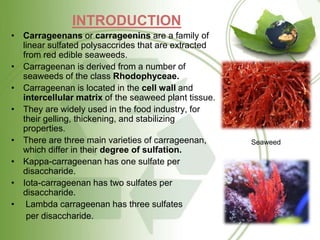
• Carrageenans or carrageenins are a family of
linear sulfated polysaccrides that are extracted
from red edible seaweeds.
• Carrageenan is derived from a number of
seaweeds of the class Rhodophyceae.
• Carrageenan is located in the cell wall and
intercellular matrix of the seaweed plant tissue.
• They are widely used in the food industry, for
their gelling, thickening, and stabilizing
properties.
• There are three main varieties of carrageenan,
which differ in their degree of sulfation.
• Kappa-carrageenan has one sulfate per
disaccharide.
• Iota-carrageenan has two sulfates per
disaccharide.
• Lambda carrageenan has three sulfates
per disaccharide.
Seaweed
STRUCTURE
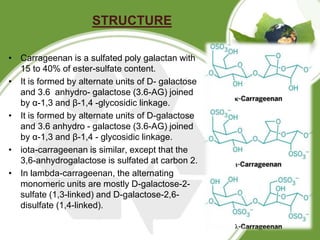
• Carrageenan is a sulfated poly galactan with
15 to 40% of ester-sulfate content.
• It is formed by alternate units of D- galactose
and 3.6 anhydro- galactose (3.6-AG) joined
by α-1,3 and β-1,4 -glycosidic linkage.
• It is formed by alternate units of D-galactose
and 3.6 anhydro - galactose (3.6-AG) joined
by α-1,3 and β-1,4 - glycosidic linkage.
• iota-carrageenan is similar, except that the
3,6-anhydrogalactose is sulfated at carbon 2.
• In lambda-carrageenan, the alternating
monomeric units are mostly D-galactose-2-
sulfate (1,3-linked) and D-galactose-2,6-
disulfate (1,4-linked).
STRUCTURE
• Carrageenans are linear polymers of about 25,000
galactose derivatives with regular but imprecise
structures, dependent on the source and extraction
conditions.
• The primary differences which influence the properties
of kappa, iota and lambda carrageenan type are the
number and position of ester sulfate groups as well as
the content of 3.6-AG.
• Kappa type carrageenan has an ester sulfate content of
about 25 to 30% and a 3,6-AG content of about 28 to
35%.
• Iota type carrageenan has an ester sulfate content of
about 28 to 30% and a 3,6-AG content of about 25 to
30%.
• Lambda type carrageenan has an ester sulfate content
of about 32 to 39% and no content of 3,6-AG.
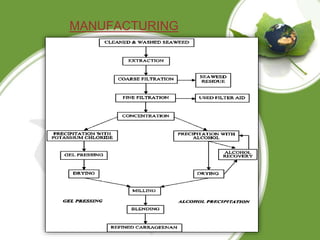
MANUFACTURING
 The seaweed is washed to remove sand, salts and
other foreign matter. It is then heated with water
containing an alkali, such as sodium hydroxide, for
several hours.
 The seaweed that does not dissolve is removed by
centrifugation or a coarse filtration, or a combination.
 The solution contains 1-2 percent carrageenan and this
is usually concentrated to 2-3 percent by vacuum
distillation and ultrafiltration.
 The processor now has a clear solution of carrageenan
and there are two methods for recovering it as a solid.
1. Alcohol-precipitation method
2. Gel method
MANUFACTURING
PROPERTIES
1. SOLUBILITY :
Hot Water: All carrageenan types are soluble in hot
water at temperatures above its gel melting temperature.
Cold Water:In cold water, only lambda-carrageenan and
the sodium salts of kappa and iota carrageenan are
soluble.
Sugar Solution :All carrageenan types are relatively
insoluble in concentrated sugar solutions at room
temperature.
2. GELLING :
Hot aqueous solution of kappa and iota carrageenans
have the ability to form thermo-reversible gels upon its
cooling. This phenomenon occurs due to the formation of
a double helix structure by the carrageenan polymers.
PROPERTIES:
3. VISCOSITY : The viscosity of carrageenan solutions
should be determined under conditions where there
are no tendencies for the solution to start gelling.
Commercial carrageenans are available generally in
viscosities ranging from about 5 to 800 cps when
measured in 1.5% solutions at 75º C.
4. STABILITY : Carrageenan solutions are quite stable at
neutral or alkaline pHs. At lower pHs their stability
decreases, especially at high temperatures. As the pH
is lowered hydrolysis of the carrageenan polymer
occurs, resulting in loss of viscosity and gelling
capability.
5. REACTIVITY WITH PROTEINS : One of the most
important properties that makes carrageenan different
from other hydrocolloids is its ability to interact with
milk proteins. The high reactivity of carrageenan with
milk is due to the strong electrostatic interaction
between the negatively charged ester sulfate groups in
the carrageenan molecule, with strong positive
charges of the milk casein micella.
PROPERTIES
6. INTERACTION WITH OTHER GUMS :Kappa
carrageenan shows an unusual synergism with locust
beam gum (LBG) in aqueous gel systems. The
interaction is marked by a considerable increase in the
gel strength, an improve in water binding capacity, a
change in gel texture from brittle to elastic, and a
reduction in the degree of syneresis.
6. THIXOTROPY : At low concentrations iota carrageenan
water gels have thixotropic rheological properties. These
gels may be fluidized by agitation or shear and will form
elastic gels when allowed to stand at rest. This
thixotropic property is particularly useful to suspend
insoluble particles such as spices in salad sauces.
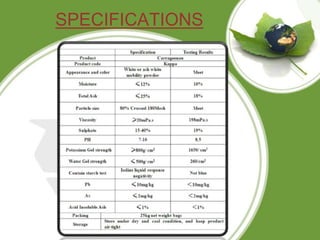
SPECIFICATIONS
APPLICATIONS
• uses and applications: gelling, thickening, emulsion stabilizing,
protein stabilizing,particle suspension, viscosity control and water retention
are just a few.
1. FOOD INDUSTRY : Milk Products
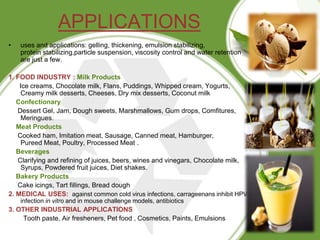
Ice creams, Chocolate milk, Flans, Puddings, Whipped cream, Yogurts,
Creamy milk desserts, Cheeses, Dry mix desserts, Coconut milk
Confectionary
Dessert Gel, Jam, Dough sweets, Marshmallows, Gum drops, Comfitures,
Meringues.
Meat Products
Cooked ham, Imitation meat, Sausage, Canned meat, Hamburger,
Pureed Meat, Poultry, Processed Meat .
Beverages
Clarifying and refining of juices, beers, wines and vinegars, Chocolate milk,
Syrups, Powdered fruit juices, Diet shakes.
Bakery Products
Cake icings, Tart fillings, Bread dough
2. MEDICAL USES: against common cold virus infections, carrageenans inhibit HPV
infection in vitro and in mouse challenge models, antibiotics
3. OTHER INDUSTRIAL APPLICATIONS
Tooth paste, Air fresheners, Pet food , Cosmetics, Paints, Emulsions
THANK YOU

Carageenan

  • 1.
  • 2.
    INTRODUCTION • Carrageenans orcarrageenins are a family of linear sulfated polysaccrides that are extracted from red edible seaweeds. • Carrageenan is derived from a number of seaweeds of the class Rhodophyceae. • Carrageenan is located in the cell wall and intercellular matrix of the seaweed plant tissue. • They are widely used in the food industry, for their gelling, thickening, and stabilizing properties. • There are three main varieties of carrageenan, which differ in their degree of sulfation. • Kappa-carrageenan has one sulfate per disaccharide. • Iota-carrageenan has two sulfates per disaccharide. • Lambda carrageenan has three sulfates per disaccharide. Seaweed
  • 3.
    STRUCTURE • Carrageenan isa sulfated poly galactan with 15 to 40% of ester-sulfate content. • It is formed by alternate units of D- galactose and 3.6 anhydro- galactose (3.6-AG) joined by α-1,3 and β-1,4 -glycosidic linkage. • It is formed by alternate units of D-galactose and 3.6 anhydro - galactose (3.6-AG) joined by α-1,3 and β-1,4 - glycosidic linkage. • iota-carrageenan is similar, except that the 3,6-anhydrogalactose is sulfated at carbon 2. • In lambda-carrageenan, the alternating monomeric units are mostly D-galactose-2- sulfate (1,3-linked) and D-galactose-2,6- disulfate (1,4-linked).
  • 4.
    STRUCTURE • Carrageenans arelinear polymers of about 25,000 galactose derivatives with regular but imprecise structures, dependent on the source and extraction conditions. • The primary differences which influence the properties of kappa, iota and lambda carrageenan type are the number and position of ester sulfate groups as well as the content of 3.6-AG. • Kappa type carrageenan has an ester sulfate content of about 25 to 30% and a 3,6-AG content of about 28 to 35%. • Iota type carrageenan has an ester sulfate content of about 28 to 30% and a 3,6-AG content of about 25 to 30%. • Lambda type carrageenan has an ester sulfate content of about 32 to 39% and no content of 3,6-AG.
  • 5.
    MANUFACTURING  The seaweedis washed to remove sand, salts and other foreign matter. It is then heated with water containing an alkali, such as sodium hydroxide, for several hours.  The seaweed that does not dissolve is removed by centrifugation or a coarse filtration, or a combination.  The solution contains 1-2 percent carrageenan and this is usually concentrated to 2-3 percent by vacuum distillation and ultrafiltration.  The processor now has a clear solution of carrageenan and there are two methods for recovering it as a solid. 1. Alcohol-precipitation method 2. Gel method
  • 6.
  • 7.
    PROPERTIES 1. SOLUBILITY : HotWater: All carrageenan types are soluble in hot water at temperatures above its gel melting temperature. Cold Water:In cold water, only lambda-carrageenan and the sodium salts of kappa and iota carrageenan are soluble. Sugar Solution :All carrageenan types are relatively insoluble in concentrated sugar solutions at room temperature. 2. GELLING : Hot aqueous solution of kappa and iota carrageenans have the ability to form thermo-reversible gels upon its cooling. This phenomenon occurs due to the formation of a double helix structure by the carrageenan polymers.
  • 8.
    PROPERTIES: 3. VISCOSITY :The viscosity of carrageenan solutions should be determined under conditions where there are no tendencies for the solution to start gelling. Commercial carrageenans are available generally in viscosities ranging from about 5 to 800 cps when measured in 1.5% solutions at 75º C. 4. STABILITY : Carrageenan solutions are quite stable at neutral or alkaline pHs. At lower pHs their stability decreases, especially at high temperatures. As the pH is lowered hydrolysis of the carrageenan polymer occurs, resulting in loss of viscosity and gelling capability. 5. REACTIVITY WITH PROTEINS : One of the most important properties that makes carrageenan different from other hydrocolloids is its ability to interact with milk proteins. The high reactivity of carrageenan with milk is due to the strong electrostatic interaction between the negatively charged ester sulfate groups in the carrageenan molecule, with strong positive charges of the milk casein micella.
  • 9.
    PROPERTIES 6. INTERACTION WITHOTHER GUMS :Kappa carrageenan shows an unusual synergism with locust beam gum (LBG) in aqueous gel systems. The interaction is marked by a considerable increase in the gel strength, an improve in water binding capacity, a change in gel texture from brittle to elastic, and a reduction in the degree of syneresis. 6. THIXOTROPY : At low concentrations iota carrageenan water gels have thixotropic rheological properties. These gels may be fluidized by agitation or shear and will form elastic gels when allowed to stand at rest. This thixotropic property is particularly useful to suspend insoluble particles such as spices in salad sauces.
  • 10.
  • 11.
    APPLICATIONS • uses andapplications: gelling, thickening, emulsion stabilizing, protein stabilizing,particle suspension, viscosity control and water retention are just a few. 1. FOOD INDUSTRY : Milk Products Ice creams, Chocolate milk, Flans, Puddings, Whipped cream, Yogurts, Creamy milk desserts, Cheeses, Dry mix desserts, Coconut milk Confectionary Dessert Gel, Jam, Dough sweets, Marshmallows, Gum drops, Comfitures, Meringues. Meat Products Cooked ham, Imitation meat, Sausage, Canned meat, Hamburger, Pureed Meat, Poultry, Processed Meat . Beverages Clarifying and refining of juices, beers, wines and vinegars, Chocolate milk, Syrups, Powdered fruit juices, Diet shakes. Bakery Products Cake icings, Tart fillings, Bread dough 2. MEDICAL USES: against common cold virus infections, carrageenans inhibit HPV infection in vitro and in mouse challenge models, antibiotics 3. OTHER INDUSTRIAL APPLICATIONS Tooth paste, Air fresheners, Pet food , Cosmetics, Paints, Emulsions
  • 12.