Submitted by
Abhishek Giri
M.F.Sc. (4th Sem)
Dept. of Zoology and Applied Aquaculture
Barkatullah University
Bhopal, Madhya Pradesh
462026
INTRODUCTION
 The rotifer, Brachionus plicatilis, is an important food
organisms for the first feeding stages of larval marine
animals around the world.
 It is a cosmopoliton euryhaline species, thus it is very
versatile in marine culture.
 The rotifer varies in size depending on culture
conditions .
 Adult size ranging from 123 to 315 µm in length.
 It can be grown in seawater in a wide range of salinities.
 Feed types vary, but the most common are algae such
as Tetraselmis, Chlorella and Isochrysis.
 Other’s incluid baker’s and torula yeast, fish oil and
artificial diets.
METHODS
 Stock cultures for inoculant or starter cultures are
maintained in 1-2 liter flasks.
 Stock cultures can be maintained on an algal diet of
Isochrysis galbana at 24-25℃ and a light cycle of 12
light : 12 dark.
 Cultures should be restarted periodically, at least
every month or more.
MAIN SPECIES OF ROTIFERS
1. Brachionus plicatilis. (MarineWater)
2. Brachionus rotundiformis. (MarineWater)
3. Brachionus calyciflorus. (FreshWater)
CULTURE METHODS
 Rotifers have been cultured in 1.8 m dia., round,
flat-bottomed tanks that hold up to 1800 liters of
water, 140 liter conical tanks; 160 liter clear,
cylindrical fiberglass tanks; 50 liter polyethylene
bags; and 1.8 m dia. 3200 liter round outdoor tanks.
 Tanks are sterilized before use by addition of 2.5
ppm bleach for 12-24 hours.
 They are then filled with filtered seawater and
salinity is adjusted .
 Temperature is maintained at 24-26℃.
 Conical (room ceiling light) and outside
tanks(sunlight) have continuous light supplied from
light banks.
Using baker’s yeast and fish oil
 Set up 1800 liter round tank or conical tanks.
 On day one yeast is fed at 0.6-0.8 g/l, fish oil at 1.0
ml/10 l.
 On day two yeast is fed at 1.5 g/106 rotifers and fish
oil at 3ml/106 rotifers daily until rotifer density
reaches 50/ml.
 Then add 1-1.3 g yeast/106 and 2-3 ml of fish oil/106
rotifers daily until a density of 100/ml is attained.
 Then fed yeast at 0.6-1.0 g/106 rotifers and fish oil at
2ml/106 rotifers until the density reaches 150-
200/ml.
 At this time harvesting may begin.
Using algae, yeast and fish oil
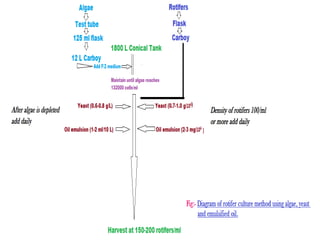
 Set up one 1800 liter tank and inoculate with a 12 liter
carboy of Isochrysis galbana (132,000 cells/ml) and
medium (0.2 ml/liter of F/2 medium).
 On the second and third days add 0.2 ml/lit of F/2
medium and when the algae density reaches 132,000
cells/ml inoculate with 1-10 rotifers/ml.
 When the concentration of algae decreases, begin
adding yeast at 50 g/tank and fish oil at 1-2 ml/10 liters
each day.
 When rotifer density reaches 100/ml or more, begin
adding yeast at 0.7-1.0 g/106 rotifers and fish oil at 2-3
ml/106 rotifers.
 Harvesting rotifers can begin when the density reaches
200 rotifers/ml.
FEEDING ROTIFERS TO LARVAL FISH
 Larval red drum begin feeding approximately three
days after hatching, when their mouth parts
develop.
 Rotifers are fed at this time at a rate of 3-5
rotifers/ml until larger fed can be consumed.
 Due to the loss in nutritional value a few hours after
harvest, it is best to feed rotifers to fish at list twice
a day.
CONCLUSION
 There are many ways to culture rotifers.
 Keep culture containers and water clean.
 Control contaminants such as ciliates and bacteria.
 Harvest daily to maintain the culture in growth
phase.
 Add some algae daily, even a small amount.
REFERENCES
 A text book of fish and fishery science –
C.B.L.Srivastava.
 An introduction to fishes – S.S.Khanna.
 Work book on Limnology – A.D.Adoni.
Rotifer culture

Rotifer culture

  • 1.
    Submitted by Abhishek Giri M.F.Sc.(4th Sem) Dept. of Zoology and Applied Aquaculture Barkatullah University Bhopal, Madhya Pradesh 462026
  • 3.
    INTRODUCTION  The rotifer,Brachionus plicatilis, is an important food organisms for the first feeding stages of larval marine animals around the world.  It is a cosmopoliton euryhaline species, thus it is very versatile in marine culture.  The rotifer varies in size depending on culture conditions .  Adult size ranging from 123 to 315 µm in length.  It can be grown in seawater in a wide range of salinities.  Feed types vary, but the most common are algae such as Tetraselmis, Chlorella and Isochrysis.  Other’s incluid baker’s and torula yeast, fish oil and artificial diets.
  • 4.
    METHODS  Stock culturesfor inoculant or starter cultures are maintained in 1-2 liter flasks.  Stock cultures can be maintained on an algal diet of Isochrysis galbana at 24-25℃ and a light cycle of 12 light : 12 dark.  Cultures should be restarted periodically, at least every month or more.
  • 5.
    MAIN SPECIES OFROTIFERS 1. Brachionus plicatilis. (MarineWater) 2. Brachionus rotundiformis. (MarineWater) 3. Brachionus calyciflorus. (FreshWater)
  • 8.
    CULTURE METHODS  Rotifershave been cultured in 1.8 m dia., round, flat-bottomed tanks that hold up to 1800 liters of water, 140 liter conical tanks; 160 liter clear, cylindrical fiberglass tanks; 50 liter polyethylene bags; and 1.8 m dia. 3200 liter round outdoor tanks.  Tanks are sterilized before use by addition of 2.5 ppm bleach for 12-24 hours.  They are then filled with filtered seawater and salinity is adjusted .  Temperature is maintained at 24-26℃.  Conical (room ceiling light) and outside tanks(sunlight) have continuous light supplied from light banks.
  • 9.
    Using baker’s yeastand fish oil  Set up 1800 liter round tank or conical tanks.  On day one yeast is fed at 0.6-0.8 g/l, fish oil at 1.0 ml/10 l.  On day two yeast is fed at 1.5 g/106 rotifers and fish oil at 3ml/106 rotifers daily until rotifer density reaches 50/ml.  Then add 1-1.3 g yeast/106 and 2-3 ml of fish oil/106 rotifers daily until a density of 100/ml is attained.  Then fed yeast at 0.6-1.0 g/106 rotifers and fish oil at 2ml/106 rotifers until the density reaches 150- 200/ml.  At this time harvesting may begin.
  • 11.
    Using algae, yeastand fish oil  Set up one 1800 liter tank and inoculate with a 12 liter carboy of Isochrysis galbana (132,000 cells/ml) and medium (0.2 ml/liter of F/2 medium).  On the second and third days add 0.2 ml/lit of F/2 medium and when the algae density reaches 132,000 cells/ml inoculate with 1-10 rotifers/ml.  When the concentration of algae decreases, begin adding yeast at 50 g/tank and fish oil at 1-2 ml/10 liters each day.  When rotifer density reaches 100/ml or more, begin adding yeast at 0.7-1.0 g/106 rotifers and fish oil at 2-3 ml/106 rotifers.  Harvesting rotifers can begin when the density reaches 200 rotifers/ml.
  • 13.
    FEEDING ROTIFERS TOLARVAL FISH  Larval red drum begin feeding approximately three days after hatching, when their mouth parts develop.  Rotifers are fed at this time at a rate of 3-5 rotifers/ml until larger fed can be consumed.  Due to the loss in nutritional value a few hours after harvest, it is best to feed rotifers to fish at list twice a day.
  • 14.
    CONCLUSION  There aremany ways to culture rotifers.  Keep culture containers and water clean.  Control contaminants such as ciliates and bacteria.  Harvest daily to maintain the culture in growth phase.  Add some algae daily, even a small amount.
  • 15.
    REFERENCES  A textbook of fish and fishery science – C.B.L.Srivastava.  An introduction to fishes – S.S.Khanna.  Work book on Limnology – A.D.Adoni.