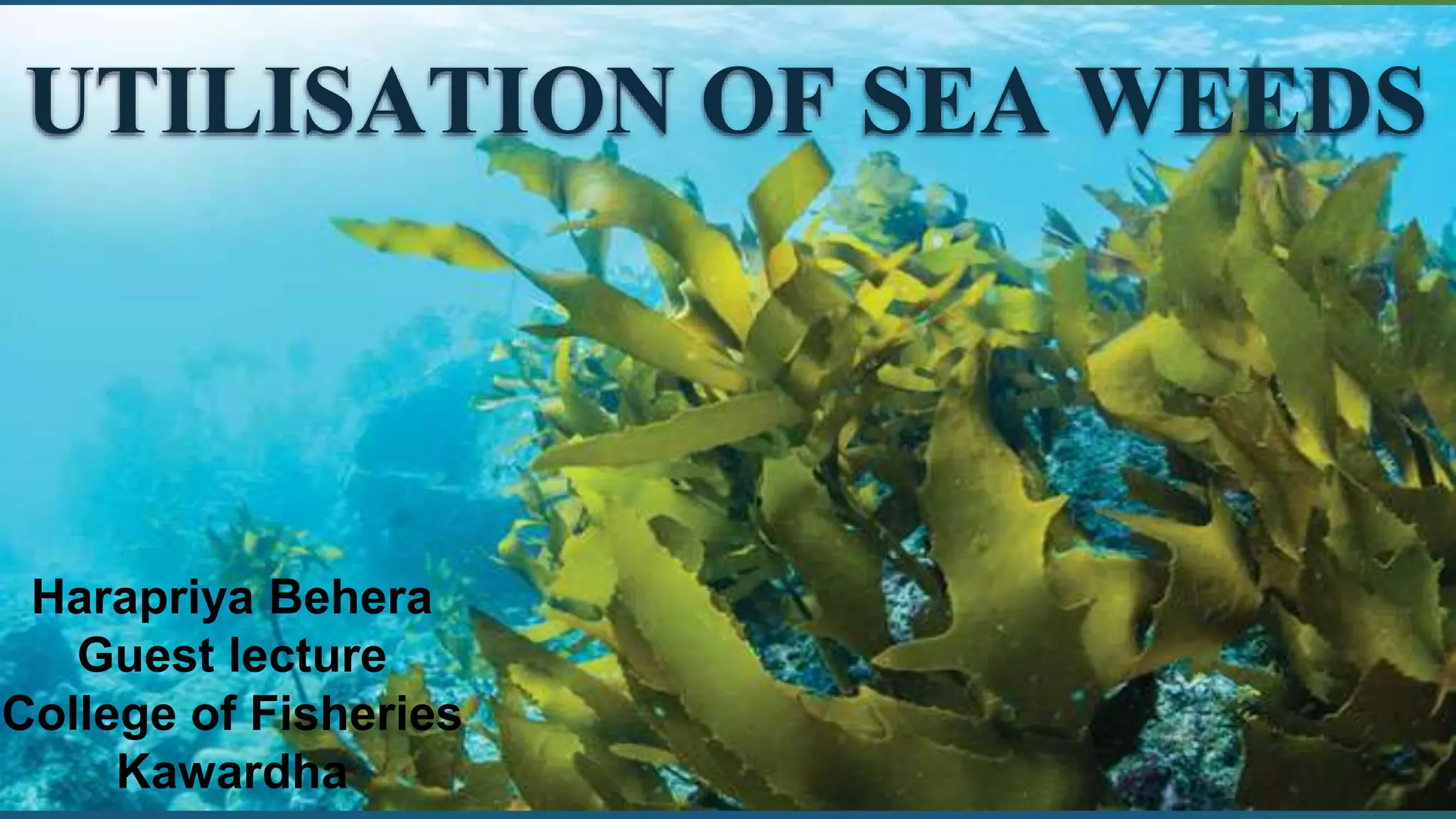
UTILISATION OF SEA WEEDS
Harapriya Behera
Guest lecture
College of Fisheries
Kawardha
Contents
 Preface
 Introduction
 Classification
 Utilization
 Questions
270 million tonnes of food grains are hard to feed more than
133.92 crore.
It is imperative that society must identify alternative resources
that will support and supplement the long-term human
food demands sustainably with minimal environmental
impacts and associated biological phenomena.
There is ample evidence of the importance of seaweeds in the
context of human food needs and ecological benefits of
farming.
Preface
4
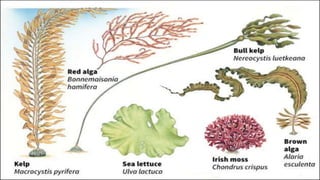
Sea weed is a loose colloquial term encompassing
muticellilar benthic macroalgae, being non
flowering plants belong to thallophyta group.
Denoted as wonder plants of the sea.
 Plant-like organisms live attached to rock or hard
substrata
.Microscopic like phytoplanktons.
Enormous like giant kelp forming marine forests.
Introduction
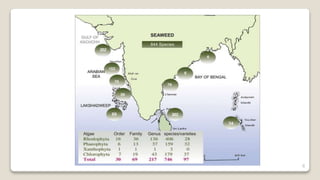
5
6
7
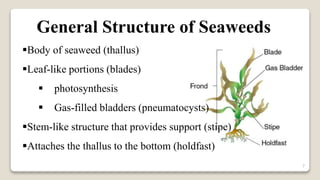
General Structure of Seaweeds
Body of seaweed (thallus)
Leaf-like portions (blades)
 photosynthesis
 Gas-filled bladders (pneumatocysts)
Stem-like structure that provides support (stipe)
Attaches the thallus to the bottom (holdfast)
8
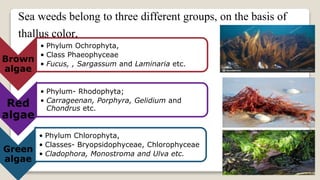
Sea weeds belong to three different groups, on the basis of
thallus color,
Brown
algae
• Phylum Ochrophyta,
• Class Phaeophyceae
• Fucus, , Sargassum and Laminaria etc.
Red
algae
• Phylum- Rhodophyta;
• Carrageenan, Porphyra, Gelidium and
Chondrus etc.
Green
algae
• Phylum Chlorophyta,
• Classes- Bryopsidophyceae, Chlorophyceae
• Cladophora, Monostroma and Ulva etc.
9
•Red and brown algae are exclusively marine, whilst
green algae are also common in freshwater
(aquatic and terrestial)
•Originated trough primary endosymbiosis for green
and red algae, secondary endosymbiosis for
brown algae, that is the reason why green algae
and red algae are kept in the Kingdom Plantae,
and brown algae are kept in the
Kingdom Chromista).
10
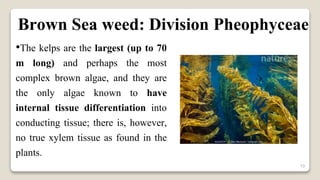
•The kelps are the largest (up to 70
m long) and perhaps the most
complex brown algae, and they are
the only algae known to have
internal tissue differentiation into
conducting tissue; there is, however,
no true xylem tissue as found in the
plants.
Brown Sea weed: Division Pheophyceae
11
•Pigment- Xanthophyll, Fucoxanthin (dominant), Chlorophyll a and
c, beta-carotene and other xanthophylls.
•Cell walls are made up of cellulose and alginic acid, a long-chained
hetero polysaccharide.
•Reserve food material - Complex polysaccharides, sugars and higher
alcohols.
*The principal carbohydrate reserve is laminaran, and true starch is
absent.
12
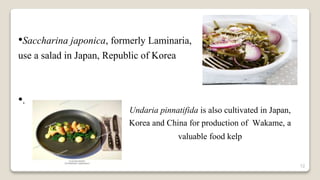
•Saccharina japonica, formerly Laminaria,
use a salad in Japan, Republic of Korea
•.
Undaria pinnatifida is also cultivated in Japan,
Korea and China for production of Wakame, a
valuable food kelp
13
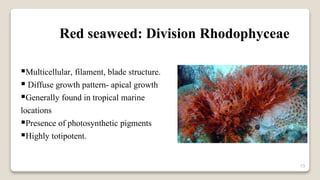
Red seaweed: Division Rhodophyceae
Multicellular, filament, blade structure.
 Diffuse growth pattern- apical growth
Generally found in tropical marine
locations
Presence of photosynthetic pigments
Highly totipotent.
14
Pigments- Phycoerythrin and Phycocyanin, Chlorophyll a , beta-
carotene and a number of unique xanthophylls.
Mode of nutrition -Saprophytic, parasitic or also epiphytic.
Main food reserves are typically floridean, starch
The walls are made of cellulose, agar and carrageenan, both
long-chain polysaccharide.
 Red algae secrete calcium carbonate onto the surface of their
cells known as corallines, which have been used in bone-
replacement therapies.
15
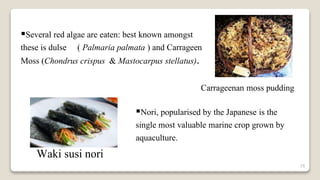
Several red algae are eaten: best known amongst
these is dulse ( Palmaria palmata ) and Carrageen
Moss (Chondrus crispus & Mastocarpus stellatus).
Carrageenan moss pudding
Nori, popularised by the Japanese is the
single most valuable marine crop grown by
aquaculture.
Waki susi nori
16
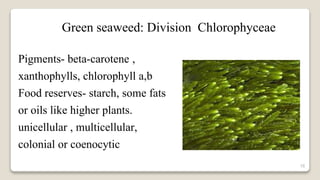
Pigments- beta-carotene ,
xanthophylls, chlorophyll a,b
Food reserves- starch, some fats
or oils like higher plants.
unicellular , multicellular,
colonial or coenocytic
Green seaweed: Division Chlorophyceae
17
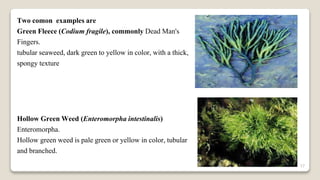
Two comon examples are
Green Fleece (Codium fragile), commonly Dead Man's
Fingers.
tubular seaweed, dark green to yellow in color, with a thick,
spongy texture
Hollow Green Weed (Enteromorpha intestinalis)
Enteromorpha.
Hollow green weed is pale green or yellow in color, tubular
and branched.
18
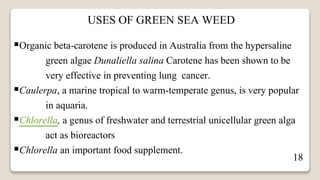
Organic beta-carotene is produced in Australia from the hypersaline
green algae Dunaliella salina Carotene has been shown to be
very effective in preventing lung cancer.
Caulerpa, a marine tropical to warm-temperate genus, is very popular
in aquaria.
Chlorella, a genus of freshwater and terrestrial unicellular green alga
act as bioreactors
Chlorella an important food supplement.
USES OF GREEN SEA WEED
19
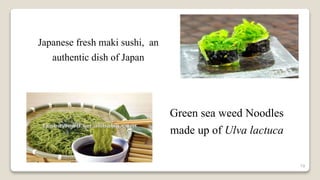
Japanese fresh maki sushi, an
authentic dish of Japan
Green sea weed Noodles
made up of Ulva lactuca
20
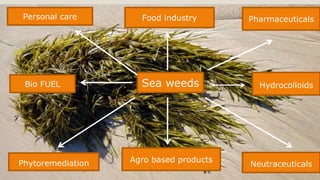
Food industry Pharmaceuticals
Hydrocolloids
Neutraceuticals
Agro based productsPhytoremediation
Bio FUEL
Personal care
Sea weeds
21
22
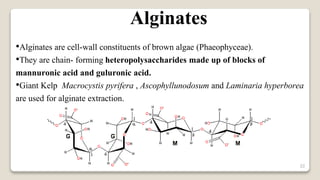
•Alginates are cell-wall constituents of brown algae (Phaeophyceae).
•They are chain- forming heteropolysaccharides made up of blocks of
mannuronic acid and guluronic acid.
•Giant Kelp Macrocystis pyrifera , Ascophyllunodosum and Laminaria hyperborea
are used for alginate extraction.
Alginates
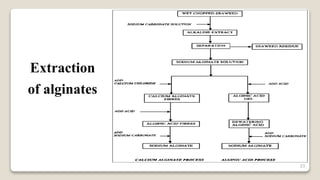
23
Extraction
of alginates
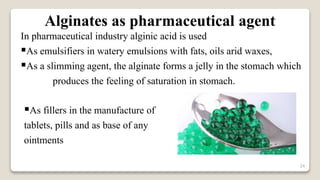
24
In pharmaceutical industry alginic acid is used
As emulsifiers in watery emulsions with fats, oils arid waxes,
As a slimming agent, the alginate forms a jelly in the stomach which
produces the feeling of saturation in stomach.
Alginates as pharmaceutical agent
As fillers in the manufacture of
tablets, pills and as base of any
ointments
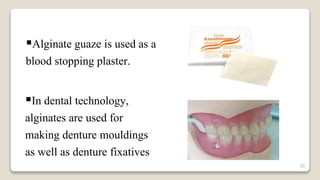
25
Alginate guaze is used as a
blood stopping plaster.
In dental technology,
alginates are used for
making denture mouldings
as well as denture fixatives
26
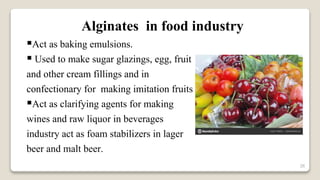
Alginates in food industry
Act as baking emulsions.
 Used to make sugar glazings, egg, fruit
and other cream fillings and in
confectionary for making imitation fruits
Act as clarifying agents for making
wines and raw liquor in beverages
industry act as foam stabilizers in lager
beer and malt beer.
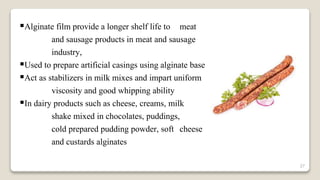
27
Alginate film provide a longer shelf life to meat
and sausage products in meat and sausage
industry,
Used to prepare artificial casings using alginate base
Act as stabilizers in milk mixes and impart uniform
viscosity and good whipping ability
In dairy products such as cheese, creams, milk
shake mixed in chocolates, puddings,
cold prepared pudding powder, soft cheese
and custards alginates
28
Alginates in day-to-day life
In creams, liquid emulsions, lotions and toothpaste as well
as an additive in hair dye, hair fixing tonics,
shampoos etc. due to the ability of alginates to form
films.
 Alginates increase the consistency of shaving creams.
Ammonium alginate wool is used as a filter for
microorganisms for laminar flowhood.
29
Alginates stabilizes the pigment and glazing suspensions to
ceramic, porcelain and chinaware as well as leather
goods in ceramic and leather industries.
Alginates act as thickening agent for printing dyes and paints
that prevents smudging and promotes quick drying and
evenness of prints
Calcium alginate use as manufacture of beads, beads with
fish oils and colour makes “fish-eggs” .
30
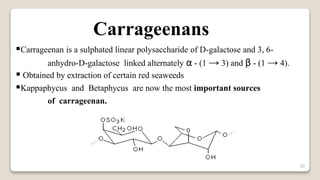
Carrageenans
Carrageenan is a sulphated linear polysaccharide of D-galactose and 3, 6-
anhydro-D-galactose linked alternately α - (1 → 3) and β - (1 → 4).
 Obtained by extraction of certain red seaweeds
Kappaphycus and Betaphycus are now the most important sources
of carrageenan.
31
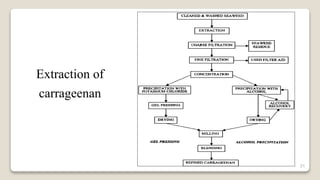
Extraction of
carrageenan
32
Carrageenans in pharmaceutical industry
Used as emulsiflers in cod liver oil and emulsions as granulation and binding
agents in tablets, elixirs, cough syrups etc.
 As polymer matrix in oral extended-release tablets
Used as a gelling agent/viscosity enhancing agent for controlled drug release
and prolonged retention because of its strong negative charge and
gelling properties
Used for tissue regeneration with therapeutic biomacromolecules and for cell
delivery
Used extensively in ulcer therapy and for diseases of blood vessels.
Act as Successful carrier of anti-retroviral drugs for the treatment of AIDS.
33
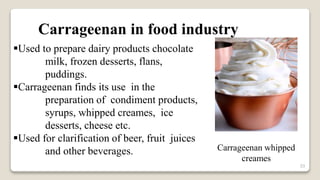
Carrageenan in food industry
Used to prepare dairy products chocolate
milk, frozen desserts, flans,
puddings.
Carrageenan finds its use in the
preparation of condiment products,
syrups, whipped creames, ice
desserts, cheese etc.
Used for clarification of beer, fruit juices
and other beverages. Carrageenan whipped
creames
34
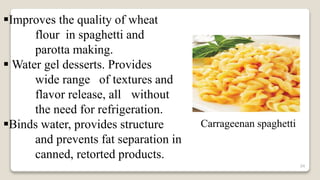
Improves the quality of wheat
flour in spaghetti and
parotta making.
 Water gel desserts. Provides
wide range of textures and
flavor release, all without
the need for refrigeration.
Binds water, provides structure
and prevents fat separation in
canned, retorted products.
Carrageenan spaghetti
35
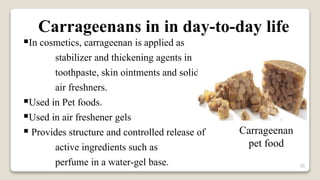
In cosmetics, carrageenan is applied as
stabilizer and thickening agents in
toothpaste, skin ointments and solid
air freshners.
Used in Pet foods.
Used in air freshener gels
 Provides structure and controlled release of
active ingredients such as
perfume in a water-gel base.
Carrageenans in in day-to-day life
Carrageenan
pet food
36
In textile industry, hot water extracts
of carrageenan is used in
printing designes with dye and
act as finishing and sizing
agents.
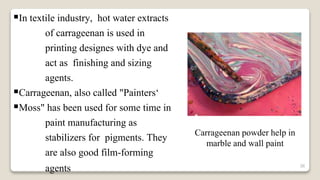
Carrageenan, also called "Painters‘
Moss" has been used for some time in
paint manufacturing as
stabilizers for pigments. They
are also good film-forming
agents
Carrageenan powder help in
marble and wall paint
37
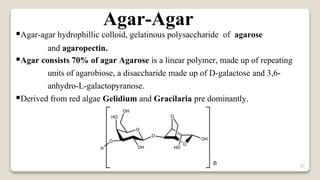
Agar-Agar
Agar-agar hydrophillic colloid, gelatinous polysaccharide of agarose
and agaropectin.
Agar consists 70% of agar Agarose is a linear polymer, made up of repeating
units of agarobiose, a disaccharide made up of D-galactose and 3,6-
anhydro-L-galactopyranose.
Derived from red algae Gelidium and Gracilaria pre dominantly.
38
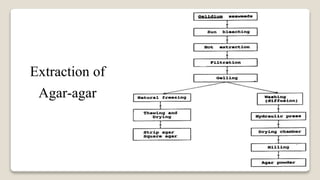
Extraction of
Agar-agar
39
Agar-agar in pharmaceutical industry
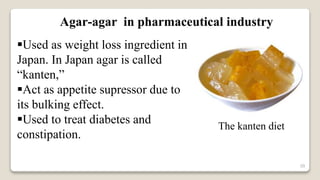
Used as weight loss ingredient in
Japan. In Japan agar is called
“kanten,”
Act as appetite supressor due to
its bulking effect.
Used to treat diabetes and
constipation.
The kanten diet
40
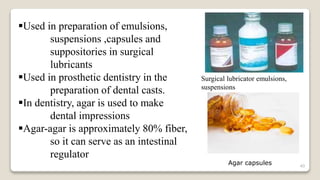
Used in preparation of emulsions,
suspensions ,capsules and
suppositories in surgical
lubricants
Used in prosthetic dentistry in the
preparation of dental casts.
In dentistry, agar is used to make
dental impressions
Agar-agar is approximately 80% fiber,
so it can serve as an intestinal
regulator
Surgical lubricator emulsions,
suspensions
Agar capsules
41
Agar-agar in food industry
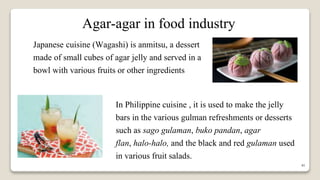
Japanese cuisine (Wagashi) is anmitsu, a dessert
made of small cubes of agar jelly and served in a
bowl with various fruits or other ingredients
In Philippine cuisine , it is used to make the jelly
bars in the various gulman refreshments or desserts
such as sago gulaman, buko pandan, agar
flan, halo-halo, and the black and red gulaman used
in various fruit salads.
42
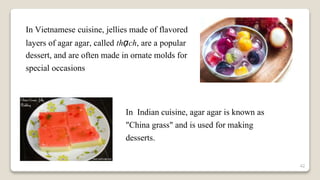
In Vietnamese cuisine, jellies made of flavored
layers of agar agar, called thạch, are a popular
dessert, and are often made in ornate molds for
special occasions
In Indian cuisine, agar agar is known as
"China grass" and is used for making
desserts.
43
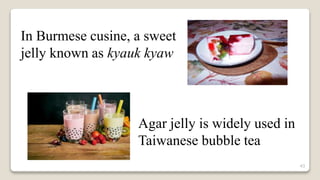
In Burmese cusine, a sweet
jelly known as kyauk kyaw
Agar jelly is widely used in
Taiwanese bubble tea
44
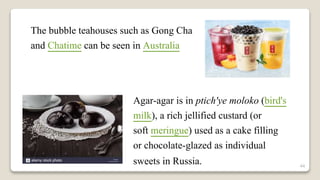
The bubble teahouses such as Gong Cha
and Chatime can be seen in Australia
Agar-agar is in ptich'ye moloko (bird's
milk), a rich jellified custard (or
soft meringue) used as a cake filling
or chocolate-glazed as individual
sweets in Russia.
45
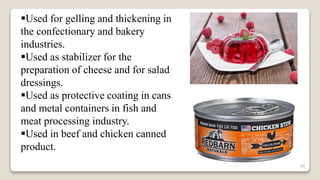
Used for gelling and thickening in
the confectionary and bakery
industries.
Used as stabilizer for the
preparation of cheese and for salad
dressings.
Used as protective coating in cans
and metal containers in fish and
meat processing industry.
Used in beef and chicken canned
product.
46
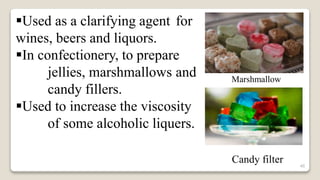
Used as a clarifying agent for
wines, beers and liquors.
In confectionery, to prepare
jellies, marshmallows and
candy fillers.
Used to increase the viscosity
of some alcoholic liquers.
Marshmallow
Candy filter
47
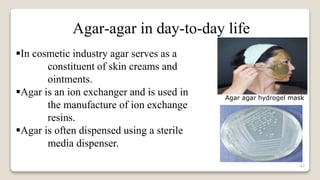
In cosmetic industry agar serves as a
constituent of skin creams and
ointments.
Agar is an ion exchanger and is used in
the manufacture of ion exchange
resins.
Agar is often dispensed using a sterile
media dispenser.
Agar-agar in day-to-day life
Agar agar hydrogel mask
48
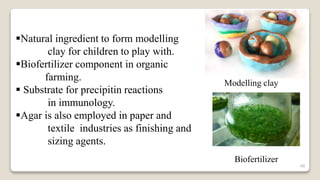
Natural ingredient to form modelling
clay for children to play with.
Biofertilizer component in organic
farming.
 Substrate for precipitin reactions
in immunology.
Agar is also employed in paper and
textile industries as finishing and
sizing agents.
Modelling clay
Biofertilizer
49
Thanks!
Anyquestions?

Sea weeds by products

  • 1.
    UTILISATION OF SEAWEEDS Harapriya Behera Guest lecture College of Fisheries Kawardha
  • 2.
    Contents  Preface  Introduction Classification  Utilization  Questions
  • 3.
    270 million tonnesof food grains are hard to feed more than 133.92 crore. It is imperative that society must identify alternative resources that will support and supplement the long-term human food demands sustainably with minimal environmental impacts and associated biological phenomena. There is ample evidence of the importance of seaweeds in the context of human food needs and ecological benefits of farming. Preface
  • 4.
    4 Sea weed isa loose colloquial term encompassing muticellilar benthic macroalgae, being non flowering plants belong to thallophyta group. Denoted as wonder plants of the sea.  Plant-like organisms live attached to rock or hard substrata .Microscopic like phytoplanktons. Enormous like giant kelp forming marine forests. Introduction
  • 5.
  • 6.
  • 7.
    7 General Structure ofSeaweeds Body of seaweed (thallus) Leaf-like portions (blades)  photosynthesis  Gas-filled bladders (pneumatocysts) Stem-like structure that provides support (stipe) Attaches the thallus to the bottom (holdfast)
  • 8.
    8 Sea weeds belongto three different groups, on the basis of thallus color, Brown algae • Phylum Ochrophyta, • Class Phaeophyceae • Fucus, , Sargassum and Laminaria etc. Red algae • Phylum- Rhodophyta; • Carrageenan, Porphyra, Gelidium and Chondrus etc. Green algae • Phylum Chlorophyta, • Classes- Bryopsidophyceae, Chlorophyceae • Cladophora, Monostroma and Ulva etc.
  • 9.
    9 •Red and brownalgae are exclusively marine, whilst green algae are also common in freshwater (aquatic and terrestial) •Originated trough primary endosymbiosis for green and red algae, secondary endosymbiosis for brown algae, that is the reason why green algae and red algae are kept in the Kingdom Plantae, and brown algae are kept in the Kingdom Chromista).
  • 10.
    10 •The kelps arethe largest (up to 70 m long) and perhaps the most complex brown algae, and they are the only algae known to have internal tissue differentiation into conducting tissue; there is, however, no true xylem tissue as found in the plants. Brown Sea weed: Division Pheophyceae
  • 11.
    11 •Pigment- Xanthophyll, Fucoxanthin(dominant), Chlorophyll a and c, beta-carotene and other xanthophylls. •Cell walls are made up of cellulose and alginic acid, a long-chained hetero polysaccharide. •Reserve food material - Complex polysaccharides, sugars and higher alcohols. *The principal carbohydrate reserve is laminaran, and true starch is absent.
  • 12.
    12 •Saccharina japonica, formerlyLaminaria, use a salad in Japan, Republic of Korea •. Undaria pinnatifida is also cultivated in Japan, Korea and China for production of Wakame, a valuable food kelp
  • 13.
    13 Red seaweed: DivisionRhodophyceae Multicellular, filament, blade structure.  Diffuse growth pattern- apical growth Generally found in tropical marine locations Presence of photosynthetic pigments Highly totipotent.
  • 14.
    14 Pigments- Phycoerythrin andPhycocyanin, Chlorophyll a , beta- carotene and a number of unique xanthophylls. Mode of nutrition -Saprophytic, parasitic or also epiphytic. Main food reserves are typically floridean, starch The walls are made of cellulose, agar and carrageenan, both long-chain polysaccharide.  Red algae secrete calcium carbonate onto the surface of their cells known as corallines, which have been used in bone- replacement therapies.
  • 15.
    15 Several red algaeare eaten: best known amongst these is dulse ( Palmaria palmata ) and Carrageen Moss (Chondrus crispus & Mastocarpus stellatus). Carrageenan moss pudding Nori, popularised by the Japanese is the single most valuable marine crop grown by aquaculture. Waki susi nori
  • 16.
    16 Pigments- beta-carotene , xanthophylls,chlorophyll a,b Food reserves- starch, some fats or oils like higher plants. unicellular , multicellular, colonial or coenocytic Green seaweed: Division Chlorophyceae
  • 17.
    17 Two comon examplesare Green Fleece (Codium fragile), commonly Dead Man's Fingers. tubular seaweed, dark green to yellow in color, with a thick, spongy texture Hollow Green Weed (Enteromorpha intestinalis) Enteromorpha. Hollow green weed is pale green or yellow in color, tubular and branched.
  • 18.
    18 Organic beta-carotene isproduced in Australia from the hypersaline green algae Dunaliella salina Carotene has been shown to be very effective in preventing lung cancer. Caulerpa, a marine tropical to warm-temperate genus, is very popular in aquaria. Chlorella, a genus of freshwater and terrestrial unicellular green alga act as bioreactors Chlorella an important food supplement. USES OF GREEN SEA WEED
  • 19.
    19 Japanese fresh makisushi, an authentic dish of Japan Green sea weed Noodles made up of Ulva lactuca
  • 20.
    20 Food industry Pharmaceuticals Hydrocolloids Neutraceuticals Agrobased productsPhytoremediation Bio FUEL Personal care Sea weeds
  • 21.
  • 22.
    22 •Alginates are cell-wallconstituents of brown algae (Phaeophyceae). •They are chain- forming heteropolysaccharides made up of blocks of mannuronic acid and guluronic acid. •Giant Kelp Macrocystis pyrifera , Ascophyllunodosum and Laminaria hyperborea are used for alginate extraction. Alginates
  • 23.
  • 24.
    24 In pharmaceutical industryalginic acid is used As emulsifiers in watery emulsions with fats, oils arid waxes, As a slimming agent, the alginate forms a jelly in the stomach which produces the feeling of saturation in stomach. Alginates as pharmaceutical agent As fillers in the manufacture of tablets, pills and as base of any ointments
  • 25.
    25 Alginate guaze isused as a blood stopping plaster. In dental technology, alginates are used for making denture mouldings as well as denture fixatives
  • 26.
    26 Alginates in foodindustry Act as baking emulsions.  Used to make sugar glazings, egg, fruit and other cream fillings and in confectionary for making imitation fruits Act as clarifying agents for making wines and raw liquor in beverages industry act as foam stabilizers in lager beer and malt beer.
  • 27.
    27 Alginate film providea longer shelf life to meat and sausage products in meat and sausage industry, Used to prepare artificial casings using alginate base Act as stabilizers in milk mixes and impart uniform viscosity and good whipping ability In dairy products such as cheese, creams, milk shake mixed in chocolates, puddings, cold prepared pudding powder, soft cheese and custards alginates
  • 28.
    28 Alginates in day-to-daylife In creams, liquid emulsions, lotions and toothpaste as well as an additive in hair dye, hair fixing tonics, shampoos etc. due to the ability of alginates to form films.  Alginates increase the consistency of shaving creams. Ammonium alginate wool is used as a filter for microorganisms for laminar flowhood.
  • 29.
    29 Alginates stabilizes thepigment and glazing suspensions to ceramic, porcelain and chinaware as well as leather goods in ceramic and leather industries. Alginates act as thickening agent for printing dyes and paints that prevents smudging and promotes quick drying and evenness of prints Calcium alginate use as manufacture of beads, beads with fish oils and colour makes “fish-eggs” .
  • 30.
    30 Carrageenans Carrageenan is asulphated linear polysaccharide of D-galactose and 3, 6- anhydro-D-galactose linked alternately α - (1 → 3) and β - (1 → 4).  Obtained by extraction of certain red seaweeds Kappaphycus and Betaphycus are now the most important sources of carrageenan.
  • 31.
  • 32.
    32 Carrageenans in pharmaceuticalindustry Used as emulsiflers in cod liver oil and emulsions as granulation and binding agents in tablets, elixirs, cough syrups etc.  As polymer matrix in oral extended-release tablets Used as a gelling agent/viscosity enhancing agent for controlled drug release and prolonged retention because of its strong negative charge and gelling properties Used for tissue regeneration with therapeutic biomacromolecules and for cell delivery Used extensively in ulcer therapy and for diseases of blood vessels. Act as Successful carrier of anti-retroviral drugs for the treatment of AIDS.
  • 33.
    33 Carrageenan in foodindustry Used to prepare dairy products chocolate milk, frozen desserts, flans, puddings. Carrageenan finds its use in the preparation of condiment products, syrups, whipped creames, ice desserts, cheese etc. Used for clarification of beer, fruit juices and other beverages. Carrageenan whipped creames
  • 34.
    34 Improves the qualityof wheat flour in spaghetti and parotta making.  Water gel desserts. Provides wide range of textures and flavor release, all without the need for refrigeration. Binds water, provides structure and prevents fat separation in canned, retorted products. Carrageenan spaghetti
  • 35.
    35 In cosmetics, carrageenanis applied as stabilizer and thickening agents in toothpaste, skin ointments and solid air freshners. Used in Pet foods. Used in air freshener gels  Provides structure and controlled release of active ingredients such as perfume in a water-gel base. Carrageenans in in day-to-day life Carrageenan pet food
  • 36.
    36 In textile industry,hot water extracts of carrageenan is used in printing designes with dye and act as finishing and sizing agents. Carrageenan, also called "Painters‘ Moss" has been used for some time in paint manufacturing as stabilizers for pigments. They are also good film-forming agents Carrageenan powder help in marble and wall paint
  • 37.
    37 Agar-Agar Agar-agar hydrophillic colloid,gelatinous polysaccharide of agarose and agaropectin. Agar consists 70% of agar Agarose is a linear polymer, made up of repeating units of agarobiose, a disaccharide made up of D-galactose and 3,6- anhydro-L-galactopyranose. Derived from red algae Gelidium and Gracilaria pre dominantly.
  • 38.
  • 39.
    39 Agar-agar in pharmaceuticalindustry Used as weight loss ingredient in Japan. In Japan agar is called “kanten,” Act as appetite supressor due to its bulking effect. Used to treat diabetes and constipation. The kanten diet
  • 40.
    40 Used in preparationof emulsions, suspensions ,capsules and suppositories in surgical lubricants Used in prosthetic dentistry in the preparation of dental casts. In dentistry, agar is used to make dental impressions Agar-agar is approximately 80% fiber, so it can serve as an intestinal regulator Surgical lubricator emulsions, suspensions Agar capsules
  • 41.
    41 Agar-agar in foodindustry Japanese cuisine (Wagashi) is anmitsu, a dessert made of small cubes of agar jelly and served in a bowl with various fruits or other ingredients In Philippine cuisine , it is used to make the jelly bars in the various gulman refreshments or desserts such as sago gulaman, buko pandan, agar flan, halo-halo, and the black and red gulaman used in various fruit salads.
  • 42.
    42 In Vietnamese cuisine,jellies made of flavored layers of agar agar, called thạch, are a popular dessert, and are often made in ornate molds for special occasions In Indian cuisine, agar agar is known as "China grass" and is used for making desserts.
  • 43.
    43 In Burmese cusine,a sweet jelly known as kyauk kyaw Agar jelly is widely used in Taiwanese bubble tea
  • 44.
    44 The bubble teahousessuch as Gong Cha and Chatime can be seen in Australia Agar-agar is in ptich'ye moloko (bird's milk), a rich jellified custard (or soft meringue) used as a cake filling or chocolate-glazed as individual sweets in Russia.
  • 45.
    45 Used for gellingand thickening in the confectionary and bakery industries. Used as stabilizer for the preparation of cheese and for salad dressings. Used as protective coating in cans and metal containers in fish and meat processing industry. Used in beef and chicken canned product.
  • 46.
    46 Used as aclarifying agent for wines, beers and liquors. In confectionery, to prepare jellies, marshmallows and candy fillers. Used to increase the viscosity of some alcoholic liquers. Marshmallow Candy filter
  • 47.
    47 In cosmetic industryagar serves as a constituent of skin creams and ointments. Agar is an ion exchanger and is used in the manufacture of ion exchange resins. Agar is often dispensed using a sterile media dispenser. Agar-agar in day-to-day life Agar agar hydrogel mask
  • 48.
    48 Natural ingredient toform modelling clay for children to play with. Biofertilizer component in organic farming.  Substrate for precipitin reactions in immunology. Agar is also employed in paper and textile industries as finishing and sizing agents. Modelling clay Biofertilizer
  • 49.