CAMPBELL BIOLOGY IN FOCUS
© 2014 Pearson Education, Inc.
Urry • Cain • Wasserman • Minorsky • Jackson • Reece
Lecture Presentations by
Kathleen Fitzpatrick and Nicole Tunbridge
31
Plant Responses
to Internal and
External Signals
© 2014 Pearson Education, Inc.
Overview: The Race to Live
 Young seedlings must outcompete their neighbors
in the race for resources in order to survive
 Unlike animals, which respond through movement,
plants must respond to environmental challenges
by altering their growth and development
© 2014 Pearson Education, Inc.
Figure 31.1
© 2014 Pearson Education, Inc.
Concept 31.1: Plant hormones help coordinate
growth, development, and responses to stimuli
 Plant hormones are chemical signals that modify or
control one or more specific physiological processes
within a plant
© 2014 Pearson Education, Inc.
 Plant hormones are produced in very low
concentration, but a minute amount can greatly
affect growth and development of a plant organ
 Most aspects of plant growth and development are
under hormonal control
© 2014 Pearson Education, Inc.
The Discovery of Plant Hormones
 Any response resulting in curvature of organs
toward or away from a stimulus is called a tropism
 In the late 1800s, Charles Darwin and his son
Francis conducted experiments on phototropism,
a plant’s response to light
 They observed that a grass seedling could bend
toward light only if the tip of the coleoptile was
present
© 2014 Pearson Education, Inc.
 They postulated that a signal was transmitted from
the tip to the elongating region
Video: Phototropism
© 2014 Pearson Education, Inc.
Figure 31.2
Results
Control
Light
Illuminated
side
Shaded
side
Boysen-Jensen
Light
Gelatin
(permeable)
Mica
(impermeable)
Opaque
shield
over
curvature
Trans-
parent
cap
Opaque
cap
Tip
removed
Light
Darwin and Darwin
© 2014 Pearson Education, Inc.
Figure 31.2a
Control
Light
Illuminated
side
Shaded
side
© 2014 Pearson Education, Inc.
Figure 31.2b
Opaque
shield
over
curvature
Trans-
parent
cap
Opaque
cap
Tip
removed
Light
Darwin and Darwin: Phototropism occurs only
when the tip is illuminated.
© 2014 Pearson Education, Inc.
Figure 31.2c
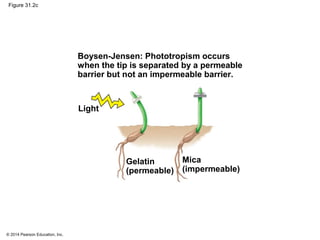
Boysen-Jensen: Phototropism occurs
when the tip is separated by a permeable
barrier but not an impermeable barrier.
Light
Gelatin
(permeable)
Mica
(impermeable)
© 2014 Pearson Education, Inc.
 In 1913, Peter Boysen-Jensen demonstrated that
the signal was a mobile chemical substance
© 2014 Pearson Education, Inc.
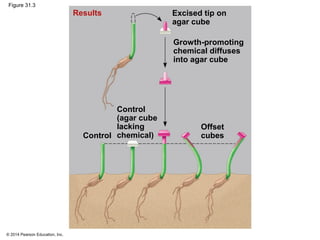
 In 1926, Frits Went extracted the chemical
messenger for phototropism, auxin, by modifying
earlier experiments
© 2014 Pearson Education, Inc.
Figure 31.3
Control
Results
Control
(agar cube
lacking
chemical)
Offset
cubes
Growth-promoting
chemical diffuses
into agar cube
Excised tip on
agar cube
© 2014 Pearson Education, Inc.
A Survey of Plant Hormones
 The major classes of plant hormones include
 Auxin
 Cytokinins
 Gibberellins
 Brassinosteroids
 Abscisic acid
 Ethylene
© 2014 Pearson Education, Inc.
Table 31.1
© 2014 Pearson Education, Inc.
Auxin
 The term auxin refers to any chemical that promotes
elongation of coleoptiles
 Indoleacetic acid (IAA) is a common auxin in plants;
in this lecture the term auxin refers specifically to IAA
 Auxin is produced in shoot tips and is transported
down the stem
 Auxin transporter proteins move the hormone from
the basal end of one cell into the apical end of the
neighboring cell
© 2014 Pearson Education, Inc.
Figure 31.4
Results
Cell 1
Cell 2100 µm
Epidermis
Cortex
Phloem
Xylem
Pith
Basal end
of cell
25 µm
© 2014 Pearson Education, Inc.
Figure 31.4a
100 µm
Epidermis
Cortex
Phloem
Xylem
Pith
© 2014 Pearson Education, Inc.
Figure 31.4b
Cell 1
Cell 2
Basal end
of cell
25 µm
© 2014 Pearson Education, Inc.
 The role of auxin in cell elongation: Polar
transport of auxin stimulates proton pumps in the
plasma membrane
 According to the acid growth hypothesis, the proton
pumps lower the pH in the cell wall, activating
expansins, enzymes that loosen the wall’s fabric
 With the cellulose loosened, the cell can elongate
© 2014 Pearson Education, Inc.
Figure 31.5
CELL WALL
H+
H+
H+
H+
H+
H+
H+
H+
Cell wall-loosening
enzymes cleave
cross-linking
polysaccharides.
Plasma
membrane
Cell
wall
H2O
Nucleus Cytoplasm
Vacuole
Sliding cellulose microfibrils
allow cell to elongate.
CYTOPLASM
H+
Plasma membrane
ATP
Proton
pump
activity
increases.
Acidity
increases.
Low pH
activates
expansins.
3
2
1
5
4
© 2014 Pearson Education, Inc.
Figure 31.5a
CELL WALL
Cell wall-loosening enzymes cleave cross-linking
polysaccharides.
CYTOPLASM
H+
Plasma membraneATP
Proton
pump
activity
increases.
Acidity
increases.
Low pH
activates
expansins.
1
2
H+
H+
H+
H+
H+
H+
H+
H+
3
4
© 2014 Pearson Education, Inc.
Figure 31.5b
Plasma
membrane
Cell
wall
H2O
Nucleus Cytoplasm
Vacuole
Sliding cellulose microfibrils
allow cell to elongate.
5
© 2014 Pearson Education, Inc.
 Auxin also alters gene expression and stimulates a
sustained growth response
© 2014 Pearson Education, Inc.
 Auxin’s role in plant development: Polar transport
of auxin controls the spatial organization of the
developing plant
 Reduced auxin flow from the shoot of a branch
stimulates growth in lower branches
 Auxin transport plays a role in phyllotaxy, the
arrangement of leaves on the stem
© 2014 Pearson Education, Inc.
 Practical uses for auxins
 The auxin indolbutyric acid (IBA) stimulates
adventitious roots and is used in vegetative
propagation of plants by cuttings
 An overdose of synthetic auxins can kill plants
 For example 2,4-D is used as an herbicide on eudicots
 Tomato growers spray their plants with synthetic
auxins to stimulate fruit growth
© 2014 Pearson Education, Inc.
Cytokinins
 Cytokinins are so named because they stimulate
cytokinesis (cell division)
© 2014 Pearson Education, Inc.
 Control of cell division and differentiation:
Cytokinins work together with auxin to control cell
division and differentiation
 Cytokinins are produced in actively growing tissues
such as roots, embryos, and fruits
© 2014 Pearson Education, Inc.
 Anti-aging effects: Cytokinins slow the aging of
some plant organs by inhibiting protein breakdown,
stimulating RNA and protein synthesis, and
mobilizing nutrients from surrounding tissues
© 2014 Pearson Education, Inc.
Gibberellins
 Gibberellins (GAs) have a variety of effects, such as
stem elongation, fruit growth, and seed germination
© 2014 Pearson Education, Inc.
 Stem elongation: Gibberellins stimulate stem and
leaf growth by enhancing cell elongation and cell
division
 Gibberellins are produced in young roots and
leaves
 They can induce bolting, rabid growth of the floral
stalk
© 2014 Pearson Education, Inc.
Figure 31.6
(a) Rosette form (left) and
gibberellin-induced bolting
(right)
(b) Grapes from control
vine (left) and gibberellin-
treated vine (right)
© 2014 Pearson Education, Inc.
Figure 31.6a
(a) Rosette form (left) and
gibberellin-induced bolting
(right)
© 2014 Pearson Education, Inc.
Figure 31.6b
(b) Grapes from control
vine (left) and gibberellin-
treated vine (right)
© 2014 Pearson Education, Inc.
 Fruit growth: In many plants, both auxin and
gibberellins must be present for fruit to develop
 Gibberellins are used in spraying of Thompson
seedless grapes
© 2014 Pearson Education, Inc.
 Germination: After water is imbibed, release of
gibberellins from the embryo signals seeds to
germinate
© 2014 Pearson Education, Inc.
Figure 31.7
Aleurone
Endosperm
Water
Scutellum
(cotyledon)
Radicle
GA
GA
α-amylase Sugar
© 2014 Pearson Education, Inc.
Brassinosteroids
 Brassinosteroids are chemically similar to
cholesterol and the sex hormones of animals
 They induce cell elongation and division in stem
segments and seedlings
 They slow leaf abscission (leaf drop) and promote
xylem differentiation
© 2014 Pearson Education, Inc.
Abscisic Acid
 Abscisic acid (ABA) slows growth
 Two of the many effects of ABA include
 Seed dormancy
 Drought tolerance
© 2014 Pearson Education, Inc.
 Seed dormancy ensures that the seed will
germinate only in optimal conditions
 In some seeds, dormancy is broken when ABA is
removed by heavy rain, light, or prolonged cold
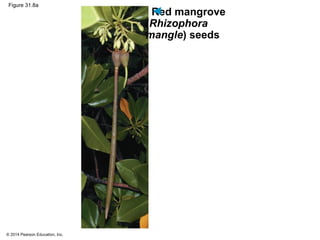
 Precocious (early) germination can be caused by
inactive or low levels of ABA
© 2014 Pearson Education, Inc.
Figure 31.8
Red mangrove
(Rhizophora
mangle) seeds
Coleoptile
Maize mutant
© 2014 Pearson Education, Inc.
Figure 31.8a
Red mangrove
(Rhizophora
mangle) seeds
© 2014 Pearson Education, Inc.
Figure 31.8b
Coleoptile
Maize mutant
© 2014 Pearson Education, Inc.
 Drought tolerance: ABA is the primary internal
signal that enables plants to withstand drought
 ABA accumulation causes stomata to close rapidly
© 2014 Pearson Education, Inc.
Ethylene
 Plants produce ethylene in response to stresses
such as drought, flooding, mechanical pressure,
injury, and infection
 The effects of ethylene include response to
mechanical stress, senescence, leaf abscission,
and fruit ripening
© 2014 Pearson Education, Inc.
 The triple response to mechanical stress:
Ethylene induces the triple response, which allows
a growing shoot to avoid obstacles
 The triple response consists of a slowing of stem
elongation, a thickening of the stem, and horizontal
growth
© 2014 Pearson Education, Inc.
 Ethylene-insensitive mutants fail to undergo the triple
response after exposure to ethylene
 Some ethylene-overproducing mutants undergo the
triple response even in air but are returned to normal
growth when treated with ethylene synthesis
inhibitors
 Other mutants are not responsive to inhibitors of
ethylene synthesis
© 2014 Pearson Education, Inc.
Figure 31.9
ein mutant
ctr mutant
(b) ctr mutant(a) ein mutant
© 2014 Pearson Education, Inc.
Figure 31.9a
ein mutant
(a) ein mutant
© 2014 Pearson Education, Inc.
Figure 31.9b
ctr mutant
(b) ctr mutant
© 2014 Pearson Education, Inc.
 Senescence: Senescence is the programmed
death of cells or organs
 A burst of ethylene is associated with apoptosis, the
programmed destruction of cells, organs, or
whole plants
© 2014 Pearson Education, Inc.
 Leaf abscission: A change in the balance of auxin
and ethylene controls leaf abscission, the process
that occurs in autumn when a leaf falls
© 2014 Pearson Education, Inc.
Figure 31.10
0.5 mm
Stem Petiole
Abscission layerProtective layer
© 2014 Pearson Education, Inc.
Figure 31.10a
0.5 mm
Stem Petiole
Abscission layerProtective layer
© 2014 Pearson Education, Inc.
 Fruit ripening: A burst of ethylene production in a
fruit triggers the ripening process
 Ethylene triggers ripening, and ripening triggers
release of more ethylene
 Fruit producers can control ripening by picking
green fruit and controlling ethylene levels
© 2014 Pearson Education, Inc.
Concept 31.2: Responses to light are critical for
plant success
 Light triggers many key events in plant growth
and development, collectively known as
photomorphogenesis
© 2014 Pearson Education, Inc.
Photomorphogenesis
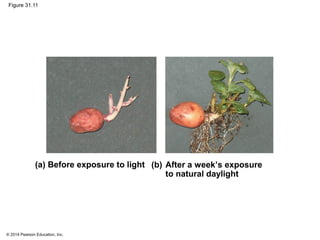
 A potato left growing in darkness produces shoots
that look unhealthy, and it lacks elongated roots
 These are morphological adaptations for growing in
darkness, collectively called etiolation
 After exposure to light, a potato undergoes changes
called de-etiolation, in which shoots and roots
grow normally
© 2014 Pearson Education, Inc.
Figure 31.11
(a) Before exposure to light (b) After a week’s exposure
to natural daylight
© 2014 Pearson Education, Inc.
Figure 31.11a
(a) Before exposure to light
© 2014 Pearson Education, Inc.
Figure 31.11b
(b) After a week’s exposure
to natural daylight
© 2014 Pearson Education, Inc.
 Plants detect not only presence of light but also its
direction, intensity, and wavelength (color)
 A graph called an action spectrum depicts
relative response of a process to different
wavelengths
 Action spectra are useful in studying any process
that depends on light
© 2014 Pearson Education, Inc.
Figure 31.12
(a) Light wavelengths below 500nm induce
curvature.
(b) Blue light induces the most curvature
of coleoptiles.
White
light
Refracting prism
Wavelength (nm)
400 450 500 550 650600 700
436 nm
Phototropiceffectiveness
1.0
0.8
0.6
0.4
0.2
0
© 2014 Pearson Education, Inc.
Figure 31.12a
(a) Light wavelengths below 500nm induce
curvature.
Wavelength (nm)
400 450 500 550 650600 700
436 nm
Phototropiceffectiveness
1.0
0.8
0.6
0.4
0.2
0
© 2014 Pearson Education, Inc.
Figure 31.12b
(b) Blue light induces the most curvature
of coleoptiles.
White
light
Refracting prism
© 2014 Pearson Education, Inc.
 Different plant responses can be mediated by the
same or different photoreceptors
 There are two major classes of light receptors:
blue-light photoreceptors and phytochromes,
photoreceptors that absorb mostly red light
© 2014 Pearson Education, Inc.
Blue-Light Photoreceptors
 Various blue-light photoreceptors control
phototropism (movement in response to light),
stomatal opening, and hypocotyl elongation
© 2014 Pearson Education, Inc.
Phytochrome Photoreceptors
 Phytochromes are pigments that regulate many of a
plant’s responses to light throughout its life
 These responses include seed germination and
shade avoidance
© 2014 Pearson Education, Inc.
 Phytochromes and seed germination: Many
seeds remain dormant until light conditions are
optimal
 In the 1930s, scientists at the U.S. Department of
Agriculture determined the action spectrum for light-
induced germination of lettuce seeds
© 2014 Pearson Education, Inc.
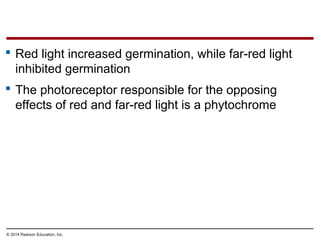
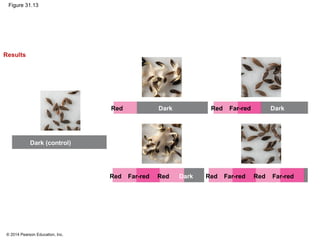
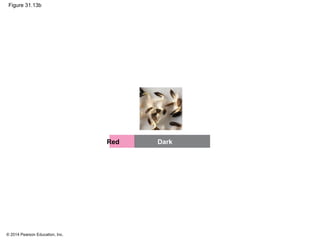
 Red light increased germination, while far-red light
inhibited germination
 The photoreceptor responsible for the opposing
effects of red and far-red light is a phytochrome
© 2014 Pearson Education, Inc.
Figure 31.13
DarkRed Red Far-red Dark
Dark (control)
Red Far-red Dark
Results
Red Red Far-red Red Far-red
© 2014 Pearson Education, Inc.
Figure 31.13a
Dark (control)
© 2014 Pearson Education, Inc.
Figure 31.13b
DarkRed
© 2014 Pearson Education, Inc.
Figure 31.13c
Red Far-red Dark
© 2014 Pearson Education, Inc.
Figure 31.13d
Red Far-red DarkRed
© 2014 Pearson Education, Inc.
Figure 31.13e
Red Far-red Red Far-red
© 2014 Pearson Education, Inc.
 Phytochromes exist in two photoreversible states,
with conversion of Pr to Pfr triggering many
developmental responses
 Red light triggers the conversion of Pr to Pfr
 Far-red light triggers the conversion of Pfr to Pr
 The conversion to Pfr is faster than the conversion
to Pr
 Sunlight increases the ratio of Pfr to Pr and triggers
germination
© 2014 Pearson Education, Inc.
Figure 31.14
Red light
Pr Pfr
Far-red
light
Enzymatic
destruction
Slow conversion
in darkness
(some species)
Responses to Pfr:
• Seed germination
• Inhibition of vertical
growth and stimu-
lation of branching
• Setting internal clocks
• Control of flowering
Synthesis
© 2014 Pearson Education, Inc.
 Phytochromes and shade avoidance: The
phytochrome system also provides the plant with
information about the quality of light
 Leaves in the canopy absorb red light
 Shaded plants receive more far-red than red light
 In the “shade avoidance” response, the phytochrome
ratio shifts in favor of Pr when a tree is shaded
 This shift induces the vertical growth of the plant
© 2014 Pearson Education, Inc.
Biological Clocks and Circadian Rhythms
 Many plant processes oscillate during the day
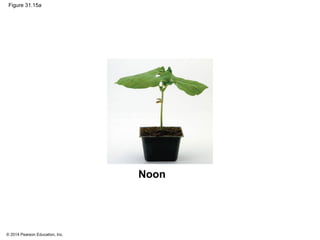
 Many legumes lower their leaves in the evening
and raise them in the morning, even when kept
under constant light or dark conditions
© 2014 Pearson Education, Inc.
Figure 31.15
Noon 10:00 PM
© 2014 Pearson Education, Inc.
Figure 31.15a
Noon
© 2014 Pearson Education, Inc.
Figure 31.15b
10:00 PM
© 2014 Pearson Education, Inc.
 Circadian rhythms are cycles that are about 24
hours long and are governed by an internal “clock”
 Circadian rhythms can be entrained to exactly 24
hours by the day/night cycle
 The clock may depend on synthesis of a protein
regulated through feedback control
© 2014 Pearson Education, Inc.
The Effect of Light on the Biological Clock
 Phytochrome conversion marks sunrise and sunset,
providing the biological clock with environmental
cues
© 2014 Pearson Education, Inc.
Photoperiodism and Responses to Seasons
 Photoperiod, the relative lengths of night and day, is
the environmental stimulus plants use most often to
detect the time of year
 Photoperiodism is a physiological response to
photoperiod
© 2014 Pearson Education, Inc.
Photoperiodism and Control of Flowering
 Some processes, including flowering in many
species, require a certain photoperiod
 Plants that flower when a light period is shorter than
a critical length are called short-day plants
 Plants that flower when a light period is longer than
a certain number of hours are called long-day
plants
 Flowering in day-neutral plants is controlled by
plant maturity, not photoperiod
© 2014 Pearson Education, Inc.
 Critical night length: In the 1940s, researchers
discovered that flowering and other responses to
photoperiod are actually controlled by night length,
not day length
© 2014 Pearson Education, Inc.
 Short-day plants are governed by whether the
critical night length sets a minimum number of
hours of darkness
 Long-day plants are governed by whether the
critical night length sets a maximum number of
hours of darkness
© 2014 Pearson Education, Inc.
Figure 31.16
(a) Short-day
(long-night)
plant
(b) Long-day
(short-night)
plant
DarknessFlash
of light
Light
Critical
dark period
Flash
of light
24 hours
© 2014 Pearson Education, Inc.
 Red light can interrupt the nighttime portion of the
photoperiod
 A flash of red light followed by a flash of far-red
light does not disrupt night length
 Action spectra and photoreversibility experiments
show that phytochrome is the pigment that
receives red light
© 2014 Pearson Education, Inc.
Figure 31.17
24 hours
Critical dark period
R FRR FR
R FRR
R FR
R
Short-day
(long-night)
plant
Long-day
(short-night)
plant
© 2014 Pearson Education, Inc.
 Some plants flower after only a single exposure to
the required photoperiod
 Other plants need several successive days of the
required photoperiod
 Still others need an environmental stimulus in
addition to the required photoperiod
 For example, vernalization is a pretreatment with
cold to induce flowering
© 2014 Pearson Education, Inc.
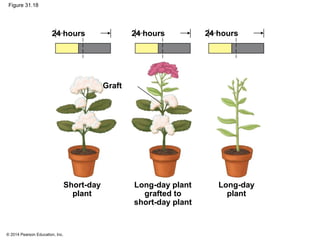
A Flowering Hormone?
 Photoperiod is detected by leaves, which cue buds
to develop as flowers
 The flowering signal is called florigen
 Florigen may be a protein governed by the
FLOWERING LOCUS T (FT) gene
© 2014 Pearson Education, Inc.
Figure 31.18
24 hours 24 hours 24 hours
Graft
Short-day
plant
Long-day plant
grafted to
short-day plant
Long-day
plant
© 2014 Pearson Education, Inc.
Concept 31.3: Plants respond to a wide variety of
stimuli other than light
 Because of immobility, plants must adjust to a range
of environmental circumstances through
developmental and physiological mechanisms
© 2014 Pearson Education, Inc.
Gravity
 Response to gravity is known as gravitropism
 Roots show positive gravitropism by growing
downward; shoots show negative gravitropism by
growing upward
 Plants may detect gravity by the settling of
statoliths, dense cytoplasmic components
Video: Gravitropism
© 2014 Pearson Education, Inc.
Figure 31.19
(a) Primary root of maize
bending gravitropically
(LMs)
(b) Statoliths settling to
the lowest sides of
root cap cells (LMs)
Statoliths
20 µm
© 2014 Pearson Education, Inc.
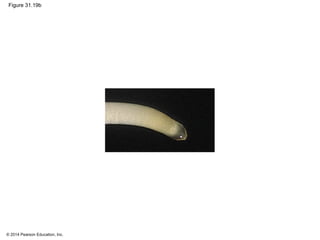
Figure 31.19a
© 2014 Pearson Education, Inc.
Figure 31.19b
© 2014 Pearson Education, Inc.
Figure 31.19c
Statoliths
20 µm
© 2014 Pearson Education, Inc.
Figure 31.19d
Statoliths
20 µm
© 2014 Pearson Education, Inc.
 Some mutants that lack statoliths are still capable
of gravitropism
 Mechanical pulling on proteins that connect the
protoplast to the cell wall may aid in gravity
detection
 Dense organelles and starch granules may also
contribute to gravity detection
© 2014 Pearson Education, Inc.
Mechanical Stimuli
 The term thigmomorphogenesis refers to
changes in form that result from mechanical
disturbance
 Rubbing stems of young plants a couple of times
daily results in plants that are shorter than controls
© 2014 Pearson Education, Inc.
Figure 31.20
© 2014 Pearson Education, Inc.
 Thigmotropism is growth in response to touch
 It occurs in vines and other climbing plants
 Another example of a touch specialist is the
sensitive plant, Mimosa pudica, which folds its
leaflets and collapses in response to touch
 Rapid leaf movements in response to mechanical
stimulation are examples of transmission of
electrical impulses called action potentials
Video: Mimosa Leaf
© 2014 Pearson Education, Inc.
Figure 31.21
(a) Unstimulated state (leaflets
spread apart)
(b) Stimulated state (leaflets folded)
© 2014 Pearson Education, Inc.
Figure 31.21a
(a) Unstimulated state (leaflets spread apart)
© 2014 Pearson Education, Inc.
Figure 31.21b
(b) Stimulated state (leaflets folded)
© 2014 Pearson Education, Inc.
Environmental Stresses
 Environmental stresses have a potentially adverse
effect on survival, growth, and reproduction
 Stresses can be abiotic (nonliving) or biotic (living)
 Abiotic stresses include drought, flooding, salt
stress, heat stress, and cold stress
 Biotic stresses include herbivores and pathogens
© 2014 Pearson Education, Inc.
Drought
 During drought, plants reduce transpiration by
closing stomata, reducing exposed surface area,
or even shedding their leaves
© 2014 Pearson Education, Inc.
Flooding
 Enzymatic destruction of root cortex cells creates
air tubes that help plants survive oxygen deprivation
during flooding
© 2014 Pearson Education, Inc.
Figure 31.22
a) Control root (aerated) (b) Experimental root
(nonaerated)
100 µm
Epidermis
100 µm
Air tubes
Vascular
cylinder
© 2014 Pearson Education, Inc.
Figure 31.22a
(a) Control root (aerated)
100 µm
Epidermis
Vascular
cylinder
© 2014 Pearson Education, Inc.
Figure 31.22b
(b) Experimental root
(nonaerated)
100 µm
Epidermis
Vascular
cylinder
Air tubes
© 2014 Pearson Education, Inc.
Salt Stress
 Salt can lower the water potential of the soil solution
and reduce water uptake
 Plants respond to salt stress by producing solutes
tolerated at high concentrations
 This process keeps the water potential of cells more
negative than that of the soil solution
© 2014 Pearson Education, Inc.
Heat Stress
 Excessive heat can denature a plant’s enzymes
 Heat-shock proteins, which help protect other
proteins from heat stress, are produced at high
temperatures
© 2014 Pearson Education, Inc.
Cold Stress
 Cold temperatures decrease membrane fluidity
 Altering lipid composition of membranes is a
response to cold stress
 Freezing causes ice to form in a plant’s cell walls
and intercellular spaces
 Water leaves the cell in response to freezing, leading
to toxic solute concentrations in the cytoplasm
© 2014 Pearson Education, Inc.
 Many plants, as well as other organisms, have
antifreeze proteins that prevent ice crystals from
growing and damaging cells
 The five classes of antifreeze proteins have
markedly different amino acid sequences but similar
structure, indicating they arose through convergent
evolution
© 2014 Pearson Education, Inc.
Concept 31.4: Plants respond to attacks by
herbivores and pathogens
 Through natural selection, plants have evolved
defense systems to deter herbivory, prevent
infection, and combat pathogens
© 2014 Pearson Education, Inc.
Defenses Against Herbivores
 Herbivory, animals eating plants, is a stress that
plants face in any ecosystem
 Plants counter excessive herbivory with physical
defenses, such as thorns and trichomes, and
chemical defenses, such as distasteful or toxic
compounds
 Some plants even “recruit” predatory animals that
help defend against specific herbivores
© 2014 Pearson Education, Inc.
Figure 31.23
Wounding Chemical
in saliva
Signal transduction
pathway
Recruitment of
parasitoid wasps
that lay their eggs
within caterpillars
Synthesis
and release
of volatile
attractants
1 1
2
3
4
© 2014 Pearson Education, Inc.
 Plants damaged by insects can release volatile
chemicals to warn other plants of the same species
 Arabidopsis can be genetically engineered to
produce volatile components that attract predatory
mites
© 2014 Pearson Education, Inc.
Defenses Against Pathogens
 A plant’s first line of defense against infection is the
barrier presented by the epidermis and periderm
 If a pathogen penetrates the dermal tissue, the
second line of defense is a chemical attack that kills
the pathogen and prevents its spread
 This second defense system is enhanced by the
plant’s ability to recognize certain pathogens
© 2014 Pearson Education, Inc.
 A virulent pathogen is one that a plant has little
specific defense against
 An avirulent pathogen is one that may harm but
does not kill the host plant
Host-Pathogen Coevolution
© 2014 Pearson Education, Inc.
 Gene-for-gene recognition involves recognition of
effector molecules by the protein products of
specific plant disease resistance (R) genes
 An R protein recognizes a corresponding molecule
made by the pathogen’s Avr gene
 R proteins activate plant defenses by triggering
signal transduction pathways
 These defenses include the hypersensitive
response and systemic acquired resistance
© 2014 Pearson Education, Inc.
The Hypersensitive Response
 The hypersensitive response
 Causes localized cell and tissue death near the
infection site
 Induces production of phytoalexins and PR proteins,
which attack the specific pathogen
 Stimulates changes in the cell wall that confine the
pathogen
© 2014 Pearson Education, Inc.
Figure 31.24
Infected tobacco leaf with lesions
Signal
transduction
pathway
Acquired
resistance
Systemic acquired
resistance
R protein
Avr effector protein
R-Avr recognition and
hypersensitive response
Avirulent
pathogen
Signal transduction pathway
Hypersensitive
response
Signal4
3
2
5
1
6
7
© 2014 Pearson Education, Inc.
Figure 31.24a
Systemic acquired
resistance
R-Avr recognition and
hypersensitive response
7 Acquired
resistance
Signal
transduction
pathway
Avr effector protein
R protein
Avirulent
pathogen
Signal
Hypersensitive
response
Signal transduction pathway
54
3
2
1
6
© 2014 Pearson Education, Inc.
Figure 31.24b
Infected tobacco leaf with lesions
© 2014 Pearson Education, Inc.
Systemic Acquired Resistance
 Systemic acquired resistance
 Causes plant-wide expression of defense genes
 Protects against a diversity of pathogens
 Provides a long-lasting response
 Methylsalicylic acid travels from an infection site to
remote areas of the plant where it is converted to
salicylic acid, which initiates pathogen resistance
© 2014 Pearson Education, Inc.
Figure 31.UN01a
Osmotic shock
Roots not connected Roots connected
© 2014 Pearson Education, Inc.
Figure 31.UN01b
Plant number
Control
15 minutes after osmotic shock
Stomatalopening(µM)
1 2 3 4 5 6 7 8 9 10 11
6
7
8
9
10
11
12
13
14
© 2014 Pearson Education, Inc.
Figure 31.UN02
© 2014 Pearson Education, Inc.
Figure 31.UN04
© 2014 Pearson Education, Inc.
Figure 31.UN01c
Pea plant (Pisum sativum)
© 2014 Pearson Education, Inc.
Figure 31.UN03
Red light
Responses
Far-red
light
PfrPr
© 2014 Pearson Education, Inc.
Figure 31.UN05
Control
Ethylene
added
Ethylene
synthesis
inhibitor
Wild-type
Ethylene insensitive
(ein)
Ethylene
overproducing (eto)
Constitutive triple
response (ctr)

Biology in Focus - Chapter 31

  • 1.
    CAMPBELL BIOLOGY INFOCUS © 2014 Pearson Education, Inc. Urry • Cain • Wasserman • Minorsky • Jackson • Reece Lecture Presentations by Kathleen Fitzpatrick and Nicole Tunbridge 31 Plant Responses to Internal and External Signals
  • 2.
    © 2014 PearsonEducation, Inc. Overview: The Race to Live  Young seedlings must outcompete their neighbors in the race for resources in order to survive  Unlike animals, which respond through movement, plants must respond to environmental challenges by altering their growth and development
  • 3.
    © 2014 PearsonEducation, Inc. Figure 31.1
  • 4.
    © 2014 PearsonEducation, Inc. Concept 31.1: Plant hormones help coordinate growth, development, and responses to stimuli  Plant hormones are chemical signals that modify or control one or more specific physiological processes within a plant
  • 5.
    © 2014 PearsonEducation, Inc.  Plant hormones are produced in very low concentration, but a minute amount can greatly affect growth and development of a plant organ  Most aspects of plant growth and development are under hormonal control
  • 6.
    © 2014 PearsonEducation, Inc. The Discovery of Plant Hormones  Any response resulting in curvature of organs toward or away from a stimulus is called a tropism  In the late 1800s, Charles Darwin and his son Francis conducted experiments on phototropism, a plant’s response to light  They observed that a grass seedling could bend toward light only if the tip of the coleoptile was present
  • 7.
    © 2014 PearsonEducation, Inc.  They postulated that a signal was transmitted from the tip to the elongating region Video: Phototropism
  • 8.
    © 2014 PearsonEducation, Inc. Figure 31.2 Results Control Light Illuminated side Shaded side Boysen-Jensen Light Gelatin (permeable) Mica (impermeable) Opaque shield over curvature Trans- parent cap Opaque cap Tip removed Light Darwin and Darwin
  • 9.
    © 2014 PearsonEducation, Inc. Figure 31.2a Control Light Illuminated side Shaded side
  • 10.
    © 2014 PearsonEducation, Inc. Figure 31.2b Opaque shield over curvature Trans- parent cap Opaque cap Tip removed Light Darwin and Darwin: Phototropism occurs only when the tip is illuminated.
  • 11.
    © 2014 PearsonEducation, Inc. Figure 31.2c Boysen-Jensen: Phototropism occurs when the tip is separated by a permeable barrier but not an impermeable barrier. Light Gelatin (permeable) Mica (impermeable)
  • 12.
    © 2014 PearsonEducation, Inc.  In 1913, Peter Boysen-Jensen demonstrated that the signal was a mobile chemical substance
  • 13.
    © 2014 PearsonEducation, Inc.  In 1926, Frits Went extracted the chemical messenger for phototropism, auxin, by modifying earlier experiments
  • 14.
    © 2014 PearsonEducation, Inc. Figure 31.3 Control Results Control (agar cube lacking chemical) Offset cubes Growth-promoting chemical diffuses into agar cube Excised tip on agar cube
  • 15.
    © 2014 PearsonEducation, Inc. A Survey of Plant Hormones  The major classes of plant hormones include  Auxin  Cytokinins  Gibberellins  Brassinosteroids  Abscisic acid  Ethylene
  • 16.
    © 2014 PearsonEducation, Inc. Table 31.1
  • 17.
    © 2014 PearsonEducation, Inc. Auxin  The term auxin refers to any chemical that promotes elongation of coleoptiles  Indoleacetic acid (IAA) is a common auxin in plants; in this lecture the term auxin refers specifically to IAA  Auxin is produced in shoot tips and is transported down the stem  Auxin transporter proteins move the hormone from the basal end of one cell into the apical end of the neighboring cell
  • 18.
    © 2014 PearsonEducation, Inc. Figure 31.4 Results Cell 1 Cell 2100 µm Epidermis Cortex Phloem Xylem Pith Basal end of cell 25 µm
  • 19.
    © 2014 PearsonEducation, Inc. Figure 31.4a 100 µm Epidermis Cortex Phloem Xylem Pith
  • 20.
    © 2014 PearsonEducation, Inc. Figure 31.4b Cell 1 Cell 2 Basal end of cell 25 µm
  • 21.
    © 2014 PearsonEducation, Inc.  The role of auxin in cell elongation: Polar transport of auxin stimulates proton pumps in the plasma membrane  According to the acid growth hypothesis, the proton pumps lower the pH in the cell wall, activating expansins, enzymes that loosen the wall’s fabric  With the cellulose loosened, the cell can elongate
  • 22.
    © 2014 PearsonEducation, Inc. Figure 31.5 CELL WALL H+ H+ H+ H+ H+ H+ H+ H+ Cell wall-loosening enzymes cleave cross-linking polysaccharides. Plasma membrane Cell wall H2O Nucleus Cytoplasm Vacuole Sliding cellulose microfibrils allow cell to elongate. CYTOPLASM H+ Plasma membrane ATP Proton pump activity increases. Acidity increases. Low pH activates expansins. 3 2 1 5 4
  • 23.
    © 2014 PearsonEducation, Inc. Figure 31.5a CELL WALL Cell wall-loosening enzymes cleave cross-linking polysaccharides. CYTOPLASM H+ Plasma membraneATP Proton pump activity increases. Acidity increases. Low pH activates expansins. 1 2 H+ H+ H+ H+ H+ H+ H+ H+ 3 4
  • 24.
    © 2014 PearsonEducation, Inc. Figure 31.5b Plasma membrane Cell wall H2O Nucleus Cytoplasm Vacuole Sliding cellulose microfibrils allow cell to elongate. 5
  • 25.
    © 2014 PearsonEducation, Inc.  Auxin also alters gene expression and stimulates a sustained growth response
  • 26.
    © 2014 PearsonEducation, Inc.  Auxin’s role in plant development: Polar transport of auxin controls the spatial organization of the developing plant  Reduced auxin flow from the shoot of a branch stimulates growth in lower branches  Auxin transport plays a role in phyllotaxy, the arrangement of leaves on the stem
  • 27.
    © 2014 PearsonEducation, Inc.  Practical uses for auxins  The auxin indolbutyric acid (IBA) stimulates adventitious roots and is used in vegetative propagation of plants by cuttings  An overdose of synthetic auxins can kill plants  For example 2,4-D is used as an herbicide on eudicots  Tomato growers spray their plants with synthetic auxins to stimulate fruit growth
  • 28.
    © 2014 PearsonEducation, Inc. Cytokinins  Cytokinins are so named because they stimulate cytokinesis (cell division)
  • 29.
    © 2014 PearsonEducation, Inc.  Control of cell division and differentiation: Cytokinins work together with auxin to control cell division and differentiation  Cytokinins are produced in actively growing tissues such as roots, embryos, and fruits
  • 30.
    © 2014 PearsonEducation, Inc.  Anti-aging effects: Cytokinins slow the aging of some plant organs by inhibiting protein breakdown, stimulating RNA and protein synthesis, and mobilizing nutrients from surrounding tissues
  • 31.
    © 2014 PearsonEducation, Inc. Gibberellins  Gibberellins (GAs) have a variety of effects, such as stem elongation, fruit growth, and seed germination
  • 32.
    © 2014 PearsonEducation, Inc.  Stem elongation: Gibberellins stimulate stem and leaf growth by enhancing cell elongation and cell division  Gibberellins are produced in young roots and leaves  They can induce bolting, rabid growth of the floral stalk
  • 33.
    © 2014 PearsonEducation, Inc. Figure 31.6 (a) Rosette form (left) and gibberellin-induced bolting (right) (b) Grapes from control vine (left) and gibberellin- treated vine (right)
  • 34.
    © 2014 PearsonEducation, Inc. Figure 31.6a (a) Rosette form (left) and gibberellin-induced bolting (right)
  • 35.
    © 2014 PearsonEducation, Inc. Figure 31.6b (b) Grapes from control vine (left) and gibberellin- treated vine (right)
  • 36.
    © 2014 PearsonEducation, Inc.  Fruit growth: In many plants, both auxin and gibberellins must be present for fruit to develop  Gibberellins are used in spraying of Thompson seedless grapes
  • 37.
    © 2014 PearsonEducation, Inc.  Germination: After water is imbibed, release of gibberellins from the embryo signals seeds to germinate
  • 38.
    © 2014 PearsonEducation, Inc. Figure 31.7 Aleurone Endosperm Water Scutellum (cotyledon) Radicle GA GA α-amylase Sugar
  • 39.
    © 2014 PearsonEducation, Inc. Brassinosteroids  Brassinosteroids are chemically similar to cholesterol and the sex hormones of animals  They induce cell elongation and division in stem segments and seedlings  They slow leaf abscission (leaf drop) and promote xylem differentiation
  • 40.
    © 2014 PearsonEducation, Inc. Abscisic Acid  Abscisic acid (ABA) slows growth  Two of the many effects of ABA include  Seed dormancy  Drought tolerance
  • 41.
    © 2014 PearsonEducation, Inc.  Seed dormancy ensures that the seed will germinate only in optimal conditions  In some seeds, dormancy is broken when ABA is removed by heavy rain, light, or prolonged cold  Precocious (early) germination can be caused by inactive or low levels of ABA
  • 42.
    © 2014 PearsonEducation, Inc. Figure 31.8 Red mangrove (Rhizophora mangle) seeds Coleoptile Maize mutant
  • 43.
    © 2014 PearsonEducation, Inc. Figure 31.8a Red mangrove (Rhizophora mangle) seeds
  • 44.
    © 2014 PearsonEducation, Inc. Figure 31.8b Coleoptile Maize mutant
  • 45.
    © 2014 PearsonEducation, Inc.  Drought tolerance: ABA is the primary internal signal that enables plants to withstand drought  ABA accumulation causes stomata to close rapidly
  • 46.
    © 2014 PearsonEducation, Inc. Ethylene  Plants produce ethylene in response to stresses such as drought, flooding, mechanical pressure, injury, and infection  The effects of ethylene include response to mechanical stress, senescence, leaf abscission, and fruit ripening
  • 47.
    © 2014 PearsonEducation, Inc.  The triple response to mechanical stress: Ethylene induces the triple response, which allows a growing shoot to avoid obstacles  The triple response consists of a slowing of stem elongation, a thickening of the stem, and horizontal growth
  • 48.
    © 2014 PearsonEducation, Inc.  Ethylene-insensitive mutants fail to undergo the triple response after exposure to ethylene  Some ethylene-overproducing mutants undergo the triple response even in air but are returned to normal growth when treated with ethylene synthesis inhibitors  Other mutants are not responsive to inhibitors of ethylene synthesis
  • 49.
    © 2014 PearsonEducation, Inc. Figure 31.9 ein mutant ctr mutant (b) ctr mutant(a) ein mutant
  • 50.
    © 2014 PearsonEducation, Inc. Figure 31.9a ein mutant (a) ein mutant
  • 51.
    © 2014 PearsonEducation, Inc. Figure 31.9b ctr mutant (b) ctr mutant
  • 52.
    © 2014 PearsonEducation, Inc.  Senescence: Senescence is the programmed death of cells or organs  A burst of ethylene is associated with apoptosis, the programmed destruction of cells, organs, or whole plants
  • 53.
    © 2014 PearsonEducation, Inc.  Leaf abscission: A change in the balance of auxin and ethylene controls leaf abscission, the process that occurs in autumn when a leaf falls
  • 54.
    © 2014 PearsonEducation, Inc. Figure 31.10 0.5 mm Stem Petiole Abscission layerProtective layer
  • 55.
    © 2014 PearsonEducation, Inc. Figure 31.10a 0.5 mm Stem Petiole Abscission layerProtective layer
  • 56.
    © 2014 PearsonEducation, Inc.  Fruit ripening: A burst of ethylene production in a fruit triggers the ripening process  Ethylene triggers ripening, and ripening triggers release of more ethylene  Fruit producers can control ripening by picking green fruit and controlling ethylene levels
  • 57.
    © 2014 PearsonEducation, Inc. Concept 31.2: Responses to light are critical for plant success  Light triggers many key events in plant growth and development, collectively known as photomorphogenesis
  • 58.
    © 2014 PearsonEducation, Inc. Photomorphogenesis  A potato left growing in darkness produces shoots that look unhealthy, and it lacks elongated roots  These are morphological adaptations for growing in darkness, collectively called etiolation  After exposure to light, a potato undergoes changes called de-etiolation, in which shoots and roots grow normally
  • 59.
    © 2014 PearsonEducation, Inc. Figure 31.11 (a) Before exposure to light (b) After a week’s exposure to natural daylight
  • 60.
    © 2014 PearsonEducation, Inc. Figure 31.11a (a) Before exposure to light
  • 61.
    © 2014 PearsonEducation, Inc. Figure 31.11b (b) After a week’s exposure to natural daylight
  • 62.
    © 2014 PearsonEducation, Inc.  Plants detect not only presence of light but also its direction, intensity, and wavelength (color)  A graph called an action spectrum depicts relative response of a process to different wavelengths  Action spectra are useful in studying any process that depends on light
  • 63.
    © 2014 PearsonEducation, Inc. Figure 31.12 (a) Light wavelengths below 500nm induce curvature. (b) Blue light induces the most curvature of coleoptiles. White light Refracting prism Wavelength (nm) 400 450 500 550 650600 700 436 nm Phototropiceffectiveness 1.0 0.8 0.6 0.4 0.2 0
  • 64.
    © 2014 PearsonEducation, Inc. Figure 31.12a (a) Light wavelengths below 500nm induce curvature. Wavelength (nm) 400 450 500 550 650600 700 436 nm Phototropiceffectiveness 1.0 0.8 0.6 0.4 0.2 0
  • 65.
    © 2014 PearsonEducation, Inc. Figure 31.12b (b) Blue light induces the most curvature of coleoptiles. White light Refracting prism
  • 66.
    © 2014 PearsonEducation, Inc.  Different plant responses can be mediated by the same or different photoreceptors  There are two major classes of light receptors: blue-light photoreceptors and phytochromes, photoreceptors that absorb mostly red light
  • 67.
    © 2014 PearsonEducation, Inc. Blue-Light Photoreceptors  Various blue-light photoreceptors control phototropism (movement in response to light), stomatal opening, and hypocotyl elongation
  • 68.
    © 2014 PearsonEducation, Inc. Phytochrome Photoreceptors  Phytochromes are pigments that regulate many of a plant’s responses to light throughout its life  These responses include seed germination and shade avoidance
  • 69.
    © 2014 PearsonEducation, Inc.  Phytochromes and seed germination: Many seeds remain dormant until light conditions are optimal  In the 1930s, scientists at the U.S. Department of Agriculture determined the action spectrum for light- induced germination of lettuce seeds
  • 70.
    © 2014 PearsonEducation, Inc.  Red light increased germination, while far-red light inhibited germination  The photoreceptor responsible for the opposing effects of red and far-red light is a phytochrome
  • 71.
    © 2014 PearsonEducation, Inc. Figure 31.13 DarkRed Red Far-red Dark Dark (control) Red Far-red Dark Results Red Red Far-red Red Far-red
  • 72.
    © 2014 PearsonEducation, Inc. Figure 31.13a Dark (control)
  • 73.
    © 2014 PearsonEducation, Inc. Figure 31.13b DarkRed
  • 74.
    © 2014 PearsonEducation, Inc. Figure 31.13c Red Far-red Dark
  • 75.
    © 2014 PearsonEducation, Inc. Figure 31.13d Red Far-red DarkRed
  • 76.
    © 2014 PearsonEducation, Inc. Figure 31.13e Red Far-red Red Far-red
  • 77.
    © 2014 PearsonEducation, Inc.  Phytochromes exist in two photoreversible states, with conversion of Pr to Pfr triggering many developmental responses  Red light triggers the conversion of Pr to Pfr  Far-red light triggers the conversion of Pfr to Pr  The conversion to Pfr is faster than the conversion to Pr  Sunlight increases the ratio of Pfr to Pr and triggers germination
  • 78.
    © 2014 PearsonEducation, Inc. Figure 31.14 Red light Pr Pfr Far-red light Enzymatic destruction Slow conversion in darkness (some species) Responses to Pfr: • Seed germination • Inhibition of vertical growth and stimu- lation of branching • Setting internal clocks • Control of flowering Synthesis
  • 79.
    © 2014 PearsonEducation, Inc.  Phytochromes and shade avoidance: The phytochrome system also provides the plant with information about the quality of light  Leaves in the canopy absorb red light  Shaded plants receive more far-red than red light  In the “shade avoidance” response, the phytochrome ratio shifts in favor of Pr when a tree is shaded  This shift induces the vertical growth of the plant
  • 80.
    © 2014 PearsonEducation, Inc. Biological Clocks and Circadian Rhythms  Many plant processes oscillate during the day  Many legumes lower their leaves in the evening and raise them in the morning, even when kept under constant light or dark conditions
  • 81.
    © 2014 PearsonEducation, Inc. Figure 31.15 Noon 10:00 PM
  • 82.
    © 2014 PearsonEducation, Inc. Figure 31.15a Noon
  • 83.
    © 2014 PearsonEducation, Inc. Figure 31.15b 10:00 PM
  • 84.
    © 2014 PearsonEducation, Inc.  Circadian rhythms are cycles that are about 24 hours long and are governed by an internal “clock”  Circadian rhythms can be entrained to exactly 24 hours by the day/night cycle  The clock may depend on synthesis of a protein regulated through feedback control
  • 85.
    © 2014 PearsonEducation, Inc. The Effect of Light on the Biological Clock  Phytochrome conversion marks sunrise and sunset, providing the biological clock with environmental cues
  • 86.
    © 2014 PearsonEducation, Inc. Photoperiodism and Responses to Seasons  Photoperiod, the relative lengths of night and day, is the environmental stimulus plants use most often to detect the time of year  Photoperiodism is a physiological response to photoperiod
  • 87.
    © 2014 PearsonEducation, Inc. Photoperiodism and Control of Flowering  Some processes, including flowering in many species, require a certain photoperiod  Plants that flower when a light period is shorter than a critical length are called short-day plants  Plants that flower when a light period is longer than a certain number of hours are called long-day plants  Flowering in day-neutral plants is controlled by plant maturity, not photoperiod
  • 88.
    © 2014 PearsonEducation, Inc.  Critical night length: In the 1940s, researchers discovered that flowering and other responses to photoperiod are actually controlled by night length, not day length
  • 89.
    © 2014 PearsonEducation, Inc.  Short-day plants are governed by whether the critical night length sets a minimum number of hours of darkness  Long-day plants are governed by whether the critical night length sets a maximum number of hours of darkness
  • 90.
    © 2014 PearsonEducation, Inc. Figure 31.16 (a) Short-day (long-night) plant (b) Long-day (short-night) plant DarknessFlash of light Light Critical dark period Flash of light 24 hours
  • 91.
    © 2014 PearsonEducation, Inc.  Red light can interrupt the nighttime portion of the photoperiod  A flash of red light followed by a flash of far-red light does not disrupt night length  Action spectra and photoreversibility experiments show that phytochrome is the pigment that receives red light
  • 92.
    © 2014 PearsonEducation, Inc. Figure 31.17 24 hours Critical dark period R FRR FR R FRR R FR R Short-day (long-night) plant Long-day (short-night) plant
  • 93.
    © 2014 PearsonEducation, Inc.  Some plants flower after only a single exposure to the required photoperiod  Other plants need several successive days of the required photoperiod  Still others need an environmental stimulus in addition to the required photoperiod  For example, vernalization is a pretreatment with cold to induce flowering
  • 94.
    © 2014 PearsonEducation, Inc. A Flowering Hormone?  Photoperiod is detected by leaves, which cue buds to develop as flowers  The flowering signal is called florigen  Florigen may be a protein governed by the FLOWERING LOCUS T (FT) gene
  • 95.
    © 2014 PearsonEducation, Inc. Figure 31.18 24 hours 24 hours 24 hours Graft Short-day plant Long-day plant grafted to short-day plant Long-day plant
  • 96.
    © 2014 PearsonEducation, Inc. Concept 31.3: Plants respond to a wide variety of stimuli other than light  Because of immobility, plants must adjust to a range of environmental circumstances through developmental and physiological mechanisms
  • 97.
    © 2014 PearsonEducation, Inc. Gravity  Response to gravity is known as gravitropism  Roots show positive gravitropism by growing downward; shoots show negative gravitropism by growing upward  Plants may detect gravity by the settling of statoliths, dense cytoplasmic components Video: Gravitropism
  • 98.
    © 2014 PearsonEducation, Inc. Figure 31.19 (a) Primary root of maize bending gravitropically (LMs) (b) Statoliths settling to the lowest sides of root cap cells (LMs) Statoliths 20 µm
  • 99.
    © 2014 PearsonEducation, Inc. Figure 31.19a
  • 100.
    © 2014 PearsonEducation, Inc. Figure 31.19b
  • 101.
    © 2014 PearsonEducation, Inc. Figure 31.19c Statoliths 20 µm
  • 102.
    © 2014 PearsonEducation, Inc. Figure 31.19d Statoliths 20 µm
  • 103.
    © 2014 PearsonEducation, Inc.  Some mutants that lack statoliths are still capable of gravitropism  Mechanical pulling on proteins that connect the protoplast to the cell wall may aid in gravity detection  Dense organelles and starch granules may also contribute to gravity detection
  • 104.
    © 2014 PearsonEducation, Inc. Mechanical Stimuli  The term thigmomorphogenesis refers to changes in form that result from mechanical disturbance  Rubbing stems of young plants a couple of times daily results in plants that are shorter than controls
  • 105.
    © 2014 PearsonEducation, Inc. Figure 31.20
  • 106.
    © 2014 PearsonEducation, Inc.  Thigmotropism is growth in response to touch  It occurs in vines and other climbing plants  Another example of a touch specialist is the sensitive plant, Mimosa pudica, which folds its leaflets and collapses in response to touch  Rapid leaf movements in response to mechanical stimulation are examples of transmission of electrical impulses called action potentials Video: Mimosa Leaf
  • 107.
    © 2014 PearsonEducation, Inc. Figure 31.21 (a) Unstimulated state (leaflets spread apart) (b) Stimulated state (leaflets folded)
  • 108.
    © 2014 PearsonEducation, Inc. Figure 31.21a (a) Unstimulated state (leaflets spread apart)
  • 109.
    © 2014 PearsonEducation, Inc. Figure 31.21b (b) Stimulated state (leaflets folded)
  • 110.
    © 2014 PearsonEducation, Inc. Environmental Stresses  Environmental stresses have a potentially adverse effect on survival, growth, and reproduction  Stresses can be abiotic (nonliving) or biotic (living)  Abiotic stresses include drought, flooding, salt stress, heat stress, and cold stress  Biotic stresses include herbivores and pathogens
  • 111.
    © 2014 PearsonEducation, Inc. Drought  During drought, plants reduce transpiration by closing stomata, reducing exposed surface area, or even shedding their leaves
  • 112.
    © 2014 PearsonEducation, Inc. Flooding  Enzymatic destruction of root cortex cells creates air tubes that help plants survive oxygen deprivation during flooding
  • 113.
    © 2014 PearsonEducation, Inc. Figure 31.22 a) Control root (aerated) (b) Experimental root (nonaerated) 100 µm Epidermis 100 µm Air tubes Vascular cylinder
  • 114.
    © 2014 PearsonEducation, Inc. Figure 31.22a (a) Control root (aerated) 100 µm Epidermis Vascular cylinder
  • 115.
    © 2014 PearsonEducation, Inc. Figure 31.22b (b) Experimental root (nonaerated) 100 µm Epidermis Vascular cylinder Air tubes
  • 116.
    © 2014 PearsonEducation, Inc. Salt Stress  Salt can lower the water potential of the soil solution and reduce water uptake  Plants respond to salt stress by producing solutes tolerated at high concentrations  This process keeps the water potential of cells more negative than that of the soil solution
  • 117.
    © 2014 PearsonEducation, Inc. Heat Stress  Excessive heat can denature a plant’s enzymes  Heat-shock proteins, which help protect other proteins from heat stress, are produced at high temperatures
  • 118.
    © 2014 PearsonEducation, Inc. Cold Stress  Cold temperatures decrease membrane fluidity  Altering lipid composition of membranes is a response to cold stress  Freezing causes ice to form in a plant’s cell walls and intercellular spaces  Water leaves the cell in response to freezing, leading to toxic solute concentrations in the cytoplasm
  • 119.
    © 2014 PearsonEducation, Inc.  Many plants, as well as other organisms, have antifreeze proteins that prevent ice crystals from growing and damaging cells  The five classes of antifreeze proteins have markedly different amino acid sequences but similar structure, indicating they arose through convergent evolution
  • 120.
    © 2014 PearsonEducation, Inc. Concept 31.4: Plants respond to attacks by herbivores and pathogens  Through natural selection, plants have evolved defense systems to deter herbivory, prevent infection, and combat pathogens
  • 121.
    © 2014 PearsonEducation, Inc. Defenses Against Herbivores  Herbivory, animals eating plants, is a stress that plants face in any ecosystem  Plants counter excessive herbivory with physical defenses, such as thorns and trichomes, and chemical defenses, such as distasteful or toxic compounds  Some plants even “recruit” predatory animals that help defend against specific herbivores
  • 122.
    © 2014 PearsonEducation, Inc. Figure 31.23 Wounding Chemical in saliva Signal transduction pathway Recruitment of parasitoid wasps that lay their eggs within caterpillars Synthesis and release of volatile attractants 1 1 2 3 4
  • 123.
    © 2014 PearsonEducation, Inc.  Plants damaged by insects can release volatile chemicals to warn other plants of the same species  Arabidopsis can be genetically engineered to produce volatile components that attract predatory mites
  • 124.
    © 2014 PearsonEducation, Inc. Defenses Against Pathogens  A plant’s first line of defense against infection is the barrier presented by the epidermis and periderm  If a pathogen penetrates the dermal tissue, the second line of defense is a chemical attack that kills the pathogen and prevents its spread  This second defense system is enhanced by the plant’s ability to recognize certain pathogens
  • 125.
    © 2014 PearsonEducation, Inc.  A virulent pathogen is one that a plant has little specific defense against  An avirulent pathogen is one that may harm but does not kill the host plant Host-Pathogen Coevolution
  • 126.
    © 2014 PearsonEducation, Inc.  Gene-for-gene recognition involves recognition of effector molecules by the protein products of specific plant disease resistance (R) genes  An R protein recognizes a corresponding molecule made by the pathogen’s Avr gene  R proteins activate plant defenses by triggering signal transduction pathways  These defenses include the hypersensitive response and systemic acquired resistance
  • 127.
    © 2014 PearsonEducation, Inc. The Hypersensitive Response  The hypersensitive response  Causes localized cell and tissue death near the infection site  Induces production of phytoalexins and PR proteins, which attack the specific pathogen  Stimulates changes in the cell wall that confine the pathogen
  • 128.
    © 2014 PearsonEducation, Inc. Figure 31.24 Infected tobacco leaf with lesions Signal transduction pathway Acquired resistance Systemic acquired resistance R protein Avr effector protein R-Avr recognition and hypersensitive response Avirulent pathogen Signal transduction pathway Hypersensitive response Signal4 3 2 5 1 6 7
  • 129.
    © 2014 PearsonEducation, Inc. Figure 31.24a Systemic acquired resistance R-Avr recognition and hypersensitive response 7 Acquired resistance Signal transduction pathway Avr effector protein R protein Avirulent pathogen Signal Hypersensitive response Signal transduction pathway 54 3 2 1 6
  • 130.
    © 2014 PearsonEducation, Inc. Figure 31.24b Infected tobacco leaf with lesions
  • 131.
    © 2014 PearsonEducation, Inc. Systemic Acquired Resistance  Systemic acquired resistance  Causes plant-wide expression of defense genes  Protects against a diversity of pathogens  Provides a long-lasting response  Methylsalicylic acid travels from an infection site to remote areas of the plant where it is converted to salicylic acid, which initiates pathogen resistance
  • 132.
    © 2014 PearsonEducation, Inc. Figure 31.UN01a Osmotic shock Roots not connected Roots connected
  • 133.
    © 2014 PearsonEducation, Inc. Figure 31.UN01b Plant number Control 15 minutes after osmotic shock Stomatalopening(µM) 1 2 3 4 5 6 7 8 9 10 11 6 7 8 9 10 11 12 13 14
  • 134.
    © 2014 PearsonEducation, Inc. Figure 31.UN02
  • 135.
    © 2014 PearsonEducation, Inc. Figure 31.UN04
  • 136.
    © 2014 PearsonEducation, Inc. Figure 31.UN01c Pea plant (Pisum sativum)
  • 137.
    © 2014 PearsonEducation, Inc. Figure 31.UN03 Red light Responses Far-red light PfrPr
  • 138.
    © 2014 PearsonEducation, Inc. Figure 31.UN05 Control Ethylene added Ethylene synthesis inhibitor Wild-type Ethylene insensitive (ein) Ethylene overproducing (eto) Constitutive triple response (ctr)

Editor's Notes

  • #4 Figure 31.1 How do plants detect light?
  • #9 Figure 31.2 Inquiry: What part of a grass coleoptile senses light, and how is the signal transmitted?
  • #10 Figure 31.2a Inquiry: What part of a grass coleoptile senses light, and how is the signal transmitted? (part 1: control)
  • #11 Figure 31.2b Inquiry: What part of a grass coleoptile senses light, and how is the signal transmitted? (part 2: Darwin and Darwin)
  • #12 Figure 31.2c Inquiry: What part of a grass coleoptile senses light, and how is the signal transmitted? (part 3: Boysen-Jensen)
  • #15 Figure 31.3 Inquiry: Does asymmetric distribution of a growth-promoting chemical cause a coleoptile to grow toward the light?
  • #17 Table 31.1 Overview of plant hormones
  • #19 Figure 31.4 Inquiry: What causes polar movement of auxin from shoot tip to base?
  • #20 Figure 31.4a Inquiry: What causes polar movement of auxin from shoot tip to base? (part 1: LM, lower magnification)
  • #21 Figure 31.4b Inquiry: What causes polar movement of auxin from shoot tip to base? (part 2: LM, higher magnification)
  • #23 Figure 31.5 Cell elongation in response to auxin: the acid growth hypothesis
  • #24 Figure 31.5a Cell elongation in response to auxin: the acid growth hypothesis (part 1: mechanism)
  • #25 Figure 31.5b Cell elongation in response to auxin: the acid growth hypothesis (part 2: cell elongation)
  • #34 Figure 31.6 Effects of gibberellins on stem elongation and fruit growth
  • #35 Figure 31.6a Effects of gibberellins on stem elongation and fruit growth (part 1: bolting)
  • #36 Figure 31.6b Effects of gibberellins on stem elongation and fruit growth (part 2: fruits)
  • #39 Figure 31.7 Mobilization of nutrients by gibberellins during the germination of grain seeds such as barley
  • #43 Figure 31.8 Precocious germination of wild-type mangrove and mutant maize seeds
  • #44 Figure 31.8a Precocious germination of wild-type mangrove and mutant maize seeds (part 1: wild-type mangrove seeds)
  • #45 Figure 31.8b Precocious germination of wild-type mangrove and mutant maize seeds (part 2: mutant maize seeds)
  • #50 Figure 31.9 Ethylene triple-response Arabidopsis mutants
  • #51 Figure 31.9a Ethylene triple-response Arabidopsis mutants (part 1: ein mutant)
  • #52 Figure 31.9b Ethylene triple-response Arabidopsis mutants (part 2: ctr mutant)
  • #55 Figure 31.10 Abscission of a maple leaf
  • #56 Figure 31.10a Abscission of a maple leaf (part 1: LM)
  • #60 Figure 31.11 Light-induced de-etiolation (greening) of dark-grown potatoes
  • #61 Figure 31.11a Light-induced de-etiolation (greening) of dark-grown potatoes (part 1: before)
  • #62 Figure 31.11b Light-induced de-etiolation (greening) of dark-grown potatoes (part 2: after)
  • #64 Figure 31.12 Action spectrum for blue-light-stimulated phototropism in maize coleoptiles
  • #65 Figure 31.12a Action spectrum for blue-light-stimulated phototropism in maize coleoptiles (part 1: action spectrum)
  • #66 Figure 31.12b Action spectrum for blue-light-stimulated phototropism in maize coleoptiles (part 2: prism)
  • #72 Figure 31.13 Inquiry: How does the order of red and far-red illumination affect seed germination?
  • #73 Figure 31.13a Inquiry: How does the order of red and far-red illumination affect seed germination? (part 1: control)
  • #74 Figure 31.13b Inquiry: How does the order of red and far-red illumination affect seed germination? (part 2: red, dark)
  • #75 Figure 31.13c Inquiry: How does the order of red and far-red illumination affect seed germination? (part 3: red, far-red, dark)
  • #76 Figure 31.13d Inquiry: How does the order of red and far-red illumination affect seed germination? (part 4: red, far-red, red, dark)
  • #77 Figure 31.13e Inquiry: How does the order of red and far-red illumination affect seed germination? (part 5: red, far-red, red, far-red, dark)
  • #79 Figure 31.14 Phytochrome: a molecular switching mechanism
  • #82 Figure 31.15 Sleep movements of a bean plant (Phaseolus vulgaris)
  • #83 Figure 31.15a Sleep movements of a bean plant (Phaseolus vulgaris) (part 1: noon)
  • #84 Figure 31.15b Sleep movements of a bean plant (Phaseolus vulgaris) (part 2: 10 PM)
  • #91 Figure 31.16 Photoperiodic control of flowering
  • #93 Figure 31.17 Reversible effects of red and far-red light on photoperiodic response
  • #96 Figure 31.18 Experimental evidence for a flowering hormone
  • #99 Figure 31.19 Positive gravitropism in roots: the statolith hypothesis
  • #100 Figure 31.19a Positive gravitropism in roots: the statolith hypothesis (part 1: horizontal root)
  • #101 Figure 31.19b Positive gravitropism in roots: the statolith hypothesis (part 2: bent root)
  • #102 Figure 31.19c Positive gravitropism in roots: the statolith hypothesis (part 3: statoliths at start)
  • #103 Figure 31.19d Positive gravitropism in roots: the statolith hypothesis (part 4: settled statoliths)
  • #106 Figure 31.20 Altering gene expression by touch in Arabidopsis
  • #108 Figure 31.21 Rapid turgor movements by the sensitive plant (Mimosa pudica)
  • #109 Figure 31.21a Rapid turgor movements by the sensitive plant (Mimosa pudica) (part 1: unstimulated)
  • #110 Figure 31.21b Rapid turgor movements by the sensitive plant (Mimosa pudica) (part 2: stimulated)
  • #114 Figure 31.22 A developmental response of maize roots to flooding and oxygen deprivation
  • #115 Figure 31.22a A developmental response of maize roots to flooding and oxygen deprivation (part 1: aerated)
  • #116 Figure 31.22b A developmental response of maize roots to flooding and oxygen deprivation (part 2: nonaerated)
  • #123 Figure 31.23 A maize leaf “recruiting” a parasitoid wasp as a defensive response to an armyworm caterpillar, an herbivore
  • #129 Figure 31.24 Defense responses against an avirulent pathogen
  • #130 Figure 31.24a Defense responses against an avirulent pathogen (part 1: art)
  • #131 Figure 31.24b Defense responses against an avirulent pathogen (part 2: photo)
  • #133 Figure 31.UN01a Skills exercise: interpreting experimental results from a bar graph (part 1)
  • #134 Figure 31.UN01b Skills exercise: interpreting experimental results from a bar graph (part 2)
  • #135 Figure 31.UN02 Summary of key concepts: plant hormones
  • #136 Figure 31.UN04 Summary of key concepts: environmental stress
  • #137 Figure 31.UN01c Skills exercise: interpreting experimental results from a bar graph (part 3)
  • #138 Figure 31.UN03 Summary of key concepts: responses to light
  • #139 Figure 31.UN05 Test your understanding, question 7 (ethylene mutants)