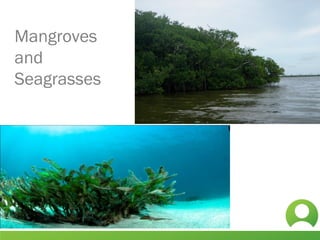
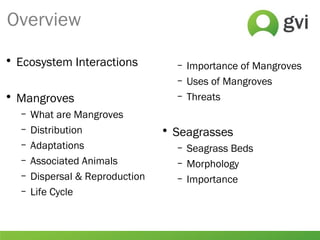
Mangroves
and
Seagrasses
Overview
• Ecosystem Interactions
• Mangroves
– What are Mangroves
– Distribution
– Adaptations
– Associated Animals
– Dispersal & Reproduction
– Life Cycle
– Importance of Mangroves
– Uses of Mangroves
– Threats
• Seagrasses
– Seagrass Beds
– Morphology
– Importance
Reduce wave action
Act as juvenile nursery
ground / Source of leaf
litterReduce coastal erosion
Freshwater buffer
Act as juvenile nursery
ground
Trap sediment
Trap sediment
Slow wave action and
currents
Ecosystem Interactions
Mangroves
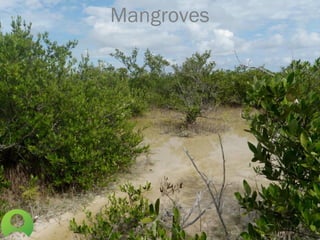
What are Mangroves?
• Woody, seed bearing halophytes
adapted for life in brackish and
waterlogged soils that are acidic
and often anoxic
• Shrubs to tall trees
• Found along sheltered tropical
mudflats
• 54 species across 20 genera
Distribution
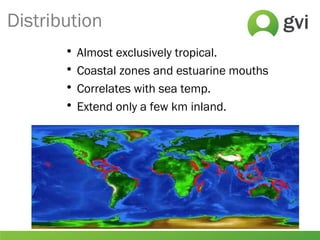
• Almost exclusively tropical.
• Coastal zones and estuarine mouths
• Correlates with sea temp.
• Extend only a few km inland.
Adaptations
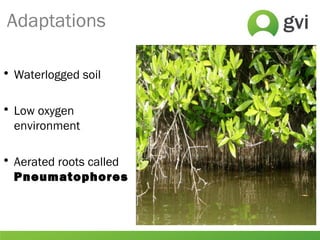
• Waterlogged soil
• Low oxygen
environment
• Aerated roots called
Pneumatophores
Adaptations
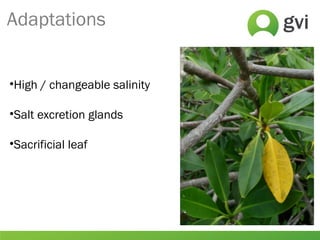
•High / changeable salinity
•Salt excretion glands
•Sacrificial leaf
Adaptations
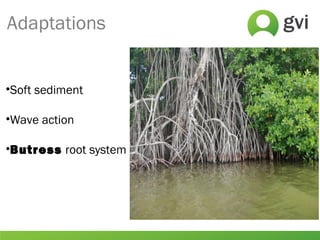
•Soft sediment
•Wave action
•Butress root system
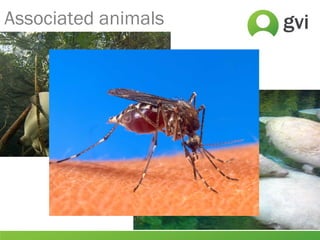
Associated animals
Dispersal and Reproduction
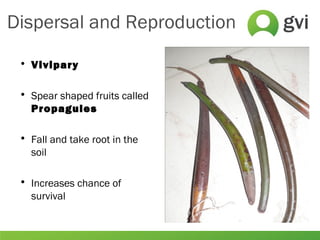
• Vivipary
• Spear shaped fruits called
Propagules
• Fall and take root in the
soil
• Increases chance of
survival
Dispersal and Reproduction
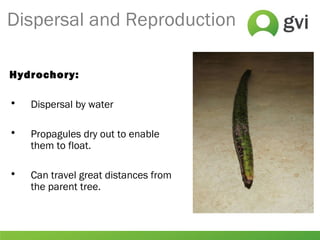
Hydrochory:
• Dispersal by water
• Propagules dry out to enable
them to float.
• Can travel great distances from
the parent tree.
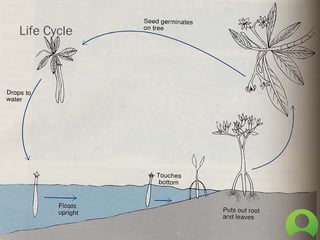
Life Cycle
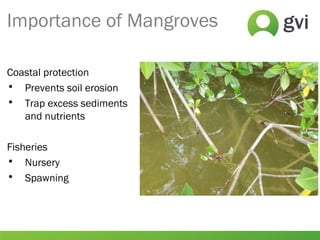
Importance of Mangroves
Coastal protection
• Prevents soil erosion
• Trap excess sediments
and nutrients
Fisheries
• Nursery
• Spawning
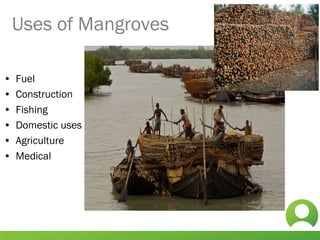
• Fuel
• Construction
• Fishing
• Domestic uses
• Agriculture
• Medical
Uses of Mangroves
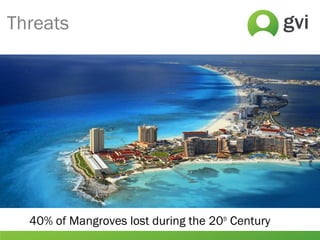
Threats
40% of Mangroves lost during the 20th
Century
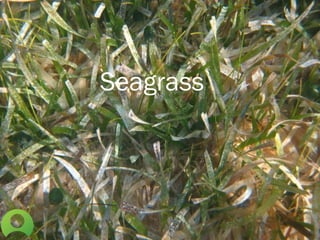
Seagrass
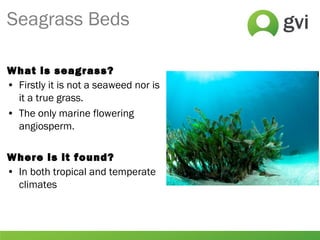
What is seagrass?
• Firstly it is not a seaweed nor is
it a true grass.
• The only marine flowering
angiosperm.
Where is it found?
• In both tropical and temperate
climates
Seagrass Beds
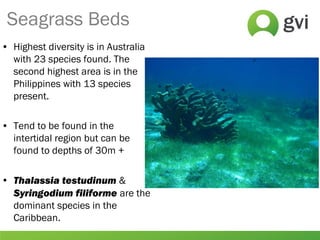
• Highest diversity is in Australia
with 23 species found. The
second highest area is in the
Philippines with 13 species
present.
• Tend to be found in the
intertidal region but can be
found to depths of 30m +
• Thalassia testudinum &
Syringodium filiforme are the
dominant species in the
Caribbean.
Seagrass Beds
The Morphology of
Seagrass
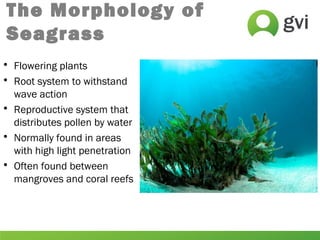
• Flowering plants
• Root system to withstand
wave action
• Reproductive system that
distributes pollen by water
• Normally found in areas
with high light penetration
• Often found between
mangroves and coral reefs
Importance of
Seagrass• Nurseries for juvenile fish
• Food source – manatees,
turtles,
• Feeding grounds for
predators
• Reduce currents and
erosion
• Improve water quality and
visibility
• Commercial uses
• Increase oxygen levels in
the water column

Mangroves & Seagrasses PR10_v0310

  • 1.
  • 2.
    Overview • Ecosystem Interactions •Mangroves – What are Mangroves – Distribution – Adaptations – Associated Animals – Dispersal & Reproduction – Life Cycle – Importance of Mangroves – Uses of Mangroves – Threats • Seagrasses – Seagrass Beds – Morphology – Importance
  • 3.
    Reduce wave action Actas juvenile nursery ground / Source of leaf litterReduce coastal erosion Freshwater buffer Act as juvenile nursery ground Trap sediment Trap sediment Slow wave action and currents Ecosystem Interactions
  • 4.
  • 5.
    What are Mangroves? •Woody, seed bearing halophytes adapted for life in brackish and waterlogged soils that are acidic and often anoxic • Shrubs to tall trees • Found along sheltered tropical mudflats • 54 species across 20 genera
  • 6.
    Distribution • Almost exclusivelytropical. • Coastal zones and estuarine mouths • Correlates with sea temp. • Extend only a few km inland.
  • 7.
    Adaptations • Waterlogged soil •Low oxygen environment • Aerated roots called Pneumatophores
  • 8.
    Adaptations •High / changeablesalinity •Salt excretion glands •Sacrificial leaf
  • 9.
  • 10.
  • 11.
    Dispersal and Reproduction •Vivipary • Spear shaped fruits called Propagules • Fall and take root in the soil • Increases chance of survival
  • 12.
    Dispersal and Reproduction Hydrochory: •Dispersal by water • Propagules dry out to enable them to float. • Can travel great distances from the parent tree.
  • 13.
  • 14.
    Importance of Mangroves Coastalprotection • Prevents soil erosion • Trap excess sediments and nutrients Fisheries • Nursery • Spawning
  • 15.
    • Fuel • Construction •Fishing • Domestic uses • Agriculture • Medical Uses of Mangroves
  • 16.
    Threats 40% of Mangroveslost during the 20th Century
  • 17.
  • 18.
    What is seagrass? •Firstly it is not a seaweed nor is it a true grass. • The only marine flowering angiosperm. Where is it found? • In both tropical and temperate climates Seagrass Beds
  • 19.
    • Highest diversityis in Australia with 23 species found. The second highest area is in the Philippines with 13 species present. • Tend to be found in the intertidal region but can be found to depths of 30m + • Thalassia testudinum & Syringodium filiforme are the dominant species in the Caribbean. Seagrass Beds
  • 20.
    The Morphology of Seagrass •Flowering plants • Root system to withstand wave action • Reproductive system that distributes pollen by water • Normally found in areas with high light penetration • Often found between mangroves and coral reefs
  • 21.
    Importance of Seagrass• Nurseriesfor juvenile fish • Food source – manatees, turtles, • Feeding grounds for predators • Reduce currents and erosion • Improve water quality and visibility • Commercial uses • Increase oxygen levels in the water column

Editor's Notes

  • #4 Mutualistic symbiosis of ecosystems
  • #6 What is a mangrove? A mangrove is....... 54 species across 20 genera Mangroves did not evolve just once and then allow rapid diversification by a common ancestor but probably evolved independently at least 16 times in 16 separate families. The common features have evolved through convergence not common descent.
  • #7 Distribution Mangroves are found almost exclusively in tropical areas, although they can be found in areas where the air temp falls as low as 5 degrees Celsius. They are however intolerant of frost. There position correlates most closely with sea temperatures and as such follow the winter position of the 20 degree isotherm. The closer you move towards this boundary the less species are found.
  • #8 Waterlogged soil: Underground tissues of plants require oxygen for respiration. In normal non-waterlogged soil gas diffusion can supply this need. However, in waterlogged soil, even when the water is saturated with oxygen, the concentration is still far below that of air and the diffusion rate is approx 10,000 less than in air. Therefore waterlogged soils are considered to be low in oxygen. When water movement is limited this oxygen is soon depleted by aerobic respiration of soil bacteria which leads to an anaerobic environment. Roots need air – absent in waterlogged anoxic mud, so… Most mangroves have at least some aerial roots- directly exposed to the air Surface of roots perforated with pores called lenticels Air passes into lenticels, then along root through honeycombed sponge-like tissue – aerenchyma – which accounts for upto 40% total volume Pneumatophores – grow vertically in air to act as snorkel Rising tide pushes old air out of roots, and when it receeds, fresh air flows in again through lenticels and pneumatophores – thus roots of mangroves effectively breathe, using sea as their diaphragm Avicennia – pencil-like; other species secondarily thicken to develop into tall, substantial cones Anoxic bacteria are toxic to the mangrove so the roots secrete a small layer of oxygen to protect it and act as a barrier.
  • #9 High/Changeable Salinity Salt excretion
  • #10 Soft sediment and wave action BUTRESSES
  • #11 Tree canopy Birds, bats, insects Trunks and aerial roots Snails, crabs, barnacles, rock oysters, sponges, anemones, tunicates, mussels, worms, hydroids, bryozoans Axial of branches and rot holes Mosquitoes Soil surface Snails Burrows Fiddler crab, mud lobster, mud skippers Surrounding water Fish, dugongs/manatees, crocodiles
  • #12 To establish themselves in unstable substrate, have large, often spear-shaped fruits that implant themselves rapidly upon reaching the mud Some can disperse propagules, which hang from branches of mature trees These may fall and take root in the soil surrounding the parent tree or float away Rhizophora has fruit that germinates on the tree Vivipary: After pollination the growing embryo remains on the parent tree and is dependant on it for a period that often stretches to many months: 4-6 months and grow 25-30cm
  • #13 Propogation by water
  • #15 Coastal Protection Fringe of mangrove prevents soil erosion from land and sediment removal by sea Removal of mangroves leaves coasts unprotected – may require construction of breakwaters Coasts then more exposed to damage by natural events, e.g. 1992 Hurricane Andrew, Florida Corals are vulnerable to sedimentation and eutrophication – mangroves may protect reefs by trapping excess sediments and nutrients Fisheries Mangroves are often the basis for thriving local fisheries Species richness is generally high Nursery areas – provide nutrition, shelter and protection e.g. shrimps, juveniles of pelagic species Spawning areas
  • #16 Fuel – charcoal, firewood Construction – timber, scaffold, boat building, docks, thatch, matting, chipboard Fishing – stakes, boats, wood for smoking fish, fish poison, fish attracting shelters Textiles – synthetics (e.g. rayon), dyes, tannins (preserving leather) Food and drink – sugar, alcohol, cooking oil, vinegar, tea substitute, fermented drinks, dessert topping, seasoning (bark), vegetables (fruit and leaves) Domestic – glue, hairdressing oil, tool handles, musical instruments, toys, matchsticks, cigarette wrappers, cosmetics Agricultural – fodder Medical – ringworm treatment, mange, toothache, leprosy, sore throat, constipation, dysentery, diarrhoea, boils, bleeding lice, fungal infections
  • #17 40% of mangroves lost during C20 - few forests are now pristine Destroyed for building, agriculture (e.g. rice), municipal rubbish dumps, commercial logging and aquaculture Apart from exposing the coast to erosion, extraction removes material which would have contributed to ecosystem Selective removal of large trees for timber affects age structure Removal of certain species affects community structure and decreases diversity .since 1985 25% of mangroves in quintanaroo have been removed....data 3 years old....get pic of cancun...used to be a wetland.