Tapeshwar Yadav
(Lecturer)
BMLT, DNHE,
M.Sc. Medical Biochemistry
DefinitionDefinition
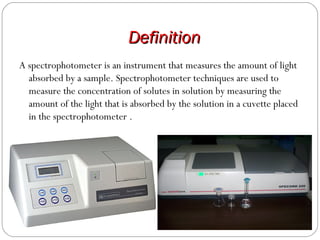
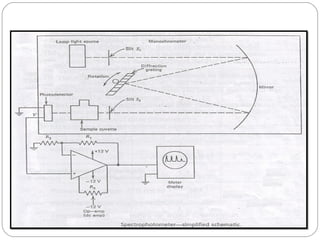
A spectrophotometer is an instrument that measures the amount of light
absorbed by a sample. Spectrophotometer techniques are used to
measure the concentration of solutes in solution by measuring the
amount of the light that is absorbed by the solution in a cuvette placed
in the spectrophotometer .
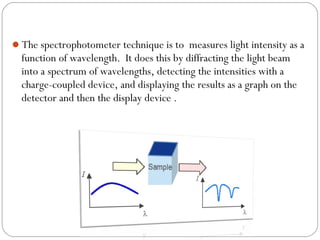
The spectrophotometer technique is to measures light intensity as a
function of wavelength. It does this by diffracting the light beam
into a spectrum of wavelengths, detecting the intensities with a
charge-coupled device, and displaying the results as a graph on the
detector and then the display device .
Introduction
The spectrophotometer technique is to measures light
intensity as a function of wavelength.
It does this by:
1. diffracting the light beam into a spectrum of
wavelengths
2. direct it to an object
3. receiving the light reflected or returned from the object
4. detecting the intensities with a charge-coupled device
5. displaying the results as a graph on the detector and then
the display device
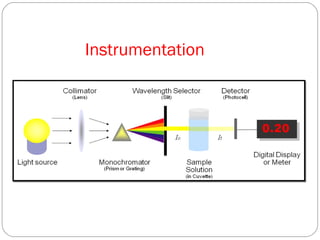
Instrumentation
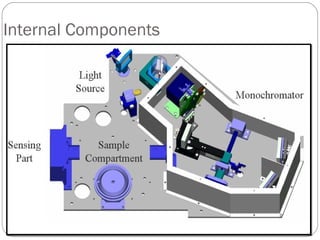
Internal Components
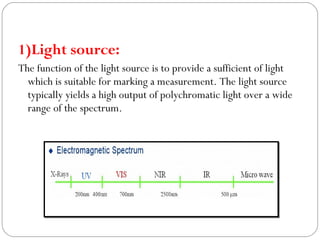
1)Light source:
The function of the light source is to provide a sufficient of light
which is suitable for marking a measurement. The light source
typically yields a high output of polychromatic light over a wide
range of the spectrum.
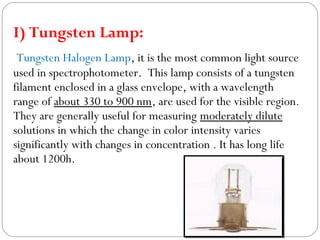
I) Tungsten Lamp:
Tungsten Halogen Lamp, it is the most common light source
used in spectrophotometer. This lamp consists of a tungsten
filament enclosed in a glass envelope, with a wavelength
range of about 330 to 900 nm, are used for the visible region.
They are generally useful for measuring moderately dilute
solutions in which the change in color intensity varies
significantly with changes in concentration . It has long life
about 1200h.
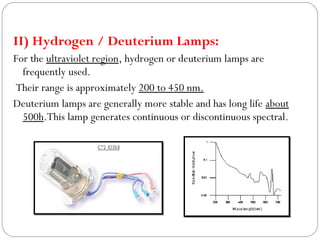
II) Hydrogen / Deuterium Lamps:
For the ultraviolet region, hydrogen or deuterium lamps are
frequently used.
Their range is approximately 200 to 450 nm.
Deuterium lamps are generally more stable and has long life about
500h.This lamp generates continuous or discontinuous spectral.
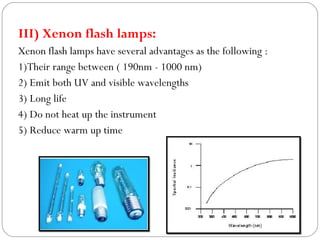
III) Xenon flash lamps:
Xenon flash lamps have several advantages as the following :
1)Their range between ( 190nm - 1000 nm)
2) Emit both UV and visible wavelengths
3) Long life
4) Do not heat up the instrument
5) Reduce warm up time
2) Dispersion devices
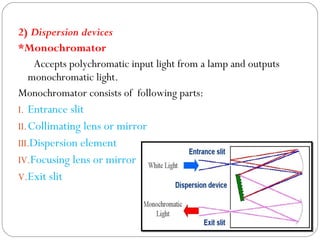
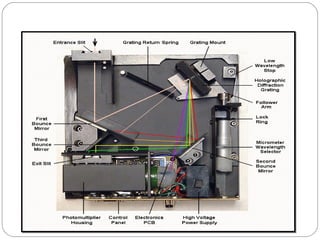
*Monochromator
Accepts polychromatic input light from a lamp and outputs
monochromatic light.
Monochromator consists of following parts:
I. Entrance slit
II.Collimating lens or mirror
III.Dispersion element
IV.Focusing lens or mirror
V.Exit slit
Monochromator
Dispersion devices :
Dispersion devices causes a different wavelength of light to be dispersion at
different angles monochromators used for function.
*Types of dispersion devices :
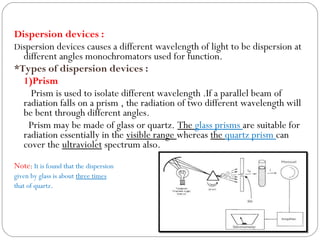
1)Prism
Prism is used to isolate different wavelength .If a parallel beam of
radiation falls on a prism , the radiation of two different wavelength will
be bent through different angles.
Prism may be made of glass or quartz. The glass prisms are suitable for
radiation essentially in the visible range whereas the quartz prism can
cover the ultraviolet spectrum also.
Note: It is found that the dispersion
given by glass is about three times
that of quartz.
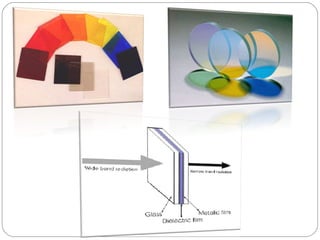
2)Filter
Filters separate different parts of the electromagnetic spectrum by absorbing
or reflecting certain wavelengths and transmitting other wavelengths.
*Absorption filters are glass substrates containing absorbing species that
absorb certain wavelength.
A typical example is a cut on color filter, which blocks short wavelength light
such as an excitation source, and transmits longer wavelength light such as
fluorescence that reaches a detector.
*Interference filters are made of multiple dielectric thin films on a
substrate. They use interference to selectively transmit or reflect a certain
range of wavelengths.
A typical example is a Bandpass interference filter that transmits a narrow
range of wavelengths, and can isolate a single emission line from a
discharge lamp.
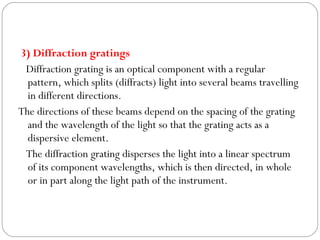
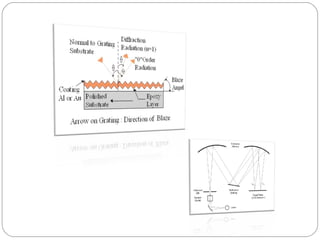
3) Diffraction gratings
Diffraction grating is an optical component with a regular
pattern, which splits (diffracts) light into several beams travelling
in different directions.
The directions of these beams depend on the spacing of the grating
and the wavelength of the light so that the grating acts as a
dispersive element.
The diffraction grating disperses the light into a linear spectrum
of its component wavelengths, which is then directed, in whole
or in part along the light path of the instrument.
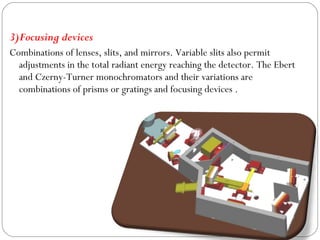
3)Focusing devices
Combinations of lenses, slits, and mirrors. Variable slits also permit
adjustments in the total radiant energy reaching the detector. The Ebert
and Czerny-Turner monochromators and their variations are
combinations of prisms or gratings and focusing devices .
Ebert and Czerny-Turner
Monochromator
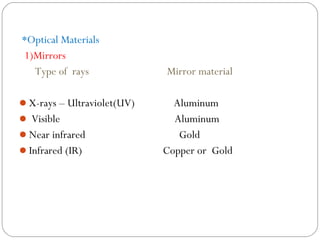
*Optical Materials
1)Mirrors
Type of rays Mirror material
X-rays – Ultraviolet(UV) Aluminum
 Visible Aluminum
Near infrared Gold
Infrared (IR) Copper or Gold
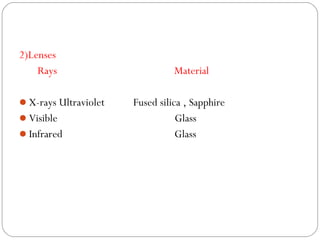
2)Lenses
Rays Material
X-rays Ultraviolet Fused silica , Sapphire
Visible Glass
Infrared Glass
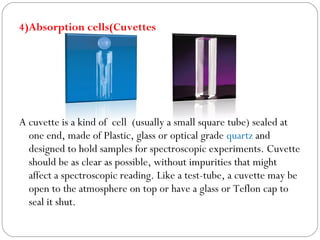
4)Absorption cells(Cuvettes
A cuvette is a kind of cell (usually a small square tube) sealed at
one end, made of Plastic, glass or optical grade quartz and
designed to hold samples for spectroscopic experiments. Cuvette
should be as clear as possible, without impurities that might
affect a spectroscopic reading. Like a test-tube, a cuvette may be
open to the atmosphere on top or have a glass or Teflon cap to
seal it shut.
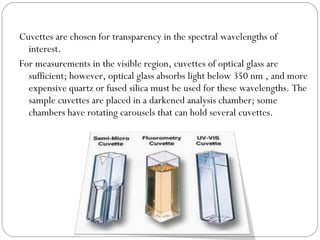
Cuvettes are chosen for transparency in the spectral wavelengths of
interest.
For measurements in the visible region, cuvettes of optical glass are
sufficient; however, optical glass absorbs light below 350 nm , and more
expensive quartz or fused silica must be used for these wavelengths. The
sample cuvettes are placed in a darkened analysis chamber; some
chambers have rotating carousels that can hold several cuvettes.
5)Detectors
Any photosensitive device can be used as a detector of radiant
energy. The photocell and phototube are the simplest
photodetectors, producing current proportional to the intensity
of the light striking them .
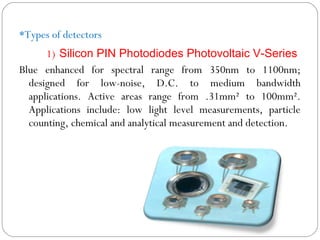
*Types of detectors
1) Silicon PIN Photodiodes Photovoltaic V-Series
Blue enhanced for spectral range from 350nm to 1100nm;
designed for low-noise, D.C. to medium bandwidth
applications. Active areas range from .31mm² to 100mm².
Applications include: low light level measurements, particle
counting, chemical and analytical measurement and detection.
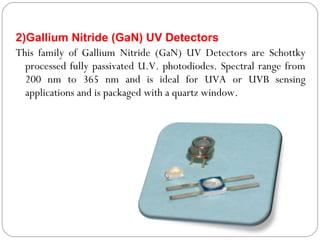
2)Gallium Nitride (GaN) UV Detectors 
This family of Gallium Nitride (GaN) UV Detectors are Schottky
processed fully passivated U.V. photodiodes. Spectral range from
200 nm to 365 nm and is ideal for UVA or UVB sensing
applications and is packaged with a quartz window.
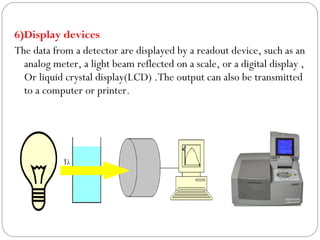
6)Display devices
The data from a detector are displayed by a readout device, such as an
analog meter, a light beam reflected on a scale, or a digital display ,
Or liquid crystal display(LCD) .The output can also be transmitted
to a computer or printer.
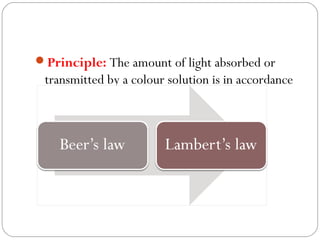
Principle: The amount of light absorbed or
transmitted by a colour solution is in accordance
with two law
Types of spectrophotometerTypes of spectrophotometer
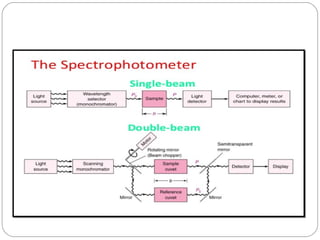
There are two classes of spectrophotometers:
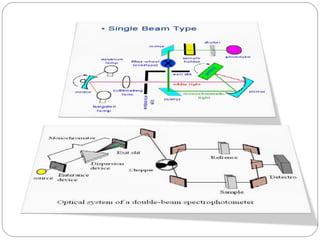
1)Single beam
The single beam spectrophotometer was the first invented, and all
the light passes through the sample. In this case, to measure the
intensity of the incident light, the sample must be removed so all
the light can pass through. This type is cheaper because there are
less parts and the system is less complicated.
The advantages of the single beam design are low cost,
high throughput, and hence high Sensitivity , because
the optical system is simple.
The disadvantage is that an appreciable amount of Time
elapses between taking the reference (I) and Making the
sample measurement (Io) so that there can be problems
with drift. This was certainly true of Early designs but
modern instruments have better electronics and more
stable lamps, so stability with single beam instruments
is now more than adequate for the vast majority of
application.
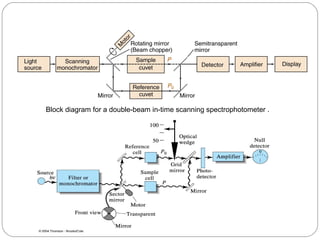
2)Double beam
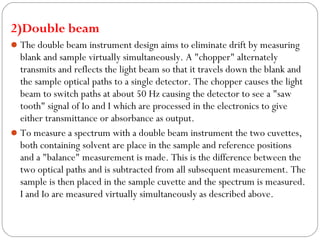
The double beam instrument design aims to eliminate drift by measuring
blank and sample virtually simultaneously. A "chopper" alternately
transmits and reflects the light beam so that it travels down the blank and
the sample optical paths to a single detector. The chopper causes the light
beam to switch paths at about 50 Hz causing the detector to see a "saw
tooth" signal of Io and I which are processed in the electronics to give
either transmittance or absorbance as output.
To measure a spectrum with a double beam instrument the two cuvettes,
both containing solvent are place in the sample and reference positions
and a "balance" measurement is made. This is the difference between the
two optical paths and is subtracted from all subsequent measurement. The
sample is then placed in the sample cuvette and the spectrum is measured.
I and Io are measured virtually simultaneously as described above.
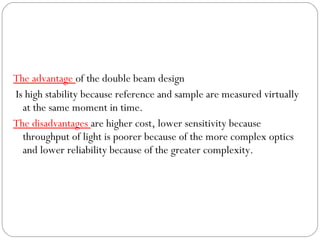
The advantage of the double beam design
Is high stability because reference and sample are measured virtually
at the same moment in time.
The disadvantages are higher cost, lower sensitivity because
throughput of light is poorer because of the more complex optics
and lower reliability because of the greater complexity.
3)Split Beam
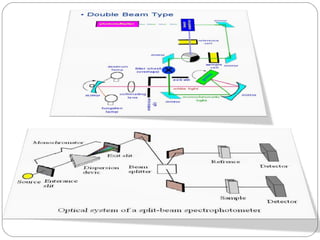
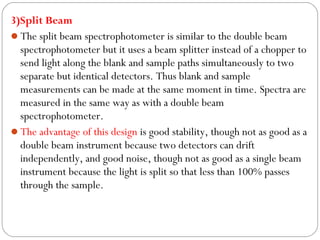
The split beam spectrophotometer is similar to the double beam
spectrophotometer but it uses a beam splitter instead of a chopper to
send light along the blank and sample paths simultaneously to two
separate but identical detectors. Thus blank and sample
measurements can be made at the same moment in time. Spectra are
measured in the same way as with a double beam
spectrophotometer.
The advantage of this design is good stability, though not as good as a
double beam instrument because two detectors can drift
independently, and good noise, though not as good as a single beam
instrument because the light is split so that less than 100% passes
through the sample.
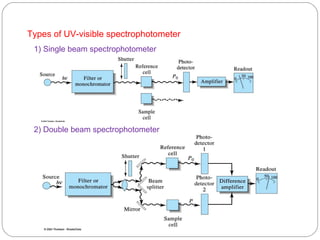
Types of UV-visible spectrophotometer
1) Single beam spectrophotometer
2) Double beam spectrophotometer
Block diagram for a double-beam in-time scanning spectrophotometer .
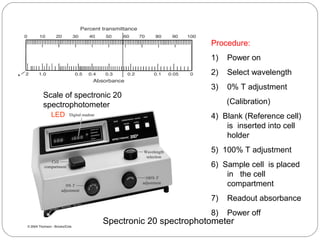
Spectronic 20 spectrophotometer
LED
Scale of spectronic 20
spectrophotometer
Procedure:
1) Power on
2) Select wavelength
3) 0% T adjustment
(Calibration)
4) Blank (Reference cell)
is inserted into cell
holder
5) 100% T adjustment
6) Sample cell is placed
in the cell
compartment
7) Readout absorbance
8) Power off
WORKING OF SPECTROPHOTOMETER
White light radiation source that passes through a MONOCHROMATOR
( prism or a diffraction grating that separates the white light into all colors of the
visible spectrum) .
After the light is separated, it passes through a FILTER (to block out unwanted
light, sometimes light of a different color) and a SLIT (to narrow the beam of
light).
 Next the beam of light passes through the SAMPLE that is in the sample holder.
(cuvette)
 The light passes through the sample and the unabsorbed portion (reflected)
strikes a PHOTODETECTOR that produces an electrical signal which is
proportional to the intensity of the light.
 The signal is then converted to A READABLE OUTPUT (absorbance )that is
used in the analysis of the sample.
 Calibration curve : generated by measuring the absorbance of several
solutions that contain known concentrations of analyte.
Applications of spectrophotometer
1. In clinical diagnosis and research laboratories:
I. these techniques are commonly used for the quantitative
estimation of different compounds in various biological
fluids. Examples: Blood glucose, urea, cholesterol,
creatinine, bilirubin and CSF protein, etc.
II. Visible and UV-spectra may be used to identify various
compounds in both pure state and in biological
preparations, e.g.proteins show a maximum light
absorption at 280nm, so we can observe a peak at 280nm
when its absorption spectra is plotted.
CONTD….
iii. Similarly nucleic acids show an absorption
maximum at 260nm. So these techniques can
be used in the structural analysis of proteins
and nucleic acids.
iv. Used in the enzyme assay and kinetic studies.
Applications
2. Detection of Impurities:
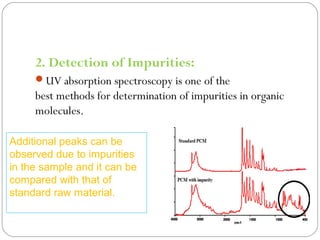
UV absorption spectroscopy is one of the
best methods for determination of impurities in organic
molecules.
44
Additional peaks can be
observed due to impurities
in the sample and it can be
compared with that of
standard raw material.
CONTD…
3. Structure elucidation of organic compounds.
From the location of peaks and combination of peaks
UV spectroscopy  elucidate structure of organic molecules:
othe presence or absence of unsaturation, 
othe presence of hetero atoms.[7]
45
CONTD...s
4. Chemical kinetics
Kinetics of reaction can also be studied using
UV spectroscopy. The UV radiation is passed through the
reaction cell and the absorbance changes can be observed.
46
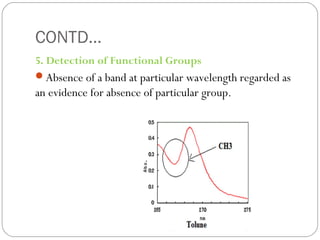
5. Detection of Functional Groups
Absence of a band at particular wavelength regarded as
an evidence for absence of particular group.
47
CONTD…
CONTD…ions
6. Molecular weight determination
Molecular weights of compounds can be measured
spectrophotometrically by preparing the suitable
derivatives of these compounds.
For example, if we want to determine the molecular
weight of amine then it is converted in to amine picrate.
48
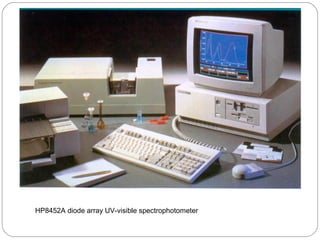
HP8452A diode array UV-visible spectrophotometer
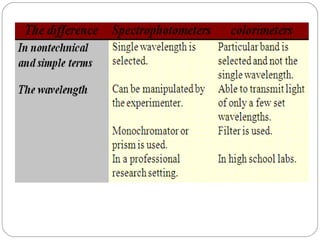
Spectrophotometers vs. colorimeters
Understanding the types of instruments available for measuring
color is important when choosing the instrument to purchase or
use for your application . The "colorimeter" and
"spectrophotometer" cause some confusion . both types of
instruments provide data obtained over the same range of visible
wavelengths (about400-700nm) but may treat this data
differently.
Spectrophotometers and colorimeters are instruments that
measure color intensities of solutions by applying a light source to
the solution.
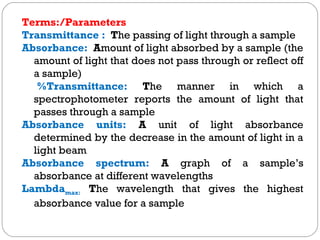
Terms:/Parameters
Transmittance : The passing of light through a sample
Absorbance: Amount of light absorbed by a sample (the
amount of light that does not pass through or reflect off
a sample)
%Transmittance: The manner in which a
spectrophotometer reports the amount of light that
passes through a sample
Absorbance units: A unit of light absorbance
determined by the decrease in the amount of light in a
light beam
Absorbance spectrum: A graph of a sample’s
absorbance at different wavelengths
Lambdamax: The wavelength that gives the highest
absorbance value for a sample
Spetrophotometer

Spetrophotometer

  • 1.
  • 3.
    DefinitionDefinition A spectrophotometer isan instrument that measures the amount of light absorbed by a sample. Spectrophotometer techniques are used to measure the concentration of solutes in solution by measuring the amount of the light that is absorbed by the solution in a cuvette placed in the spectrophotometer .
  • 4.
    The spectrophotometer techniqueis to measures light intensity as a function of wavelength. It does this by diffracting the light beam into a spectrum of wavelengths, detecting the intensities with a charge-coupled device, and displaying the results as a graph on the detector and then the display device .
  • 5.
    Introduction The spectrophotometer techniqueis to measures light intensity as a function of wavelength. It does this by: 1. diffracting the light beam into a spectrum of wavelengths 2. direct it to an object 3. receiving the light reflected or returned from the object 4. detecting the intensities with a charge-coupled device 5. displaying the results as a graph on the detector and then the display device
  • 6.
  • 7.
  • 8.
    1)Light source: The functionof the light source is to provide a sufficient of light which is suitable for marking a measurement. The light source typically yields a high output of polychromatic light over a wide range of the spectrum.
  • 9.
    I) Tungsten Lamp: TungstenHalogen Lamp, it is the most common light source used in spectrophotometer. This lamp consists of a tungsten filament enclosed in a glass envelope, with a wavelength range of about 330 to 900 nm, are used for the visible region. They are generally useful for measuring moderately dilute solutions in which the change in color intensity varies significantly with changes in concentration . It has long life about 1200h.
  • 10.
    II) Hydrogen /Deuterium Lamps: For the ultraviolet region, hydrogen or deuterium lamps are frequently used. Their range is approximately 200 to 450 nm. Deuterium lamps are generally more stable and has long life about 500h.This lamp generates continuous or discontinuous spectral.
  • 11.
    III) Xenon flashlamps: Xenon flash lamps have several advantages as the following : 1)Their range between ( 190nm - 1000 nm) 2) Emit both UV and visible wavelengths 3) Long life 4) Do not heat up the instrument 5) Reduce warm up time
  • 12.
    2) Dispersion devices *Monochromator Acceptspolychromatic input light from a lamp and outputs monochromatic light. Monochromator consists of following parts: I. Entrance slit II.Collimating lens or mirror III.Dispersion element IV.Focusing lens or mirror V.Exit slit
  • 13.
  • 14.
    Dispersion devices : Dispersiondevices causes a different wavelength of light to be dispersion at different angles monochromators used for function. *Types of dispersion devices : 1)Prism Prism is used to isolate different wavelength .If a parallel beam of radiation falls on a prism , the radiation of two different wavelength will be bent through different angles. Prism may be made of glass or quartz. The glass prisms are suitable for radiation essentially in the visible range whereas the quartz prism can cover the ultraviolet spectrum also. Note: It is found that the dispersion given by glass is about three times that of quartz.
  • 15.
    2)Filter Filters separate differentparts of the electromagnetic spectrum by absorbing or reflecting certain wavelengths and transmitting other wavelengths. *Absorption filters are glass substrates containing absorbing species that absorb certain wavelength. A typical example is a cut on color filter, which blocks short wavelength light such as an excitation source, and transmits longer wavelength light such as fluorescence that reaches a detector. *Interference filters are made of multiple dielectric thin films on a substrate. They use interference to selectively transmit or reflect a certain range of wavelengths. A typical example is a Bandpass interference filter that transmits a narrow range of wavelengths, and can isolate a single emission line from a discharge lamp.
  • 17.
    3) Diffraction gratings Diffractiongrating is an optical component with a regular pattern, which splits (diffracts) light into several beams travelling in different directions. The directions of these beams depend on the spacing of the grating and the wavelength of the light so that the grating acts as a dispersive element. The diffraction grating disperses the light into a linear spectrum of its component wavelengths, which is then directed, in whole or in part along the light path of the instrument.
  • 19.
    3)Focusing devices Combinations oflenses, slits, and mirrors. Variable slits also permit adjustments in the total radiant energy reaching the detector. The Ebert and Czerny-Turner monochromators and their variations are combinations of prisms or gratings and focusing devices . Ebert and Czerny-Turner Monochromator
  • 20.
    *Optical Materials 1)Mirrors Type ofrays Mirror material X-rays – Ultraviolet(UV) Aluminum  Visible Aluminum Near infrared Gold Infrared (IR) Copper or Gold
  • 21.
    2)Lenses Rays Material X-rays UltravioletFused silica , Sapphire Visible Glass Infrared Glass
  • 22.
    4)Absorption cells(Cuvettes A cuvetteis a kind of cell (usually a small square tube) sealed at one end, made of Plastic, glass or optical grade quartz and designed to hold samples for spectroscopic experiments. Cuvette should be as clear as possible, without impurities that might affect a spectroscopic reading. Like a test-tube, a cuvette may be open to the atmosphere on top or have a glass or Teflon cap to seal it shut.
  • 23.
    Cuvettes are chosenfor transparency in the spectral wavelengths of interest. For measurements in the visible region, cuvettes of optical glass are sufficient; however, optical glass absorbs light below 350 nm , and more expensive quartz or fused silica must be used for these wavelengths. The sample cuvettes are placed in a darkened analysis chamber; some chambers have rotating carousels that can hold several cuvettes.
  • 24.
    5)Detectors Any photosensitive devicecan be used as a detector of radiant energy. The photocell and phototube are the simplest photodetectors, producing current proportional to the intensity of the light striking them .
  • 25.
    *Types of detectors 1)Silicon PIN Photodiodes Photovoltaic V-Series Blue enhanced for spectral range from 350nm to 1100nm; designed for low-noise, D.C. to medium bandwidth applications. Active areas range from .31mm² to 100mm². Applications include: low light level measurements, particle counting, chemical and analytical measurement and detection.
  • 26.
    2)Gallium Nitride (GaN)UV Detectors  This family of Gallium Nitride (GaN) UV Detectors are Schottky processed fully passivated U.V. photodiodes. Spectral range from 200 nm to 365 nm and is ideal for UVA or UVB sensing applications and is packaged with a quartz window.
  • 27.
    6)Display devices The datafrom a detector are displayed by a readout device, such as an analog meter, a light beam reflected on a scale, or a digital display , Or liquid crystal display(LCD) .The output can also be transmitted to a computer or printer.
  • 29.
    Principle: The amountof light absorbed or transmitted by a colour solution is in accordance with two law
  • 30.
    Types of spectrophotometerTypesof spectrophotometer There are two classes of spectrophotometers: 1)Single beam The single beam spectrophotometer was the first invented, and all the light passes through the sample. In this case, to measure the intensity of the incident light, the sample must be removed so all the light can pass through. This type is cheaper because there are less parts and the system is less complicated.
  • 31.
    The advantages ofthe single beam design are low cost, high throughput, and hence high Sensitivity , because the optical system is simple. The disadvantage is that an appreciable amount of Time elapses between taking the reference (I) and Making the sample measurement (Io) so that there can be problems with drift. This was certainly true of Early designs but modern instruments have better electronics and more stable lamps, so stability with single beam instruments is now more than adequate for the vast majority of application.
  • 33.
    2)Double beam The doublebeam instrument design aims to eliminate drift by measuring blank and sample virtually simultaneously. A "chopper" alternately transmits and reflects the light beam so that it travels down the blank and the sample optical paths to a single detector. The chopper causes the light beam to switch paths at about 50 Hz causing the detector to see a "saw tooth" signal of Io and I which are processed in the electronics to give either transmittance or absorbance as output. To measure a spectrum with a double beam instrument the two cuvettes, both containing solvent are place in the sample and reference positions and a "balance" measurement is made. This is the difference between the two optical paths and is subtracted from all subsequent measurement. The sample is then placed in the sample cuvette and the spectrum is measured. I and Io are measured virtually simultaneously as described above.
  • 34.
    The advantage ofthe double beam design Is high stability because reference and sample are measured virtually at the same moment in time. The disadvantages are higher cost, lower sensitivity because throughput of light is poorer because of the more complex optics and lower reliability because of the greater complexity.
  • 36.
    3)Split Beam The splitbeam spectrophotometer is similar to the double beam spectrophotometer but it uses a beam splitter instead of a chopper to send light along the blank and sample paths simultaneously to two separate but identical detectors. Thus blank and sample measurements can be made at the same moment in time. Spectra are measured in the same way as with a double beam spectrophotometer. The advantage of this design is good stability, though not as good as a double beam instrument because two detectors can drift independently, and good noise, though not as good as a single beam instrument because the light is split so that less than 100% passes through the sample.
  • 38.
    Types of UV-visiblespectrophotometer 1) Single beam spectrophotometer 2) Double beam spectrophotometer
  • 39.
    Block diagram fora double-beam in-time scanning spectrophotometer .
  • 40.
    Spectronic 20 spectrophotometer LED Scaleof spectronic 20 spectrophotometer Procedure: 1) Power on 2) Select wavelength 3) 0% T adjustment (Calibration) 4) Blank (Reference cell) is inserted into cell holder 5) 100% T adjustment 6) Sample cell is placed in the cell compartment 7) Readout absorbance 8) Power off
  • 41.
    WORKING OF SPECTROPHOTOMETER Whitelight radiation source that passes through a MONOCHROMATOR ( prism or a diffraction grating that separates the white light into all colors of the visible spectrum) . After the light is separated, it passes through a FILTER (to block out unwanted light, sometimes light of a different color) and a SLIT (to narrow the beam of light).  Next the beam of light passes through the SAMPLE that is in the sample holder. (cuvette)  The light passes through the sample and the unabsorbed portion (reflected) strikes a PHOTODETECTOR that produces an electrical signal which is proportional to the intensity of the light.  The signal is then converted to A READABLE OUTPUT (absorbance )that is used in the analysis of the sample.  Calibration curve : generated by measuring the absorbance of several solutions that contain known concentrations of analyte.
  • 42.
    Applications of spectrophotometer 1.In clinical diagnosis and research laboratories: I. these techniques are commonly used for the quantitative estimation of different compounds in various biological fluids. Examples: Blood glucose, urea, cholesterol, creatinine, bilirubin and CSF protein, etc. II. Visible and UV-spectra may be used to identify various compounds in both pure state and in biological preparations, e.g.proteins show a maximum light absorption at 280nm, so we can observe a peak at 280nm when its absorption spectra is plotted.
  • 43.
    CONTD…. iii. Similarly nucleicacids show an absorption maximum at 260nm. So these techniques can be used in the structural analysis of proteins and nucleic acids. iv. Used in the enzyme assay and kinetic studies.
  • 44.
    Applications 2. Detection ofImpurities: UV absorption spectroscopy is one of the best methods for determination of impurities in organic molecules. 44 Additional peaks can be observed due to impurities in the sample and it can be compared with that of standard raw material.
  • 45.
    CONTD… 3. Structure elucidationof organic compounds. From the location of peaks and combination of peaks UV spectroscopy  elucidate structure of organic molecules: othe presence or absence of unsaturation,  othe presence of hetero atoms.[7] 45
  • 46.
    CONTD...s 4. Chemical kinetics Kinetics ofreaction can also be studied using UV spectroscopy. The UV radiation is passed through the reaction cell and the absorbance changes can be observed. 46
  • 47.
    5. Detection ofFunctional Groups Absence of a band at particular wavelength regarded as an evidence for absence of particular group. 47 CONTD…
  • 48.
    CONTD…ions 6. Molecular weight determination Molecularweights of compounds can be measured spectrophotometrically by preparing the suitable derivatives of these compounds. For example, if we want to determine the molecular weight of amine then it is converted in to amine picrate. 48
  • 49.
    HP8452A diode arrayUV-visible spectrophotometer
  • 50.
    Spectrophotometers vs. colorimeters Understandingthe types of instruments available for measuring color is important when choosing the instrument to purchase or use for your application . The "colorimeter" and "spectrophotometer" cause some confusion . both types of instruments provide data obtained over the same range of visible wavelengths (about400-700nm) but may treat this data differently. Spectrophotometers and colorimeters are instruments that measure color intensities of solutions by applying a light source to the solution.
  • 52.
    Terms:/Parameters Transmittance : Thepassing of light through a sample Absorbance: Amount of light absorbed by a sample (the amount of light that does not pass through or reflect off a sample) %Transmittance: The manner in which a spectrophotometer reports the amount of light that passes through a sample Absorbance units: A unit of light absorbance determined by the decrease in the amount of light in a light beam Absorbance spectrum: A graph of a sample’s absorbance at different wavelengths Lambdamax: The wavelength that gives the highest absorbance value for a sample