Spectroscopy
• It is the branch of science that deals with the study
of interaction of electromagnetic radiation with
matter.
Dr. Siju N Antony
Electromagnetic Radiation
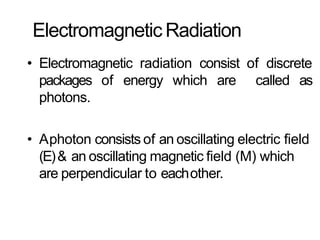
• Electromagnetic radiation consist of discrete
packages of energy which are called as
photons.
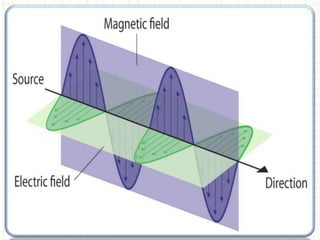
• Aphoton consists of an oscillating electric field
(E)& an oscillating magnetic field (M) which
are perpendicular to eachother.
Electromagnetic Radiation
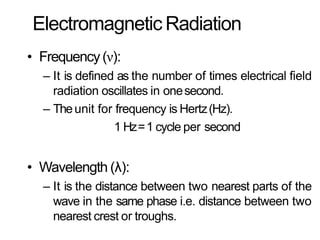
• Frequency(ν):
– It is defined as the number of times electrical field
radiation oscillates in onesecond.
– Theunit for frequency is Hertz(Hz).
1 Hz=1 cycle per second
• Wavelength (λ):
– It is the distance between two nearest parts of the
wave in the same phase i.e. distance between two
nearest crest or troughs.
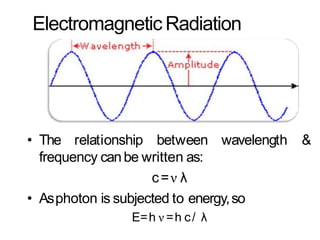
Electromagnetic Radiation
• The relationship between wavelength &
frequency canbe written as:
c=ν λ
• Asphoton is subjected to energy,so
E=h ν =h c/ λ
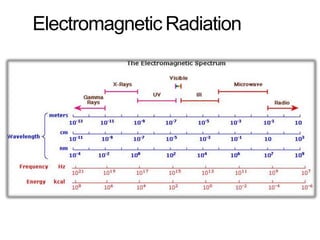
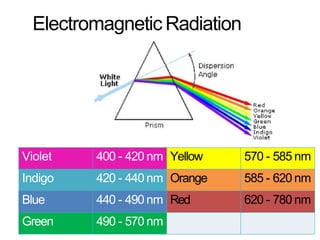
Electromagnetic Radiation
Violet 400 - 420 nm Yellow 570 - 585 nm
Indigo 420 - 440 nm Orange 585 - 620 nm
Blue 440 - 490 nm Red 620 - 780 nm
Green 490 - 570 nm
Principles of Spectroscopy
• The principle is based on the measurement of
spectrum of a sample containing atoms /
molecules.
• Spectrum is a graph of intensity of absorbed or
emitted radiation by sample verses frequency
(ν) or wavelength(λ).
• Spectrometer is an instrument design to
measure the spectrum of acompound.
Principles of Spectroscopy
1. Absorption Spectroscopy:
• An analytical technique which concerns with
the measurement of absorption of
electromagnetic radiation.
• e.g. UV (185 - 400 nm) / Visible (400 - 800 nm)
Spectroscopy, IRSpectroscopy (0.76 - 15μm)
Principles of Spectroscopy
2. Emission Spectroscopy:
• An analytical technique in which emission
(of a particle or radiation) is dispersed
according to some property of the emission
& the amount ofdispersion is measured.
• e.g. MassSpectroscopy
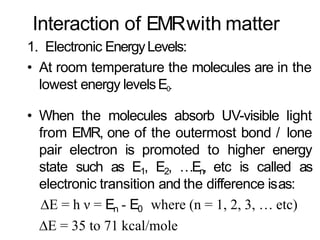
Interaction of EMRwith matter
1. Electronic EnergyLevels:
• At room temperature the molecules are in the
lowest energy levelsE0.
• When the molecules absorb UV-visible light
from EMR, one of the outermost bond / lone
pair electron is promoted to higher energy
state such as E1, E2, …En, etc is called as
electronic transition and the difference isas:
∆E = h ν = En - E0 where (n = 1, 2, 3, … etc)
∆E = 35 to 71 kcal/mole
Interaction of EMRwith matter
2. Vibrational EnergyLevels:
• These are of less energy than electronic
energy levels.
• The spacing between energy levels are
relatively small i.e. 0.01 to 10kcal/mole.
• e.g. when IR radiation is absorbed, molecules
are excited from one vibrational level to
another or it vibrates with higher amplitude.
Interaction of EMRwith matter
3. Rotational EnergyLevels:
• Theseenergy levels are quantized & discrete.
• The spacing between energy levels are even
smaller than vibrational energylevels.
∆Erotational < ∆Evibrational <∆Eelectronic
Lambert’s
Law
Lambert’s Law
• When a monochromatic radiation is passed
through a solution, the decrease in the
intensity of radiation with thickness of the
solution is directly proportional to the
intensity of the incidentlight.
• Let I be the intensity of incident radiation.
xbe the thickness of thesolution.
Then
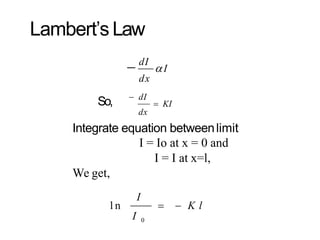
Lambert’s Law
 dI
I
dx
So,  KI
 dI
dx
Integrate equation betweenlimit
I = Io at x = 0 and
I = I at x=l,
We get,
I
I 0
l n   K l
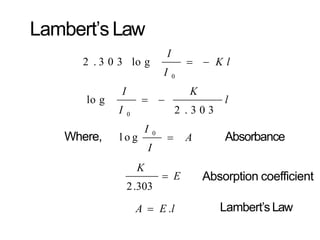
Lambert’s Law
I
  K l
I 0
2 . 3 0 3 lo g
l
KI
2 . 3 0 3
lo g
I 0
 
Absorbance
I
 A
I 0
Where, l o g
K
 E
2.303
A  E .l
Absorption coefficient
Lambert’s Law
Beer-Lambert’s Law
• When a monochromatic radiation is passed
through a solution, the decrease in the
intensity of radiation with thickness ofthe
solution
intensity
is directly proportional
of the incident light as
to the
well as
concentration of thesolution.
• Let I be the intensity of incident radiation. x
be the thickness of thesolution. Cbe the
concentration of thesolution.
Then
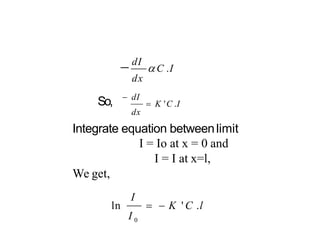
 dI
 C .I
dx
So,  K 'C .I
 dI
dx
Integrate equation betweenlimit
I = Io at x = 0 and
I = I at x=l,
We get,
I
I 0
ln   K ' C .l
I
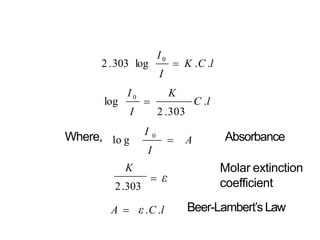
2 .303 log
I0
 K .C .l
K
I
C .l
2 .303
log
I 0

Where, Absorbance
I
 A
I 0
lo g
K
 ε
2.303
A  ε.C .l
Molar extinction
coefficient
Beer-Lambert’s Law
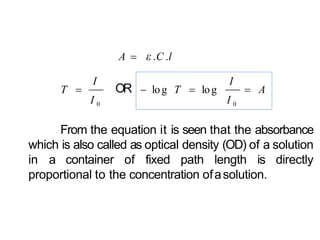
A  ε.C .l
I
T  OR
I
 A log T  log
I 0 I 0
From the equation it is seen that the absorbance
which is also called as optical density (OD) of a solution
in a container of fixed path length is directly
proportional to the concentration ofasolution.
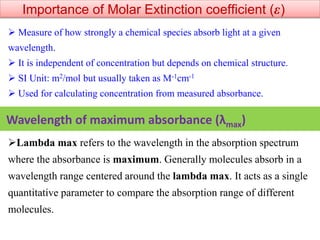
Importance of Molar Extinction coefficient (ε)
 Measure of how strongly a chemical species absorb light at a given
wavelength.
 It is independent of concentration but depends on chemical structure.
 SI Unit: m2/mol but usually taken as M-1cm-1
 Used for calculating concentration from measured absorbance.
Lambda max refers to the wavelength in the absorption spectrum
where the absorbance is maximum. Generally molecules absorb in a
wavelength range centered around the lambda max. It acts as a single
quantitative parameter to compare the absorption range of different
molecules.
Wavelength of maximum absorbance (λmax)
PRINCIPLES OF
UV - VISIBLE
SPECTROSCOPY
Principle
• The UV radiation region extends from 10 nm
to 400 nm and the visible radiation region
extends from 400 nm to 800nm.
Near UVRegion:200 nm to 400nm
FarUVRegion:below 200 nm
• Far UV spectroscopy is studied under vacuum
condition.
• The common solvent used for preparing
sample to be analyzed is either ethyl alcohol
or hexane.
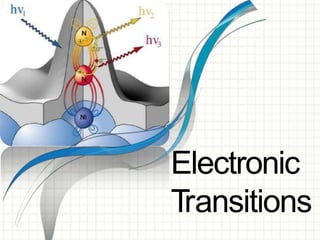
Electronic
Transitions
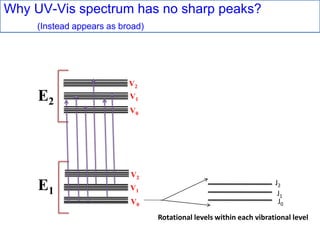
Why UV-Vis spectrum has no sharp peaks?
(Instead appears as broad)
E2
V0
V1
V2
E1
V0
V1
V2
Rotational levels within each vibrational level
J0
J1
J2
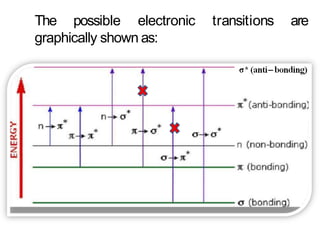
transitions areThe possible electronic
graphically shown as:
this
• σ electron from orbital is excited to
corresponding anti-bonding orbital σ*.
• The energy required is large for
transition.
• e.g. Methane (CH4) has C-H bond only and
can undergo σ → σ* transition and shows
absorbance maxima at 125nm.
• σ → σ* transition1
• π electron in a bonding orbital is excited to
corresponding anti-bonding orbital π*.
• Compounds containing multiple bonds like
alkenes, alkynes, carbonyl, nitriles, aromatic
compounds, etc undergo π→π* transitions.
• e.g. Alkenes generally absorb in the region
170 to 205nm.
• π → π* transition2
• Saturated compounds containing atoms with
lone pair of electrons like O, N, S and
halogens are capable of n →σ* transition.
• These transitions usually requires less energy
than σ→σ* transitions.
• The number of organic functional groups
with n →σ* peaksin UVregion is small (150
– 250 nm).
• n → σ* transition3
• An electron from non-bonding orbital is
promoted to anti-bonding π*orbital.
• Compounds containing double bond
involving hetero atoms (C=O, C≡N, N=O)
undergo suchtransitions.
• n → π* transitions require minimum energy
and show absorption at longer wavelength
around 300 nm.
• n → π* transition4
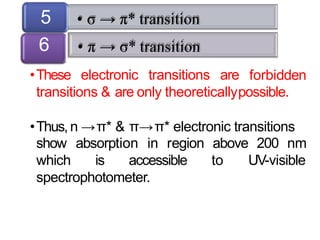
•These electronic transitions are
transitions & are only theoreticallypossible.
•Thus,n →π* & π→π* electronic transitions
show absorption in region
which is accessible
above 200 nm
to UV-visible
spectrophotometer.
• σ → π* transition
• π → σ* transition 6
forbidden
5
6
Termsused
in
UV/ Visible
Spectroscopy
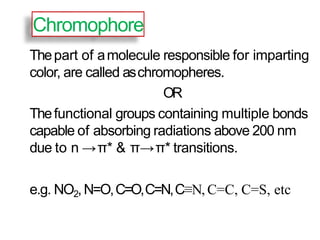
Chromophore
Thepart of amolecule responsible for imparting
color, are called aschromopheres.
OR
Thefunctional groups containing multiple bonds
capable of absorbing radiations above 200 nm
due to n →π* & π→π* transitions.
e.g. NO2,N=O,C=O,C=N,C≡N, C=C, C=S, etc
Chromophore
To interpret UV– visible spectrum following
points should benoted:
1. Non-conjugated alkenes show an intense
absorption below 200 nm & are therefore
inaccessible to UVspectrophotometer.
2. Non-conjugated carbonyl group compound
give a weak absorption band in the 200 - 300
nm region.
Chromophore
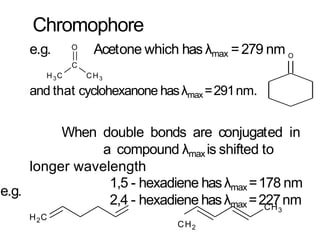
e.g.
C
H3C CH3
and that cyclohexanone hasλmax =291nm.
When double bonds are conjugated in
a compound λmax is shifted to
longer wavelength
O
e.g. Acetone which has λmax =279 nm O
H2C
1,5 - hexadiene hasλmax =178 nm
2,4 - hexadiene hasλmax =227nm
CH2
CH3
Chromophore
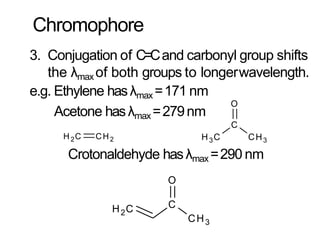
3. Conjugation of C=Cand carbonyl group shifts
the λmax of both groups to longerwavelength.
e.g. Ethylene hasλmax =171 nm
Acetone hasλmax =279nm
C
H3C CH3
O
H 2C CH2
C
CH3
Crotonaldehyde hasλmax =290 nm
O
H2C
The functional groups attached to a
chromophore which modifies the ability of the
chromophore to absorb light , altering the
wavelength or intensity ofabsorption.
OR
Thefunctional group with non-bondingelectrons
that does not absorb radiation in near UVregion
but when attached to achromophore alters the
wavelength & intensity ofabsorption.
Auxochrome
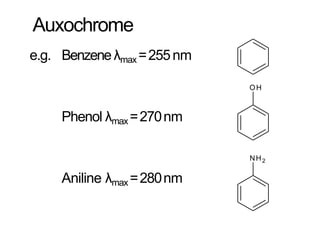
e.g. Benzeneλmax =255nm
Phenol λmax =270nm
Aniline λmax =280nm
OH
NH2
Absorption
& Intensity
Shifts
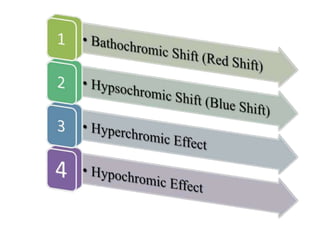
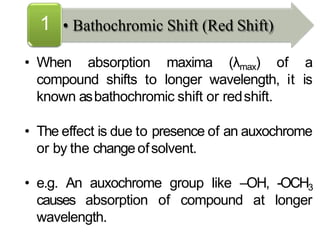
• When absorption maxima (λmax) of a
compound shifts to longer wavelength, it is
known asbathochromic shift or redshift.
• The effect is due to presence of an auxochrome
or by the changeofsolvent.
• e.g. An auxochrome group like –OH, -OCH3
causes absorption of compound at longer
wavelength.
• Bathochromic Shift (Red Shift)1
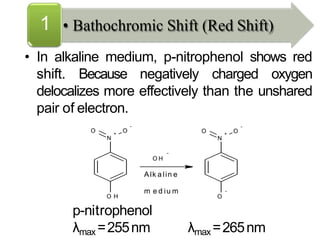
• In alkaline medium, p-nitrophenol shows red
shift. Because negatively charged oxygen
delocalizes more effectively than the unshared
pair of electron.
p-nitrophenol
λmax =255nm λmax =265nm
• Bathochromic Shift (Red Shift)1
O H
N
+
O O
-
O H
Alk a lin e
m e d iu m -
O
N
+
- -
O O
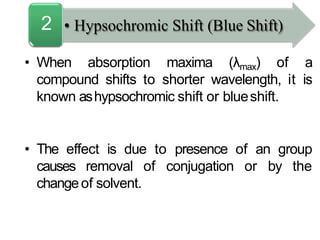
• When absorption maxima (λmax) of a
compound shifts to shorter wavelength, it is
known ashypsochromic shift or blueshift.
• The effect is due to presence of an group
causes removal of conjugation or by the
changeof solvent.
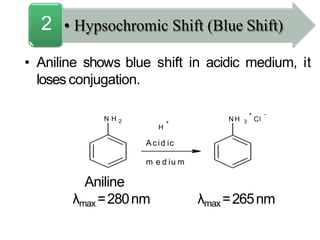
• Hypsochromic Shift (Blue Shift)2
• Aniline shows blue shift in acidic medium, it
loses conjugation.
Aniline
λmax =280nm λmax =265nm
• Hypsochromic Shift (Blue Shift)2
N H 2 +
H
A cid ic
m e d iu m
+
N H 3 Cl
-
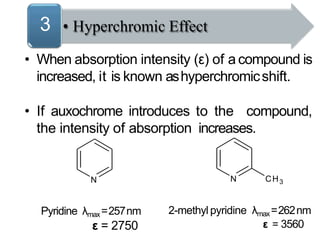
• When absorption intensity (ε) of a compound is
increased, it is known ashyperchromicshift.
• If auxochrome introduces to the compound,
the intensity of absorption increases.
Pyridine λmax=257nm
ε = 2750
2-methyl pyridine λmax=262nm
ε = 3560
• Hyperchromic Effect3
N N CH3
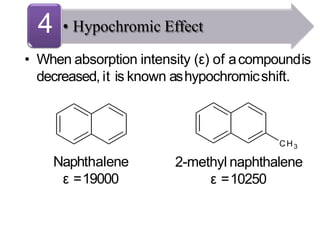
• When absorption intensity (ε) of acompoundis
decreased, it is known ashypochromicshift.
Naphthalene
ε =19000
CH3
2-methyl naphthalene
ε =10250
• Hypochromic Effect4
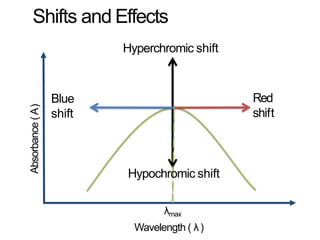
Absorbance(A)
Shifts and Effects
Hyperchromic shift
Red
shift
Blue
shift
Hypochromic shift
λmax
Wavelength ( λ)
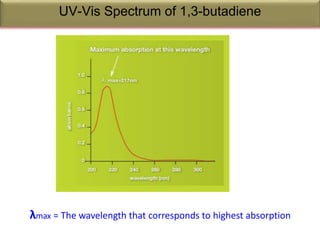
UV-Vis Spectrum of 1,3-butadiene
λmax = The wavelength that corresponds to highest absorption
APPLICATIONS OF
UV / VISIBLE
SPECTROSCOPY
1. Absence of certain groups- If the spectrum of a compound comes out to be transparent
above 200 nm than it confirms the absence of –
a) Conjugation b) A carbonyl group c) Benzene or aromatic compound d) Bromo or iodo
atoms.
2. Detection of extent of conjugation- If the double bond is increased by 8 in the polyenes
then that polyene appears visible to the human eye as the absorption comes in the visible
region.
3. Identification of an unknown compound- The spectrum of unknown compound is
compared with the spectrum of a reference compound and if both the spectrums coincide
then it confirms the identification of the unknown substance.
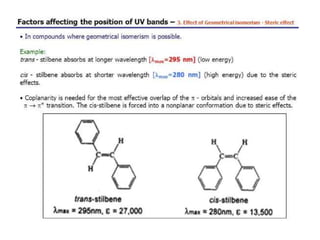
4. Determination of configurations of geometrical isomers- The two isomers can be
distinguished with each other when one of the isomers has non-coplanar structure due to
steric hindrances. The cis-isomer suffers distortion and absorbs at lower wavelength as
compared to trans-isomer.
5. Determination of the purity of a substance- The absorption of the sample solution is
compared with the absorption of the reference solution. The intensity of the absorption
can be used for the relative calculation of the purity of the sample substance.
6. Determination of molecular weight using Beer Lambert’s law
ReferenceBooks
• Introduction to Spectroscopy
– DonaldA. Pavia
• Elementary OrganicSpectroscopy
– Y.R.Sharma
• PhysicalChemistry
– Puri, Sharma& Pathaniya

Uv vis spectroscopy for ktu students

  • 1.
    Spectroscopy • It isthe branch of science that deals with the study of interaction of electromagnetic radiation with matter. Dr. Siju N Antony
  • 2.
    Electromagnetic Radiation • Electromagneticradiation consist of discrete packages of energy which are called as photons. • Aphoton consists of an oscillating electric field (E)& an oscillating magnetic field (M) which are perpendicular to eachother.
  • 4.
    Electromagnetic Radiation • Frequency(ν): –It is defined as the number of times electrical field radiation oscillates in onesecond. – Theunit for frequency is Hertz(Hz). 1 Hz=1 cycle per second • Wavelength (λ): – It is the distance between two nearest parts of the wave in the same phase i.e. distance between two nearest crest or troughs.
  • 5.
    Electromagnetic Radiation • Therelationship between wavelength & frequency canbe written as: c=ν λ • Asphoton is subjected to energy,so E=h ν =h c/ λ
  • 6.
  • 7.
    Electromagnetic Radiation Violet 400- 420 nm Yellow 570 - 585 nm Indigo 420 - 440 nm Orange 585 - 620 nm Blue 440 - 490 nm Red 620 - 780 nm Green 490 - 570 nm
  • 8.
    Principles of Spectroscopy •The principle is based on the measurement of spectrum of a sample containing atoms / molecules. • Spectrum is a graph of intensity of absorbed or emitted radiation by sample verses frequency (ν) or wavelength(λ). • Spectrometer is an instrument design to measure the spectrum of acompound.
  • 9.
    Principles of Spectroscopy 1.Absorption Spectroscopy: • An analytical technique which concerns with the measurement of absorption of electromagnetic radiation. • e.g. UV (185 - 400 nm) / Visible (400 - 800 nm) Spectroscopy, IRSpectroscopy (0.76 - 15μm)
  • 10.
    Principles of Spectroscopy 2.Emission Spectroscopy: • An analytical technique in which emission (of a particle or radiation) is dispersed according to some property of the emission & the amount ofdispersion is measured. • e.g. MassSpectroscopy
  • 11.
    Interaction of EMRwithmatter 1. Electronic EnergyLevels: • At room temperature the molecules are in the lowest energy levelsE0. • When the molecules absorb UV-visible light from EMR, one of the outermost bond / lone pair electron is promoted to higher energy state such as E1, E2, …En, etc is called as electronic transition and the difference isas: ∆E = h ν = En - E0 where (n = 1, 2, 3, … etc) ∆E = 35 to 71 kcal/mole
  • 12.
    Interaction of EMRwithmatter 2. Vibrational EnergyLevels: • These are of less energy than electronic energy levels. • The spacing between energy levels are relatively small i.e. 0.01 to 10kcal/mole. • e.g. when IR radiation is absorbed, molecules are excited from one vibrational level to another or it vibrates with higher amplitude.
  • 13.
    Interaction of EMRwithmatter 3. Rotational EnergyLevels: • Theseenergy levels are quantized & discrete. • The spacing between energy levels are even smaller than vibrational energylevels. ∆Erotational < ∆Evibrational <∆Eelectronic
  • 14.
  • 15.
    Lambert’s Law • Whena monochromatic radiation is passed through a solution, the decrease in the intensity of radiation with thickness of the solution is directly proportional to the intensity of the incidentlight. • Let I be the intensity of incident radiation. xbe the thickness of thesolution. Then
  • 16.
    Lambert’s Law  dI I dx So, KI  dI dx Integrate equation betweenlimit I = Io at x = 0 and I = I at x=l, We get, I I 0 l n   K l
  • 17.
    Lambert’s Law I  K l I 0 2 . 3 0 3 lo g l KI 2 . 3 0 3 lo g I 0   Absorbance I  A I 0 Where, l o g K  E 2.303 A  E .l Absorption coefficient Lambert’s Law
  • 18.
    Beer-Lambert’s Law • Whena monochromatic radiation is passed through a solution, the decrease in the intensity of radiation with thickness ofthe solution intensity is directly proportional of the incident light as to the well as concentration of thesolution. • Let I be the intensity of incident radiation. x be the thickness of thesolution. Cbe the concentration of thesolution. Then
  • 19.
     dI  C.I dx So,  K 'C .I  dI dx Integrate equation betweenlimit I = Io at x = 0 and I = I at x=l, We get, I I 0 ln   K ' C .l
  • 20.
    I 2 .303 log I0 K .C .l K I C .l 2 .303 log I 0  Where, Absorbance I  A I 0 lo g K  ε 2.303 A  ε.C .l Molar extinction coefficient Beer-Lambert’s Law
  • 21.
    A  ε.C.l I T  OR I  A log T  log I 0 I 0 From the equation it is seen that the absorbance which is also called as optical density (OD) of a solution in a container of fixed path length is directly proportional to the concentration ofasolution.
  • 22.
    Importance of MolarExtinction coefficient (ε)  Measure of how strongly a chemical species absorb light at a given wavelength.  It is independent of concentration but depends on chemical structure.  SI Unit: m2/mol but usually taken as M-1cm-1  Used for calculating concentration from measured absorbance. Lambda max refers to the wavelength in the absorption spectrum where the absorbance is maximum. Generally molecules absorb in a wavelength range centered around the lambda max. It acts as a single quantitative parameter to compare the absorption range of different molecules. Wavelength of maximum absorbance (λmax)
  • 23.
    PRINCIPLES OF UV -VISIBLE SPECTROSCOPY
  • 24.
    Principle • The UVradiation region extends from 10 nm to 400 nm and the visible radiation region extends from 400 nm to 800nm. Near UVRegion:200 nm to 400nm FarUVRegion:below 200 nm • Far UV spectroscopy is studied under vacuum condition. • The common solvent used for preparing sample to be analyzed is either ethyl alcohol or hexane.
  • 25.
  • 26.
    Why UV-Vis spectrumhas no sharp peaks? (Instead appears as broad) E2 V0 V1 V2 E1 V0 V1 V2 Rotational levels within each vibrational level J0 J1 J2
  • 27.
    transitions areThe possibleelectronic graphically shown as:
  • 28.
    this • σ electronfrom orbital is excited to corresponding anti-bonding orbital σ*. • The energy required is large for transition. • e.g. Methane (CH4) has C-H bond only and can undergo σ → σ* transition and shows absorbance maxima at 125nm. • σ → σ* transition1
  • 29.
    • π electronin a bonding orbital is excited to corresponding anti-bonding orbital π*. • Compounds containing multiple bonds like alkenes, alkynes, carbonyl, nitriles, aromatic compounds, etc undergo π→π* transitions. • e.g. Alkenes generally absorb in the region 170 to 205nm. • π → π* transition2
  • 30.
    • Saturated compoundscontaining atoms with lone pair of electrons like O, N, S and halogens are capable of n →σ* transition. • These transitions usually requires less energy than σ→σ* transitions. • The number of organic functional groups with n →σ* peaksin UVregion is small (150 – 250 nm). • n → σ* transition3
  • 31.
    • An electronfrom non-bonding orbital is promoted to anti-bonding π*orbital. • Compounds containing double bond involving hetero atoms (C=O, C≡N, N=O) undergo suchtransitions. • n → π* transitions require minimum energy and show absorption at longer wavelength around 300 nm. • n → π* transition4
  • 32.
    •These electronic transitionsare transitions & are only theoreticallypossible. •Thus,n →π* & π→π* electronic transitions show absorption in region which is accessible above 200 nm to UV-visible spectrophotometer. • σ → π* transition • π → σ* transition 6 forbidden 5 6
  • 33.
  • 34.
    Chromophore Thepart of amoleculeresponsible for imparting color, are called aschromopheres. OR Thefunctional groups containing multiple bonds capable of absorbing radiations above 200 nm due to n →π* & π→π* transitions. e.g. NO2,N=O,C=O,C=N,C≡N, C=C, C=S, etc
  • 35.
    Chromophore To interpret UV–visible spectrum following points should benoted: 1. Non-conjugated alkenes show an intense absorption below 200 nm & are therefore inaccessible to UVspectrophotometer. 2. Non-conjugated carbonyl group compound give a weak absorption band in the 200 - 300 nm region.
  • 36.
    Chromophore e.g. C H3C CH3 and thatcyclohexanone hasλmax =291nm. When double bonds are conjugated in a compound λmax is shifted to longer wavelength O e.g. Acetone which has λmax =279 nm O H2C 1,5 - hexadiene hasλmax =178 nm 2,4 - hexadiene hasλmax =227nm CH2 CH3
  • 37.
    Chromophore 3. Conjugation ofC=Cand carbonyl group shifts the λmax of both groups to longerwavelength. e.g. Ethylene hasλmax =171 nm Acetone hasλmax =279nm C H3C CH3 O H 2C CH2 C CH3 Crotonaldehyde hasλmax =290 nm O H2C
  • 38.
    The functional groupsattached to a chromophore which modifies the ability of the chromophore to absorb light , altering the wavelength or intensity ofabsorption. OR Thefunctional group with non-bondingelectrons that does not absorb radiation in near UVregion but when attached to achromophore alters the wavelength & intensity ofabsorption.
  • 39.
    Auxochrome e.g. Benzeneλmax =255nm Phenolλmax =270nm Aniline λmax =280nm OH NH2
  • 40.
  • 42.
    • When absorptionmaxima (λmax) of a compound shifts to longer wavelength, it is known asbathochromic shift or redshift. • The effect is due to presence of an auxochrome or by the changeofsolvent. • e.g. An auxochrome group like –OH, -OCH3 causes absorption of compound at longer wavelength. • Bathochromic Shift (Red Shift)1
  • 43.
    • In alkalinemedium, p-nitrophenol shows red shift. Because negatively charged oxygen delocalizes more effectively than the unshared pair of electron. p-nitrophenol λmax =255nm λmax =265nm • Bathochromic Shift (Red Shift)1 O H N + O O - O H Alk a lin e m e d iu m - O N + - - O O
  • 44.
    • When absorptionmaxima (λmax) of a compound shifts to shorter wavelength, it is known ashypsochromic shift or blueshift. • The effect is due to presence of an group causes removal of conjugation or by the changeof solvent. • Hypsochromic Shift (Blue Shift)2
  • 45.
    • Aniline showsblue shift in acidic medium, it loses conjugation. Aniline λmax =280nm λmax =265nm • Hypsochromic Shift (Blue Shift)2 N H 2 + H A cid ic m e d iu m + N H 3 Cl -
  • 46.
    • When absorptionintensity (ε) of a compound is increased, it is known ashyperchromicshift. • If auxochrome introduces to the compound, the intensity of absorption increases. Pyridine λmax=257nm ε = 2750 2-methyl pyridine λmax=262nm ε = 3560 • Hyperchromic Effect3 N N CH3
  • 47.
    • When absorptionintensity (ε) of acompoundis decreased, it is known ashypochromicshift. Naphthalene ε =19000 CH3 2-methyl naphthalene ε =10250 • Hypochromic Effect4
  • 48.
    Absorbance(A) Shifts and Effects Hyperchromicshift Red shift Blue shift Hypochromic shift λmax Wavelength ( λ)
  • 49.
    UV-Vis Spectrum of1,3-butadiene λmax = The wavelength that corresponds to highest absorption
  • 50.
    APPLICATIONS OF UV /VISIBLE SPECTROSCOPY
  • 51.
    1. Absence ofcertain groups- If the spectrum of a compound comes out to be transparent above 200 nm than it confirms the absence of – a) Conjugation b) A carbonyl group c) Benzene or aromatic compound d) Bromo or iodo atoms. 2. Detection of extent of conjugation- If the double bond is increased by 8 in the polyenes then that polyene appears visible to the human eye as the absorption comes in the visible region. 3. Identification of an unknown compound- The spectrum of unknown compound is compared with the spectrum of a reference compound and if both the spectrums coincide then it confirms the identification of the unknown substance. 4. Determination of configurations of geometrical isomers- The two isomers can be distinguished with each other when one of the isomers has non-coplanar structure due to steric hindrances. The cis-isomer suffers distortion and absorbs at lower wavelength as compared to trans-isomer. 5. Determination of the purity of a substance- The absorption of the sample solution is compared with the absorption of the reference solution. The intensity of the absorption can be used for the relative calculation of the purity of the sample substance. 6. Determination of molecular weight using Beer Lambert’s law
  • 53.
    ReferenceBooks • Introduction toSpectroscopy – DonaldA. Pavia • Elementary OrganicSpectroscopy – Y.R.Sharma • PhysicalChemistry – Puri, Sharma& Pathaniya