GEL PERMEATION
CHROMATOGRAPHY
BY:-
SHRADHA BASU
M.PHARM-I
DEPT. OF PHARM. BIOTECHNOLOGY
MCOPS
CONTENTS
• Introduction
• Mechanism of separation
• Theory of separation
• Instrumentation
I. Column packing
II. Solvents
III. Detectors
• Advantages & disadvantages
• Applications
• References
INTRODUCTION
• Non-interactive mode of separation
• Particles of column-range of pore size & pore
networks
• Solute molecules separated on the basis of size &
shape
• Also called gel permeation chromatography,
exclusion chromatography and molecular sieve
chromatography
• Molecular sieve chromatography-separation carried
out on natural or synthetic zeolites
• General formula of a typical zeolite-M2/n. Al2O3 x SiO2
. y H2O
• Separation not based on any distribution ratio
• Not strictly chromatographic
MECHANISM OF SEPARATION
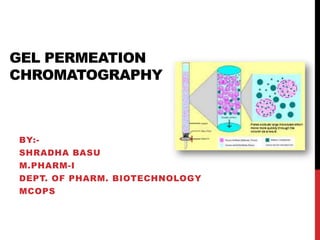
• GPC separates molecules in solution by their “effective
size in solution.”
• To prepare a sample for GPC analysis the resin is first
dissolved in an appropriate solvent.
• Inside the gel permeation chromatograph, the dissolved
resin is injected into a continually flowing stream of
solvent (mobile phase).
• The mobile phase flows through millions of highly porous,
rigid particles (stationary phase) tightly packed together in
a column.
• The pore sizes of these particles are controlled and
available in a range of sizes.
THEORY
• Total volume of column packed with a gel that has been
swelled by water or other solvent is given by
• V t = Vg + Vl + Vo
where,
Vt = total bed volume
Vg = vol. occupied by solid matrix of gel
Vl = vol. of solvent held in pores or interstices
Vo = free vol. outside the gel particles
• If conditions are assumed such that
I. time taken for solute molecules to diffuse into pore is less
as compared to time spent by molecule near pore
II. separation process independent of diffusion process
• Under these conditions
Ve = Vo+K d . Vl
Ve =vol. of effluent flowing through column between point of sample
injection & sample emergence from column
Kd = distribution coefficient
• For large molecules
k d = 0, Ve = Vo,
• For molecules that can penetrate all the pores
kd = 1, Ve = Vo+Vl
INSTRUMENTATION
COLUMN PACKING
• Different types:-
I. Semi-rigid, cross-linked macromolecular polymers
II. Rigid, controlled-pore-size glasses or silica
• Semi-rigid polymers:-
I. these materials swell slightly
II. care must be taken during use
III. limited to a maximum pressure of 300 psi due to bed
compressibility
Egs: styrene divinylbenzene polymers (for compounds of MW
range of 100-500 million) & suspension polymerization of 2-
hydroxyethyl methacrylate with ethylene dimethacrylate (can
withstand pressure upto 3000 psi)
• Porous glasses or silica:-
I. Cover wide range of pore diameter
II. Chemically resistant at pH values<10
III. Used with aq. & polar organic solvents
IV. Non-polar solvents-deactivate surface with silylation &
avoid irreversible retention by polar solutes
Silylation:-
• introduction of substituted silyl group (R3Si) to a molecule
• process involves replacement of proton with trialkylsilyl group such as
trimethylsilyl(-SiMe3)
• deprotonate the substrate with a suitable strong base (e.g. butyl
lithium)
• allow it to react with a silyl chloride (e.g. trimethylsilyl chloride)
• base used in this reaction must not form HCl- hydrolyze the silyl
protecting group
• introduction of a silyl group(s) gives derivatives of enhanced volatility-
making the derivatives suitable for analysis by GC
• Advantages of porous inorganic
packing
I. Column use-routine & indefinite
after calibration
II. Low possibility of sample
contamination & biodegradation
III. Bed volume-constant at high flow-
rates & pressures
IV.Thermal stability-use at elevated
temperatures
SOLVENTS
• Requires single solvent to dissolve & chromatograph
sample
• Issues caused by high viscosity of high MW samples
• Viscosity difference between injected sample & MP is
high-
I. Peak distortion
II. Anomalous changes in elution times
• Solvent Selection Guide for Room Temp. Aqueous Soluble
Polymers
Eluent Polymer
0.10M NaNo3 Neutral polymers
(PEG,PVA,Dextrans)
Anionic polymers (polyalginic acid,
carrageenan)
0.8M NaNo3 Cationic (polyvinylamine)
80:20
0.10M NaNo3/acetonitrile
Amphoteric (collagen gelatin)
SAMPLE PREPARATION
DETECTORS
• Detectors used must be compatible with exclusion
columns
I. 3-6m long
II. Working volume-1-10mL
III. Analysis time<10 mins
• Widely used detectors :-
I. Differential refractometer
II. Spectrophotometric detectors
• Low-angle laser light scattering( LALLS) detector
I. Determination of absolute molecular weights
II. Provides information on variation of long chain branching
with molecular weight
ADVANTAGES & DISADVANTAGES
• Has well defined
separation time
• Can provide
narrow bands
• Low chance for
analyte loss
• Determination of
MW of polymers
• Less time of
analysis
• Requires at least
10% difference
in MW for
reasonable
resolution of
peaks
• Pre-filtration of
sample
APPLICATIONS
• Separation of sugars polypeptides, proteins, liquids, butyl
rubbers, polystyrenes, silicon polymers.
• Sephadex G-25 : for separation of salts & amino acids
from proteins .
• Sephadex G-75 : fractionation & purification of proteins
polysaccharides & nucleic acids.
• Polymers can be characterized for number average
mol.wt. (Mn), weight average mol. wt. (Mw), size average
mol. wt. (Mz), polydispersity index.
REFERENCE
• Book reference
I. Willard H H, Merritt l l, Dean J A, Settle F A. Instrumental
Methods of Analysis.2012:7:644-648
II. Sharma B K. Instrumental Methods of Chemical
Analysis.2004:pg161-170
• Web references
I. http://chemcatalog.waters.com/publication/frame.php?i=1
42735&p=292&pn=&ver=flex
II. http://www.waters.com/waters/en_US/GPC---Gel-
Permeation-
Chromatography/nav.htm?cid=10167568&locale=en_US

Gel permeation chromatography

  • 1.
  • 2.
    CONTENTS • Introduction • Mechanismof separation • Theory of separation • Instrumentation I. Column packing II. Solvents III. Detectors • Advantages & disadvantages • Applications • References
  • 3.
    INTRODUCTION • Non-interactive modeof separation • Particles of column-range of pore size & pore networks • Solute molecules separated on the basis of size & shape • Also called gel permeation chromatography, exclusion chromatography and molecular sieve chromatography • Molecular sieve chromatography-separation carried out on natural or synthetic zeolites • General formula of a typical zeolite-M2/n. Al2O3 x SiO2 . y H2O • Separation not based on any distribution ratio • Not strictly chromatographic
  • 4.
  • 5.
    • GPC separatesmolecules in solution by their “effective size in solution.” • To prepare a sample for GPC analysis the resin is first dissolved in an appropriate solvent. • Inside the gel permeation chromatograph, the dissolved resin is injected into a continually flowing stream of solvent (mobile phase). • The mobile phase flows through millions of highly porous, rigid particles (stationary phase) tightly packed together in a column. • The pore sizes of these particles are controlled and available in a range of sizes.
  • 6.
    THEORY • Total volumeof column packed with a gel that has been swelled by water or other solvent is given by • V t = Vg + Vl + Vo where, Vt = total bed volume Vg = vol. occupied by solid matrix of gel Vl = vol. of solvent held in pores or interstices Vo = free vol. outside the gel particles
  • 7.
    • If conditionsare assumed such that I. time taken for solute molecules to diffuse into pore is less as compared to time spent by molecule near pore II. separation process independent of diffusion process • Under these conditions Ve = Vo+K d . Vl Ve =vol. of effluent flowing through column between point of sample injection & sample emergence from column Kd = distribution coefficient • For large molecules k d = 0, Ve = Vo, • For molecules that can penetrate all the pores kd = 1, Ve = Vo+Vl
  • 8.
  • 9.
    COLUMN PACKING • Differenttypes:- I. Semi-rigid, cross-linked macromolecular polymers II. Rigid, controlled-pore-size glasses or silica • Semi-rigid polymers:- I. these materials swell slightly II. care must be taken during use III. limited to a maximum pressure of 300 psi due to bed compressibility Egs: styrene divinylbenzene polymers (for compounds of MW range of 100-500 million) & suspension polymerization of 2- hydroxyethyl methacrylate with ethylene dimethacrylate (can withstand pressure upto 3000 psi)
  • 10.
    • Porous glassesor silica:- I. Cover wide range of pore diameter II. Chemically resistant at pH values<10 III. Used with aq. & polar organic solvents IV. Non-polar solvents-deactivate surface with silylation & avoid irreversible retention by polar solutes Silylation:- • introduction of substituted silyl group (R3Si) to a molecule • process involves replacement of proton with trialkylsilyl group such as trimethylsilyl(-SiMe3) • deprotonate the substrate with a suitable strong base (e.g. butyl lithium) • allow it to react with a silyl chloride (e.g. trimethylsilyl chloride) • base used in this reaction must not form HCl- hydrolyze the silyl protecting group • introduction of a silyl group(s) gives derivatives of enhanced volatility- making the derivatives suitable for analysis by GC
  • 11.
    • Advantages ofporous inorganic packing I. Column use-routine & indefinite after calibration II. Low possibility of sample contamination & biodegradation III. Bed volume-constant at high flow- rates & pressures IV.Thermal stability-use at elevated temperatures
  • 12.
    SOLVENTS • Requires singlesolvent to dissolve & chromatograph sample • Issues caused by high viscosity of high MW samples • Viscosity difference between injected sample & MP is high- I. Peak distortion II. Anomalous changes in elution times • Solvent Selection Guide for Room Temp. Aqueous Soluble Polymers Eluent Polymer 0.10M NaNo3 Neutral polymers (PEG,PVA,Dextrans) Anionic polymers (polyalginic acid, carrageenan) 0.8M NaNo3 Cationic (polyvinylamine) 80:20 0.10M NaNo3/acetonitrile Amphoteric (collagen gelatin)
  • 13.
  • 14.
    DETECTORS • Detectors usedmust be compatible with exclusion columns I. 3-6m long II. Working volume-1-10mL III. Analysis time<10 mins • Widely used detectors :- I. Differential refractometer II. Spectrophotometric detectors • Low-angle laser light scattering( LALLS) detector I. Determination of absolute molecular weights II. Provides information on variation of long chain branching with molecular weight
  • 15.
    ADVANTAGES & DISADVANTAGES •Has well defined separation time • Can provide narrow bands • Low chance for analyte loss • Determination of MW of polymers • Less time of analysis • Requires at least 10% difference in MW for reasonable resolution of peaks • Pre-filtration of sample
  • 16.
    APPLICATIONS • Separation ofsugars polypeptides, proteins, liquids, butyl rubbers, polystyrenes, silicon polymers. • Sephadex G-25 : for separation of salts & amino acids from proteins . • Sephadex G-75 : fractionation & purification of proteins polysaccharides & nucleic acids. • Polymers can be characterized for number average mol.wt. (Mn), weight average mol. wt. (Mw), size average mol. wt. (Mz), polydispersity index.
  • 17.
    REFERENCE • Book reference I.Willard H H, Merritt l l, Dean J A, Settle F A. Instrumental Methods of Analysis.2012:7:644-648 II. Sharma B K. Instrumental Methods of Chemical Analysis.2004:pg161-170 • Web references I. http://chemcatalog.waters.com/publication/frame.php?i=1 42735&p=292&pn=&ver=flex II. http://www.waters.com/waters/en_US/GPC---Gel- Permeation- Chromatography/nav.htm?cid=10167568&locale=en_US

Editor's Notes

  • #11 Silylation is the introduction of a (usually) substituted silyl group (R3Si) to a molecule.The process involves the replacement of a proton with a trialkylsilyl group, typically trimethylsilyl (-SiMe3). A general technique is to deprotonate the substrate with a suitable strong base (e.g. butyl lithium), and allow it to react with a silyl chloride (e.g. trimethylsilyl chloride). The base used in this reaction mustn&apos;t form any HCl as it will hydrolyze the silyl protecting group. The introduction of a silyl group(s) gives derivatives of enhanced volatility, making the derivatives suitable for analysis by gas chromatography and electron-impact mass spectrometry