COLUMN
CHROMATOGRAPHY
COLUMN CHROMATOGRAPHY
• Chromatography is the term used to describe a
separation technique in which a mobile phase carrying a
mixture is caused to move in contact with a selectively
absorbent stationary phase.
• There are a number of different kinds of
chromatography, which differ in the mobile and the
stationary phase used.
COLUMN CHROMATOGRAPHY
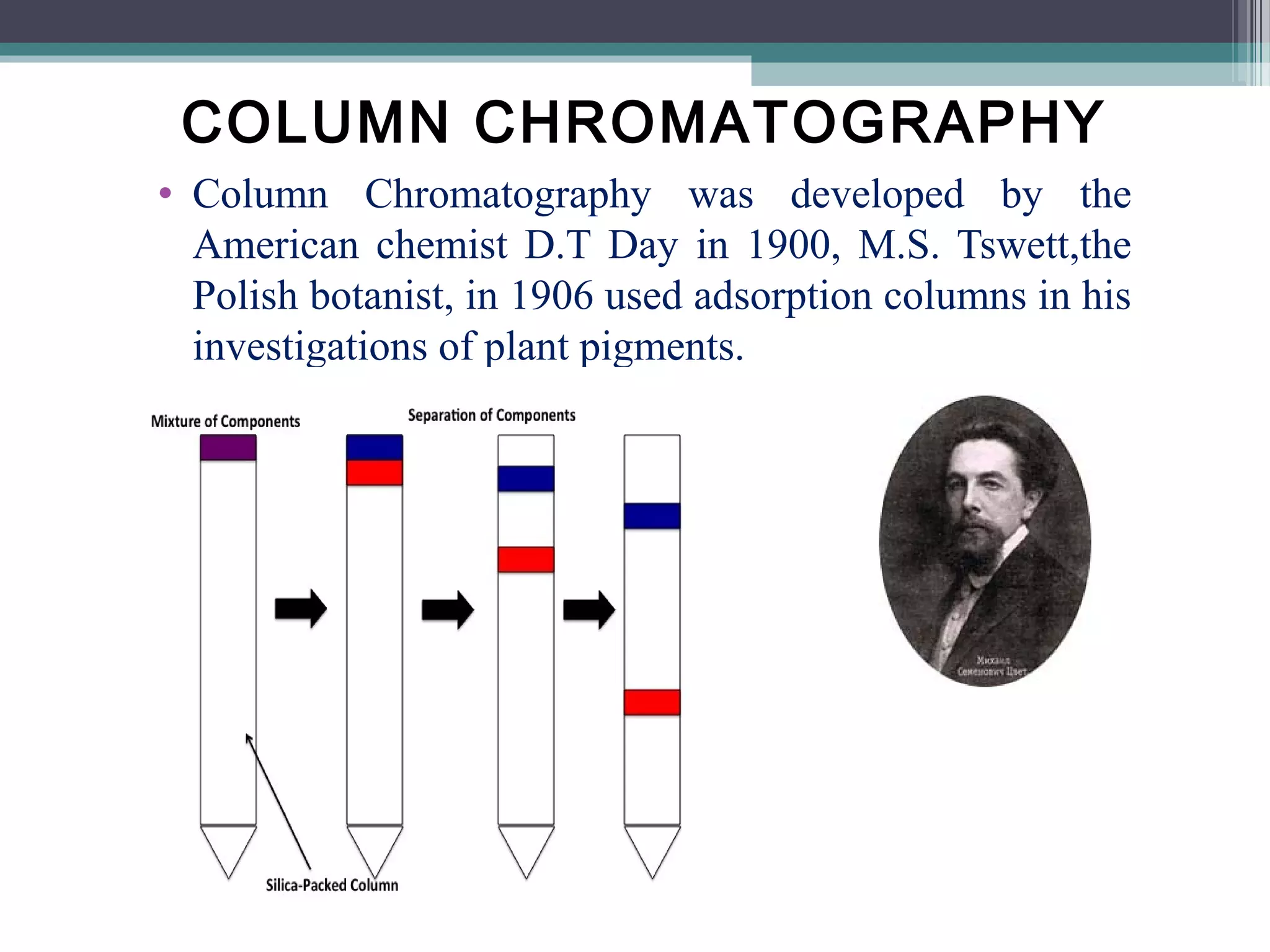
• Column Chromatography was developed by the
American chemist D.T Day in 1900, M.S. Tswett,the
Polish botanist, in 1906 used adsorption columns in his
investigations of plant pigments.
COLUMN CHROMATOGRAPHY
• Column chromatography is one of the most useful
methods for the separation and purification of both
solids and liquids.
• This is a solid - liquid technique in which the
stationary phase is a solid & mobile phase is a
liquid.
PRINCIPLE
• Adsorption
• Mixture of components dissolved in the M.P is
introduced in to the column. Components moves
depending upon their relative affinities.
COLUMN CHROMATOGRAPHY
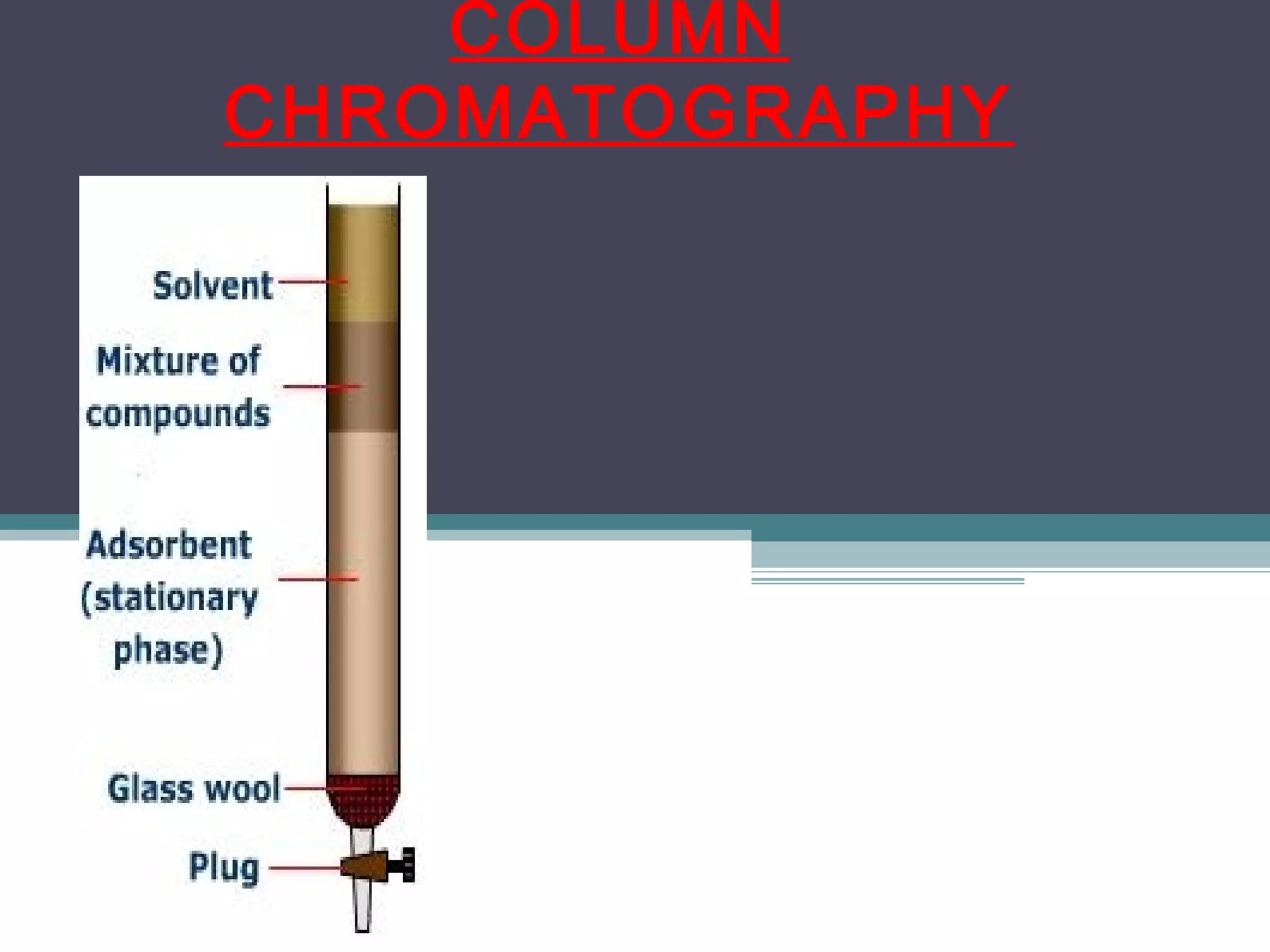
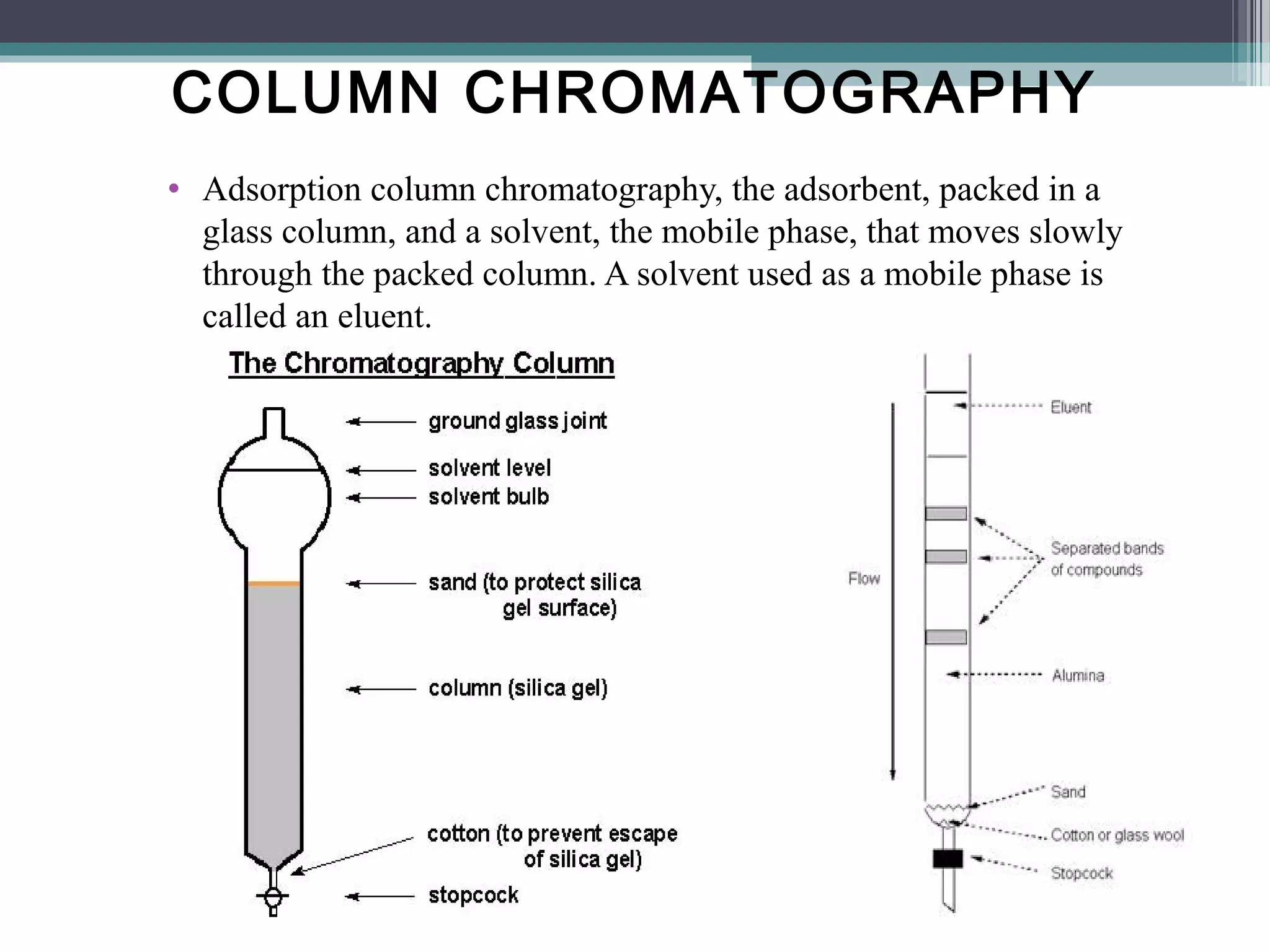
• Adsorption column chromatography, the adsorbent, packed in a
glass column, and a solvent, the mobile phase, that moves slowly
through the packed column. A solvent used as a mobile phase is
called an eluent.
COLUMN CHROMATOGRAPHY
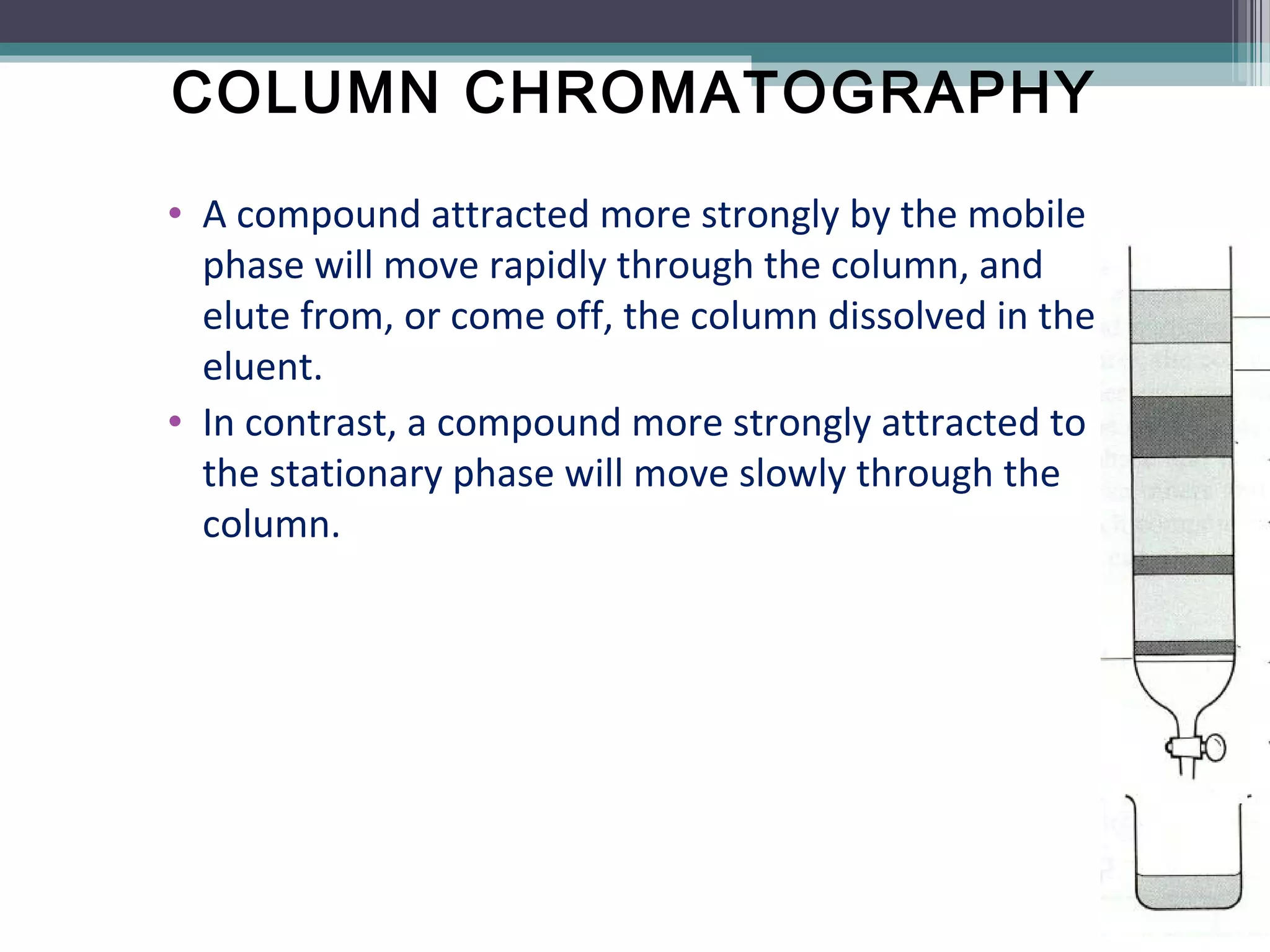
• A compound attracted more strongly by the mobile
phase will move rapidly through the column, and
elute from, or come off, the column dissolved in the
eluent.
• In contrast, a compound more strongly attracted to
the stationary phase will move slowly through the
column.
COLUMN CHROMATOGRAPHY
• Experimental aspects of
column chromatography:
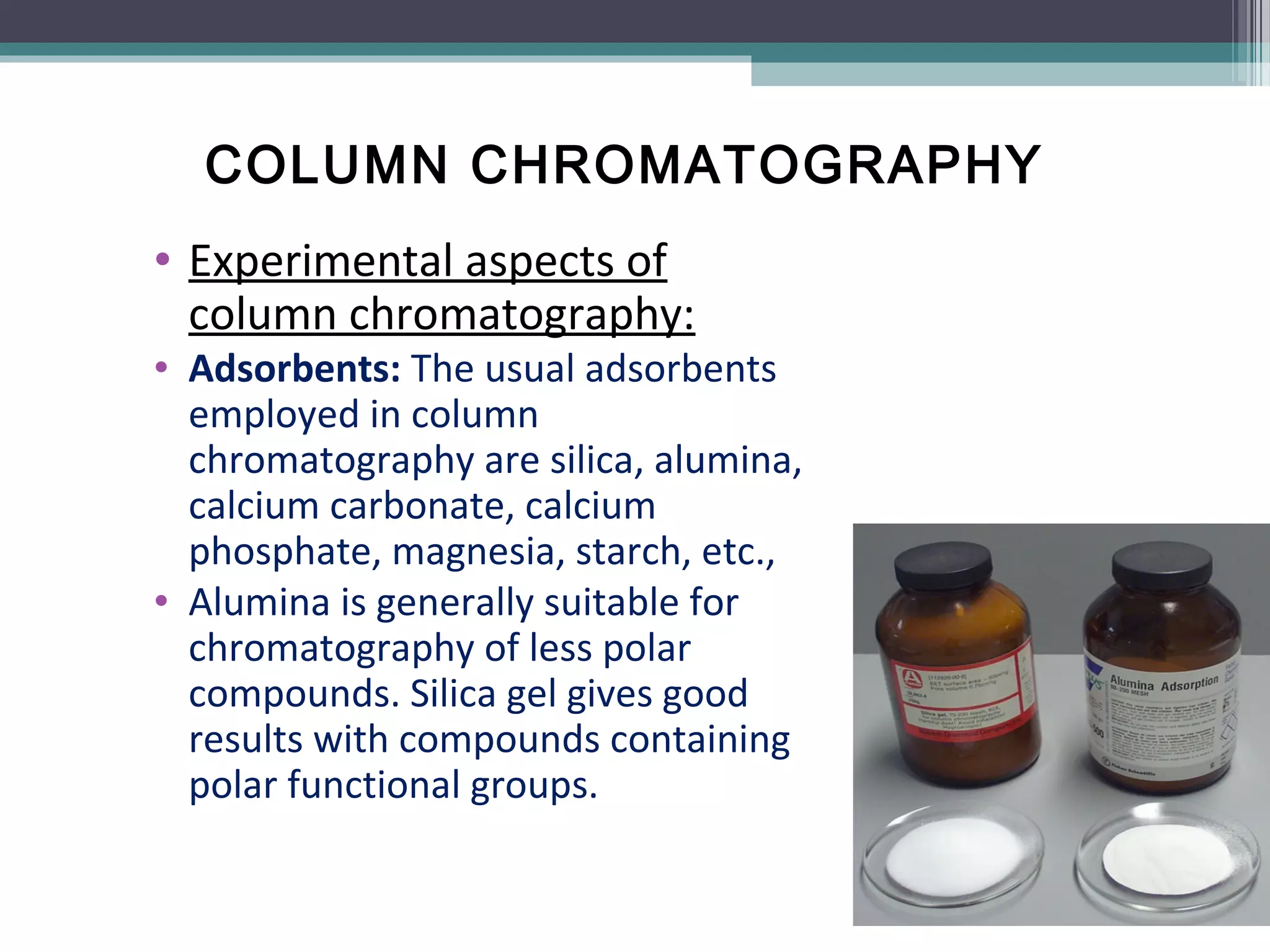
• Adsorbents: The usual adsorbents
employed in column
chromatography are silica, alumina,
calcium carbonate, calcium
phosphate, magnesia, starch, etc.,
• Alumina is generally suitable for
chromatography of less polar
compounds. Silica gel gives good
results with compounds containing
polar functional groups.
COLUMN CHROMATOGRAPHY
• Adsorbent in C.C should meet following criteria
• Particles should be spherical in shape & uniform in
size
• Mechanical stability must be high
• They shouldn’t react chemically
• It should be useful for separating for wide variety of
compounds
• It should be freely available & inexpensive
(The particle size of the commercially available grade
is in the range 50 – 200 µm.)
COLUMN CHROMATOGRAPHY
Selection of Stationary Phase
• Success of chromatography depends upon proper selection of
S.P, it depends on the following:
1.Removal of impurities
2.No. of components to be separated
3.Length of the column used
4.Affinity differences b/w components
5.Quantity of adsorbent used
COLUMN CHROMATOGRAPHY
Mobile Phase
• They act as solvent, developer & eluent. The function of a
mobile phase are:
• As developing agent
• To introduce the mixture into the column – as solvent
• To developing agent
• To remove pure components out of the column – as eluent
COLUMN CHROMATOGRAPHY
• The choice of the solvent is depend on the solubility
characteristics of the mixture. The solvents should
also have sufficiently low boiling points to permit
ready recovery of eluted material.
• However, polarity as seen the most important factor
in adsorption chromatography.
• Different mobile phases used: ( in increasing order of
polarity)
• Petroleum ether, carbon tetrachloride, cyclohexane,
ether, acetone, benzene, toluene, esters, water, etc
• It can b e used in either pure form or as mixture of
solvents
Types of Column
• 1- Gravity Columns: The mobile phase move through the
stationary phase by gravity force.
• 2- Flash Columns (Air or nitrogen pressure):
The mobile phase is pushed by stream of air or
nitrogen using special using special values
(Adaptors).
Types of Column
• 3-Low and Medium Pressure Columns (pumped): The
movement of mobile phase is accelerated by using pumps that
generate low or medium pressure. The increase in the flow
rate shorten the time of separation.
Types of Column
• 4-Vacuum Columns [Vacuum liquid
chromatography (VLC)]:
The adsorbent is applied dry into a sintered glass
funnel. The sample is applied by dry method or as
solution. Then the mobile phase is added portion by
portion and vacuum is applied after each portion to
collect each fraction.
COLUMN CHROMATOGRAPHY
COLUMN CHARACTERISTICS
• The main function of all the columns is to support the
stationary phase.
• The material of the column is mostly good quality
neutral glass since it shouldn’t be affected by solvents.
An ordinary burette can also be used as column for
separation.
• Column dimensions - length & diameter ratio
(10:1,30:1 or 100:1)
• Various accessories are attached to the top and
bottom of the column for maintenance of the elution
process.
COLUMN CHROMATOGRAPHY
The length of the column depends upon:
•Number of compounds to be separated
•Type of adsorbent used
•Quantity of the sample
•Affinity of compounds towards the adsorbent used
•Better separation will be obtained with a long narrow column
than short thick column because number of plates will be more.
COLUMN CHROMATOGRAPHY
PREPARATION OF THE COLUMN
•It consists of a glass tube with bottom portion of the
column – packed with glass wool/cotton wool or may
contain asbestos pad,
» Above which adsorbent is packed
» After packing a paper disc kept on the top, so that
the adsorbent layer is not disturbed during the
introduction of sample or mobile phase.
COLUMN CHROMATOGRAPHY
Packing techniques in C.C
• There are two types of preparing the column, they
are:
• i. Dry packing / dry filling
• Ii. Wet packing / wet filling
• The column should be free from impurity, before
using column, it should be washed properly and dry it.
• Before filling column with stationary phase,
cotton/glass wool is kept
• It should be uniformly filled
COLUMN CHROMATOGRAPHY
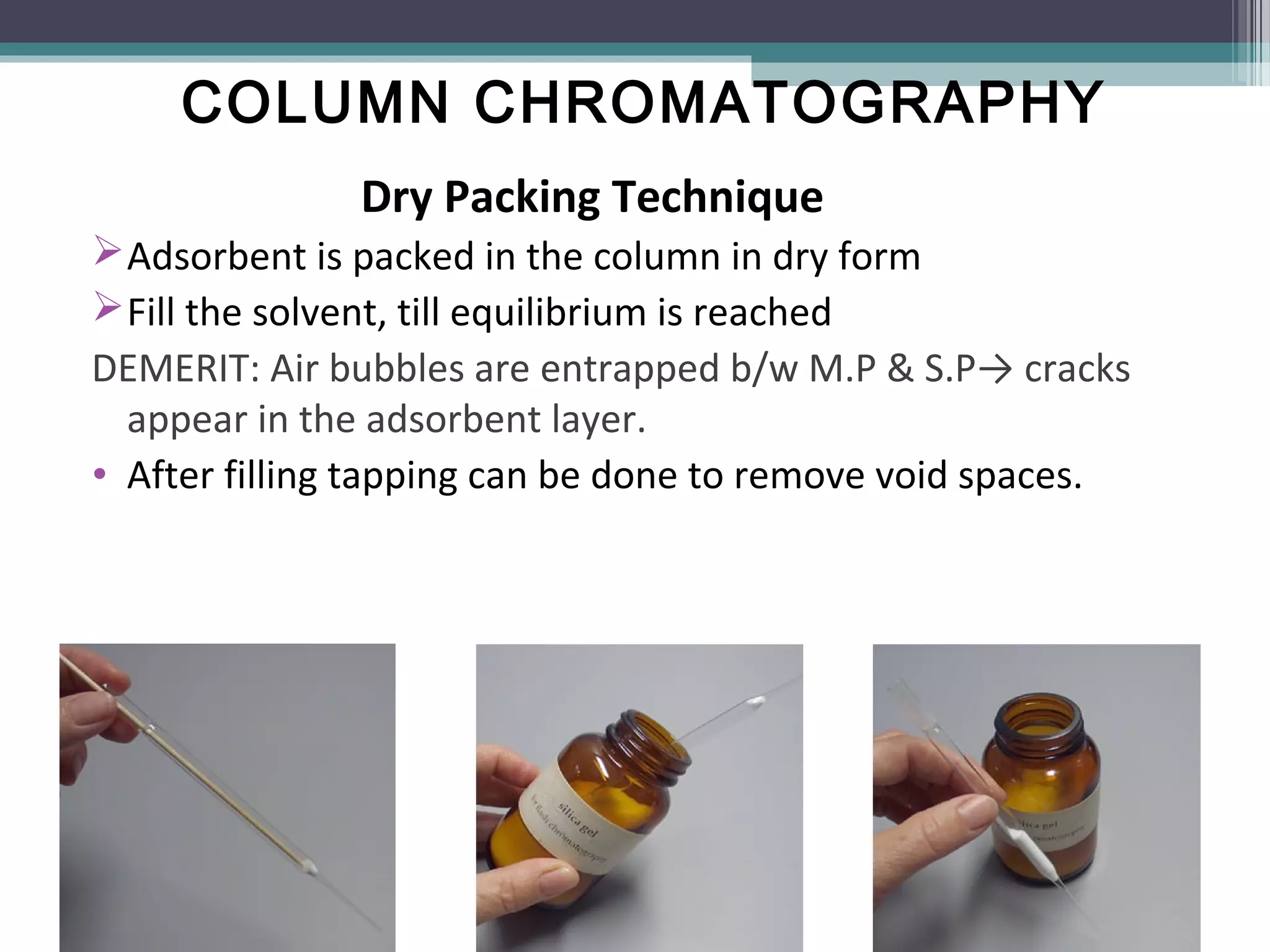
Dry Packing Technique
Adsorbent is packed in the column in dry form
Fill the solvent, till equilibrium is reached
DEMERIT: Air bubbles are entrapped b/w M.P & S.P→ cracks
appear in the adsorbent layer.
• After filling tapping can be done to remove void spaces.
COLUMN CHROMATOGRAPHY
Wet Packing Technique
» ideal & common technique
The material is slurried with solvent and generally added to
the column in portions.
◊ S.P settles uniformly & no crack in the column of adsorbent.
» solid settle down while the solvent remain upward.
» this solvent is removed then again cotton plug is placed.
COLUMN CHROMATOGRAPHY
Introduction of the Sample
• The sample which is usually a mixture of components
is dissolved in minimum quantity of the mobile phase.
• The entire sample is introduced into the column at
once and get adsorbed on the top portion of the
column.
• From this zone, individual sample can be separated by
a process of elution.
COLUMN CHROMATOGRAPHY
• Development technique ( Elution)
• By elution technique, the individual components are
separated out from the column. The two techniques are:
• (i) Isocratic elution technique : in this elution technique ,
same solvent composition or solvent of same polarity is used
throughout the process of separation.
• Example: chloroform only
COLUMN CHROMATOGRAPHY
(ii) Gradient elution techniques:
( gradient – gradually)
Solvents of gradually ↑ polarity or ↑ elution strength are
used during the process of separation.
E.g. initially benzene, then chloroform, then ethyl acetate
then chloroform
COLUMN CHROMATOGRAPHY
• DETECTION OF COMPONENTS
• If the compounds separated in a column chromatography
procedure are colored, the progress of the separation can
simply be monitored visually.
• If the compounds to be isolated from column
chromatography are colorless. In this case, small fractions of
the eluent are collected sequentially in labelled tubes and the
composition of each fraction is analyzed by TLC.
COLUMN CHROMATOGRAPHY
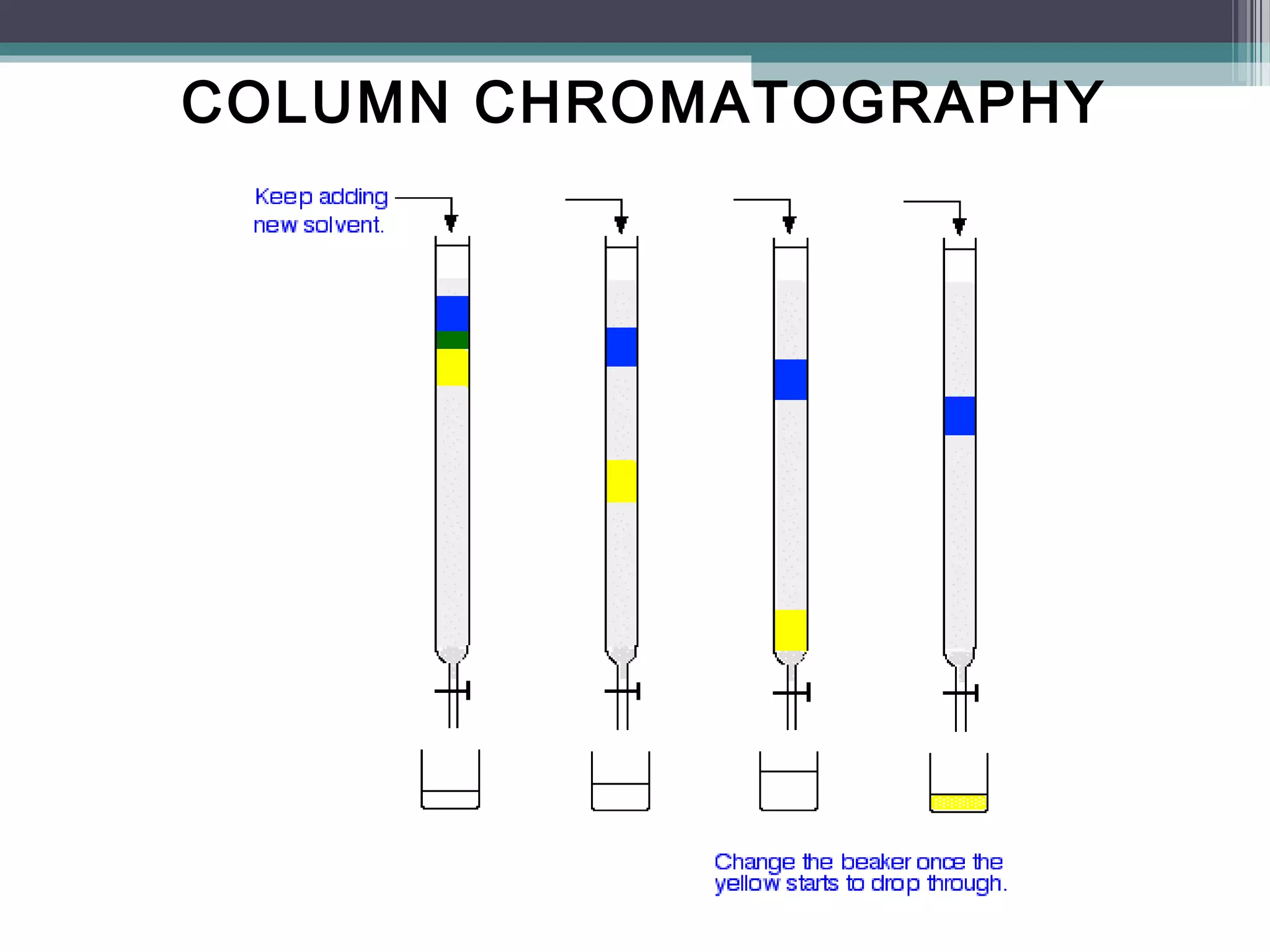
• Eluting the sample: Components a, b, and c separate
as column progresses.
• Fractions can be collected in test tubes, vials,
beakers, or Erlenmeyer flasks.
COLUMN CHROMATOGRAPHY
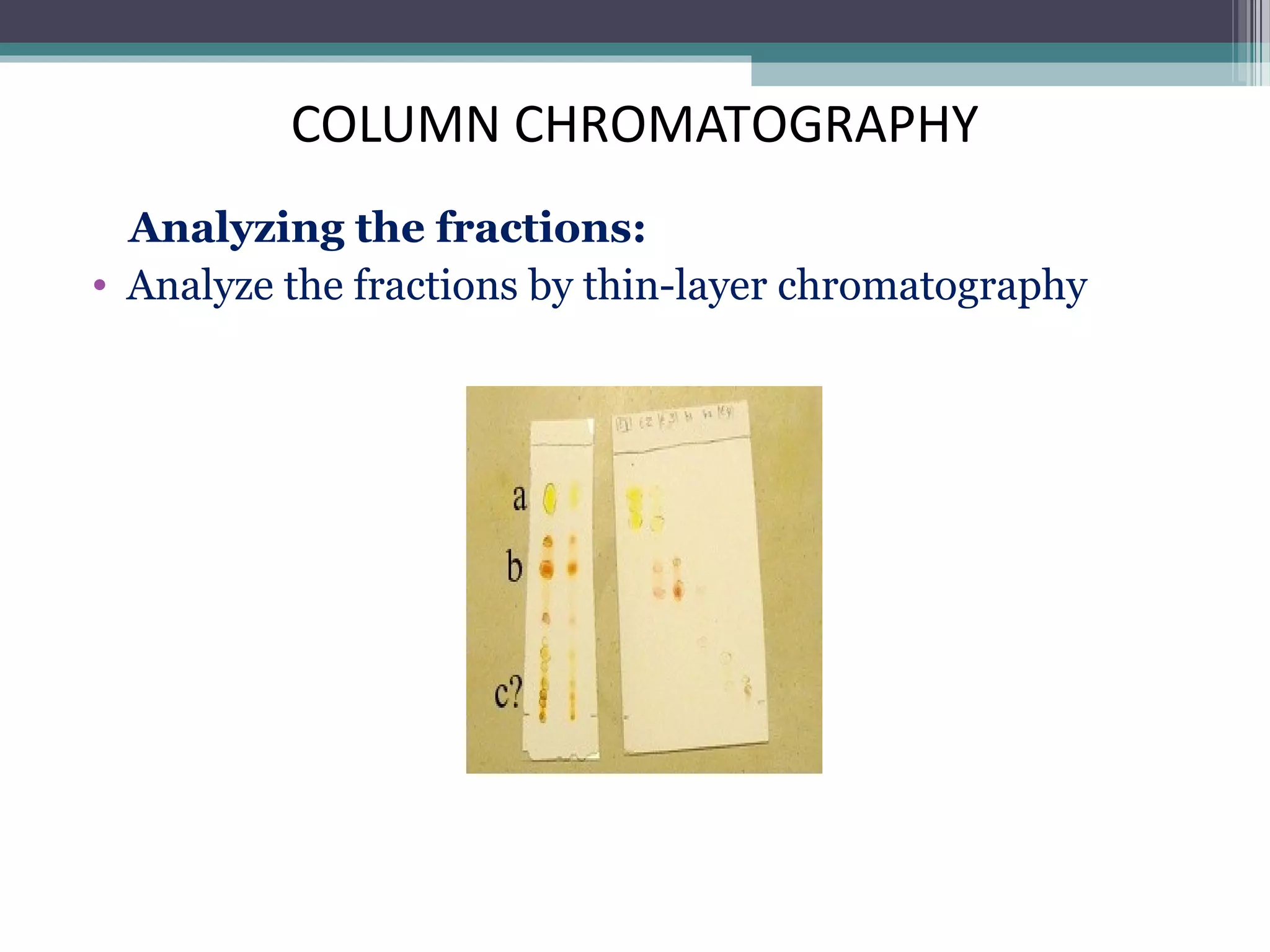
Analyzing the fractions:
• Analyze the fractions by thin-layer chromatography
COLUMN CHROMATOGRAPHY
• FACTORS AFFECTING COLUMN EFFICIENCY
1.Dimension of the column: column efficiency has been
improved by increasing length/width ratio of the
column.
2.Particle size of column packing: separation to be
improved by decreasing the particle size of the
adsorbent.
3. Activity of the adsorbent
4.Temperature of the column: The speed of the elution
increases at higher temperatures.
5.Packing of the column
6.Quality of solvents: solvents having low viscosities is
giving better results.
COLUMN CHROMATOGRAPHY
APPLICATIONS
►Separation of mixture of compounds
►Purification process
►Isolation of active constituents
►Estimation of drugs in formulation
►Isolation of active constituents
►Determination of primary and secondary glycosides in
digitalis leaf.
► separation of diastereomers
COLUMN CHROMATOGRAPHY
• Advantages of C.C
» Any type of mixture can be separated
» Any quantity of mixture can be separated
» Wider choice of Mobile Phase
» Automation is possible
• Disadvantages of C.C
» Time consuming
» more amount of Mobile Phase are required
» Automation makes the techniques more complicated &
expensive

Column chromatography

  • 1.
  • 2.
    COLUMN CHROMATOGRAPHY • Chromatographyis the term used to describe a separation technique in which a mobile phase carrying a mixture is caused to move in contact with a selectively absorbent stationary phase. • There are a number of different kinds of chromatography, which differ in the mobile and the stationary phase used.
  • 3.
    COLUMN CHROMATOGRAPHY • ColumnChromatography was developed by the American chemist D.T Day in 1900, M.S. Tswett,the Polish botanist, in 1906 used adsorption columns in his investigations of plant pigments.
  • 4.
    COLUMN CHROMATOGRAPHY • Columnchromatography is one of the most useful methods for the separation and purification of both solids and liquids. • This is a solid - liquid technique in which the stationary phase is a solid & mobile phase is a liquid. PRINCIPLE • Adsorption • Mixture of components dissolved in the M.P is introduced in to the column. Components moves depending upon their relative affinities.
  • 5.
    COLUMN CHROMATOGRAPHY • Adsorptioncolumn chromatography, the adsorbent, packed in a glass column, and a solvent, the mobile phase, that moves slowly through the packed column. A solvent used as a mobile phase is called an eluent.
  • 6.
    COLUMN CHROMATOGRAPHY • Acompound attracted more strongly by the mobile phase will move rapidly through the column, and elute from, or come off, the column dissolved in the eluent. • In contrast, a compound more strongly attracted to the stationary phase will move slowly through the column.
  • 7.
    COLUMN CHROMATOGRAPHY • Experimentalaspects of column chromatography: • Adsorbents: The usual adsorbents employed in column chromatography are silica, alumina, calcium carbonate, calcium phosphate, magnesia, starch, etc., • Alumina is generally suitable for chromatography of less polar compounds. Silica gel gives good results with compounds containing polar functional groups.
  • 8.
    COLUMN CHROMATOGRAPHY • Adsorbentin C.C should meet following criteria • Particles should be spherical in shape & uniform in size • Mechanical stability must be high • They shouldn’t react chemically • It should be useful for separating for wide variety of compounds • It should be freely available & inexpensive (The particle size of the commercially available grade is in the range 50 – 200 µm.)
  • 9.
    COLUMN CHROMATOGRAPHY Selection ofStationary Phase • Success of chromatography depends upon proper selection of S.P, it depends on the following: 1.Removal of impurities 2.No. of components to be separated 3.Length of the column used 4.Affinity differences b/w components 5.Quantity of adsorbent used
  • 10.
    COLUMN CHROMATOGRAPHY Mobile Phase •They act as solvent, developer & eluent. The function of a mobile phase are: • As developing agent • To introduce the mixture into the column – as solvent • To developing agent • To remove pure components out of the column – as eluent
  • 11.
    COLUMN CHROMATOGRAPHY • Thechoice of the solvent is depend on the solubility characteristics of the mixture. The solvents should also have sufficiently low boiling points to permit ready recovery of eluted material. • However, polarity as seen the most important factor in adsorption chromatography. • Different mobile phases used: ( in increasing order of polarity) • Petroleum ether, carbon tetrachloride, cyclohexane, ether, acetone, benzene, toluene, esters, water, etc • It can b e used in either pure form or as mixture of solvents
  • 12.
    Types of Column •1- Gravity Columns: The mobile phase move through the stationary phase by gravity force. • 2- Flash Columns (Air or nitrogen pressure): The mobile phase is pushed by stream of air or nitrogen using special using special values (Adaptors).
  • 13.
    Types of Column •3-Low and Medium Pressure Columns (pumped): The movement of mobile phase is accelerated by using pumps that generate low or medium pressure. The increase in the flow rate shorten the time of separation.
  • 14.
    Types of Column •4-Vacuum Columns [Vacuum liquid chromatography (VLC)]: The adsorbent is applied dry into a sintered glass funnel. The sample is applied by dry method or as solution. Then the mobile phase is added portion by portion and vacuum is applied after each portion to collect each fraction.
  • 15.
    COLUMN CHROMATOGRAPHY COLUMN CHARACTERISTICS •The main function of all the columns is to support the stationary phase. • The material of the column is mostly good quality neutral glass since it shouldn’t be affected by solvents. An ordinary burette can also be used as column for separation. • Column dimensions - length & diameter ratio (10:1,30:1 or 100:1) • Various accessories are attached to the top and bottom of the column for maintenance of the elution process.
  • 16.
    COLUMN CHROMATOGRAPHY The lengthof the column depends upon: •Number of compounds to be separated •Type of adsorbent used •Quantity of the sample •Affinity of compounds towards the adsorbent used •Better separation will be obtained with a long narrow column than short thick column because number of plates will be more.
  • 17.
    COLUMN CHROMATOGRAPHY PREPARATION OFTHE COLUMN •It consists of a glass tube with bottom portion of the column – packed with glass wool/cotton wool or may contain asbestos pad, » Above which adsorbent is packed » After packing a paper disc kept on the top, so that the adsorbent layer is not disturbed during the introduction of sample or mobile phase.
  • 18.
    COLUMN CHROMATOGRAPHY Packing techniquesin C.C • There are two types of preparing the column, they are: • i. Dry packing / dry filling • Ii. Wet packing / wet filling • The column should be free from impurity, before using column, it should be washed properly and dry it. • Before filling column with stationary phase, cotton/glass wool is kept • It should be uniformly filled
  • 19.
    COLUMN CHROMATOGRAPHY Dry PackingTechnique Adsorbent is packed in the column in dry form Fill the solvent, till equilibrium is reached DEMERIT: Air bubbles are entrapped b/w M.P & S.P→ cracks appear in the adsorbent layer. • After filling tapping can be done to remove void spaces.
  • 20.
  • 21.
    COLUMN CHROMATOGRAPHY Wet PackingTechnique » ideal & common technique The material is slurried with solvent and generally added to the column in portions. ◊ S.P settles uniformly & no crack in the column of adsorbent. » solid settle down while the solvent remain upward. » this solvent is removed then again cotton plug is placed.
  • 22.
    COLUMN CHROMATOGRAPHY Introduction ofthe Sample • The sample which is usually a mixture of components is dissolved in minimum quantity of the mobile phase. • The entire sample is introduced into the column at once and get adsorbed on the top portion of the column. • From this zone, individual sample can be separated by a process of elution.
  • 23.
  • 24.
  • 25.
    COLUMN CHROMATOGRAPHY • Developmenttechnique ( Elution) • By elution technique, the individual components are separated out from the column. The two techniques are: • (i) Isocratic elution technique : in this elution technique , same solvent composition or solvent of same polarity is used throughout the process of separation. • Example: chloroform only
  • 26.
    COLUMN CHROMATOGRAPHY (ii) Gradientelution techniques: ( gradient – gradually) Solvents of gradually ↑ polarity or ↑ elution strength are used during the process of separation. E.g. initially benzene, then chloroform, then ethyl acetate then chloroform
  • 27.
    COLUMN CHROMATOGRAPHY • DETECTIONOF COMPONENTS • If the compounds separated in a column chromatography procedure are colored, the progress of the separation can simply be monitored visually. • If the compounds to be isolated from column chromatography are colorless. In this case, small fractions of the eluent are collected sequentially in labelled tubes and the composition of each fraction is analyzed by TLC.
  • 28.
    COLUMN CHROMATOGRAPHY • Elutingthe sample: Components a, b, and c separate as column progresses. • Fractions can be collected in test tubes, vials, beakers, or Erlenmeyer flasks.
  • 29.
    COLUMN CHROMATOGRAPHY Analyzing thefractions: • Analyze the fractions by thin-layer chromatography
  • 30.
    COLUMN CHROMATOGRAPHY • FACTORSAFFECTING COLUMN EFFICIENCY 1.Dimension of the column: column efficiency has been improved by increasing length/width ratio of the column. 2.Particle size of column packing: separation to be improved by decreasing the particle size of the adsorbent. 3. Activity of the adsorbent 4.Temperature of the column: The speed of the elution increases at higher temperatures. 5.Packing of the column 6.Quality of solvents: solvents having low viscosities is giving better results.
  • 31.
    COLUMN CHROMATOGRAPHY APPLICATIONS ►Separation ofmixture of compounds ►Purification process ►Isolation of active constituents ►Estimation of drugs in formulation ►Isolation of active constituents ►Determination of primary and secondary glycosides in digitalis leaf. ► separation of diastereomers
  • 32.
    COLUMN CHROMATOGRAPHY • Advantagesof C.C » Any type of mixture can be separated » Any quantity of mixture can be separated » Wider choice of Mobile Phase » Automation is possible • Disadvantages of C.C » Time consuming » more amount of Mobile Phase are required » Automation makes the techniques more complicated & expensive