WOODWARD_FIESER RULE
Presented
By
Faizan Ahmed Md Israeel
First Year M.Pharm.
Department of Pharmaceutical Chemistry
R. C. Patel Institute of Pharmaceutical Education and Research
1
CONTENTS
 Introduction
 Basic Terminologies
 Woodward_Fieser Rules For Dienes
 Woodward_Fieser Rules For Aromatics
 Woodward_Fieser Rules For α,β-
unsaturated Carbonyl Compounds
(Enones)
 Fieser_Kuhn Rule
 References
2
WOODWARD_FIESER RULE
Robert Burns Woodward Louis Frederick Fieser
3
INTRODUCTION
 In 1945 Robert Burns Woodward gave certain rules for correlating wavelength of maximum
absorption (λmax) with molecular structure.
 In 1959 Louis Fredrick Fieser modified these rules with more experimental data and the
modified rule is known as Woodward_Fieser Rules.
 Woodward rules work well for dienes and polyenes with upto 4-double bonds or less.
 These sets of rules to calculate the wavelength of maximum absorption (λmax) of a compound in
the ultraviolet-visible spectrum, based empirically have been called the Woodward_Fieser Rules
or Woodward’s Rules.
 This may be differs from observed value by 4-5nm.
4
BASIC TERMINOLOGIES
Homoannular diene Heteroannular diene Endocyclic double bond Exocyclic double bond
Double bond extending conjugation
A B
5
A) WOODWARD_FIESER RULE FOR CONJUGATED
DIENES AND TRIENES
 Conjugated diene: Organic compound containing two or more double bonds each separated from
other by a single bond.
 Base/Parent value: It means that each type of diene or triene system is having a certain fixed
values at which absorption takes place; this constitutes the Base value or Parent value.
 The contribution made by various alkyl substituents or ring residue, double bond extending
conjugation and polar groups such as -Cl,-Br etc. are added to the base value to obtain λmax for a
particular compound.
 Longer the conjugated system greater the wavelength of absorption maximum.
 According to Woodward’s rules the λmax of the molecule can be calculated using a formula:
λmax = Base value + Σ Substituent Contributions + Σ Other Contributions
6
Table A: Parent values and increments for different substituents /groups for
calculating maximum wavelength
Conjugated dienes correlations Standard (nm)
(A) Parent value
Homo-annular conjugated dienes 253
Hetero-annular conjugated dienes 214
Butadiene system or a cyclic conjugated dienes 217
Acyclic trienes 245
7
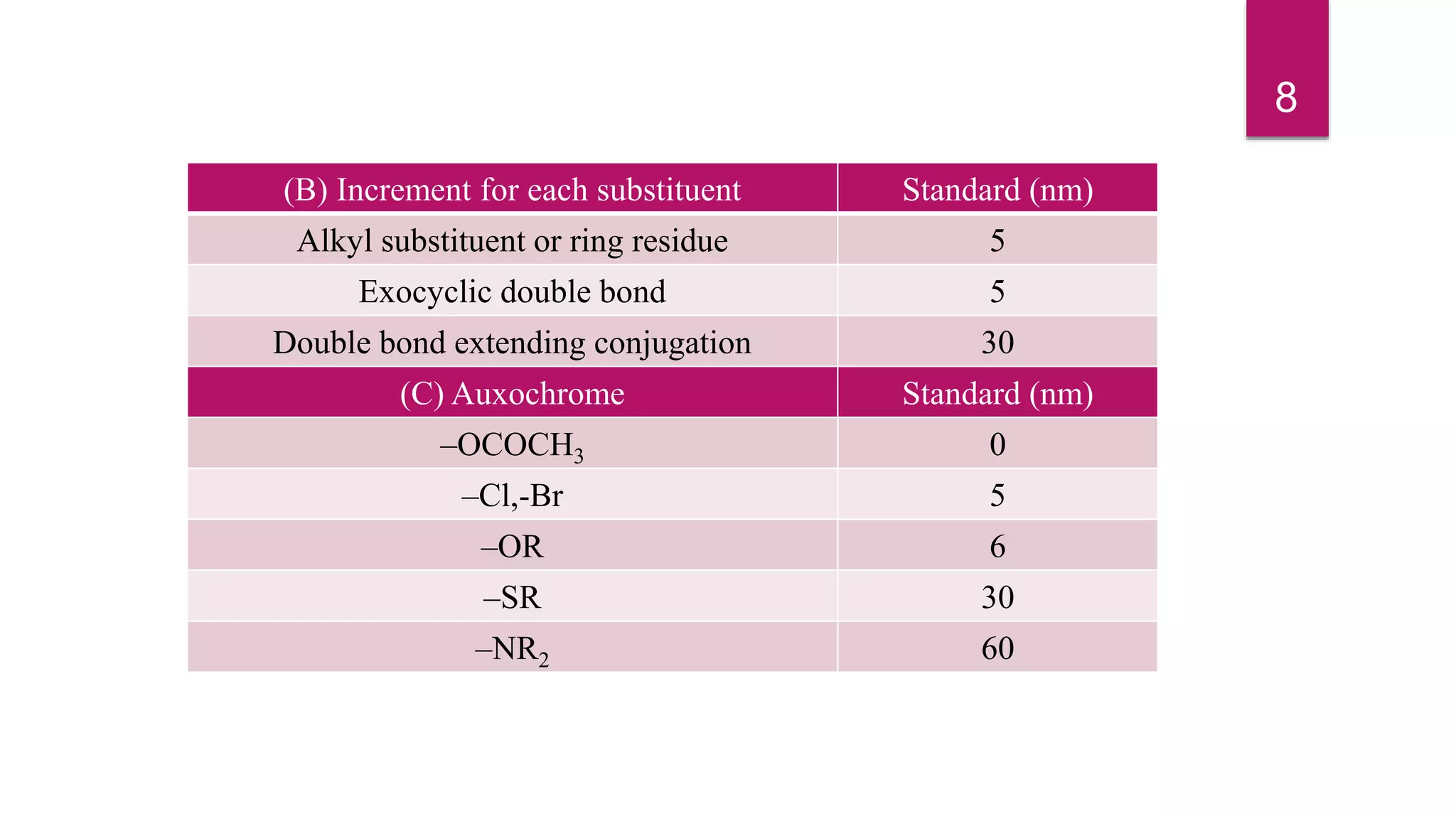
(B) Increment for each substituent Standard (nm)
Alkyl substituent or ring residue 5
Exocyclic double bond 5
Double bond extending conjugation 30
(C) Auxochrome Standard (nm)
–OCOCH3 0
–Cl,-Br 5
–OR 6
–SR 30
–NR2 60
8
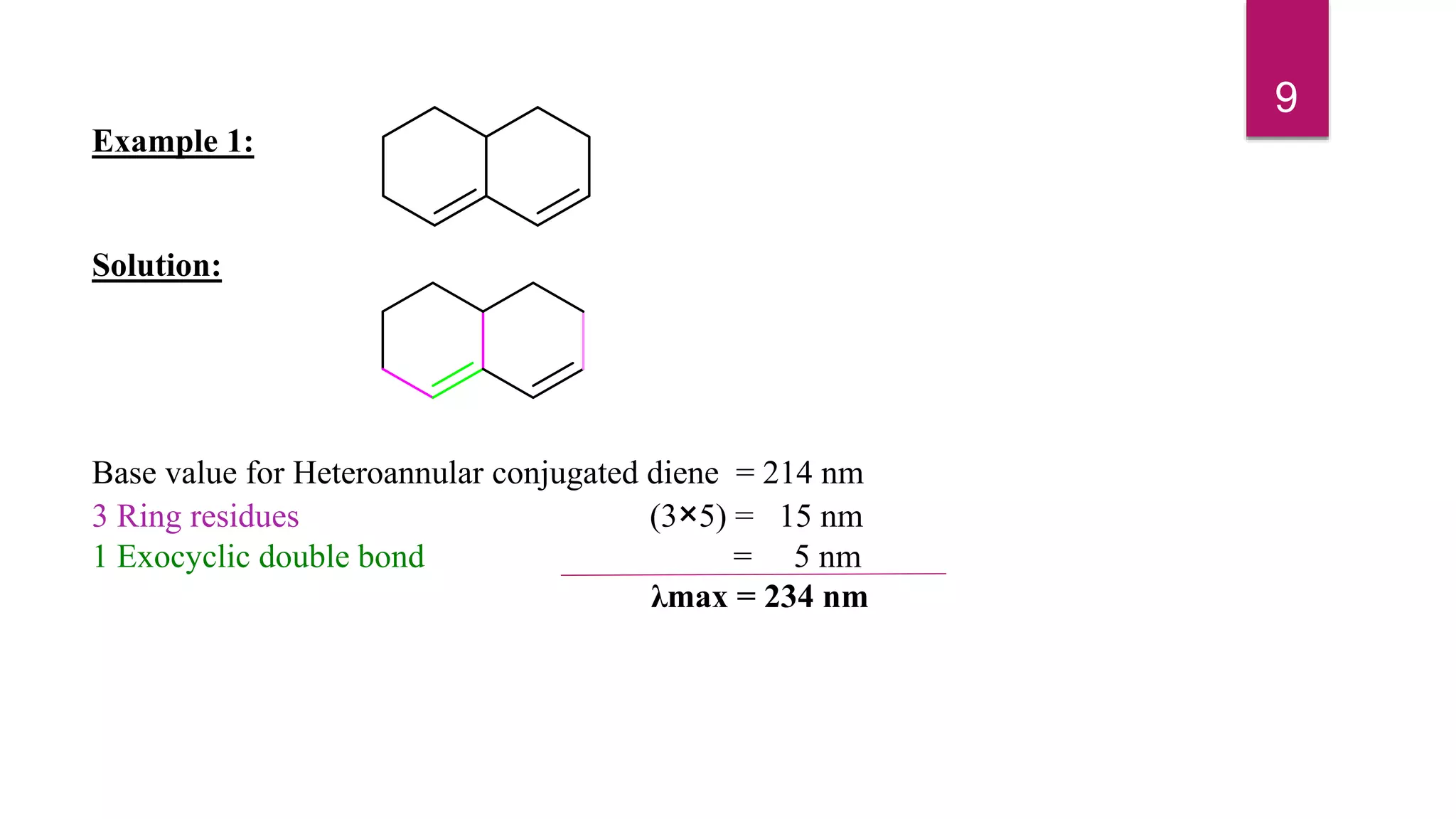
Example 1:
Solution:
Base value for Heteroannular conjugated diene = 214 nm
3 Ring residues (3×5) = 15 nm
1 Exocyclic double bond = 5 nm
λmax = 234 nm
9
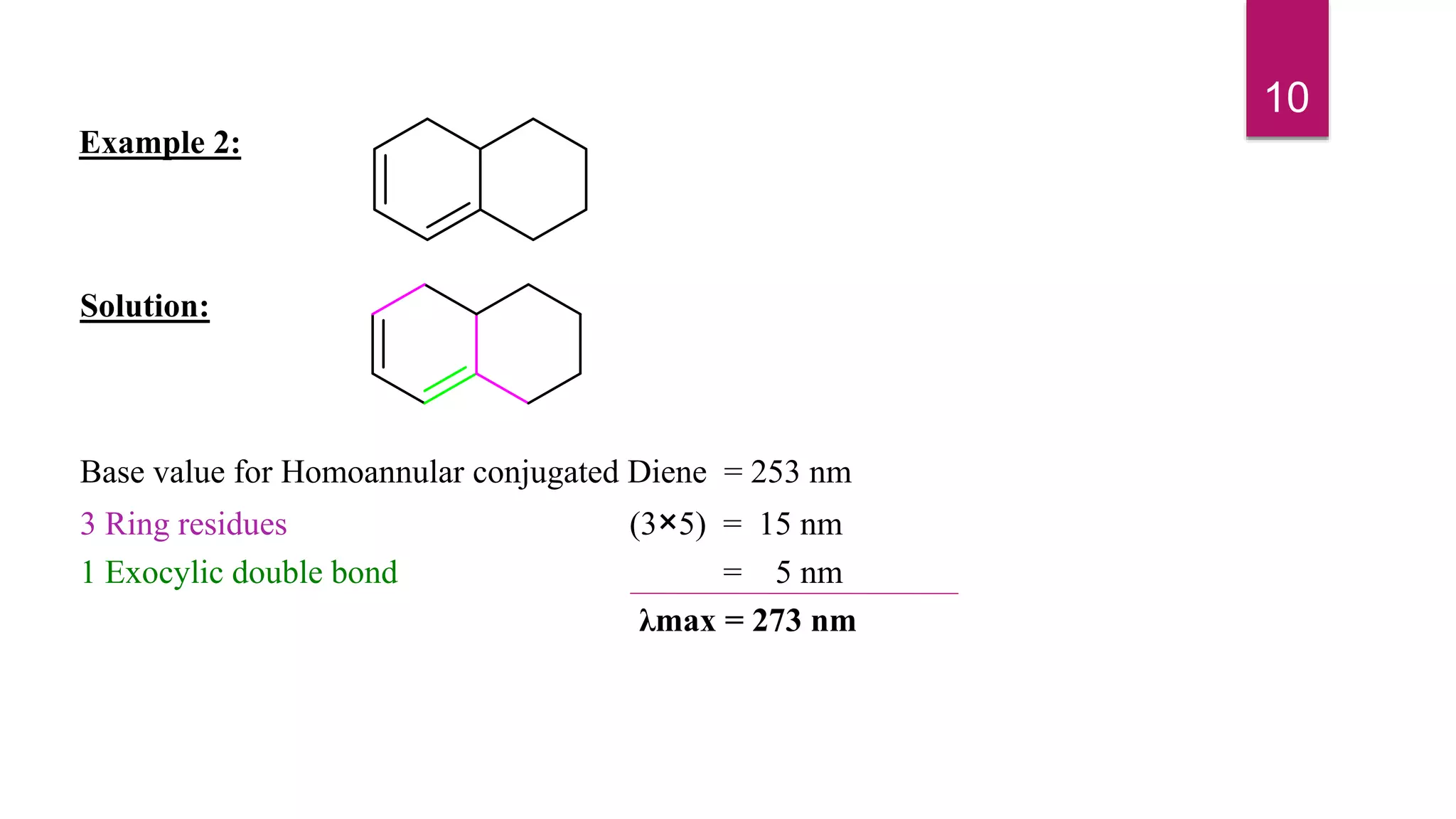
Example 2:
Solution:
Base value for Homoannular conjugated Diene = 253 nm
3 Ring residues (3×5) = 15 nm
1 Exocylic double bond = 5 nm
λmax = 273 nm
10
Example 3:
Solution:
Base value for Heteroannular conjugated diene = 214 nm
3 Ring residues (3×5) = 15 nm
1 Exocyclic double bond = 5 nm
λmax = 234 nm
11
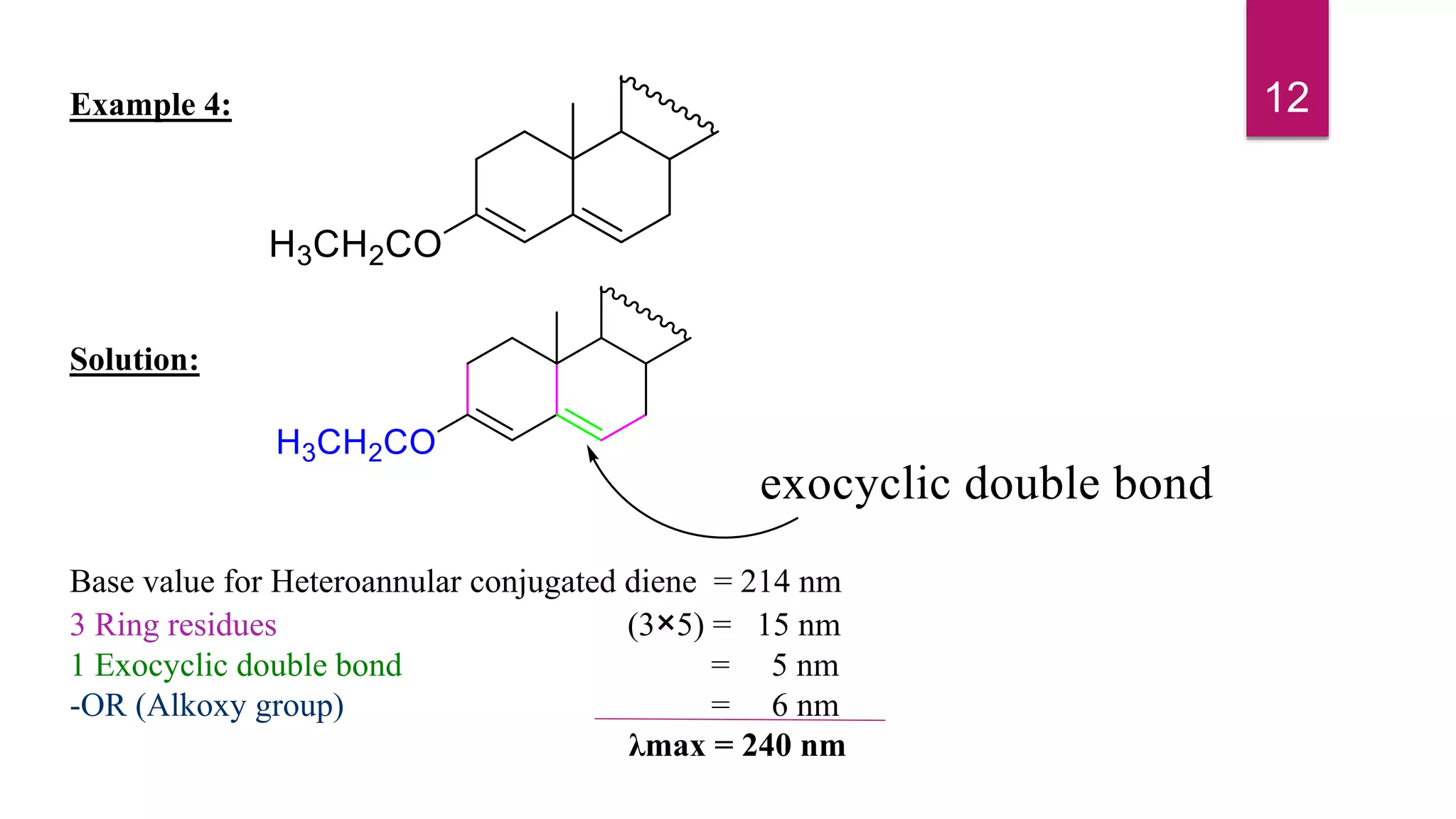
Example 4:
Solution:
Base value for Heteroannular conjugated diene = 214 nm
3 Ring residues (3×5) = 15 nm
1 Exocyclic double bond = 5 nm
-OR (Alkoxy group) = 6 nm
λmax = 240 nm
12
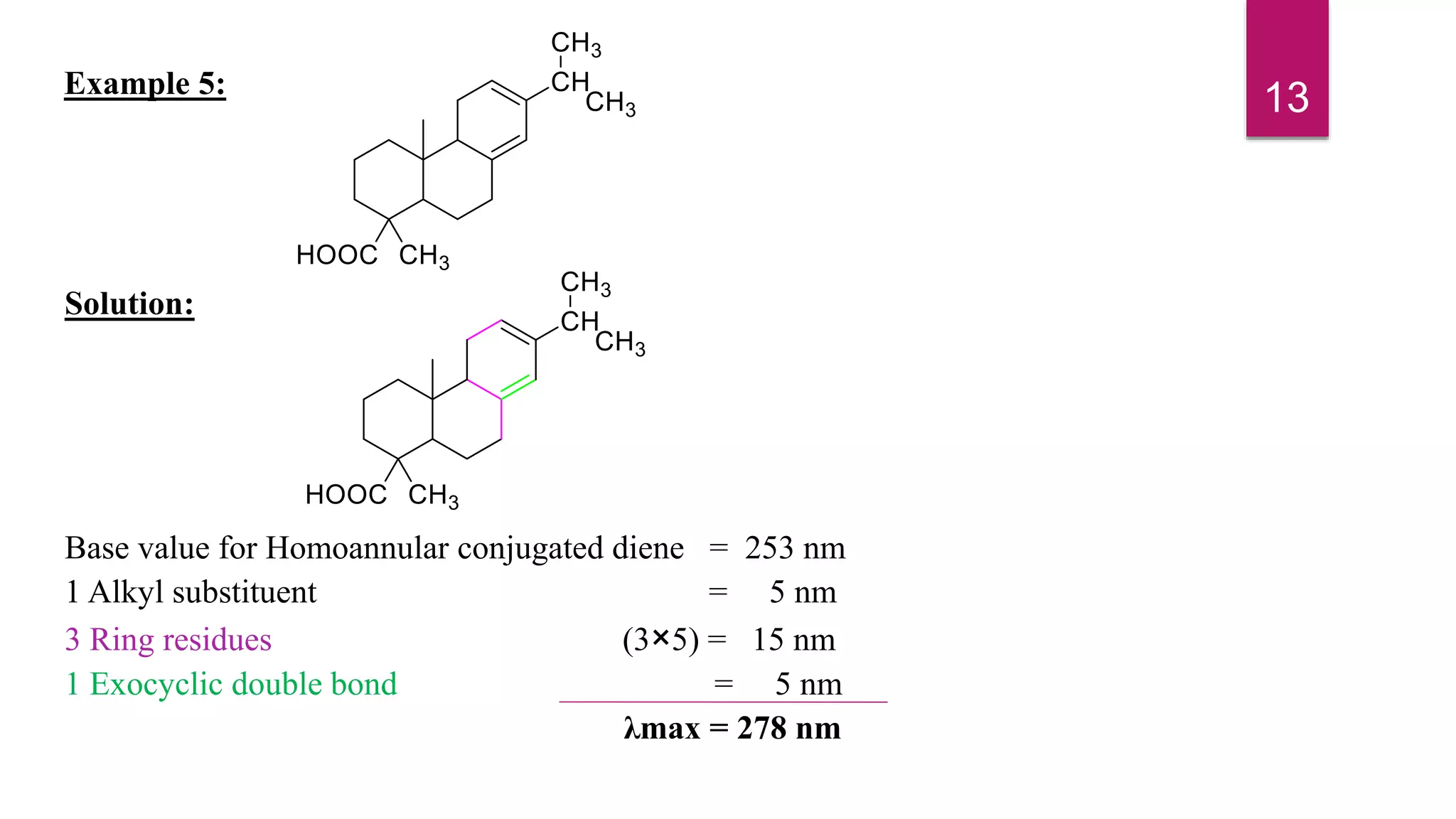
Example 5:
Solution:
Base value for Homoannular conjugated diene = 253 nm
1 Alkyl substituent = 5 nm
3 Ring residues (3×5) = 15 nm
1 Exocyclic double bond = 5 nm
λmax = 278 nm
13
Example 6:
Solution:
Base value for Homoannular conjugated diene = 253 nm
5 Ring residues (5×5) = 25 nm
2 Double bond extending conjugation (2×30) = 60 nm
3 Exocyclic double bond (3×5) = 15 nm
-OCOCH3 = 0 nm
λmax = 353 nm
14
B) WOODWARD_FIESER RULE FOR CYCLIC
DIENES (or AROMATIC COMPOUNDS)
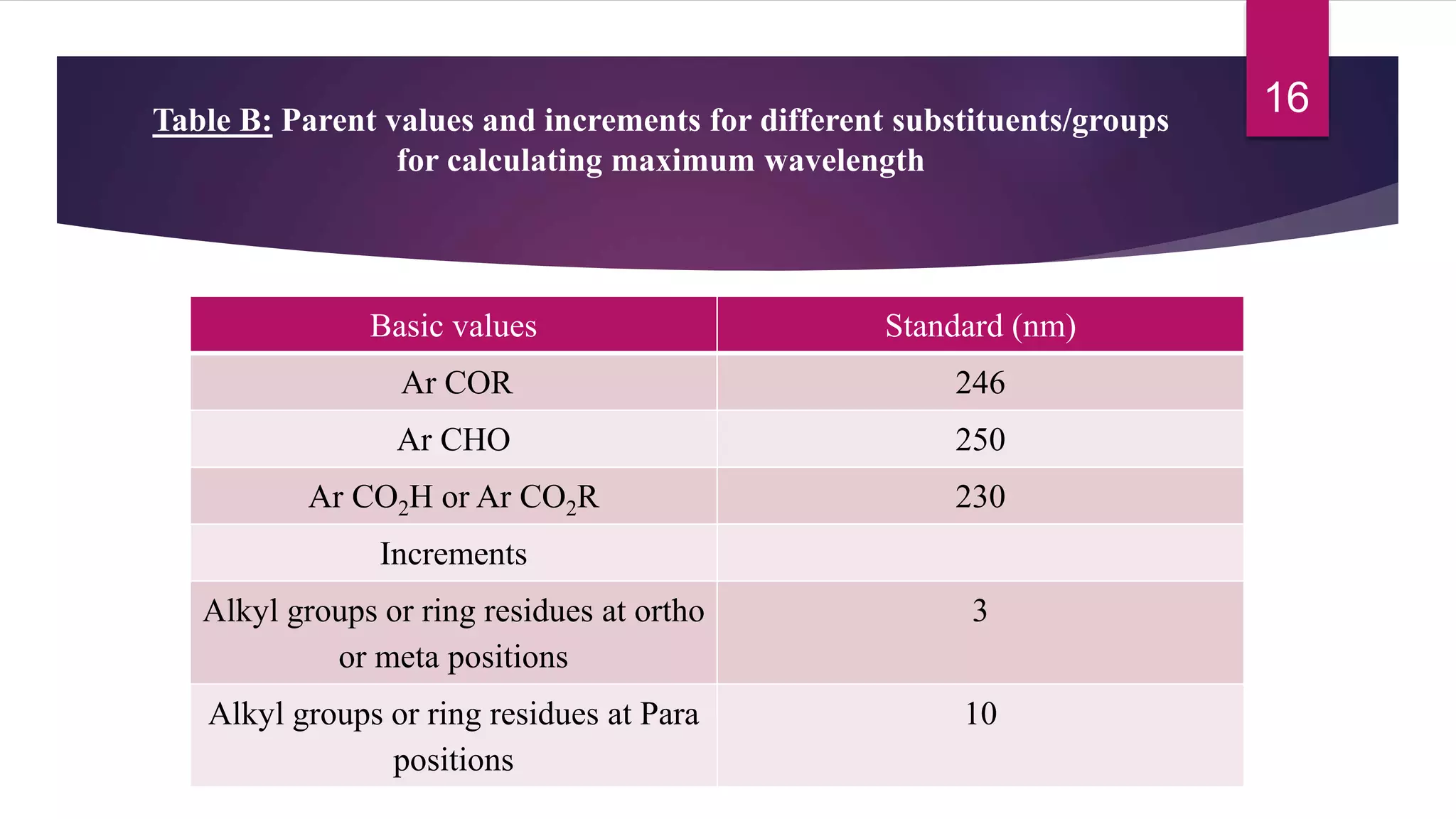
 Like Woodward fieser rules, Scott devised a set of rules for calculating the absorption
maximum for the derivatives of Acyl benzenes. These rules help in estimating the position of
absorption maximum (λmax) in ethanol in a number of mono substituted aromatic ketones,
aldehydes, acids, and esters.
15
Basic values Standard (nm)
Ar COR 246
Ar CHO 250
Ar CO2H or Ar CO2R 230
Increments
Alkyl groups or ring residues at ortho
or meta positions
3
Alkyl groups or ring residues at Para
positions
10
Table B: Parent values and increments for different substituents/groups
for calculating maximum wavelength
16
Values for substituents or groups:
Auxochromes Ortho
position(nm)
Meta
position(nm)
Para
position(nm)
-OH 7 7 25
-OCH3 7 7 25
-O(Oxonium) 11 20 78
-Cl 0 0 10
-Br 2 2 15
-NH2 13 13 58
-NHCOCH3 20 20 45
-N(CH3)2 20 20 85
17
Example 1:
Solution:
Base value for Aromatic ketone = 246 nm
Hydroxyl group at meta position = 7 nm
Hydroxyl group at para position = 25 nm
λmax = 278 nm
18
Example 2:
Solution:
Base value for Ar-COOH = 230 nm
Hydroxyl groups at meta positions (2×7) = 14 nm
Hydroxyl group at para position = 25 nm
λmax = 269 nm
19
Example 3:
Solution:
Base value = 246 nm
Ring residue = 3 nm
- OCH3 at meta position = 7 nm
λmax = 256 nm
20
C) WOODWARD-FIESER RULE FOR α,β -
UNSATURATED CARBONYL COMPOUNDS
(ENONES)
 Woodward and Fieser framed certain empirical rules for estimating the
absorption maximum for α,β-unsaturated carbonyl compounds. The rules
later modified by Scott.
21
Table C: Parent values and
increments for different
substituents/groups for
calculating maximum
wavelength
22
Values for substituents or groups:
Auxochromes α- β- γ- δ- or higher
-OH 35 30 - 50
-OR 35 30 17 31
-OAc 6 6 6 6
-Cl 15 12 - -
-Br 25 30 - -
-SR - 85 - -
-NR2 - 95 - -
23
Example 1:
Solution:
α, β-unsaturated acyclic ketone = 215 nm
2 alkyl groups at β-position (2×12) = 24 nm
λmax = 239 nm
24
Example 2:
Solution:
Base value for α, β-unsaturated six membered ring ketone = 214 nm
β- ring residue (1×12) = 12 nm
δ- ring residue (1×18) = 18 nm
1 Double bond extending Conjugation (1×30) = 30 nm
1 Exocyclic double bond = 5 nm
λmax = 279 nm
25
Example 3:
Solution:
Base value for α, β-unsaturated six membered ring ketone = 215 nm
Substitution of alkyl groups at α-position = 10 nm
Ring residue at β-position = 12 nm
λmax = 237 nm
26
Example 4:
Solution:
Basic value = 215 nm
2 β ring residue (2×12) = 24 nm
1Exocylic double bonds = 5 nm
λmax = 244 nm
27
Example 5:
Solution:
Basic value = 215 nm
ά-ring residue = 10 nm
δ-ring residue = 18 nm
1 Exocylic double bond = 5 nm
1Homoannular conjugated diene = 39 nm
1 Double bond extending conjugation = 30 nm
λmax = 317 nm
28
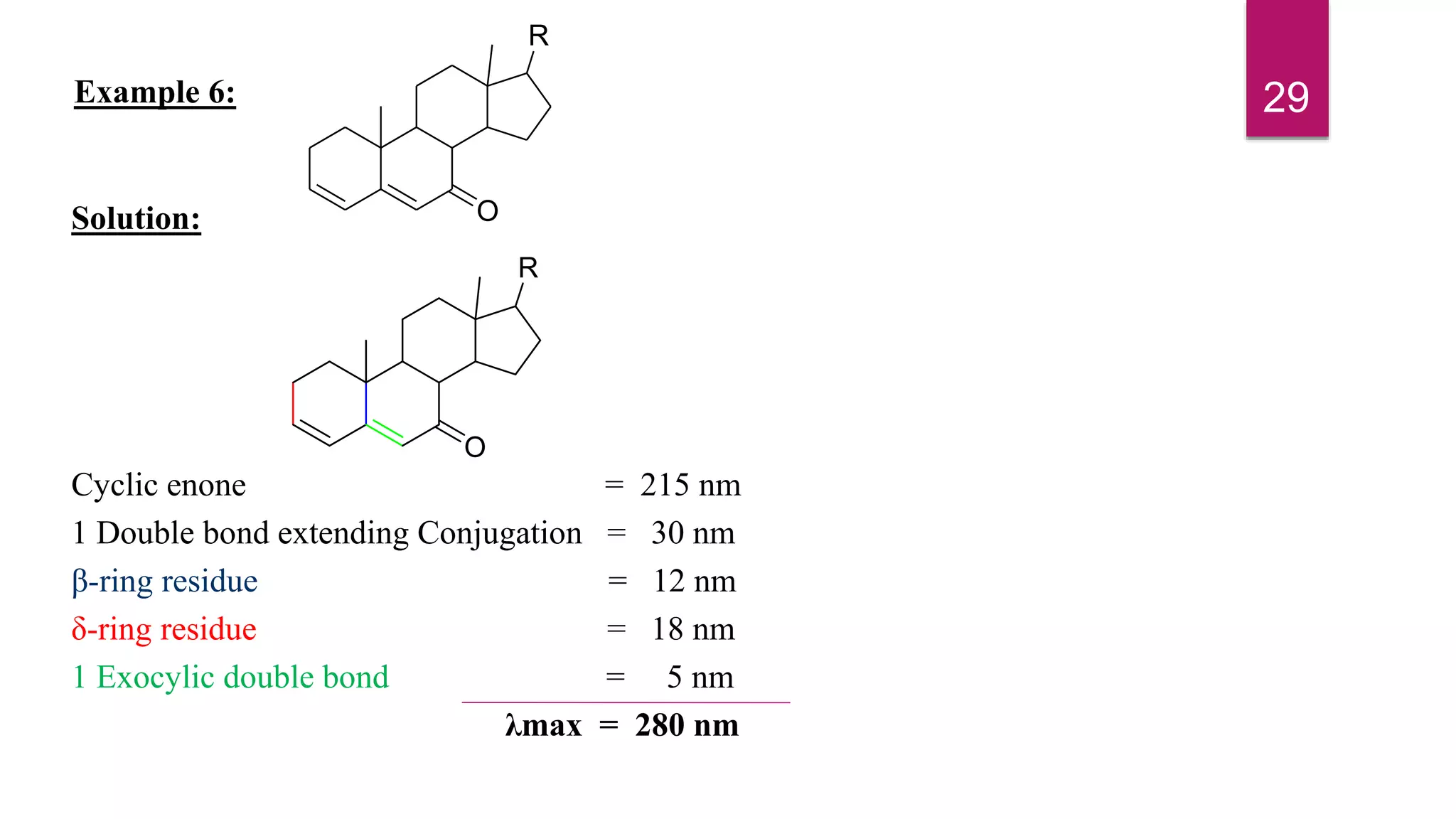
Example 6:
R
OSolution:
Cyclic enone = 215 nm
1 Double bond extending Conjugation = 30 nm
β-ring residue = 12 nm
δ-ring residue = 18 nm
1 Exocylic double bond = 5 nm
λmax = 280 nm
29
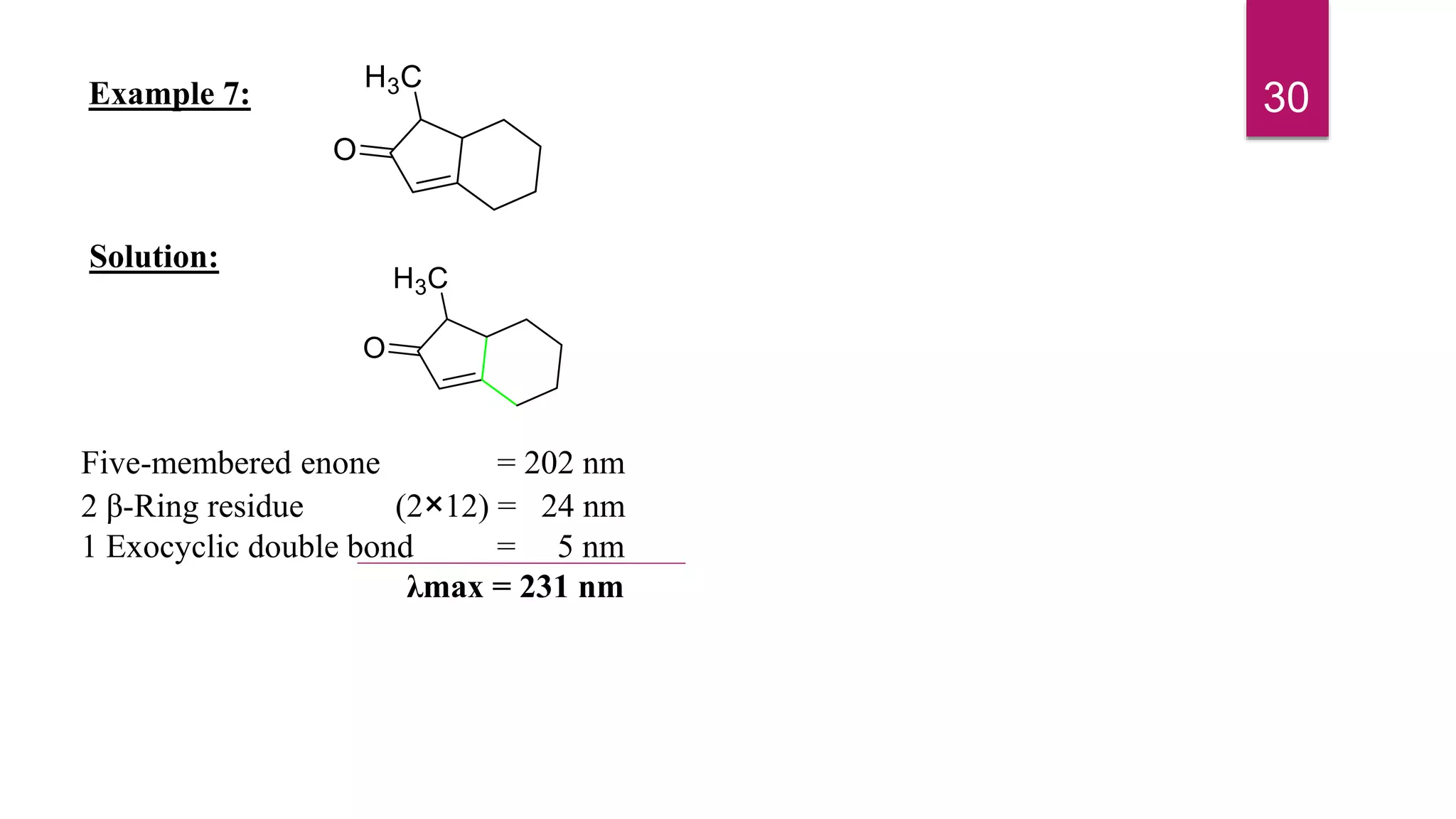
Example 7:
Five-membered enone = 202 nm
2 β-Ring residue (2×12) = 24 nm
1 Exocyclic double bond = 5 nm
λmax = 231 nm
Solution:
30
FIESER-KUHN RULE
 If the number of conjugated double bonds is more than 4, the Woodward and Fieser rules may
not be applicable and hence Fieser with Kuhn has derived an equation for predicting the λmax.
M = No. of alkyl substitutents
N = No. of conjugated double bonds
Rendo = No. of rings with endocyclic double bonds
Rexo = No. of rings with exocyclic double bonds
λmax = 114 + 5(M) + n(48-1.7n) - 16.5 Rendo - 10 Rexo
31
Examples:1
Solution:
No. of alkyl substituents = 10
No. of rings with endocyclic double bond=2
λmax = 114+5(M) + n(48-1.7n) -16.5 Rendo -10 Rexo
λmax = 114 + 5(10) +11(48-1.7×11) - (16.5×2) - (10×0) = 453.3 nm
32
POINTS TO REMEMBER
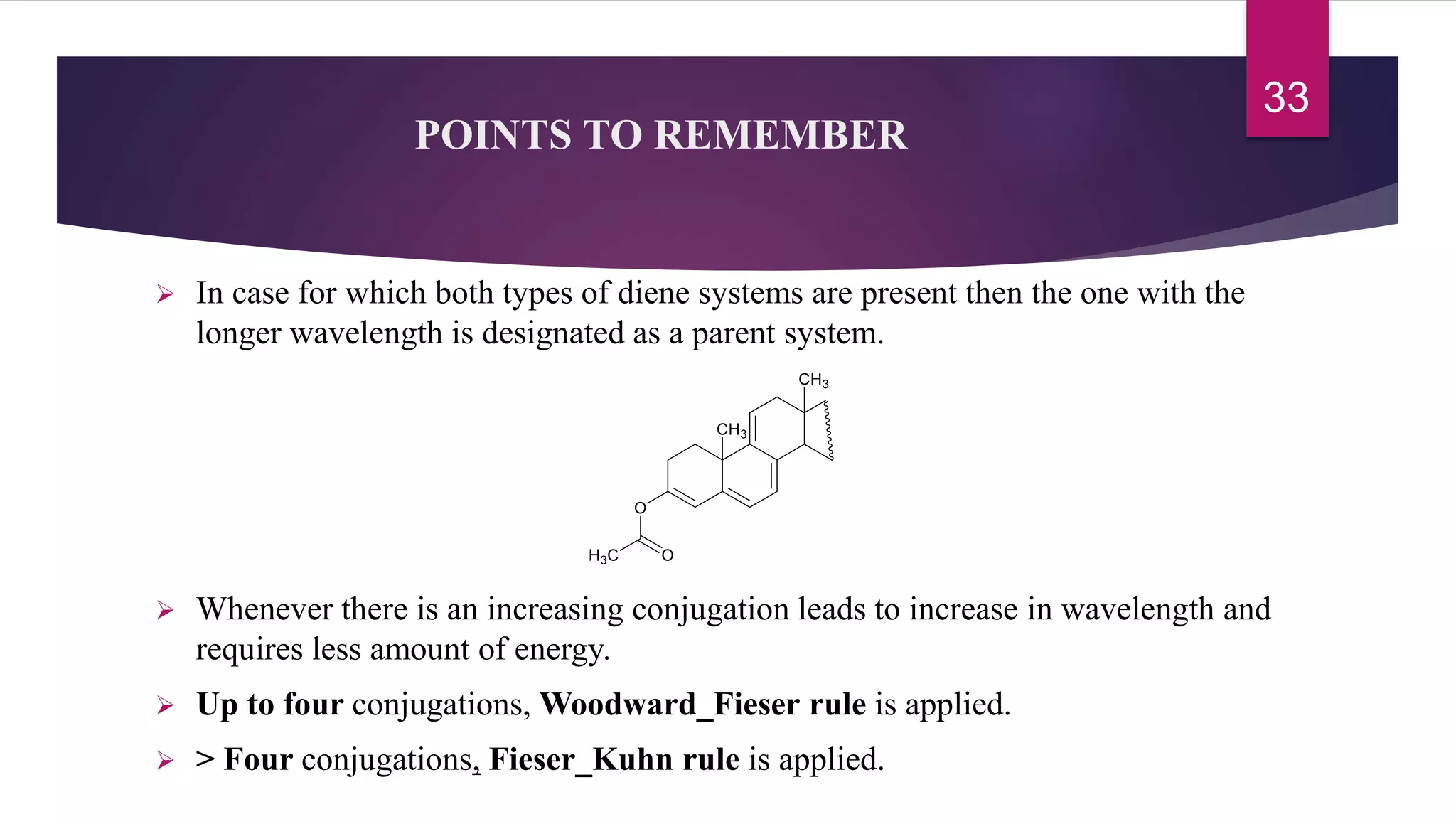
 In case for which both types of diene systems are present then the one with the
longer wavelength is designated as a parent system.
 Whenever there is an increasing conjugation leads to increase in wavelength and
requires less amount of energy.
 Up to four conjugations, Woodward_Fieser rule is applied.
 > Four conjugations, Fieser_Kuhn rule is applied.
33
REFRENCES
1) Donald L. Pavia, Gary M. Lampman, George S. Kriz, “ Spectroscopy”, published by Cengage
Learning, 2010. Pp. (379-387)
2) SHARMA Y.R., “Elementary Organic Spectroscopy”, published by S. Chand & Company
Ltd. 1st edition, 2006. Pp. (31-49)
3) CHATWAL G.R., ANAND S.K., “Instrumental Methods Of Chemical Analysis”, published
by Himalaya Publishing House, 5th edition, 2008. Pp. ( 2.162- 2.167)
4) KALSI P.S., “A Text Book Of Organic Spectroscopy”, published by NEW AGE
INTERNATIONAL PUBLISHERS, 6th edition. 2007. Pp. (40)
5) RAJASHEKARAN, “A Text Book Of UV-Visible and Infrared Spectroscopy”, Pp. (88-100)
34
35
36

Woodward__fieser Rule

  • 1.
    WOODWARD_FIESER RULE Presented By Faizan AhmedMd Israeel First Year M.Pharm. Department of Pharmaceutical Chemistry R. C. Patel Institute of Pharmaceutical Education and Research 1
  • 2.
    CONTENTS  Introduction  BasicTerminologies  Woodward_Fieser Rules For Dienes  Woodward_Fieser Rules For Aromatics  Woodward_Fieser Rules For α,β- unsaturated Carbonyl Compounds (Enones)  Fieser_Kuhn Rule  References 2
  • 3.
    WOODWARD_FIESER RULE Robert BurnsWoodward Louis Frederick Fieser 3
  • 4.
    INTRODUCTION  In 1945Robert Burns Woodward gave certain rules for correlating wavelength of maximum absorption (λmax) with molecular structure.  In 1959 Louis Fredrick Fieser modified these rules with more experimental data and the modified rule is known as Woodward_Fieser Rules.  Woodward rules work well for dienes and polyenes with upto 4-double bonds or less.  These sets of rules to calculate the wavelength of maximum absorption (λmax) of a compound in the ultraviolet-visible spectrum, based empirically have been called the Woodward_Fieser Rules or Woodward’s Rules.  This may be differs from observed value by 4-5nm. 4
  • 5.
    BASIC TERMINOLOGIES Homoannular dieneHeteroannular diene Endocyclic double bond Exocyclic double bond Double bond extending conjugation A B 5
  • 6.
    A) WOODWARD_FIESER RULEFOR CONJUGATED DIENES AND TRIENES  Conjugated diene: Organic compound containing two or more double bonds each separated from other by a single bond.  Base/Parent value: It means that each type of diene or triene system is having a certain fixed values at which absorption takes place; this constitutes the Base value or Parent value.  The contribution made by various alkyl substituents or ring residue, double bond extending conjugation and polar groups such as -Cl,-Br etc. are added to the base value to obtain λmax for a particular compound.  Longer the conjugated system greater the wavelength of absorption maximum.  According to Woodward’s rules the λmax of the molecule can be calculated using a formula: λmax = Base value + Σ Substituent Contributions + Σ Other Contributions 6
  • 7.
    Table A: Parentvalues and increments for different substituents /groups for calculating maximum wavelength Conjugated dienes correlations Standard (nm) (A) Parent value Homo-annular conjugated dienes 253 Hetero-annular conjugated dienes 214 Butadiene system or a cyclic conjugated dienes 217 Acyclic trienes 245 7
  • 8.
    (B) Increment foreach substituent Standard (nm) Alkyl substituent or ring residue 5 Exocyclic double bond 5 Double bond extending conjugation 30 (C) Auxochrome Standard (nm) –OCOCH3 0 –Cl,-Br 5 –OR 6 –SR 30 –NR2 60 8
  • 9.
    Example 1: Solution: Base valuefor Heteroannular conjugated diene = 214 nm 3 Ring residues (3×5) = 15 nm 1 Exocyclic double bond = 5 nm λmax = 234 nm 9
  • 10.
    Example 2: Solution: Base valuefor Homoannular conjugated Diene = 253 nm 3 Ring residues (3×5) = 15 nm 1 Exocylic double bond = 5 nm λmax = 273 nm 10
  • 11.
    Example 3: Solution: Base valuefor Heteroannular conjugated diene = 214 nm 3 Ring residues (3×5) = 15 nm 1 Exocyclic double bond = 5 nm λmax = 234 nm 11
  • 12.
    Example 4: Solution: Base valuefor Heteroannular conjugated diene = 214 nm 3 Ring residues (3×5) = 15 nm 1 Exocyclic double bond = 5 nm -OR (Alkoxy group) = 6 nm λmax = 240 nm 12
  • 13.
    Example 5: Solution: Base valuefor Homoannular conjugated diene = 253 nm 1 Alkyl substituent = 5 nm 3 Ring residues (3×5) = 15 nm 1 Exocyclic double bond = 5 nm λmax = 278 nm 13
  • 14.
    Example 6: Solution: Base valuefor Homoannular conjugated diene = 253 nm 5 Ring residues (5×5) = 25 nm 2 Double bond extending conjugation (2×30) = 60 nm 3 Exocyclic double bond (3×5) = 15 nm -OCOCH3 = 0 nm λmax = 353 nm 14
  • 15.
    B) WOODWARD_FIESER RULEFOR CYCLIC DIENES (or AROMATIC COMPOUNDS)  Like Woodward fieser rules, Scott devised a set of rules for calculating the absorption maximum for the derivatives of Acyl benzenes. These rules help in estimating the position of absorption maximum (λmax) in ethanol in a number of mono substituted aromatic ketones, aldehydes, acids, and esters. 15
  • 16.
    Basic values Standard(nm) Ar COR 246 Ar CHO 250 Ar CO2H or Ar CO2R 230 Increments Alkyl groups or ring residues at ortho or meta positions 3 Alkyl groups or ring residues at Para positions 10 Table B: Parent values and increments for different substituents/groups for calculating maximum wavelength 16
  • 17.
    Values for substituentsor groups: Auxochromes Ortho position(nm) Meta position(nm) Para position(nm) -OH 7 7 25 -OCH3 7 7 25 -O(Oxonium) 11 20 78 -Cl 0 0 10 -Br 2 2 15 -NH2 13 13 58 -NHCOCH3 20 20 45 -N(CH3)2 20 20 85 17
  • 18.
    Example 1: Solution: Base valuefor Aromatic ketone = 246 nm Hydroxyl group at meta position = 7 nm Hydroxyl group at para position = 25 nm λmax = 278 nm 18
  • 19.
    Example 2: Solution: Base valuefor Ar-COOH = 230 nm Hydroxyl groups at meta positions (2×7) = 14 nm Hydroxyl group at para position = 25 nm λmax = 269 nm 19
  • 20.
    Example 3: Solution: Base value= 246 nm Ring residue = 3 nm - OCH3 at meta position = 7 nm λmax = 256 nm 20
  • 21.
    C) WOODWARD-FIESER RULEFOR α,β - UNSATURATED CARBONYL COMPOUNDS (ENONES)  Woodward and Fieser framed certain empirical rules for estimating the absorption maximum for α,β-unsaturated carbonyl compounds. The rules later modified by Scott. 21
  • 22.
    Table C: Parentvalues and increments for different substituents/groups for calculating maximum wavelength 22
  • 23.
    Values for substituentsor groups: Auxochromes α- β- γ- δ- or higher -OH 35 30 - 50 -OR 35 30 17 31 -OAc 6 6 6 6 -Cl 15 12 - - -Br 25 30 - - -SR - 85 - - -NR2 - 95 - - 23
  • 24.
    Example 1: Solution: α, β-unsaturatedacyclic ketone = 215 nm 2 alkyl groups at β-position (2×12) = 24 nm λmax = 239 nm 24
  • 25.
    Example 2: Solution: Base valuefor α, β-unsaturated six membered ring ketone = 214 nm β- ring residue (1×12) = 12 nm δ- ring residue (1×18) = 18 nm 1 Double bond extending Conjugation (1×30) = 30 nm 1 Exocyclic double bond = 5 nm λmax = 279 nm 25
  • 26.
    Example 3: Solution: Base valuefor α, β-unsaturated six membered ring ketone = 215 nm Substitution of alkyl groups at α-position = 10 nm Ring residue at β-position = 12 nm λmax = 237 nm 26
  • 27.
    Example 4: Solution: Basic value= 215 nm 2 β ring residue (2×12) = 24 nm 1Exocylic double bonds = 5 nm λmax = 244 nm 27
  • 28.
    Example 5: Solution: Basic value= 215 nm ά-ring residue = 10 nm δ-ring residue = 18 nm 1 Exocylic double bond = 5 nm 1Homoannular conjugated diene = 39 nm 1 Double bond extending conjugation = 30 nm λmax = 317 nm 28
  • 29.
    Example 6: R OSolution: Cyclic enone= 215 nm 1 Double bond extending Conjugation = 30 nm β-ring residue = 12 nm δ-ring residue = 18 nm 1 Exocylic double bond = 5 nm λmax = 280 nm 29
  • 30.
    Example 7: Five-membered enone= 202 nm 2 β-Ring residue (2×12) = 24 nm 1 Exocyclic double bond = 5 nm λmax = 231 nm Solution: 30
  • 31.
    FIESER-KUHN RULE  Ifthe number of conjugated double bonds is more than 4, the Woodward and Fieser rules may not be applicable and hence Fieser with Kuhn has derived an equation for predicting the λmax. M = No. of alkyl substitutents N = No. of conjugated double bonds Rendo = No. of rings with endocyclic double bonds Rexo = No. of rings with exocyclic double bonds λmax = 114 + 5(M) + n(48-1.7n) - 16.5 Rendo - 10 Rexo 31
  • 32.
    Examples:1 Solution: No. of alkylsubstituents = 10 No. of rings with endocyclic double bond=2 λmax = 114+5(M) + n(48-1.7n) -16.5 Rendo -10 Rexo λmax = 114 + 5(10) +11(48-1.7×11) - (16.5×2) - (10×0) = 453.3 nm 32
  • 33.
    POINTS TO REMEMBER In case for which both types of diene systems are present then the one with the longer wavelength is designated as a parent system.  Whenever there is an increasing conjugation leads to increase in wavelength and requires less amount of energy.  Up to four conjugations, Woodward_Fieser rule is applied.  > Four conjugations, Fieser_Kuhn rule is applied. 33
  • 34.
    REFRENCES 1) Donald L.Pavia, Gary M. Lampman, George S. Kriz, “ Spectroscopy”, published by Cengage Learning, 2010. Pp. (379-387) 2) SHARMA Y.R., “Elementary Organic Spectroscopy”, published by S. Chand & Company Ltd. 1st edition, 2006. Pp. (31-49) 3) CHATWAL G.R., ANAND S.K., “Instrumental Methods Of Chemical Analysis”, published by Himalaya Publishing House, 5th edition, 2008. Pp. ( 2.162- 2.167) 4) KALSI P.S., “A Text Book Of Organic Spectroscopy”, published by NEW AGE INTERNATIONAL PUBLISHERS, 6th edition. 2007. Pp. (40) 5) RAJASHEKARAN, “A Text Book Of UV-Visible and Infrared Spectroscopy”, Pp. (88-100) 34
  • 35.
  • 36.