UV - VISIBLE SPECTROPHOTOMETER HARIS P
Spectrophotometer • Measures the light that passes through a liquid sample • Spectrophotometer gives readings in Percent Transmittance (%T) and in Absorbance (A)
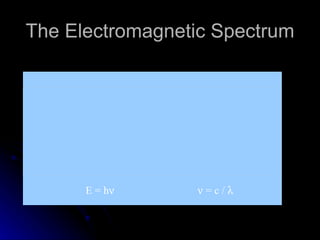
The Electromagnetic Spectrum    = c /   E = h 
Absorbance and Complementary Colors
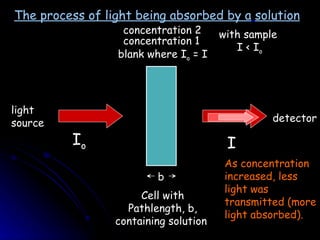
I o I Cell with Pathlength, b, containing solution  light source detector blank where I o  = I concentration 2 concentration 1 b with sample  I < I o The process of light being absorbed by a   solution As concentration increased, less light was transmitted (more light absorbed).
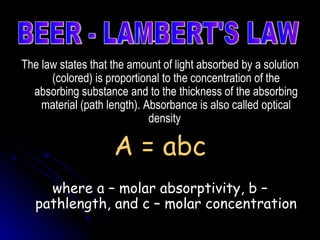
The law states that the amount of light absorbed by a solution (colored) is proportional to the concentration of the absorbing substance and to the thickness of the absorbing material (path length). Absorbance is also called optical density  A = abc where a – molar absorptivity, b – pathlength, and c – molar concentration BEER - LAMBERT'S LAW
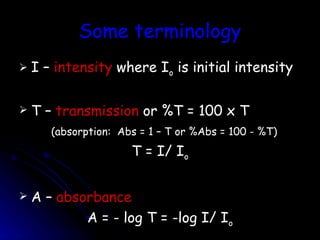
Some terminology I –  intensity  where I o  is initial intensity T –  transmission  or %T = 100 x T (absorption:  Abs = 1 – T or %Abs = 100 - %T) T = I/ I o A –  absorbance A = - log T = -log I/ I o
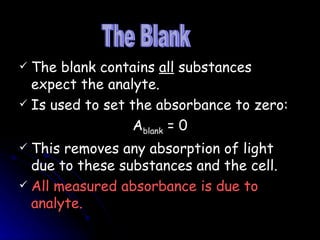
The blank contains  all  substances expect the analyte. Is used to set the absorbance to zero: A blank  = 0 This removes any absorption of light due to these substances and the cell. All measured absorbance is due to analyte. The Blank
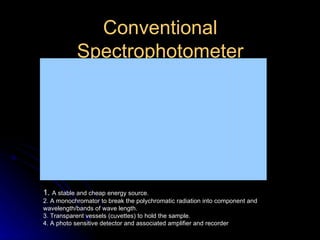
Conventional Spectrophotometer 1.  A stable and cheap energy source. 2. A monochromator to break the polychromatic radiation into component and wavelength/bands of wave length. 3. Transparent vessels (cuvettes) to hold the sample. 4. A photo sensitive detector and associated amplifier and recorder
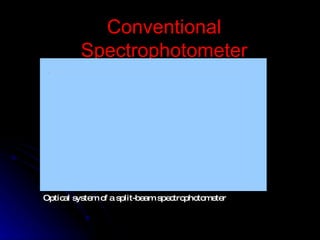
Conventional Spectrophotometer Optical system of a split-beam spectrophotometer
LIGHT SOURCES    UV Spectrophotometer 1. Hydrogen Gas Lamp 2. Mercury Lamp Visible Spectrophotometer 1. Tungsten Lamp IR Spectrophotometer 1. Carborundum (SIC)
Light Source Deuterium Arc Lamp   UV Region Wavelength Range : 190~420nm Tungsten Lamp   Wavelength Range : Part of the UV and the whole of the Visible range ( 약 350 ~ 2,500nm) Xenon Lamp   Wavelength Range : 190~800nm
Monochromator Accepts polychromatic input light from a lamp and outputs  monochromatic light Components  : Entrance slit, Dispersion device, Exit slit. The resolving element are of two kinds namely, prisms  and diffraction gratings. Simple glass prisms are used for visible range. For UV region silica, fused silica or quartz prism is used. Fluorite is used in vaccum UV range.  Gratings  are often used in the monochromators of spectrophotometers operating in UV, visible and infra red regions. Their resolving power is far superior to that of prisms & they yield a linear resolution of spectrum.
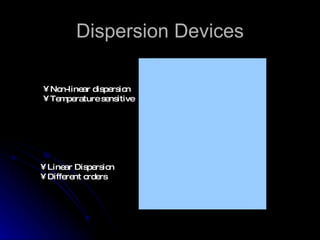
Dispersion Devices Non-linear dispersion Temperature sensitive Linear Dispersion Different orders
CELLS  UV Spectrophotometer Quartz (crystalline silica)   Visible Spectrophotometer Glass   IR Spectrophotometer NaCl
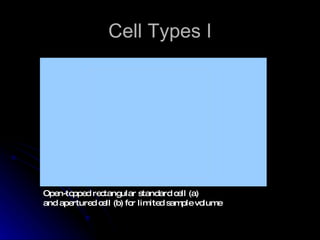
Cell Types I Open-topped rectangular standard cell (a)  and apertured cell (b) for limited sample volume
Cell Types II Micro cell (a) for very small volumes  and flow-through cell (b) for automated applications
Detection Devices Most detectors depend on the photoelectric effect, where incident light photons) liberates electrons from a metal or other material surface. Important requirements for a detector  (1)high sensitivity to allow the detection of low levels of radiant energy, (2)short response time, (3)long term stability, and  (4)an electronic signal which is easily amplified for typical read out apparatus, Ultraviolet and visible radiation detectors are photocells, phototubes and photo multiplier tubes.
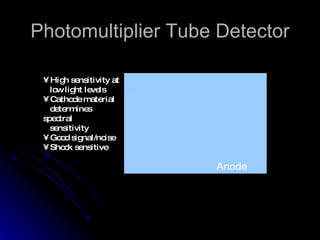
Photomultiplier Tube Detector Anode High sensitivity at  low light levels Cathode material determines spectral    sensitivity Good signal/noise Shock sensitive
Amplification and Readout Radiation detectors generate electronic signals which are proportional to the transmitter light.  These signals need to be translated to a form that is easy to interpret.  This is accomplished by using amplifiers, ammeters, potentiometers, and potentiometric recorders.
1. Qualitative Analysis 2. Quantitative Analysis 3. Molecular weight determination 4. Study of cis-trans Isomerism 5. Other Physiochemical studies 6. Control of Purification 7.  Difference Spectroscopy 8. Turbidimetry Applications of UV - Visible Spectroscopy
Thank You

Uv – Visible Spectrophotometer.HARIS

  • 1.
    UV - VISIBLESPECTROPHOTOMETER HARIS P
  • 2.
    Spectrophotometer • Measuresthe light that passes through a liquid sample • Spectrophotometer gives readings in Percent Transmittance (%T) and in Absorbance (A)
  • 3.
    The Electromagnetic Spectrum = c /  E = h 
  • 4.
  • 5.
    I o ICell with Pathlength, b, containing solution light source detector blank where I o = I concentration 2 concentration 1 b with sample I < I o The process of light being absorbed by a solution As concentration increased, less light was transmitted (more light absorbed).
  • 6.
    The law statesthat the amount of light absorbed by a solution (colored) is proportional to the concentration of the absorbing substance and to the thickness of the absorbing material (path length). Absorbance is also called optical density A = abc where a – molar absorptivity, b – pathlength, and c – molar concentration BEER - LAMBERT'S LAW
  • 7.
    Some terminology I– intensity where I o is initial intensity T – transmission or %T = 100 x T (absorption: Abs = 1 – T or %Abs = 100 - %T) T = I/ I o A – absorbance A = - log T = -log I/ I o
  • 8.
    The blank contains all substances expect the analyte. Is used to set the absorbance to zero: A blank = 0 This removes any absorption of light due to these substances and the cell. All measured absorbance is due to analyte. The Blank
  • 9.
    Conventional Spectrophotometer 1. A stable and cheap energy source. 2. A monochromator to break the polychromatic radiation into component and wavelength/bands of wave length. 3. Transparent vessels (cuvettes) to hold the sample. 4. A photo sensitive detector and associated amplifier and recorder
  • 10.
    Conventional Spectrophotometer Opticalsystem of a split-beam spectrophotometer
  • 11.
    LIGHT SOURCES   UV Spectrophotometer 1. Hydrogen Gas Lamp 2. Mercury Lamp Visible Spectrophotometer 1. Tungsten Lamp IR Spectrophotometer 1. Carborundum (SIC)
  • 12.
    Light Source DeuteriumArc Lamp UV Region Wavelength Range : 190~420nm Tungsten Lamp Wavelength Range : Part of the UV and the whole of the Visible range ( 약 350 ~ 2,500nm) Xenon Lamp Wavelength Range : 190~800nm
  • 13.
    Monochromator Accepts polychromaticinput light from a lamp and outputs monochromatic light Components : Entrance slit, Dispersion device, Exit slit. The resolving element are of two kinds namely, prisms and diffraction gratings. Simple glass prisms are used for visible range. For UV region silica, fused silica or quartz prism is used. Fluorite is used in vaccum UV range. Gratings are often used in the monochromators of spectrophotometers operating in UV, visible and infra red regions. Their resolving power is far superior to that of prisms & they yield a linear resolution of spectrum.
  • 14.
    Dispersion Devices Non-lineardispersion Temperature sensitive Linear Dispersion Different orders
  • 15.
    CELLS UVSpectrophotometer Quartz (crystalline silica)   Visible Spectrophotometer Glass   IR Spectrophotometer NaCl
  • 16.
    Cell Types IOpen-topped rectangular standard cell (a) and apertured cell (b) for limited sample volume
  • 17.
    Cell Types IIMicro cell (a) for very small volumes and flow-through cell (b) for automated applications
  • 18.
    Detection Devices Mostdetectors depend on the photoelectric effect, where incident light photons) liberates electrons from a metal or other material surface. Important requirements for a detector (1)high sensitivity to allow the detection of low levels of radiant energy, (2)short response time, (3)long term stability, and (4)an electronic signal which is easily amplified for typical read out apparatus, Ultraviolet and visible radiation detectors are photocells, phototubes and photo multiplier tubes.
  • 19.
    Photomultiplier Tube DetectorAnode High sensitivity at low light levels Cathode material determines spectral sensitivity Good signal/noise Shock sensitive
  • 20.
    Amplification and ReadoutRadiation detectors generate electronic signals which are proportional to the transmitter light. These signals need to be translated to a form that is easy to interpret. This is accomplished by using amplifiers, ammeters, potentiometers, and potentiometric recorders.
  • 21.
    1. Qualitative Analysis2. Quantitative Analysis 3. Molecular weight determination 4. Study of cis-trans Isomerism 5. Other Physiochemical studies 6. Control of Purification 7. Difference Spectroscopy 8. Turbidimetry Applications of UV - Visible Spectroscopy
  • 22.