Brain Mechanisms of Movement
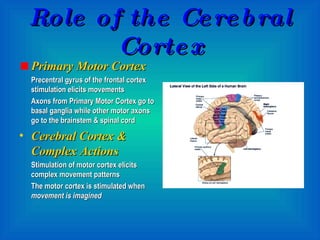
Role of the Cerebral Cortex Primary Motor Cortex Precentral gyrus of the frontal cortex stimulation elicits movements Axons from Primary Motor Cortex go to basal ganglia while other motor axons go to the brainstem & spinal cord Cerebral Cortex & Complex Actions Stimulation of motor cortex elicits complex movement patterns The motor cortex is stimulated when  movement is imagined
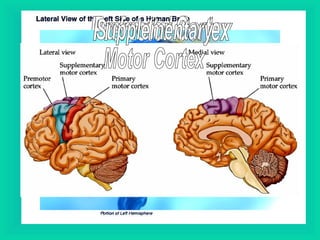
Areas Near the Primary Motor Cortex Posterior Parietal Cortex Primary Somatosensory Cortex Prefrontal Cortex Premotor Cortex Supplementary Motor Cortex
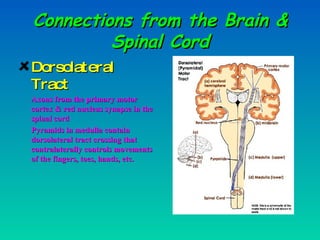
Connections from the Brain & Spinal Cord Dorsolateral Tract Axons from the primary motor cortex & red nucleus synapse in the spinal cord Pyramids in medulla contain dorsolateral tract crossing that contralaterally controls movements of the fingers, toes, hands, etc.
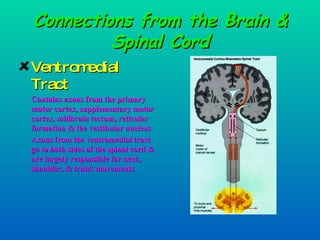
Connections from the Brain & Spinal Cord Ventromedial Tract Contains axons from the primary motor cortex, supplementary motor cortex, midbrain tectum, reticular formation & the vestibular nucleus Axons from the ventromedial tract go to both sides of the spinal cord & are largely responsible for neck, shoulder, & trunk movements
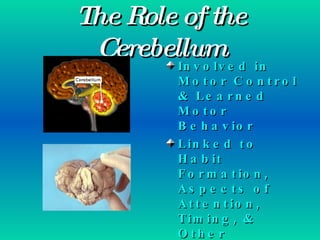
The Role of the Cerebellum Involved in Motor Control & Learned Motor Behavior Linked to Habit Formation, Aspects of Attention, Timing, & Other Psychological Motor Functions
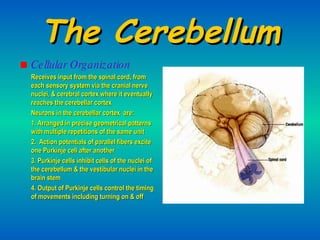
The Cerebellum Cellular Organization Receives input from the spinal cord, from each sensory system via the cranial nerve nuclei, & cerebral cortex where it eventually reaches the cerebellar cortex Neurons in the cerebellar cortex  are: 1. Arranged in precise geometrical patterns with multiple repetitions of the same unit 2.  Action potentials of parallel fibers excite one Purkinje cell after another 3. Purkinje cells inhibit cells of the nuclei of the cerebellum & the vestibular nuclei in the brain stem 4. Output of Purkinje cells control the timing of movements including turning on & off
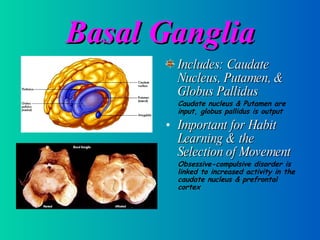
Basal Ganglia Includes: Caudate Nucleus, Putamen, & Globus Pallidus Caudate nucleus & Putamen are input, globus pallidus is output Important for Habit Learning & the Selection of Movement Obsessive-compulsive disorder is linked to increased activity in the caudate nucleus & prefrontal cortex
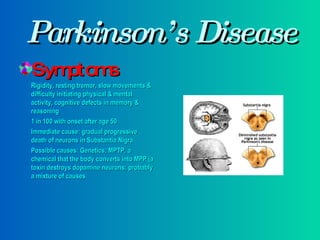
Parkinson’s Disease Symptoms Rigidity, resting tremor, slow movements & difficulty initiating physical & mental activity, cognitive defects in memory & reasoning 1 in 100 with onset after age 50 Immediate cause: gradual progressive death of neurons in Substantia Nigra Possible causes: Genetics; MPTP, a chemical that the body converts into MPP (a toxin destroys dopamine neurons; probably a mixture of causes
Parkinson’s Disease Standard Treatment L-Dopa Precursor to dopamine Effectiveness varies Doesn’t prevent the loss of dopamine containing neurons & may contribute to the death of neurons Produces harmful side-effects Alternative Treatments Antioxidant drugs Direct dopamine agonists Glutamate antagonists Neurotrophins Apoptosis blockers High frequency electrical stimulation of the Globus Pallidus Surgical damage to the Globus Pallidus or parts of the Thalamus
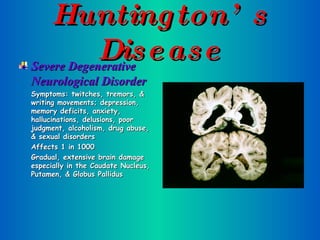
Huntington’s Disease Severe Degenerative Neurological Disorder Symptoms: twitches, tremors, & writing movements; depression, memory deficits, anxiety, hallucinations, delusions, poor judgment, alcoholism, drug abuse, & sexual disorders Affects 1 in 1000 Gradual, extensive brain damage especially in the Caudate Nucleus, Putamen, & Globus Pallidus
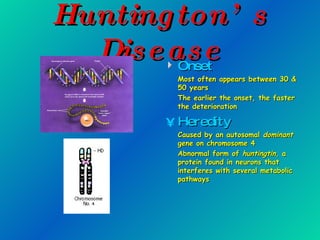
Huntington’s Disease Onset Most often appears between 30 & 50 years The earlier the onset, the faster the deterioration Heredity Caused by an autosomal  dominant  gene on chromosome 4 Abnormal form of  huntingtin , a protein found in neurons that interferes with several metabolic pathways

Chapter 08: Movement

  • 1.
  • 2.
    Role of theCerebral Cortex Primary Motor Cortex Precentral gyrus of the frontal cortex stimulation elicits movements Axons from Primary Motor Cortex go to basal ganglia while other motor axons go to the brainstem & spinal cord Cerebral Cortex & Complex Actions Stimulation of motor cortex elicits complex movement patterns The motor cortex is stimulated when movement is imagined
  • 3.
    Areas Near thePrimary Motor Cortex Posterior Parietal Cortex Primary Somatosensory Cortex Prefrontal Cortex Premotor Cortex Supplementary Motor Cortex
  • 4.
    Connections from theBrain & Spinal Cord Dorsolateral Tract Axons from the primary motor cortex & red nucleus synapse in the spinal cord Pyramids in medulla contain dorsolateral tract crossing that contralaterally controls movements of the fingers, toes, hands, etc.
  • 5.
    Connections from theBrain & Spinal Cord Ventromedial Tract Contains axons from the primary motor cortex, supplementary motor cortex, midbrain tectum, reticular formation & the vestibular nucleus Axons from the ventromedial tract go to both sides of the spinal cord & are largely responsible for neck, shoulder, & trunk movements
  • 6.
    The Role ofthe Cerebellum Involved in Motor Control & Learned Motor Behavior Linked to Habit Formation, Aspects of Attention, Timing, & Other Psychological Motor Functions
  • 7.
    The Cerebellum CellularOrganization Receives input from the spinal cord, from each sensory system via the cranial nerve nuclei, & cerebral cortex where it eventually reaches the cerebellar cortex Neurons in the cerebellar cortex are: 1. Arranged in precise geometrical patterns with multiple repetitions of the same unit 2. Action potentials of parallel fibers excite one Purkinje cell after another 3. Purkinje cells inhibit cells of the nuclei of the cerebellum & the vestibular nuclei in the brain stem 4. Output of Purkinje cells control the timing of movements including turning on & off
  • 8.
    Basal Ganglia Includes:Caudate Nucleus, Putamen, & Globus Pallidus Caudate nucleus & Putamen are input, globus pallidus is output Important for Habit Learning & the Selection of Movement Obsessive-compulsive disorder is linked to increased activity in the caudate nucleus & prefrontal cortex
  • 9.
    Parkinson’s Disease SymptomsRigidity, resting tremor, slow movements & difficulty initiating physical & mental activity, cognitive defects in memory & reasoning 1 in 100 with onset after age 50 Immediate cause: gradual progressive death of neurons in Substantia Nigra Possible causes: Genetics; MPTP, a chemical that the body converts into MPP (a toxin destroys dopamine neurons; probably a mixture of causes
  • 10.
    Parkinson’s Disease StandardTreatment L-Dopa Precursor to dopamine Effectiveness varies Doesn’t prevent the loss of dopamine containing neurons & may contribute to the death of neurons Produces harmful side-effects Alternative Treatments Antioxidant drugs Direct dopamine agonists Glutamate antagonists Neurotrophins Apoptosis blockers High frequency electrical stimulation of the Globus Pallidus Surgical damage to the Globus Pallidus or parts of the Thalamus
  • 11.
    Huntington’s Disease SevereDegenerative Neurological Disorder Symptoms: twitches, tremors, & writing movements; depression, memory deficits, anxiety, hallucinations, delusions, poor judgment, alcoholism, drug abuse, & sexual disorders Affects 1 in 1000 Gradual, extensive brain damage especially in the Caudate Nucleus, Putamen, & Globus Pallidus
  • 12.
    Huntington’s Disease OnsetMost often appears between 30 & 50 years The earlier the onset, the faster the deterioration Heredity Caused by an autosomal dominant gene on chromosome 4 Abnormal form of huntingtin , a protein found in neurons that interferes with several metabolic pathways