Neurologic System  The Motor System and the Cerebellar Function
Motor Pathways &  Type of Movements Corticospinal or Pyramidal Tract Voluntary, skilled, discrete, purposeful (writing) Extrapyramidal Tracts Maintain muscle tone and control body movements (walking) Cerebellar System Coordinates movement, maintains equilibrium and posture….Operates on subconsious level
Question for Thought Describe 3 major motor pathways in the CNS including the type of movements mediated by each?
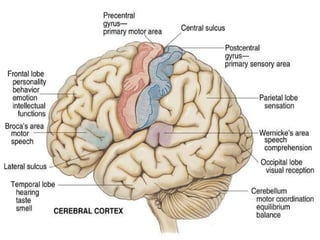
Chapter 21 Cerebral Cortex Figure 21-1. p. 688.
Upper and Lower Motor Neurons Upper motor neurons All descending motor neurons that impact on the lower motor neurons Located in the CNS  Convey impulses from motor areas of cerebral cortex to lower motor neurons in the cord Diseases = CVA, Cerebral palsy, Multiple sclerosis
Upper and Lower Motor Neurons Lower motor neurons In the peripheral nervous system 12 cranial nerves 31 pairs of spinal nerves and all branches Final direct contact with the muscles Movement translated into action Reflex arc Examples = cranial nerves, spinal nerves Diseases = spinal cord lesions, poliomyelitis, ALS
Question for Thought Differentiate an upper motor neuron from a lower motor neuron?
Subjective Data In the Interview Any shakes or tremors in the hands or face? Worsen with anxiety, fatigue Relieved with activity, alcohol ADL’s affected Weakness Where? When? Why?
Subjective Data Incoordination Balance, falling,  Legs give out Clumsy Numbness/ Tingling Describe ( pins and needles) Significant past history  TIA’s, Atrial Fib.
Assessment of Motor System Body position Involuntary movements Muscle size ( bulk) Muscle tone Muscle strength
Body Position Observe during movement  Observe at rest
Involuntary Movements Tremors, tics, fasciculations, myoclonus Note:  Location Quality Rate Rhythm Amplitude
Involuntary Movements Note the involuntary movement in relation to : Posture Activity Fatigue Emotion Other factors
Terms to Describe Movement Flexion Extension Abduction Adduction Pronation Supination
More Terms for Movement Circumduction Inversion Eversion Rotation Protraction
Terms of Movement Continued Retraction Elevation Depression
Muscle Size Compare size and contour Atrophy Unilateral/bilateral Proximal/distal
Muscle Tone A relaxed muscle maintains a slight residual tension referred to as muscle tone. Hypo tonic, Flaccidity. Spasticity. Lead-pipe rigidity.
Muscle Strength Test muscle strength by asking the client to move actively against your resistance or to resist your movement. A muscle is strongest when shortest and weakest when longest.
Terms to Describe Strength Weakness (paresis) Paralysis (plegia) Hemiparesis Hemiplegia Paraplegia Quadriplegia
Grading Muscle Strength Scale 0-5 0 -  no muscular contraction  1 – slight contraction 2 – Full ROM, gravity eliminated
Grading Muscle Strength 3 – Full ROM against gravity 4 – Full ROM against gravity, some resistance 5 – Full ROM against gravity full resistance without evident fatigue = Normal Muscle Strength
Cerebellar Function Balance tests Gait Observe normal walk Tandem Walking ( heel – to- toe ) Romberg Test  (stand, feet together, arms at side, close eyes) Shallow knee bend or hop on one leg What findings would you expect to see when assessing gait and balance in an older adult?
Cerebellar Function Coordination and Skilled Movements RAM ( Rapid alternating movements) Pat Knees Thumb to each finger Finger to finger Finger to nose Heel to shin
Question for Thought List and describe 3 tests of cerebellar function?
Charting Sample For Normal Muscle Strength (objective) Able to maintain flexion against resistance and without tenderness For Motor ( objective) No atrophy, weakness or tremors. Gait smooth and coordinated, able to tandem walk, negative Romberg. RAM, finger-to-nose smoothly intact

NurseReview.Org - Proprioception & Cerebellar Function

  • 1.
    Neurologic System The Motor System and the Cerebellar Function
  • 2.
    Motor Pathways & Type of Movements Corticospinal or Pyramidal Tract Voluntary, skilled, discrete, purposeful (writing) Extrapyramidal Tracts Maintain muscle tone and control body movements (walking) Cerebellar System Coordinates movement, maintains equilibrium and posture….Operates on subconsious level
  • 3.
    Question for ThoughtDescribe 3 major motor pathways in the CNS including the type of movements mediated by each?
  • 4.
    Chapter 21 CerebralCortex Figure 21-1. p. 688.
  • 5.
    Upper and LowerMotor Neurons Upper motor neurons All descending motor neurons that impact on the lower motor neurons Located in the CNS Convey impulses from motor areas of cerebral cortex to lower motor neurons in the cord Diseases = CVA, Cerebral palsy, Multiple sclerosis
  • 6.
    Upper and LowerMotor Neurons Lower motor neurons In the peripheral nervous system 12 cranial nerves 31 pairs of spinal nerves and all branches Final direct contact with the muscles Movement translated into action Reflex arc Examples = cranial nerves, spinal nerves Diseases = spinal cord lesions, poliomyelitis, ALS
  • 7.
    Question for ThoughtDifferentiate an upper motor neuron from a lower motor neuron?
  • 8.
    Subjective Data Inthe Interview Any shakes or tremors in the hands or face? Worsen with anxiety, fatigue Relieved with activity, alcohol ADL’s affected Weakness Where? When? Why?
  • 9.
    Subjective Data IncoordinationBalance, falling, Legs give out Clumsy Numbness/ Tingling Describe ( pins and needles) Significant past history TIA’s, Atrial Fib.
  • 10.
    Assessment of MotorSystem Body position Involuntary movements Muscle size ( bulk) Muscle tone Muscle strength
  • 11.
    Body Position Observeduring movement Observe at rest
  • 12.
    Involuntary Movements Tremors,tics, fasciculations, myoclonus Note: Location Quality Rate Rhythm Amplitude
  • 13.
    Involuntary Movements Notethe involuntary movement in relation to : Posture Activity Fatigue Emotion Other factors
  • 14.
    Terms to DescribeMovement Flexion Extension Abduction Adduction Pronation Supination
  • 15.
    More Terms forMovement Circumduction Inversion Eversion Rotation Protraction
  • 16.
    Terms of MovementContinued Retraction Elevation Depression
  • 17.
    Muscle Size Comparesize and contour Atrophy Unilateral/bilateral Proximal/distal
  • 18.
    Muscle Tone Arelaxed muscle maintains a slight residual tension referred to as muscle tone. Hypo tonic, Flaccidity. Spasticity. Lead-pipe rigidity.
  • 19.
    Muscle Strength Testmuscle strength by asking the client to move actively against your resistance or to resist your movement. A muscle is strongest when shortest and weakest when longest.
  • 20.
    Terms to DescribeStrength Weakness (paresis) Paralysis (plegia) Hemiparesis Hemiplegia Paraplegia Quadriplegia
  • 21.
    Grading Muscle StrengthScale 0-5 0 - no muscular contraction 1 – slight contraction 2 – Full ROM, gravity eliminated
  • 22.
    Grading Muscle Strength3 – Full ROM against gravity 4 – Full ROM against gravity, some resistance 5 – Full ROM against gravity full resistance without evident fatigue = Normal Muscle Strength
  • 23.
    Cerebellar Function Balancetests Gait Observe normal walk Tandem Walking ( heel – to- toe ) Romberg Test (stand, feet together, arms at side, close eyes) Shallow knee bend or hop on one leg What findings would you expect to see when assessing gait and balance in an older adult?
  • 24.
    Cerebellar Function Coordinationand Skilled Movements RAM ( Rapid alternating movements) Pat Knees Thumb to each finger Finger to finger Finger to nose Heel to shin
  • 25.
    Question for ThoughtList and describe 3 tests of cerebellar function?
  • 26.
    Charting Sample ForNormal Muscle Strength (objective) Able to maintain flexion against resistance and without tenderness For Motor ( objective) No atrophy, weakness or tremors. Gait smooth and coordinated, able to tandem walk, negative Romberg. RAM, finger-to-nose smoothly intact