Brain and Behavior Chapter 2
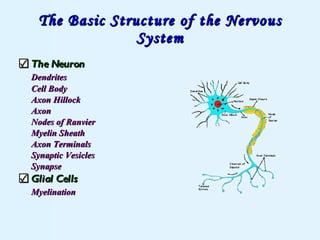
The Basic Structure of the Nervous System The Neuron Dendrites Cell Body Axon Hillock Axon Nodes of Ranvier Myelin Sheath Axon Terminals Synaptic Vesicles Synapse Glial Cells Myelination
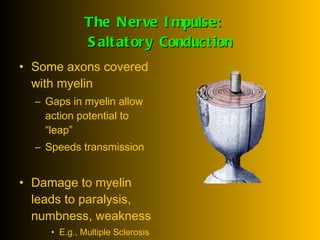
The Nerve Impulse:  Saltatory Conduction Some axons covered with myelin Gaps in myelin allow action potential to “leap” Speeds transmission Damage to myelin leads to paralysis, numbness, weakness E.g., Multiple Sclerosis
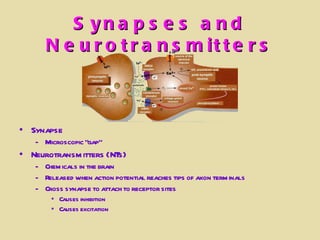
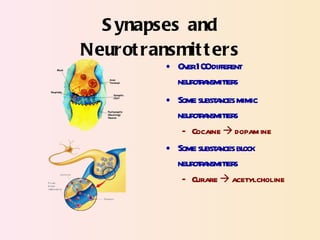
Synapses and Neurotransmitters Synapse Microscopic “gap” Neurotransmitters (NTs) Chemicals in the brain Released when action potential reaches tips of axon terminals Cross synapse to attach to receptor sites Causes inhibition Causes excitation
Synapses and Neurotransmitters Over 100 different neurotransmitters Some substances mimic neurotransmitters Cocaine    dopamine Some substances block neurotransmitters Curare    acetylcholine
Synapses and Neurotransmitters: Neural Regulators   Neuropeptides Do not carry messages directly Regulate activities of other neurons Endorphins Released by pituitary gland Help to relieve pain  Enkephalins   Relieve pain and stress Similar to endorphins
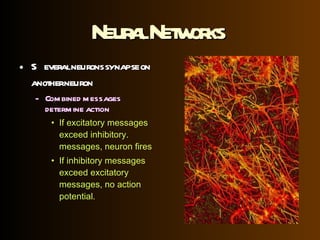
Neural Networks   Several neurons synapse on another neuron Combined messages determine action If excitatory messages exceed inhibitory. messages, neuron fires If inhibitory messages exceed excitatory messages, no action potential.
Neural Networks Neuroplasticity Capacity of the brain to change in response to experience New synapses form Unused synapses are pruned
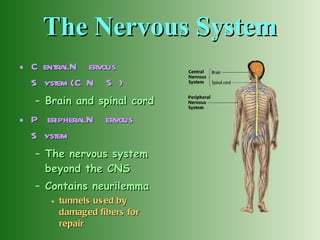
The Nervous System Central Nervous System (CNS)   Brain and spinal cord Peripheral Nervous System   The nervous system beyond the CNS Contains neurilemma   tunnels used by damaged fibers for repair
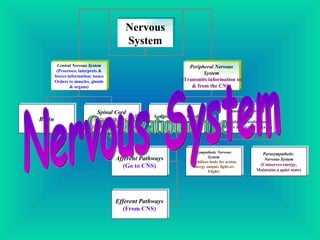
Organization of the Nervous System Nervous System Central Nervous System (Processes, interprets & Stores information; issues Orders to muscles, glands & organs) Peripheral Nervous System (Transmits information to & from the CNS) Brain Spinal Cord (Controls the brain & peripheral nerves) Somatic Nervous System (Controls skeletal muscles) Autonomic Nervous System (Regulates glands, blood Vessels & internal organs) Sympathetic Nervous System (Mobilizes body for action, Energy output; fight-or- Flight) Parasympathetic  Nervous System (Conserves energy, Maintains a quiet state) Afferent Pathways (Go to CNS) Efferent Pathways (From CNS)
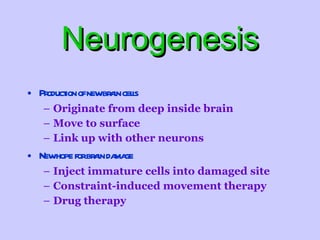
Neurogenesis Production of new brain cells Originate from deep inside brain Move to surface Link up with other neurons New hope for brain damage Inject immature cells into damaged site Constraint-induced movement therapy Drug therapy
The Brain The Brain contains between 100 Billion & 1 Trillion Neurons with more than 1000 Synapses per Neuron.
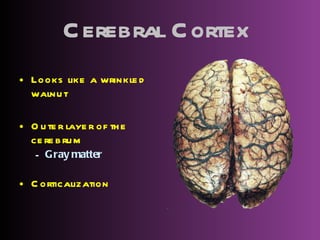
Cerebral Cortex   Looks like a wrinkled walnut Outer layer of the cerebrum Gray matter Corticalization
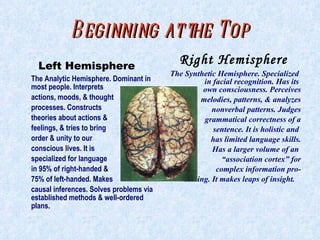
Beginning at the Top Left Hemisphere The Analytic Hemisphere. Dominant in most people. Interprets actions, moods, & thought processes. Constructs theories about actions & feelings, & tries to bring order & unity to our conscious lives. It is specialized for language in 95% of right-handed & 75% of left-handed. Makes causal inferences. Solves problems via established methods & well-ordered plans. Right Hemisphere The Synthetic Hemisphere. Specialized  in facial recognition. Has its  own consciousness. Perceives melodies, patterns, & analyzes nonverbal patterns. Judges grammatical correctness of a sentence. It is holistic and  has limited language skills. Has a larger volume of an  “ association cortex” for complex information pro- cessing. It makes leaps of insight.
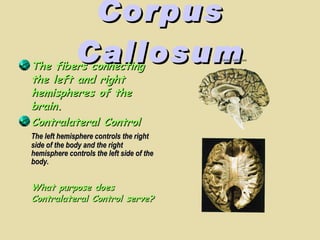
Corpus Callosum The fibers connecting the left and right hemispheres of the brain. Contralateral Control The left hemisphere controls the right side of the body and the right hemisphere controls the left side of the body. What purpose does Contralateral Control serve?
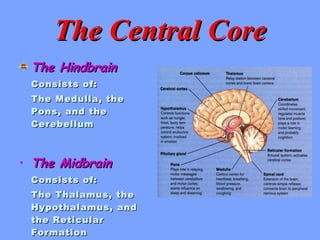
The Central Core The Hindbrain Consists of: The Medulla, the Pons, and the Cerebellum The Midbrain Consists of: The Thalamus, the Hypothalamus, and the Reticular Formation
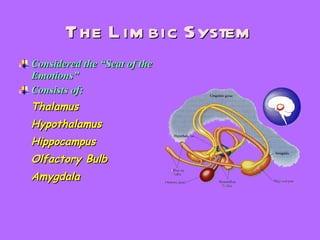
The Limbic System Considered the “Seat of the Emotions” Consists of: Thalamus Hypothalamus Hippocampus Olfactory Bulb Amygdala
 
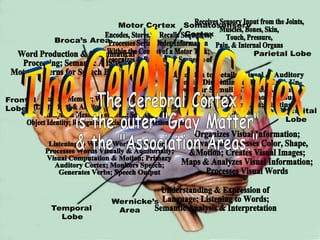
Working Memory; Word & Speech Perception (Left); Visual & Auditory Words; Associates Words;  Analysis & Meanings of Items; Self-Analysis;  Object Identity; Recognizes Facial Features; Action Plans Encodes, Stores, & Recalls Sequences; Processes Serial Order Information Within the Context of a Motor Task; Recognizes & Remembers Sequence of Events in Time. Receives Sensory Input from the Joints, Muscles, Bones, Skin,  Touch, Pressure, Pain, & Internal Organs Attention to Details; Visual & Auditory Words; Discriminates Familiar & Un- familiar Stimuli; STM for Abstract Symbols; Sentence Memory; Visual Orienting; Concentration; Shifting of Attention Organizes Visual Information; Activates &Processes Color, Shape,  &Motion; Creates Visual Images;  Maps & Analyzes Visual Information;  Processes Visual Words Listening to Words; Working Memory; Processes Words Visually & Auditorially;  Visual Computation & Motion; Primary  Auditory Cortex; Monitors Speech;  Generates Verbs; Speech Output Word Production & Grammatical Processing; Semantic Analysis; Motor Patterns for Speech Production Understanding & Expression of Language; Listening to Words; Semantic Analysis & Interpretation The Cerebral Cortex The Cerebral Cortex  is the outer "Gray Matter"  & the "Association Areas."
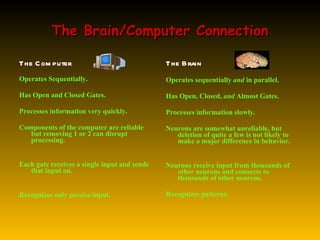
The Brain/Computer Connection The Computer Operates Sequentially. Has Open and Closed Gates. Processes information very quickly. Components of the computer are reliable but removing 1 or 2 can disrupt processing. Each gate receives a single input and sends that input on. Recognizes only precise input. The Brain Operates sequentially  and  in parallel. Has Open, Closed,  and  Almost Gates. Processes information slowly. Neurons are somewhat unreliable, but deletion of quite a few is not likely to make a major difference in behavior. Neurons receive input from thousands of other neurons and connects to thousands of other neurons. Recognizes patterns.
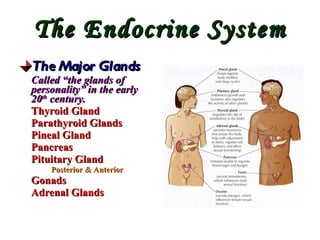
The Endocrine System The Major Glands Called “the glands of personality” in the early 20 th  century. Thyroid Gland Parathyroid Glands Pineal Gland Pancreas Pituitary Gland Posterior & Anterior Gonads Adrenal Glands
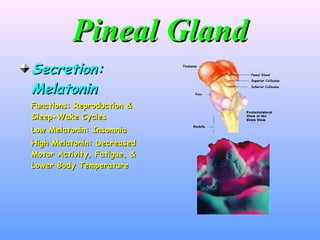
Pineal Gland Secretion: Melatonin Functions: Reproduction & Sleep-Wake Cycles Low Melatonin: Insomnia High Melatonin: Decreased Motor Activity, Fatigue, & Lower Body Temperature
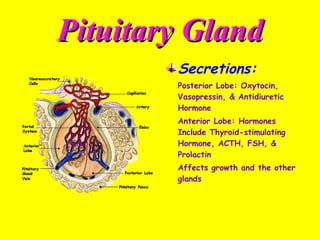
Pituitary Gland Secretions: Posterior Lobe: Oxytocin, Vasopressin, & Antidiuretic Hormone Anterior Lobe: Hormones Include Thyroid-stimulating Hormone, ACTH, FSH, & Prolactin Affects growth and the other glands
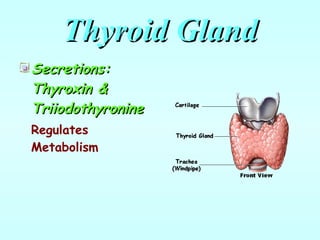
Thyroid Gland Secretions: Thyroxin & Triiodothyronine Regulates Metabolism
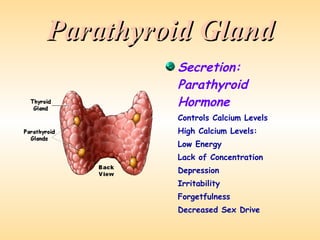
Parathyroid Gland Secretion: Parathyroid Hormone Controls Calcium Levels High Calcium Levels: Low Energy Lack of Concentration Depression Irritability Forgetfulness Decreased Sex Drive
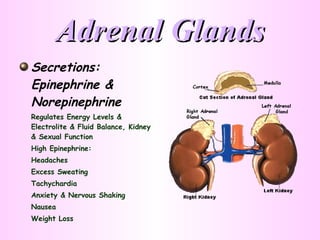
Adrenal Glands Secretions: Epinephrine & Norepinephrine Regulates Energy Levels & Electrolite & Fluid Balance, Kidney & Sexual Function High Epinephrine: Headaches Excess Sweating Tachychardia Anxiety & Nervous Shaking Nausea Weight Loss
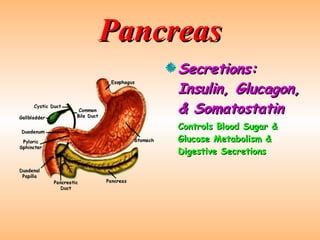
Pancreas Secretions: Insulin, Glucagon, & Somatostatin Controls Blood Sugar & Glucose Metabolism & Digestive Secretions
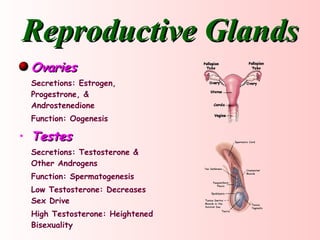
Reproductive Glands Ovaries Secretions: Estrogen, Progestrone, & Androstenedione Function: Oogenesis Testes Secretions: Testosterone & Other Androgens Function: Spermatogenesis Low Testosterone: Decreases Sex Drive High Testosterone: Heightened Bisexuality

2011 ch 2

  • 1.
  • 2.
  • 3.
    The Basic Structureof the Nervous System The Neuron Dendrites Cell Body Axon Hillock Axon Nodes of Ranvier Myelin Sheath Axon Terminals Synaptic Vesicles Synapse Glial Cells Myelination
  • 4.
    The Nerve Impulse: Saltatory Conduction Some axons covered with myelin Gaps in myelin allow action potential to “leap” Speeds transmission Damage to myelin leads to paralysis, numbness, weakness E.g., Multiple Sclerosis
  • 5.
    Synapses and NeurotransmittersSynapse Microscopic “gap” Neurotransmitters (NTs) Chemicals in the brain Released when action potential reaches tips of axon terminals Cross synapse to attach to receptor sites Causes inhibition Causes excitation
  • 6.
    Synapses and NeurotransmittersOver 100 different neurotransmitters Some substances mimic neurotransmitters Cocaine  dopamine Some substances block neurotransmitters Curare  acetylcholine
  • 7.
    Synapses and Neurotransmitters:Neural Regulators Neuropeptides Do not carry messages directly Regulate activities of other neurons Endorphins Released by pituitary gland Help to relieve pain Enkephalins Relieve pain and stress Similar to endorphins
  • 8.
    Neural Networks Several neurons synapse on another neuron Combined messages determine action If excitatory messages exceed inhibitory. messages, neuron fires If inhibitory messages exceed excitatory messages, no action potential.
  • 9.
    Neural Networks NeuroplasticityCapacity of the brain to change in response to experience New synapses form Unused synapses are pruned
  • 10.
    The Nervous SystemCentral Nervous System (CNS) Brain and spinal cord Peripheral Nervous System The nervous system beyond the CNS Contains neurilemma tunnels used by damaged fibers for repair
  • 11.
    Organization of theNervous System Nervous System Central Nervous System (Processes, interprets & Stores information; issues Orders to muscles, glands & organs) Peripheral Nervous System (Transmits information to & from the CNS) Brain Spinal Cord (Controls the brain & peripheral nerves) Somatic Nervous System (Controls skeletal muscles) Autonomic Nervous System (Regulates glands, blood Vessels & internal organs) Sympathetic Nervous System (Mobilizes body for action, Energy output; fight-or- Flight) Parasympathetic Nervous System (Conserves energy, Maintains a quiet state) Afferent Pathways (Go to CNS) Efferent Pathways (From CNS)
  • 12.
    Neurogenesis Production ofnew brain cells Originate from deep inside brain Move to surface Link up with other neurons New hope for brain damage Inject immature cells into damaged site Constraint-induced movement therapy Drug therapy
  • 13.
    The Brain TheBrain contains between 100 Billion & 1 Trillion Neurons with more than 1000 Synapses per Neuron.
  • 14.
    Cerebral Cortex Looks like a wrinkled walnut Outer layer of the cerebrum Gray matter Corticalization
  • 15.
    Beginning at theTop Left Hemisphere The Analytic Hemisphere. Dominant in most people. Interprets actions, moods, & thought processes. Constructs theories about actions & feelings, & tries to bring order & unity to our conscious lives. It is specialized for language in 95% of right-handed & 75% of left-handed. Makes causal inferences. Solves problems via established methods & well-ordered plans. Right Hemisphere The Synthetic Hemisphere. Specialized in facial recognition. Has its own consciousness. Perceives melodies, patterns, & analyzes nonverbal patterns. Judges grammatical correctness of a sentence. It is holistic and has limited language skills. Has a larger volume of an “ association cortex” for complex information pro- cessing. It makes leaps of insight.
  • 16.
    Corpus Callosum Thefibers connecting the left and right hemispheres of the brain. Contralateral Control The left hemisphere controls the right side of the body and the right hemisphere controls the left side of the body. What purpose does Contralateral Control serve?
  • 17.
    The Central CoreThe Hindbrain Consists of: The Medulla, the Pons, and the Cerebellum The Midbrain Consists of: The Thalamus, the Hypothalamus, and the Reticular Formation
  • 18.
    The Limbic SystemConsidered the “Seat of the Emotions” Consists of: Thalamus Hypothalamus Hippocampus Olfactory Bulb Amygdala
  • 19.
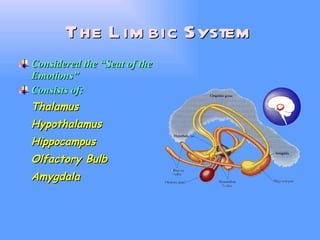
    The Limbic SystemConsidered the “Seat of the Emotions” Consists of: Thalamus Hypothalamus Hippocampus Olfactory Bulb Amygdala
  • 20.
  • 21.
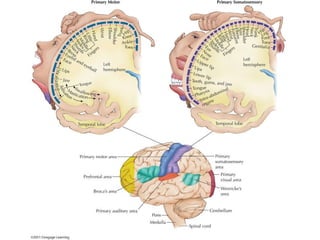
    Working Memory; Word& Speech Perception (Left); Visual & Auditory Words; Associates Words; Analysis & Meanings of Items; Self-Analysis; Object Identity; Recognizes Facial Features; Action Plans Encodes, Stores, & Recalls Sequences; Processes Serial Order Information Within the Context of a Motor Task; Recognizes & Remembers Sequence of Events in Time. Receives Sensory Input from the Joints, Muscles, Bones, Skin, Touch, Pressure, Pain, & Internal Organs Attention to Details; Visual & Auditory Words; Discriminates Familiar & Un- familiar Stimuli; STM for Abstract Symbols; Sentence Memory; Visual Orienting; Concentration; Shifting of Attention Organizes Visual Information; Activates &Processes Color, Shape, &Motion; Creates Visual Images; Maps & Analyzes Visual Information; Processes Visual Words Listening to Words; Working Memory; Processes Words Visually & Auditorially; Visual Computation & Motion; Primary Auditory Cortex; Monitors Speech; Generates Verbs; Speech Output Word Production & Grammatical Processing; Semantic Analysis; Motor Patterns for Speech Production Understanding & Expression of Language; Listening to Words; Semantic Analysis & Interpretation The Cerebral Cortex The Cerebral Cortex is the outer "Gray Matter" & the "Association Areas."
  • 22.
    The Brain/Computer ConnectionThe Computer Operates Sequentially. Has Open and Closed Gates. Processes information very quickly. Components of the computer are reliable but removing 1 or 2 can disrupt processing. Each gate receives a single input and sends that input on. Recognizes only precise input. The Brain Operates sequentially and in parallel. Has Open, Closed, and Almost Gates. Processes information slowly. Neurons are somewhat unreliable, but deletion of quite a few is not likely to make a major difference in behavior. Neurons receive input from thousands of other neurons and connects to thousands of other neurons. Recognizes patterns.
  • 23.
    The Endocrine SystemThe Major Glands Called “the glands of personality” in the early 20 th century. Thyroid Gland Parathyroid Glands Pineal Gland Pancreas Pituitary Gland Posterior & Anterior Gonads Adrenal Glands
  • 24.
    Pineal Gland Secretion:Melatonin Functions: Reproduction & Sleep-Wake Cycles Low Melatonin: Insomnia High Melatonin: Decreased Motor Activity, Fatigue, & Lower Body Temperature
  • 25.
    Pituitary Gland Secretions:Posterior Lobe: Oxytocin, Vasopressin, & Antidiuretic Hormone Anterior Lobe: Hormones Include Thyroid-stimulating Hormone, ACTH, FSH, & Prolactin Affects growth and the other glands
  • 26.
    Thyroid Gland Secretions:Thyroxin & Triiodothyronine Regulates Metabolism
  • 27.
    Parathyroid Gland Secretion:Parathyroid Hormone Controls Calcium Levels High Calcium Levels: Low Energy Lack of Concentration Depression Irritability Forgetfulness Decreased Sex Drive
  • 28.
    Adrenal Glands Secretions:Epinephrine & Norepinephrine Regulates Energy Levels & Electrolite & Fluid Balance, Kidney & Sexual Function High Epinephrine: Headaches Excess Sweating Tachychardia Anxiety & Nervous Shaking Nausea Weight Loss
  • 29.
    Pancreas Secretions: Insulin,Glucagon, & Somatostatin Controls Blood Sugar & Glucose Metabolism & Digestive Secretions
  • 30.
    Reproductive Glands OvariesSecretions: Estrogen, Progestrone, & Androstenedione Function: Oogenesis Testes Secretions: Testosterone & Other Androgens Function: Spermatogenesis Low Testosterone: Decreases Sex Drive High Testosterone: Heightened Bisexuality

Editor's Notes

  • #11 Myelin: Fatty layer of tissue that coats axons Neurilemma: Thin layer of cells wrapped around axons outside brain and spinal cord; forms a tunnel where damaged fibers go as they repair themselves
  • #15 Cerebrum: Two large hemispheres that cover upper part of the brain Corticalization: Increase in size and wrinkling of the cortex