EVOKED POTENTIALS:
    An overview


  DR. M. ANBARASI
DEFINITION

An electrical potential recorded from a
 human or animal following presentation of
 a stimulus


  {EEG / EKG / EMG – detects spontaneous
 potentials}
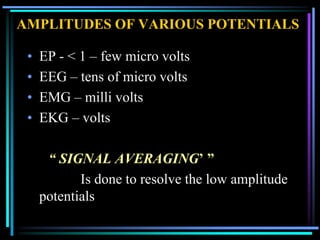
AMPLITUDES OF VARIOUS POTENTIALS

 •   EP - < 1 – few micro volts
 •   EEG – tens of micro volts
 •   EMG – milli volts
 •   EKG – volts

      “ SIGNAL AVERAGING’ ”
            Is done to resolve the low amplitude
     potentials
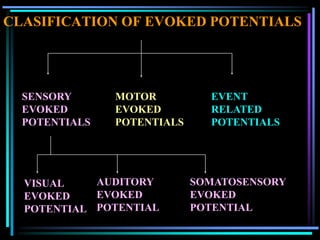
CLASIFICATION OF EVOKED POTENTIALS


  SENSORY      MOTOR          EVENT
  EVOKED       EVOKED         RELATED
  POTENTIALS   POTENTIALS     POTENTIALS


  VISUAL    AUDITORY        SOMATOSENSORY
  EVOKED    EVOKED          EVOKED
  POTENTIAL POTENTIAL       POTENTIAL
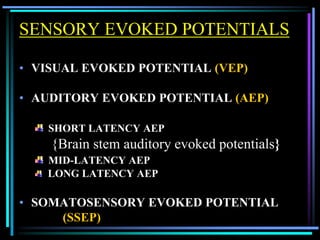
SENSORY EVOKED POTENTIALS

• VISUAL EVOKED POTENTIAL (VEP)

• AUDITORY EVOKED POTENTIAL (AEP)

   SHORT LATENCY AEP
    {Brain stem auditory evoked potentials}
   MID-LATENCY AEP
   LONG LATENCY AEP

• SOMATOSENSORY EVOKED POTENTIAL
     (SSEP)
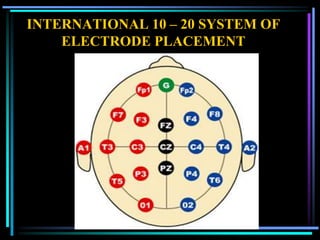
INTERNATIONAL 10 – 20 SYSTEM OF
    ELECTRODE PLACEMENT
ANATOMICAL & PHYSIOLOGICAL
       BASIS OF VEP
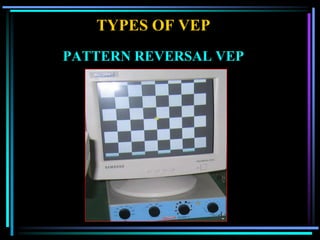
TYPES OF VEP
PATTERN REVERSAL VEP
• Primary visual system is arranged to
  emphasize the edges and movements so
  shifting patterns with multiple edges and
  contrasts are the most appropriate method to
  assess visual function.
FLASH VEP
• Stroboscopic flash units

• Greater variability of response with multiple
  positive and negative peaks

• Activates additional cortical projection systems
  including retino-tectal pathways.

• Primarily use when an individual cannot
  cooperate or for gross determination of visual
  pathway. Ex in infants / comatose patients

• Flash stimuli is also Used to produce ERG.
PARTIAL FIELD STIMULATION

   To evaluate Retro-chiasmatic lesions.

   Involves additional electrodes

  Other valuable investigation - MRI
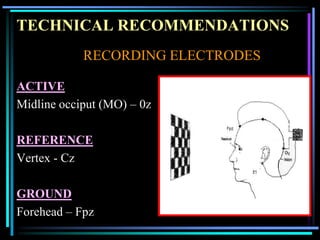
TECHNICAL RECOMMENDATIONS
            RECORDING ELECTRODES

ACTIVE
Midline occiput (MO) – 0z

REFERENCE
Vertex - Cz

GROUND
Forehead – Fpz
PATIENT & SEATING PREREQUISITES

• Each eye tested separately
• Patient seated at a distance of 0.75 to 1.5
  meters
• Eye glasses to be worn
• The eye not tested should be patched
• Gaze at the centre of the monitor
RECORDING CONDITIONS


•   Band pass : 1 – 300 Hz
•   Analysis time : 250 ms
•   Number of epocs : minimum 100
•   Electrode impedence : < 5 Ω
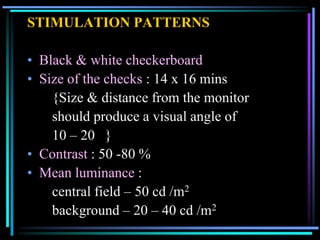
STIMULATION PATTERNS

• Black & white checkerboard
• Size of the checks : 14 x 16 mins
    {Size & distance from the monitor
    should produce a visual angle of
    10 – 20 }
• Contrast : 50 -80 %
• Mean luminance :
    central field – 50 cd /m2
    background – 20 – 40 cd /m2
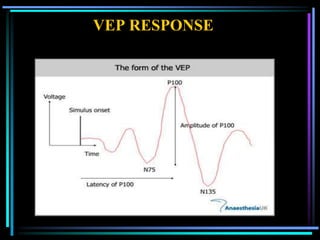
VEP RESPONSE
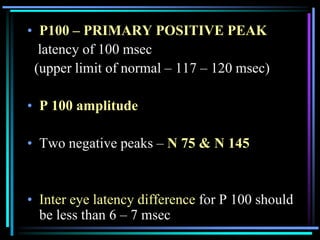
• P100 – PRIMARY POSITIVE PEAK
  latency of 100 msec
 (upper limit of normal – 117 – 120 msec)

• P 100 amplitude

• Two negative peaks – N 75 & N 145


• Inter eye latency difference for P 100 should
  be less than 6 – 7 msec
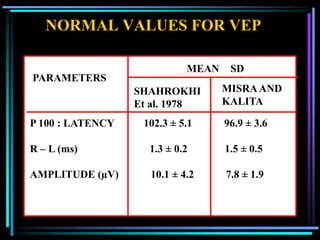
NORMAL VALUES FOR VEP

                            MEAN    SD
PARAMETERS
                  SHAHROKHI        MISRA AND
                  Et al. 1978      KALITA

P 100 : LATENCY    102.3 ± 5.1     96.9 ± 3.6

R – L (ms)          1.3 ± 0.2      1.5 ± 0.5

AMPLITUDE (µV)      10.1 ± 4.2     7.8 ± 1.9
CLINICAL UTILITY
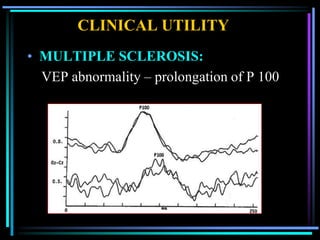
• MULTIPLE SCLEROSIS:
  VEP abnormality – prolongation of P 100
• DEMYELINATING DISORDERS
   Increase in response latency

• AXONAL LOSS DISORDERS
   reduction in response amplitude

• MIGRAINE HEADACHES
    more commonly seen soon after the
  attacks and with flash stimuli
• CATARACTS & GLAUCOMA :
    Decrease in P100 amplitude

• Visual aquity:
     Direct correlation with VEP

• Monitoring visual pathway integrity during
  surgeries
LIMITATIONS OF VEP
• Normal cortical response is obtained if
  entire visual system is intact

• Disturbances anywhere in the visual system
  can produce abnormal VEP
    localizing value of VEP is limited
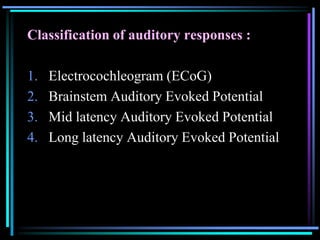
Classification of auditory responses :

1.   Electrocochleogram (ECoG)
2.   Brainstem Auditory Evoked Potential
3.   Mid latency Auditory Evoked Potential
4.   Long latency Auditory Evoked Potential
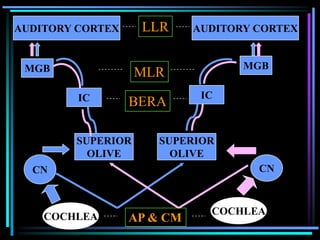
AUDITORY CORTEX    LLR      AUDITORY CORTEX


 MGB                               MGB
                   MLR
         IC                  IC
                  BERA

        SUPERIOR      SUPERIOR
          OLIVE         OLIVE
  CN                                 CN


                              COCHLEA
    COCHLEA       AP & CM
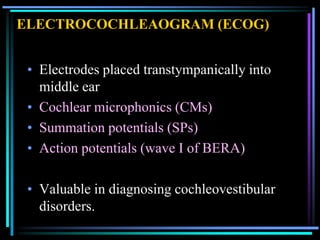
ELECTROCOCHLEAOGRAM (ECOG)


 • Electrodes placed transtympanically into
   middle ear
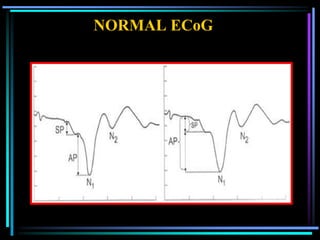
 • Cochlear microphonics (CMs)
 • Summation potentials (SPs)
 • Action potentials (wave I of BERA)

 • Valuable in diagnosing cochleovestibular
   disorders.
NORMAL ECoG
BRAINSTEM AUDITORY EVOKED
         POTENTIALS

• BERA / BAEP / SHORT LATENCY AEP

• It is the evoked transient response of the
  first 10 msec from the onset of stimulation

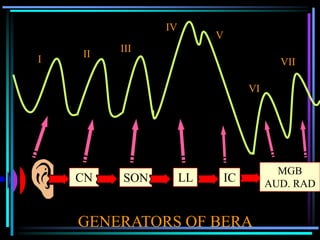
• Produces waveforms when passing through
  brainstem.
IV
                         V
         III
    II
I                                        VII

                                  VI


                                         MGB
    CN   SON        LL       IC        AUD. RAD


    GENERATORS OF BERA
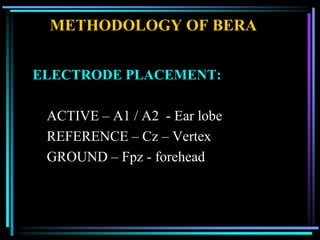
METHODOLOGY OF BERA


ELECTRODE PLACEMENT:

 ACTIVE – A1 / A2 - Ear lobe
 REFERENCE – Cz – Vertex
 GROUND – Fpz - forehead
AUDITORY STIMULUS

•   Breif electrical pulse “ click”
•   Intensity – 65 – 70 dB above
    threshold
•   Rate – 10 – 50 clicks / sec
•   Averaging of 1000 – 2000 stimuli
•   The other ear is masked with
     „ white noise‟ of 30 – 50 dB
BERA PARAMETERS


• Absolute waveform latencies

• Interpeak latencies ( I – III, I – V & III – V )

• Amplitude ratio of wave V / I
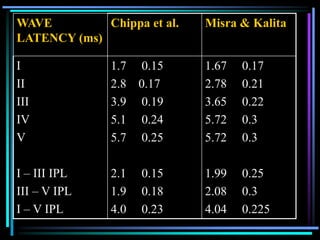
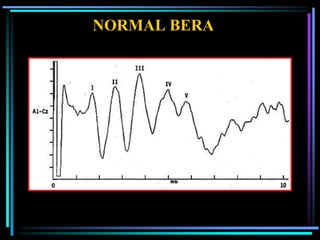
NORMAL BERA
WAVE         Chippa et al.   Misra & Kalita
LATENCY (ms)

I              1.7 0.15      1.67   0.17
II             2.8 0.17      2.78   0.21
III            3.9 0.19      3.65   0.22
IV             5.1 0.24      5.72   0.3
V              5.7 0.25      5.72   0.3

I – III IPL    2.1   0.15    1.99   0.25
III – V IPL    1.9   0.18    2.08   0.3
I – V IPL      4.0   0.23    4.04   0.225
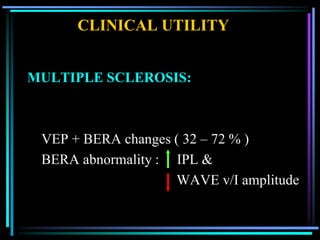
CLINICAL UTILITY


MULTIPLE SCLEROSIS:


 VEP + BERA changes ( 32 – 72 % )
 BERA abnormality : IPL &
                    WAVE v/I amplitude
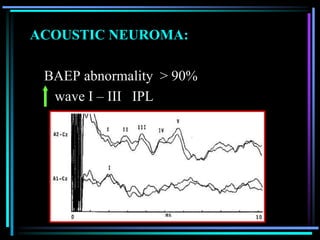
ACOUSTIC NEUROMA:

 BAEP abnormality > 90%
  wave I – III IPL
• COMATOSE PATIENTS :
   COMA due to toxic or metabolic cause – no BAEP
  abnormality
    due to structural brainstem lesion – changes in
  BAEP

• HEAD INJURY :
  More severe BAEP abnormality – poorer prognosis

• Monitor auditory pathway during surgery

• Hearing sensitivity in patients unable to undergo
  audiometry . Ex. Infants
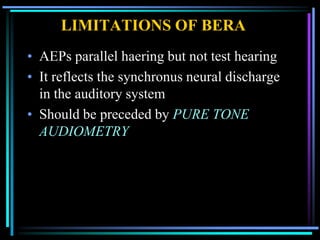
LIMITATIONS OF BERA
• AEPs parallel haering but not test hearing
• It reflects the synchronus neural discharge
  in the auditory system
• Should be preceded by PURE TONE
  AUDIOMETRY
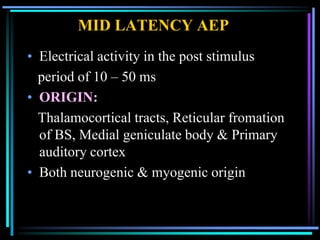
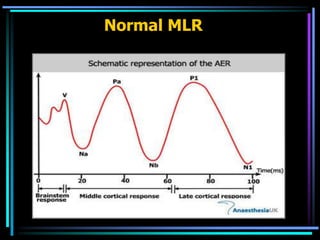
MID LATENCY AEP
• Electrical activity in the post stimulus
  period of 10 – 50 ms
• ORIGIN:
  Thalamocortical tracts, Reticular fromation
  of BS, Medial geniculate body & Primary
  auditory cortex
• Both neurogenic & myogenic origin
Normal MLR
LONG LATENCY AEP (LLR)

• Electrical activity in the post stimulus
  period of 50 to 500 ms
• Five wave peaks – P1, N1, P2, N2 & P3
• P3 – P300 : related to cognitive and
  perceptive functions of brain.

• Also called ‘cortical evoked potential’
• Evoked potentials of large diameter sensory
  nerves in the peripheral & central nervous
  system

• Used to diagnose nerve damage or
  degeneration in the spinal cord

• Can distinguish central Vs peripheral nerve
  lesion
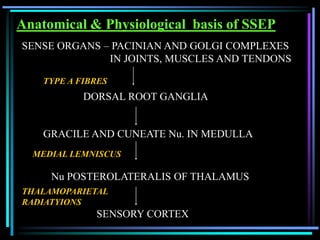
Anatomical & Physiological basis of SSEP
SENSE ORGANS – PACINIAN AND GOLGI COMPLEXES
              IN JOINTS, MUSCLES AND TENDONS

    TYPE A FIBRES
            DORSAL ROOT GANGLIA


    GRACILE AND CUNEATE Nu. IN MEDULLA
  MEDIAL LEMNISCUS

     Nu POSTEROLATERALIS OF THALAMUS
THALAMOPARIETAL
RADIATYIONS
              SENSORY CORTEX
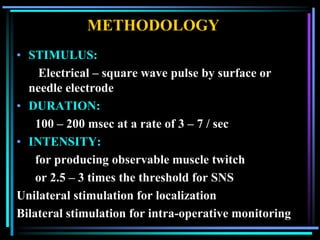
METHODOLOGY
• STIMULUS:
     Electrical – square wave pulse by surface or
  needle electrode
• DURATION:
    100 – 200 msec at a rate of 3 – 7 / sec
• INTENSITY:
    for producing observable muscle twitch
    or 2.5 – 3 times the threshold for SNS
Unilateral stimulation for localization
Bilateral stimulation for intra-operative monitoring
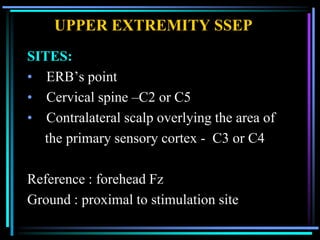
UPPER EXTREMITY SSEP
SITES:
• ERB‟s point
• Cervical spine –C2 or C5
• Contralateral scalp overlying the area of
  the primary sensory cortex - C3 or C4

Reference : forehead Fz
Ground : proximal to stimulation site
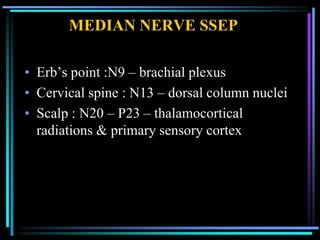
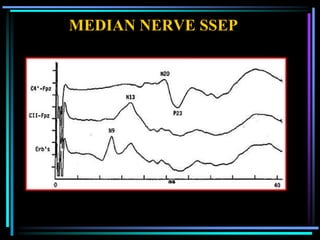
MEDIAN NERVE SSEP

• Erb‟s point :N9 – brachial plexus
• Cervical spine : N13 – dorsal column nuclei
• Scalp : N20 – P23 – thalamocortical
  radiations & primary sensory cortex
MEDIAN NERVE SSEP
LOWER LIMB SSEP
SITES:
• Lumbar spine – L3
• Thoracic spine – T12
• Primary sensory cortex - Cz
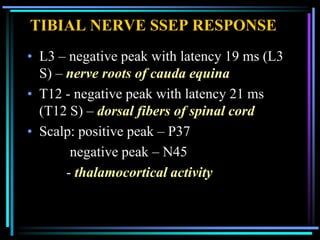
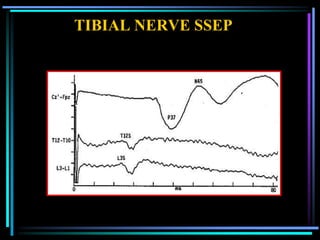
TIBIAL NERVE SSEP RESPONSE
• L3 – negative peak with latency 19 ms (L3
  S) – nerve roots of cauda equina
• T12 - negative peak with latency 21 ms
  (T12 S) – dorsal fibers of spinal cord
• Scalp: positive peak – P37
        negative peak – N45
       - thalamocortical activity
TIBIAL NERVE SSEP
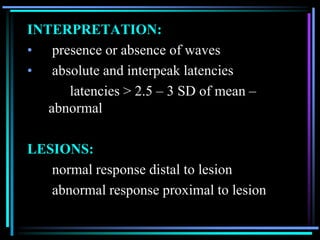
INTERPRETATION:
• presence or absence of waves
• absolute and interpeak latencies
      latencies > 2.5 – 3 SD of mean –
   abnormal

LESIONS:
   normal response distal to lesion
   abnormal response proximal to lesion
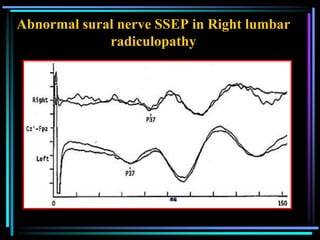
Abnormal sural nerve SSEP in Right lumbar
             radiculopathy
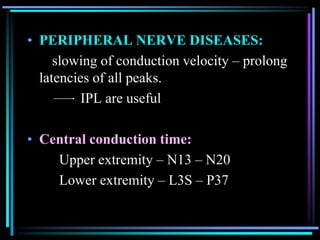
• PERIPHERAL NERVE DISEASES:
     slowing of conduction velocity – prolong
  latencies of all peaks.
          IPL are useful

• Central conduction time:
    Upper extremity – N13 – N20
    Lower extremity – L3S – P37
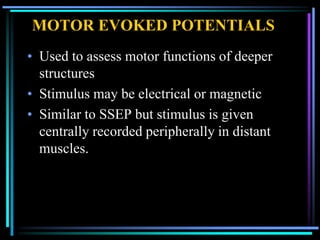
MOTOR EVOKED POTENTIALS
• Used to assess motor functions of deeper
  structures
• Stimulus may be electrical or magnetic
• Similar to SSEP but stimulus is given
  centrally recorded peripherally in distant
  muscles.
CLINICAL UTILITY
• To diagnose disorders that affect central &
  peripheral motor pathway
• Examples: multiple sclerosis, Parkinsons,
  CVA, Myelopathy of cervial & lumbar
  plexus.

• Intra-operative monitoring.
EVENT RELATED POTENTIALS
• Record cortical activity evoked by a
  stimulus with cognitive significance

• Stimuli : presenting randomly occuring
  infrequent stimuli interspersed withmore
  frequently occuring stimuli.

• Patient to attend only to infrequent stimuli.
• Waveform is called ‘P 300’ with a positive
  peak.

• Prolongation of P 300 :
     Dementia
     Neurodegenerative disorders
     Schizophrenia
     Autism
Evoked potential - An overview

Evoked potential - An overview

  • 1.
    EVOKED POTENTIALS: An overview DR. M. ANBARASI
  • 2.
    DEFINITION An electrical potentialrecorded from a human or animal following presentation of a stimulus {EEG / EKG / EMG – detects spontaneous potentials}
  • 3.
    AMPLITUDES OF VARIOUSPOTENTIALS • EP - < 1 – few micro volts • EEG – tens of micro volts • EMG – milli volts • EKG – volts “ SIGNAL AVERAGING’ ” Is done to resolve the low amplitude potentials
  • 4.
    CLASIFICATION OF EVOKEDPOTENTIALS SENSORY MOTOR EVENT EVOKED EVOKED RELATED POTENTIALS POTENTIALS POTENTIALS VISUAL AUDITORY SOMATOSENSORY EVOKED EVOKED EVOKED POTENTIAL POTENTIAL POTENTIAL
  • 5.
    SENSORY EVOKED POTENTIALS •VISUAL EVOKED POTENTIAL (VEP) • AUDITORY EVOKED POTENTIAL (AEP) SHORT LATENCY AEP {Brain stem auditory evoked potentials} MID-LATENCY AEP LONG LATENCY AEP • SOMATOSENSORY EVOKED POTENTIAL (SSEP)
  • 6.
    INTERNATIONAL 10 –20 SYSTEM OF ELECTRODE PLACEMENT
  • 8.
  • 9.
  • 10.
    • Primary visualsystem is arranged to emphasize the edges and movements so shifting patterns with multiple edges and contrasts are the most appropriate method to assess visual function.
  • 11.
    FLASH VEP • Stroboscopicflash units • Greater variability of response with multiple positive and negative peaks • Activates additional cortical projection systems including retino-tectal pathways. • Primarily use when an individual cannot cooperate or for gross determination of visual pathway. Ex in infants / comatose patients • Flash stimuli is also Used to produce ERG.
  • 12.
    PARTIAL FIELD STIMULATION To evaluate Retro-chiasmatic lesions. Involves additional electrodes Other valuable investigation - MRI
  • 13.
    TECHNICAL RECOMMENDATIONS RECORDING ELECTRODES ACTIVE Midline occiput (MO) – 0z REFERENCE Vertex - Cz GROUND Forehead – Fpz
  • 14.
    PATIENT & SEATINGPREREQUISITES • Each eye tested separately • Patient seated at a distance of 0.75 to 1.5 meters • Eye glasses to be worn • The eye not tested should be patched • Gaze at the centre of the monitor
  • 15.
    RECORDING CONDITIONS • Band pass : 1 – 300 Hz • Analysis time : 250 ms • Number of epocs : minimum 100 • Electrode impedence : < 5 Ω
  • 16.
    STIMULATION PATTERNS • Black& white checkerboard • Size of the checks : 14 x 16 mins {Size & distance from the monitor should produce a visual angle of 10 – 20 } • Contrast : 50 -80 % • Mean luminance : central field – 50 cd /m2 background – 20 – 40 cd /m2
  • 17.
  • 18.
    • P100 –PRIMARY POSITIVE PEAK latency of 100 msec (upper limit of normal – 117 – 120 msec) • P 100 amplitude • Two negative peaks – N 75 & N 145 • Inter eye latency difference for P 100 should be less than 6 – 7 msec
  • 19.
    NORMAL VALUES FORVEP MEAN SD PARAMETERS SHAHROKHI MISRA AND Et al. 1978 KALITA P 100 : LATENCY 102.3 ± 5.1 96.9 ± 3.6 R – L (ms) 1.3 ± 0.2 1.5 ± 0.5 AMPLITUDE (µV) 10.1 ± 4.2 7.8 ± 1.9
  • 20.
    CLINICAL UTILITY • MULTIPLESCLEROSIS: VEP abnormality – prolongation of P 100
  • 21.
    • DEMYELINATING DISORDERS Increase in response latency • AXONAL LOSS DISORDERS reduction in response amplitude • MIGRAINE HEADACHES more commonly seen soon after the attacks and with flash stimuli
  • 22.
    • CATARACTS &GLAUCOMA : Decrease in P100 amplitude • Visual aquity: Direct correlation with VEP • Monitoring visual pathway integrity during surgeries
  • 23.
    LIMITATIONS OF VEP •Normal cortical response is obtained if entire visual system is intact • Disturbances anywhere in the visual system can produce abnormal VEP localizing value of VEP is limited
  • 25.
    Classification of auditoryresponses : 1. Electrocochleogram (ECoG) 2. Brainstem Auditory Evoked Potential 3. Mid latency Auditory Evoked Potential 4. Long latency Auditory Evoked Potential
  • 26.
    AUDITORY CORTEX LLR AUDITORY CORTEX MGB MGB MLR IC IC BERA SUPERIOR SUPERIOR OLIVE OLIVE CN CN COCHLEA COCHLEA AP & CM
  • 27.
    ELECTROCOCHLEAOGRAM (ECOG) •Electrodes placed transtympanically into middle ear • Cochlear microphonics (CMs) • Summation potentials (SPs) • Action potentials (wave I of BERA) • Valuable in diagnosing cochleovestibular disorders.
  • 28.
  • 29.
    BRAINSTEM AUDITORY EVOKED POTENTIALS • BERA / BAEP / SHORT LATENCY AEP • It is the evoked transient response of the first 10 msec from the onset of stimulation • Produces waveforms when passing through brainstem.
  • 30.
    IV V III II I VII VI MGB CN SON LL IC AUD. RAD GENERATORS OF BERA
  • 31.
    METHODOLOGY OF BERA ELECTRODEPLACEMENT: ACTIVE – A1 / A2 - Ear lobe REFERENCE – Cz – Vertex GROUND – Fpz - forehead
  • 32.
    AUDITORY STIMULUS • Breif electrical pulse “ click” • Intensity – 65 – 70 dB above threshold • Rate – 10 – 50 clicks / sec • Averaging of 1000 – 2000 stimuli • The other ear is masked with „ white noise‟ of 30 – 50 dB
  • 33.
    BERA PARAMETERS • Absolutewaveform latencies • Interpeak latencies ( I – III, I – V & III – V ) • Amplitude ratio of wave V / I
  • 34.
  • 35.
    WAVE Chippa et al. Misra & Kalita LATENCY (ms) I 1.7 0.15 1.67 0.17 II 2.8 0.17 2.78 0.21 III 3.9 0.19 3.65 0.22 IV 5.1 0.24 5.72 0.3 V 5.7 0.25 5.72 0.3 I – III IPL 2.1 0.15 1.99 0.25 III – V IPL 1.9 0.18 2.08 0.3 I – V IPL 4.0 0.23 4.04 0.225
  • 36.
    CLINICAL UTILITY MULTIPLE SCLEROSIS: VEP + BERA changes ( 32 – 72 % ) BERA abnormality : IPL & WAVE v/I amplitude
  • 37.
    ACOUSTIC NEUROMA: BAEPabnormality > 90% wave I – III IPL
  • 38.
    • COMATOSE PATIENTS: COMA due to toxic or metabolic cause – no BAEP abnormality due to structural brainstem lesion – changes in BAEP • HEAD INJURY : More severe BAEP abnormality – poorer prognosis • Monitor auditory pathway during surgery • Hearing sensitivity in patients unable to undergo audiometry . Ex. Infants
  • 39.
    LIMITATIONS OF BERA •AEPs parallel haering but not test hearing • It reflects the synchronus neural discharge in the auditory system • Should be preceded by PURE TONE AUDIOMETRY
  • 40.
    MID LATENCY AEP •Electrical activity in the post stimulus period of 10 – 50 ms • ORIGIN: Thalamocortical tracts, Reticular fromation of BS, Medial geniculate body & Primary auditory cortex • Both neurogenic & myogenic origin
  • 41.
  • 42.
    LONG LATENCY AEP(LLR) • Electrical activity in the post stimulus period of 50 to 500 ms • Five wave peaks – P1, N1, P2, N2 & P3 • P3 – P300 : related to cognitive and perceptive functions of brain. • Also called ‘cortical evoked potential’
  • 44.
    • Evoked potentialsof large diameter sensory nerves in the peripheral & central nervous system • Used to diagnose nerve damage or degeneration in the spinal cord • Can distinguish central Vs peripheral nerve lesion
  • 45.
    Anatomical & Physiologicalbasis of SSEP SENSE ORGANS – PACINIAN AND GOLGI COMPLEXES IN JOINTS, MUSCLES AND TENDONS TYPE A FIBRES DORSAL ROOT GANGLIA GRACILE AND CUNEATE Nu. IN MEDULLA MEDIAL LEMNISCUS Nu POSTEROLATERALIS OF THALAMUS THALAMOPARIETAL RADIATYIONS SENSORY CORTEX
  • 46.
    METHODOLOGY • STIMULUS: Electrical – square wave pulse by surface or needle electrode • DURATION: 100 – 200 msec at a rate of 3 – 7 / sec • INTENSITY: for producing observable muscle twitch or 2.5 – 3 times the threshold for SNS Unilateral stimulation for localization Bilateral stimulation for intra-operative monitoring
  • 47.
    UPPER EXTREMITY SSEP SITES: •ERB‟s point • Cervical spine –C2 or C5 • Contralateral scalp overlying the area of the primary sensory cortex - C3 or C4 Reference : forehead Fz Ground : proximal to stimulation site
  • 48.
    MEDIAN NERVE SSEP •Erb‟s point :N9 – brachial plexus • Cervical spine : N13 – dorsal column nuclei • Scalp : N20 – P23 – thalamocortical radiations & primary sensory cortex
  • 49.
  • 50.
    LOWER LIMB SSEP SITES: •Lumbar spine – L3 • Thoracic spine – T12 • Primary sensory cortex - Cz
  • 51.
    TIBIAL NERVE SSEPRESPONSE • L3 – negative peak with latency 19 ms (L3 S) – nerve roots of cauda equina • T12 - negative peak with latency 21 ms (T12 S) – dorsal fibers of spinal cord • Scalp: positive peak – P37 negative peak – N45 - thalamocortical activity
  • 52.
  • 53.
    INTERPRETATION: • presence orabsence of waves • absolute and interpeak latencies latencies > 2.5 – 3 SD of mean – abnormal LESIONS: normal response distal to lesion abnormal response proximal to lesion
  • 54.
    Abnormal sural nerveSSEP in Right lumbar radiculopathy
  • 55.
    • PERIPHERAL NERVEDISEASES: slowing of conduction velocity – prolong latencies of all peaks. IPL are useful • Central conduction time: Upper extremity – N13 – N20 Lower extremity – L3S – P37
  • 56.
    MOTOR EVOKED POTENTIALS •Used to assess motor functions of deeper structures • Stimulus may be electrical or magnetic • Similar to SSEP but stimulus is given centrally recorded peripherally in distant muscles.
  • 57.
    CLINICAL UTILITY • Todiagnose disorders that affect central & peripheral motor pathway • Examples: multiple sclerosis, Parkinsons, CVA, Myelopathy of cervial & lumbar plexus. • Intra-operative monitoring.
  • 58.
    EVENT RELATED POTENTIALS •Record cortical activity evoked by a stimulus with cognitive significance • Stimuli : presenting randomly occuring infrequent stimuli interspersed withmore frequently occuring stimuli. • Patient to attend only to infrequent stimuli.
  • 59.
    • Waveform iscalled ‘P 300’ with a positive peak. • Prolongation of P 300 : Dementia Neurodegenerative disorders Schizophrenia Autism