How do relationships form? What are the barriers to them developing and how do you cope with the emotions that accompany them? Developing Interpersonal Relationships
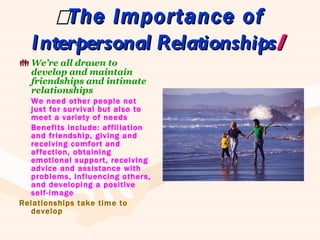
 The Importance of  Interpersonal Relationships  We’re all drawn to develop and maintain friendships and intimate relationships We need other people not just for survival but also to meet a variety of needs Benefits include: affiliation and friendship, giving and receiving comfort and affection, obtaining emotional support, receiving advice and assistance with problems, influencing others, and developing a positive self-image Relationships take time to develop
Factors that Promote the Development of Relationships, 1 Liking, Respect, and Trust Liking is a positive attitude toward another Two characteristics to liking 1. You must respect that person 2. You believe that person is trustworthy Sometimes this is based more on wishful thinking than reality People need to earn your trust and respect Deciding if someone is deserving of your trust How predictable is that individual? Can you depend on that person? Do you have faith in that person? Trust helps to form and maintain bonds with another and provide a sense of  security in the relationship Trust takes time and is very fragile
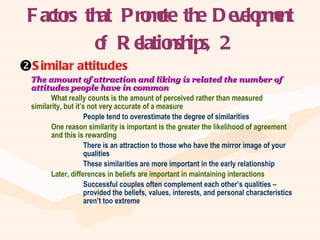
Factors that Promote the Development of Relationships, 2 Similar attitudes The amount of attraction and liking is related the number of attitudes people have in common What really counts is the amount of perceived rather than measured  similarity, but it’s not very accurate of a measure People tend to overestimate the degree of similarities One reason similarity is important is the greater the likelihood of agreement  and this is rewarding There is an attraction to those who have the mirror image of your  qualities These similarities are more important in the early relationship Later, differences in beliefs are important in maintaining interactions Successful couples often complement each other’s qualities –  provided the beliefs, values, interests, and personal characteristics  aren’t too extreme
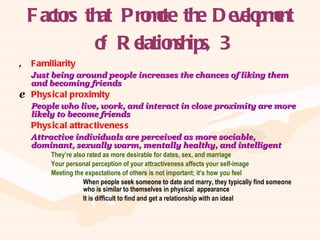
Factors that Promote the Development of Relationships, 3 Familiarity Just being around people increases the chances of liking them and becoming friends Physical proximity People who live, work, and interact in close proximity are more likely to become friends Physical attractiveness Attractive individuals are perceived as more sociable, dominant, sexually warm, mentally healthy, and intelligent They’re also rated as more desirable for dates, sex, and marriage Your personal perception of your attractiveness affects your self-image Meeting the expectations of others is not important; it’s how you feel When people seek someone to date and marry, they typically find someone  who is similar to themselves in physical  appearance It is difficult to find and get a relationship with an ideal
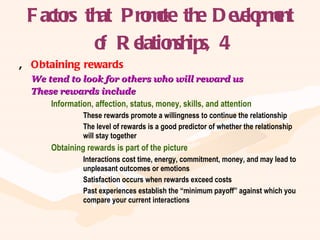
Factors that Promote the Development of Relationships, 4 Obtaining rewards We tend to look for others who will reward us These rewards include Information, affection, status, money, skills, and attention These rewards promote a willingness to continue the relationship The level of rewards is a good predictor of whether the relationship  will stay together Obtaining rewards is part of the picture Interactions cost time, energy, commitment, money, and may lead to  unpleasant outcomes or emotions Satisfaction occurs when rewards exceed costs Past experiences establish the “minimum payoff” against which you  compare your current interactions
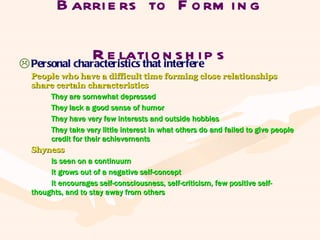
Barriers to Forming Relationships Personal characteristics that interfere People who have a difficult time forming close relationships share certain characteristics They are somewhat depressed They lack a good sense of humor They have very few interests and outside hobbies They take very little interest in what others do and failed to give people  credit for their achievements Shyness Is seen on a continuum It grows out of a negative self-concept It encourages self-consciousness, self-criticism, few positive self- thoughts, and to stay away from others
Barriers to Forming Relationships, 2 More on shyness Occasional periods of shyness may have  some benefits It may promote periods of private reflection, or help think through  problems and develop solutions Acquiring shyness Can come from overreactions in the past where you “looked silly” People may have laughed at you May have felt “on the spot with everyone judging you” May be the risk of rejection May be cultural A self-fulfilling prophecy then gets set up 1. A social situation occurs and anxiety develops 2. The label “shy” initiates a script 3. Following the script informs others how to treat you 4. People’s withdrawal or lack of interest is interpreted as confirming  the self-image 5. In other social situations, the process repeats itself
Coping with shyness You must want to do something about it What you can do about shyness Follow a role model Use your imagination Try a new behavior in which you think you’ll be successful Focus on some of your positive qualities Show more interest in others SOFTEN (Smile, Open posture, Forward lean, Touch, Eye  contact, Nod)
Stereotypes and Prejudices,1 Stereotypes –  preconceived rigid beliefs about other individuals They’re mental short-cuts to categorize people, places, and events Prejudiced attitude –  an attitude that has rigid beliefs and strong feelings about another person It’s a combination of a stereotype with strong feelings about a person, object, or event Discrimination –  differential treatment of individuals because they belong to a particular social group It’s a natural outcome of negative stereotypes and prejudices
Stereotypes and Prejudices, 2 One of psychology’s core concepts is that of individual differences Prejudiced people ignore the fact that individual differences exist among members of any group Positive prejudices also exist: “a great statesman,” “a fine musician,” etc. Negative stereotypes and prejudices lead to unfair perceptions of others Members of specific groups are singled out and evaluated as a group instead of individually Negative stereotypes and prejudices lead to unfair treatment of others This is the basis of discrimination Since such beliefs are thought to be valid, they are used to justify the actions taken against the group The self-serving bias in negative stereotypes and prejudices is that it makes discrimination easier
Coping with Your Stereotypes and Prejudices Look for unique qualities in others Take the time to think about the personal qualities others have Personal contacts can teach you about how much you have in common with others Try to cooperate and work together with people you sometimes stereotype Take on the initiative to work with a member of a group whom you stereotype or have had little contact Negative attitudes can change with a positive emotional climate through working together
Lack of Self-Disclosure Self-disclosure – revealing intimate details about yourself Relationships depend on developing trust and respect for others, the belief that you are honest and open with others, and the discussion of shared interests The relationship between self-disclosure and feeling close to another is reciprocal Self-disclosure fosters intimacy and trust, and intimacy and trust encourage more self- disclosure Disadvantages to self-disclosure Talking too much about yourself early in the relationship may not facilitate the  development of the relationship High self-disclosure is considered a sign of immaturity, insecurity, being phoney, or that  you tell everyone the same things When someone knows everything there is to know about you, there’s no room  for  surprises
Increasing Self-Disclosure How much you reveal about yourself is a personal choice The advantage to self-disclosure lies somewhere between not talking about yourself and doing it too much There is some risk involved: Fears the other person may not  reciprocate, what is said is unacceptable, the other person may  take advantage of you, or the other is not willing to share  friendship and love You need to consider your needs for privacy and discretion, the disadvantages of  too much self-disclosure, and the advantages of forming relationships
Love Love is an attachment and caring between two or more people People love others when they Will do almost anything for them Seek them out when they feel lonely Feel possessive toward them Become concerned for their welfare Believe it would be difficult to get along without them We can like or have a positive attitude toward others without loving them, but we do not love others unless we like them Adult intimate relationships tend to have other things in common with earlier  developmental stages: secure, avoidant, and anxious-ambivalent attachment  styles found in childhood tend to appear in adult intimate relationships
The Ingredients of Love Intimacy Warmth, closeness, and sharing in a relationship Commitment An intent to maintain a relationship in spite of the difficulties and costs that may arise Passion Intense sexual and erotic desire for another person Different varieties of love develop from the combinations of the three ingredients
The Types of Love,1 Empty, liking, and infatuation Empty love is when the people feel committed, but not very warm and close, and passion is largely absent Liking another is fundamental for a relationship to begin Infatuation represents an intense desire for another, and is an erotic attachment Mutual respect and trust and a sense of commitment to the relationship are largely absent in infatuation Passionate/ romantic love This is romantic love with an intense absorption with another Passionate love typically leads to unrealistic expectations and there’s no way the partner can live up to those expectations Romantic love leads you to ignore how dissimilar you are from  your partner Caught up in romantic love, you can ignore developing problems in a relationship Romantic/passionate love eventually cools over time
The Types of Love, 2 Companionate love The less intense but steady concern, warm attachment and caring for another person A relationship in this stage has the partners more realistic about what to expect from each other Measures of the level of commitment and intimacy are one of the best predictors of whether a relationship will continue Consummate love All three ingredients are present, which leads the couple to have a close interpersonal relationship Maintaining consummate love for extended periods of time is not easy, because simultaneously keeping passion, commitment, and intimacy at appropriate levels is difficult Few couples have a relationship in these terms
Envy and Jealousy Envy –  a desire to acquire something another person possesses When experiencing envy, individuals are generally unhappy and feel inferior A little envy can be motivational Jealousy –  a fear of losing something to which you have become attached When jealous the emotions of sadness, fear, anxiety, and, especially, anger dominate Jealousy is more likely to occur in relationships where people adhere to rigid  definitions of their sex roles Jealousy is used to gain power and control over another Expressing jealousy can be cathartic Jealousy may legitimize retaliation One of the hardest feelings in a relationship to deal with is the fear of losing  someone Sexual jealousy is difficult to cope with because of the relationship to self-worth
Coping with Envy and Jealousy Reframe your thinking Our thinking tends to be “apples = oranges” “ Just because he talks to other girls doesn’t mean he’s going out with them” Gain control over your imagination We tend to run “worst-case scenarios” in our mind and this makes us come up with all kinds of unrealistic fantasies Take steps to build your self-confidence Envy and jealousy flourish when our self-confidence is low You’re the only person who can do something about that Pick activities and learn to do them well, become knowledgeable about the world around you and share that knowledge with your partner and others
Loneliness Loneliness – an emotional reaction to periods of isolation from others It is a warning sign that your ability to connect with and remain attached to other people is in trouble We all have two important social needs:  the need to feel attached to someone in an intimate relationship and a need for community Feeling lonely is both a contributor to feeling sad and depressed as well as a personal problem in itself Low self-esteem, feeling unloved and uncared for, unable to disclose  private thoughts to others, feeling alienated, feelings of inadequacy When there’s a mismatch between your social contacts and what you might desire you feel lonely What we might desire is based on a rather distorted view of the world Loneliness varies with the time of day, week, and time of year
Coping with Loneliness Taking preventive action When you’re feeling lonely, look at what’s happening in your relationship Look at the trouble spots and identify the problems Reestablishing contact, and becoming active Call a friend, join a club, visit someone, find new friends Forget yourself and help others Do things for others, volunteer, tutor students Identify the cause of loneliness Make a distinction between events that trigger loneliness and those that maintain it Loneliness is maintained by low self-esteem, fear of rejection or intimacy, self-blame  being overly dependent on others Look at your thinking and behavior patterns as well as maintaining the feelings
Separating from Relationships Reasons for breaking up 1. Boredom and changing interests Cooling of romantic/passionate love and differences in interests,  intelligence, religion, and education 2. Sexual attitudes and differences in expectations Problems about the type and frequency of sexual activities as well as  differences in ideas about the relationship 3. Role conflicts Whether each partner should play traditional gender roles 4. Poor communication patterns Communication channels closed and criticism of the partner developed 5. Problematic attachment styles Secure, avoidant, and anxious/ambivalent attachment styles
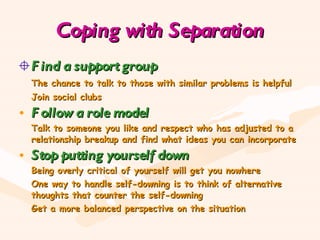
Coping with Separation Find a support group The chance to talk to those with similar problems is helpful Join social clubs Follow a role model Talk to someone you like and respect who has adjusted to a relationship breakup and find what ideas you can incorporate Stop putting yourself down Being overly critical of yourself will get you nowhere One way to handle self-downing is to think of alternative thoughts that counter the self-downing Get a more balanced perspective on the situation

Critical Thinking 8

  • 1.
    How do relationshipsform? What are the barriers to them developing and how do you cope with the emotions that accompany them? Developing Interpersonal Relationships
  • 2.
     The Importanceof Interpersonal Relationships  We’re all drawn to develop and maintain friendships and intimate relationships We need other people not just for survival but also to meet a variety of needs Benefits include: affiliation and friendship, giving and receiving comfort and affection, obtaining emotional support, receiving advice and assistance with problems, influencing others, and developing a positive self-image Relationships take time to develop
  • 3.
    Factors that Promotethe Development of Relationships, 1 Liking, Respect, and Trust Liking is a positive attitude toward another Two characteristics to liking 1. You must respect that person 2. You believe that person is trustworthy Sometimes this is based more on wishful thinking than reality People need to earn your trust and respect Deciding if someone is deserving of your trust How predictable is that individual? Can you depend on that person? Do you have faith in that person? Trust helps to form and maintain bonds with another and provide a sense of security in the relationship Trust takes time and is very fragile
  • 4.
    Factors that Promotethe Development of Relationships, 2 Similar attitudes The amount of attraction and liking is related the number of attitudes people have in common What really counts is the amount of perceived rather than measured similarity, but it’s not very accurate of a measure People tend to overestimate the degree of similarities One reason similarity is important is the greater the likelihood of agreement and this is rewarding There is an attraction to those who have the mirror image of your qualities These similarities are more important in the early relationship Later, differences in beliefs are important in maintaining interactions Successful couples often complement each other’s qualities – provided the beliefs, values, interests, and personal characteristics aren’t too extreme
  • 5.
    Factors that Promotethe Development of Relationships, 3 Familiarity Just being around people increases the chances of liking them and becoming friends Physical proximity People who live, work, and interact in close proximity are more likely to become friends Physical attractiveness Attractive individuals are perceived as more sociable, dominant, sexually warm, mentally healthy, and intelligent They’re also rated as more desirable for dates, sex, and marriage Your personal perception of your attractiveness affects your self-image Meeting the expectations of others is not important; it’s how you feel When people seek someone to date and marry, they typically find someone who is similar to themselves in physical appearance It is difficult to find and get a relationship with an ideal
  • 6.
    Factors that Promotethe Development of Relationships, 4 Obtaining rewards We tend to look for others who will reward us These rewards include Information, affection, status, money, skills, and attention These rewards promote a willingness to continue the relationship The level of rewards is a good predictor of whether the relationship will stay together Obtaining rewards is part of the picture Interactions cost time, energy, commitment, money, and may lead to unpleasant outcomes or emotions Satisfaction occurs when rewards exceed costs Past experiences establish the “minimum payoff” against which you compare your current interactions
  • 7.
    Barriers to FormingRelationships Personal characteristics that interfere People who have a difficult time forming close relationships share certain characteristics They are somewhat depressed They lack a good sense of humor They have very few interests and outside hobbies They take very little interest in what others do and failed to give people credit for their achievements Shyness Is seen on a continuum It grows out of a negative self-concept It encourages self-consciousness, self-criticism, few positive self- thoughts, and to stay away from others
  • 8.
    Barriers to FormingRelationships, 2 More on shyness Occasional periods of shyness may have some benefits It may promote periods of private reflection, or help think through problems and develop solutions Acquiring shyness Can come from overreactions in the past where you “looked silly” People may have laughed at you May have felt “on the spot with everyone judging you” May be the risk of rejection May be cultural A self-fulfilling prophecy then gets set up 1. A social situation occurs and anxiety develops 2. The label “shy” initiates a script 3. Following the script informs others how to treat you 4. People’s withdrawal or lack of interest is interpreted as confirming the self-image 5. In other social situations, the process repeats itself
  • 9.
    Coping with shynessYou must want to do something about it What you can do about shyness Follow a role model Use your imagination Try a new behavior in which you think you’ll be successful Focus on some of your positive qualities Show more interest in others SOFTEN (Smile, Open posture, Forward lean, Touch, Eye contact, Nod)
  • 10.
    Stereotypes and Prejudices,1Stereotypes – preconceived rigid beliefs about other individuals They’re mental short-cuts to categorize people, places, and events Prejudiced attitude – an attitude that has rigid beliefs and strong feelings about another person It’s a combination of a stereotype with strong feelings about a person, object, or event Discrimination – differential treatment of individuals because they belong to a particular social group It’s a natural outcome of negative stereotypes and prejudices
  • 11.
    Stereotypes and Prejudices,2 One of psychology’s core concepts is that of individual differences Prejudiced people ignore the fact that individual differences exist among members of any group Positive prejudices also exist: “a great statesman,” “a fine musician,” etc. Negative stereotypes and prejudices lead to unfair perceptions of others Members of specific groups are singled out and evaluated as a group instead of individually Negative stereotypes and prejudices lead to unfair treatment of others This is the basis of discrimination Since such beliefs are thought to be valid, they are used to justify the actions taken against the group The self-serving bias in negative stereotypes and prejudices is that it makes discrimination easier
  • 12.
    Coping with YourStereotypes and Prejudices Look for unique qualities in others Take the time to think about the personal qualities others have Personal contacts can teach you about how much you have in common with others Try to cooperate and work together with people you sometimes stereotype Take on the initiative to work with a member of a group whom you stereotype or have had little contact Negative attitudes can change with a positive emotional climate through working together
  • 13.
    Lack of Self-DisclosureSelf-disclosure – revealing intimate details about yourself Relationships depend on developing trust and respect for others, the belief that you are honest and open with others, and the discussion of shared interests The relationship between self-disclosure and feeling close to another is reciprocal Self-disclosure fosters intimacy and trust, and intimacy and trust encourage more self- disclosure Disadvantages to self-disclosure Talking too much about yourself early in the relationship may not facilitate the development of the relationship High self-disclosure is considered a sign of immaturity, insecurity, being phoney, or that you tell everyone the same things When someone knows everything there is to know about you, there’s no room for surprises
  • 14.
    Increasing Self-Disclosure Howmuch you reveal about yourself is a personal choice The advantage to self-disclosure lies somewhere between not talking about yourself and doing it too much There is some risk involved: Fears the other person may not reciprocate, what is said is unacceptable, the other person may take advantage of you, or the other is not willing to share friendship and love You need to consider your needs for privacy and discretion, the disadvantages of too much self-disclosure, and the advantages of forming relationships
  • 15.
    Love Love isan attachment and caring between two or more people People love others when they Will do almost anything for them Seek them out when they feel lonely Feel possessive toward them Become concerned for their welfare Believe it would be difficult to get along without them We can like or have a positive attitude toward others without loving them, but we do not love others unless we like them Adult intimate relationships tend to have other things in common with earlier developmental stages: secure, avoidant, and anxious-ambivalent attachment styles found in childhood tend to appear in adult intimate relationships
  • 16.
    The Ingredients ofLove Intimacy Warmth, closeness, and sharing in a relationship Commitment An intent to maintain a relationship in spite of the difficulties and costs that may arise Passion Intense sexual and erotic desire for another person Different varieties of love develop from the combinations of the three ingredients
  • 17.
    The Types ofLove,1 Empty, liking, and infatuation Empty love is when the people feel committed, but not very warm and close, and passion is largely absent Liking another is fundamental for a relationship to begin Infatuation represents an intense desire for another, and is an erotic attachment Mutual respect and trust and a sense of commitment to the relationship are largely absent in infatuation Passionate/ romantic love This is romantic love with an intense absorption with another Passionate love typically leads to unrealistic expectations and there’s no way the partner can live up to those expectations Romantic love leads you to ignore how dissimilar you are from your partner Caught up in romantic love, you can ignore developing problems in a relationship Romantic/passionate love eventually cools over time
  • 18.
    The Types ofLove, 2 Companionate love The less intense but steady concern, warm attachment and caring for another person A relationship in this stage has the partners more realistic about what to expect from each other Measures of the level of commitment and intimacy are one of the best predictors of whether a relationship will continue Consummate love All three ingredients are present, which leads the couple to have a close interpersonal relationship Maintaining consummate love for extended periods of time is not easy, because simultaneously keeping passion, commitment, and intimacy at appropriate levels is difficult Few couples have a relationship in these terms
  • 19.
    Envy and JealousyEnvy – a desire to acquire something another person possesses When experiencing envy, individuals are generally unhappy and feel inferior A little envy can be motivational Jealousy – a fear of losing something to which you have become attached When jealous the emotions of sadness, fear, anxiety, and, especially, anger dominate Jealousy is more likely to occur in relationships where people adhere to rigid definitions of their sex roles Jealousy is used to gain power and control over another Expressing jealousy can be cathartic Jealousy may legitimize retaliation One of the hardest feelings in a relationship to deal with is the fear of losing someone Sexual jealousy is difficult to cope with because of the relationship to self-worth
  • 20.
    Coping with Envyand Jealousy Reframe your thinking Our thinking tends to be “apples = oranges” “ Just because he talks to other girls doesn’t mean he’s going out with them” Gain control over your imagination We tend to run “worst-case scenarios” in our mind and this makes us come up with all kinds of unrealistic fantasies Take steps to build your self-confidence Envy and jealousy flourish when our self-confidence is low You’re the only person who can do something about that Pick activities and learn to do them well, become knowledgeable about the world around you and share that knowledge with your partner and others
  • 21.
    Loneliness Loneliness –an emotional reaction to periods of isolation from others It is a warning sign that your ability to connect with and remain attached to other people is in trouble We all have two important social needs: the need to feel attached to someone in an intimate relationship and a need for community Feeling lonely is both a contributor to feeling sad and depressed as well as a personal problem in itself Low self-esteem, feeling unloved and uncared for, unable to disclose private thoughts to others, feeling alienated, feelings of inadequacy When there’s a mismatch between your social contacts and what you might desire you feel lonely What we might desire is based on a rather distorted view of the world Loneliness varies with the time of day, week, and time of year
  • 22.
    Coping with LonelinessTaking preventive action When you’re feeling lonely, look at what’s happening in your relationship Look at the trouble spots and identify the problems Reestablishing contact, and becoming active Call a friend, join a club, visit someone, find new friends Forget yourself and help others Do things for others, volunteer, tutor students Identify the cause of loneliness Make a distinction between events that trigger loneliness and those that maintain it Loneliness is maintained by low self-esteem, fear of rejection or intimacy, self-blame being overly dependent on others Look at your thinking and behavior patterns as well as maintaining the feelings
  • 23.
    Separating from RelationshipsReasons for breaking up 1. Boredom and changing interests Cooling of romantic/passionate love and differences in interests, intelligence, religion, and education 2. Sexual attitudes and differences in expectations Problems about the type and frequency of sexual activities as well as differences in ideas about the relationship 3. Role conflicts Whether each partner should play traditional gender roles 4. Poor communication patterns Communication channels closed and criticism of the partner developed 5. Problematic attachment styles Secure, avoidant, and anxious/ambivalent attachment styles
  • 24.
    Coping with SeparationFind a support group The chance to talk to those with similar problems is helpful Join social clubs Follow a role model Talk to someone you like and respect who has adjusted to a relationship breakup and find what ideas you can incorporate Stop putting yourself down Being overly critical of yourself will get you nowhere One way to handle self-downing is to think of alternative thoughts that counter the self-downing Get a more balanced perspective on the situation