Brunnstrom concept
Dr. Subhasish Chatterjee (PT)
MPT, Neurology
Assistant Professor, MMIPR
History…
• Developed by Signe Brunnstrom, a physical
therapist from Sweden
• Theoretical foundations:
 Sherrington
 Magnus
 Jackson
 Twitchell
ASSUMPTIONS
1. Reflex- Hierarchical theory
2. Lower level reflexes get modified &
rearranged into purposeful movements
through influence of higher centers
3. Reflexes & primitive movement patterns can
used to facilitate the recovery of voluntary
mvts.
4. Proprioceptive and exteroceptive stimuli can
be used to evoke desired motion or alter
tone
5. Recovery of voluntary movts occur in
sequence
6. Newly produced correct movements must be
practiced to be learned
7. Practice within the context of daily activities
enhances learning process
Premise
When the CNS is injured, as in CVA, an
individual goes through an “evolution in
reverse”
–Movement becomes primitive, reflexive,
and automatic
Changes in tone and the presence of reflexes
are considered part of the normal process of
recovery
Principles of treatment
 Facilitate the patient’s progress throughout the
recovery stages
 Use of postural and attitudinal reflexes to increase
and decrease tone of muscles
 Stimulation of skin over the muscle produces
contraction
 Resistance facilitates contraction
Basic limb synergies
• Mass movement patterns in response to
stimulus or voluntary effort or both
– Gross flexor movement (flexor synergy)
– Gross extensor movement (extensor synergy)
– Combination of the strongest components of the
synergies (mixed synergy)
• Appear during the early spastic period of
recovery
Important! (Limb Synergies)
• Muscles are neurophysiologically linked and
cannot act alone or perform all of their
functions
• If one muscle in the synergy is activated, each
muscle in the synergy responds partially or
completely
• Patient cannot perform isolated movements
when bound by these synergies
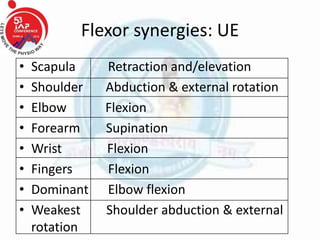
Flexor synergies: UE
• Scapula Retraction and/elevation
• Shoulder Abduction & external rotation
• Elbow Flexion
• Forearm Supination
• Wrist Flexion
• Fingers Flexion
• Dominant Elbow flexion
• Weakest Shoulder abduction & external
rotation
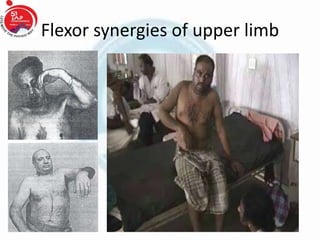
Flexor synergies of upper limb
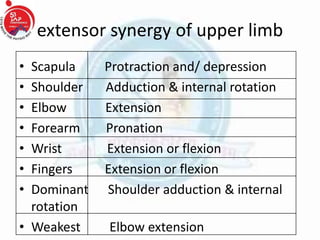
extensor synergy of upper limb
• Scapula Protraction and/ depression
• Shoulder Adduction & internal rotation
• Elbow Extension
• Forearm Pronation
• Wrist Extension or flexion
• Fingers Extension or flexion
• Dominant Shoulder adduction & internal
rotation
• Weakest Elbow extension
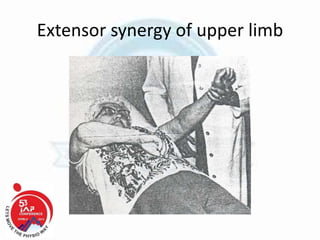
Extensor synergy of upper limb
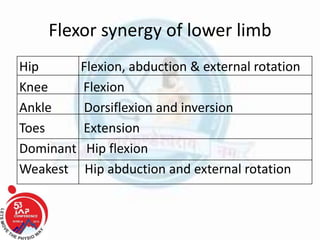
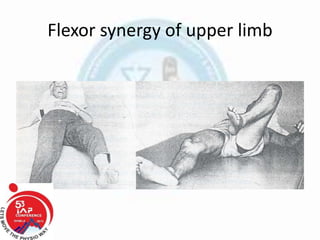
Flexor synergy of lower limb
Hip Flexion, abduction & external rotation
Knee Flexion
Ankle Dorsiflexion and inversion
Toes Extension
Dominant Hip flexion
Weakest Hip abduction and external rotation
Flexor synergy of upper limb
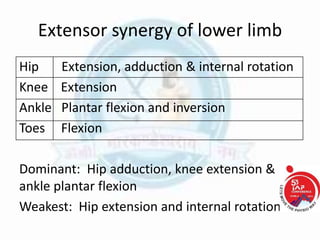
Extensor synergy of lower limb
Hip Extension, adduction & internal rotation
Knee Extension
Ankle Plantar flexion and inversion
Toes Flexion
Dominant: Hip adduction, knee extension &
ankle plantar flexion
Weakest: Hip extension and internal rotation
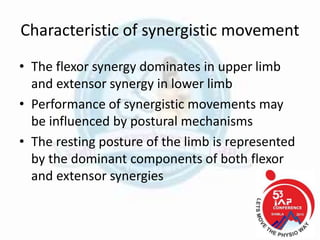
Characteristic of synergistic movement
• The flexor synergy dominates in upper limb
and extensor synergy in lower limb
• Performance of synergistic movements may
be influenced by postural mechanisms
• The resting posture of the limb is represented
by the dominant components of both flexor
and extensor synergies
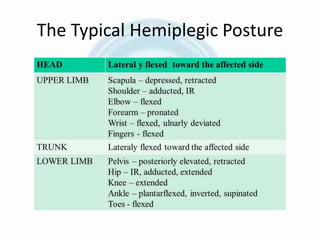
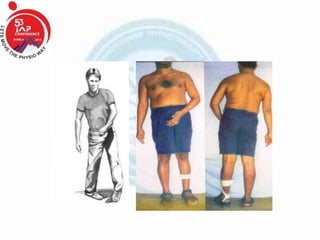
The Typical Hemiplegic Posture
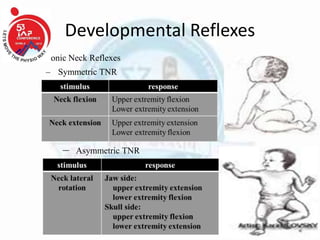
Developmental Reflexes
• Tonic Neck Reflexes
– Symmetric TNR
– Asymmetric TNR
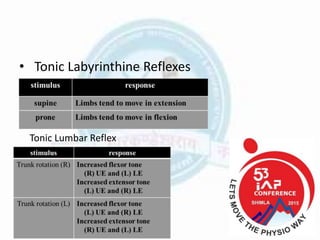
• Tonic Labyrinthine Reflexes
Tonic Lumbar Reflex
Associated reaction
• In patients with hemiparesis reflex tensing of
muscles and involuntary limb movement are
frequently observed. These response are
known as associated reactions.
• In most patients voluntary forcefull
movements in other part of the body readily
elicit such reactions in the affected limb.
Associated reactions
• Investigation by Walshe (1923)
Associated reactions are released postural reactions
deprived of voluntary control
• Investigation by Simons (1923)
Position of the head has a marked influence on the
outcome of the associated rections
Limb reactions evoked closely resemble tonic neck
reflexes
• Observations by Brunnstrom (1951,1952)
UE: movements employed elicited the same reactions
in the affected limb
LE: movements employed elicited opposite reactions
in the affected limb
Associated reactions
• Observations by Brunnstrom (1951, 1952)
 May be evoked in a limb that is essentially flaccid,
although latent spasticity may be present
 May occur in the affected limb under a variety of
condition: in the presence of spasticity, when a
degree of voluntary control has been achieved, and
after spasticity has subsided
 May be present years after the onset of hemiplegia
Associated reactions
• Observations by Brunnstrom (1951,1952)
 repeated stimuli may be required to evoke a
response
 tension in the muscles of the affected limb decrease
rapidly after cessation of stimulus that evoked the
associate directions
 attitudinal reflexes influence the outcome of
associated reactions
Associated reactions
• HOMOLATERAL LIMB SYNKINESIS
The response of one extremity to stimulus will
elicit the same response in its ipsilateral
extremity
• RAIMISTE’S PHENOMENON
Resisted abduction or adduction of the sound
limb evokes a similar response in the affected
limb
• IMITATION SYNKINESIS
Mirroring of movements occur in the affected
side when movements are attempted or
performed on the unaffected side
E.g.
Flexion of the unaffected side will evoke
flexion of the affected side
 Used generally to facilitate movements on the
affected side
• INSTINCTIVE GRASP REACTION
Closure of hand in response to contact of
stationary object with palm of the hand
Seen in frontal lobe lesions
• INSTINCTIVE AVOIDING REACTION
Stroking over palmar surface of hand in distal
direction causes hyperextension of fingers in a
characteristic fashion
Seen in parietal lobe lesions
• SOUQUES PHENOMENON
• Elevation of the affected arm causes the
paralyzed fingers to extend automatically
• Used to facilitate release of fingers
• PROPRIOCEPTIVE TRACTION RESPONSE
• Stretch of any of the flexor muscles in upper
limb evokes or facilitates contraction of flexor
muscles all other joints in upper limb
Associated reactions
• Yawning
• Flexor synergy is elicited during initiation of
yawn
• Coughing and Sneezing
• Evoke sudden muscular contractions of short
duration
Hand reactions
• Steps to restoration of hand function
(Twitchell, 1951)
• Tendon reflexes return and become
hyperactive
• Spasticity develops; resistance to passive
motion is felt
• Voluntary finger flexion occurs, if facilitated by
proprioceptive stimuli
Hand reactions
• Proprioceptive traction response can be
elicited
• Aka proximal traction response
• Stretch of flexors of one of the joints of the
upper limb facilitates a contraction of the
flexor muscles of other joints of the same limb
thus producing total limb shortening
• Control of hand without proprioceptive stimuli
begins
Hand reactions
• Grasp is reinforced by tactile stimulus on the palm of
the hand; spasticity declines
• True grasp reflex can be elicited; spasticity further
declines
• Elicited by distally moving deep pressure over certain
areas of the palm and digits
• Catching phase: weak contraction of flexors and
adductors upon stimulus
• Holding phase: proceeds when traction is done on
muscles activated in the catching phase
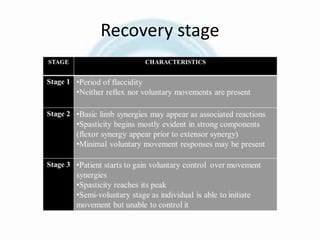
Recovery stage
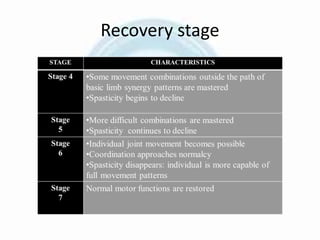
Recovery stage
EVALUATION
MOTOR TEST- SHOULDER AND ELBOW
• Stage 1.
No voluntary movement
Limbs feel heavy
Flaccidity
• Stage 2.
Basic limb synergies appear
Flexor synergy appear before extensor synergy
Spasticity develops in elbow flexors
• Stage 3.
Basic limb synergies become stronger
Flexor synergy tested by asking the patient to
scratch behind the ear
Extensor synergy tested by asking the patient
to touch between the knees held together
Usually synergies does not combine in stage 3
• Stage 4.
4A: Placing the hand behind the body
4B: Elevation of the arm to a forward-
horizontal position
4C: Pronation- supination with elbow at 90.
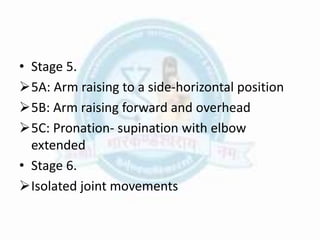
• Stage 5.
5A: Arm raising to a side-horizontal position
5B: Arm raising forward and overhead
5C: Pronation- supination with elbow
extended
• Stage 6.
Isolated joint movements
MOTOR TEST- HAND
• Stage 1: Flaccidity
• Stage 2: Little or no active finger flexion
• Stage 3:
Mass grasp
Hook grasp but no release
No voluntary finger extension
Possible reflex extension of digits
• Stage 4:
Lateral prehension
Release by thumb movement
Semi voluntary finger extension, small range
• Stage 5:
Palmar prehension
Possibly cylindrical & spherical grasp
Awkwardly performed with limited use
Voluntary mass extension of digits
• Stage 6:
• Individual finger movements
• Voluntary extension of digits
• Less accurate than opposite side
SPEED TEST
1. Hand is moved from lap to chin, requiring
complete ROM of elbow flexion
2. Hand is moved from lap to opposite knee,
requiring full ROM of elbow extension
Stop watch is used
No of full strokes completed in 5 seconds
MOTOR TEST- TRUNK AND LOWER
LIMB
• Stage 1. Flaccidity
• Stage 2. Minimal voluntary movement of lower limb
• Stage 3. Hip knee ankle flexion in lying & standing
• Stage 4.
 Sitting, knee flexion beyond 90⁰ with the foot sliding
backward on the floor,
 Voluntary dorsiflexion of the ankle without lifting the
foot of the floor
• Stage 5.
 Standing, isolated non weight bearing knee flexion
with hip in extension or nearly extended
 Standing, isolated dorsiflexion of the ankle with knee
in extension.
• Stage 6.
 Standing, hip abduction beyond range obtained from
elevation of the pelvis
 Sitting, reciprocal action of the inner & outer hams
muscles, combined with inversion & eversion
SENSORY STATUS
• Position sense
• Passive motion sense of upper and lower limb
• Finger tip recognition
• Sole sensation
PRINCIPAL OF TREATMENT
• Treatment must progresses developmentally
(Reflex, Voluntary , Functional)
• Movement is facilitated using
Reflexes
Associated reactions
Proprioceptive and exteroceptive stimuli
Resistance
References
• Bandong, A. (2008). Approaches to therapeutic exercise:
Concepts, principles, and strategies. Power point lecture
presentation in PT 154.
• Bobath B (1990). Adult hemiplegia: Evaluation and treatment
(3rd ed). Oxford, Heinemann Medical Books.
• Levitt S (2004). Treatment of cerebral palsy and motor delay
(4th ed). Singapore, McGraw-Hill Inc.
• Sawner K & LaVigne J (1992). Brunnstrom’s Movement
Therapy in hemiplegia: A Neurophysiological Approach (2nd
ed). Philadelphia, J.B. Lippincott Company.

Brunnstrom

  • 1.
    Brunnstrom concept Dr. SubhasishChatterjee (PT) MPT, Neurology Assistant Professor, MMIPR
  • 2.
    History… • Developed bySigne Brunnstrom, a physical therapist from Sweden • Theoretical foundations:  Sherrington  Magnus  Jackson  Twitchell
  • 3.
    ASSUMPTIONS 1. Reflex- Hierarchicaltheory 2. Lower level reflexes get modified & rearranged into purposeful movements through influence of higher centers 3. Reflexes & primitive movement patterns can used to facilitate the recovery of voluntary mvts.
  • 4.
    4. Proprioceptive andexteroceptive stimuli can be used to evoke desired motion or alter tone 5. Recovery of voluntary movts occur in sequence 6. Newly produced correct movements must be practiced to be learned 7. Practice within the context of daily activities enhances learning process
  • 5.
    Premise When the CNSis injured, as in CVA, an individual goes through an “evolution in reverse” –Movement becomes primitive, reflexive, and automatic Changes in tone and the presence of reflexes are considered part of the normal process of recovery
  • 6.
    Principles of treatment Facilitate the patient’s progress throughout the recovery stages  Use of postural and attitudinal reflexes to increase and decrease tone of muscles  Stimulation of skin over the muscle produces contraction  Resistance facilitates contraction
  • 7.
    Basic limb synergies •Mass movement patterns in response to stimulus or voluntary effort or both – Gross flexor movement (flexor synergy) – Gross extensor movement (extensor synergy) – Combination of the strongest components of the synergies (mixed synergy) • Appear during the early spastic period of recovery
  • 8.
    Important! (Limb Synergies) •Muscles are neurophysiologically linked and cannot act alone or perform all of their functions • If one muscle in the synergy is activated, each muscle in the synergy responds partially or completely • Patient cannot perform isolated movements when bound by these synergies
  • 9.
    Flexor synergies: UE •Scapula Retraction and/elevation • Shoulder Abduction & external rotation • Elbow Flexion • Forearm Supination • Wrist Flexion • Fingers Flexion • Dominant Elbow flexion • Weakest Shoulder abduction & external rotation
  • 10.
  • 11.
    extensor synergy ofupper limb • Scapula Protraction and/ depression • Shoulder Adduction & internal rotation • Elbow Extension • Forearm Pronation • Wrist Extension or flexion • Fingers Extension or flexion • Dominant Shoulder adduction & internal rotation • Weakest Elbow extension
  • 12.
  • 13.
    Flexor synergy oflower limb Hip Flexion, abduction & external rotation Knee Flexion Ankle Dorsiflexion and inversion Toes Extension Dominant Hip flexion Weakest Hip abduction and external rotation
  • 14.
  • 15.
    Extensor synergy oflower limb Hip Extension, adduction & internal rotation Knee Extension Ankle Plantar flexion and inversion Toes Flexion Dominant: Hip adduction, knee extension & ankle plantar flexion Weakest: Hip extension and internal rotation
  • 16.
    Characteristic of synergisticmovement • The flexor synergy dominates in upper limb and extensor synergy in lower limb • Performance of synergistic movements may be influenced by postural mechanisms • The resting posture of the limb is represented by the dominant components of both flexor and extensor synergies
  • 17.
  • 19.
    Developmental Reflexes • TonicNeck Reflexes – Symmetric TNR – Asymmetric TNR
  • 20.
    • Tonic LabyrinthineReflexes Tonic Lumbar Reflex
  • 21.
    Associated reaction • Inpatients with hemiparesis reflex tensing of muscles and involuntary limb movement are frequently observed. These response are known as associated reactions. • In most patients voluntary forcefull movements in other part of the body readily elicit such reactions in the affected limb.
  • 22.
    Associated reactions • Investigationby Walshe (1923) Associated reactions are released postural reactions deprived of voluntary control • Investigation by Simons (1923) Position of the head has a marked influence on the outcome of the associated rections Limb reactions evoked closely resemble tonic neck reflexes • Observations by Brunnstrom (1951,1952) UE: movements employed elicited the same reactions in the affected limb LE: movements employed elicited opposite reactions in the affected limb
  • 23.
    Associated reactions • Observationsby Brunnstrom (1951, 1952)  May be evoked in a limb that is essentially flaccid, although latent spasticity may be present  May occur in the affected limb under a variety of condition: in the presence of spasticity, when a degree of voluntary control has been achieved, and after spasticity has subsided  May be present years after the onset of hemiplegia
  • 24.
    Associated reactions • Observationsby Brunnstrom (1951,1952)  repeated stimuli may be required to evoke a response  tension in the muscles of the affected limb decrease rapidly after cessation of stimulus that evoked the associate directions  attitudinal reflexes influence the outcome of associated reactions
  • 25.
    Associated reactions • HOMOLATERALLIMB SYNKINESIS The response of one extremity to stimulus will elicit the same response in its ipsilateral extremity • RAIMISTE’S PHENOMENON Resisted abduction or adduction of the sound limb evokes a similar response in the affected limb
  • 26.
    • IMITATION SYNKINESIS Mirroringof movements occur in the affected side when movements are attempted or performed on the unaffected side E.g. Flexion of the unaffected side will evoke flexion of the affected side  Used generally to facilitate movements on the affected side
  • 27.
    • INSTINCTIVE GRASPREACTION Closure of hand in response to contact of stationary object with palm of the hand Seen in frontal lobe lesions • INSTINCTIVE AVOIDING REACTION Stroking over palmar surface of hand in distal direction causes hyperextension of fingers in a characteristic fashion Seen in parietal lobe lesions
  • 28.
    • SOUQUES PHENOMENON •Elevation of the affected arm causes the paralyzed fingers to extend automatically • Used to facilitate release of fingers • PROPRIOCEPTIVE TRACTION RESPONSE • Stretch of any of the flexor muscles in upper limb evokes or facilitates contraction of flexor muscles all other joints in upper limb
  • 29.
    Associated reactions • Yawning •Flexor synergy is elicited during initiation of yawn • Coughing and Sneezing • Evoke sudden muscular contractions of short duration
  • 30.
    Hand reactions • Stepsto restoration of hand function (Twitchell, 1951) • Tendon reflexes return and become hyperactive • Spasticity develops; resistance to passive motion is felt • Voluntary finger flexion occurs, if facilitated by proprioceptive stimuli
  • 31.
    Hand reactions • Proprioceptivetraction response can be elicited • Aka proximal traction response • Stretch of flexors of one of the joints of the upper limb facilitates a contraction of the flexor muscles of other joints of the same limb thus producing total limb shortening • Control of hand without proprioceptive stimuli begins
  • 32.
    Hand reactions • Graspis reinforced by tactile stimulus on the palm of the hand; spasticity declines • True grasp reflex can be elicited; spasticity further declines • Elicited by distally moving deep pressure over certain areas of the palm and digits • Catching phase: weak contraction of flexors and adductors upon stimulus • Holding phase: proceeds when traction is done on muscles activated in the catching phase
  • 33.
  • 34.
  • 35.
  • 36.
    MOTOR TEST- SHOULDERAND ELBOW • Stage 1. No voluntary movement Limbs feel heavy Flaccidity • Stage 2. Basic limb synergies appear Flexor synergy appear before extensor synergy Spasticity develops in elbow flexors
  • 37.
    • Stage 3. Basiclimb synergies become stronger Flexor synergy tested by asking the patient to scratch behind the ear Extensor synergy tested by asking the patient to touch between the knees held together Usually synergies does not combine in stage 3
  • 38.
    • Stage 4. 4A:Placing the hand behind the body 4B: Elevation of the arm to a forward- horizontal position 4C: Pronation- supination with elbow at 90.
  • 39.
    • Stage 5. 5A:Arm raising to a side-horizontal position 5B: Arm raising forward and overhead 5C: Pronation- supination with elbow extended • Stage 6. Isolated joint movements
  • 40.
    MOTOR TEST- HAND •Stage 1: Flaccidity • Stage 2: Little or no active finger flexion • Stage 3: Mass grasp Hook grasp but no release No voluntary finger extension Possible reflex extension of digits
  • 41.
    • Stage 4: Lateralprehension Release by thumb movement Semi voluntary finger extension, small range • Stage 5: Palmar prehension Possibly cylindrical & spherical grasp Awkwardly performed with limited use Voluntary mass extension of digits
  • 42.
    • Stage 6: •Individual finger movements • Voluntary extension of digits • Less accurate than opposite side
  • 43.
    SPEED TEST 1. Handis moved from lap to chin, requiring complete ROM of elbow flexion 2. Hand is moved from lap to opposite knee, requiring full ROM of elbow extension Stop watch is used No of full strokes completed in 5 seconds
  • 44.
    MOTOR TEST- TRUNKAND LOWER LIMB • Stage 1. Flaccidity • Stage 2. Minimal voluntary movement of lower limb • Stage 3. Hip knee ankle flexion in lying & standing • Stage 4.  Sitting, knee flexion beyond 90⁰ with the foot sliding backward on the floor,  Voluntary dorsiflexion of the ankle without lifting the foot of the floor
  • 45.
    • Stage 5. Standing, isolated non weight bearing knee flexion with hip in extension or nearly extended  Standing, isolated dorsiflexion of the ankle with knee in extension. • Stage 6.  Standing, hip abduction beyond range obtained from elevation of the pelvis  Sitting, reciprocal action of the inner & outer hams muscles, combined with inversion & eversion
  • 46.
    SENSORY STATUS • Positionsense • Passive motion sense of upper and lower limb • Finger tip recognition • Sole sensation
  • 47.
    PRINCIPAL OF TREATMENT •Treatment must progresses developmentally (Reflex, Voluntary , Functional) • Movement is facilitated using Reflexes Associated reactions Proprioceptive and exteroceptive stimuli Resistance
  • 48.
    References • Bandong, A.(2008). Approaches to therapeutic exercise: Concepts, principles, and strategies. Power point lecture presentation in PT 154. • Bobath B (1990). Adult hemiplegia: Evaluation and treatment (3rd ed). Oxford, Heinemann Medical Books. • Levitt S (2004). Treatment of cerebral palsy and motor delay (4th ed). Singapore, McGraw-Hill Inc. • Sawner K & LaVigne J (1992). Brunnstrom’s Movement Therapy in hemiplegia: A Neurophysiological Approach (2nd ed). Philadelphia, J.B. Lippincott Company.