MOTOR RE-LEARNING
PROGRAM
Dr.Satish K Pimpale PT
MPTh in Neurosciences
Assistant Professor
TMV'S Lokmanya Medical College of Physiotherapy,
Kharghar ,Navi Mumbai
At the end of the session...
• Introduction
• Principle
• Techniques
Dr.Satish K Pimpale PT
Introduction
• The Motor Relearning Programme (MRP) was developed by the Australian
physiotherapists Janet Carr and Roberta Shepherd.
• It is a task-oriented approach to improving motor control, focusing on the
relearning of daily activities.
• It is strongly based on theories in kinesiology that emphasize a distributed
(rather than a hierarchal) motor control model.
• Postural adjustments are anticipatory and ongoing.
• Changes occur in muscular organization of a person occur simultaneously
with the plan to move and prepare the person for performing the task.
• Motor behaviors emerge as a result of context or regulatory conditions in
the environment (performer-environment interaction).
• Postural adjustments can be learned only in the context of task performance.
Dr.Satish K Pimpale PT
• Skilled motor performance is defined as the ability to perform in different
ways according to variations in environmental demands.
• Deficits in generating appropriate models of action are the primary
problem following stroke, and not spasticity or pathologic movement
synergies.
• Stereotypic movement patterns are compensatory strategies that result
when movement is attempted.
• Development of abnormal movement patterns in stroke
• Attempt to move(Obstacles to efficient movement,Diminished soft tissue
extensibility,Impaired balance,Postural insecurity and resultant fixation
patterns ,Specific muscle weakness,(Compensatory movement strategy
• (Repeated practice of the compensatory strategy(Learned use of the
compensatory strategy
Dr.Satish K Pimpale PT
Motor Relearning Programme
r Focus on practice of missing task components and whole tasks, and
transference of learning
r Examples: Use of “real-world” environments
“Forced use” of affected UL
Inc. activity UL muscles
Stretching of key UL muscles
Feedback and guidance
Dr.Satish K Pimpale PT
Basic Description & guidelines
• The programme is composed of guidelines for evaluating and improving 7
daily functions:
• Upper limb function
• Oro-facial function
• Sitting up from supine
• Sitting
• Standing up and sitting down
• Standing
• Walking
Dr.Satish K Pimpale PT
• Each section is composed of a description of normal activity (essential
movement components).
• Mastery of a section is not necessary before going onto another section.
• There is no intent of progressing from one section to the next; the order of
sections is not important.
• The patient must always be actively participating in the activity (without
resistance) and given some opportunity to make mistakes.
Dr.Satish K Pimpale PT
INTERVENTION
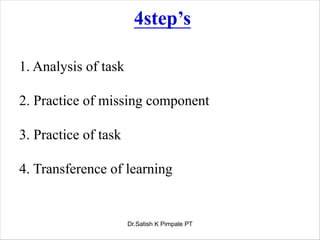
4step’s
1. Analysis of task
2. Practice of missing component
3. Practice of task
4. Transference of learning
Dr.Satish K Pimpale PT
1.ANALYSIS OF TASK-
• Observation
• Comparison
• Analysis
*
Dr.Satish K Pimpale PT
2.PRACTICE OF MISSING COMPONENTS-
* Explanation – Identification of goal
* Instruction
* Practice + verbal + visual feedback + manual guidance
Dr.Satish K Pimpale PT
3. PRACTICE OF TASK-
• Explanation – Identification of goal
• Instruction
• Practice +verbal + visual feedback + manual guidance
*Progression:-
• Increase complexity
• Add variety
• Dec. feedback & guidance
• Reevaluation
• Encourage flexibility
Dr.Satish K Pimpale PT
4. Transference of learning-
*Opportunity to practice
*Consistency of practice
• +ve reinforcement
*Organization of self-monitored
• Practice
*Structured & stimulating
learning environment
*Involvement of relatives and staff
Dr.Satish K Pimpale PT
Strategies for instructing the patient
• Verbal instruction is kept to a minimum. The therapist identifies the most
important aspect of the movement on which the patient will concentrate.
• Visual demonstration is provided by the therapist’s performance of the task,
focusing on one or two most important components.
• Manual guidance helps to clarify the model of action by passively guiding
the patient through the path of movement or by physically constraining
inappropriate components.
• Accurate, timely feedback about the quality of performance helps the
patient to learn which strategies to repeat and which ones to avoid.
• Consistency of practice facilitates development of skill in task performance.
Dr.Satish K Pimpale PT
Important points to consider
• Motor tasks are either practiced in entirety or broken down into
components. The practice of each component is immediately followed by
the practice of the entire activity.
• Techniques principally comprise verbal and visual feedback and instruction,
and manual guidance.
• Passive movement during demonstration should not persist >1-2 times
• Body alignment should be monitored consistently
Dr.Satish K Pimpale PT
Acceptable methods of progression
• Decrease in manual guidance and feedback
• Alteration in speed
• Increase in variety
Dr.Satish K Pimpale PT
Inappropriate methods of progression
• Performance of motor activities in the neurodevelopmental sequence
• Passive ROM exercise to resistive exercise
• Parallel bars to quad cane
• Wide to narrow base of support
• Roll over before sitting balance
Dr.Satish K Pimpale PT
Equipment
• Objects that can be used as normally operative regulatory conditions for
tasks
• Unnecessary equipment
• Parallel bars and canes
• Splints / braces that hold the ankle in dorsiflexion
Dr.Satish K Pimpale PT
Effectiveness
• Depends on the therapist’s knowledge of biomechanics and motor control,
and problem-solving ability
• The therapist must recognize and analyze the motor problem, select the
most essential missing component, effectively teach the patient the required
movement, monitor the patient’s response, give meaningful feedback, and
create an environment that promotes a drive toward recovery and
relearning.
Dr.Satish K Pimpale PT
Limitation
• Spasticity is not considered a significant residual problem of stroke.
However, no management is recommended to reduce abnormal muscle
tone.
• Focus on active learning indicates limited applicability in patients with
severe cognitive deficits.
Dr.Satish K Pimpale PT
Description of normal function
Essential components of rolling onto the side
• Neck flexion and rotation
• Shoulder flexion and protraction
• Trunk rotation
• Hip and knee flexion
• Other components: posterior hip shifting; foot pushing on the bed
Dr.Satish K Pimpale PT
Essential components of sitting up over the side of the bed
• Lateral neck flexion
• Lateral trunk flexion
• Lowering of the legs over the side of the bed
• Other component: shoulder abduction of the lower arm
Dr.Satish K Pimpale PT
Common compensatory responses
• Forward neck flexion and rotation
• Pulling self over using the intact hand; wriggling
• Hooking of the intact leg under the affected leg to dangle over the side of
the bed
Dr.Satish K Pimpale PT
Specific techniques
• To stimulate shoulder girdle protraction for rolling over
• To stimulate hip extension for rolling onto the side
• To stimulate lateral neck flexion
Dr.Satish K Pimpale PT
BALANCED SITTING
Appropriate body alignment
Correct adjustments made to changes in body alignment (with shifts in the
center of gravity)
Dr.Satish K Pimpale PT
BALANCED SITTING
Appropriate body alignment
Correct adjustments made to changes in body alignment (with shifts in the
center of gravity)
BALANCE
Sitting without using undue muscle activity, to move about in sitting, to
move in and out of the sitting position, without arm support
BALANCE REACTIONS
Head trunk and limb movement in response to any shift in the center of
gravity to maintain balance
Protective extension only occurs when the center of gravity is moved so far
that balance is lost
Description of Normal Function
Dr.Satish K Pimpale PT
ESSENTIAL COMPONENTS OF SITTING ALIGNMENT
• Feet and knees close together
• Symmetrical weight-bearing / sitting
• Hip flexion with trunk extension
• Head balanced on level shoulders
Dr.Satish K Pimpale PT
ESSENTIAL COMPONENTS OF BALANCE REACTIONS
• Lateral shift in the center of gravity
• Lateral neck flexion
• Lateral trunk flexion (pelvic elevation, shoulder depression)
• Backward shift in the center of gravity
• Forward neck and trunk flexion
Dr.Satish K Pimpale PT
WHAT TO DO...
• Observe sitting alignment
• Sitting on a firm base with feet flat on the floor, knees and feet a few inches
apart and hands on the lap.
• Test the ability to adjust to self-initiated movement of head, trunk and
limbs
• Looking behind, up Grasping an object from the floor
• Lifting the intact leg and foot Reaching in various directions
• Test the displacement of weight sideways and backward (equilibrium
reactions)
Dr.Satish K Pimpale PT
Common Compensatory Responses
• Wide base of support (placement of the feet and / or knees apart)
• Voluntary restriction of movement (holding the breath or maintaining a stiff
body
• posture)
• Shuffling of the feet instead of adjusting using appropriate body segments
• Leaning forward or backward when the center of gravity shifts sideways
• Use of protective support by the upper limbs (grabbing for support, holding
arms
• out sideways or forward) with minimal shifts in the center of gravity
Dr.Satish K Pimpale PT
SPECIFIC TECHNIQUES
• To Stimulate Adjustments to Shifts in Center of Gravity
• To Stimulate Essential Aspects of Balanced Sitting Alignment
STANDING UPAND SITTING DOWN
• Placement of the feet and shifting of the body such that the center of
gravity moves forward or backwards
• Good sitting balance is not a prerequisite to standing up; the patient,
however, needs good sitting alignment.
• Description of Normal Function
Dr.Satish K Pimpale PT
ESSENTIAL COMPONENTS OF STANDING UP
• Foot placement
• Forward trunk inclination by hip flexion with the neck and spine extended
• Hip extension (for final standing adjustment)
ESSENTIAL COMPONENTS OF SITTING DOWN
• Forward trunk inclination by hip flexion with the neck and spine extended
• Knee flexion
Dr.Satish K Pimpale PT
Common Problems:
• Inability to shift the center of gravity forward sufficiently during the early
stages of
• standing up and the late stages of sitting down
• Failure to place the affected foot
Dr.Satish K Pimpale PT
Common Compensatory Responses:
• Weight borne primarily on the intact side which becomes accentuated when
the
• intact foot is positioned posterior to the affected foot
• Forward neck and trunk flexion or wriggling forward to the edge of the
chair to shift
• the weight forward
Dr.Satish K Pimpale PT
SPECIFIC TECHNIQUES
• To Stimulate Trunk Inclination Forward at the Hips
• Practice Standing Up
• Practice Sitting Down
BALANCED STANDING
• Appropriate body alignment
• Correct adjustments made to changes in body alignment (with shifts in the
center of gravity)
• Increases awareness of bilaterality, position in space and positioning of
body parts; may minimize the development of spasticity
Dr.Satish K Pimpale PT
BALANCE
• Constant accurately balanced movement of the center of gravity on a
stationary base to keep the line of gravity just in front of the ankles
• Standing without using undue muscle activity, to move about in standing,
to move in and out of the standing position, and to walk, without arm
support
Dr.Satish K Pimpale PT
Description of Normal Function
Dr.Satish K Pimpale PT
ESSENTIAL COMPONENTS OF STANDING ALIGNMENT
• Feet a few inches apart
• Symmetrical weight-bearing
• Extended knees and hips
• Hips over feet
• Erect trunk
• Shoulders over hips
• Head balanced on level shoulders
ESSENTIAL COMPONENTS OF BALANCE REACTIONS
• Lateral shift in the center of gravity
• Lateral neck flexion
• Lateral trunk flexion (pelvic elevation, shoulder depression)
• Backward shift in the center of gravity
• Neck extension
• Forward trunk inclination at the hips
• Ankle dorsiflexion
Dr.Satish K Pimpale PT
WHAT TO DO...
• Observe standing alignment
• Test the ability to adjust to self-initiated movement of head, trunk and
limbs
• Looking behind, up Grasping an object from the floor
• Standing on one leg Reaching in various directions
• Test the displacement of weight sideways and backward (equilibrium
reactions) with feet a few inches apart
Dr.Satish K Pimpale PT
Common Compensatory Responses
• Wide base of support (placement of the feet and knees apart)
• Voluntary restriction of movement (holding the breath or maintaining a stiff
body
• posture)
• Shuffling of the feet instead of adjusting using appropriate body segments
• Stepping sideways or backward as soon as the center of gravity moves
• Leaning backwards when the center of gravity shifts sideways
• Proximal (instead of distal) movement of parts when shifting the center of
gravity
• Use of protective support by the upper limbs (grabbing for support, holding
arms
• out sideways or forward) with minimal shifts in the center of gravity
Dr.Satish K Pimpale PT
SPECIFIC TECHNIQUES
• To Stimulate Hip Extension
• To Maintain Knee Extension
• To Stimulate Adjustments to Shifts in Center of Gravity
• To Stimulate Essential Aspects of Balanced Standing Alignment
• To Stimulate Protective Support through the Arm
Dr.Satish K Pimpale PT
UPPER LIMB FUNCTION
• Training of muscle activity at the scapula and shoulder in supine until the
patient can control his shoulder girdle in sitting without excessive
compensatory movements
• Upper limb movement problems are usually secondary to shortening of soft
tissues due to habitual posturing, use of the intact arm to compensate for
the affected arm, and learned non-use of the affected arm.
• MANAGEMENT: Early active mobilization of the affected arm in
functional patterns
Dr.Satish K Pimpale PT
Common Problems and Compensatory Responses:
• Impaired scapular movement, especially rotation and protraction
• Persistent depression of the shoulder girdle
• Impaired control over the deltoids causing the inability to sustain shoulder
abduction and flexion
• Compensation: Excessive shoulder girdle elevation
• Lateral trunk flexion
• Excessive shoulder internal rotation, elbow flexion and forearm pronation
Dr.Satish K Pimpale PT
Common adaptive movements
1. Flexion at the hips instead of flexion at the GHJ during reach
2. Shoulder girdle elevation, spinal lateral flexion, GHJ abduction with
elbow flexion, and GHJ IR with forearm pronation during reach
3. Excessive hand opening for grasp
4. Excessive flexor force during grasp
5. Finger extension with the wrist flexed and thumb CMC and MCP
extension during release
.Dr.Satish K Pimpale PT
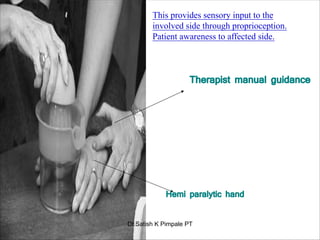
Hemi paralytic hand
Therapist manual guidance
This provides sensory input to the
involved side through proprioception.
Patient awareness to affected side.
Dr.Satish K Pimpale PT
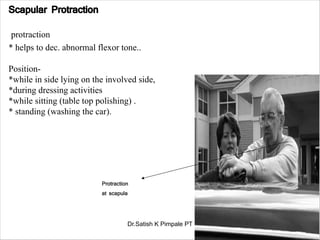
Scapular Protraction
protraction
* helps to dec. abnormal flexor tone..
Position-
*while in side lying on the involved side,
*during dressing activities
*while sitting (table top polishing) .
* standing (washing the car).
Protraction
at scapula
Dr.Satish K Pimpale PT
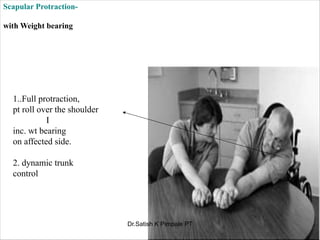
Scapular Protraction-
with Weight bearing
1..Full protraction,
pt roll over the shoulder
I
inc. wt bearing
on affected side.
2. dynamic trunk
control
Dr.Satish K Pimpale PT
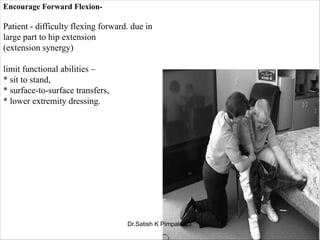
Encourage Forward Flexion-
Patient - difficulty flexing forward. due in
large part to hip extension
(extension synergy)
limit functional abilities –
* sit to stand,
* surface-to-surface transfers,
* lower extremity dressing.
Dr.Satish K Pimpale PT
REFERENCE
• Carr, J. H., & Shepherd, R. B. (1987). A motor relearning programme for
stroke (2nd ed.). Oxford: Butterworth-Heinemann.
Dr.Satish K Pimpale PT

Motor relearning program

  • 1.
    MOTOR RE-LEARNING PROGRAM Dr.Satish KPimpale PT MPTh in Neurosciences Assistant Professor TMV'S Lokmanya Medical College of Physiotherapy, Kharghar ,Navi Mumbai
  • 2.
    At the endof the session... • Introduction • Principle • Techniques Dr.Satish K Pimpale PT
  • 3.
    Introduction • The MotorRelearning Programme (MRP) was developed by the Australian physiotherapists Janet Carr and Roberta Shepherd. • It is a task-oriented approach to improving motor control, focusing on the relearning of daily activities. • It is strongly based on theories in kinesiology that emphasize a distributed (rather than a hierarchal) motor control model. • Postural adjustments are anticipatory and ongoing. • Changes occur in muscular organization of a person occur simultaneously with the plan to move and prepare the person for performing the task. • Motor behaviors emerge as a result of context or regulatory conditions in the environment (performer-environment interaction). • Postural adjustments can be learned only in the context of task performance. Dr.Satish K Pimpale PT
  • 4.
    • Skilled motorperformance is defined as the ability to perform in different ways according to variations in environmental demands. • Deficits in generating appropriate models of action are the primary problem following stroke, and not spasticity or pathologic movement synergies. • Stereotypic movement patterns are compensatory strategies that result when movement is attempted. • Development of abnormal movement patterns in stroke • Attempt to move(Obstacles to efficient movement,Diminished soft tissue extensibility,Impaired balance,Postural insecurity and resultant fixation patterns ,Specific muscle weakness,(Compensatory movement strategy • (Repeated practice of the compensatory strategy(Learned use of the compensatory strategy Dr.Satish K Pimpale PT
  • 5.
    Motor Relearning Programme rFocus on practice of missing task components and whole tasks, and transference of learning r Examples: Use of “real-world” environments “Forced use” of affected UL Inc. activity UL muscles Stretching of key UL muscles Feedback and guidance Dr.Satish K Pimpale PT
  • 6.
    Basic Description &guidelines • The programme is composed of guidelines for evaluating and improving 7 daily functions: • Upper limb function • Oro-facial function • Sitting up from supine • Sitting • Standing up and sitting down • Standing • Walking Dr.Satish K Pimpale PT
  • 7.
    • Each sectionis composed of a description of normal activity (essential movement components). • Mastery of a section is not necessary before going onto another section. • There is no intent of progressing from one section to the next; the order of sections is not important. • The patient must always be actively participating in the activity (without resistance) and given some opportunity to make mistakes. Dr.Satish K Pimpale PT
  • 8.
  • 9.
    4step’s 1. Analysis oftask 2. Practice of missing component 3. Practice of task 4. Transference of learning Dr.Satish K Pimpale PT
  • 10.
    1.ANALYSIS OF TASK- •Observation • Comparison • Analysis * Dr.Satish K Pimpale PT
  • 11.
    2.PRACTICE OF MISSINGCOMPONENTS- * Explanation – Identification of goal * Instruction * Practice + verbal + visual feedback + manual guidance Dr.Satish K Pimpale PT
  • 12.
    3. PRACTICE OFTASK- • Explanation – Identification of goal • Instruction • Practice +verbal + visual feedback + manual guidance *Progression:- • Increase complexity • Add variety • Dec. feedback & guidance • Reevaluation • Encourage flexibility Dr.Satish K Pimpale PT
  • 13.
    4. Transference oflearning- *Opportunity to practice *Consistency of practice • +ve reinforcement *Organization of self-monitored • Practice *Structured & stimulating learning environment *Involvement of relatives and staff Dr.Satish K Pimpale PT
  • 14.
    Strategies for instructingthe patient • Verbal instruction is kept to a minimum. The therapist identifies the most important aspect of the movement on which the patient will concentrate. • Visual demonstration is provided by the therapist’s performance of the task, focusing on one or two most important components. • Manual guidance helps to clarify the model of action by passively guiding the patient through the path of movement or by physically constraining inappropriate components. • Accurate, timely feedback about the quality of performance helps the patient to learn which strategies to repeat and which ones to avoid. • Consistency of practice facilitates development of skill in task performance. Dr.Satish K Pimpale PT
  • 15.
    Important points toconsider • Motor tasks are either practiced in entirety or broken down into components. The practice of each component is immediately followed by the practice of the entire activity. • Techniques principally comprise verbal and visual feedback and instruction, and manual guidance. • Passive movement during demonstration should not persist >1-2 times • Body alignment should be monitored consistently Dr.Satish K Pimpale PT
  • 16.
    Acceptable methods ofprogression • Decrease in manual guidance and feedback • Alteration in speed • Increase in variety Dr.Satish K Pimpale PT
  • 17.
    Inappropriate methods ofprogression • Performance of motor activities in the neurodevelopmental sequence • Passive ROM exercise to resistive exercise • Parallel bars to quad cane • Wide to narrow base of support • Roll over before sitting balance Dr.Satish K Pimpale PT
  • 18.
    Equipment • Objects thatcan be used as normally operative regulatory conditions for tasks • Unnecessary equipment • Parallel bars and canes • Splints / braces that hold the ankle in dorsiflexion Dr.Satish K Pimpale PT
  • 19.
    Effectiveness • Depends onthe therapist’s knowledge of biomechanics and motor control, and problem-solving ability • The therapist must recognize and analyze the motor problem, select the most essential missing component, effectively teach the patient the required movement, monitor the patient’s response, give meaningful feedback, and create an environment that promotes a drive toward recovery and relearning. Dr.Satish K Pimpale PT
  • 20.
    Limitation • Spasticity isnot considered a significant residual problem of stroke. However, no management is recommended to reduce abnormal muscle tone. • Focus on active learning indicates limited applicability in patients with severe cognitive deficits. Dr.Satish K Pimpale PT
  • 21.
    Description of normalfunction Essential components of rolling onto the side • Neck flexion and rotation • Shoulder flexion and protraction • Trunk rotation • Hip and knee flexion • Other components: posterior hip shifting; foot pushing on the bed Dr.Satish K Pimpale PT
  • 22.
    Essential components ofsitting up over the side of the bed • Lateral neck flexion • Lateral trunk flexion • Lowering of the legs over the side of the bed • Other component: shoulder abduction of the lower arm Dr.Satish K Pimpale PT
  • 23.
    Common compensatory responses •Forward neck flexion and rotation • Pulling self over using the intact hand; wriggling • Hooking of the intact leg under the affected leg to dangle over the side of the bed Dr.Satish K Pimpale PT
  • 24.
    Specific techniques • Tostimulate shoulder girdle protraction for rolling over • To stimulate hip extension for rolling onto the side • To stimulate lateral neck flexion Dr.Satish K Pimpale PT
  • 25.
    BALANCED SITTING Appropriate bodyalignment Correct adjustments made to changes in body alignment (with shifts in the center of gravity) Dr.Satish K Pimpale PT
  • 26.
    Dr.Satish K PimpalePT BALANCED SITTING Appropriate body alignment Correct adjustments made to changes in body alignment (with shifts in the center of gravity) BALANCE Sitting without using undue muscle activity, to move about in sitting, to move in and out of the sitting position, without arm support BALANCE REACTIONS Head trunk and limb movement in response to any shift in the center of gravity to maintain balance Protective extension only occurs when the center of gravity is moved so far that balance is lost
  • 27.
    Description of NormalFunction Dr.Satish K Pimpale PT
  • 28.
    ESSENTIAL COMPONENTS OFSITTING ALIGNMENT • Feet and knees close together • Symmetrical weight-bearing / sitting • Hip flexion with trunk extension • Head balanced on level shoulders Dr.Satish K Pimpale PT
  • 29.
    ESSENTIAL COMPONENTS OFBALANCE REACTIONS • Lateral shift in the center of gravity • Lateral neck flexion • Lateral trunk flexion (pelvic elevation, shoulder depression) • Backward shift in the center of gravity • Forward neck and trunk flexion Dr.Satish K Pimpale PT
  • 30.
    WHAT TO DO... •Observe sitting alignment • Sitting on a firm base with feet flat on the floor, knees and feet a few inches apart and hands on the lap. • Test the ability to adjust to self-initiated movement of head, trunk and limbs • Looking behind, up Grasping an object from the floor • Lifting the intact leg and foot Reaching in various directions • Test the displacement of weight sideways and backward (equilibrium reactions) Dr.Satish K Pimpale PT
  • 31.
    Common Compensatory Responses •Wide base of support (placement of the feet and / or knees apart) • Voluntary restriction of movement (holding the breath or maintaining a stiff body • posture) • Shuffling of the feet instead of adjusting using appropriate body segments • Leaning forward or backward when the center of gravity shifts sideways • Use of protective support by the upper limbs (grabbing for support, holding arms • out sideways or forward) with minimal shifts in the center of gravity Dr.Satish K Pimpale PT
  • 32.
    SPECIFIC TECHNIQUES • ToStimulate Adjustments to Shifts in Center of Gravity • To Stimulate Essential Aspects of Balanced Sitting Alignment STANDING UPAND SITTING DOWN • Placement of the feet and shifting of the body such that the center of gravity moves forward or backwards • Good sitting balance is not a prerequisite to standing up; the patient, however, needs good sitting alignment. • Description of Normal Function Dr.Satish K Pimpale PT
  • 33.
    ESSENTIAL COMPONENTS OFSTANDING UP • Foot placement • Forward trunk inclination by hip flexion with the neck and spine extended • Hip extension (for final standing adjustment) ESSENTIAL COMPONENTS OF SITTING DOWN • Forward trunk inclination by hip flexion with the neck and spine extended • Knee flexion Dr.Satish K Pimpale PT
  • 34.
    Common Problems: • Inabilityto shift the center of gravity forward sufficiently during the early stages of • standing up and the late stages of sitting down • Failure to place the affected foot Dr.Satish K Pimpale PT
  • 35.
    Common Compensatory Responses: •Weight borne primarily on the intact side which becomes accentuated when the • intact foot is positioned posterior to the affected foot • Forward neck and trunk flexion or wriggling forward to the edge of the chair to shift • the weight forward Dr.Satish K Pimpale PT
  • 36.
    SPECIFIC TECHNIQUES • ToStimulate Trunk Inclination Forward at the Hips • Practice Standing Up • Practice Sitting Down BALANCED STANDING • Appropriate body alignment • Correct adjustments made to changes in body alignment (with shifts in the center of gravity) • Increases awareness of bilaterality, position in space and positioning of body parts; may minimize the development of spasticity Dr.Satish K Pimpale PT
  • 37.
    BALANCE • Constant accuratelybalanced movement of the center of gravity on a stationary base to keep the line of gravity just in front of the ankles • Standing without using undue muscle activity, to move about in standing, to move in and out of the standing position, and to walk, without arm support Dr.Satish K Pimpale PT
  • 38.
    Description of NormalFunction Dr.Satish K Pimpale PT
  • 39.
    ESSENTIAL COMPONENTS OFSTANDING ALIGNMENT • Feet a few inches apart • Symmetrical weight-bearing • Extended knees and hips • Hips over feet • Erect trunk • Shoulders over hips • Head balanced on level shoulders
  • 40.
    ESSENTIAL COMPONENTS OFBALANCE REACTIONS • Lateral shift in the center of gravity • Lateral neck flexion • Lateral trunk flexion (pelvic elevation, shoulder depression) • Backward shift in the center of gravity • Neck extension • Forward trunk inclination at the hips • Ankle dorsiflexion Dr.Satish K Pimpale PT
  • 41.
    WHAT TO DO... •Observe standing alignment • Test the ability to adjust to self-initiated movement of head, trunk and limbs • Looking behind, up Grasping an object from the floor • Standing on one leg Reaching in various directions • Test the displacement of weight sideways and backward (equilibrium reactions) with feet a few inches apart Dr.Satish K Pimpale PT
  • 42.
    Common Compensatory Responses •Wide base of support (placement of the feet and knees apart) • Voluntary restriction of movement (holding the breath or maintaining a stiff body • posture) • Shuffling of the feet instead of adjusting using appropriate body segments • Stepping sideways or backward as soon as the center of gravity moves • Leaning backwards when the center of gravity shifts sideways • Proximal (instead of distal) movement of parts when shifting the center of gravity • Use of protective support by the upper limbs (grabbing for support, holding arms • out sideways or forward) with minimal shifts in the center of gravity Dr.Satish K Pimpale PT
  • 43.
    SPECIFIC TECHNIQUES • ToStimulate Hip Extension • To Maintain Knee Extension • To Stimulate Adjustments to Shifts in Center of Gravity • To Stimulate Essential Aspects of Balanced Standing Alignment • To Stimulate Protective Support through the Arm Dr.Satish K Pimpale PT
  • 44.
    UPPER LIMB FUNCTION •Training of muscle activity at the scapula and shoulder in supine until the patient can control his shoulder girdle in sitting without excessive compensatory movements • Upper limb movement problems are usually secondary to shortening of soft tissues due to habitual posturing, use of the intact arm to compensate for the affected arm, and learned non-use of the affected arm. • MANAGEMENT: Early active mobilization of the affected arm in functional patterns Dr.Satish K Pimpale PT
  • 45.
    Common Problems andCompensatory Responses: • Impaired scapular movement, especially rotation and protraction • Persistent depression of the shoulder girdle • Impaired control over the deltoids causing the inability to sustain shoulder abduction and flexion • Compensation: Excessive shoulder girdle elevation • Lateral trunk flexion • Excessive shoulder internal rotation, elbow flexion and forearm pronation Dr.Satish K Pimpale PT
  • 46.
    Common adaptive movements 1.Flexion at the hips instead of flexion at the GHJ during reach 2. Shoulder girdle elevation, spinal lateral flexion, GHJ abduction with elbow flexion, and GHJ IR with forearm pronation during reach 3. Excessive hand opening for grasp 4. Excessive flexor force during grasp 5. Finger extension with the wrist flexed and thumb CMC and MCP extension during release .Dr.Satish K Pimpale PT
  • 47.
    Hemi paralytic hand Therapistmanual guidance This provides sensory input to the involved side through proprioception. Patient awareness to affected side. Dr.Satish K Pimpale PT
  • 48.
    Scapular Protraction protraction * helpsto dec. abnormal flexor tone.. Position- *while in side lying on the involved side, *during dressing activities *while sitting (table top polishing) . * standing (washing the car). Protraction at scapula Dr.Satish K Pimpale PT
  • 49.
    Scapular Protraction- with Weightbearing 1..Full protraction, pt roll over the shoulder I inc. wt bearing on affected side. 2. dynamic trunk control Dr.Satish K Pimpale PT
  • 50.
    Encourage Forward Flexion- Patient- difficulty flexing forward. due in large part to hip extension (extension synergy) limit functional abilities – * sit to stand, * surface-to-surface transfers, * lower extremity dressing. Dr.Satish K Pimpale PT
  • 51.
    REFERENCE • Carr, J.H., & Shepherd, R. B. (1987). A motor relearning programme for stroke (2nd ed.). Oxford: Butterworth-Heinemann. Dr.Satish K Pimpale PT