Ch. 6.3 Biological Evidence of
Evolution
1. What evidence from living species
supports the theory of evolution?
2. How are Earth’s organisms
related?
Focus Questions
• As fossils were discovered, patterns emerged
that showed many different species with
similar body structures.
• Evidence suggests that species change over
time.
• Evolution (to evolve) = Change in species
over time
What causes species to change over
time?
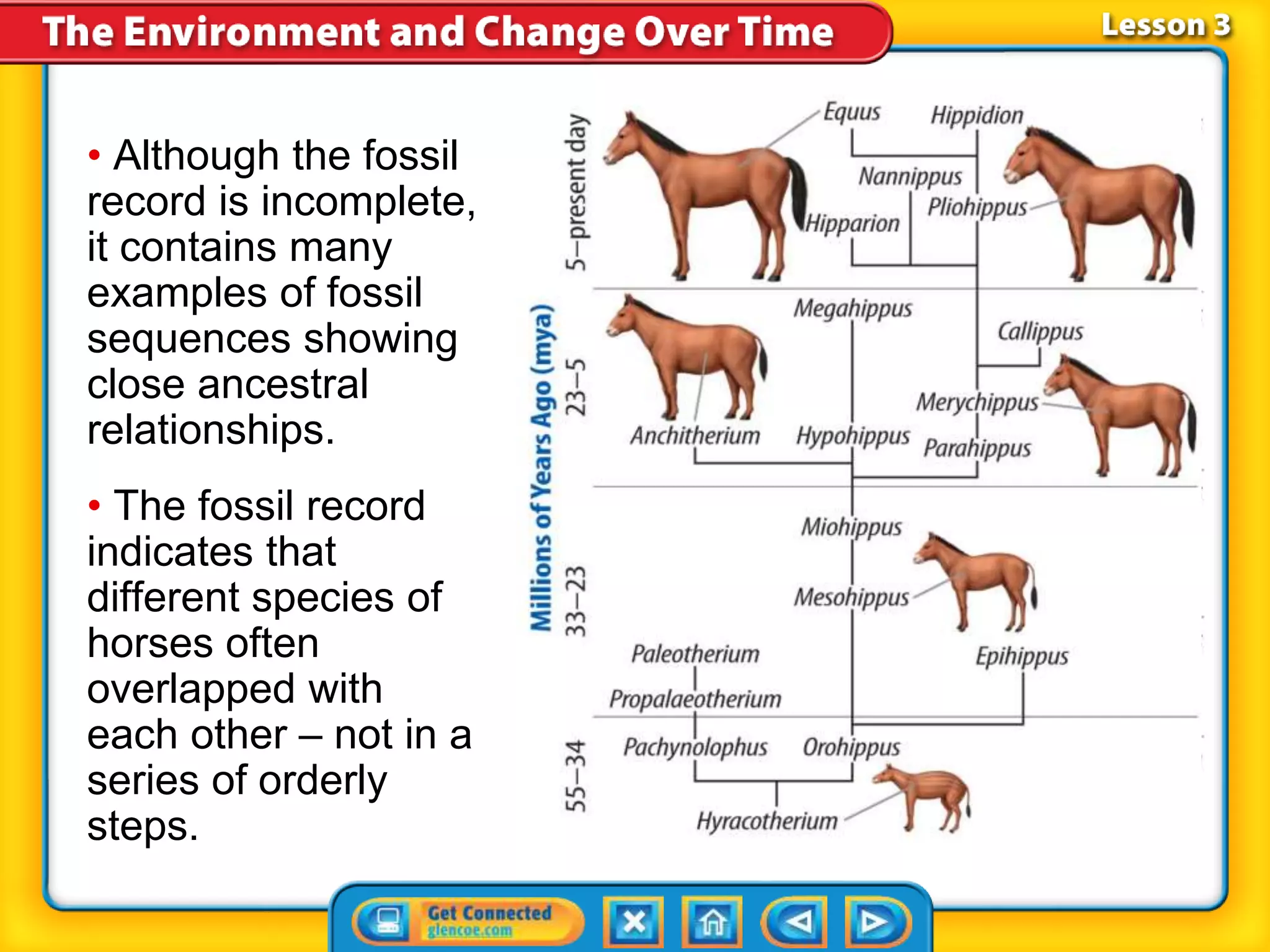
• The fossil record
is evidence
that horses
descended from
organisms for
which only fossils
exist today
•The degree to
which species are
related depends on
how closely in time
they diverged, or
split, from their
common ancestor.
• Although the fossil
record is incomplete,
it contains many
examples of fossil
sequences showing
close ancestral
relationships.
• The fossil record
indicates that
different species of
horses often
overlapped with
each other – not in a
series of orderly
steps.
• Comparative Anatomy – the study of similarities
and differences among structures of living species.
• Homologous Structures – body parts are similar in
structure, but different in function
Comparative Anatomy
The forelimbs of these species are different sizes, but
their placement and structure suggest common
ancestry.
Evidence: More similar structures = more related
species (evolved from common ancestor)
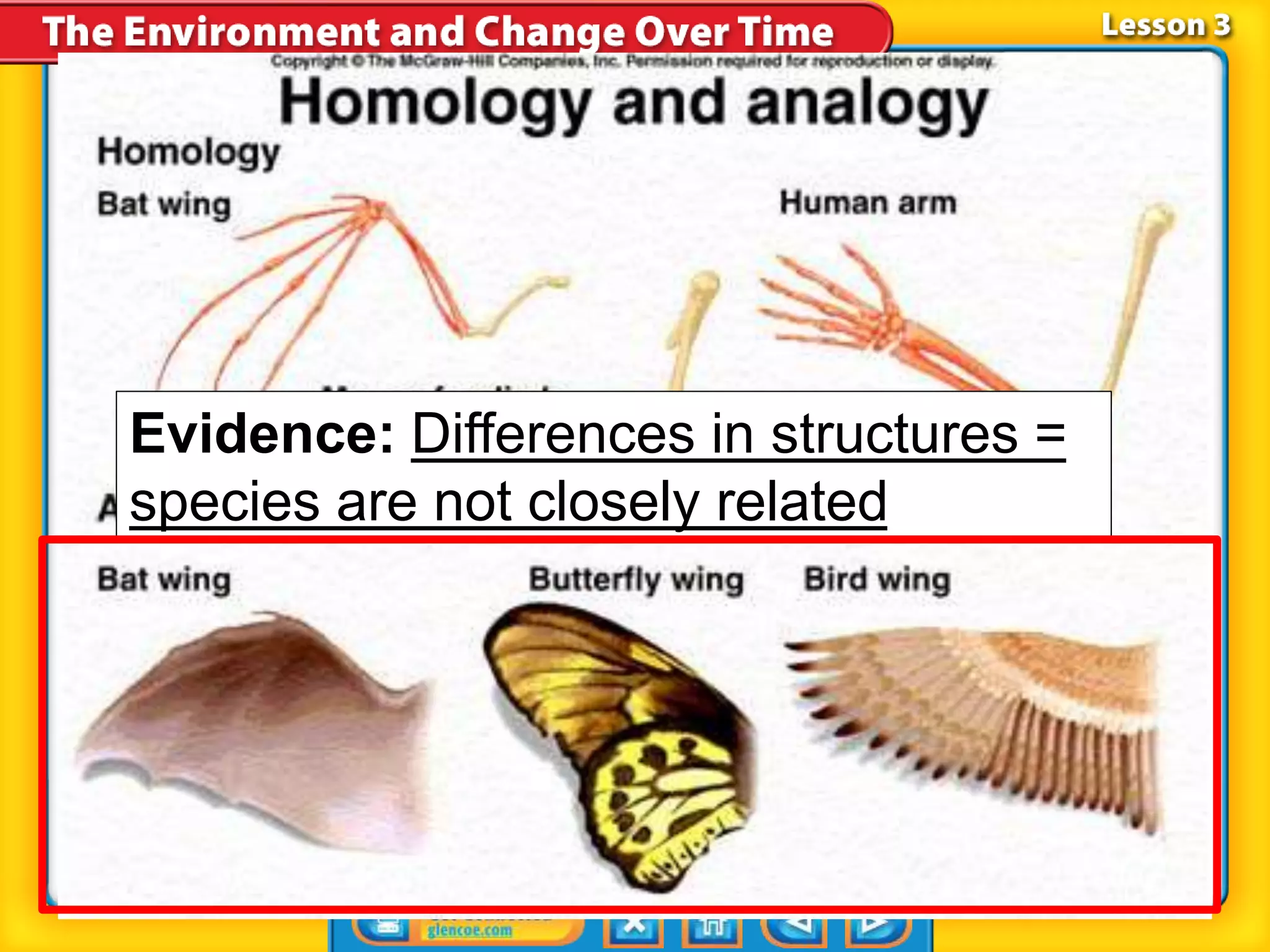
Analogous
structures:
Body parts are
similar in
function, but
different in
structure (not
closely related)
(ex: bird wings
vs. insect wings)
Comparative Anatomy
Evidence: Differences in structures =
species are not closely related
Vestigial structures are body parts that
have lost their original function through
evolution.
Comparative Anatomy
Section 1 Change over Time
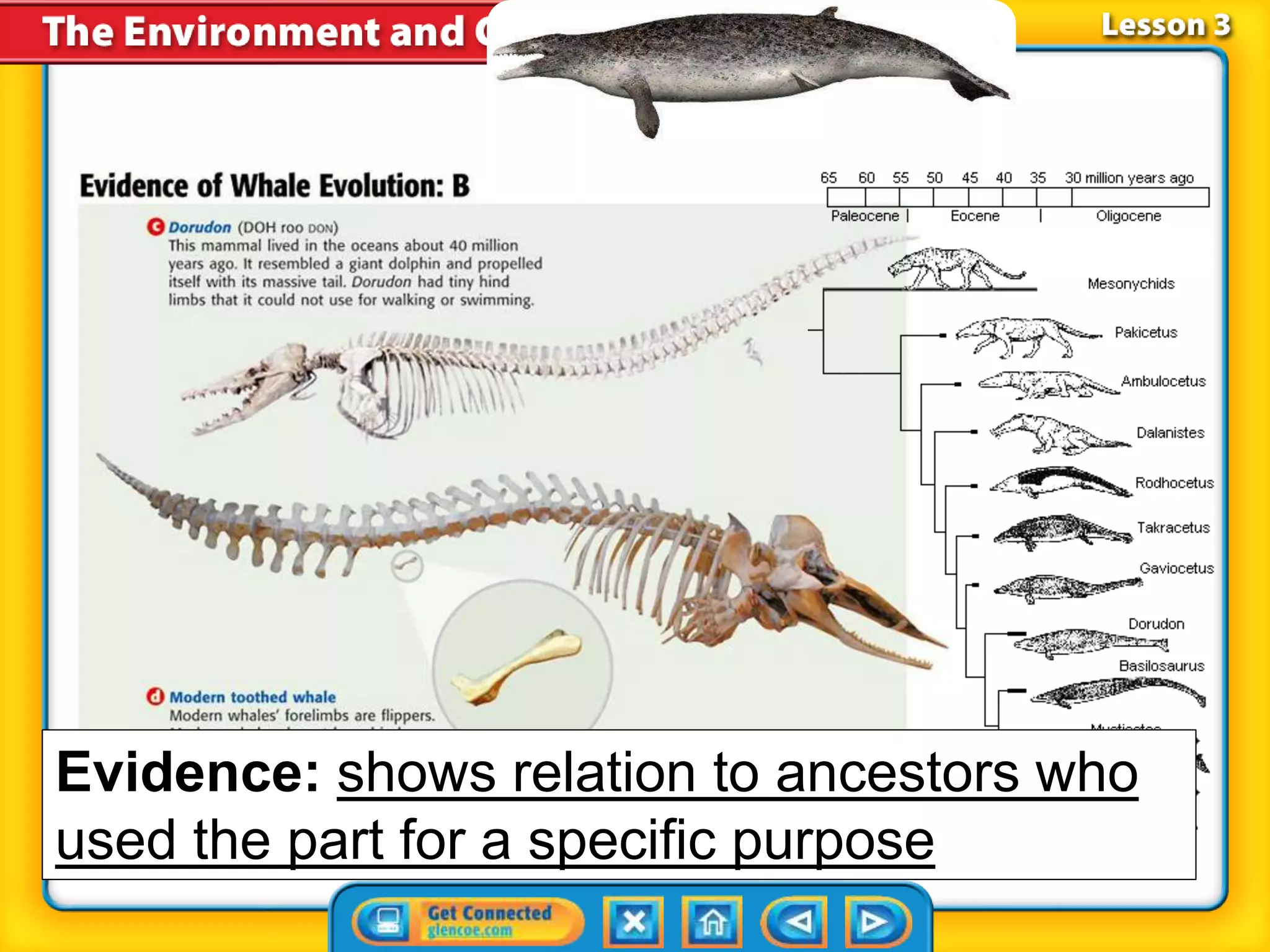
Evidence: shows relation to ancestors who
used the part for a specific purpose
Studying the development of embryos can
also provide scientists with evidence that
certain species are related.
Embryology – The study of the
development of embryos from fertilization
to birth
Evidence: similar embryo development =
more closely related
Developmental Biology
All vertebrate embryos exhibit pharyngeal
pouches at a certain stage of their development.
In reptiles, birds, & humans, pharyngeal pouches
develop into a gland in the neck – in fish, they
form gills. (both glands & gills regulate calcium)
2. How are Earth’s organisms related?
Rat Chicken Human
• Molecular biology is the study of gene
structure and function.
• Discoveries in molecular biology have
confirmed and extended much of the
data already collected about the theory
of evolution.
• Comparing DNA Sequences: Scientists
compare the similarity of genes (DNA) &
proteins to study the relatedness of living
species.
Molecular Biology
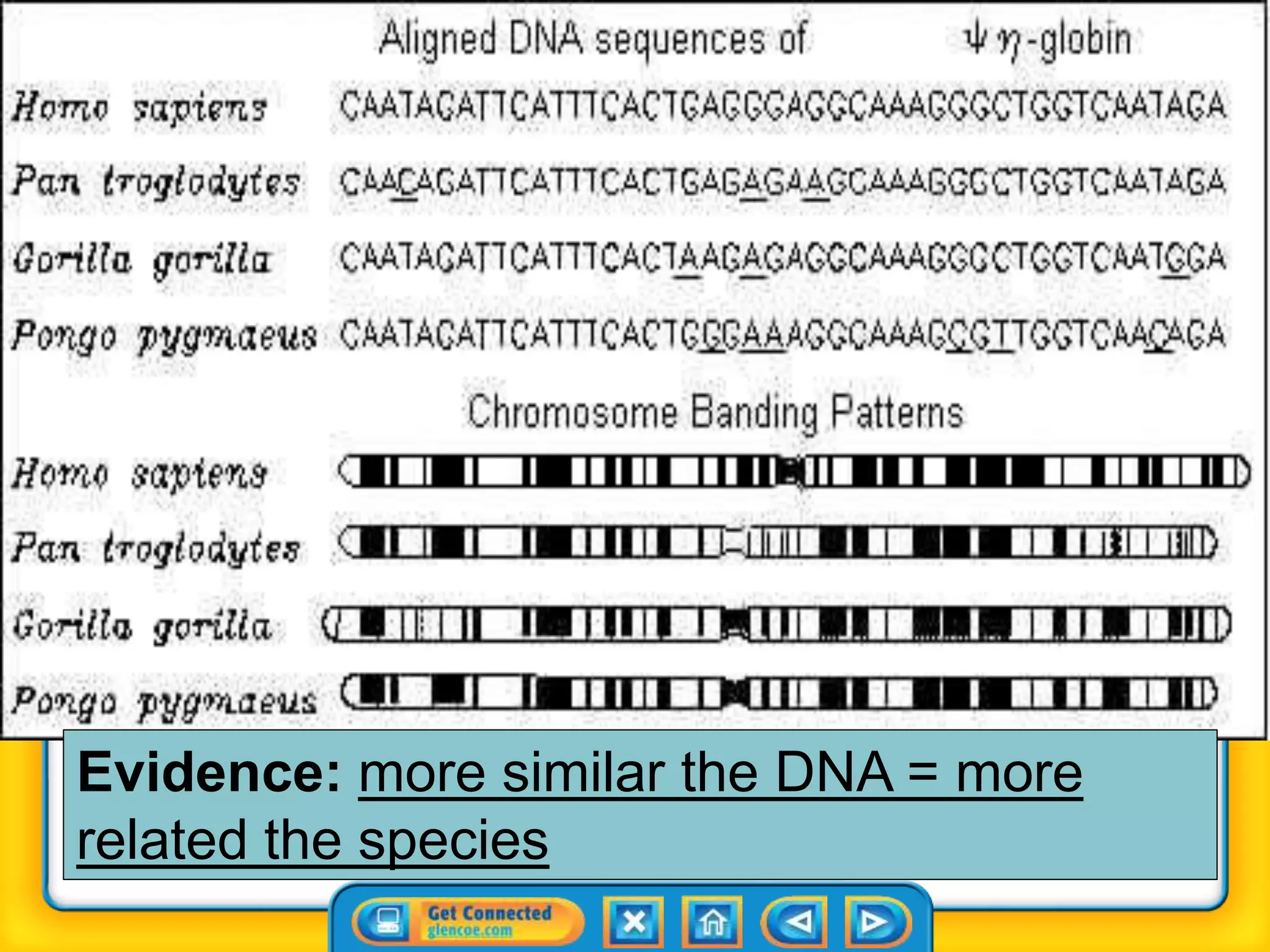
Aligned DNA fragment and first chromosome banding patterns for man (Homo
sapiens), chimpanzee (Pan troglodytes), gorilla (Gorilla gorilla), and orangutan
(Pongo pygmaeus).
Evidence: more similar the DNA = more
related the species
Divergence: Using the rate
of DNA mutations (“molecular
clock”) to estimate when
species changed
Molecular data indicate that
whales and porpoises are
more closely related to
hippopotamuses than they
are to any other living
species.
Molecular Biology
~55
Evidence: shows how long ago species
diverged from a common ancestor
• The fossil record is still incomplete, but new fossils
are being discovered all the time.
• For example, the Tiktaalik fossil has both fish and
amphibian features – linking the 2.
• Most evolution research is now done at the molecular
level, but Darwin’s basic principles still hold true after
150+ years.

Ch 6.3 evidence of evolution

  • 1.
    Ch. 6.3 BiologicalEvidence of Evolution
  • 2.
    1. What evidencefrom living species supports the theory of evolution? 2. How are Earth’s organisms related? Focus Questions
  • 3.
    • As fossilswere discovered, patterns emerged that showed many different species with similar body structures. • Evidence suggests that species change over time. • Evolution (to evolve) = Change in species over time What causes species to change over time?
  • 4.
    • The fossilrecord is evidence that horses descended from organisms for which only fossils exist today •The degree to which species are related depends on how closely in time they diverged, or split, from their common ancestor.
  • 5.
    • Although thefossil record is incomplete, it contains many examples of fossil sequences showing close ancestral relationships. • The fossil record indicates that different species of horses often overlapped with each other – not in a series of orderly steps.
  • 6.
    • Comparative Anatomy– the study of similarities and differences among structures of living species. • Homologous Structures – body parts are similar in structure, but different in function Comparative Anatomy
  • 7.
    The forelimbs ofthese species are different sizes, but their placement and structure suggest common ancestry. Evidence: More similar structures = more related species (evolved from common ancestor)
  • 8.
    Analogous structures: Body parts are similarin function, but different in structure (not closely related) (ex: bird wings vs. insect wings) Comparative Anatomy
  • 9.
    Evidence: Differences instructures = species are not closely related
  • 10.
    Vestigial structures arebody parts that have lost their original function through evolution. Comparative Anatomy
  • 12.
    Section 1 Changeover Time Evidence: shows relation to ancestors who used the part for a specific purpose
  • 13.
    Studying the developmentof embryos can also provide scientists with evidence that certain species are related. Embryology – The study of the development of embryos from fertilization to birth Evidence: similar embryo development = more closely related Developmental Biology
  • 14.
    All vertebrate embryosexhibit pharyngeal pouches at a certain stage of their development. In reptiles, birds, & humans, pharyngeal pouches develop into a gland in the neck – in fish, they form gills. (both glands & gills regulate calcium) 2. How are Earth’s organisms related?
  • 15.
  • 16.
    • Molecular biologyis the study of gene structure and function. • Discoveries in molecular biology have confirmed and extended much of the data already collected about the theory of evolution. • Comparing DNA Sequences: Scientists compare the similarity of genes (DNA) & proteins to study the relatedness of living species. Molecular Biology
  • 17.
    Aligned DNA fragmentand first chromosome banding patterns for man (Homo sapiens), chimpanzee (Pan troglodytes), gorilla (Gorilla gorilla), and orangutan (Pongo pygmaeus). Evidence: more similar the DNA = more related the species
  • 19.
    Divergence: Using therate of DNA mutations (“molecular clock”) to estimate when species changed Molecular data indicate that whales and porpoises are more closely related to hippopotamuses than they are to any other living species. Molecular Biology ~55 Evidence: shows how long ago species diverged from a common ancestor
  • 20.
    • The fossilrecord is still incomplete, but new fossils are being discovered all the time. • For example, the Tiktaalik fossil has both fish and amphibian features – linking the 2. • Most evolution research is now done at the molecular level, but Darwin’s basic principles still hold true after 150+ years.

Editor's Notes

  • #2 Tiktaalik roseae, better known as the "fishapod," is a 375 million year old fossil fish which was discovered in the Canadian Arctic in 2004. Its discovery sheds light on a pivotal point in the history of life on Earth: when the very first fish ventured out onto land. Tiktaalik has a mix of fish and amphibian traits Tiktaalik looks like a cross between the primitive fish it lived amongst and the first four-legged animals (a group called "tetrapods" from tetra-, meaning four, and -pod, meaning foot. Actually, all animals that descended from these pioneer amphibians, including us, can be called tetrapods). Tiktaalik lived about 12 million years before the first tetrapods (which are approximately 363 million years old). So, the existence of tetrapod features in a fish like Tiktaalik is significant because it marks the earliest appearance of these novel features in the fossil record.
  • #12 Appendix, wisdom teeth, tailbone, some bird wings
  • #21 Human genes are 96% similar to chimpanzees and 85% similar to mice. There’s a gene (FOXP2 gene) that controls speech development in people (learning how to move our mouths & tongues to produce speech), song in birds, and learning sequences of rapid movement for mice.