Biological
Macromolecules
Content Standards
• The learners demonstrate an understanding of
the relationship between the function and
structure of biological macromolecules
Performance Standards
• The learners shall be able to distinguish the
structures of different biological macromolecules
and relate them to their properties
Learning Competencies
• Explain how the structures of carbohydrates,
lipids, nucleic acid and proteins, and determine
their properties and functions (S11/12PS-IIIe-22)
Carbohydrate
The word carbohydrate may be broken down to
carbon and hydrate. From the chemical formula
of carbohydrate, notice that the ratio of C:H:O is
1:2:1, which can be rewritten as Cn(H2O)n.
Carbohydrates can be seen as hydrates of
carbon.
Another term for carbohydrate is saccharide.
This term is derived from the Latin word
saccharum referring to sugar--a common
carbohydrate
• Carbohydrates are classified either as simple or complex.
Simple sugars are monosaccharides and disaccharides.
Complex sugars are polysaccharides.
• Carbohydrates are the primary energy source of the human
body. The different saccharides that humans eat are
converted to glucose which can be readily used by the body.
Around 4 kilocalories is derived from one gram of
carbohydrate. Should there be an excessive consumption of
carbohydrates, the excess is converted to glycogen which is
stored in the liver and in muscles. Glycogen is a slow-
releasing carbohydrate.
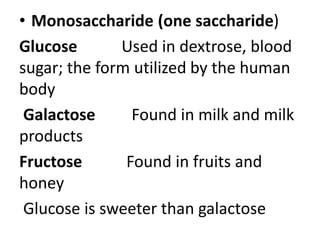
• Monosaccharide (one saccharide)
Glucose Used in dextrose, blood
sugar; the form utilized by the human
body
Galactose Found in milk and milk
products
Fructose Found in fruits and
honey
Glucose is sweeter than galactose
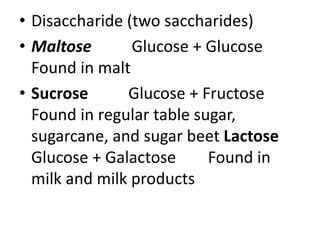
• Disaccharide (two saccharides)
• Maltose Glucose + Glucose
Found in malt
• Sucrose Glucose + Fructose
Found in regular table sugar,
sugarcane, and sugar beet Lactose
Glucose + Galactose Found in
milk and milk products
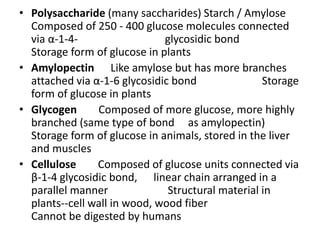
• Polysaccharide (many saccharides) Starch / Amylose
Composed of 250 - 400 glucose molecules connected
via α-1-4- glycosidic bond
Storage form of glucose in plants
• Amylopectin Like amylose but has more branches
attached via α-1-6 glycosidic bond Storage
form of glucose in plants
• Glycogen Composed of more glucose, more highly
branched (same type of bond as amylopectin)
Storage form of glucose in animals, stored in the liver
and muscles
• Cellulose Composed of glucose units connected via
β-1-4 glycosidic bond, linear chain arranged in a
parallel manner Structural material in
plants--cell wall in wood, wood fiber
Cannot be digested by humans
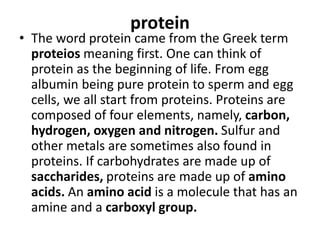
protein
• The word protein came from the Greek term
proteios meaning first. One can think of
protein as the beginning of life. From egg
albumin being pure protein to sperm and egg
cells, we all start from proteins. Proteins are
composed of four elements, namely, carbon,
hydrogen, oxygen and nitrogen. Sulfur and
other metals are sometimes also found in
proteins. If carbohydrates are made up of
saccharides, proteins are made up of amino
acids. An amino acid is a molecule that has an
amine and a carboxyl group.
• There are 20 amino acids. The
combination of many amino acids creates
protein. Amino acids are joined together
with a peptide bond. Proteins are also
called polypeptides.
1.Keratin is a structural protein found in
hair, skin, and nails. It is a highly cross-
linked protein containing α-helix and β-
pleated sheets. Sheep’s wool is made
largely of keratin
2.Fibroin / Silk protein
Silk has a smooth and soft texture. It is one
of the strongest natural fibers that have
high resistance to deformation. It is also a
good insulation. Silk is primarily composed
of β-pleated sheets. The long polypeptide
chain doubles back on its own running
parallel connected together by H-bonds
3.Collagen is a major insoluble fibrous
protein found in connective tissues such as
tendons, ligaments, skin, cartilage and the
cornea of the eye. It comprises as much as
30% of proteins in animals. Its strength is
attributed to its triple helix structure
comprising of α-helices braided together.
When several triple helices combine, they
form the fibrils that make up connective
tissues.
4.Enzymes function to catalyze chemical
reactions. They either speed up a reaction,
lower the needed energy for a reaction to take
place, or bind substances to their specific
partners. Enzymes themselves are very specific
as can be seen in their shape. Examples of
enzymes are below:
• 1. Lipase - help in digestion of fats
• 2. Pepsin - help in breaking down proteins
into peptides (smaller units)
• 3. Sucrase - also called invertase, help in the
digestion of sugars and starches
5.Myoglobin is a polypeptide that stores oxygen
in muscles. It is a globular protein comprised of
153 amino acids in a single polypeptide chain. It
contains a heme group which has an iron (II) ion
at its center. This is where the oxygen is stored.
6.Hemoglobin is a globular protein that carries
oxygen from the lungs to the bloodstream. It is
composed of four sub-units, each containing a
heme group that enables it to transport four
oxygen molecules at a time
• Lipids
The word lipid comes from the Greek word lipos
which means fat. Lipids are a family of
biomolecules having varied structures. They are
grouped together simply because of their
hydrophilic property (water-fearing). They are
soluble in non-polar solvents such as ether,
acetone, and benzene. Lipids can be classified
into four categories:
a. Wax
b. Triglycerides
c. Phospholipids
d. Steroids
. Fatty acids. Fatty acids are long-chain
carboxylic acids that are insoluble in water.
Fatty acids can be saturated or
unsaturated. Saturated fatty acids contain
single bonds in its hydro-carbon chain
whereas unsaturated fatty acids contain
double bonds.
• Phospholipids contains glycerol, two fatty
acids, and a phosphate group. The two parts
of a phospholipid can be termed as the
hydrophilic head (phosphate group) and
hydrophobic tail (fatty acid group). This dual
property allows phospholipids to form a
phospholipid bilayer. In this configuration, the
hydrophilic head sticks out while the
hydrophobic tail is tucked in and away from
the watery environment. This is why
phospholipids are suitable as cell membrane.
• Triglyceride Fat and oil are the most
common examples of lipids. They are
under triglycerides because they are
composed of glycerol and three fatty
acids
• .
• Nucleic acids play an essential role in the
storage, transfer, and expression of genetic
information. Nucleic acid was discovered by a
twenty-four- year-old Swiss physician named
Friedrich Miescher in 1868. He was puzzled
that an unknown substance in white blood
cells did not resemble carbohydrates,
proteins, or lipids. He was able to isolate the
substance from the nucleus and initially called
it nuclein. He eventually was able to break
down nuclein into protein and nucleic acids.
He found out that nucleic acids contain
carbon, hydrogen, oxygen, nitrogen, and
phosphorus.
• The most common examples of nucleic acids
are DNA (deoxyribonucleic acid) and
RNA(ribonucleic acid). DNA is a nucleic acid
that carries the genetic code of organisms. It is
fondly termed as the blueprint of life. RNA, on
another hand, carries the information from
the DNA to the cellular factories for the
synthesis of proteins. If carbohydrates are
composed of saccharide units, proteins of
amino acids, and lipids of fatty acids, nucleic
acids are composed of nucleotides. Nucleic
acids are also known as polynucleotides.
• A nucleotide has three parts:
• a. Nitrogenous base
• b. Five-carbon carbohydrate or sugar
• c. Phosphate group
• The nitrogenous bases of DNA and RNA are:
DNA’s : Adenine (A), Guanine (G), Cytosine (C),
and Thymine (T) RNA’s : Adenine (A), Guanine
(G), Cytosine (C), and Uracil (U)
• DNA has a different sugar group than RNA.
DNA has deoxyribose while RNA has ribose.
Guide questions
• 1. Why are nucleic acids named so?
• 2. What comprises nucleic acids?
• 3. What is another term for nucleic
acids?
• 4. What are the three parts of a
nucleotide?
• 5. What are common examples of
nucleic acids?
• 6. What is the primary role of DNA? -
• 7. How does RNA help in protein
synthesis?
• 8. What are the bases of DNA? of
RNA?
• 9. How are DNA and RNA similar?
• 10. How are DNA and RNA
different? -
• Fat refers to solid triglyceride usually
from animal sources such as meat, milk,
butter, margarine, eggs, and cheese. Oil
refers to liquid triglycerides from plant
sources. Examples are olive oil, corn oil,
sunflower oil, and soybean oil. Animal fat
contains high percentages of saturated
fatty acids while plant oil are mostly
unsaturated fatty acids.
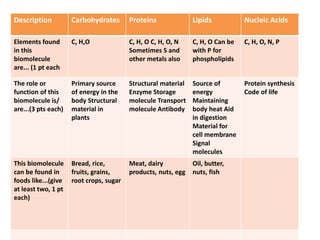
Description Carbohydrates Proteins Lipids Nucleic Acids
Elements found
in this
biomolecule
are... (1 pt each
C, H,O C, H, O C, H, O, N
Sometimes S and
other metals also
C, H, O Can be
with P for
phospholipids
C, H, O, N, P
The role or
function of this
biomolecule is/
are...(3 pts each)
Primary source
of energy in the
body Structural
material in
plants
Structural material
Enzyme Storage
molecule Transport
molecule Antibody
Source of
energy
Maintaining
body heat Aid
in digestion
Material for
cell membrane
Signal
molecules
Protein synthesis
Code of life
This biomolecule
can be found in
foods like...(give
at least two, 1 pt
each)
Bread, rice,
fruits, grains,
root crops, sugar
Meat, dairy
products, nuts, egg
Oil, butter,
nuts, fish
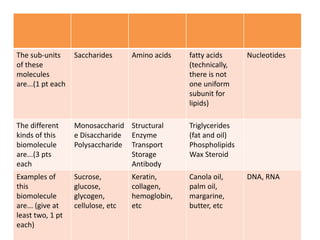
The sub-units
of these
molecules
are...(1 pt each
Saccharides Amino acids fatty acids
(technically,
there is not
one uniform
subunit for
lipids)
Nucleotides
The different
kinds of this
biomolecule
are...(3 pts
each
Monosaccharid
e Disaccharide
Polysaccharide
Structural
Enzyme
Transport
Storage
Antibody
Triglycerides
(fat and oil)
Phospholipids
Wax Steroid
Examples of
this
biomolecule
are... (give at
least two, 1 pt
each)
Sucrose,
glucose,
glycogen,
cellulose, etc
Keratin,
collagen,
hemoglobin,
etc
Canola oil,
palm oil,
margarine,
butter, etc
DNA, RNA

Biological Macromolecules.pptx

  • 1.
  • 2.
    Content Standards • Thelearners demonstrate an understanding of the relationship between the function and structure of biological macromolecules Performance Standards • The learners shall be able to distinguish the structures of different biological macromolecules and relate them to their properties Learning Competencies • Explain how the structures of carbohydrates, lipids, nucleic acid and proteins, and determine their properties and functions (S11/12PS-IIIe-22)
  • 3.
    Carbohydrate The word carbohydratemay be broken down to carbon and hydrate. From the chemical formula of carbohydrate, notice that the ratio of C:H:O is 1:2:1, which can be rewritten as Cn(H2O)n. Carbohydrates can be seen as hydrates of carbon. Another term for carbohydrate is saccharide. This term is derived from the Latin word saccharum referring to sugar--a common carbohydrate
  • 4.
    • Carbohydrates areclassified either as simple or complex. Simple sugars are monosaccharides and disaccharides. Complex sugars are polysaccharides. • Carbohydrates are the primary energy source of the human body. The different saccharides that humans eat are converted to glucose which can be readily used by the body. Around 4 kilocalories is derived from one gram of carbohydrate. Should there be an excessive consumption of carbohydrates, the excess is converted to glycogen which is stored in the liver and in muscles. Glycogen is a slow- releasing carbohydrate.
  • 5.
    • Monosaccharide (onesaccharide) Glucose Used in dextrose, blood sugar; the form utilized by the human body Galactose Found in milk and milk products Fructose Found in fruits and honey Glucose is sweeter than galactose
  • 6.
    • Disaccharide (twosaccharides) • Maltose Glucose + Glucose Found in malt • Sucrose Glucose + Fructose Found in regular table sugar, sugarcane, and sugar beet Lactose Glucose + Galactose Found in milk and milk products
  • 7.
    • Polysaccharide (manysaccharides) Starch / Amylose Composed of 250 - 400 glucose molecules connected via α-1-4- glycosidic bond Storage form of glucose in plants • Amylopectin Like amylose but has more branches attached via α-1-6 glycosidic bond Storage form of glucose in plants • Glycogen Composed of more glucose, more highly branched (same type of bond as amylopectin) Storage form of glucose in animals, stored in the liver and muscles • Cellulose Composed of glucose units connected via β-1-4 glycosidic bond, linear chain arranged in a parallel manner Structural material in plants--cell wall in wood, wood fiber Cannot be digested by humans
  • 8.
    protein • The wordprotein came from the Greek term proteios meaning first. One can think of protein as the beginning of life. From egg albumin being pure protein to sperm and egg cells, we all start from proteins. Proteins are composed of four elements, namely, carbon, hydrogen, oxygen and nitrogen. Sulfur and other metals are sometimes also found in proteins. If carbohydrates are made up of saccharides, proteins are made up of amino acids. An amino acid is a molecule that has an amine and a carboxyl group.
  • 9.
    • There are20 amino acids. The combination of many amino acids creates protein. Amino acids are joined together with a peptide bond. Proteins are also called polypeptides. 1.Keratin is a structural protein found in hair, skin, and nails. It is a highly cross- linked protein containing α-helix and β- pleated sheets. Sheep’s wool is made largely of keratin
  • 10.
    2.Fibroin / Silkprotein Silk has a smooth and soft texture. It is one of the strongest natural fibers that have high resistance to deformation. It is also a good insulation. Silk is primarily composed of β-pleated sheets. The long polypeptide chain doubles back on its own running parallel connected together by H-bonds
  • 11.
    3.Collagen is amajor insoluble fibrous protein found in connective tissues such as tendons, ligaments, skin, cartilage and the cornea of the eye. It comprises as much as 30% of proteins in animals. Its strength is attributed to its triple helix structure comprising of α-helices braided together. When several triple helices combine, they form the fibrils that make up connective tissues.
  • 12.
    4.Enzymes function tocatalyze chemical reactions. They either speed up a reaction, lower the needed energy for a reaction to take place, or bind substances to their specific partners. Enzymes themselves are very specific as can be seen in their shape. Examples of enzymes are below: • 1. Lipase - help in digestion of fats • 2. Pepsin - help in breaking down proteins into peptides (smaller units) • 3. Sucrase - also called invertase, help in the digestion of sugars and starches
  • 13.
    5.Myoglobin is apolypeptide that stores oxygen in muscles. It is a globular protein comprised of 153 amino acids in a single polypeptide chain. It contains a heme group which has an iron (II) ion at its center. This is where the oxygen is stored. 6.Hemoglobin is a globular protein that carries oxygen from the lungs to the bloodstream. It is composed of four sub-units, each containing a heme group that enables it to transport four oxygen molecules at a time
  • 14.
    • Lipids The wordlipid comes from the Greek word lipos which means fat. Lipids are a family of biomolecules having varied structures. They are grouped together simply because of their hydrophilic property (water-fearing). They are soluble in non-polar solvents such as ether, acetone, and benzene. Lipids can be classified into four categories: a. Wax b. Triglycerides c. Phospholipids d. Steroids
  • 15.
    . Fatty acids.Fatty acids are long-chain carboxylic acids that are insoluble in water. Fatty acids can be saturated or unsaturated. Saturated fatty acids contain single bonds in its hydro-carbon chain whereas unsaturated fatty acids contain double bonds.
  • 16.
    • Phospholipids containsglycerol, two fatty acids, and a phosphate group. The two parts of a phospholipid can be termed as the hydrophilic head (phosphate group) and hydrophobic tail (fatty acid group). This dual property allows phospholipids to form a phospholipid bilayer. In this configuration, the hydrophilic head sticks out while the hydrophobic tail is tucked in and away from the watery environment. This is why phospholipids are suitable as cell membrane.
  • 17.
    • Triglyceride Fatand oil are the most common examples of lipids. They are under triglycerides because they are composed of glycerol and three fatty acids • .
  • 18.
    • Nucleic acidsplay an essential role in the storage, transfer, and expression of genetic information. Nucleic acid was discovered by a twenty-four- year-old Swiss physician named Friedrich Miescher in 1868. He was puzzled that an unknown substance in white blood cells did not resemble carbohydrates, proteins, or lipids. He was able to isolate the substance from the nucleus and initially called it nuclein. He eventually was able to break down nuclein into protein and nucleic acids. He found out that nucleic acids contain carbon, hydrogen, oxygen, nitrogen, and phosphorus.
  • 19.
    • The mostcommon examples of nucleic acids are DNA (deoxyribonucleic acid) and RNA(ribonucleic acid). DNA is a nucleic acid that carries the genetic code of organisms. It is fondly termed as the blueprint of life. RNA, on another hand, carries the information from the DNA to the cellular factories for the synthesis of proteins. If carbohydrates are composed of saccharide units, proteins of amino acids, and lipids of fatty acids, nucleic acids are composed of nucleotides. Nucleic acids are also known as polynucleotides.
  • 20.
    • A nucleotidehas three parts: • a. Nitrogenous base • b. Five-carbon carbohydrate or sugar • c. Phosphate group • The nitrogenous bases of DNA and RNA are: DNA’s : Adenine (A), Guanine (G), Cytosine (C), and Thymine (T) RNA’s : Adenine (A), Guanine (G), Cytosine (C), and Uracil (U) • DNA has a different sugar group than RNA. DNA has deoxyribose while RNA has ribose.
  • 21.
    Guide questions • 1.Why are nucleic acids named so? • 2. What comprises nucleic acids? • 3. What is another term for nucleic acids? • 4. What are the three parts of a nucleotide? • 5. What are common examples of nucleic acids? • 6. What is the primary role of DNA? -
  • 22.
    • 7. Howdoes RNA help in protein synthesis? • 8. What are the bases of DNA? of RNA? • 9. How are DNA and RNA similar? • 10. How are DNA and RNA different? -
  • 23.
    • Fat refersto solid triglyceride usually from animal sources such as meat, milk, butter, margarine, eggs, and cheese. Oil refers to liquid triglycerides from plant sources. Examples are olive oil, corn oil, sunflower oil, and soybean oil. Animal fat contains high percentages of saturated fatty acids while plant oil are mostly unsaturated fatty acids.
  • 24.
    Description Carbohydrates ProteinsLipids Nucleic Acids Elements found in this biomolecule are... (1 pt each C, H,O C, H, O C, H, O, N Sometimes S and other metals also C, H, O Can be with P for phospholipids C, H, O, N, P The role or function of this biomolecule is/ are...(3 pts each) Primary source of energy in the body Structural material in plants Structural material Enzyme Storage molecule Transport molecule Antibody Source of energy Maintaining body heat Aid in digestion Material for cell membrane Signal molecules Protein synthesis Code of life This biomolecule can be found in foods like...(give at least two, 1 pt each) Bread, rice, fruits, grains, root crops, sugar Meat, dairy products, nuts, egg Oil, butter, nuts, fish
  • 25.
    The sub-units of these molecules are...(1pt each Saccharides Amino acids fatty acids (technically, there is not one uniform subunit for lipids) Nucleotides The different kinds of this biomolecule are...(3 pts each Monosaccharid e Disaccharide Polysaccharide Structural Enzyme Transport Storage Antibody Triglycerides (fat and oil) Phospholipids Wax Steroid Examples of this biomolecule are... (give at least two, 1 pt each) Sucrose, glucose, glycogen, cellulose, etc Keratin, collagen, hemoglobin, etc Canola oil, palm oil, margarine, butter, etc DNA, RNA