What makes an atom “stable”
and not likely to react?
Having a full outer electron shell
or highest energy level (8 valence
electrons, in most cases)
How can atoms achieve stable
electron configurations?
By reacting or forming chemical
bonds with other atoms
What are the 3 main types of
chemical bonds?
Ionic bonds, covalent bonds (polar
& nonpolar), & metallic bonds
What happens during an
ionic bond?
One atom gives up an electron to
another atom, creating two
oppositely-charged ions
(positive & negative) that stick
together
How does an anion form?
When an atom gains an electron,
giving it a negative charge
How does a cation form?
When an atom loses an electron,
giving it a positive charge
How do covalent bonds
form?
When atoms share a pair of
valence electrons
How do chemical reactions
show
evidence of the law of
conservation of mass?
The total mass of the
products
always equals the total mass
of the reactants
What are metallic bonds?
Metals give up their electrons
(becoming cations), and are
surrounded by a pool of
shared electrons
Why are metals good
conductors and malleable?
(related to electrons)
The free-moving electrons can
easily shift positions without
breaking bonds, and can align
themselves for electrical currents
What happens during a
chemical reaction?
One or more substances react
to form new substances
What are reactants and
products?
Reactants are the original
substances (left side of the
chemical reaction), and products
are the new substances (right
side)
What parts of the atom are
involved in chemical reactions?
Only valence electrons are
involved in chemical reactions
What is the law of
conservation of mass?
Matter cannot be created or
destroyed, but it can change
form
What are exothermic
reactions?
When more energy (heat) is
released than absorbed
What are endothermic
reactions?
When more energy (heat) is
absorbed than released
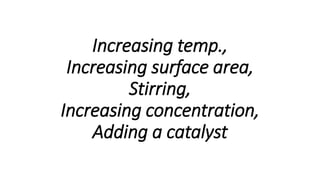
What factors cause a chemical
reaction rate to increase?
Increasing temp.,
Increasing surface area,
Stirring,
Increasing concentration,
Adding a catalyst
What are examples of (pure)
substance?
Elements and compounds
What are homogenous
mixtures?
Mixtures that are evenly
mixed
What are heterogeneous
mixtures?
Mixtures that are not evenly
mixed
What parts make up a
solution?
Solvent = substance that has
greatest quantity;
Solute = all other substances
(added to solvent)
Why is water a good solvent?
Water is a universal solvent
because
is polar, so it dissolves other
polar substances easily
How do you calculate a
solution’s concentration?
Mass of solute divided by
volume
of solvent
What 3 things can you do to
speed
up dissolving?
Stirring, increase temperature, &
increase surface area (crush)
What are properties of
acids?
Sour taste, pH less than 7,
corrosive to metal,
releases H+ ions,
turns blue litmus paper to red
What are properties of
bases?
Bitter taste, pH greater than
7, corrosive to metal,
releases OH- ions,
turns red litmus paper blue
What is the pH scale?
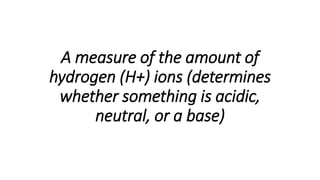
A measure of the amount of
hydrogen (H+) ions (determines
whether something is acidic,
neutral, or a base)
How is the pH scale
measured?
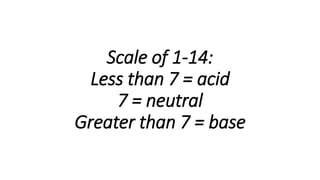
Scale of 1-14:
Less than 7 = acid
7 = neutral
Greater than 7 = base
What happens to the pH of a
solution when acids & bases
are combined?
The solution is neutralized
What is created when an acid
and
base are combined?
Salts and water

Chemistry Review flashcards