I. What is Paleontology?
The study of
past life.
I1. Paleontologist
□ Paleontologist –
scientist who studies
fossils and plants
from past life and
other past
ecosystems
□ Studies traces left
behind by animals
and piece together
the conditions under
which fossils were
formed.
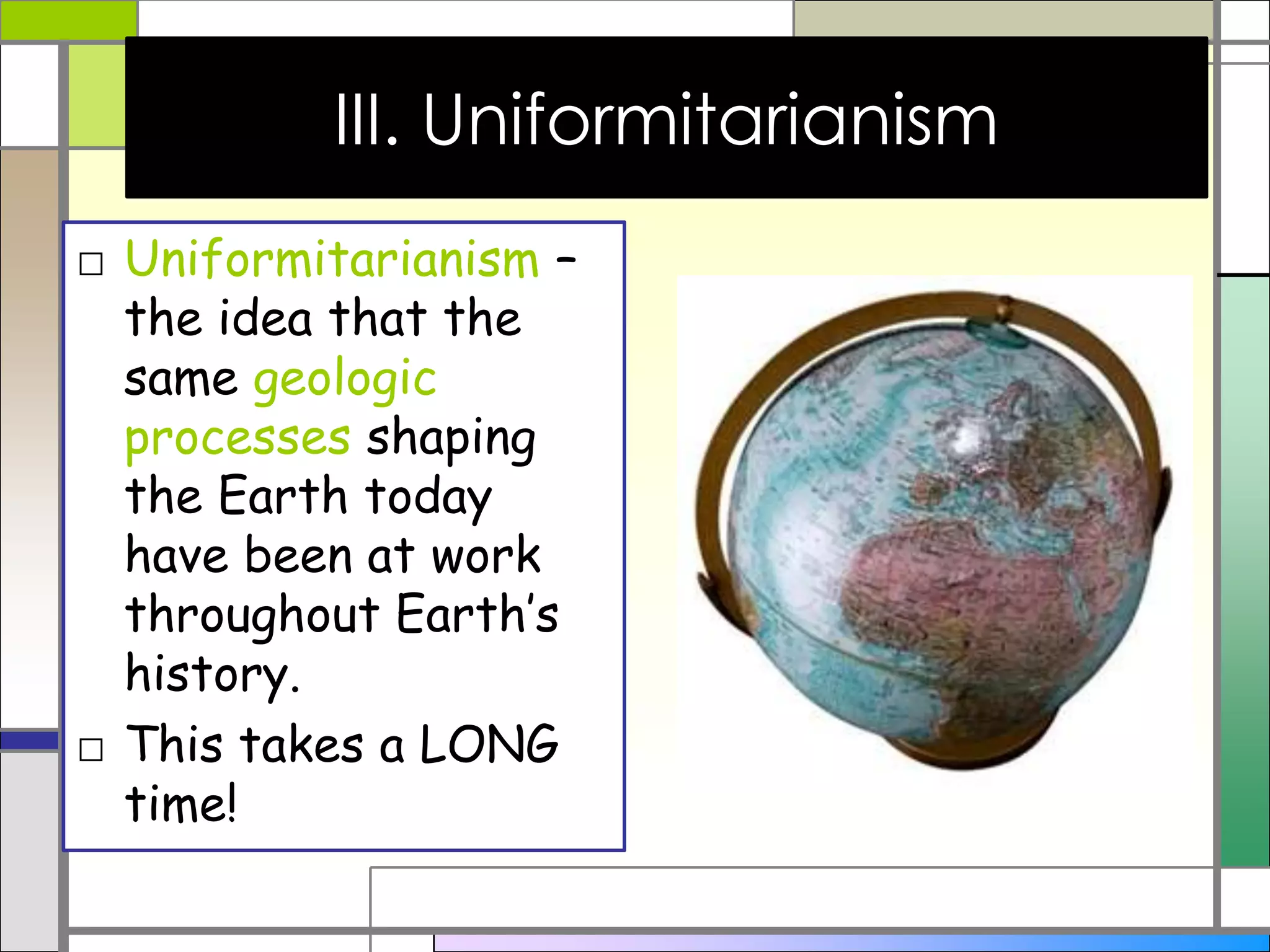
III. Uniformitarianism
□ Uniformitarianism –
the idea that the
same geologic
processes shaping
the Earth today
have been at work
throughout Earth’s
history.
□ This takes a LONG
time!
Extra Info!
James Hutton was the
first to develop the
idea of
Uniformitarianism in
1788
His theory sparked a
scientific debate by
suggesting that Earth
was much molder
than previously
thought!
 Rocks record geological events and
changing life forms of the past.
 We have learned that Earth is much older
than anyone had previously imagined
Continued
 There are two ways that we can determine
the age of a rock:
1. Relative Dating
2. Absolute Dating
IV. Relative Dating
Relative dating
tells us the
sequence in which
events occurred,
not how long ago
they occurred.
Chronological order
- relational
a. Law of Superposition
The law of superposition states that in an
undeformed, undisturbed sequence of
sedimentary rocks, each bed is older
than the one above it and younger than
the one below it.
Undistrubed Rock Layer
Distrubed Rock Layer
b. Original Horizontality
The principle of original horizontality
means that layers of sediment are
generally deposited in a horizontal position.
c. Index fossils
• Index fossils are used to determine
approximate age. Index fossils are
widespread geographically, are
limited to a short span of geologic
time, and occur in large numbers.
FOUND IN SEDIMENTARY ROCKS
Index Fossils
d. Geological Column
Geologic column is an ideal sequence
of rock layers that contains all the
known fossils and rock formations on
Earth arranged from oldest to
youngest.
Ticket out the
Door!
What is
Uniformitarianism?

Paleontology and uniformitariansm

  • 1.
    I. What isPaleontology? The study of past life.
  • 2.
    I1. Paleontologist □ Paleontologist– scientist who studies fossils and plants from past life and other past ecosystems □ Studies traces left behind by animals and piece together the conditions under which fossils were formed.
  • 3.
    III. Uniformitarianism □ Uniformitarianism– the idea that the same geologic processes shaping the Earth today have been at work throughout Earth’s history. □ This takes a LONG time!
  • 4.
    Extra Info! James Huttonwas the first to develop the idea of Uniformitarianism in 1788 His theory sparked a scientific debate by suggesting that Earth was much molder than previously thought!
  • 5.
     Rocks recordgeological events and changing life forms of the past.  We have learned that Earth is much older than anyone had previously imagined Continued  There are two ways that we can determine the age of a rock: 1. Relative Dating 2. Absolute Dating
  • 6.
  • 7.
    Relative dating tells usthe sequence in which events occurred, not how long ago they occurred. Chronological order - relational
  • 8.
    a. Law ofSuperposition The law of superposition states that in an undeformed, undisturbed sequence of sedimentary rocks, each bed is older than the one above it and younger than the one below it.
  • 9.
  • 10.
  • 11.
    b. Original Horizontality Theprinciple of original horizontality means that layers of sediment are generally deposited in a horizontal position.
  • 12.
    c. Index fossils •Index fossils are used to determine approximate age. Index fossils are widespread geographically, are limited to a short span of geologic time, and occur in large numbers. FOUND IN SEDIMENTARY ROCKS
  • 13.
  • 14.
    d. Geological Column Geologiccolumn is an ideal sequence of rock layers that contains all the known fossils and rock formations on Earth arranged from oldest to youngest.
  • 16.
    Ticket out the Door! Whatis Uniformitarianism?